
Screening newborn babies for CCHD using pulse oximetry
Screening newborn babies for CCHD using pulse oximetry: which algorithm is best? Andrew Ewer Professor of Neonatal Medicine, University of Birmingham UK Neonatologist, Birmingham Women’s Hospital
Disclosure Received travel and accommodation expenses from oximeter manufacturers to present at scientific meetings only No payments or honoraria from any oximeter manufacturers No financial interests in any oximeter manufacturers

Further disclosure Pulse. Ox Nerd

Overview Decision making process for USA PO screening Current practices – algorithm variations Future work

Heart House Jan 2011

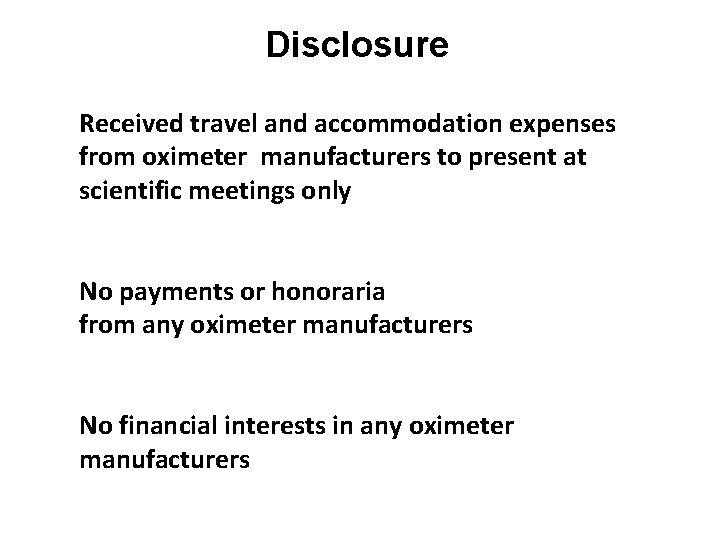
8 studies involving 36 000 babies

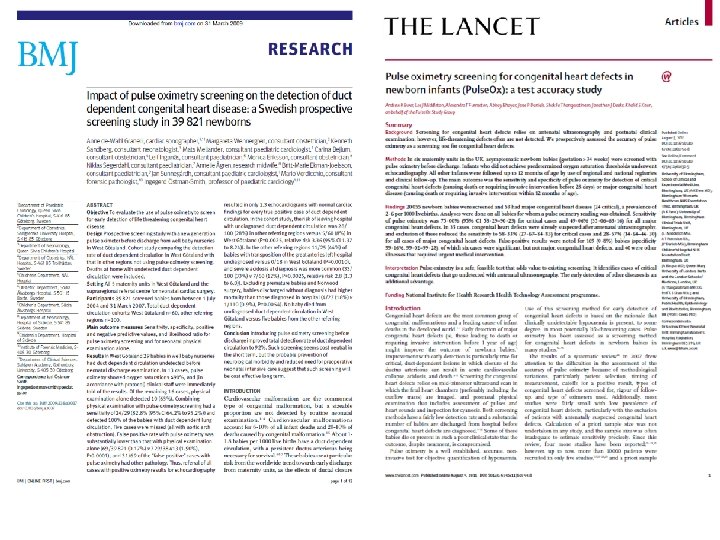

2012 From pulseoxadvocacy. com
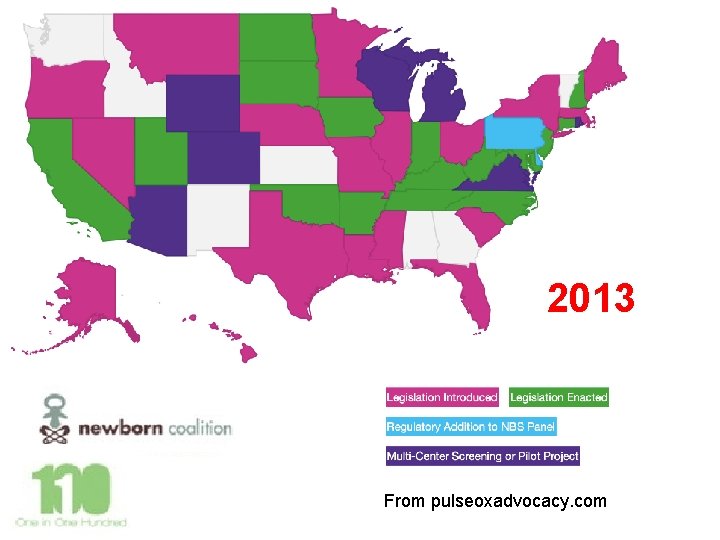
2013 From pulseoxadvocacy. com
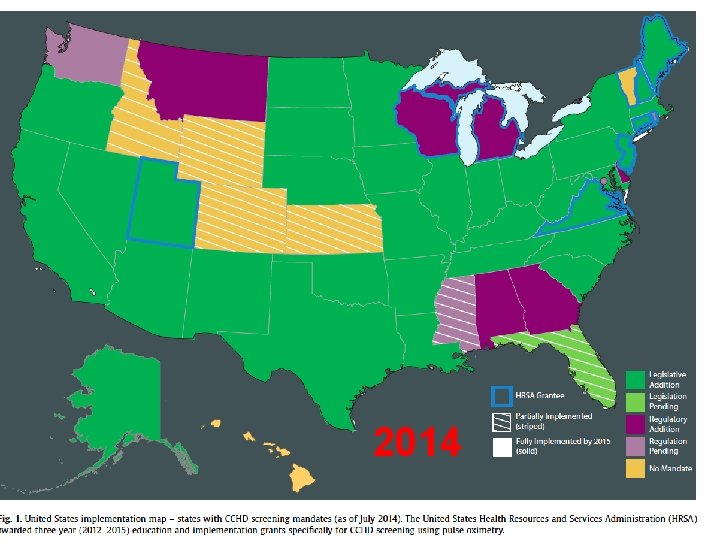
2014
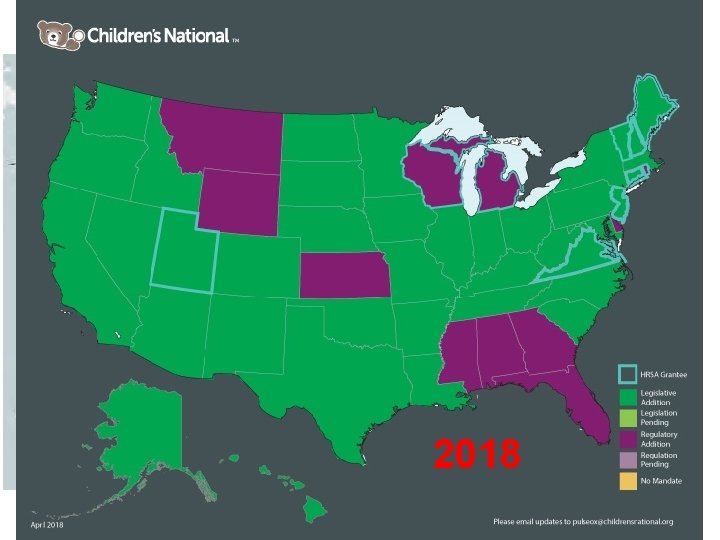
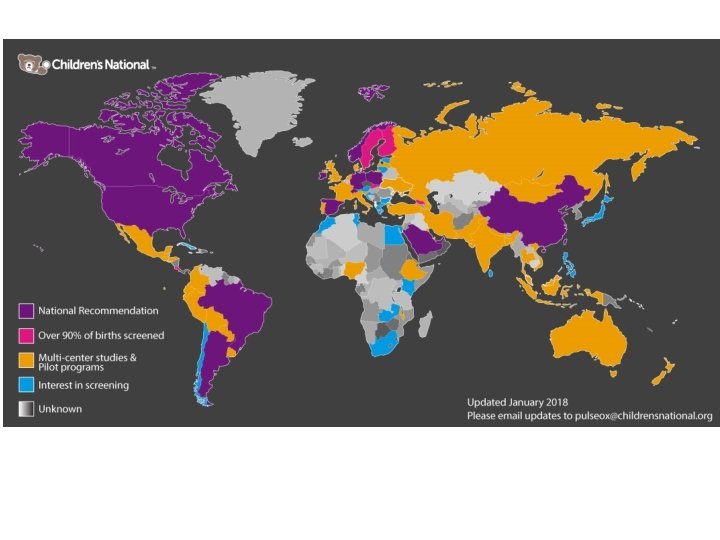
2018

33% reduction in mortality from early deaths due to CCHD 21% reduction in mortality from early deaths other/non specified cardiac causes
UK National Screening Committee have had same data for a longer time… and are yet to make a decision
Pulse oximetry screening for CCHD Back to basics What does a pulse oximeter measure and what is the best way to use this information to identify babies at risk?

Oxygen transport • Blood contains red cells • Haemoglobin (Hb) in red cells binds oxygen • Oxygen bound to Hb - Oxy. Hb No oxygen bound to Hb – De. Oxy. Hb • Proportion of Hb which is Oxy. Hb called oxygen saturations – should be 95 -100%
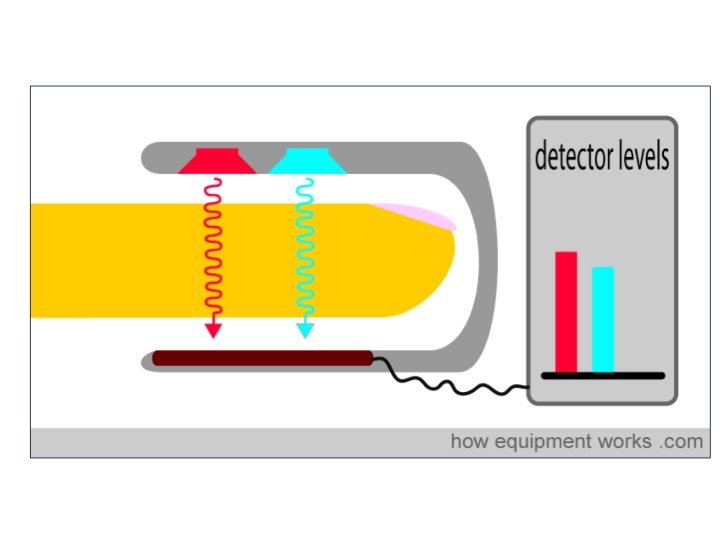
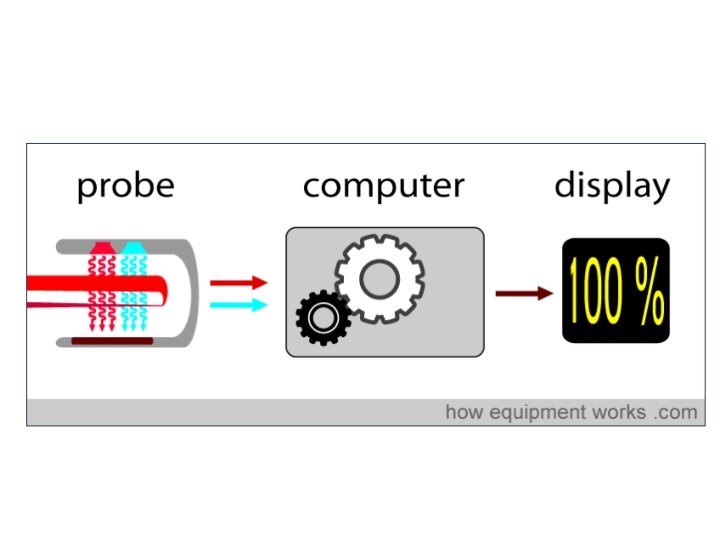
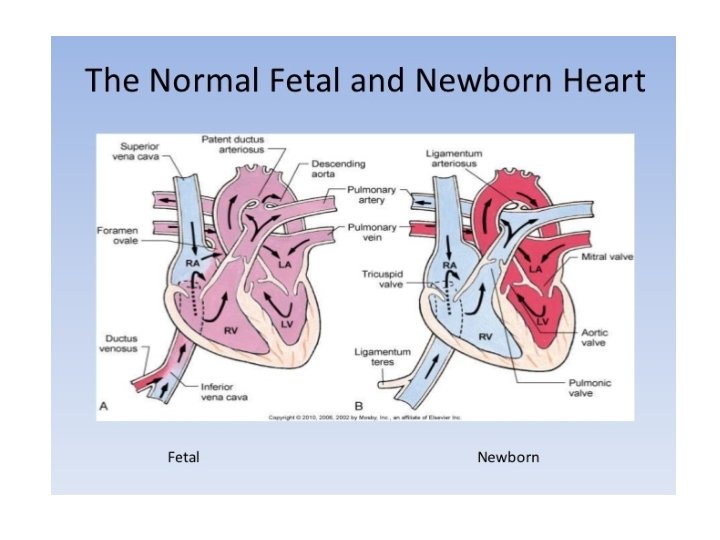
Pulse oximetry Oxy. Hb and De. Oxy. Hb absorb different light spectra in different ways
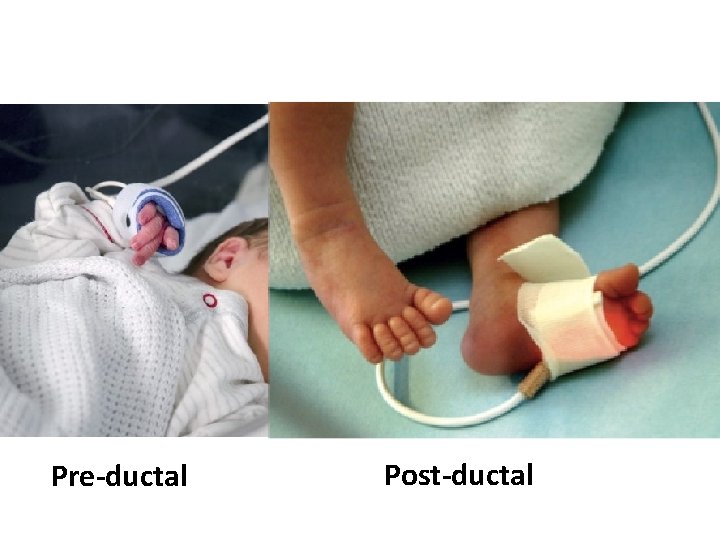
Pre-ductal Post-ductal
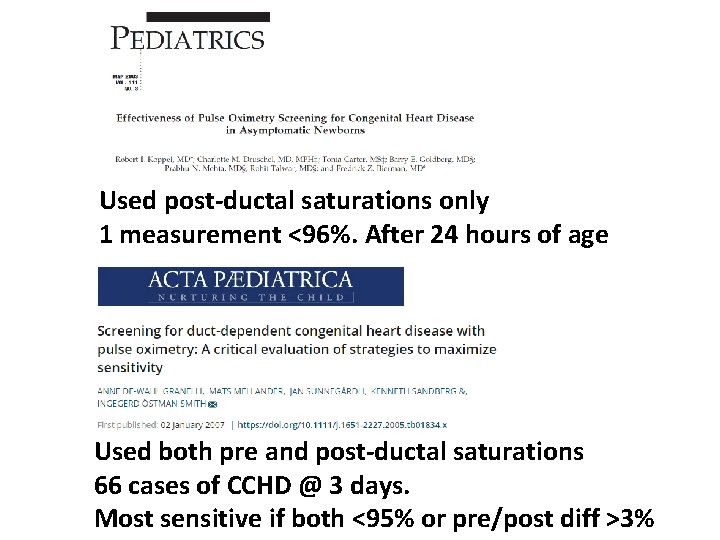
Used post-ductal saturations only 1 measurement <96%. After 24 hours of age Used both pre and post-ductal saturations 66 cases of CCHD @ 3 days. Most sensitive if both <95% or pre/post diff >3%
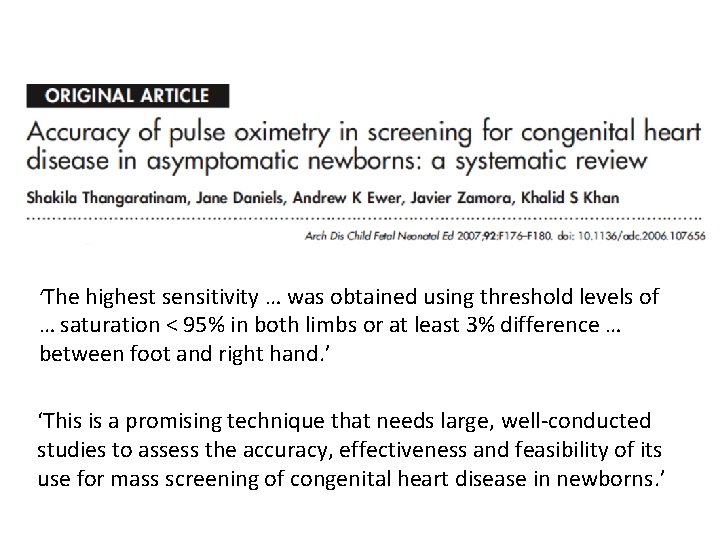
‘The highest sensitivity … was obtained using threshold levels of … saturation < 95% in both limbs or at least 3% difference … between foot and right hand. ’ ‘This is a promising technique that needs large, well-conducted studies to assess the accuracy, effectiveness and feasibility of its use for mass screening of congenital heart disease in newborns. ’
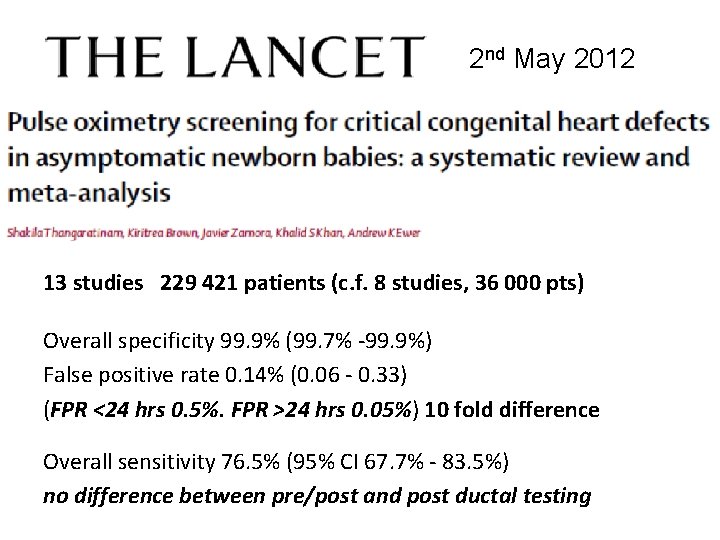
2 nd May 2012 13 studies 229 421 patients (c. f. 8 studies, 36 000 pts) Overall specificity 99. 9% (99. 7% -99. 9%) False positive rate 0. 14% (0. 06 - 0. 33) (FPR <24 hrs 0. 5%. FPR >24 hrs 0. 05%) 10 fold difference Overall sensitivity 76. 5% (95% CI 67. 7% - 83. 5%) no difference between pre/post and post ductal testing
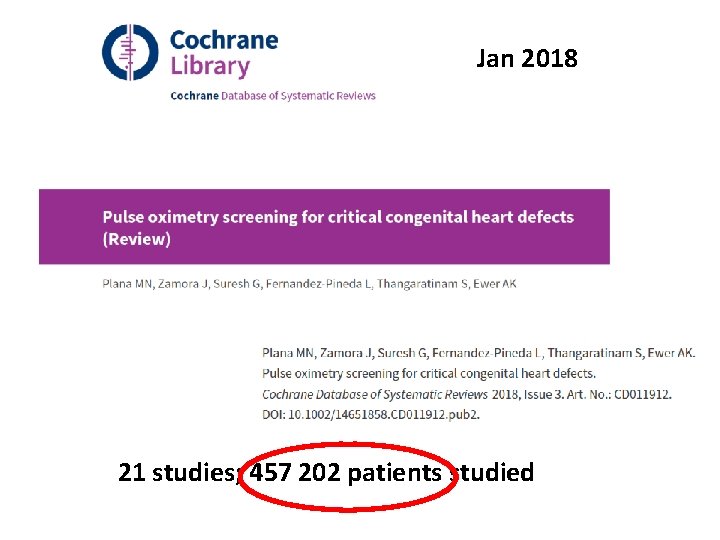
Jan 2018 21 studies; 457 202 patients studied
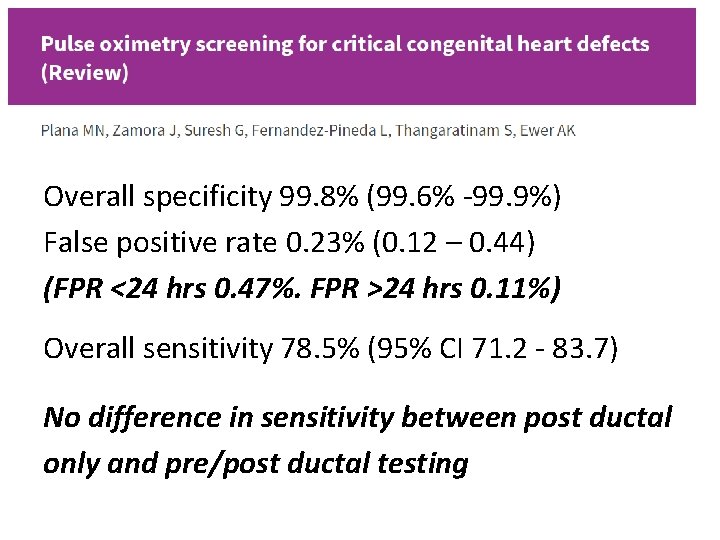
Overall specificity 99. 8% (99. 6% -99. 9%) False positive rate 0. 23% (0. 12 – 0. 44) (FPR <24 hrs 0. 47%. FPR >24 hrs 0. 11%) Overall sensitivity 78. 5% (95% CI 71. 2 - 83. 7) No difference in sensitivity between post ductal only and pre/post ductal testing
So… Surely it’s better to screen using post-ductal saturations only (quicker and easier) … and after 24 hours (much lower false positive rate) ? ?
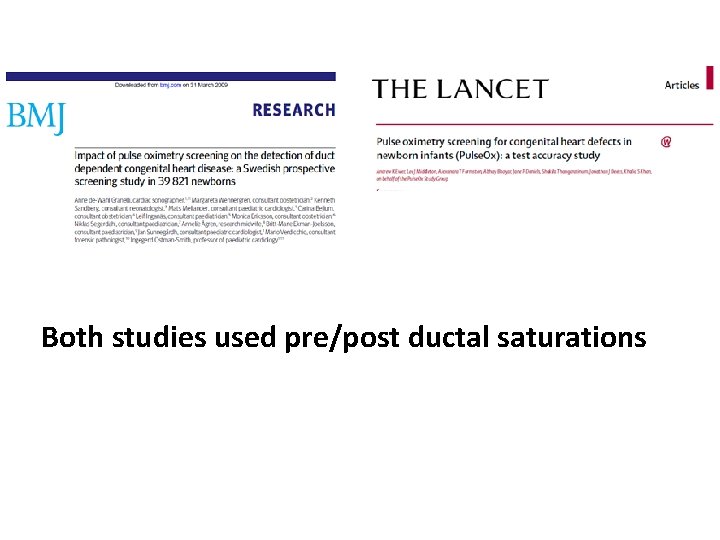
Both studies used pre/post ductal saturations
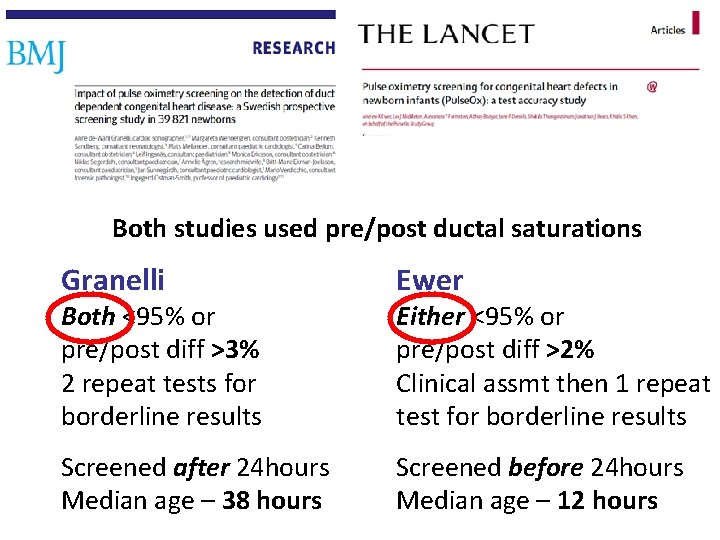
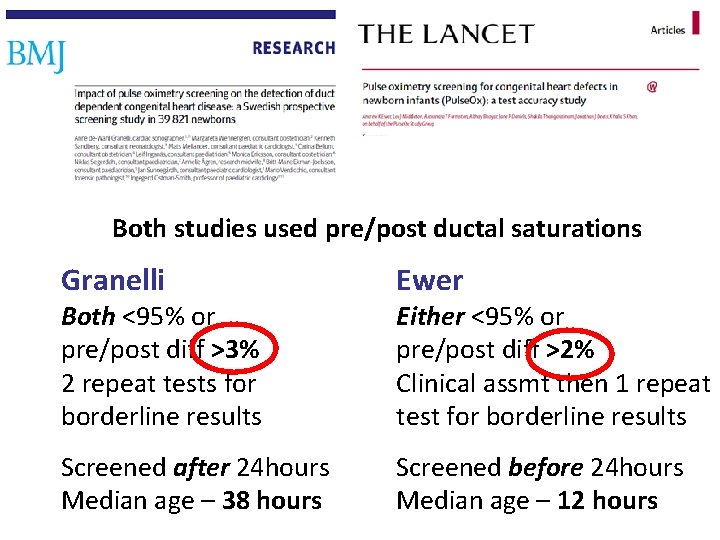
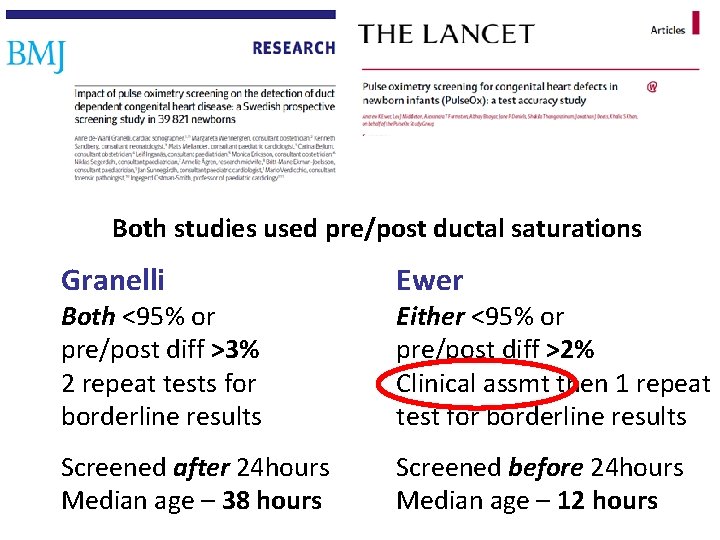
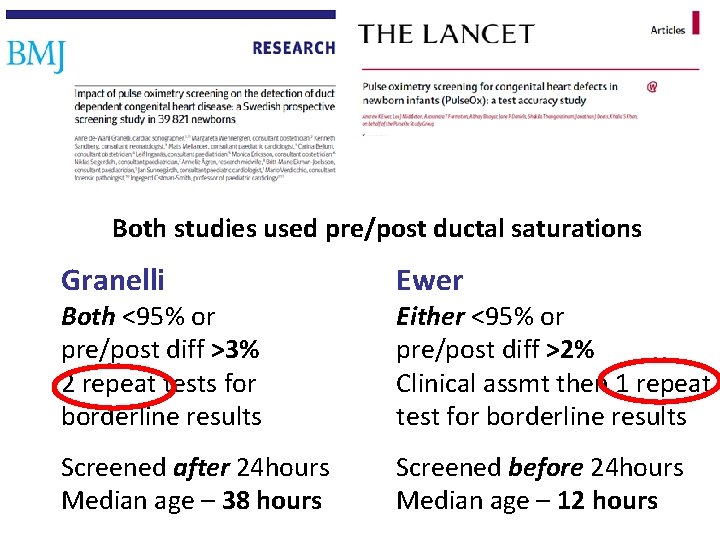
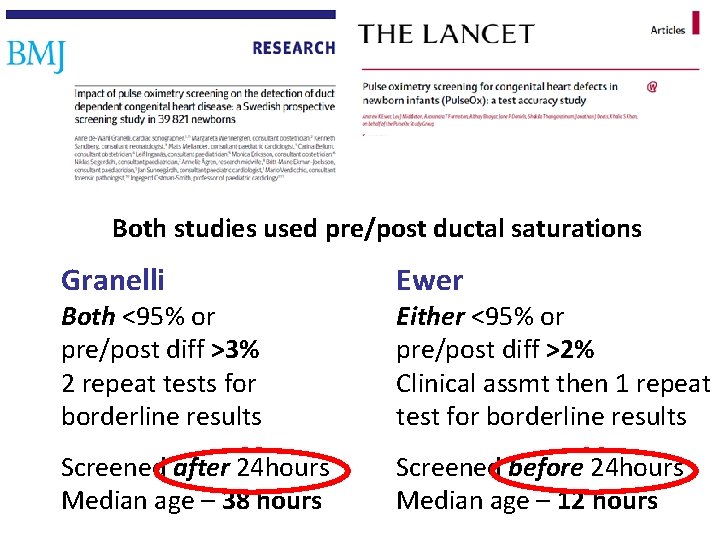
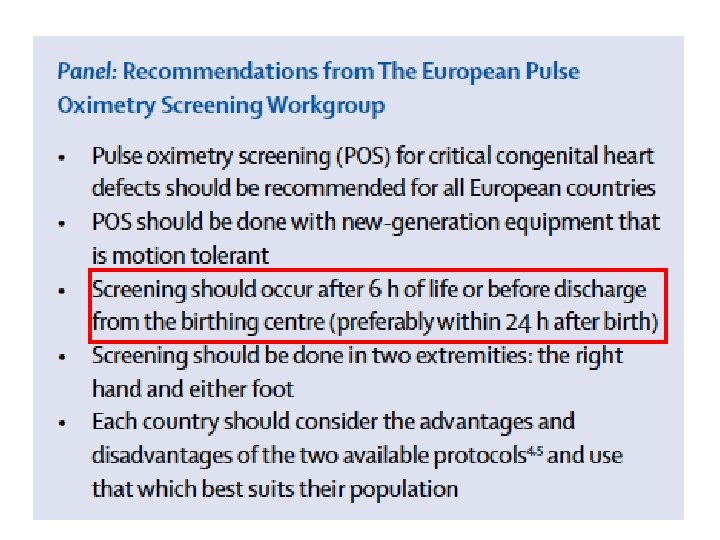
Both studies used pre/post ductal saturations Granelli Ewer Screened after 24 hours Median age – 38 hours Screened before 24 hours Median age – 12 hours Both <95% or pre/post diff >3% 2 repeat tests for borderline results Either <95% or pre/post diff >2% Clinical assmt then 1 repeat test for borderline results
Both studies used pre/post ductal saturations Granelli Ewer Screened after 24 hours Median age – 38 hours Screened before 24 hours Median age – 12 hours Both <95% or pre/post diff >3% 2 repeat tests for borderline results Either <95% or pre/post diff >2% Clinical assmt then 1 repeat test for borderline results
Both studies used pre/post ductal saturations Granelli Ewer Screened after 24 hours Median age – 38 hours Screened before 24 hours Median age – 12 hours Both <95% or pre/post diff >3% 2 repeat tests for borderline results Either <95% or pre/post diff >2% Clinical assmt then 1 repeat test for borderline results
Both studies used pre/post ductal saturations Granelli Ewer Screened after 24 hours Median age – 38 hours Screened before 24 hours Median age – 12 hours Both <95% or pre/post diff >3% 2 repeat tests for borderline results Either <95% or pre/post diff >2% Clinical assmt then 1 repeat test for borderline results
Both studies used pre/post ductal saturations Granelli Ewer Screened after 24 hours Median age – 38 hours Screened before 24 hours Median age – 12 hours Both <95% or pre/post diff >3% 2 repeat tests for borderline results Either <95% or pre/post diff >2% Clinical assmt then 1 repeat test for borderline results
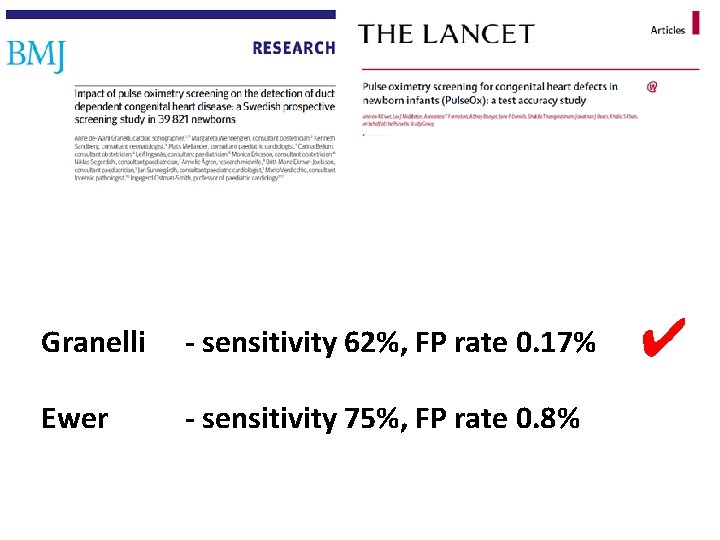
Granelli - sensitivity 62%, FP rate 0. 17% Ewer - sensitivity 75%, FP rate 0. 8% ✔

US PO screening algorithm

What is the best PO screening algorithm?
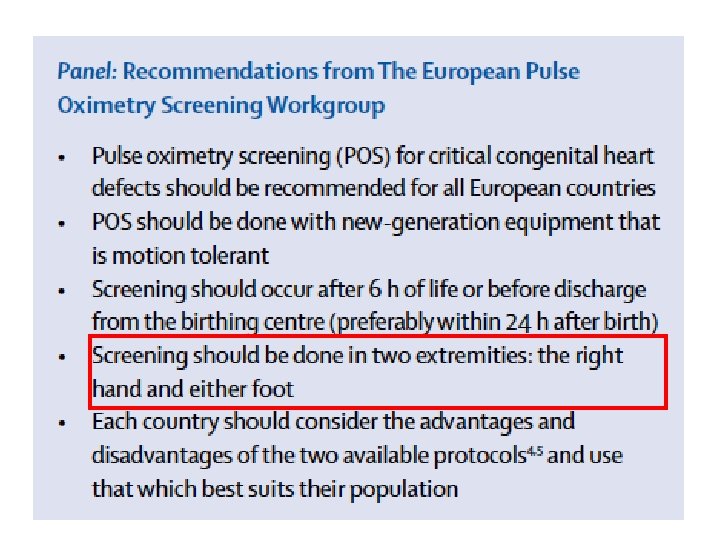
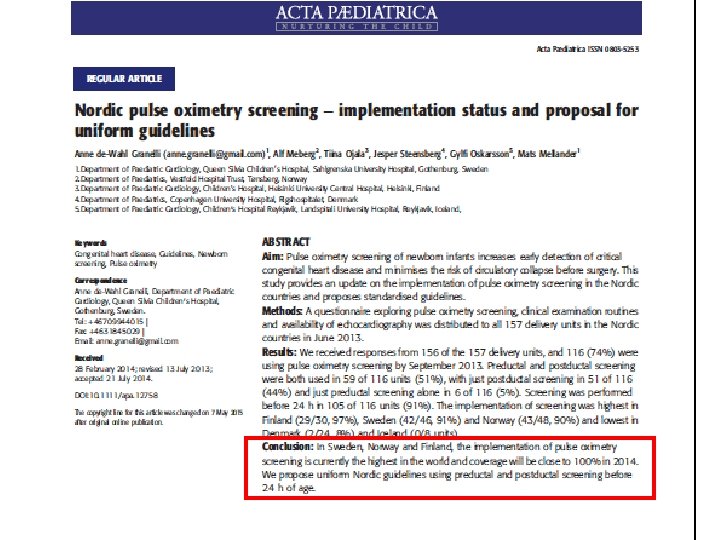
Screening algorithms • Pre and post or post ductal only? • Early or late screening? • Most sensitive thresholds for screening algorithm?
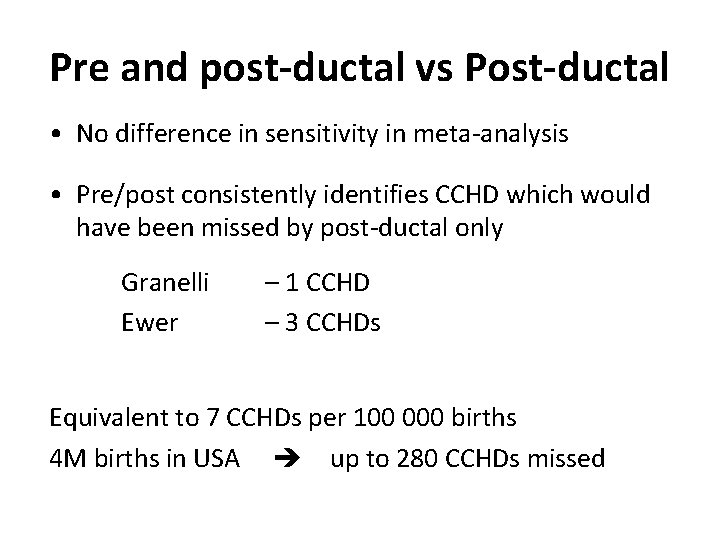
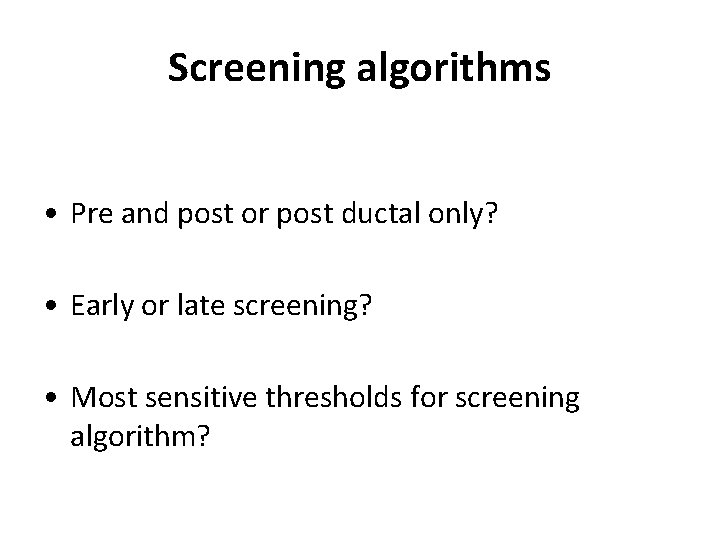
Pre and post-ductal vs Post-ductal • No difference in sensitivity in meta-analysis • Pre/post consistently identifies CCHD which would have been missed by post-ductal only Granelli Ewer – 1 CCHD – 3 CCHDs Equivalent to 7 CCHDs per 100 000 births 4 M births in USA up to 280 CCHDs missed
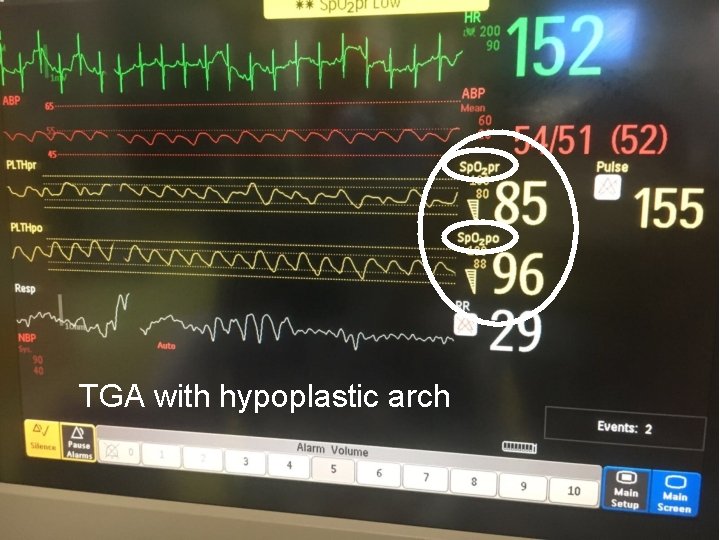
TGA with hypoplastic arch
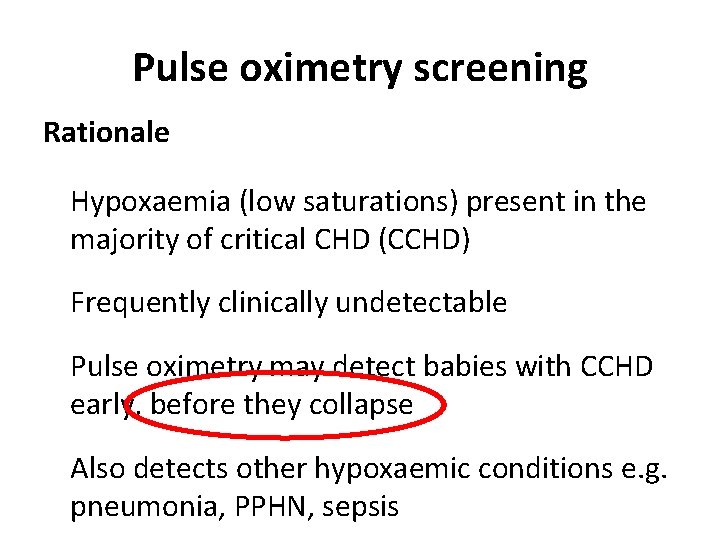
Pulse oximetry screening Rationale Hypoxaemia (low saturations) present in the majority of critical CHD (CCHD) Frequently clinically undetectable Pulse oximetry may detect babies with CCHD early, before they collapse Also detects other hypoxaemic conditions e. g. pneumonia, PPHN, sepsis
Pulse oximetry screening Rationale Hypoxaemia (low saturations) present in the majority of critical CHD (CCHD) Frequently clinically undetectable Pulse oximetry may detect babies with CCHD early, before they collapse Also detects other hypoxaemic conditions e. g. pneumonia, PPHN, sepsis
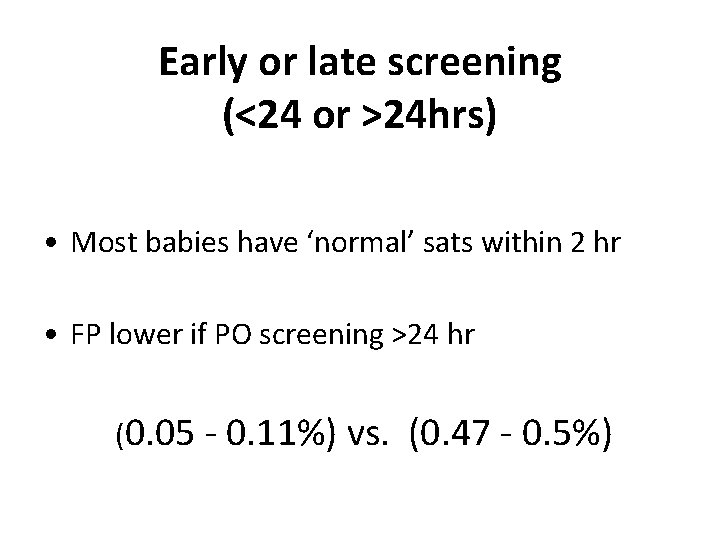
Early or late screening (<24 or >24 hrs) • Most babies have ‘normal’ sats within 2 hr • FP lower if PO screening >24 hr (0. 05 - 0. 11%) vs. (0. 47 - 0. 5%)
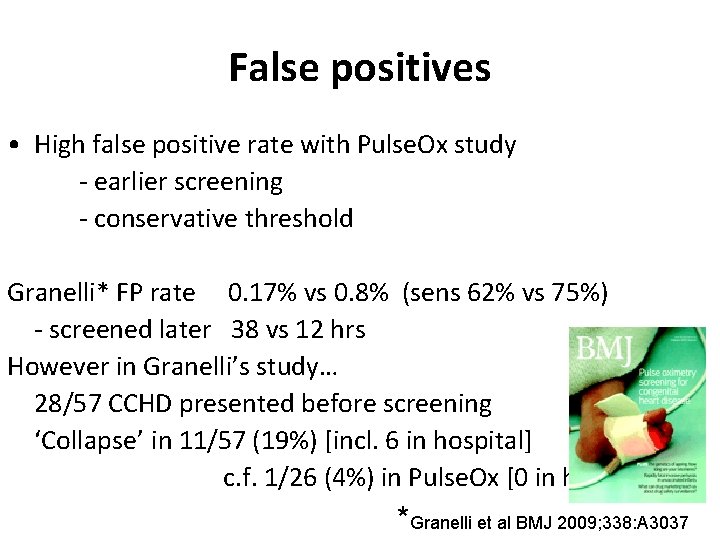
False positives • High false positive rate with Pulse. Ox study - earlier screening - conservative threshold Granelli* FP rate 0. 17% vs 0. 8% (sens 62% vs 75%) - screened later 38 vs 12 hrs However in Granelli’s study… 28/57 CCHD presented before screening ‘Collapse’ in 11/57 (19%) [incl. 6 in hospital] c. f. 1/26 (4%) in Pulse. Ox [0 in hospital] *Granelli et al BMJ 2009; 338: A 3037
CCHD presenting before screening Later screening studies report 50% of CCHD babies presented before screening 1, 2 Up to 10% present with collapse in hospital 1 1. Granelli BMJ 2009 2. Riede EJP 2010
CCHD presenting before screening ’The concept of timely diagnosis… defined as occurring in hospital and in time to prevent severe acidosis before the diagnosis is made. Thus patients discharged with duct dependent circulation without diagnosis and patients who collapsed in hospital without diagnosis would not be considered to have had a timely diagnosis. With these criteria, we found absence of timely diagnosis of duct dependent circulation in 45/100 (45%) of patients in [non – PO] regions compared with 11/60 (18%) of patients in [PO regions]. ’ 1 1. Granelli BMJ 2009
CCHD presenting before screening ‘The ideal way of optimising number of timely diagnoses is probably to have one pulse oximetry screening during the first 24 hours of life to prevent circulatory collapse in hospital of babies with duct dependent [CCHD]. 1’ 1. Granelli BMJ 2009
Non-cardiac conditions Pneumonia, sepsis and PPHN all more likely to present in first 24 hours (false positives) Although not target conditions a baby is just as likely to die from undiagnosed sepsis as undiagnosed CCHD
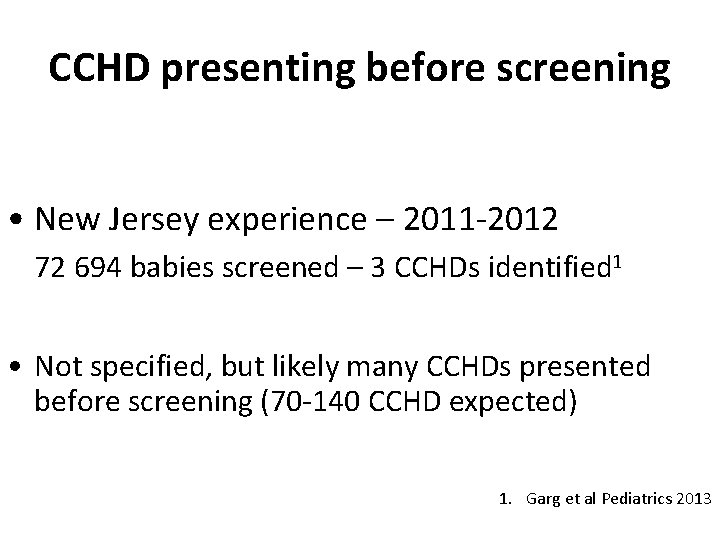
CCHD presenting before screening • New Jersey experience – 2011 -2012 72 694 babies screened – 3 CCHDs identified 1 • Not specified, but likely many CCHDs presented before screening (70 -140 CCHD expected) 1. Garg et al Pediatrics 2013
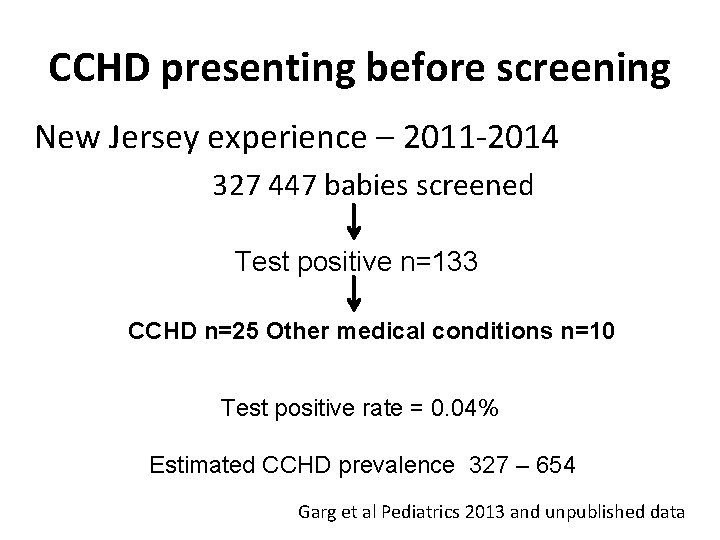
CCHD presenting before screening New Jersey experience – 2011 -2014 327 447 babies screened Test positive n=133 CCHD n=25 Other medical conditions n=10 Test positive rate = 0. 04% Estimated CCHD prevalence 327 – 654 Garg et al Pediatrics 2013 and unpublished data
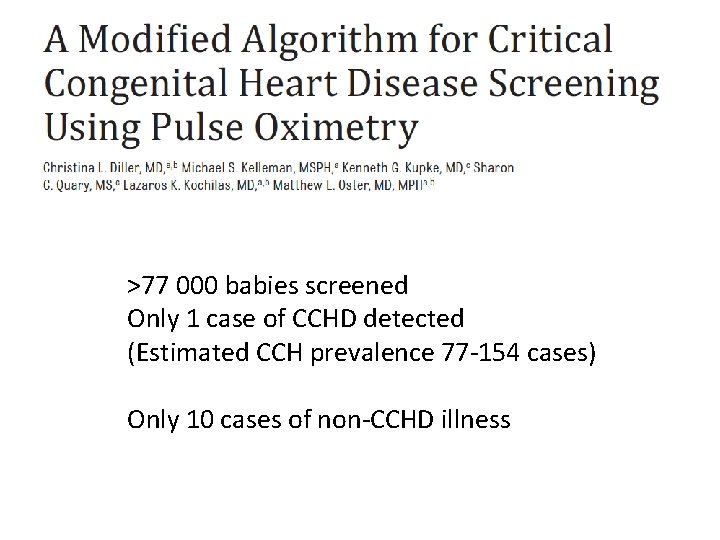
>77 000 babies screened Only 1 case of CCHD detected (Estimated CCH prevalence 77 -154 cases) Only 10 cases of non-CCHD illness
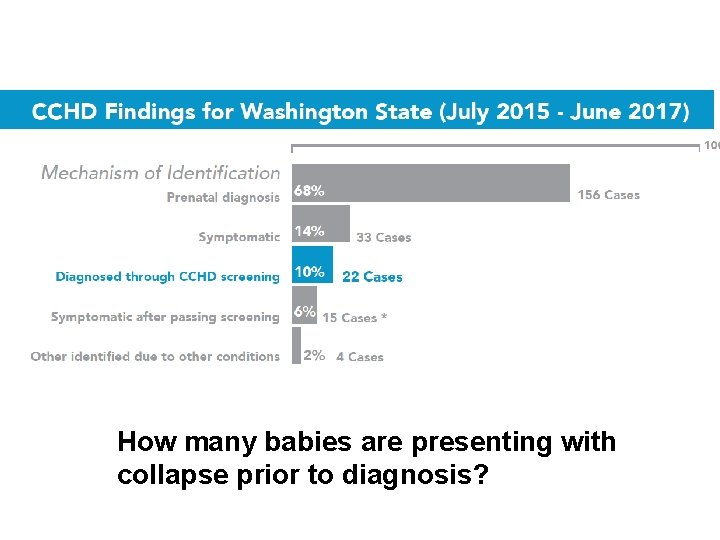
How many babies are presenting with collapse prior to diagnosis?
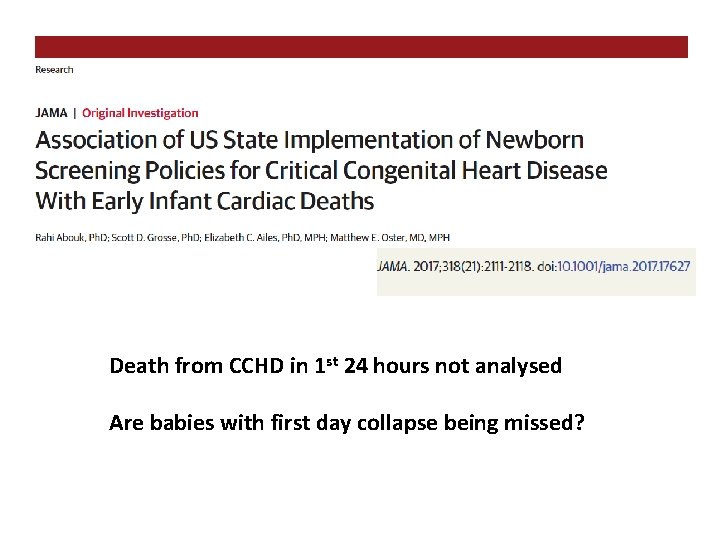
Death from CCHD in 1 st 24 hours not analysed Are babies with first day collapse being missed?
Early screening (<24 hours) Will reduce the risk of first day collapse… … both from undiagnosed CCHD and other potentially lethal conditions such as GBS sepsis But… the FP rate will be higher
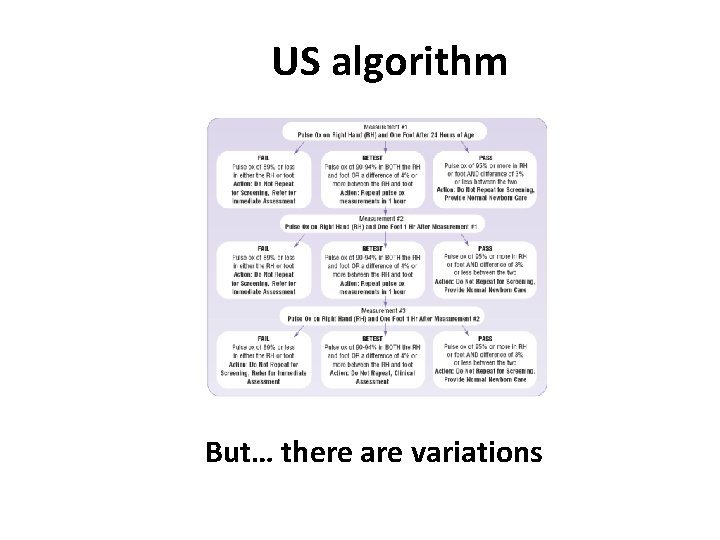
US algorithm But… there are variations
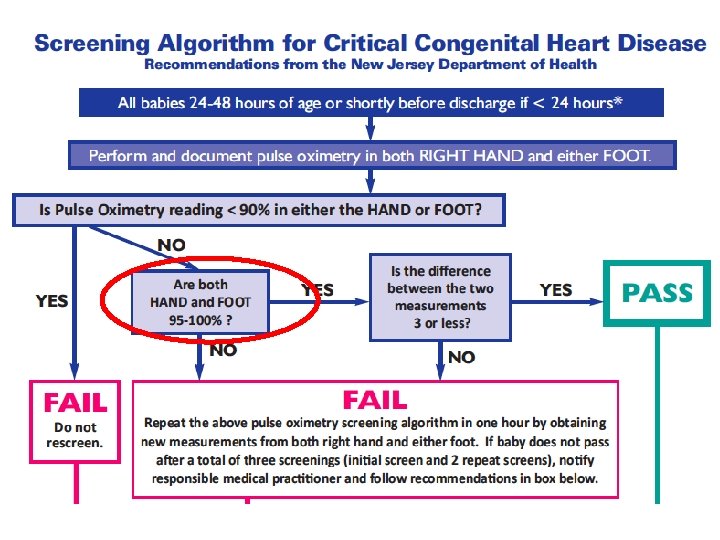
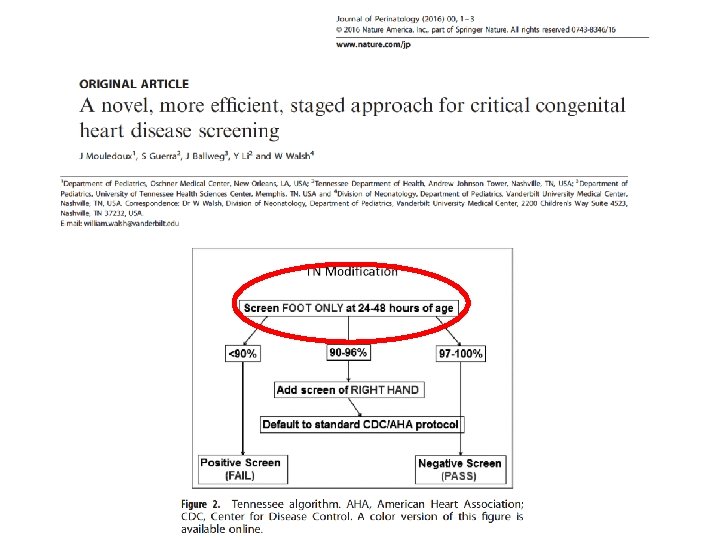
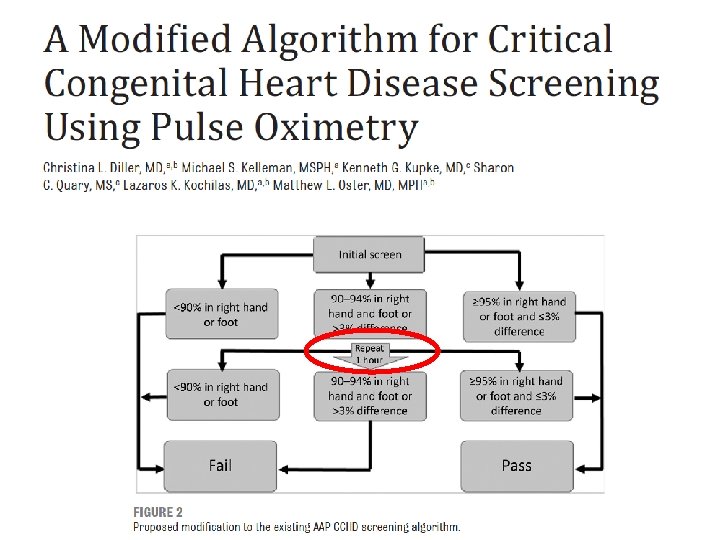
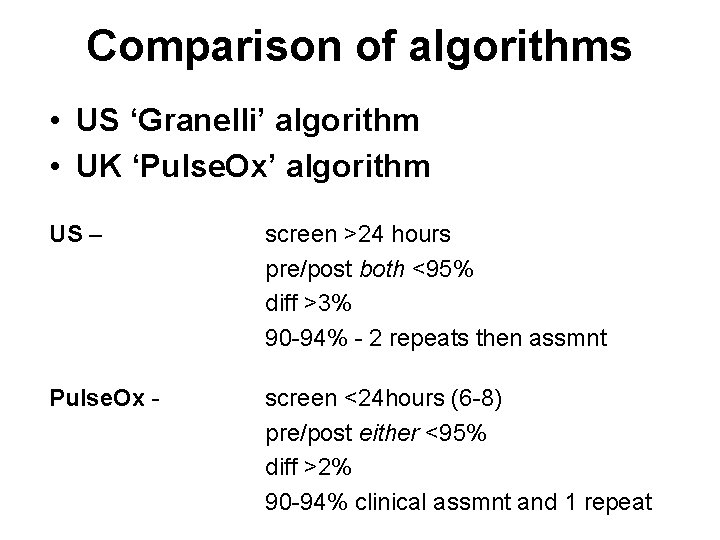
Comparison of algorithms • US ‘Granelli’ algorithm • UK ‘Pulse. Ox’ algorithm US – screen >24 hours pre/post both <95% diff >3% 90 -94% - 2 repeats then assmnt Pulse. Ox - screen <24 hours (6 -8) pre/post either <95% diff >2% 90 -94% clinical assmnt and 1 repeat
Pre/post either or both <95% Clinical conundrum (1) Sats - post 92%
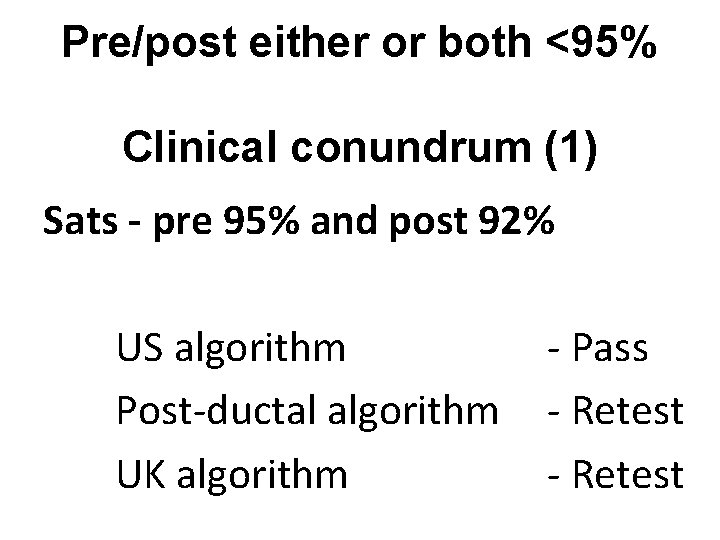
Pre/post either or both <95% Clinical conundrum (1) Sats - pre 95% and post 92% US algorithm Post-ductal algorithm UK algorithm - Pass - Retest
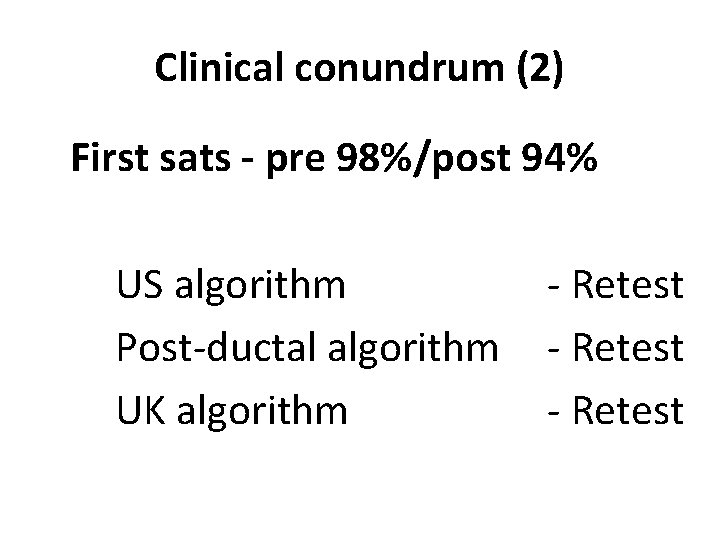
Clinical conundrum (2) First sats - pre 98%/post 94% US algorithm Post-ductal algorithm UK algorithm - Retest
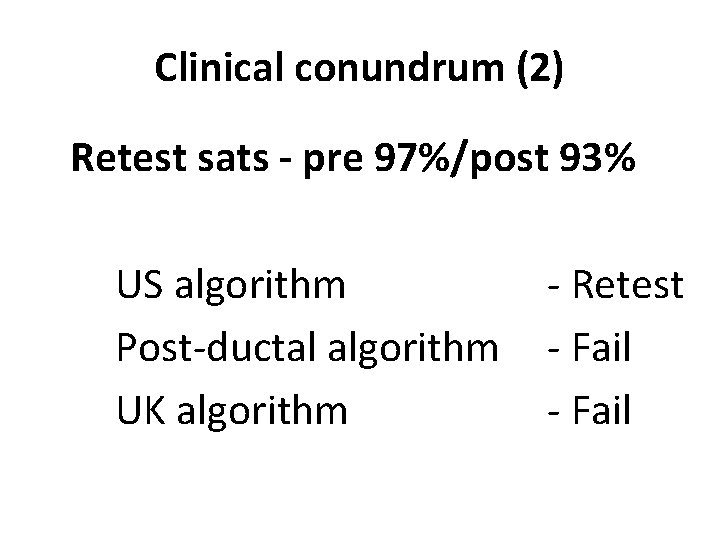
Clinical conundrum (2) Retest sats - pre 97%/post 93% US algorithm Post-ductal algorithm UK algorithm - Retest - Fail
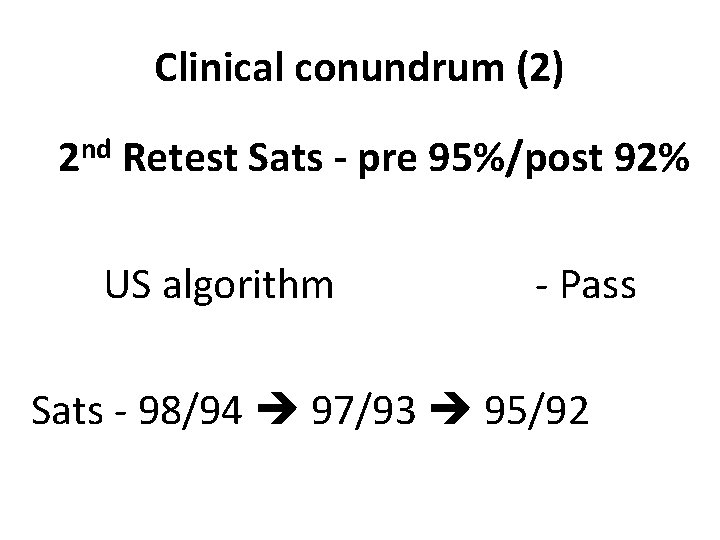
Clinical conundrum (2) 2 nd Retest Sats - pre 95%/post 92% US algorithm - Pass Sats - 98/94 97/93 95/92
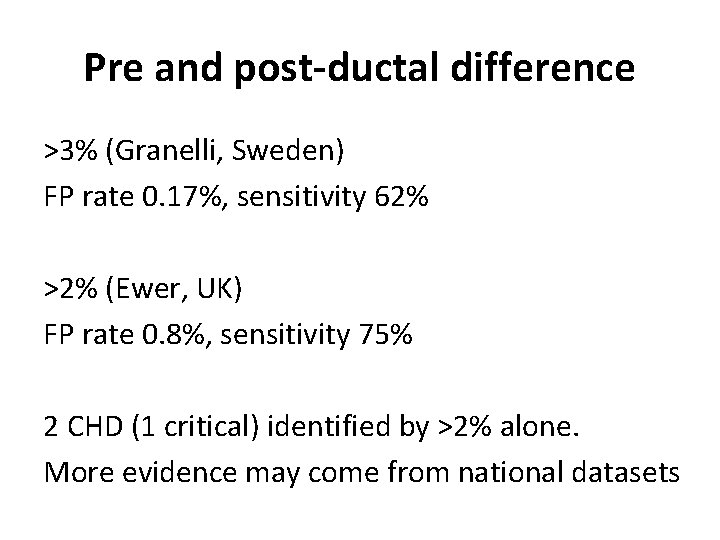
Pre and post-ductal difference >3% (Granelli, Sweden) FP rate 0. 17%, sensitivity 62% >2% (Ewer, UK) FP rate 0. 8%, sensitivity 75% 2 CHD (1 critical) identified by >2% alone. More evidence may come from national datasets
Repeat testing without prior assessment may delay the identification of a sick baby
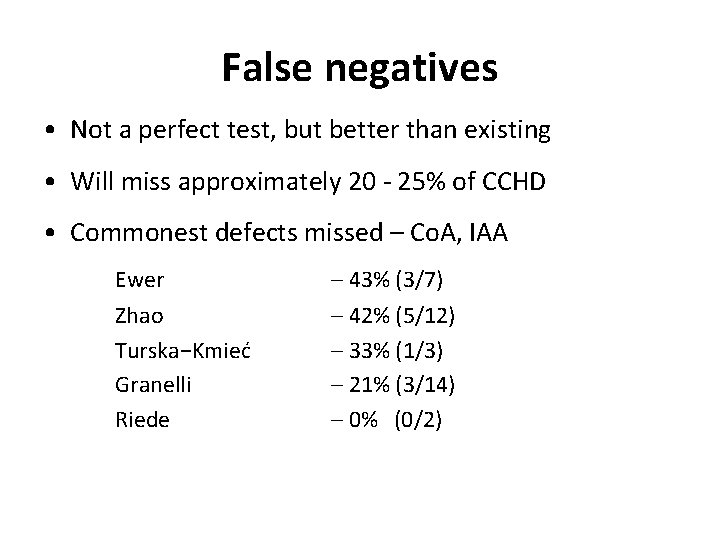
False negatives • Not a perfect test, but better than existing • Will miss approximately 20 - 25% of CCHD • Commonest defects missed – Co. A, IAA Ewer – 43% (3/7) Zhao Turska−Kmieć Granelli Riede – 42% (5/12) – 33% (1/3) – 21% (3/14) – 0% (0/2)
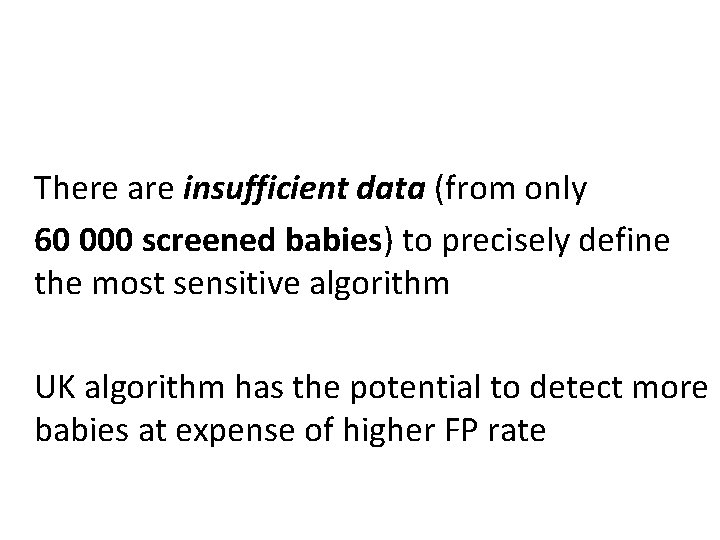
There are insufficient data (from only 60 000 screened babies) to precisely define the most sensitive algorithm UK algorithm has the potential to detect more babies at expense of higher FP rate
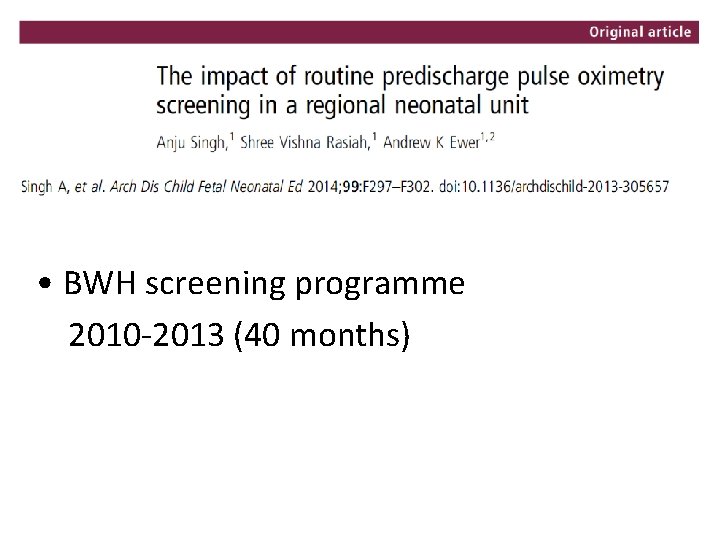
• BWH screening programme 2010 -2013 (40 months)
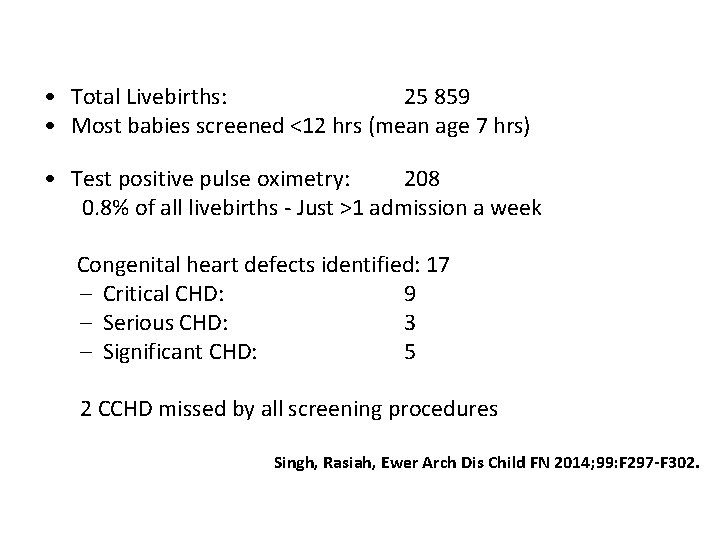
• Total Livebirths: 25 859 • Most babies screened <12 hrs (mean age 7 hrs) • Test positive pulse oximetry: 208 0. 8% of all livebirths - Just >1 admission a week Congenital heart defects identified: 17 – Critical CHD: 9 – Serious CHD: 3 – Significant CHD: 5 2 CCHD missed by all screening procedures Singh, Rasiah, Ewer Arch Dis Child FN 2014; 99: F 297 -F 302.
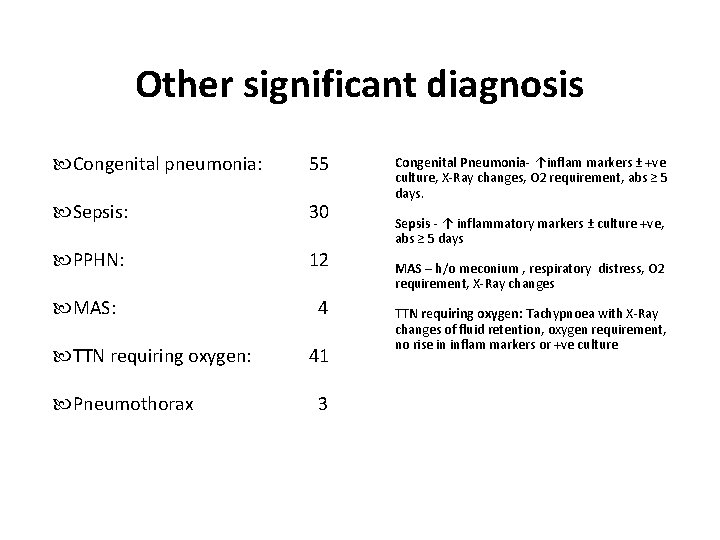
Other significant diagnosis Congenital pneumonia: 55 Sepsis: 30 PPHN: 12 MAS: 4 TTN requiring oxygen: Pneumothorax 41 3 Congenital Pneumonia- ↑inflam markers ± +ve culture, X-Ray changes, O 2 requirement, abs ≥ 5 days. Sepsis - ↑ inflammatory markers ± culture +ve, abs ≥ 5 days MAS – h/o meconium , respiratory distress, O 2 requirement, X-Ray changes TTN requiring oxygen: Tachypnoea with X-Ray changes of fluid retention, oxygen requirement, no rise in inflam markers or +ve culture
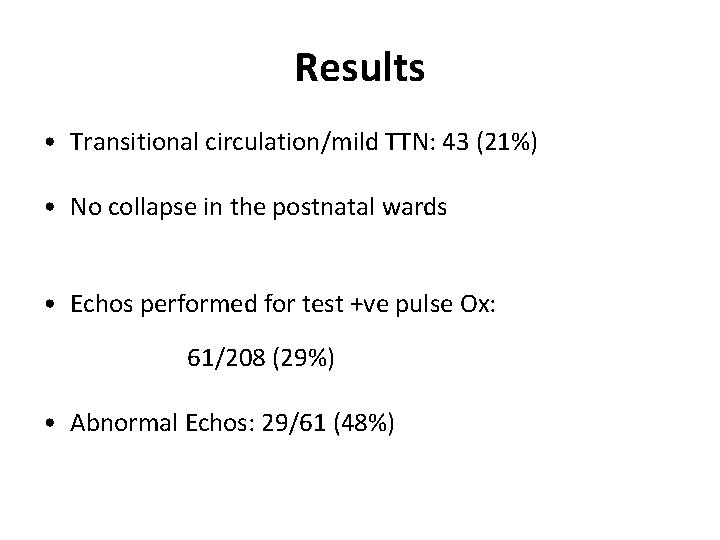
Results • Transitional circulation/mild TTN: 43 (21%) • No collapse in the postnatal wards • Echos performed for test +ve pulse Ox: 61/208 (29%) • Abnormal Echos: 29/61 (48%)
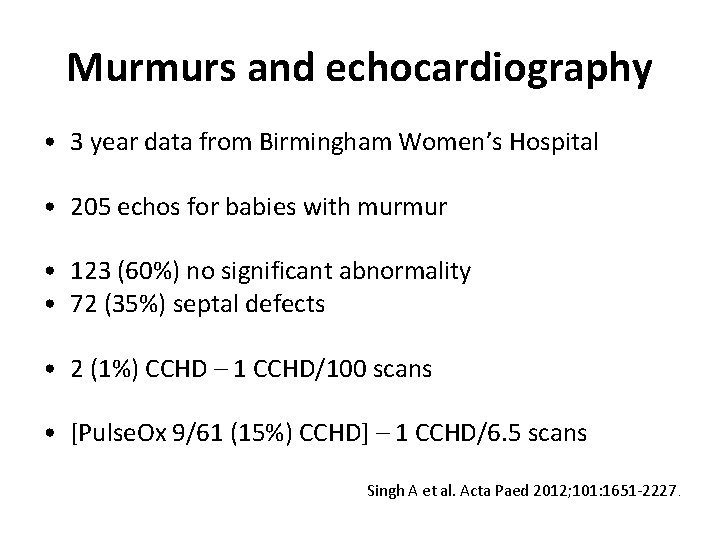
Murmurs and echocardiography • 3 year data from Birmingham Women’s Hospital • 205 echos for babies with murmur • 123 (60%) no significant abnormality • 72 (35%) septal defects • 2 (1%) CCHD – 1 CCHD/100 scans • [Pulse. Ox 9/61 (15%) CCHD] – 1 CCHD/6. 5 scans Singh A et al. Acta Paed 2012; 101: 1651 -2227.
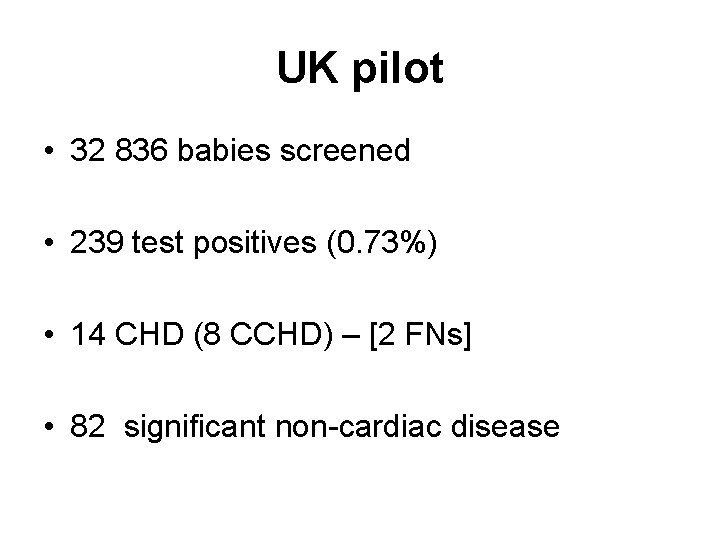
UK pilot • 32 836 babies screened • 239 test positives (0. 73%) • 14 CHD (8 CCHD) – [2 FNs] • 82 significant non-cardiac disease
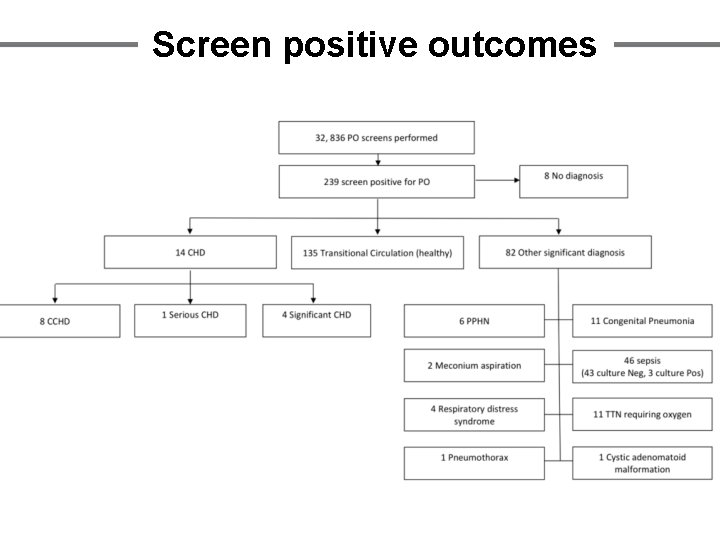
Screen positive outcomes
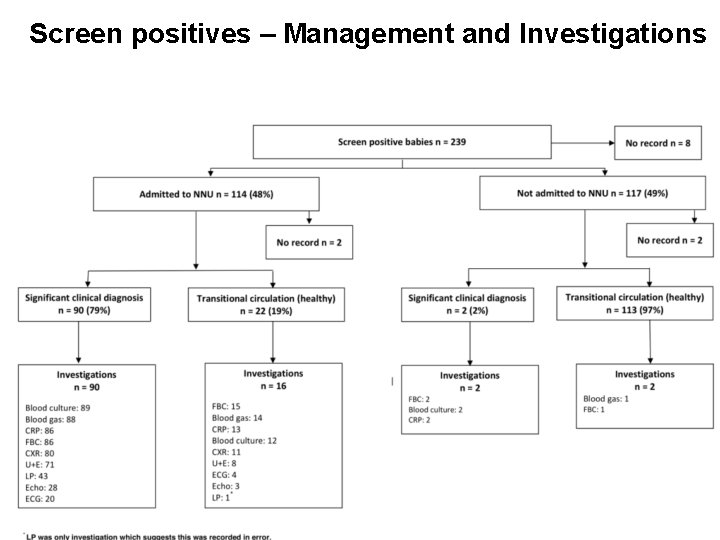
Screen positives – Management and Investigations
Milan 2016

NSC Workgroup meeting 22 nd June 2018
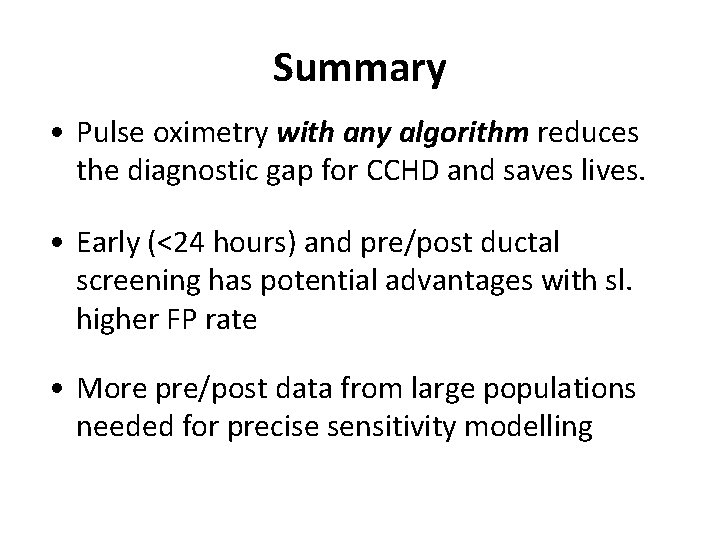
Summary • Pulse oximetry with any algorithm reduces the diagnostic gap for CCHD and saves lives. • Early (<24 hours) and pre/post ductal screening has potential advantages with sl. higher FP rate • More pre/post data from large populations needed for precise sensitivity modelling
Final thought Which is better…? detecting more babies with significant illness before they become unwell (at the expense of a moderately higher FP rate), or a test with a very low FP rate which detects relatively few ill babies? a. k. ewer@bham. ac. uk
- Slides: 88