
Screening for Social Determinants of Health SDOH and

- Slides: 27
Screening for Social Determinants of Health (SDOH) and offering SDOH assistance in health care settings: Patient Perspectives Amy Huebschmann, MD, MS With attribution for project leadership and slides shared by Emilia De Marchis, MD, MAS and UCSF SIREN group April 15, 2020
Funding & Disclosures • Funder: The Commonwealth Fund • UCSF Social Interventions Research & Evaluation Network (SIREN) led this multisite research project • University of Colorado Internal Medicine clinic served as one of 10 national sites of study that had not previously conducted SDOH screenings (Huebschmann site PI)
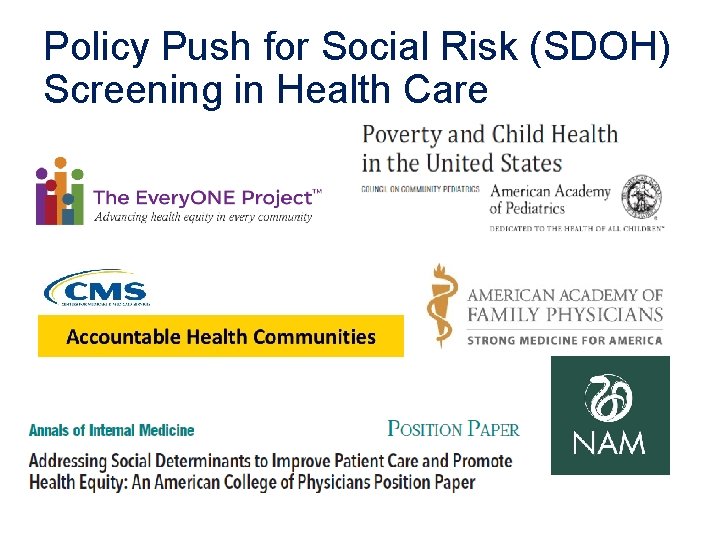
Policy Push for Social Risk (SDOH) Screening in Health Care
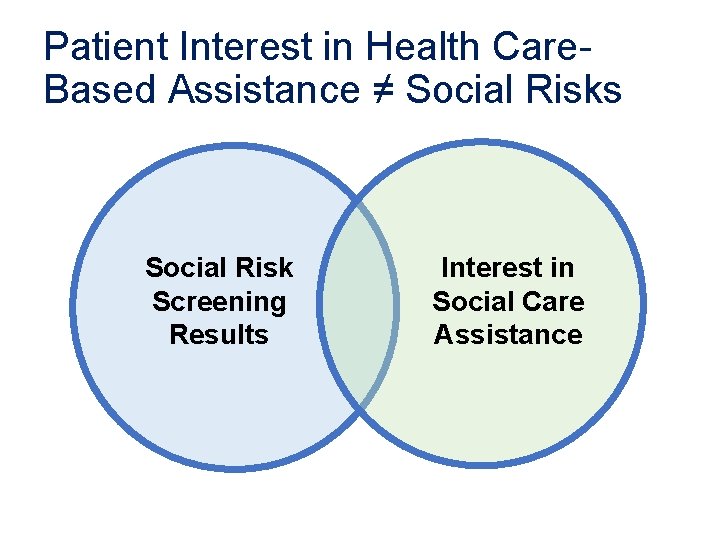
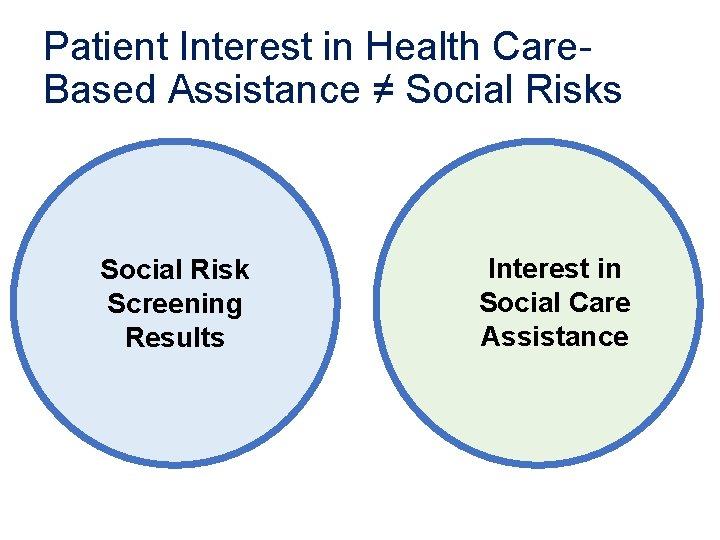
Patient Interest in Health Care. Based Assistance ≠ Social Risks Social Risk Screening Results Interest in Social Care Assistance
Patient Interest in Health Care. Based Assistance ≠ Social Risks Social Risk Screening Results Interest in Social Care Assistance
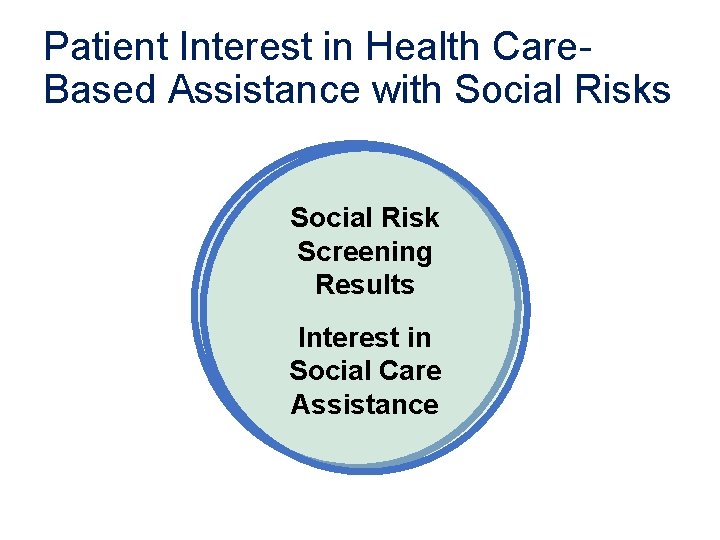
Patient Interest in Health Care. Based Assistance with Social Risks Social Risk Screening Results Interest in Social Care Assistance
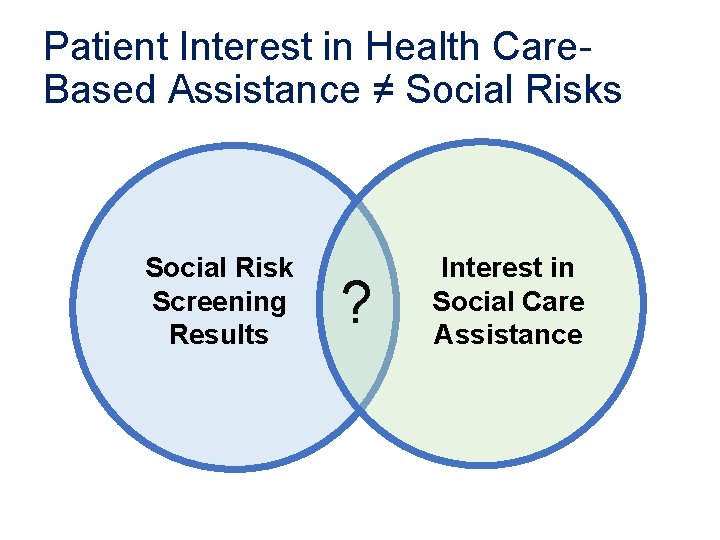
Patient Interest in Health Care. Based Assistance ≠ Social Risks Social Risk Screening Results ? Interest in Social Care Assistance
Aims presented today Within diverse primary care and emergency care health systems caring for >50% Medicaid/Medicare patients: 1. Determine the acceptability of health carebased SDOH/social risk screening to patients and their caregivers 2. Examine the frequency and predictors of interest in SDOH/social risk assistance in diverse health care setting De Marchis E, et al. Part 1: A Quantitative Study of Social Risk Screening Acceptability in Patients and Caregivers. Am J Prev Med, 2019.
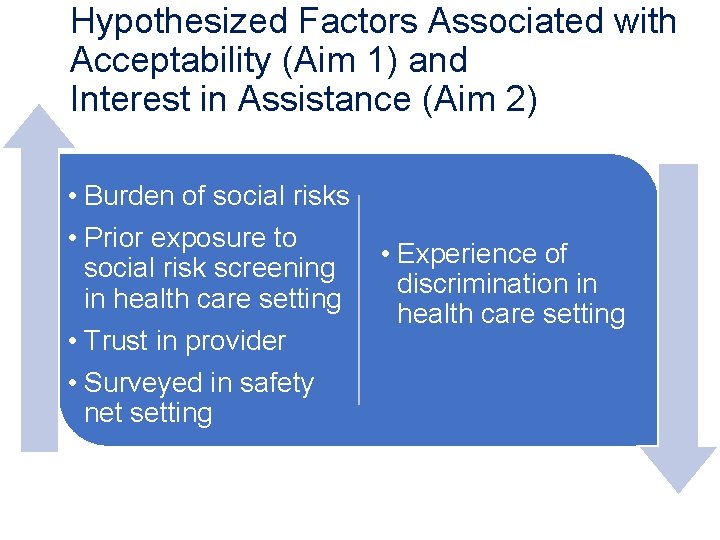
Hypothesized Factors Associated with Acceptability (Aim 1) and Interest in Assistance (Aim 2) • Burden of social risks • Prior exposure to social risk screening in health care setting • Trust in provider • Surveyed in safety net setting • Experience of discrimination in health care setting
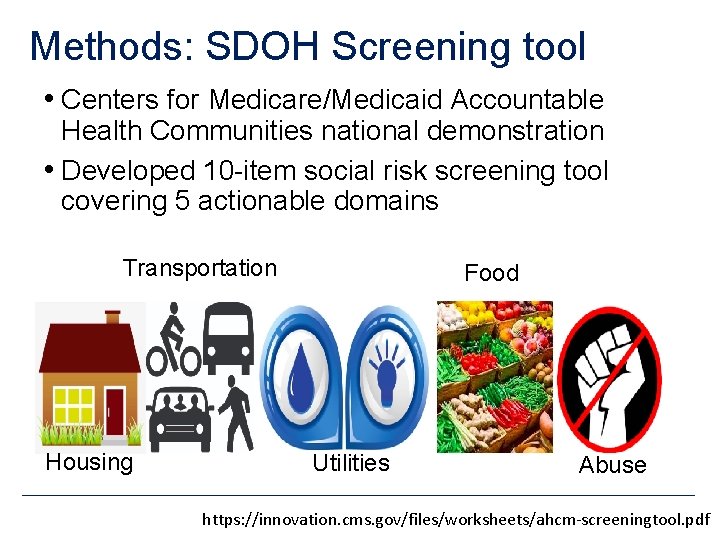
Methods: SDOH Screening tool • Centers for Medicare/Medicaid Accountable Health Communities national demonstration • Developed 10 -item social risk screening tool covering 5 actionable domains Transportation Housing Food Utilities Abuse https: //innovation. cms. gov/files/worksheets/ahcm-screeningtool. pdf
Methods: Interest in SDOH assessment “Would you like to receive assistance with any of the following issues? (Check all that apply). ” Transportation Housing Food Utilities Abuse
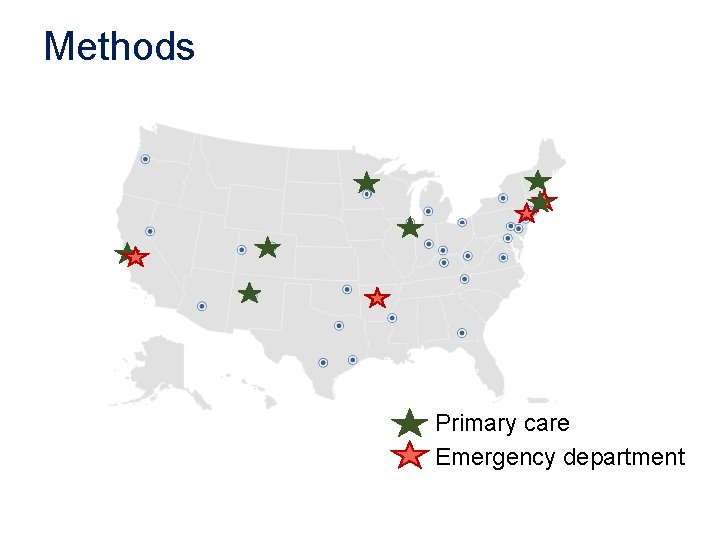
Methods Primary care Emergency department
Aim 1: Survey Measures of Acceptability 1. “Do you think it is appropriate to be asked these questions about your social and economic needs at [‘this clinic’ or ‘this emergency department’]? ” 2. “Would you be comfortable having these kinds of needs included in your health records (also known as your medical record or chart)? ”
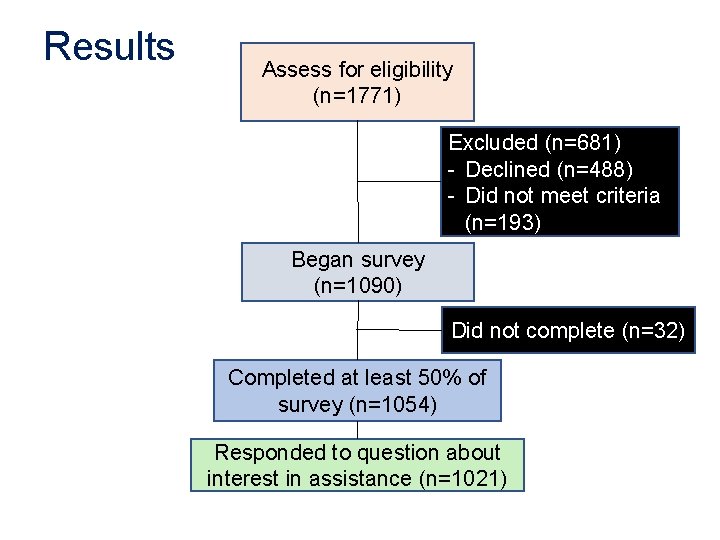
Results Assess for eligibility (n=1771) Excluded (n=681) - Declined (n=488) - Did not meet criteria (n=193) Began survey (n=1090) Did not complete (n=32) Completed at least 50% of survey (n=1054) Responded to question about interest in assistance (n=1021)
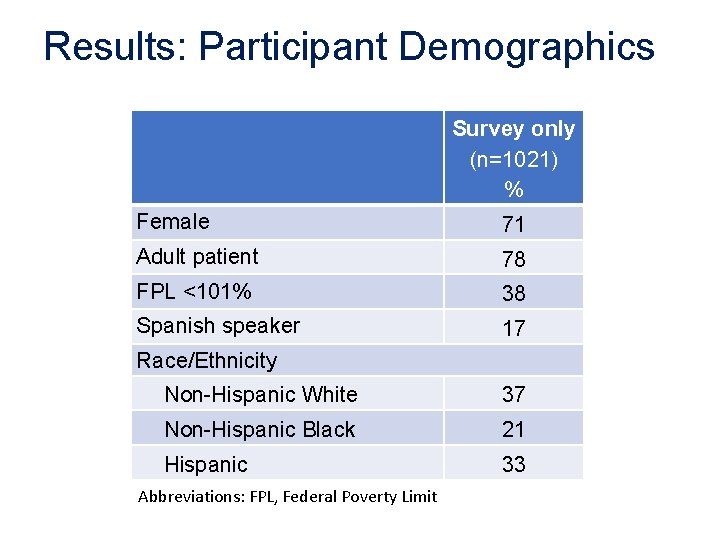
Results: Participant Demographics Survey only (n=1021) % Female 71 Adult patient 78 FPL <101% 38 Spanish speaker 17 Race/Ethnicity Non-Hispanic White 37 Non-Hispanic Black 21 Hispanic 33 Abbreviations: FPL, Federal Poverty Limit
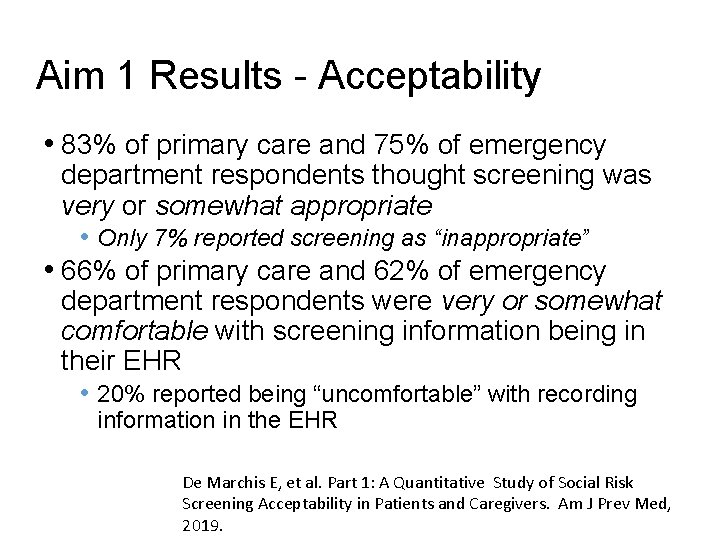
Aim 1 Results - Acceptability • 83% of primary care and 75% of emergency department respondents thought screening was very or somewhat appropriate • Only 7% reported screening as “inappropriate” • 66% of primary care and 62% of emergency department respondents were very or somewhat comfortable with screening information being in their EHR • 20% reported being “uncomfortable” with recording information in the EHR De Marchis E, et al. Part 1: A Quantitative Study of Social Risk Screening Acceptability in Patients and Caregivers. Am J Prev Med, 2019.
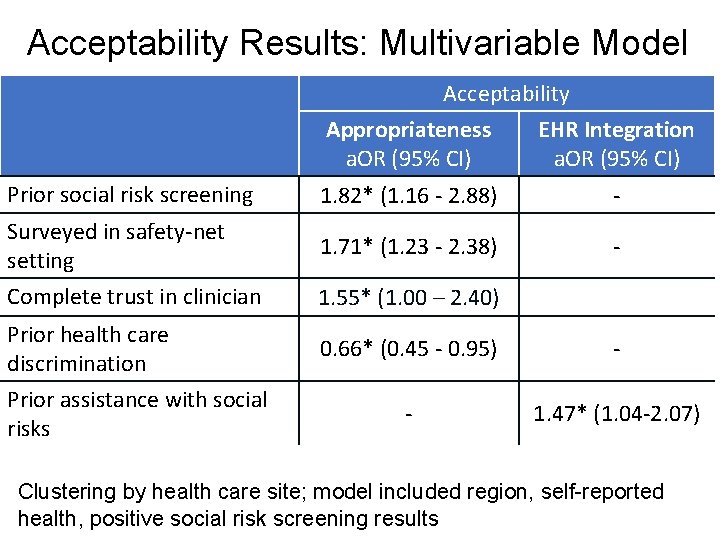
Acceptability Results: Multivariable Model Acceptability Appropriateness EHR Integration a. OR (95% CI) Prior social risk screening Surveyed in safety-net setting Complete trust in clinician Prior health care discrimination Prior assistance with social risks 1. 82* (1. 16 - 2. 88) - 1. 71* (1. 23 - 2. 38) - 1. 55* (1. 00 – 2. 40) 0. 66* (0. 45 - 0. 95) - - 1. 47* (1. 04 -2. 07) Clustering by health care site; model included region, self-reported health, positive social risk screening results
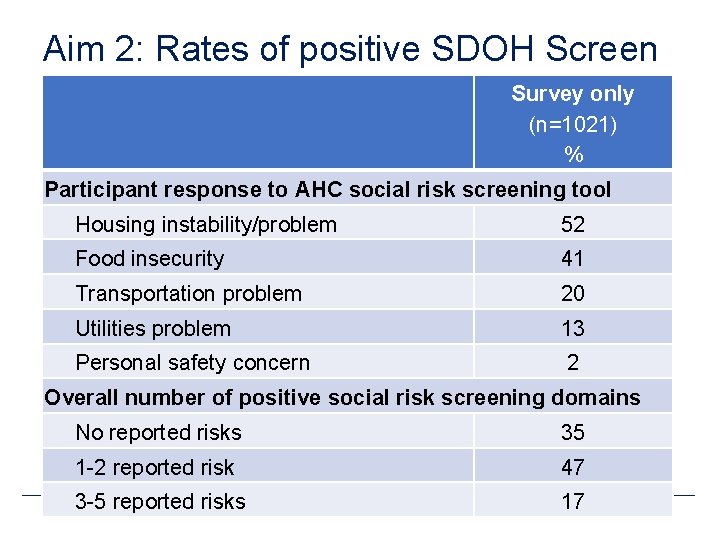
Aim 2: Rates of positive SDOH Screen Survey only (n=1021) % Participant response to AHC social risk screening tool Housing instability/problem 52 Food insecurity 41 Transportation problem 20 Utilities problem 13 Personal safety concern 2 Overall number of positive social risk screening domains No reported risks 35 1 -2 reported risk 47 3 -5 reported risks 17
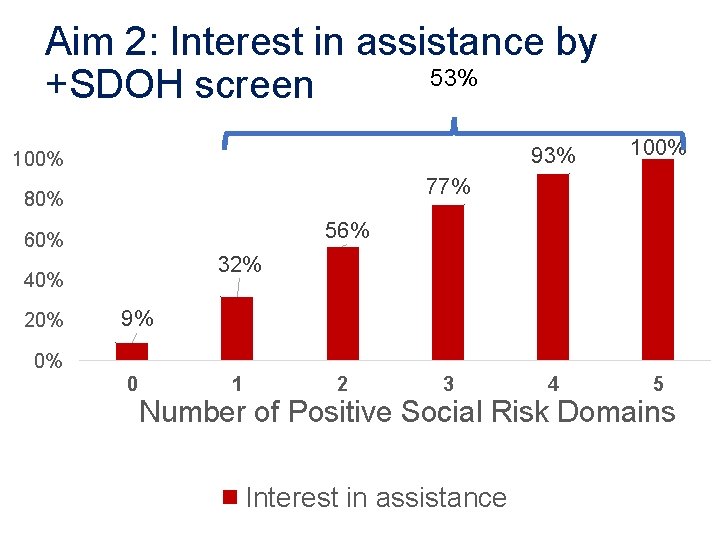
Aim 2: Interest in assistance by 53% +SDOH screen 100% 4 5 77% 80% 56% 60% 32% 40% 20% 93% 9% 0% 0 1 2 3 Number of Positive Social Risk Domains Interest in assistance
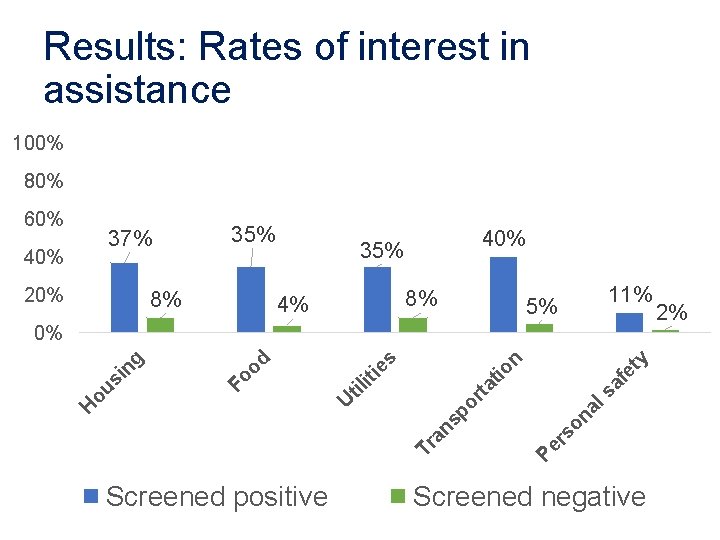
Results: Rates of interest in assistance 100% 80% 60% 37% 40% 20% 35% 8% 4% 11% 5% y Pe r so na ls af ta tio or sp an Tr Screened positive et n es U til iti od Fo H ou si ng 0% Screened negative 2%
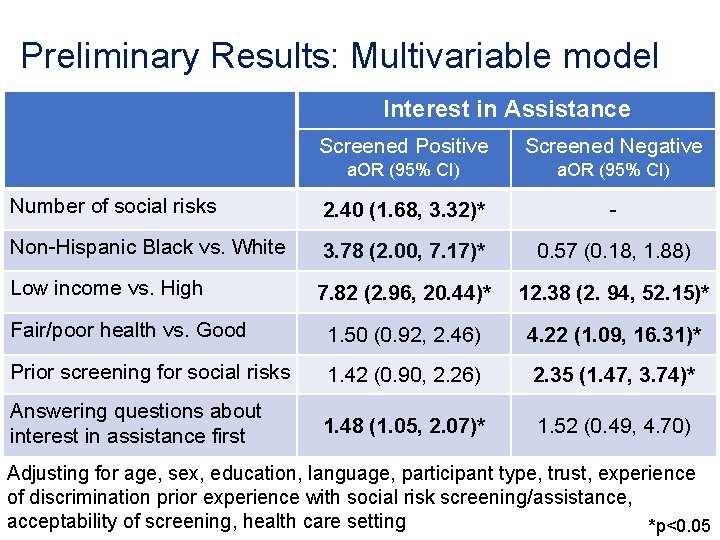
Preliminary Results: Multivariable model Interest in Assistance Screened Positive Screened Negative a. OR (95% CI) Number of social risks 2. 40 (1. 68, 3. 32)* - Non-Hispanic Black vs. White 3. 78 (2. 00, 7. 17)* 0. 57 (0. 18, 1. 88) Low income vs. High 7. 82 (2. 96, 20. 44)* 12. 38 (2. 94, 52. 15)* Fair/poor health vs. Good 1. 50 (0. 92, 2. 46) 4. 22 (1. 09, 16. 31)* Prior screening for social risks 1. 42 (0. 90, 2. 26) 2. 35 (1. 47, 3. 74)* Answering questions about interest in assistance first 1. 48 (1. 05, 2. 07)* 1. 52 (0. 49, 4. 70) Adjusting for age, sex, education, language, participant type, trust, experience of discrimination prior experience with social risk screening/assistance, acceptability of screening, health care setting *p<0. 05
Limitations • Cross-sectional • Excluded patients who did not speak or read English or Spanish • Limited to 10 included sites • Acceptability and Interest in assistance asked as part of a research study
Conclusions • Acceptability of SDOH screening is very high among patients, but a significant minority would not want the answers recorded in the health record. • Congruence between positive screening and interest in assistance is higher among: • those with multiple social needs, of lower income, and in those asked about interest in assistance before being screened for social risks. • People we are more likely to miss if we don’t explicitly ask about interest in assistance (negative SDOH screen/+interest in assistance): • those in poorer health and of lower income
Future Directions • Screen for interest in assistance rather than social risk, per se? • Use of tools that guide patients towards resources/assistance in the process of screening? • Myownhealthreport. org (select “other” clinic) • UCSF Siren network has excellent resources for implementing screening on their website (sirenetwork. ucsf. edu) and a free monthly e-newsletter
Thank you! • Research team: • Emilia De. Marchis, MD, MPH • Danielle Hessler, Ph. D • Caroline Fichtenberg, Ph. D • Elena Byhoff, MD, MSc • Alicia Cohen, MD, MSc • Eric Fleegler, MD, MPH • Nicholas Gavin, MD • Mark Ommerborn, MPH • Cheryl Clark, MD, Sc. D • Laura Gottlieb, MD, MPH
Thank you! • University of Arkansas • Boston Medical Center • Brigham & Women’s Hospital • University of Chicago • University of Colorado • Dartmouth Medical Center • Hennepin Health Center • La Familia Medical Center • New York University • Sirenetwork. ucsf. edu
Thank you! • Questions/Comments: amy. Huebschmann@cuanschutz. edu • @ahuebschmann