
Screening for pregnancy intention to address unmet reproductive
- Slides: 1
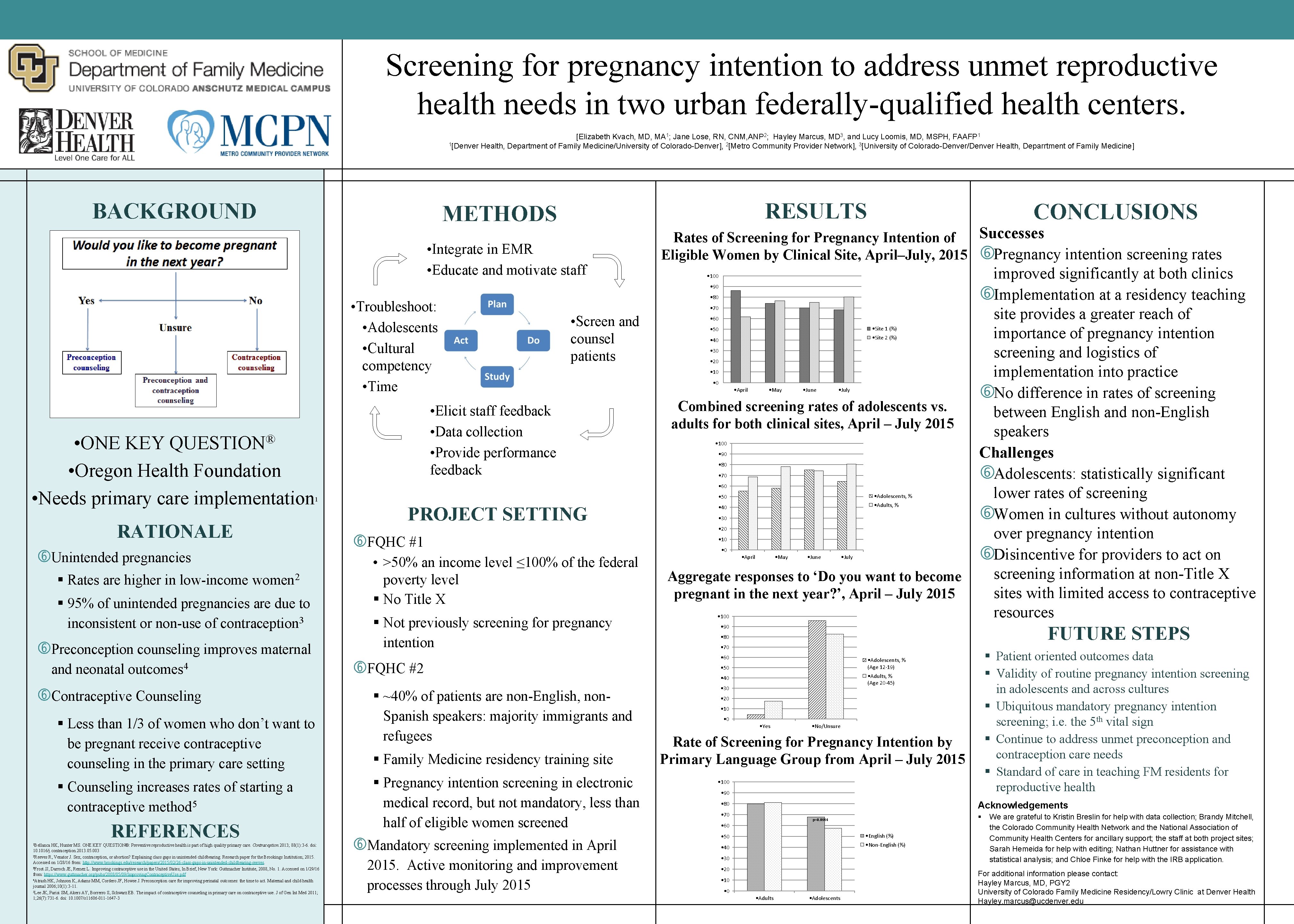
Screening for pregnancy intention to address unmet reproductive health needs in two urban federally-qualified health centers.  [Elizabeth Kvach, MD, MA 1; Jane Lose, RN, CNM, ANP 2; Hayley Marcus, MD 3, and Lucy Loomis, MD, MSPH, FAAFP 1 1[Denver Health, Department of Family Medicine/University of Colorado-Denver], 2[Metro Community Provider Network], 3[University of Colorado-Denver/Denver Health, Deparrtment of Family Medicine] BACKGROUND RESULTS METHODS • Integrate in EMR • Educate and motivate staff CONCLUSIONS Successes Rates of Screening for Pregnancy Intention of Eligible Women by Clinical Site, April–July, 2015 Pregnancy intention screening rates • 100 • 90 • Troubleshoot: • Adolescents • Cultural competency • Time • ONE KEY • Oregon Health Foundation • Needs primary care implementation • 70 • Screen and counsel patients • Elicit staff feedback • Data collection • Provide performance feedback ® QUESTION • 60 • Site 1 (%) • Site 2 (%) • 50 • 40 • 30 • 20 • 10 • 0 • April • May • June • July Combined screening rates of adolescents vs. adults for both clinical sites, April – July 2015 • 100 • 90 • 80 • 70 • 60 Unintended pregnancies § Rates are higher in low-income women 2 § 95% of unintended pregnancies are due to 3 inconsistent or non-use of contraception Preconception counseling improves maternal and neonatal outcomes 4 Contraceptive Counseling § Less than 1/3 of women who don’t want to be pregnant receive contraceptive counseling in the primary care setting § Counseling increases rates of starting a 5 contraceptive method REFERENCES HK, Hunter MS. ONE KEY QUESTION®: Preventive reproductive health is part of high quality primary care. Contraception 2013; 88(1): 3 -6. doi: 10. 1016/j. contraception. 2013. 05. 003 2 Reeves R, Venator J. Sex, contraception, or abortion? Explaining class gaps in unintended childbearing. Research paper for the Brookings Institution; 2015. Accessed on 1/28/16 from: http: //www. brookings. edu/research/papers/2015/02/26 -class-gaps-in-unintended-childbearing-reeves. 3 Frost JJ, Darroch JE, Remez L. Improving contraceptive use in the United States, In Brief, New York: Guttmacher Institute, 2008, No. 1. Accessed on 1/29/16 from: https: //www. guttmacher. org/pubs/2008/05/09/Improving. Contraceptive. Use. pdf 4 Atrash HK, Johnson K, Adams MM, Cordero JF, Howse J. Preconception care for improving perinatal outcomes: the time to act. Maternal and child health journal 2006; 10(1): 3 -11. 5 Lee JK, Parisi SM, Akers AY, Borrerro S, Schwarz EB. The impact of contraceptive counseling in primary care on contraceptive use. J of Gen Int Med 2011; 1; 26(7): 731 -6. doi: 10. 1007/s 11606 -011 -1647 -3 • Adolescents, % • Adults, % • 50 1 RATIONALE 1 Bellanca • 80 PROJECT SETTING FQHC #1 • >50% an income level ≤ 100% of the federal poverty level § No Title X § Not previously screening for pregnancy intention FQHC #2 § ~40% of patients are non-English, non. Spanish speakers: majority immigrants and refugees § Family Medicine residency training site § Pregnancy intention screening in electronic medical record, but not mandatory, less than half of eligible women screened • 40 • 30 • 20 • 10 • 0 • April • May • June • July Aggregate responses to ‘Do you want to become pregnant in the next year? ’, April – July 2015 • 100 improved significantly at both clinics Implementation at a residency teaching site provides a greater reach of importance of pregnancy intention screening and logistics of implementation into practice No difference in rates of screening between English and non-English speakers Challenges Adolescents: statistically significant lower rates of screening Women in cultures without autonomy over pregnancy intention Disincentive for providers to act on screening information at non-Title X sites with limited access to contraceptive resources FUTURE STEPS • 90 • 80 • 70 • 60 § Patient oriented outcomes data § Validity of routine pregnancy intention screening in adolescents and across cultures § Ubiquitous mandatory pregnancy intention screening; i. e. the 5 th vital sign § Continue to address unmet preconception and contraception care needs § Standard of care in teaching FM residents for reproductive health • Adolescents, % (Age 12 -19) • Adults, % (Age 20 -45) • 50 • 40 • 30 • 20 • 10 • 0 • Yes • No/Unsure Rate of Screening for Pregnancy Intention by Primary Language Group from April – July 2015 • 100 • 90 Acknowledgements • 80 • 70 • 60 Mandatory screening implemented in April • 50 2015. Active monitoring and improvement processes through July 2015 • 30 • English (%) • Non-English (%) • 40 • 20 • 10 • 0 § p=0. 0514 • Adults • Adolescents We are grateful to Kristin Breslin for help with data collection; Brandy Mitchell, the Colorado Community Health Network and the National Association of Community Health Centers for ancillary support; the staff at both project sites; Sarah Hemeida for help with editing; Nathan Huttner for assistance with statistical analysis; and Chloe Finke for help with the IRB application. For additional information please contact: Hayley Marcus, MD, PGY 2 University of Colorado Family Medicine Residency/Lowry Clinic at Denver Health Hayley. marcus@ucdenver. edu