
Screening for High Risk Pregnancy Peter Hornnes EBCOG
Screening for High Risk Pregnancy Peter Hornnes EBCOG TSOG Antalya May 18 th 2017 Nordsjællands Hospital, University of Copenhagen
Elements of antenatal care • Early, accurate determination of gestational age • Identification of the patient at risk for complications • Ongoing evaluation of health of mother and fetus • Prediction of problems, intervention when possible • Patient education, communication • But does it work? EBCOG TSOG Antalya May 18 th 2017 Nordsjællands Hospital, University of Copenhagen
Fiscella Obstet Gynecol 1995 • 14 observational studies, total sample size 670, 000 • 11 RCTs • Prenatal care has not conclusively been demonstrated to improve birth outcomes • Policymakers deciding on funding for prenatal care must consider these findings in the context of prenatal care´s overall benefits and potential costeffectiveness EBCOG TSOG Antalya May 18 th 2017 Nordsjællands Hospital, University of Copenhagen
Klerman et al Am J Public Health 2001 • RCT: augmented prenatal care (N=318) consisting of educationally oriented peer groups, additional appointments, extended time with clinicians, versus controls (N=301) • Augmented care significantly increased women´s satisfaction, knowledge of risk conditions, and perceived mastery in their lives, but it did not reduce the primary outcome which was low birth weight EBCOG TSOG Antalya May 18 th 2017 Nordsjællands Hospital, University of Copenhagen
Villar et al Lancet 2001 • 27 center RCT comparing standard antenatal care (N=11, 958) with a new model (N=12, 568) emphasising effective actions and fewer visits • No effect on low birth weight, postpartum anemia, or urinary tract infections. Possibly higher rate of eclampsia/pre-eclampsie in new model • Conclusion: Provision of routine antenatal care by new model seemed not to affect maternal and perinatal outcomes EBCOG TSOG Antalya May 18 th 2017 Nordsjællands Hospital, University of Copenhagen
Antenatal care might work • Studies hampered by numerous confounding factors • Provision of antenatal care is a marker for quality in health care • Many elements in antenatal care have well documented effects EBCOG TSOG Antalya May 18 th 2017 Nordsjællands Hospital, University of Copenhagen
Screening for high risk pregnancy • Numerous international and national guidelines • Geographical, genetical and economical variation • Risc factor or universal approach • Individual or group antenatal care • History and physical examination, EDD • Tests for immunity and infections, blood types and hemoglobinopathies, endocrine and metabolic disorders • Ultrasound • Patient education EBCOG TSOG Antalya May 18 th 2017 Nordsjællands Hospital, University of Copenhagen
• Screening for chromosone abnormalities • Prevention of Rhesus haemolytic diease of the fetus and newborn • Screening for preeclampsia EBCOG TSOG Antalya May 18 th 2017 Nordsjællands Hospital, University of Copenhagen
Screening for chromosone abnormalities • Introduced nation wide • Double test 8+0 -9+6 -13+6 • Nuchal Translucency 11+0 -14+0 • Trained and certificated sonographors EBCOG TSOG Antalya May 18 th 2017 Nordsjællands Hospital, University of Copenhagen
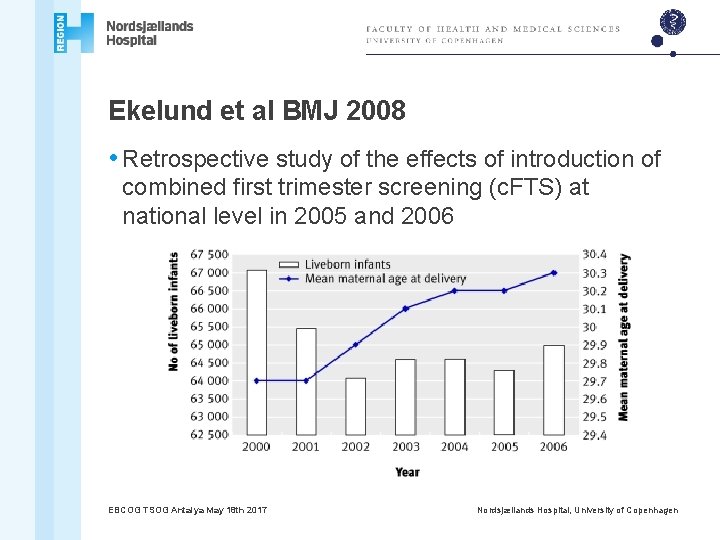
Ekelund et al BMJ 2008 • Retrospective study of the effects of introduction of combined first trimester screening (c. FTS) at national level in 2005 and 2006 EBCOG TSOG Antalya May 18 th 2017 Nordsjællands Hospital, University of Copenhagen
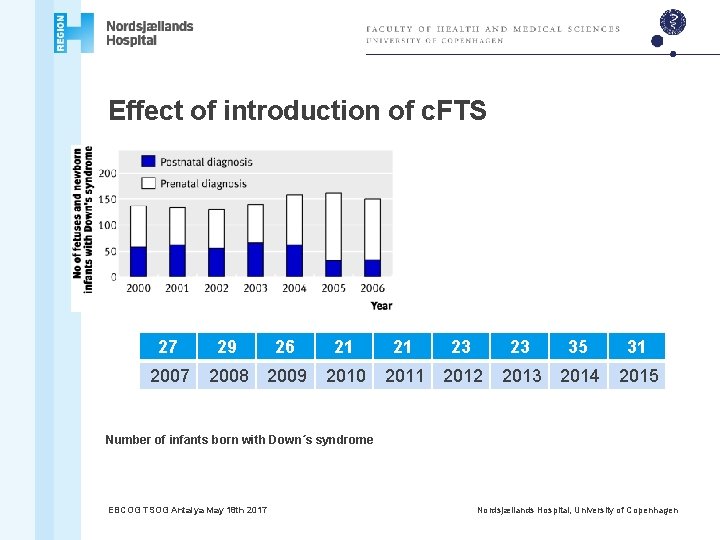
Effect of introduction of c. FTS 27 29 26 21 21 23 23 35 31 2007 2008 2009 2010 2011 2012 2013 2014 2015 Number of infants born with Down´s syndrome EBCOG TSOG Antalya May 18 th 2017 Nordsjællands Hospital, University of Copenhagen
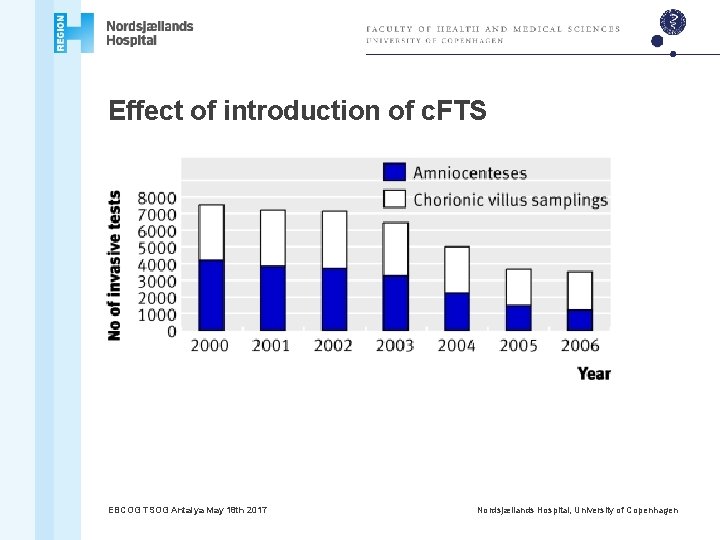
Effect of introduction of c. FTS EBCOG TSOG Antalya May 18 th 2017 Nordsjællands Hospital, University of Copenhagen
Screening for and prevention of Rhesus D haemolytic disease of the fetus and newborn • Postnatal screening and prophylaxis was introduced in the 1960 ies resulting in a decrease of immunization from 17% to 1 -1. 5% of Rh negative women • Bowman 1978 introduced antenatal prophylaxis causing a further reduction of immunization to 0. 2% with one dose 250 -300µg anti-D in week 28 -29 or twice 150µg in week 29 and 34 • Analysis of ccf. DNA allows antenatal prophylaxis targeted at the 40% that carry a D-negative foetus • Introduced nationally in DK (2010), NL (2011), FI (2014) and regionally in BE, SE, FR and UK EBCOG TSOG Antalya May 18 th 2017 Nordsjællands Hospital, University of Copenhagen
Dziegiel Science Series 2012 • Jan 1 st 2010 DK changed from postnatal to antenatal anti-D prophylaxis • RHD screening in week 25 (ccf. DNA) and postnatally in cord blood, 300 µg anti-D to those found positive • Three possible outcomes of antenatal screening • Fetus is RHD positive. Anti-D is recommended • Fetus is RHD negative. Anti-D is not recommended • Assay inconclusive. Anti-D is recommended • Sensitivity 99. 9% • Specificity 99. 3% EBCOG TSOG Antalya May 18 th 2017 Nordsjællands Hospital, University of Copenhagen
Damkjær et al Vox Sang 2012 • Hvidovre University Hospital in Copenhagen • Compliance with the new program after 2 -5 months • 90% were examined • 86% of those recommended to receive anti-D were actually treated • Newer data indicate that compliance has increased EBCOG TSOG Antalya May 18 th 2017 Nordsjællands Hospital, University of Copenhagen
Screening for preeclampsia • Prevalence 2 -3% of pregnancies • 0, 5% of pregnancies delivered before week 34 • 1 maternal mortality in DK/year • 300 deliveries in DK < week 34/year • Potential treatment with aspirin from early pregnancy • How do we find the pregnant women who will develope PE? EBCOG TSOG Antalya May 18 th 2017 Nordsjællands Hospital, University of Copenhagen
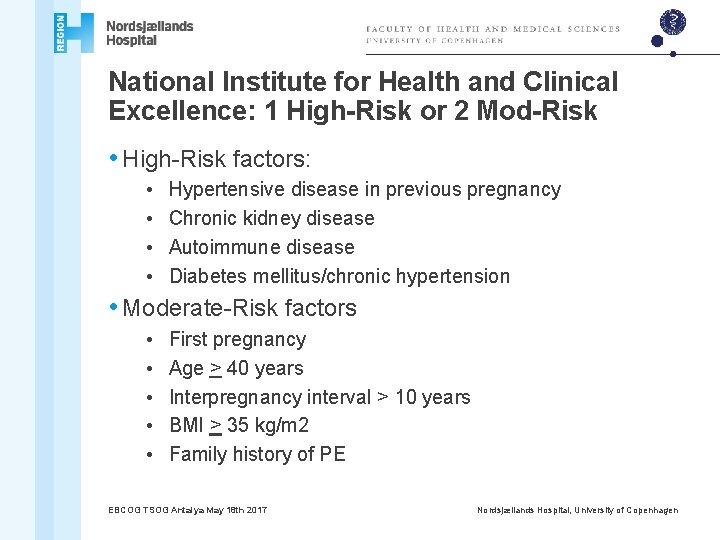
National Institute for Health and Clinical Excellence: 1 High-Risk or 2 Mod-Risk • High-Risk factors: • • Hypertensive disease in previous pregnancy Chronic kidney disease Autoimmune disease Diabetes mellitus/chronic hypertension • Moderate-Risk factors • • • First pregnancy Age > 40 years Interpregnancy interval > 10 years BMI > 35 kg/m 2 Family history of PE EBCOG TSOG Antalya May 18 th 2017 Nordsjællands Hospital, University of Copenhagen
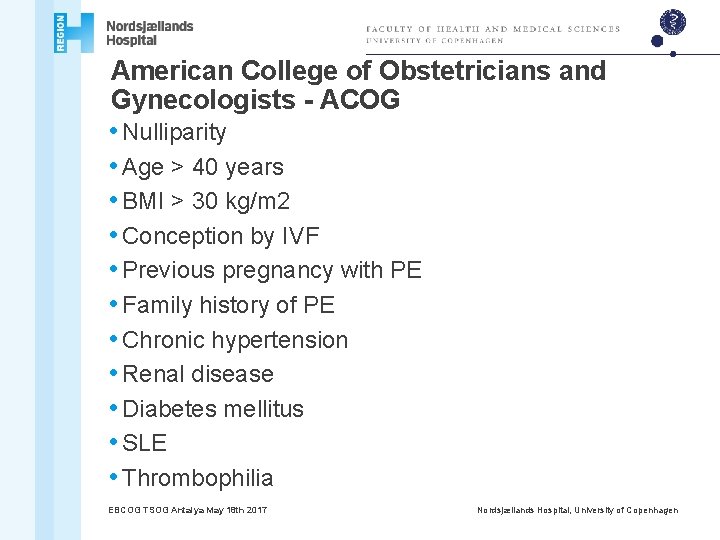
American College of Obstetricians and Gynecologists - ACOG • Nulliparity • Age > 40 years • BMI > 30 kg/m 2 • Conception by IVF • Previous pregnancy with PE • Family history of PE • Chronic hypertension • Renal disease • Diabetes mellitus • SLE • Thrombophilia EBCOG TSOG Antalya May 18 th 2017 Nordsjællands Hospital, University of Copenhagen
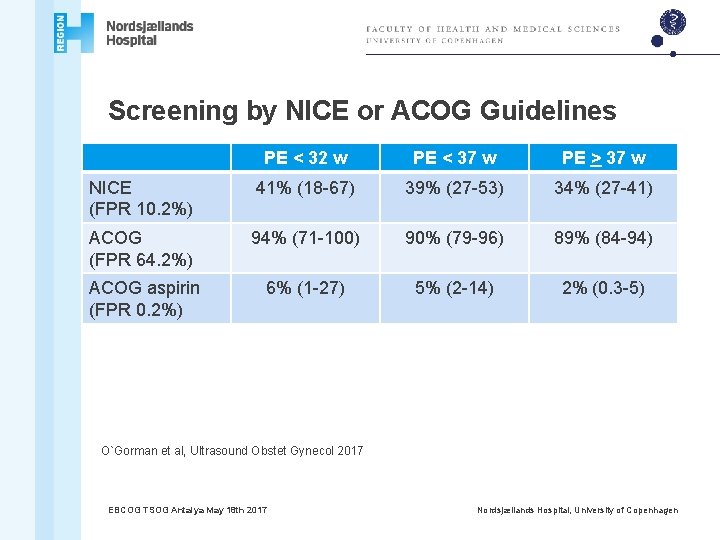
Screening by NICE or ACOG Guidelines PE < 32 w PE < 37 w PE > 37 w NICE (FPR 10. 2%) 41% (18 -67) 39% (27 -53) 34% (27 -41) ACOG (FPR 64. 2%) 94% (71 -100) 90% (79 -96) 89% (84 -94) ACOG aspirin (FPR 0. 2%) 6% (1 -27) 5% (2 -14) 2% (0. 3 -5) O`Gorman et al, Ultrasound Obstet Gynecol 2017 EBCOG TSOG Antalya May 18 th 2017 Nordsjællands Hospital, University of Copenhagen
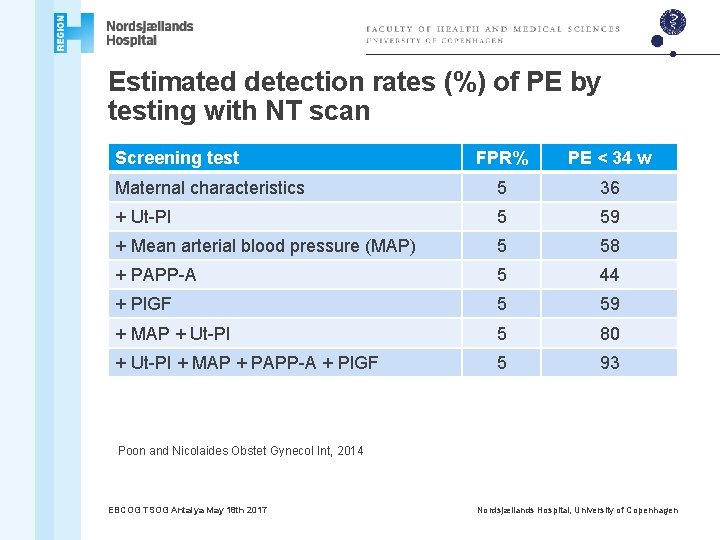
Estimated detection rates (%) of PE by testing with NT scan Screening test FPR% PE < 34 w Maternal characteristics 5 36 + Ut-PI 5 59 + Mean arterial blood pressure (MAP) 5 58 + PAPP-A 5 44 + Pl. GF 5 59 + MAP + Ut-PI 5 80 + Ut-PI + MAP + PAPP-A + Pl. GF 5 93 Poon and Nicolaides Obstet Gynecol Int, 2014 EBCOG TSOG Antalya May 18 th 2017 Nordsjællands Hospital, University of Copenhagen
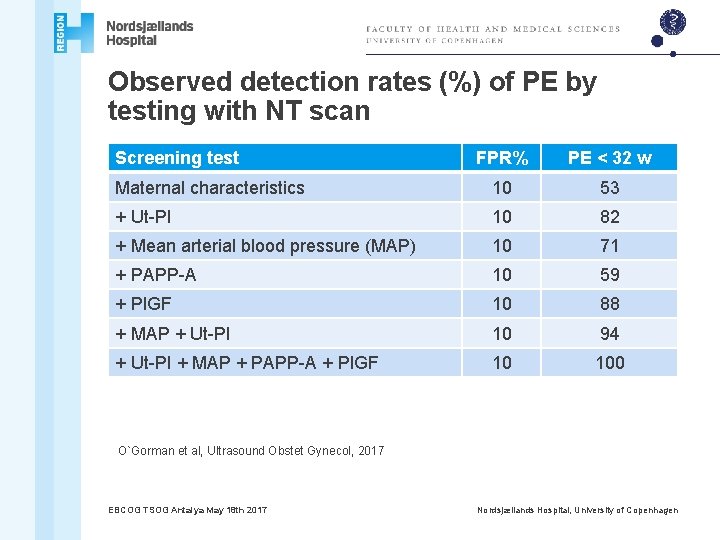
Observed detection rates (%) of PE by testing with NT scan Screening test FPR% PE < 32 w Maternal characteristics 10 53 + Ut-PI 10 82 + Mean arterial blood pressure (MAP) 10 71 + PAPP-A 10 59 + Pl. GF 10 88 + MAP + Ut-PI 10 94 + Ut-PI + MAP + PAPP-A + Pl. GF 10 100 O`Gorman et al, Ultrasound Obstet Gynecol, 2017 EBCOG TSOG Antalya May 18 th 2017 Nordsjællands Hospital, University of Copenhagen
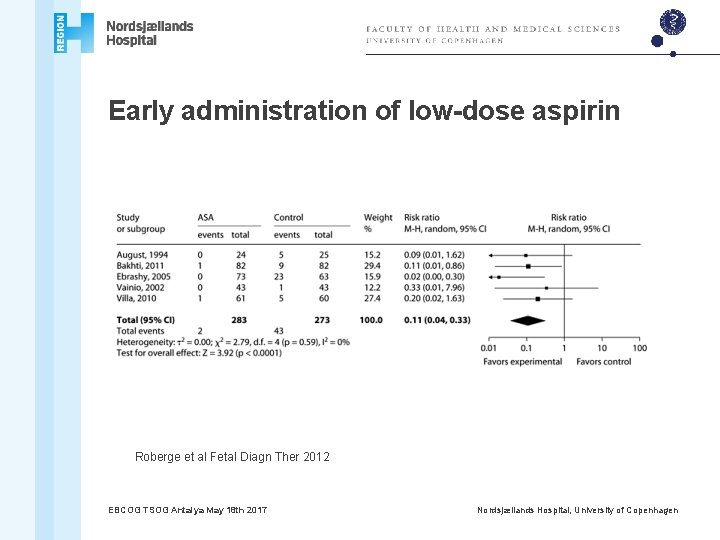
Early administration of low-dose aspirin Roberge et al Fetal Diagn Ther 2012 EBCOG TSOG Antalya May 18 th 2017 Nordsjællands Hospital, University of Copenhagen
Conclusions • Screening for High Risk Pregnancy is complex and varied • Consists of very basic and very sophisticated technologies • Might appear to be quite stable but is actually evolving swiftly • Thank you for your attention EBCOG TSOG Antalya May 18 th 2017 Nordsjællands Hospital, University of Copenhagen
EBCOG TSOG Antalya May 18 th 2017 Nordsjællands Hospital, University of Copenhagen
- Slides: 24