
Screening for Brain Injury presented at Brain Injury
Screening for Brain Injury presented at Brain Injury & the Criminal Justice System Seminar June 27 -28, 2017 Claire Brownson, MA, LMHCA Coordinator of Training & Education 1
Objectives To define why screening is important To train to use the TBI screening measure Identify various types of ABI Detect presence and determine severity To optimize knowledge through presentation of Resource Facilitation case example 2
OSU-TBI-ID Originally published in 2007 by John Corrigan, Ph. D A standardized procedure for eliciting lifetime history of TBI via a structured interview Strong psychometric properties Corrigan, J. D. , Bogner, J. A. (2007). Initial reliability and validity of the OSU TBI Identification Method. J Head Trauma Rehabil, 22(6): 318 -329. 3
Why is Screening Important? Because you might have patients/clients who have suffered a brain injury and you don’t know it yet. This is going to have an effect on outcomes (clinical, etc. ) Often clients don’t know they’ve suffered a brain injury Brain injuries are usually not visible disorders Documentation may be lacking in medical records It might explain why he/she is less responsive to the treatment/services provided Because understanding brain injuries and their effects can jumpstart recovery and healing. You can more easily tailor their treatment and/or rehabilitation
Why Self-Report? “While self-report is not an ideal for determining how much compromise a person’s brain may have incurred as a result of lifetime exposure to TBI, it is for now the gold standard for both research and clinical uses. ” We know self-report leaves much to be desired… However, a face-to-face interview conducted in a standardized manner by a trained interviewer is indeed the “gold standard” for determining lifetime history of TBI. Be warned: Self-report is vulnerable to under-reporting 5
Ohio Valley Center for Brain Injury Prevention and Rehabilitation Web-based Training Module: TBI Identification Method may be viewed on this site CEUs available here also Can find information on “Background for the OSU TBI Identification Method” and “Federally Funded Projects Using OSU TBI-ID” there as well http: //ohiovalley. org/informationeducation/screening/index. cfm 6

Clinical and Research Resources for OSU TBI-ID We utilize an adapted version of the OSU TBI-ID Short Version because: Of clinical, research or programmatic purposes It can typically be administered in 5 minutes It can be used free of charge, and It can be used without further permission from the authors as long as no changes are made to the provided version. http: //ohiovalley. org/tbi-id-method/ 7
Benefits of Using OSU “The OSU TBI-ID can be adapted for specific populations and situations; primarily via adaptation of the ‘probe’ questions that are intended to elicit injuries that may have been TBIs. ” Versions can vary in length and can be customized for clinical screening, treatment planning, system administration or research applications. We have adapted the Short Version to what we need: Ohio State University TBI Identification Method – Revised: A Screening Tool for the Identification of Acquired Brain Injury http: //ohiovalley. org/informationeducation/screening/index. cfm 8

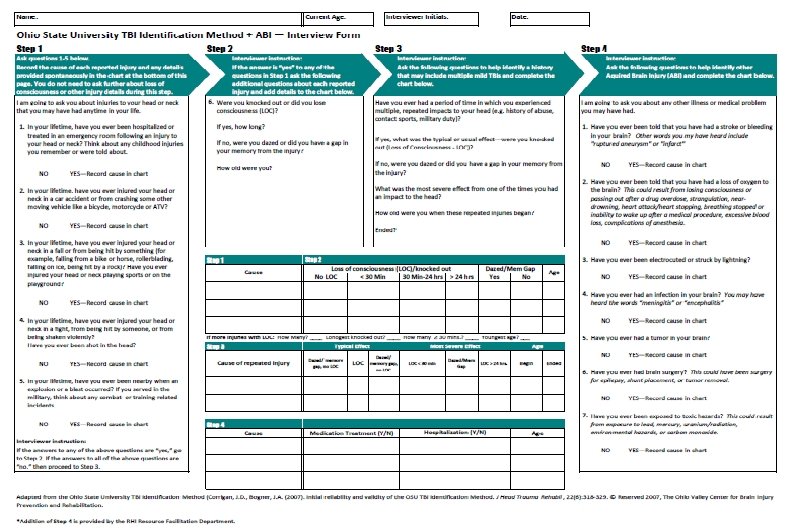
Adapted ABI items Introduced as a supplement to aid in identification of nontraumatic brain injury Stroke Loss of oxygen Lightning Infection Tumor Brain surgery Toxic exposure 9
10
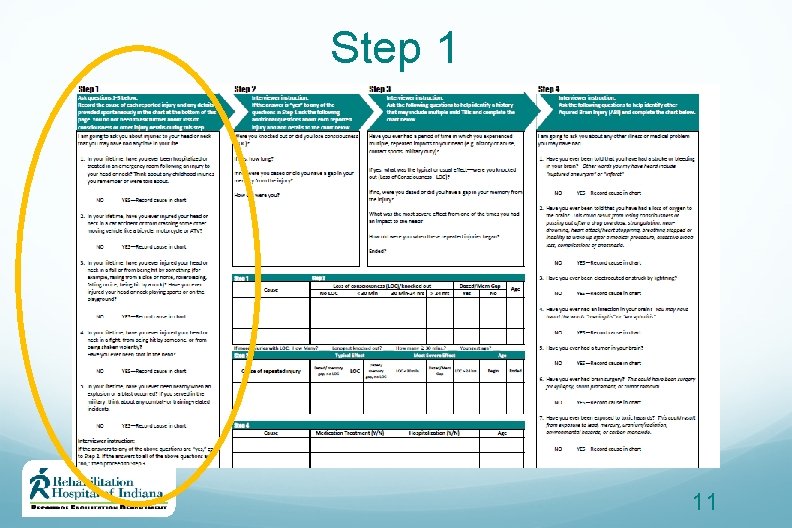
Step 1 11
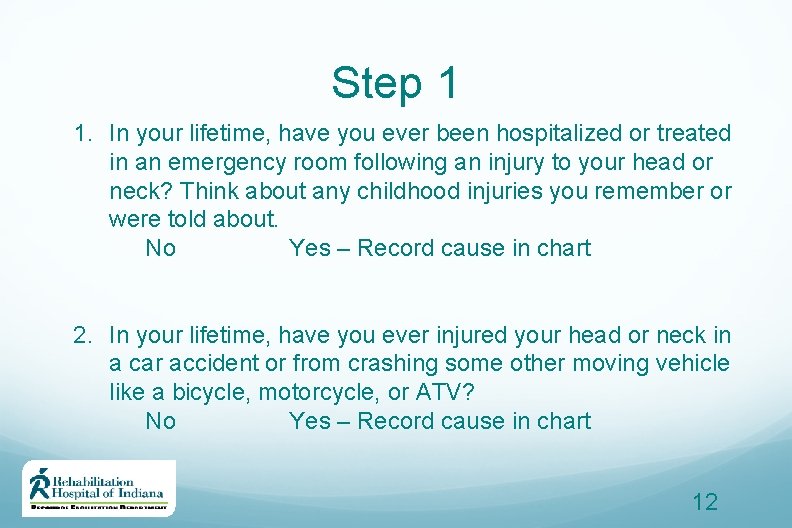
Step 1 1. In your lifetime, have you ever been hospitalized or treated in an emergency room following an injury to your head or neck? Think about any childhood injuries you remember or were told about. No Yes – Record cause in chart 2. In your lifetime, have you ever injured your head or neck in a car accident or from crashing some other moving vehicle like a bicycle, motorcycle, or ATV? No Yes – Record cause in chart 12
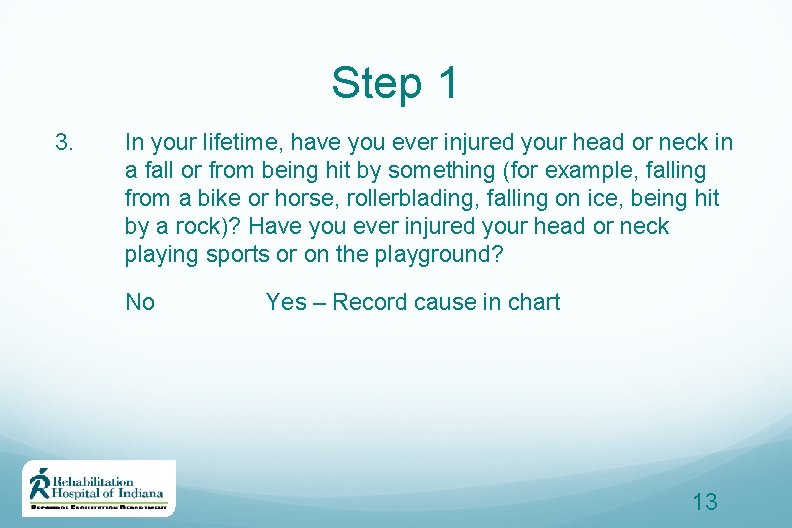
Step 1 3. In your lifetime, have you ever injured your head or neck in a fall or from being hit by something (for example, falling from a bike or horse, rollerblading, falling on ice, being hit by a rock)? Have you ever injured your head or neck playing sports or on the playground? No Yes – Record cause in chart 13
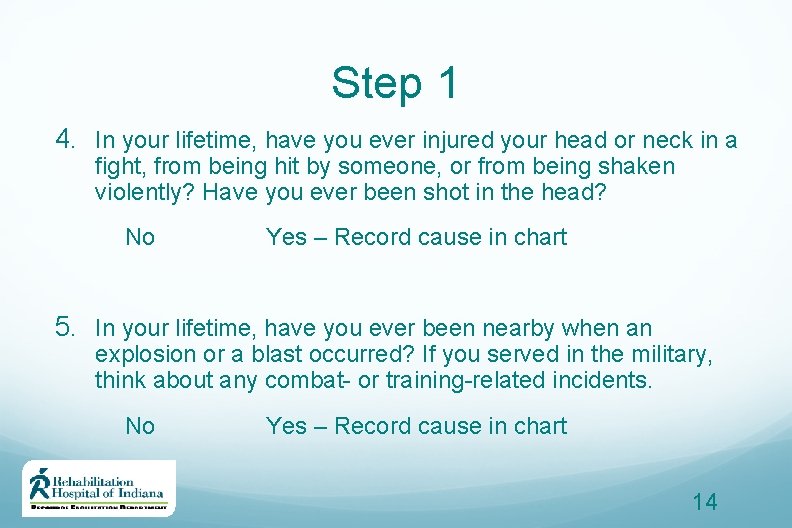
Step 1 4. In your lifetime, have you ever injured your head or neck in a fight, from being hit by someone, or from being shaken violently? Have you ever been shot in the head? No Yes – Record cause in chart 5. In your lifetime, have you ever been nearby when an explosion or a blast occurred? If you served in the military, think about any combat- or training-related incidents. No Yes – Record cause in chart 14
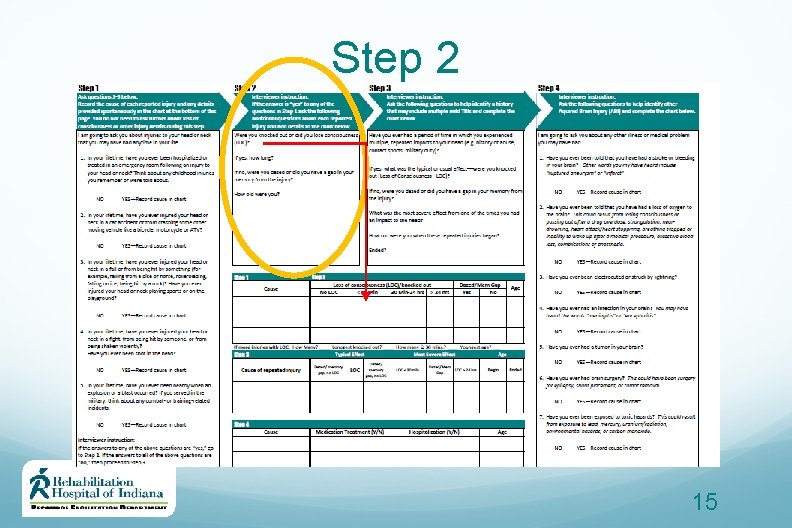
Step 2 15
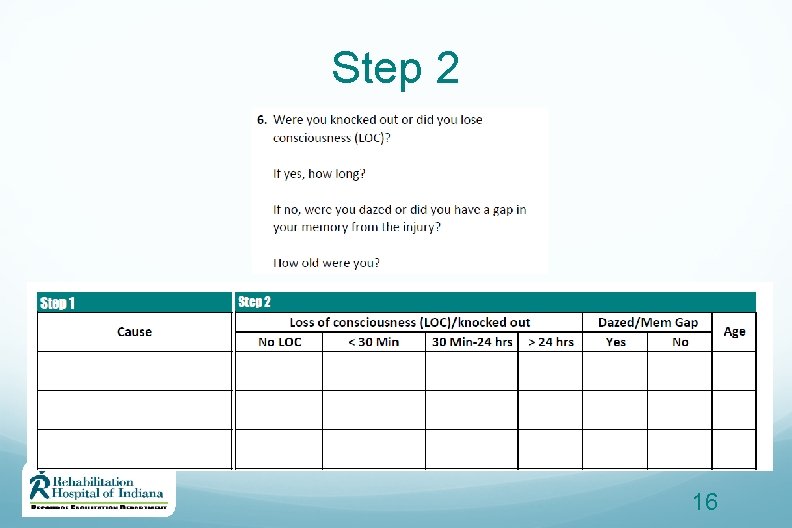
Step 2 16
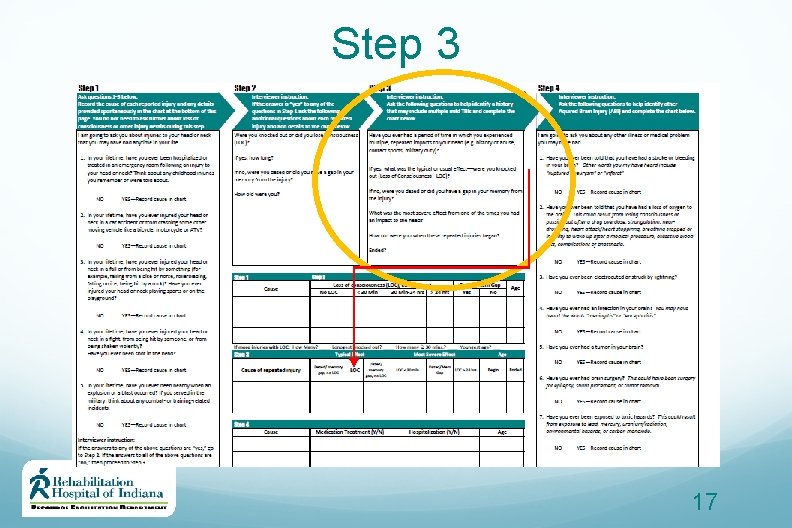
Step 3 17
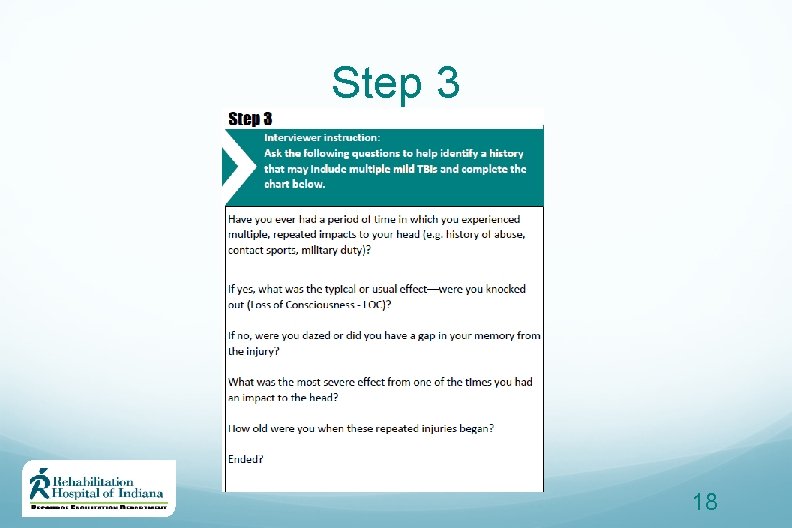
Step 3 18
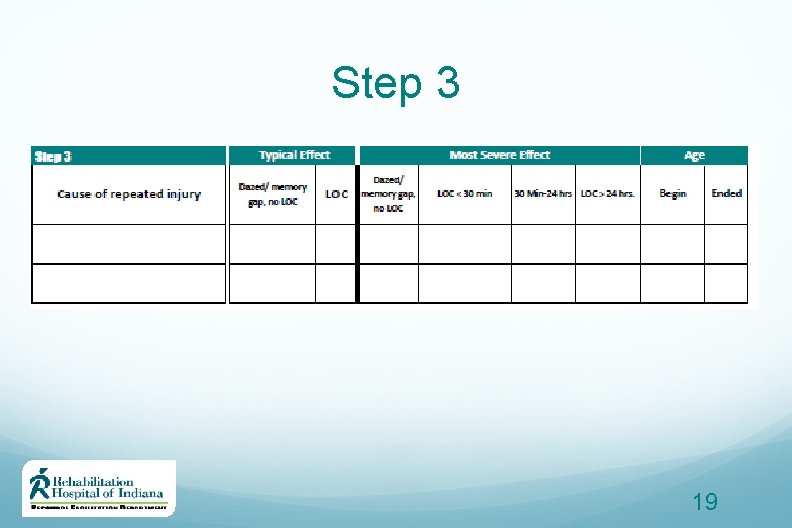
Step 3 19

New ABI items: Step 4 20
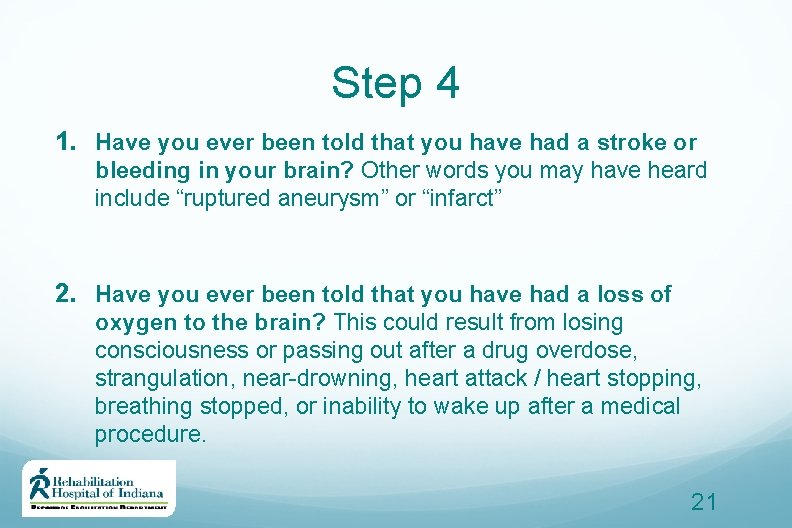
Step 4 1. Have you ever been told that you have had a stroke or bleeding in your brain? Other words you may have heard include “ruptured aneurysm” or “infarct” 2. Have you ever been told that you have had a loss of oxygen to the brain? This could result from losing consciousness or passing out after a drug overdose, strangulation, near-drowning, heart attack / heart stopping, breathing stopped, or inability to wake up after a medical procedure. 21
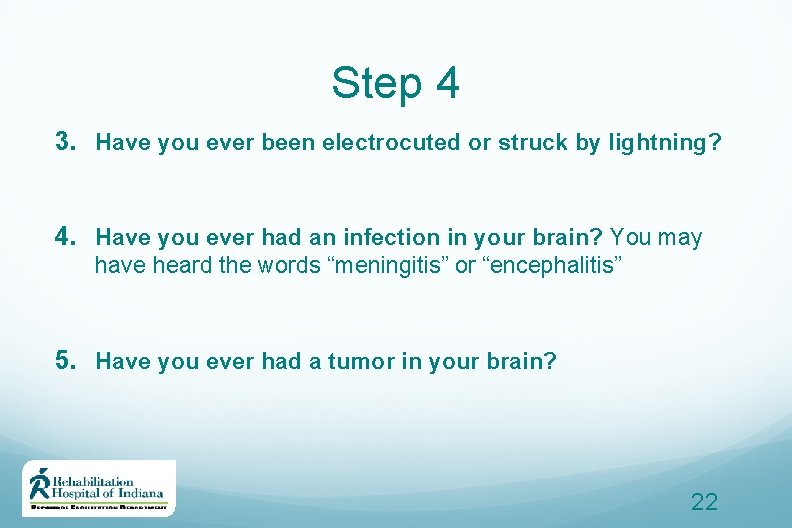
Step 4 3. Have you ever been electrocuted or struck by lightning? 4. Have you ever had an infection in your brain? You may have heard the words “meningitis” or “encephalitis” 5. Have you ever had a tumor in your brain? 22
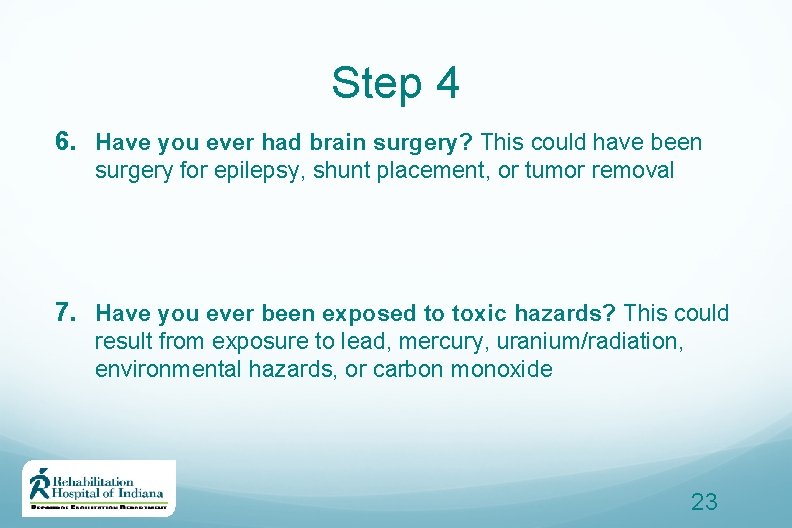
Step 4 6. Have you ever had brain surgery? This could have been surgery for epilepsy, shunt placement, or tumor removal 7. Have you ever been exposed to toxic hazards? This could result from exposure to lead, mercury, uranium/radiation, environmental hazards, or carbon monoxide 23
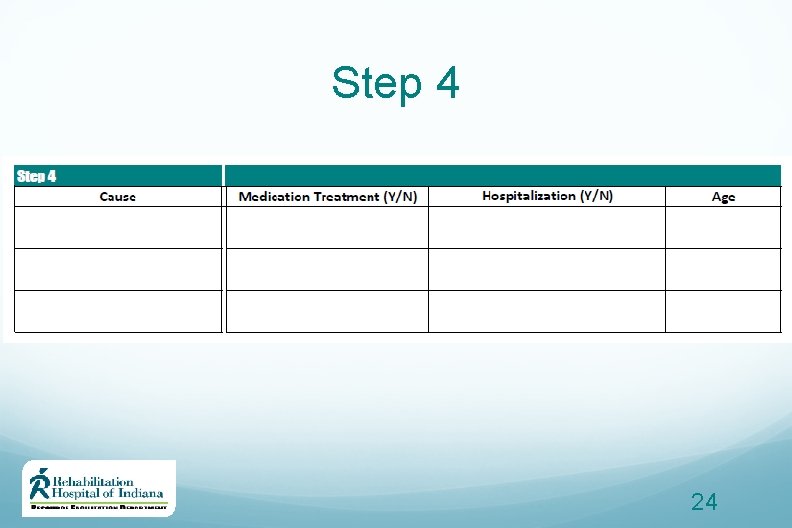
Step 4 24
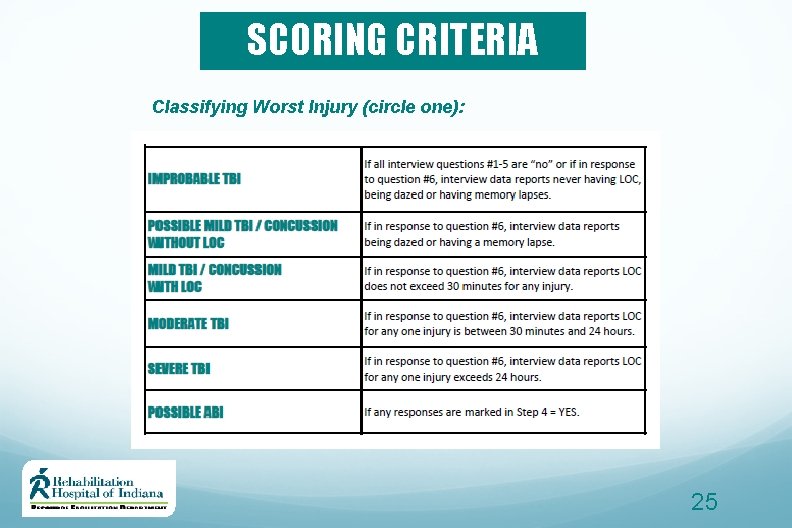
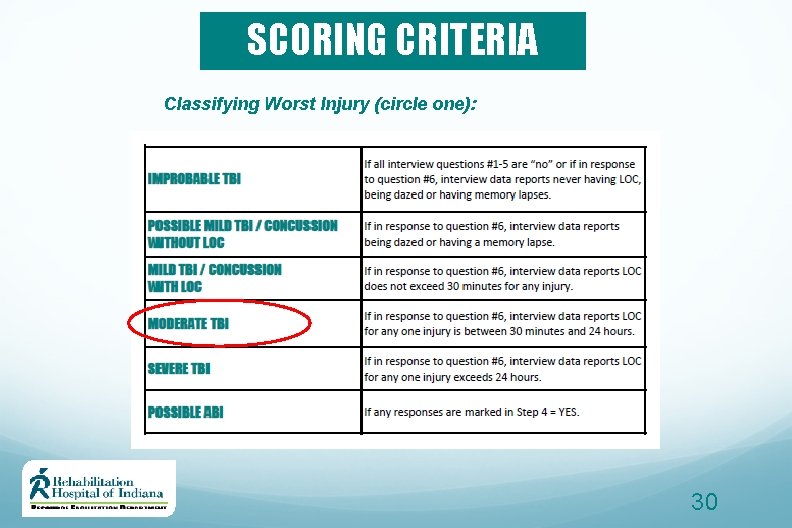
SCORING CRITERIA Classifying Worst Injury (circle one): 25
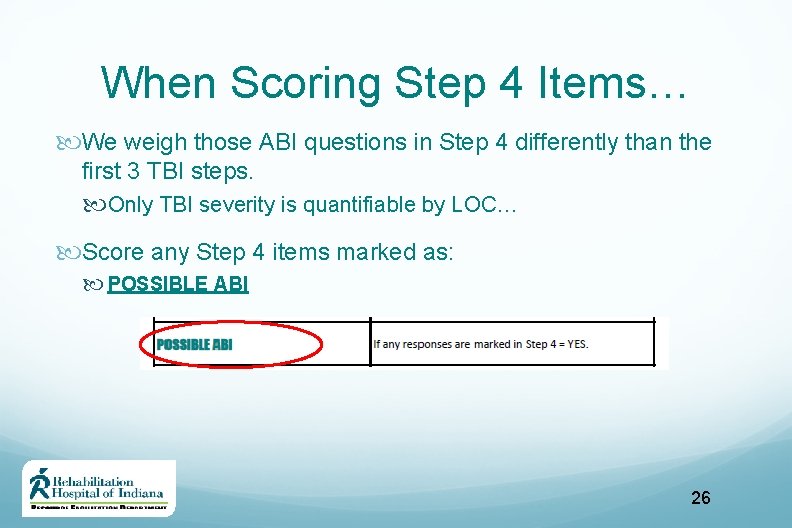
When Scoring Step 4 Items… We weigh those ABI questions in Step 4 differently than the first 3 TBI steps. Only TBI severity is quantifiable by LOC… Score any Step 4 items marked as: POSSIBLE ABI 26
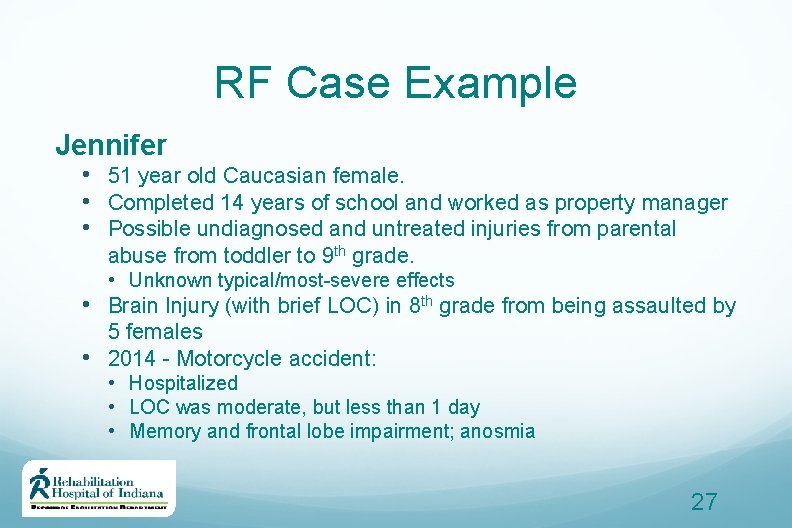
RF Case Example Jennifer • 51 year old Caucasian female. • Completed 14 years of school and worked as property manager • Possible undiagnosed and untreated injuries from parental abuse from toddler to 9 th grade. • Unknown typical/most-severe effects • Brain Injury (with brief LOC) in 8 th grade from being assaulted by 5 females • 2014 - Motorcycle accident: • Hospitalized • LOC was moderate, but less than 1 day • Memory and frontal lobe impairment; anosmia 27
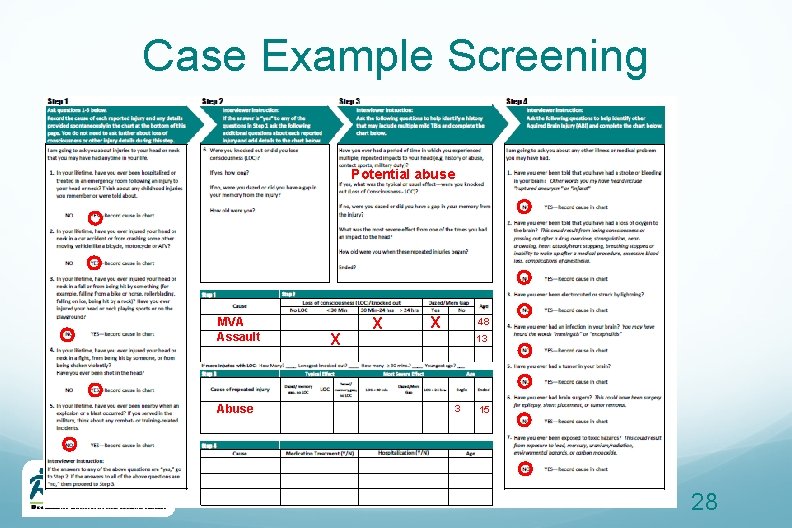
Case Example Screening Potential abuse MVA Assault Abuse X X X 48 13 3 15 28
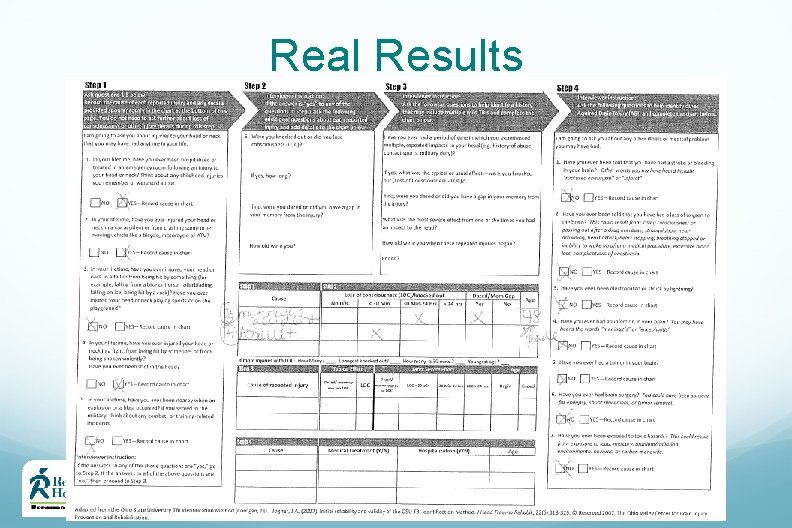
Real Results 29
SCORING CRITERIA Classifying Worst Injury (circle one): 30

Now you should be able: To define why screening is important To use the TBI screening measure Identify various types of ABI Detect presence and determine severity To optimize knowledge through other case examples
References Corrigan, J. D. , & Bogner, J. (2007). Initial reliability and validity of the Ohio State University TBI identification method. The Journal of head trauma rehabilitation, 22(6), 318 -329. http: //ohiovalley. org/ 32
Questions? Contact: Claire Brownson, MA, LMHCA Coordinator of Training & Education Claire. brownson@rhin. com (317) 329 -2262 THANK YOU! 33
- Slides: 33