
Screening Brief Intervention and Referral to Treatment SBIRT
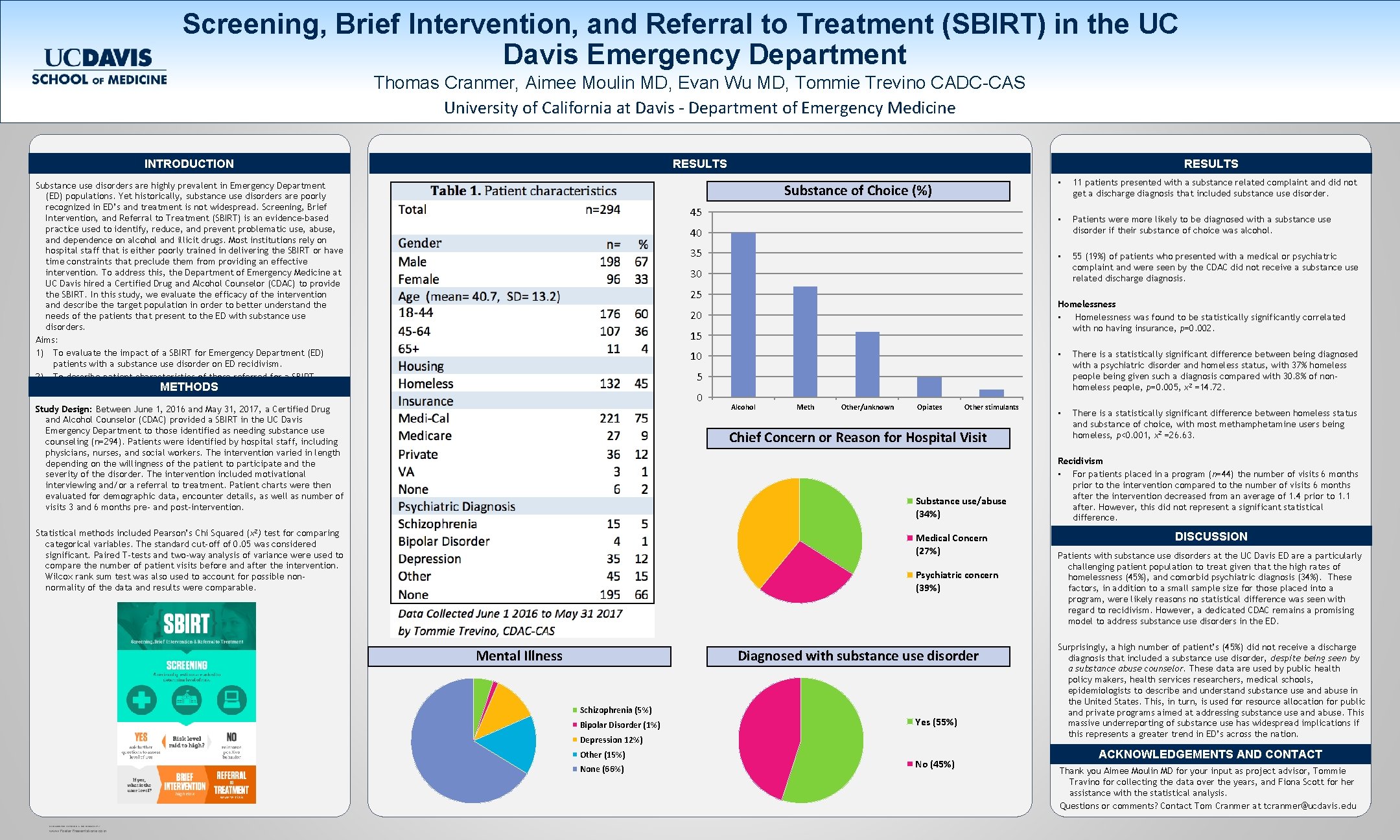
Screening, Brief Intervention, and Referral to Treatment (SBIRT) in the UC Davis Emergency Department Thomas Cranmer, Aimee Moulin MD, Evan Wu MD, Tommie Trevino CADC-CAS University of California at Davis - Department of Emergency Medicine INTRODUCTION RESULTS Substance use disorders are highly prevalent in Emergency Department (ED) populations. Yet historically, substance use disorders are poorly recognized in ED’s and treatment is not widespread. Screening, Brief Intervention, and Referral to Treatment (SBIRT) is an evidence-based practice used to identify, reduce, and prevent problematic use, abuse, and dependence on alcohol and illicit drugs. Most institutions rely on hospital staff that is either poorly trained in delivering the SBIRT or have time constraints that preclude them from providing an effective intervention. To address this, the Department of Emergency Medicine at UC Davis hired a Certified Drug and Alcohol Counselor (CDAC) to provide the SBIRT. In this study, we evaluate the efficacy of the intervention and describe the target population in order to better understand the needs of the patients that present to the ED with substance use disorders. Aims: 1) To evaluate the impact of a SBIRT for Emergency Department (ED) patients with a substance use disorder on ED recidivism. 2) To describe patient characteristics of those referred for a SBIRT. RESULTS Substance of Choice (%) 45 35 • Patients were more likely to be diagnosed with a substance use disorder if their substance of choice was alcohol. • 55 (19%) of patients who presented with a medical or psychiatric complaint and were seen by the CDAC did not receive a substance use related discharge diagnosis. 30 25 Homelessness • Homelessness was found to be statistically significantly correlated with no having insurance, p=0. 002. 20 15 10 • There is a statistically significant difference between being diagnosed with a psychiatric disorder and homeless status, with 37% homeless people being given such a diagnosis compared with 30. 8% of nonhomeless people, p=0. 005, χ2 =14. 72. • There is a statistically significant difference between homeless status and substance of choice, with most methamphetamine users being homeless, p<0. 001, χ2 =26. 63. 5 0 Study Design: Between June 1, 2016 and May 31, 2017, a Certified Drug and Alcohol Counselor (CDAC) provided a SBIRT in the UC Davis Emergency Department to those identified as needing substance use counseling (n=294). Patients were identified by hospital staff, including physicians, nurses, and social workers. The intervention varied in length depending on the willingness of the patient to participate and the severity of the disorder. The intervention included motivational interviewing and/or a referral to treatment. Patient charts were then evaluated for demographic data, encounter details, as well as number of visits 3 and 6 months pre- and post-intervention. Alcohol Meth Other/unknown Opiates Other stimulants Chief Concern or Reason for Hospital Visit Substance use/abuse (34%) Statistical methods included Pearson’s Chi Squared (χ2) test for comparing categorical variables. The standard cut-off of 0. 05 was considered significant. Paired T-tests and two-way analysis of variance were used to compare the number of patient visits before and after the intervention. Wilcox rank sum test was also used to account for possible nonnormality of the data and results were comparable. Medical Concern (27%) Psychiatric concern (39%) Diagnosed with substance use disorder Mental Illness Schizophrenia (5%) Bipolar Disorder (1%) Yes (55%) Depression 12%) Other (15%) None (66%) www. Poster. Presentations. com 11 patients presented with a substance related complaint and did not get a discharge diagnosis that included substance use disorder. 40 METHODS RESEARCH POSTER PRESENTATION DESIGN © 2012 • No (45%) Recidivism • For patients placed in a program (n=44) the number of visits 6 months prior to the intervention compared to the number of visits 6 months after the intervention decreased from an average of 1. 4 prior to 1. 1 after. However, this did not represent a significant statistical difference. DISCUSSION Patients with substance use disorders at the UC Davis ED are a particularly challenging patient population to treat given that the high rates of homelessness (45%), and comorbid psychiatric diagnosis (34%). These factors, in addition to a small sample size for those placed into a program, were likely reasons no statistical difference was seen with regard to recidivism. However, a dedicated CDAC remains a promising model to address substance use disorders in the ED. Surprisingly, a high number of patient’s (45%) did not receive a discharge diagnosis that included a substance use disorder, despite being seen by a substance abuse counselor. These data are used by public health policy makers, health services researchers, medical schools, epidemiologists to describe and understand substance use and abuse in the United States. This, in turn, is used for resource allocation for public and private programs aimed at addressing substance use and abuse. This massive underreporting of substance use has widespread implications if this represents a greater trend in ED’s across the nation. ACKNOWLEDGEMENTS AND CONTACT Thank you Aimee Moulin MD for your input as project advisor, Tommie Travino for collecting the data over the years, and Fiona Scott for her assistance with the statistical analysis. Questions or comments? Contact Tom Cranmer at tcranmer@ucdavis. edu
- Slides: 1