
Screening Brief Intervention and Referral to Treatment SBIRT
Screening, Brief Intervention, and Referral to Treatment (SBIRT) Core Curriculum: Getting SBIRT into Practice The University of Iowa College of Nursing With funding from the Substance Abuse and Mental Health Services Administration (SAMHSA)
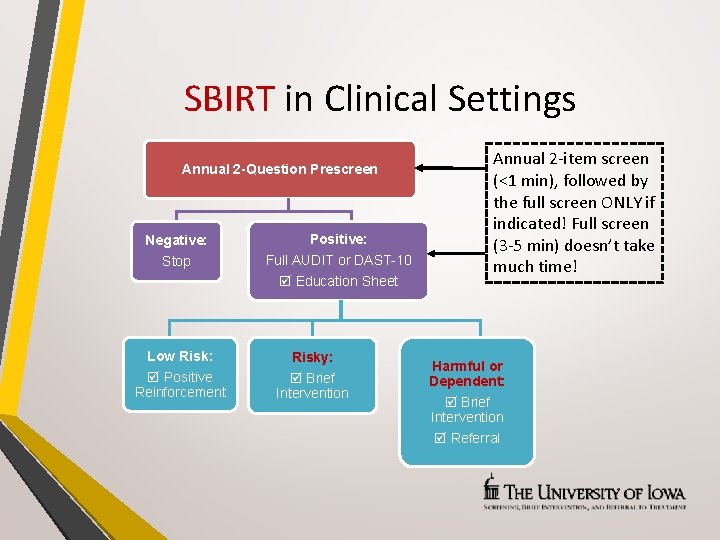
SBIRT in Clinical Settings Annual 2 -Question Prescreen Negative: Positive: Stop Full AUDIT or DAST-10 Education Sheet Low Risk: Positive Reinforcement Risky: Brief Intervention Annual 2 -item screen (<1 min), followed by the full screen ONLY if indicated! Full screen (3 -5 min) doesn’t take much time! Harmful or Dependent: Brief Intervention Referral
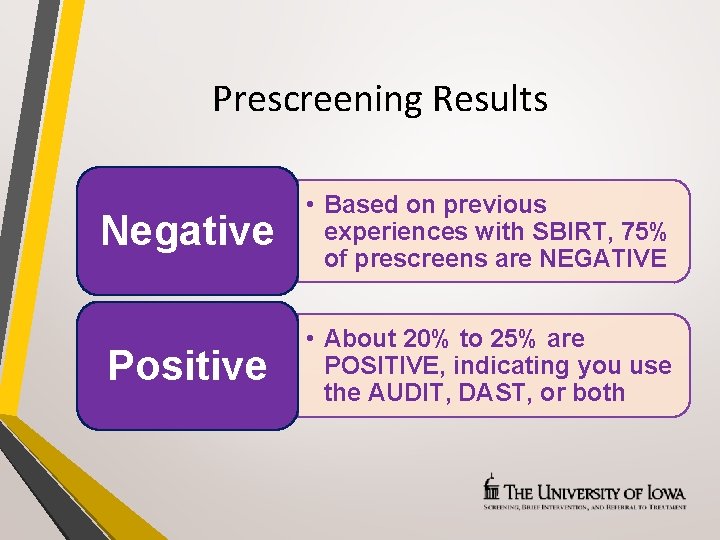
Prescreening Results Negative • Based on previous experiences with SBIRT, 75% of prescreens are NEGATIVE Positive • About 20% to 25% are POSITIVE, indicating you use the AUDIT, DAST, or both
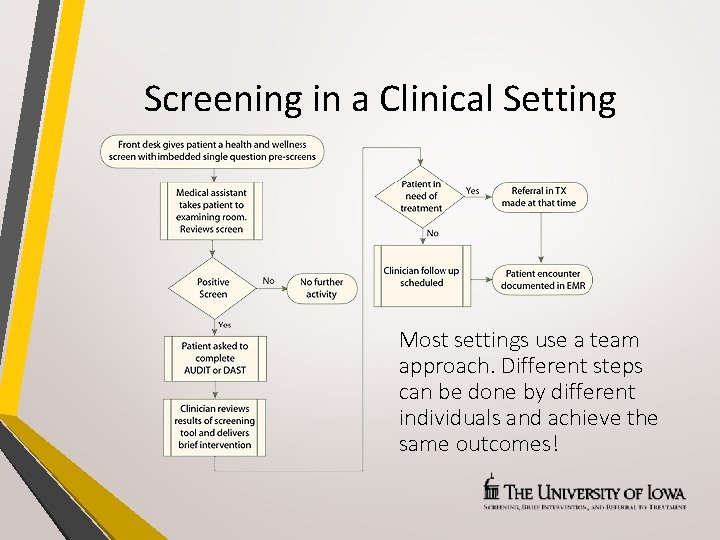
Screening in a Clinical Setting Most settings use a team approach. Different steps can be done by different individuals and achieve the same outcomes!
Using SBIRT in Practice Like other evidence-based practices… • Great to know about evidence/success • Hard to implement in daily practices!!! ü ü Too busy Too much paperwork already Not enough staff to help Not comfortable with substance use discussions
Using SBIRT in Practice • Additional concerns: ü Too much to learn ü No time to learn new skills (Motivational Interviewing, Brief Intervention) ü Availability of and access to SBIRT training ü Workflow issues ü Sustainability
Models for Adoption of Evidence Lots of models related to changing practice • The Iowa Model https: //uihc. org/iowa-model-revised-evidence-based-practice-promoteexcellence-health-care • Strengths-Weaknesses-Opportunities-Threats (SWOT) Analysis http: //www. health. state. mn. us/divs/opi/qi/toolbox/swot. html • Rapid Cycle Quality Improvement (RCQI) http: //www. health. state. mn. us/divs/opi/qi/toolbox/pdsa. html https: //www. healthit. gov/providers-professionals/faqs/how-do-i-use-rapidcycle-improvement-strategy
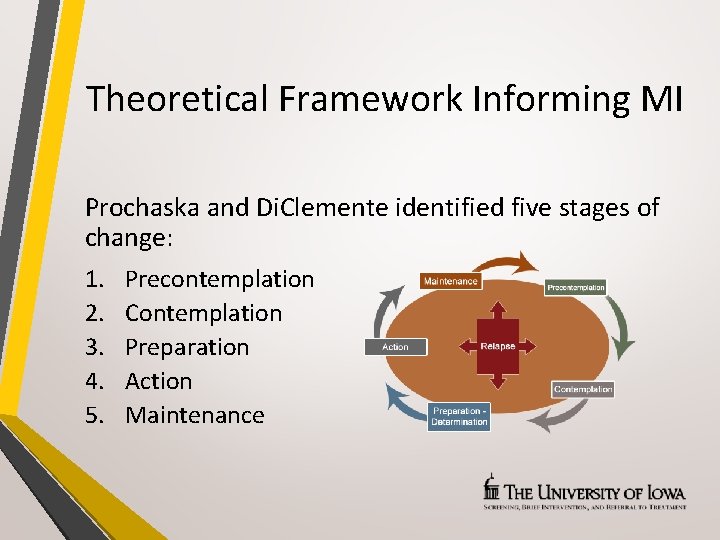
Theoretical Framework Informing MI Prochaska and Di. Clemente identified five stages of change: 1. 2. 3. 4. 5. Precontemplation Contemplation Preparation Action Maintenance

SBIRT Model Matrix Systems-Level Implementation of Screening, Brief Intervention, and Referral to Treatment Technical Assistance Publication Series, TAP 33 SAMHSA www. samhsa. gov (free publications)
SBIRT Model Matrix Three main topics that intersect → • Service delivery: What SBIRT services will be delivered? What risks will be assessed? • Implementation model: How will services be provided? Who will provide what services? • Settings: What are the unique characteristics (and challenges!) of the program setting or service area? Who is the target population?
Planning Process & Collaborations Assess organizational readiness • Motivation for change → Perceptions of current functioning, needs for improvement? • Institutional resources → Adequacy of office space, staffing? • Attributes of staff members → Confidence in counseling abilities, adaptability? • Organizational climate → Clarity of mission? Medical Organizational Readiness for Change (MORC), Bohman et al. , 2008
Planning Process & Collaborations Involve as many staff members as possible • Who are the primary stakeholders? • Who has useful skills and experience? Assess what is needed • Is it possible to use existing staff to provide SBIRT? • What training will they need? • Will additional staff be needed? • What are the space considerations?
Planning Process & Collaborations Set clear goals • What is realistic given resources available? • What is a logical starting point? Assign clear roles and responsibilities • Who is the logical coordinator? • Who can help with specific tasks (billing, EHR)? Develop collaborations and partnerships • Other departments in your health system? • Agencies or services outside your setting?
Identify the Setting Questions to consider: • Who is the target audience? • Does the target audience have access to this setting? • What are the unique characteristics and challenges? • What resources are available? • What are the options/opportunities for screening? • What are the options for privacy?
Implementation Models In-House Generalist → a staff member who is trained to perform SBIRT in addition to usual duties (not a substance use professional) • Performs screening, brief intervention (BI); makes referrals to treatment • Pros: Recommendations can be tied to other health or medical problems; increases comfort for the person • Cons: Competing demands; discomfort with having substance use conversations
Implementation Models Lessons learned: Overcoming barriers to In-House Generalist • Implement SBIRT in ways to reduce staff burden • Develop strong SBIRT “Champions” • Provide time for “buy in” activities • Provide adequate training and support • Collect and share information about outcomes to help staff see how they are helping people
Implementation Models In-House Specialist → a person already trained in SBIRT is hired specifically for this role • Performs all SBIRT-related activities • Pros: Frees regular staff from having to conduct SBIRTrelated activities; provides consistency in service • Cons: Non-medical specialists may find health setting challenging; turf wars; supervision issues; disagreements on roles
Implementation Models Contracted Specialist → an outside provider conducts SBIRT services • Performs all SBIRT-related services • Pros: Frees regular staff from having to conduct SBIRT; provides consistent quality • Cons: Time needed to learn about organizational culture, setting, staff; insurance reimbursement may be a problem
No One Best Way!!! Blended models are commonly used • In-house generalist does prescreening and screening; a contracted specialist does the brief intervention and referral • Options and choices depend on: ü Volume of patients seen ü Accessible community resources • No matter which model, many different professionals and paraprofessionals use SBIRT!
Service Components Screening → WHO will be screened? • Will screening be universal? • Will prescreening be used? • Will a subset of the population be screened? How will those individuals be identified? • What is realistic given resources available? • Will screening be done at every visit? At regular intervals?
Service Components Screening → WHAT are you screening for? • Risky/harmful alcohol use? • Illegal drug use? • Prescription medication misuse/abuse? • Tobacco use?
Service Components Screening → HOW will patients be screened? • What scales or instruments will be used? * • What are the key characteristics of the target population? Age? Literacy level? Cognitive functioning? • What percent cannot self-administer? • What language(s) do patients understand? • Will staff administer? Or patients self-complete? • Who will score? Interpret results? *See TAP 33, p. 28, for examples
Service Components Brief Intervention → How will the BI be provided? • Where and when will BI occur? Onsite? By referral? • Who will provide onsite BI? • What educational materials will be used? • What community resources may be tapped? • What training do staff need?
Service Components Referral to Treatment → What processes best fit resources and needs of patients and the setting? • Who will make the referrals to treatment? • What resources are available? Know in advance!!! • What processes best support a “warm handoff”? • What follow-up methods are needed?
Service Components Referral to Treatment → Lessons learned • Make the referral from your clinic (warm handoff) • Talk through transportation issues • Consider use of supportive services ü Peer/mentor health educator support ü Case management • Negotiate dedicated treatment slots for SBIRT patients
Service Components Evaluation plan and records → What is the best way to track SBIRT practices for individuals and the system? • What are the best ways to easily identify patient level information? ü ü ü Initial screen score(s)? Interventions used? Progress notes? Referrals made? Follow-up activities/outcomes?
Service Components Evaluation plan and records → How do staff think SBIRT is working for them? Patients? • What is the plan for staff evaluations? ü Frequency? Type of feedback? Who is involved? • What improvements can be made? • What is working well/should be continued? • What resources are needed to maintain progress?
Reimbursement Billing codes → Support for adoption of SBIRT • Commercial Insurance ü CPT 99408: Alcohol and/or substance (other than tobacco) abuse structured screening and brief intervention, 15 -30 minutes ü CPT 99409: Alcohol and/or substance (other than tobacco) abuse structured screening and brief intervention, >30 minutes
Reimbursement Billing codes → Support for adoption of SBIRT • Medicare ü G 0396: Alcohol and/or substance (other than tobacco) abuse structured screening and brief intervention, 15 -30 minutes ü G 0397: Alcohol and/or substance (other than tobacco) abuse structured screening and brief intervention, >30 minutes ü G 0442: Annual alcohol misuse screening, 15 minutes ü G 0443: Brief face-to-face behavioral counseling for alcohol misuse, 15 minutes
Reimbursement Billing codes → Support for adoption of SBIRT • Medicaid ü H 0049: Alcohol and/or drug screening ü H 0050: Alcohol and/or drug services, brief intervention, per 15 minutes (not currently “unlocked” in Iowa) • Affordable Care Act (2010) includes substance use disorders as “one of the ten elements of essential health benefits”
Cost Effectiveness Why SBIRT? Cost-benefit analyses suggest… • Screening and BI for risky alcohol use → $43 K in future healthcare use for every $10 K invested ü Fewer hospital days ü Fewer ED visits • Meta-analysis of 15 studies of unhealthy alcohol use → Cost-saving benefits met or exceeded standard preventive healthcare services – like immunizations and colorectal screening
Key Elements of Sustainability • Vision: What is the scope, scale of operation, and timeline? How does it fit in the larger community? • Results Orientation: What results will be achieved for the target population? What indicators and performance measures will be used to track progress? • Financing: What are expected fiscal needs? How can existing resources be best used?
Key Elements of Sustainability • Adapting to changing conditions: How will you/your organization stay informed about policy/funding issues? • Community support: How will you build partnerships with clients? Community members? Agencies? Funding sources? • Champions: Who are key decision-makers? Opinionleaders? How will you build a broad base of support?
Key Elements of Sustainability • Identify internal supports: Who is most likely/best able to support SBIRT as part of the organizational mission? • Make a sustainability plan ü What are your short- and long-term goals? ü What challenges or barriers need to be addressed? ü What strategies can be used to obtain needed resources? ü What are the best methods/approaches to communicate with key partners and stakeholders?
Summary Many factors to consider when implementing SBIRT in practice settings! • Setting and target population • Implementation models • Service components • Reimbursement • Sustainability Collaborative, stakeholder-informed, process-oriented focus helps!
Additional Resources • TAP 31 – Implementing Change in Substance Abuse Treatment Programs http: //store. samhsa. gov/shin/content//SMA 09 -4377. pdf • TAP 33 – Systems-Level Implementation of Screening, Brief Intervention, and Referral to Treatment http: //store. samhsa. gov/shin/content//SMA 13 -4741/TAP 33. pdf • SBIRT: Opportunities for Implementation and Points for Consideration http: //www. integration. samhsa. gov/SBIRT_Issue_Brief. pdf
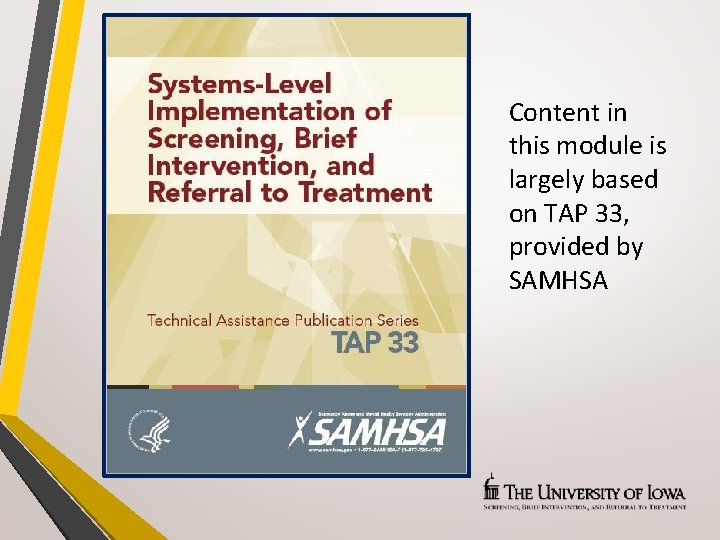
Content in this module is largely based on TAP 33, provided by SAMHSA
Acknowledgements
- Slides: 38