
Scouting After a Herbicide Application and Confirming Herbicide

Scouting After a Herbicide Application and Confirming Herbicide Resistance Lesson 4 The copyright in these Weed Science Society of America (WSSA) training lessons is owned by the WSSA grants you a limited license to use these materials solely for training and educational purposes. Slides may be used individually, and their order of use may be changed; however, the content of each slide and the associated narrative may not be altered. If you have questions, please e-mail ‘info@wssa. net’. WSSA Herbicide Resistance Management Lesson 4 © 2011 WSSA All Rights Reserved 1

Objectives By the end of this lesson, you will: Understand the importance of scouting for herbicide-resistant weeds. Know the factors that can contribute to weeds being present after a herbicide application. Know how to identify herbicide resistance in the field. Above: Italian ryegrass is a weed that is known to be resistant to several herbicides. Image number 5387406 at www. invasive. org. Understand when to suspect and test for herbicide resistance in the field. Know procedures for confirming herbicide resistance. WSSA Herbicide Resistance Management Lesson 4 © 2011 WSSA All Rights Reserved 2
The Importance of Scouting Many factors can contribute to the presence of weeds in the field after a herbicide application and later in the growing season. Scouting is the only way to know which weeds are present, and their patterns in the field can help to understand why they are present. Scouting will be helpful in documenting changes in the weed population that occur over time in response to land management practices, including the evolution of herbicide-resistant weeds. Changes in crop and weed management practices based on scouting help to: ü Maximize crop yield and profitability by reducing weed competition ü Reduce weed seed production ü Maximize remedial management tactics within the same growing season WSSA Herbicide Resistance Management Lesson 4 © 2011 WSSA All Rights Reserved 3
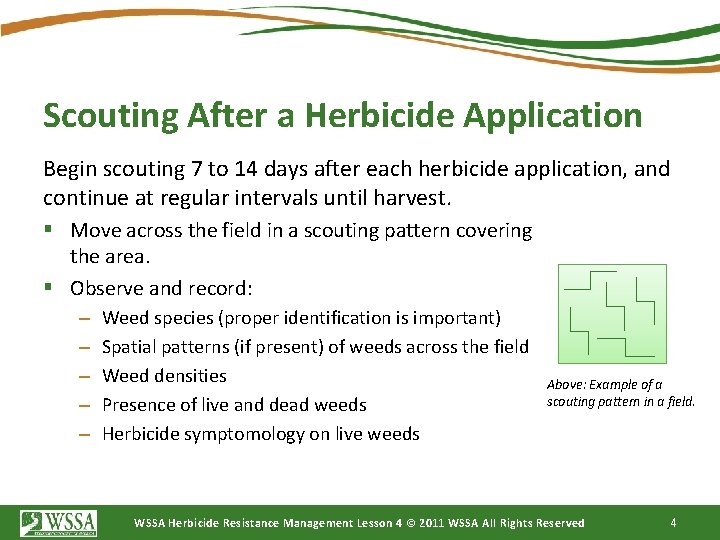
Scouting After a Herbicide Application Begin scouting 7 to 14 days after each herbicide application, and continue at regular intervals until harvest. § Move across the field in a scouting pattern covering the area. § Observe and record: – – – Weed species (proper identification is important) Spatial patterns (if present) of weeds across the field Weed densities Presence of live and dead weeds Herbicide symptomology on live weeds Above: Example of a scouting pattern in a field. WSSA Herbicide Resistance Management Lesson 4 © 2011 WSSA All Rights Reserved 4
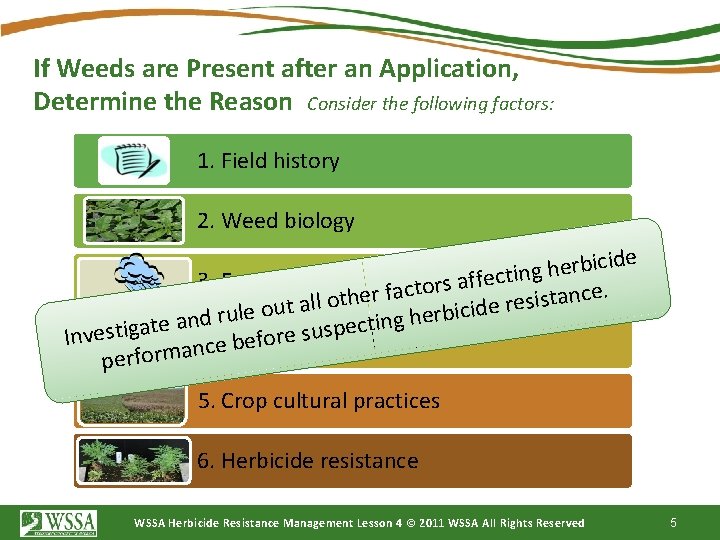
If Weeds are Present after an Application, Determine the Reason Consider the following factors: 1. Field history 2. Weed biology e d i c i b r e g h n i t c e f f 3. Environment a s tor c a e. f c r n e a h t t s i o s l l e r a ide out c i e l b r u e r h d g n tin e a c t e a p g i s t u s s e v e In for 4. Application problems e b e c n a perform 5. Crop cultural practices 6. Herbicide resistance WSSA Herbicide Resistance Management Lesson 4 © 2011 WSSA All Rights Reserved 5
If Weeds are Present After an Application, Determine the Reason Field History Past cultural, chemical, and mechanical weed management practices have all influenced the current weed community. These practices can also provide insight into the likelihood that weed populations may become herbicideresistant. Some important information to consider includes: • • Number of herbicide mechanisms of action used Number and kinds of crops in rotation Use of mechanical and cultural weed management practices Presence of weed species, including density and distribution § The probability for herbicide-resistant weed populations to evolve is increased as diversity in weed management practices is reduced. § Keeping records on weed populations, including density and distribution, will help you to note important changes that may be underway. WSSA Herbicide Resistance Management Lesson 4 © 2011 WSSA All Rights Reserved 6
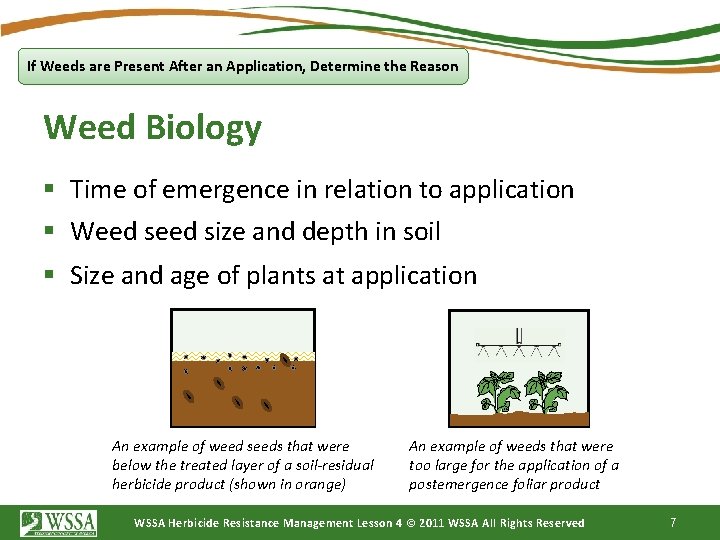
If Weeds are Present After an Application, Determine the Reason Weed Biology § Time of emergence in relation to application § Weed size and depth in soil § Size and age of plants at application An example of weed seeds that were below the treated layer of a soil-residual herbicide product (shown in orange) An example of weeds that were too large for the application of a postemergence foliar product WSSA Herbicide Resistance Management Lesson 4 © 2011 WSSA All Rights Reserved 7
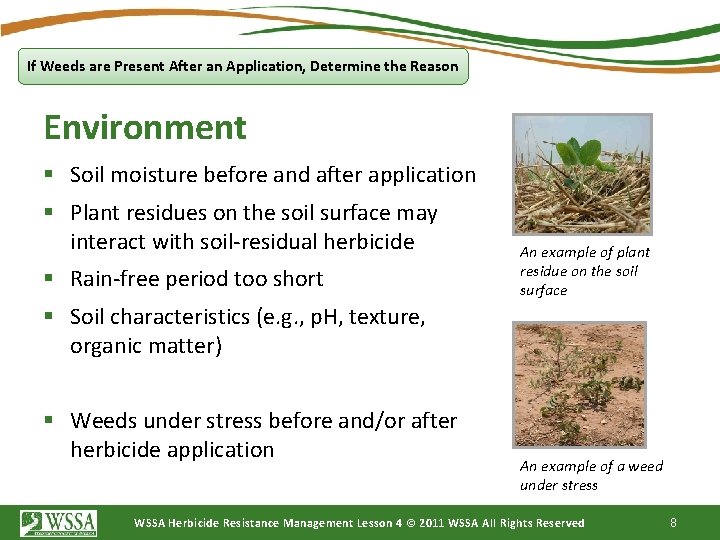
If Weeds are Present After an Application, Determine the Reason Environment § Soil moisture before and after application § Plant residues on the soil surface may interact with soil-residual herbicide § Rain-free period too short An example of plant residue on the soil surface § Soil characteristics (e. g. , p. H, texture, organic matter) § Weeds under stress before and/or after herbicide application An example of a weed under stress WSSA Herbicide Resistance Management Lesson 4 © 2011 WSSA All Rights Reserved 8
If Weeds are Present After an Application, Determine the Reason Application Problems during a herbicide application can reduce the performance of herbicides and therefore, increase the presence of weeds. Problems can be related to the equipment (E), choice of herbicide (H) and related products, herbicide rate (R), or herbicide incorporation and soil conditions (S). Examples • Sprayer skips (E) • Poor sprayer calibration and/or equipment failures (E) • Herbicide rate too low (R) • Dust/soil on plant leaves at application (R) • Poor spray coverage (R) • Selection of ineffective herbicide for weed spectrum (H) • Improper choice of adjuvant (H) • Soil incorporation too shallow, too deep, and/or not uniform (S) • Soil conditions at time of application (S) WSSA Herbicide Resistance Management Lesson 4 © 2011 WSSA All Rights Reserved 9
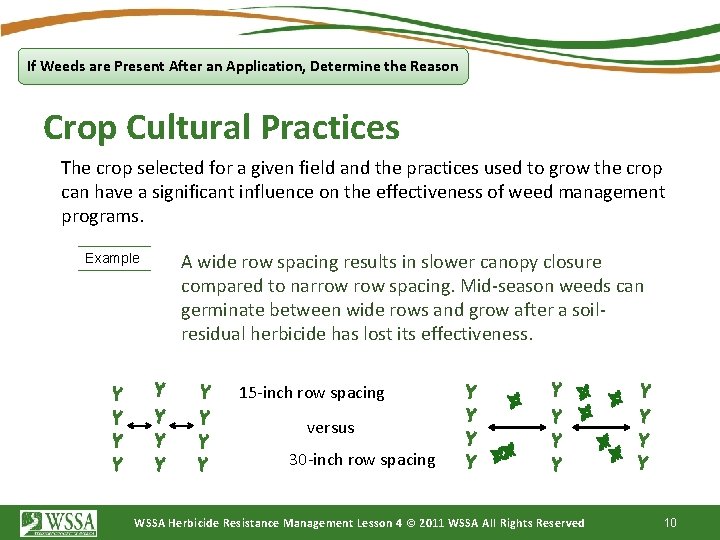
If Weeds are Present After an Application, Determine the Reason Crop Cultural Practices The crop selected for a given field and the practices used to grow the crop can have a significant influence on the effectiveness of weed management programs. Example A wide row spacing results in slower canopy closure compared to narrow spacing. Mid-season weeds can germinate between wide rows and grow after a soilresidual herbicide has lost its effectiveness. 15 -inch row spacing versus 30 -inch row spacing WSSA Herbicide Resistance Management Lesson 4 © 2011 WSSA All Rights Reserved 10
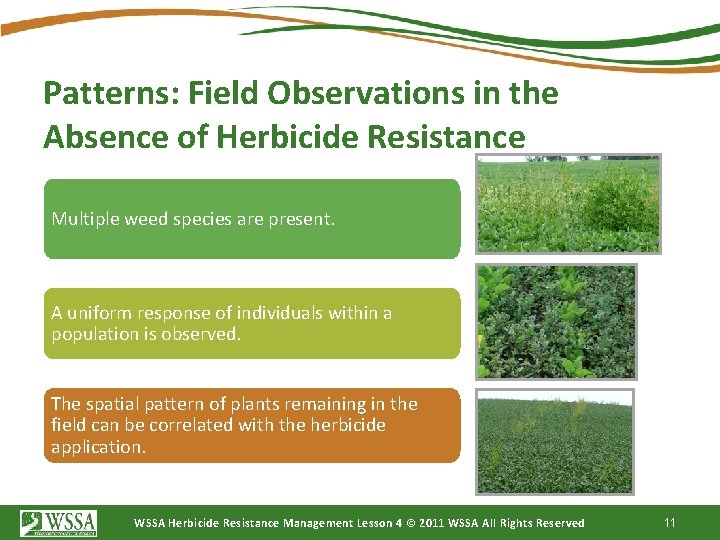
Patterns: Field Observations in the Absence of Herbicide Resistance Multiple weed species are present. A uniform response of individuals within a population is observed. The spatial pattern of plants remaining in the field can be correlated with the herbicide application. WSSA Herbicide Resistance Management Lesson 4 © 2011 WSSA All Rights Reserved 11
Weed Shifts With the repeated use of a herbicide, certain weed species may become dominant due to selection for those that are tolerant. These populations are not herbicide-resistant. Weed shifts due to herbicide use can be caused by: Using a herbicide to which the species is tolerant Using rates that are lower than recommended Using postemergence herbicides when weeds are too large WSSA Herbicide Resistance Management Lesson 4 © 2011 WSSA All Rights Reserved 12
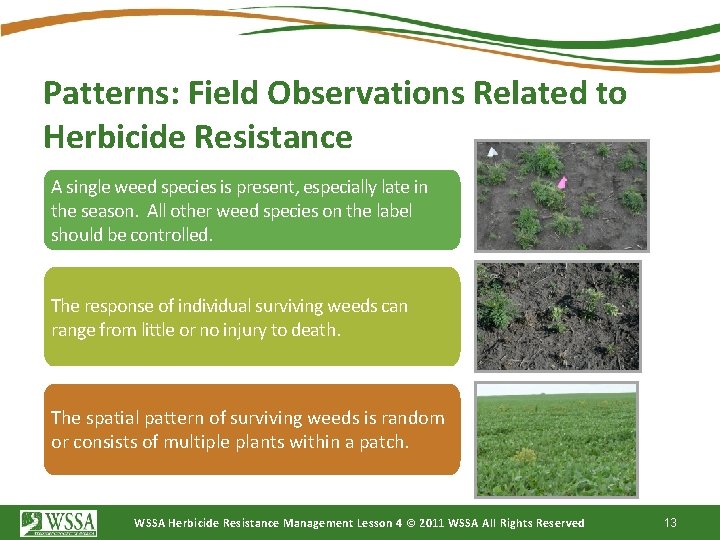
Patterns: Field Observations Related to Herbicide Resistance A single weed species is present, especially late in the season. All other weed species on the label should be controlled. The response of individual surviving weeds can range from little or no injury to death. The spatial pattern of surviving weeds is random or consists of multiple plants within a patch. WSSA Herbicide Resistance Management Lesson 4 © 2011 WSSA All Rights Reserved 13
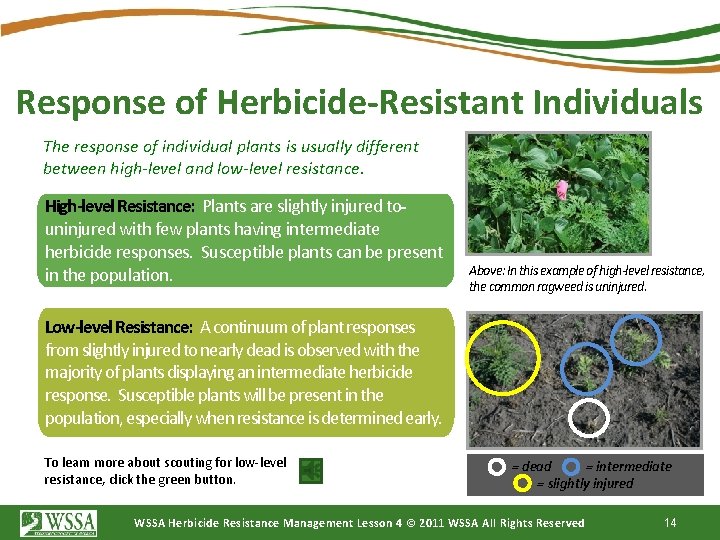
Response of Herbicide-Resistant Individuals The response of individual plants is usually different between high-level and low-level resistance. High-level Resistance: Plants are slightly injured to uninjured with few plants having intermediate herbicide responses. Susceptible plants can be present in the population. Above: In this example of high-level resistance, the common ragweed is uninjured. Low-level Resistance: A continuum of plant responses from slightly injured to nearly dead is observed with the majority of plants displaying an intermediate herbicide response. Susceptible plants will be present in the population, especially when resistance is determined early. To learn more about scouting for low-level resistance, click the green button. = dead = intermediate = slightly injured WSSA Herbicide Resistance Management Lesson 4 © 2011 WSSA All Rights Reserved 14
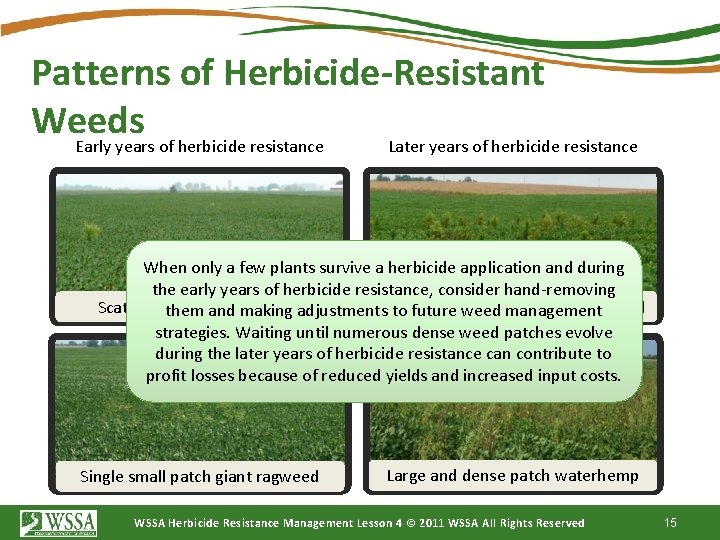
Patterns of Herbicide-Resistant Weeds Early years of herbicide resistance Later years of herbicide resistance When only a few plants survive a herbicide application and during the early years of herbicide resistance, consider hand-removing Small to moderate patch horseweed Scattered horseweed plants them and making adjustments to future weed management strategies. Waiting until numerous dense weed patches evolve during the later years of herbicide resistance can contribute to profit losses because of reduced yields and increased input costs. Single small patch giant ragweed Large and dense patch waterhemp WSSA Herbicide Resistance Management Lesson 4 © 2011 WSSA All Rights Reserved 15
Check List for Scouting ü Scout 7 to 14 days after each herbicide application and near harvest. ü Identify and record the weed species present. ü Determine the distribution pattern of plants in the field. • Correlate with application pattern or identify as random ü Determine if plants present survived a previously applied herbicide or emerged after the last herbicide application. ü Observe individual plant responses, especially if plants survived a herbicide application. ü Look at previous field history to understand what changes may be occurring. WSSA Herbicide Resistance Management Lesson 4 © 2011 WSSA All Rights Reserved 16
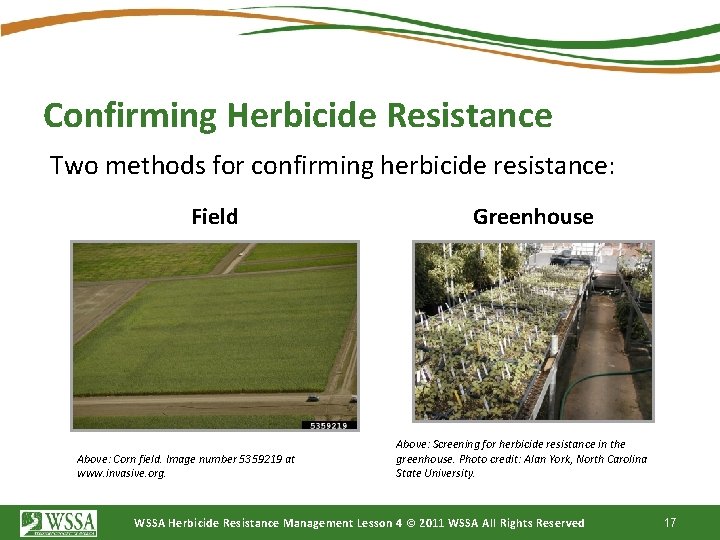
Confirming Herbicide Resistance Two methods for confirming herbicide resistance: Field Above: Corn field. Image number 5359219 at www. invasive. org. Greenhouse Above: Screening for herbicide resistance in the greenhouse. Photo credit: Alan York, North Carolina State University. WSSA Herbicide Resistance Management Lesson 4 © 2011 WSSA All Rights Reserved 17
Field Confirmation (Postemergence Foliar Herbicides) • Flag a minimum of 5, but preferably 20, of the healthiest weeds that survived the first herbicide application. Flag In Field Flag Outside • Find an area outside of the field that was not previously sprayed and contains the same species. Flag the same number of weeds. • Spray the weeds in both areas with the same herbicide in two strips – one labeled “rate” and another labeled “twice the labeled rate” 1. Spray Evaluate 1 • Evaluate all plants 10 to 14 days after herbicide application. Crops sprayed with greater than labeled herbicide rates must not be harvested for grain or animal use. WSSA Herbicide Resistance Management Lesson 4 © 2011 WSSA All Rights Reserved 18
Greenhouse Confirmation The best method for confirming herbicide resistance in a weed species with no history of resistance, in a weed species suspecting of having resistance to multiple herbicides, and when laboratory tests are not available. Procedure: § Collect seeds from mature plants suspected of being herbicide-resistant and generate plants from these seeds in the greenhouse. Plants are sprayed with the herbicide of interest and the response of suspected population is compared to the responses of known herbicidesusceptible and -resistant populations. § Contact your local extension specialist for instructions on seed collection procedures. § Allow only those plants necessary for collection to flower and set seed and destroy all other surviving plants. WSSA Herbicide Resistance Management Lesson 4 © 2011 WSSA All Rights Reserved 19
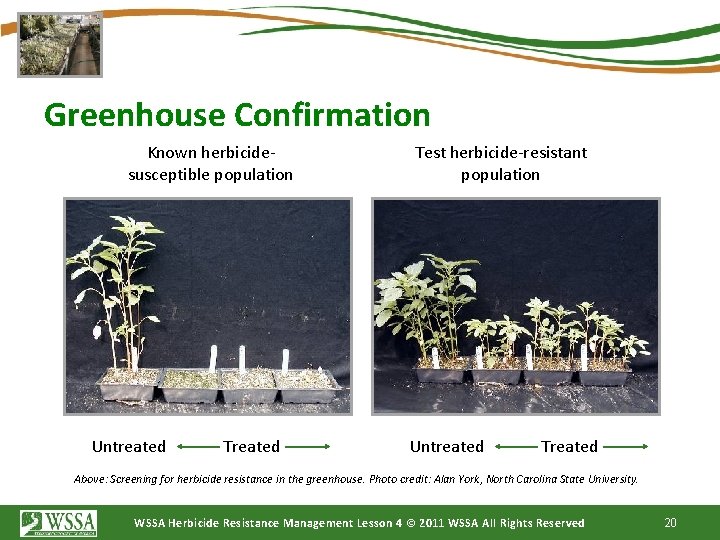
Greenhouse Confirmation Known herbicidesusceptible population Untreated Test herbicide-resistant population Untreated Treated Above: Screening for herbicide resistance in the greenhouse. Photo credit: Alan York, North Carolina State University. WSSA Herbicide Resistance Management Lesson 4 © 2011 WSSA All Rights Reserved 20
Conclusions Scouting fields to determine the reasons for weed survival after a herbicide application is important. Field history, weed biology, environment, application parameters, crop cultural practices and herbicide resistance are factors that can contribute to weeds surviving the application of a herbicide. Symptomology may differ between the observations of low-level and high-level herbicide resistance. Confirming herbicide resistance early, when just a few weeds are present, and removing them by hand can decrease the spread of herbicide-resistant weeds, thereby reducing the costs required to manage them. WSSA Herbicide Resistance Management Lesson 4 © 2011 WSSA All Rights Reserved 21
Credits: This lesson was developed by a WSSA sub-committee and reviewed by the WSSA Board of Directors and other WSSA members before being released. The sub-committee was composed of the following individuals. § § § § Wes Everman, Ph. D Les Glasgow, Ph. D Lynn Ingegneri, Ph. D Jill Schroeder, Ph. D David Shaw, Ph. D John Soteres, Ph. D Jeff Stachler, Ph. D François Tardif, Ph. D (North Carolina State University) (Syngenta) (Consultant) (New Mexico State University) (Mississippi State University) (Monsanto Company) (Sub-committee chairman) (North Dakota State University and University of Minnesota) (University of Guelph) Financial support for this was provided by Global HRAC, North America HRAC, and WSSA. Our thanks are extended to the National Corn Growers Association for allowing us to use training materials posted on their website as the starting point for these training lessons. WSSA Herbicide Resistance Management Lesson 4 © 2011 WSSA All Rights Reserved 22
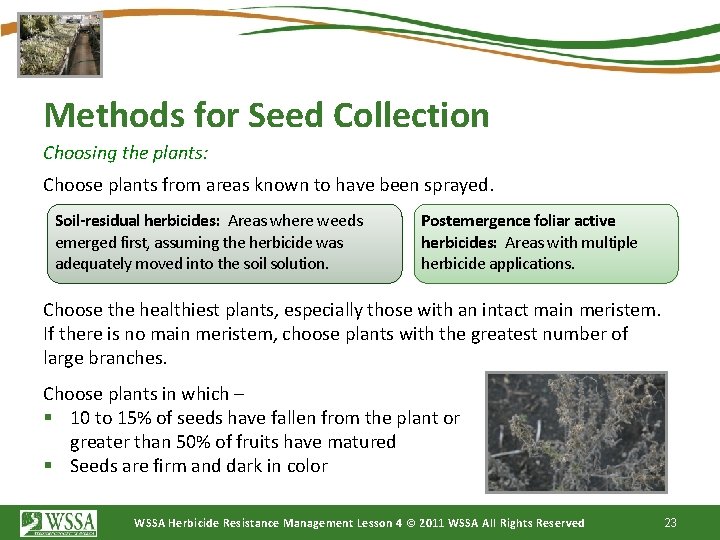
Methods for Seed Collection Choosing the plants: Choose plants from areas known to have been sprayed. Soil-residual herbicides: Areas where weeds emerged first, assuming the herbicide was adequately moved into the soil solution. Postemergence foliar active herbicides: Areas with multiple herbicide applications. Choose the healthiest plants, especially those with an intact main meristem. If there is no main meristem, choose plants with the greatest number of large branches. Choose plants in which – § 10 to 15% of seeds have fallen from the plant or greater than 50% of fruits have matured § Seeds are firm and dark in color WSSA Herbicide Resistance Management Lesson 4 © 2011 WSSA All Rights Reserved 23
Methods for Seed Collection Collecting the plants: Example § Cut the plants below the lowest fruiting Mature seed structures (90% of plant having seeds) and Male carefully place them in a large paper bag. flowers Staple shut in the field to contain all seeds. § Mark the bag to clearly identify sample Female flowers of common location, weed species, herbicide(s) and rates ragweed in leafy bracts applied, and collection date. § Harvest a minimum of 5 to 10 plants with larger quantities preferred. Place a single plant in a single bag. § Upon return from the field, open bags to allow plants to dry before shipment. Re-staple the bags prior to shipment. § For a dioecious species, such as Palmer amaranth or waterhemp, collect only the female plants (plants with seeds). WSSA Herbicide Resistance Management Lesson 4 © 2011 WSSA All Rights Reserved 24
- Slides: 24