
SCOTTISH ENGLISH ARABIA MARTNEZ SEGU INDEX Background Grammar
SCOTTISH ENGLISH ARABIA MARTÍNEZ SEGUÍ
INDEX Background Grammar Vocabulary Phonetics Test
SCOTLAND Scotland is part of United Kingdom The money used is called the sterling pound The population of Scotland is 4. 996. 000
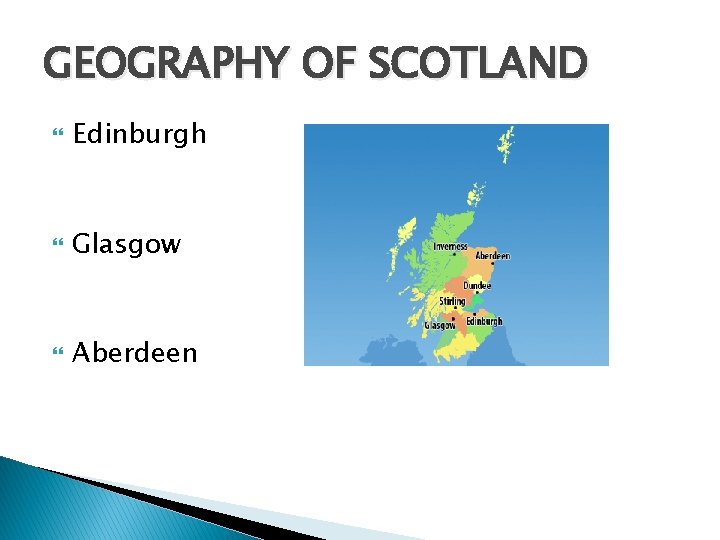
GEOGRAPHY OF SCOTLAND Edinburgh Glasgow Aberdeen
LANGUAGE Scottish English: varieties of English spoken in Scotland ◦ Gaelic is an ancient language of Scotland ◦ Most of the Gaelic speaking-people live in the north -west
LANGUAGE HISTORY Ø Ø Ø Union of the Crowns (1603) Union of the Parliaments (1707) Steady decline of Scots begins in 16 th century, by the end of the 17 th century English has gained considerable influence in Scotland English learned formally in Highlands and northern and western
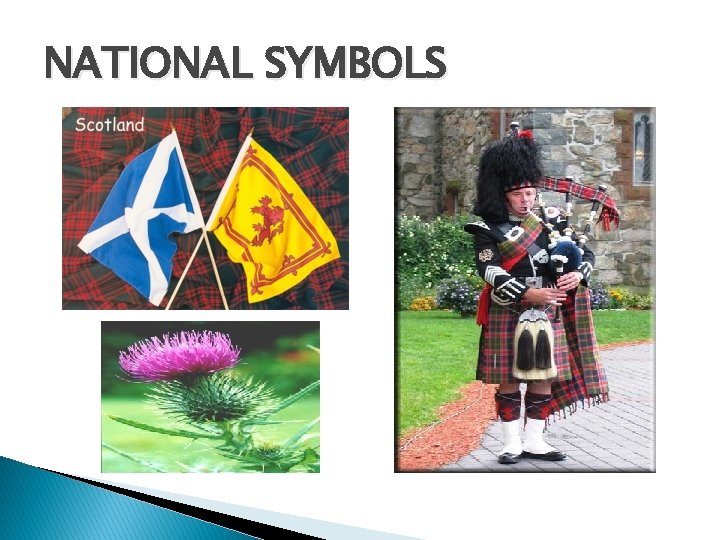
NATIONAL SYMBOLS
GRAMMATICAL CHARACTERISTICS
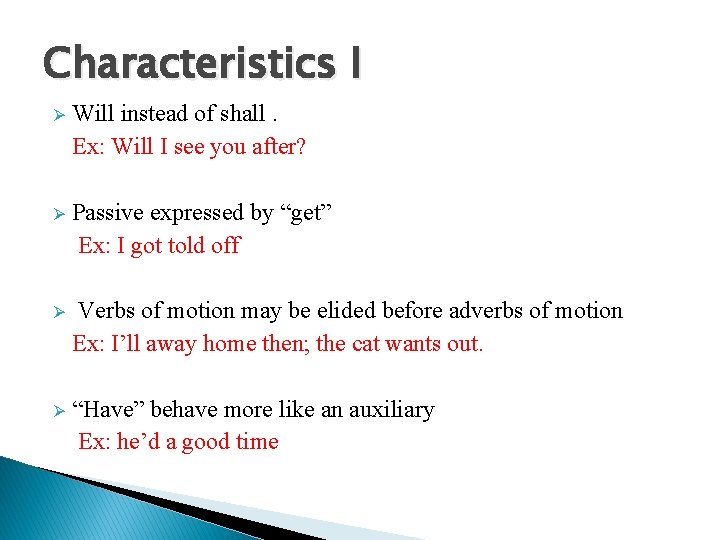
Characteristics I Ø Will instead of shall. Ex: Will I see you after? Ø Passive expressed by “get” Ex: I got told off Ø Verbs of motion may be elided before adverbs of motion Ex: I’ll away home then; the cat wants out. Ø “Have” behave more like an auxiliary Ex: he’d a good time
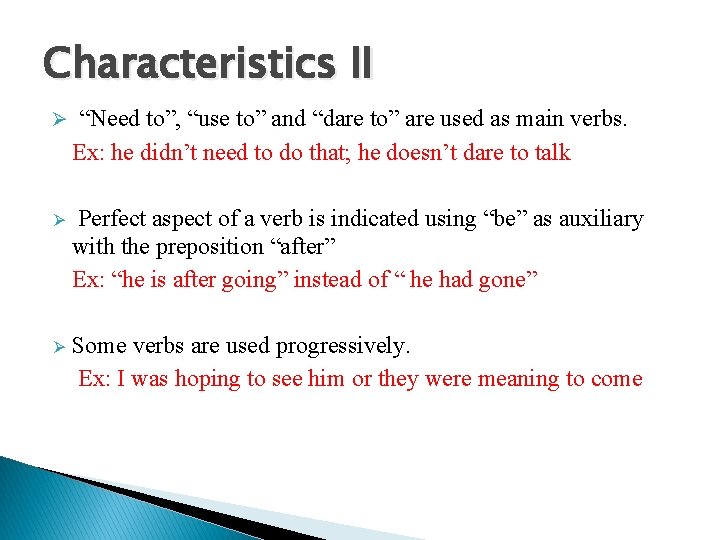
Characteristics II Ø “Need to”, “use to” and “dare to” are used as main verbs. Ex: he didn’t need to do that; he doesn’t dare to talk Ø Perfect aspect of a verb is indicated using “be” as auxiliary with the preposition “after” Ex: “he is after going” instead of “ he had gone” Ø Some verbs are used progressively. Ex: I was hoping to see him or they were meaning to come
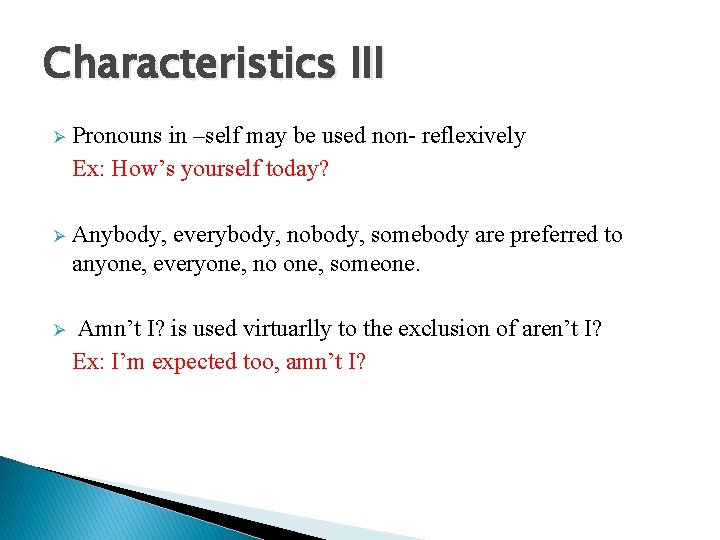
Characteristics III Ø Pronouns in –self may be used non- reflexively Ex: How’s yourself today? Ø Anybody, everybody, nobody, somebody are preferred to anyone, everyone, no one, someone. Ø Amn’t I? is used virtuarlly to the exclusion of aren’t I? Ex: I’m expected too, amn’t I?
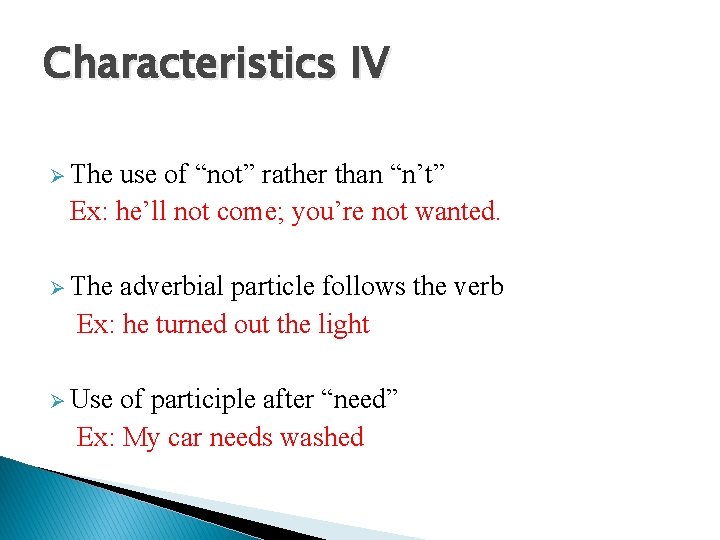
Characteristics IV Ø The use of “not” rather than “n’t” Ex: he’ll not come; you’re not wanted. Ø The adverbial particle follows the verb Ex: he turned out the light Ø Use of participle after “need” Ex: My car needs washed
LEXICAL CHARACTERISTICS
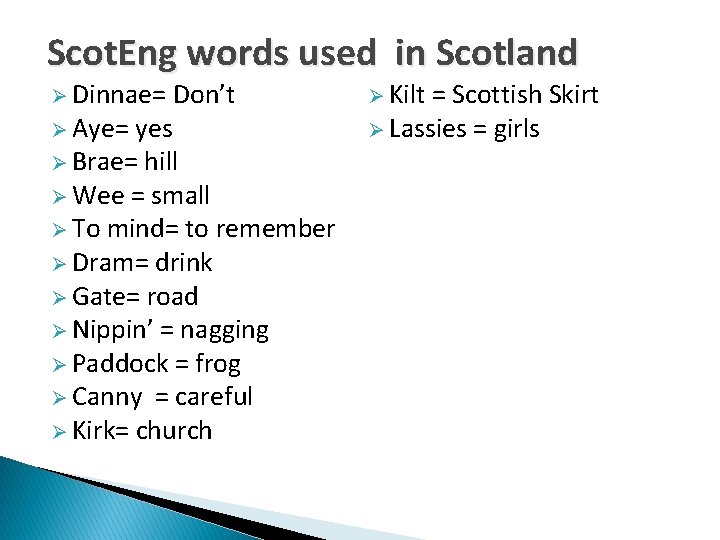
Scot. Eng words used in Scotland Ø Dinnae= Ø Aye= Don’t yes Ø Brae= hill Ø Wee = small Ø To mind= to remember Ø Dram= drink Ø Gate= road Ø Nippin’ = nagging Ø Paddock = frog Ø Canny = careful Ø Kirk= church Ø Kilt = Scottish Skirt Ø Lassies = girls
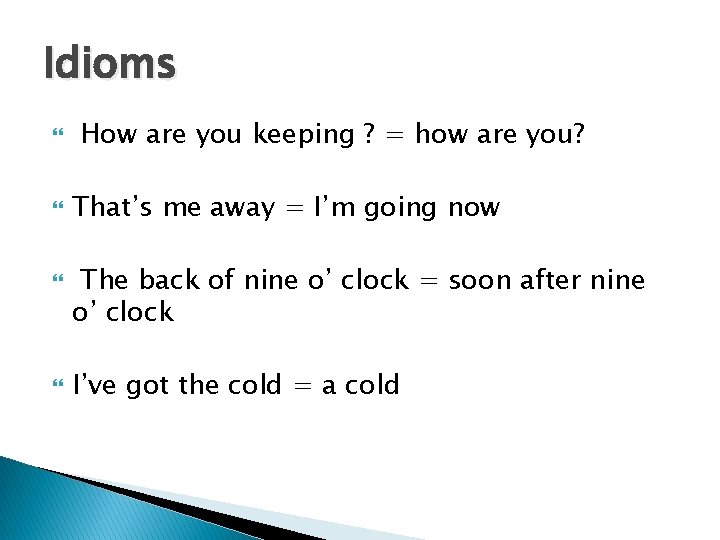
Idioms How are you keeping ? = how are you? That’s me away = I’m going now The back of nine o’ clock = soon after nine o’ clock I’ve got the cold = a cold
PHONETIC CHARACTERISTICS Vowels and consonants
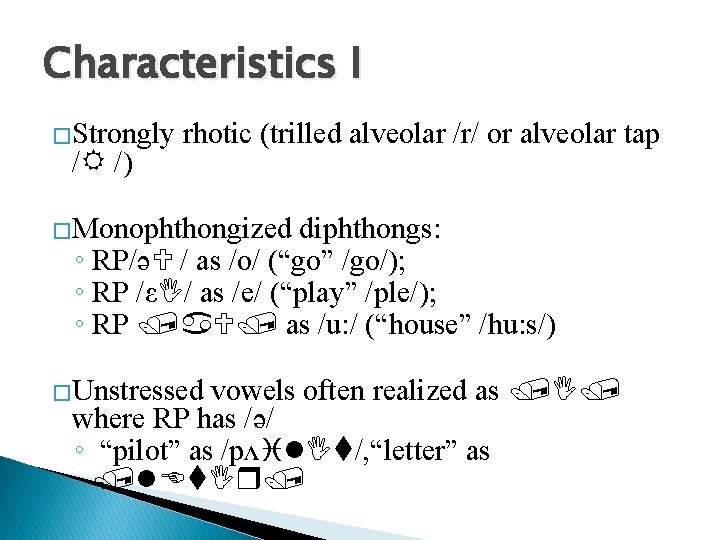
Characteristics I �Strongly /R /) rhotic (trilled alveolar /r/ or alveolar tap �Monophthongized diphthongs: ◦ RP/əU / as /o/ (“go” /go/); ◦ RP /εI/ as /e/ (“play” /ple/); ◦ RP /a. U/ as /u: / (“house” /hu: s/) vowels often realized as /I/ where RP has /ə/ ◦ “pilot” as /pʌil. It/, “letter” as /l. Et. Ir/ �Unstressed
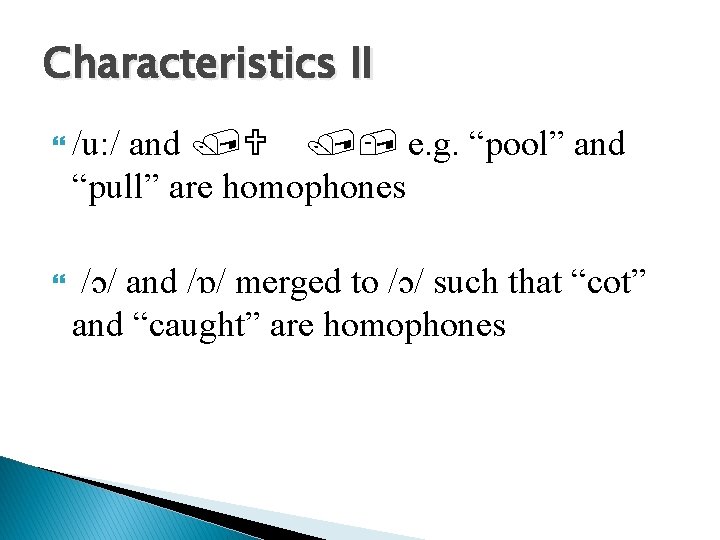
Characteristics II and /U /, e. g. “pool” and “pull” are homophones /u: / /ɔ/ and /ɒ/ merged to /ɔ/ such that “cot” and “caught” are homophones
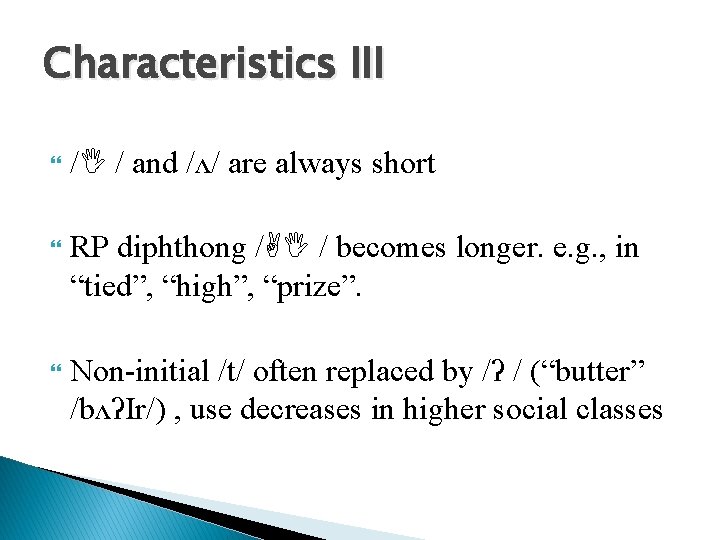
Characteristics III /I / and /ʌ/ are always short RP diphthong /AI / becomes longer. e. g. , in “tied”, “high”, “prize”. Non-initial /t/ often replaced by /ʔ / (“butter” /bʌʔIr/) , use decreases in higher social classes
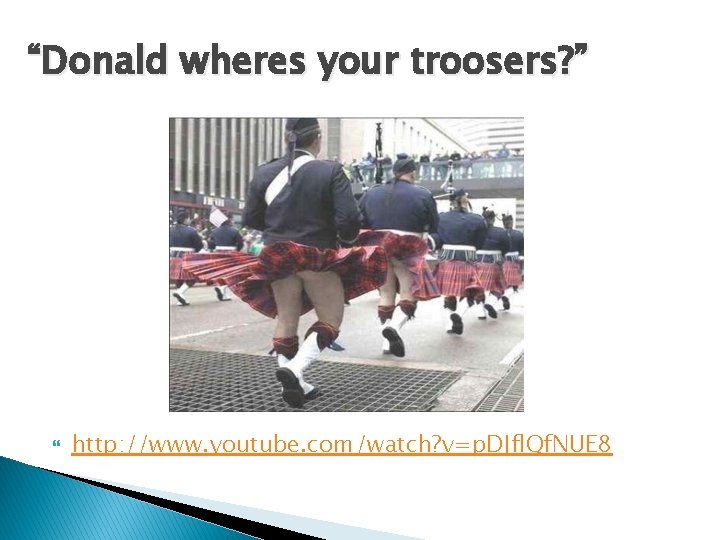
“Donald wheres your troosers? ” http: //www. youtube. com/watch? v=p. DJfl. Qf. NUE 8
Test Which is the second largest city of Scotland? a) Aberdeen b) Glasgow c) Edinburgh When did the Union of the Parliaments happen? a) 1607 b) 1807 c) 1707 Which is a national symbol of Scotland? a) Sunflower b) Thistle c) Rose
Test In Scottish English, “have” could be…. a) A modal b) An auxiliar c) Both of them Perfect aspect of a verb is indicated using “be” as auxiliary with the preposition… a) Before b) After c) At
Test What does “wee” mean? a) Small b) Big c) Cold What does “kilt” mean? a) Church b) Scottish skirt c) Trousers In Scottish English, which are homophones? a) /u: / and /U/ b) /U/ and /I/ c) /U/ and /A/
Test /I / and /ʌ/ are always… a) Homophones b) Long c) Short When does Scottish use glottal stop? a) Consonant “t” b) Consonant “d” c) Consonant “k”

THANKS FOR YOUR ATTENTION
- Slides: 25