
Score Report Insights to Drive Instruction Part 1

- Slides: 44
Score Report Insights to Drive Instruction, Part 1: Focus on RLA and Social Studies Debi Faucette September 2018
Session Objectives • Analyze the GED Ready® and Operational GED® Test Score Reports • Discuss the why and how of using score reports (as prescriptions) to drive instruction • Share ideas and resources 2
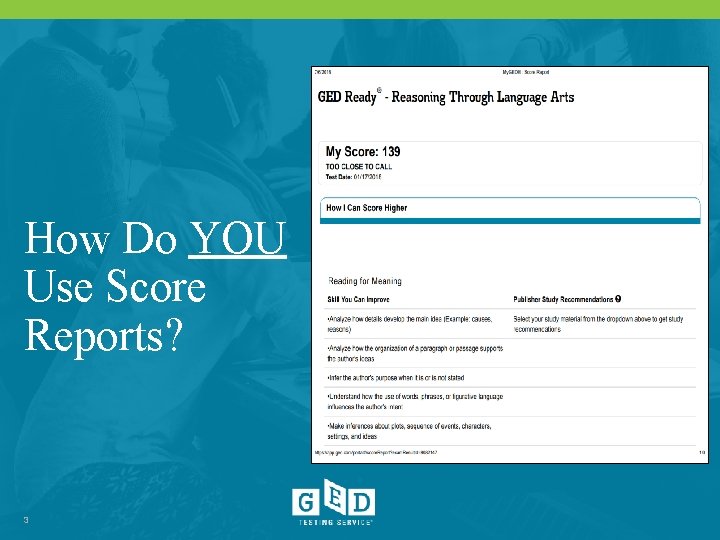
How Do YOU Use Score Reports? 3
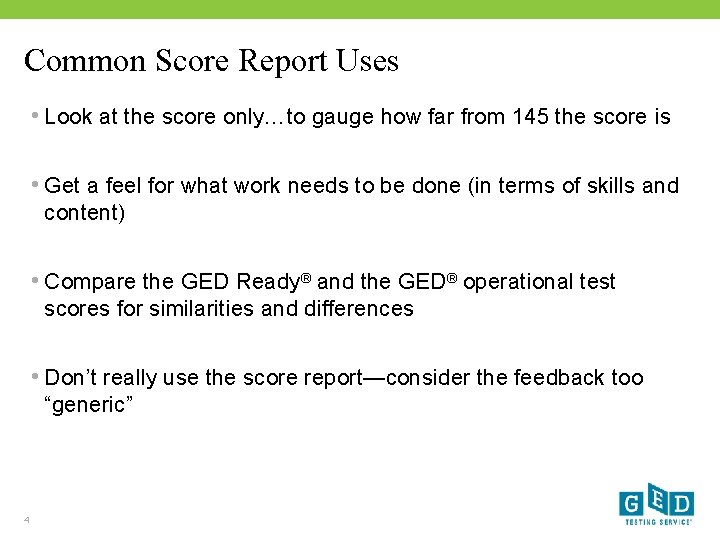
Common Score Report Uses • Look at the score only…to gauge how far from 145 the score is • Get a feel for what work needs to be done (in terms of skills and content) • Compare the GED Ready® and the GED® operational test scores for similarities and differences • Don’t really use the score report—consider the feedback too “generic” 4
So How Do You Take It From This. . . ……………………. . To This? 5
How? Take Action! • Review • Diagnose • Prescribe 6
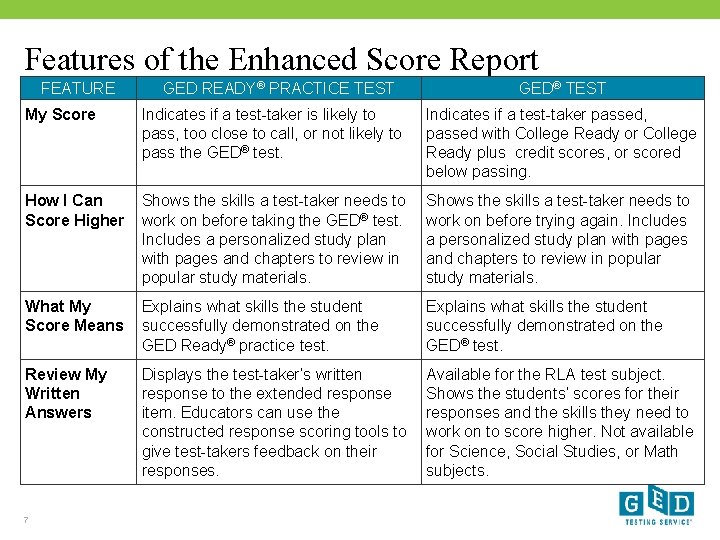
Features of the Enhanced Score Report FEATURE GED READY® PRACTICE TEST GED® TEST My Score Indicates if a test-taker is likely to pass, too close to call, or not likely to pass the GED® test. Indicates if a test-taker passed, passed with College Ready or College Ready plus credit scores, or scored below passing. How I Can Score Higher Shows the skills a test-taker needs to work on before taking the GED® test. Includes a personalized study plan with pages and chapters to review in popular study materials. Shows the skills a test-taker needs to work on before trying again. Includes a personalized study plan with pages and chapters to review in popular study materials. What My Score Means Explains what skills the student successfully demonstrated on the GED Ready® practice test. Explains what skills the student successfully demonstrated on the GED® test. Review My Written Answers Displays the test-taker’s written response to the extended response item. Educators can use the constructed response scoring tools to give test-takers feedback on their responses. Available for the RLA test subject. Shows the students’ scores for their responses and the skills they need to work on to score higher. Not available for Science, Social Studies, or Math subjects. 7
What Instructors Need to Know Resources for Success. 8
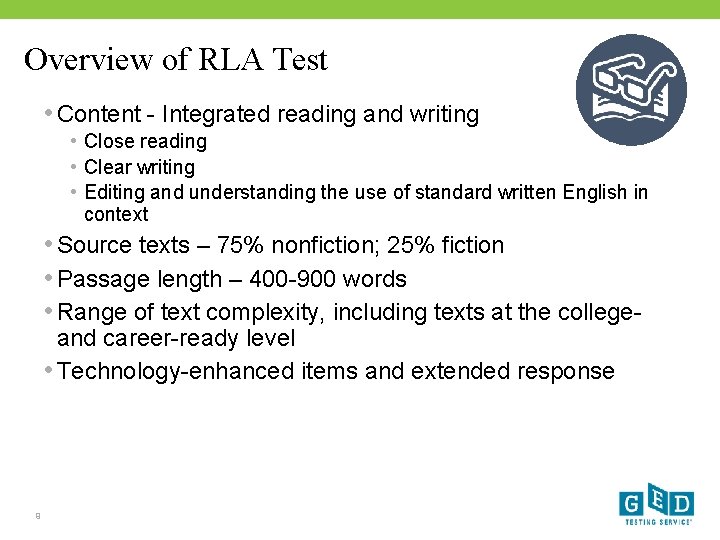
Overview of RLA Test • Content - Integrated reading and writing • Close reading • Clear writing • Editing and understanding the use of standard written English in context • Source texts – 75% nonfiction; 25% fiction • Passage length – 400 -900 words • Range of text complexity, including texts at the college- and career-ready level • Technology-enhanced items and extended response 9
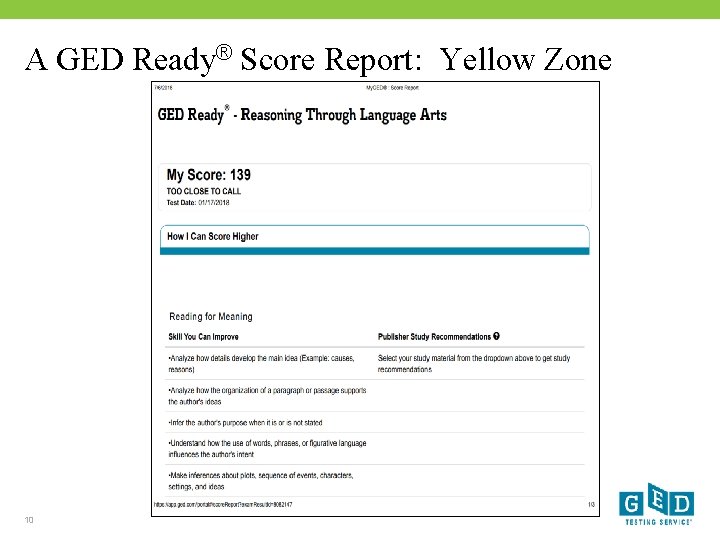
A GED Ready® Score Report: Yellow Zone 10
11
12
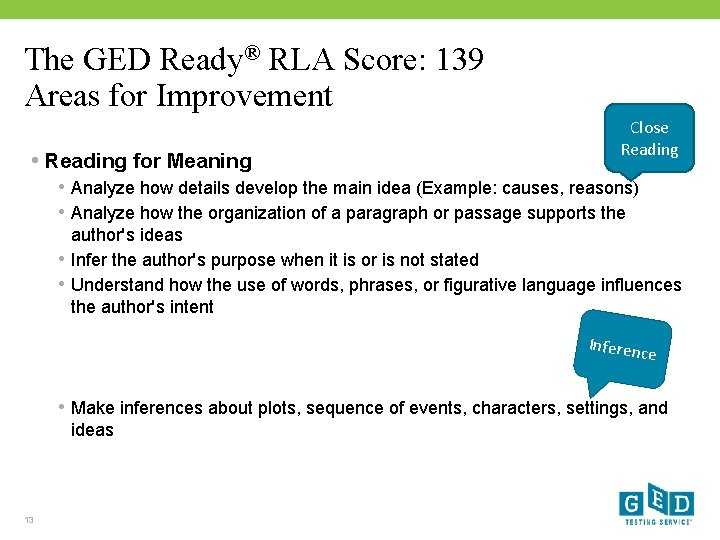
The GED Ready® RLA Score: 139 Areas for Improvement • Reading for Meaning Close Reading • Analyze how details develop the main idea (Example: causes, reasons) • Analyze how the organization of a paragraph or passage supports the author's ideas • Infer the author's purpose when it is or is not stated • Understand how the use of words, phrases, or figurative language influences the author's intent Inferenc e • Make inferences about plots, sequence of events, characters, settings, and ideas 13
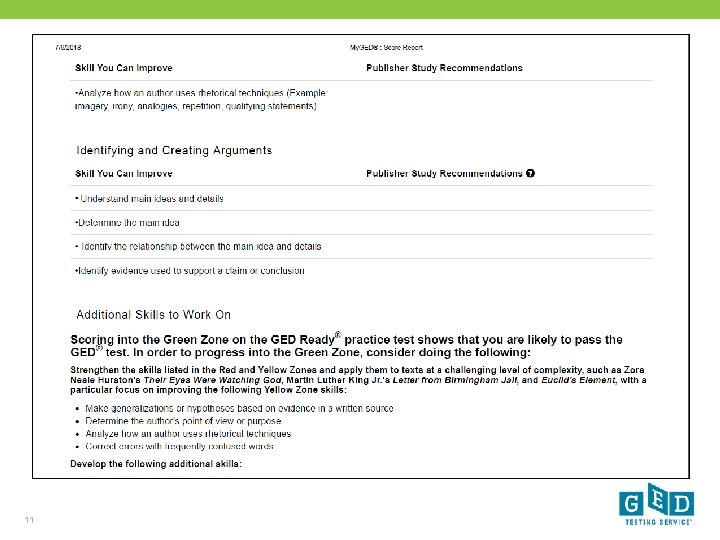
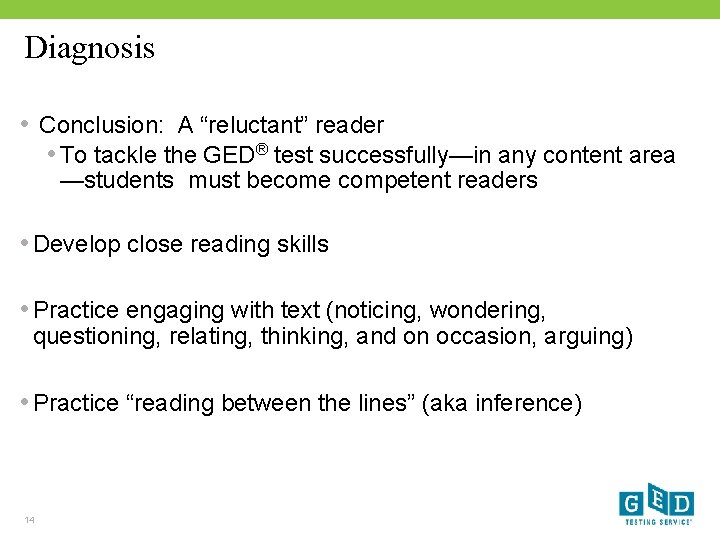
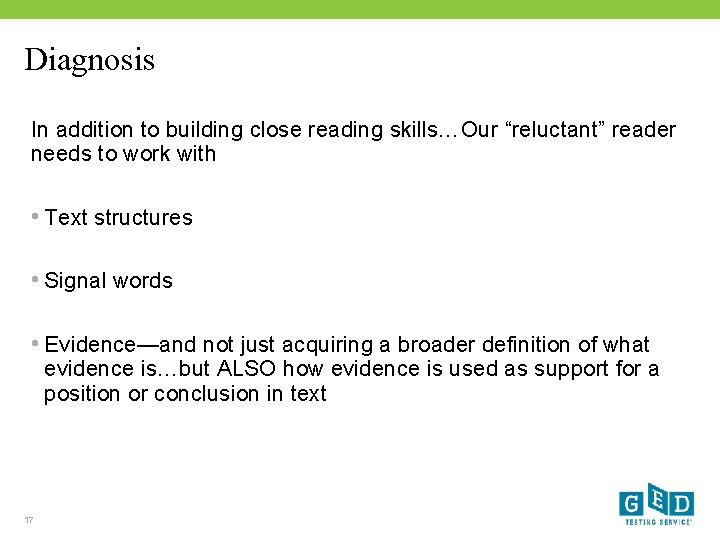
Diagnosis • Conclusion: A “reluctant” reader • To tackle the GED® test successfully—in any content area —students must become competent readers • Develop close reading skills • Practice engaging with text (noticing, wondering, questioning, relating, thinking, and on occasion, arguing) • Practice “reading between the lines” (aka inference) 14
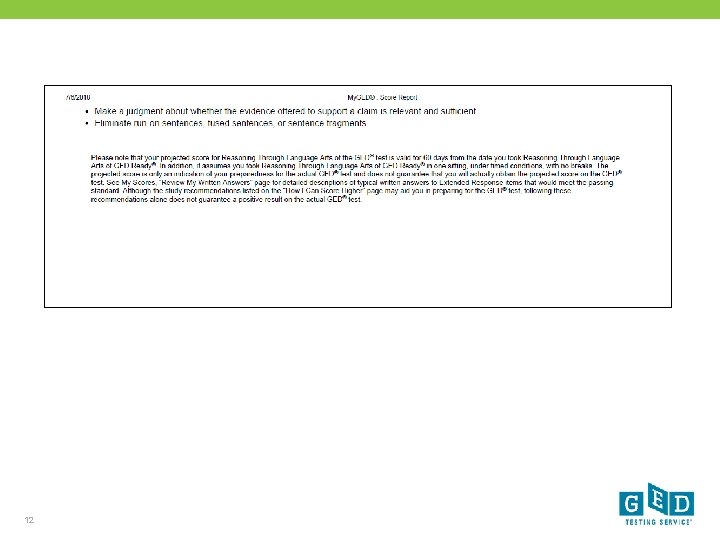
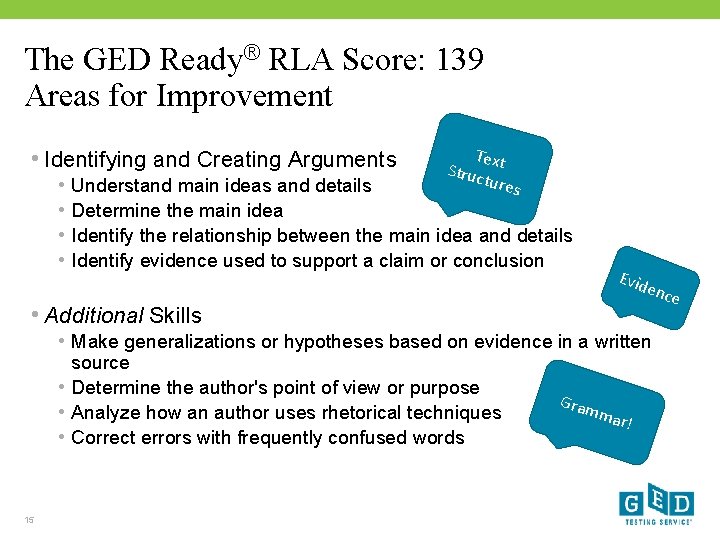
The GED Ready® RLA Score: 139 Areas for Improvement • Identifying and Creating Arguments Tex Struc t tures • Understand main ideas and details • Determine the main idea • Identify the relationship between the main idea and details • Identify evidence used to support a claim or conclusion Evid enc e • Additional Skills • Make generalizations or hypotheses based on evidence in a written source • Determine the author's point of view or purpose • Analyze how an author uses rhetorical techniques • Correct errors with frequently confused words 15 Gram mar !
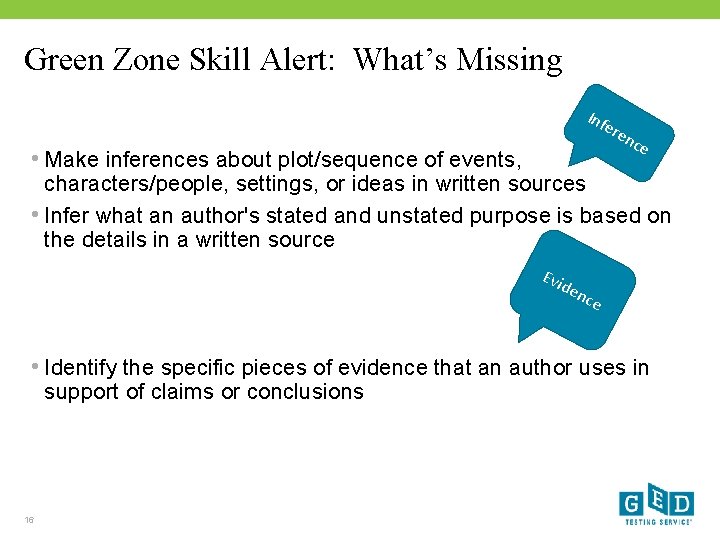
Green Zone Skill Alert: What’s Missing Inf ere • Make inferences about plot/sequence of events, nce characters/people, settings, or ideas in written sources • Infer what an author's stated and unstated purpose is based on the details in a written source Evi den ce • Identify the specific pieces of evidence that an author uses in support of claims or conclusions 16
Diagnosis In addition to building close reading skills…Our “reluctant” reader needs to work with • Text structures • Signal words • Evidence—and not just acquiring a broader definition of what evidence is…but ALSO how evidence is used as support for a position or conclusion in text 17
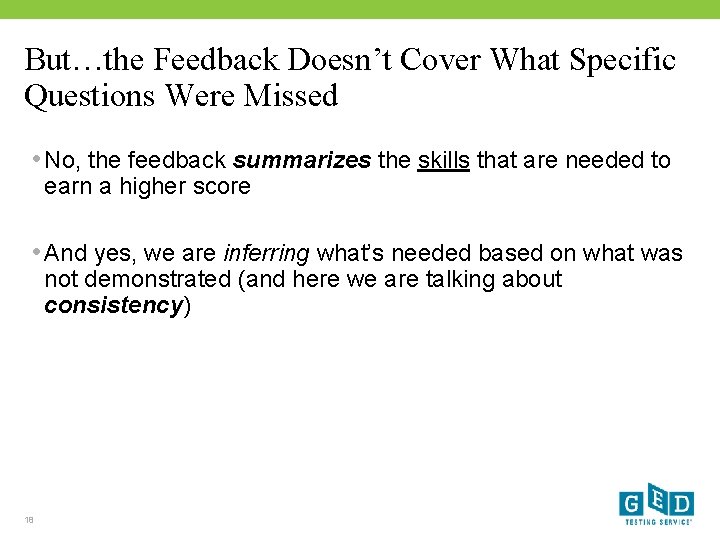
But…the Feedback Doesn’t Cover What Specific Questions Were Missed • No, the feedback summarizes the skills that are needed to earn a higher score • And yes, we are inferring what’s needed based on what was not demonstrated (and here we are talking about consistency) 18
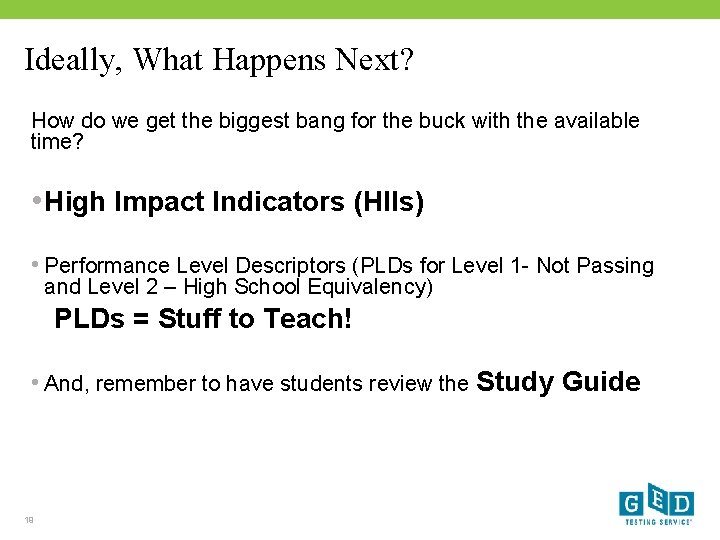
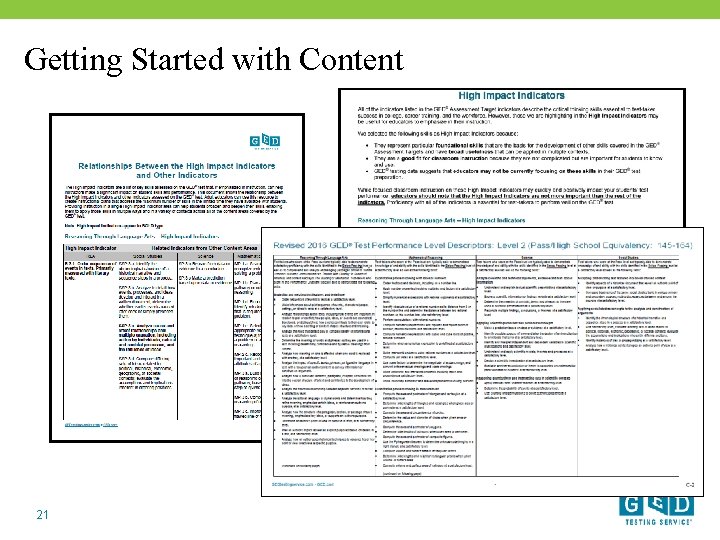
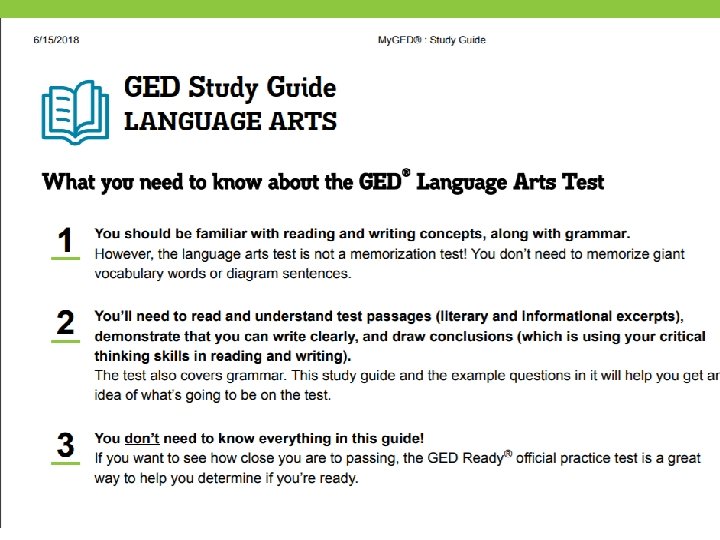
Ideally, What Happens Next? How do we get the biggest bang for the buck with the available time? • High Impact Indicators (HIIs) • Performance Level Descriptors (PLDs for Level 1 - Not Passing and Level 2 – High School Equivalency) PLDs = Stuff to Teach! • And, remember to have students review the Study Guide 19
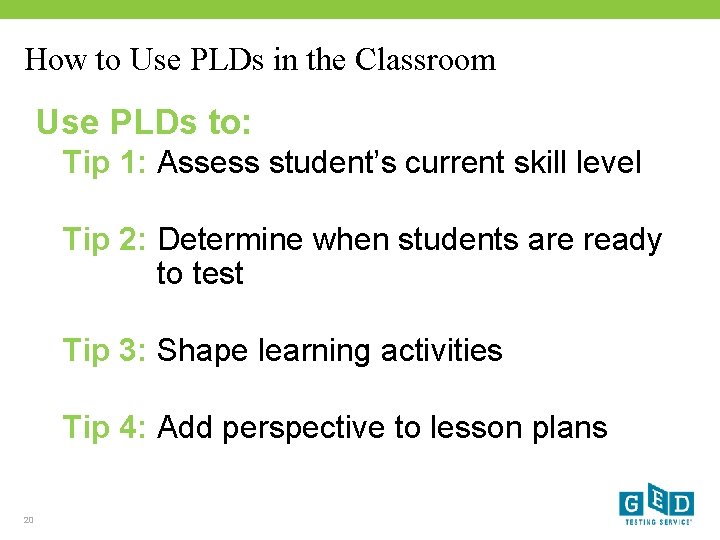
How to Use PLDs in the Classroom Use PLDs to: Tip 1: Assess student’s current skill level Tip 2: Determine when students are ready to test Tip 3: Shape learning activities Tip 4: Add perspective to lesson plans 20
Getting Started with Content 21
22
And What About Our “Too Close to Call” Test. Taker? • The RLA test score was 137—completely in line with the feedback from the GED Ready® RLA exam • The operational exam feedback identified the following areas as needing improvement • Reading for Meaning • Identifying and Creating Arguments • Making Inferences • Sound familiar? 23
What Instructors Need to Know: Social Studies Same Skills…Different Context 24
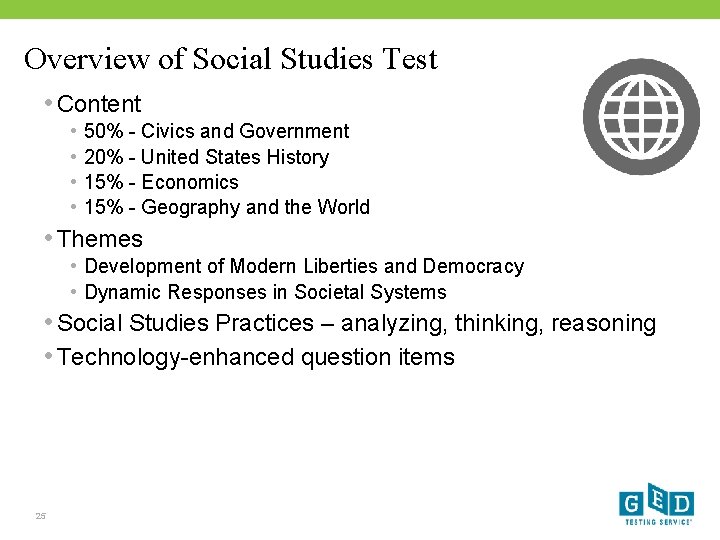
Overview of Social Studies Test • Content • 50% - Civics and Government • 20% - United States History • 15% - Economics • 15% - Geography and the World • Themes • Development of Modern Liberties and Democracy • Dynamic Responses in Societal Systems • Social Studies Practices – analyzing, thinking, reasoning • Technology-enhanced question items 25
26
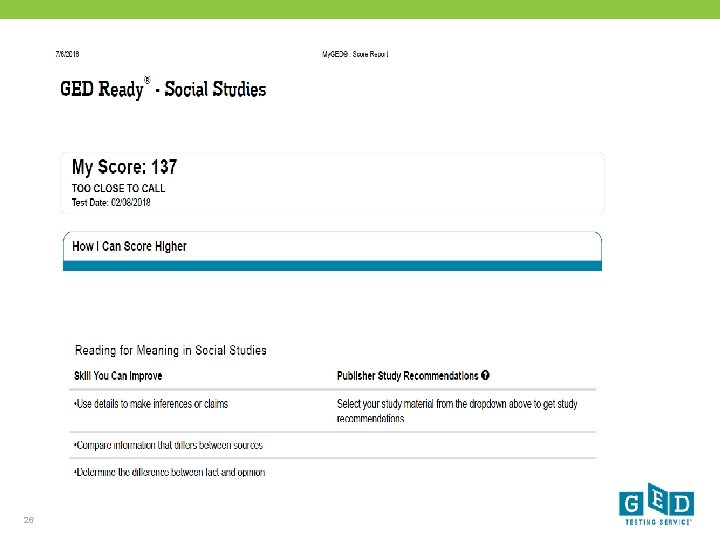
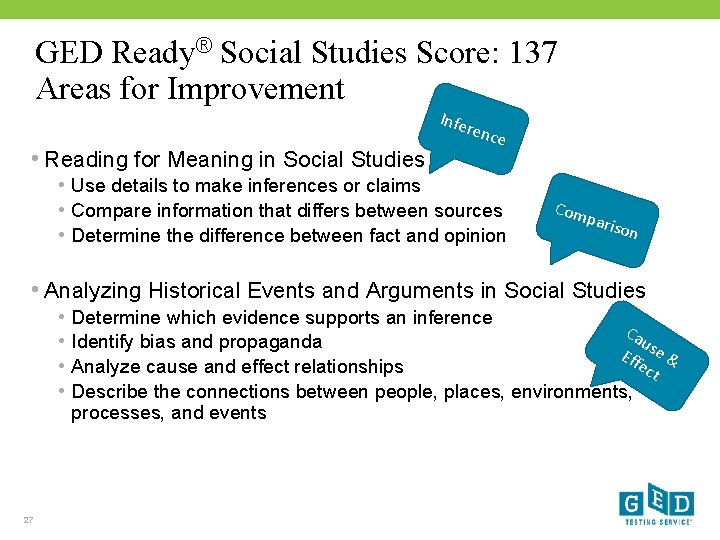
GED Ready® Social Studies Score: 137 Areas for Improvement Infe • Reading for Meaning in Social Studies renc e • Use details to make inferences or claims • Compare information that differs between sources • Determine the difference between fact and opinion Com paris on • Analyzing Historical Events and Arguments in Social Studies • Determine which evidence supports an inference Ca u • Identify bias and propaganda Eff se & ect • Analyze cause and effect relationships • Describe the connections between people, places, environments, processes, and events 27
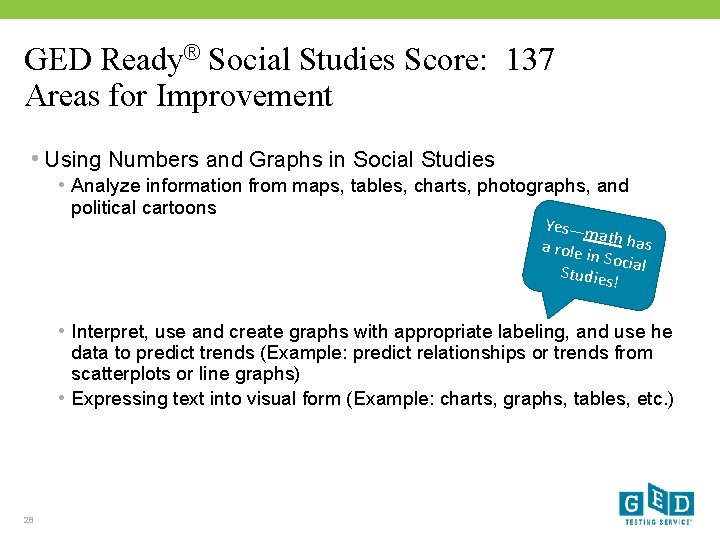
GED Ready® Social Studies Score: 137 Areas for Improvement • Using Numbers and Graphs in Social Studies • Analyze information from maps, tables, charts, photographs, and political cartoons Yes—m at a role i h has n Socia l Studies ! • Interpret, use and create graphs with appropriate labeling, and use he data to predict trends (Example: predict relationships or trends from scatterplots or line graphs) • Expressing text into visual form (Example: charts, graphs, tables, etc. ) 28
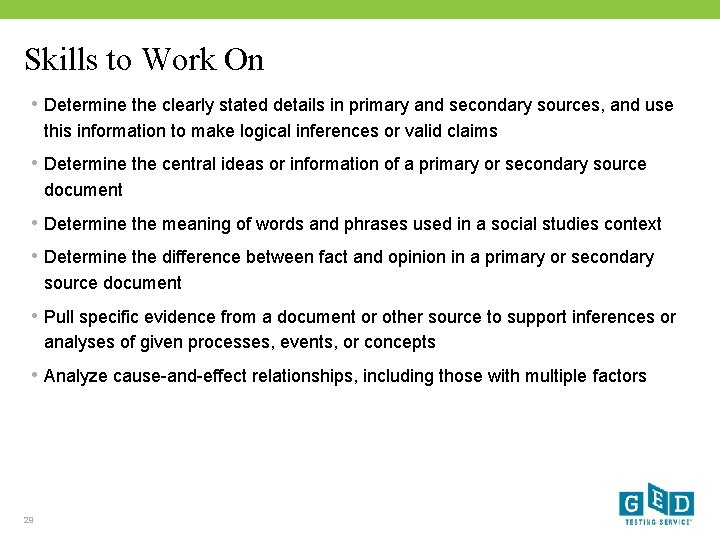
Skills to Work On • Determine the clearly stated details in primary and secondary sources, and use this information to make logical inferences or valid claims • Determine the central ideas or information of a primary or secondary source document • Determine the meaning of words and phrases used in a social studies context • Determine the difference between fact and opinion in a primary or secondary source document • Pull specific evidence from a document or other source to support inferences or analyses of given processes, events, or concepts • Analyze cause-and-effect relationships, including those with multiple factors 29
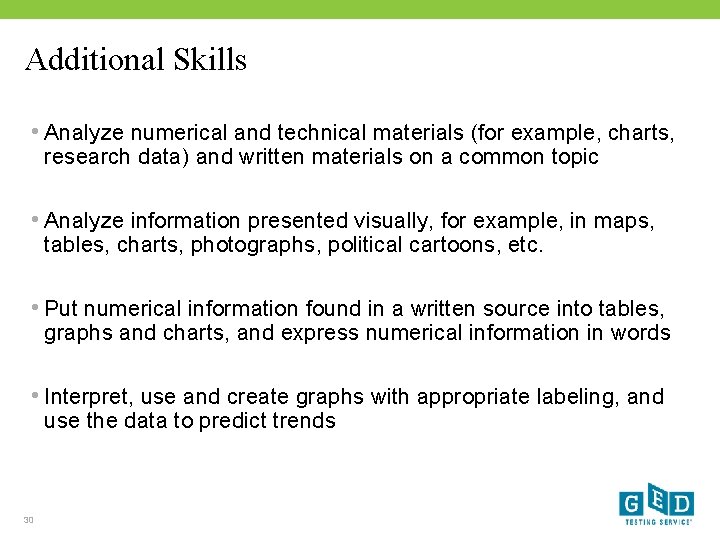
Additional Skills • Analyze numerical and technical materials (for example, charts, research data) and written materials on a common topic • Analyze information presented visually, for example, in maps, tables, charts, photographs, political cartoons, etc. • Put numerical information found in a written source into tables, graphs and charts, and express numerical information in words • Interpret, use and create graphs with appropriate labeling, and use the data to predict trends 30
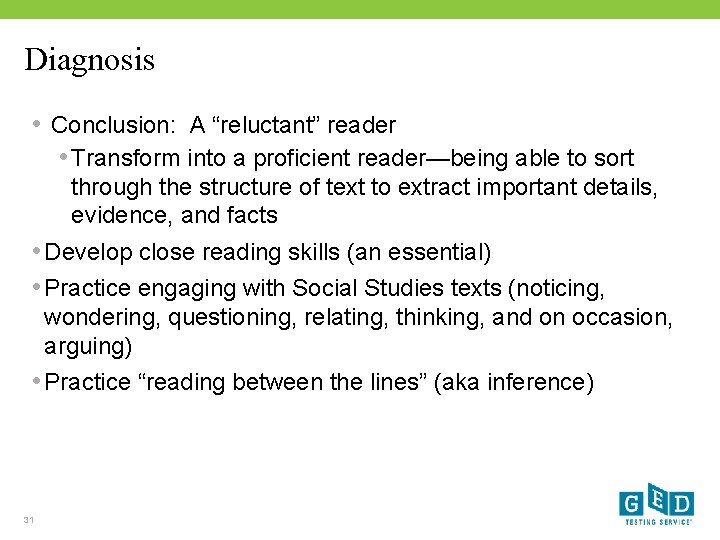
Diagnosis • Conclusion: A “reluctant” reader • Transform into a proficient reader—being able to sort through the structure of text to extract important details, evidence, and facts • Develop close reading skills (an essential) • Practice engaging with Social Studies texts (noticing, wondering, questioning, relating, thinking, and on occasion, arguing) • Practice “reading between the lines” (aka inference) 31
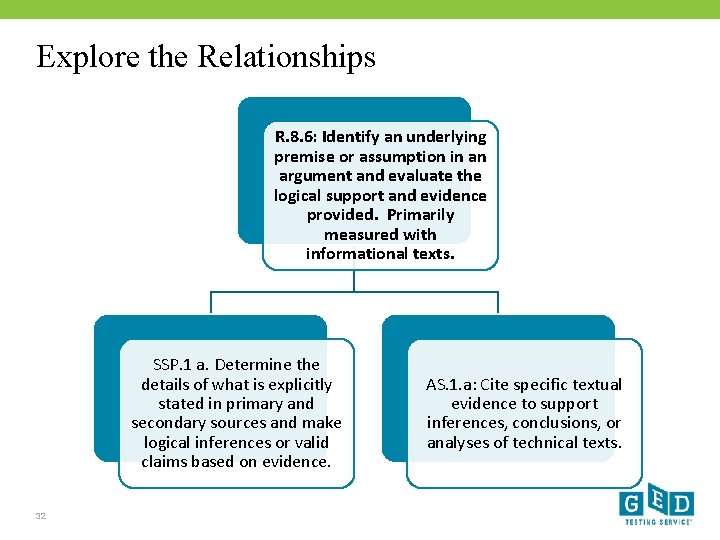
Explore the Relationships R. 8. 6: Identify an underlying premise or assumption in an argument and evaluate the logical support and evidence provided. Primarily measured with informational texts. SSP. 1 a. Determine the details of what is explicitly stated in primary and secondary sources and make logical inferences or valid claims based on evidence. 32 AS. 1. a: Cite specific textual evidence to support inferences, conclusions, or analyses of technical texts.
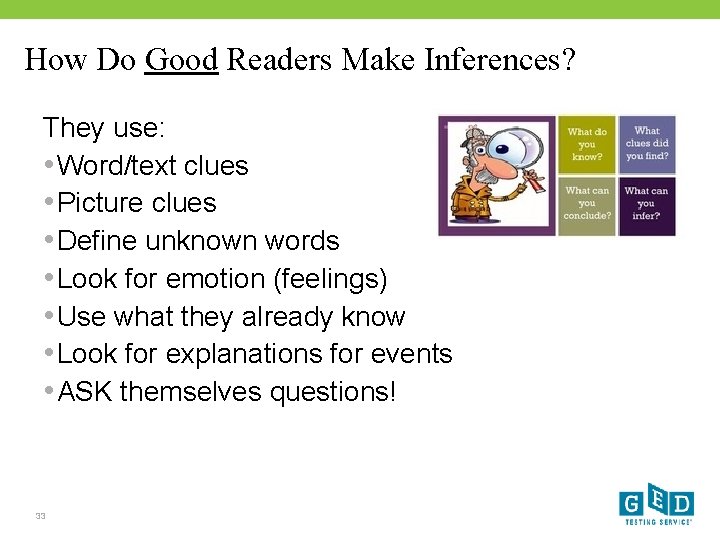
How Do Good Readers Make Inferences? They use: • Word/text clues • Picture clues • Define unknown words • Look for emotion (feelings) • Use what they already know • Look for explanations for events • ASK themselves questions! 33
Inference is Process-Driven The alchemy of inference: • Using active reading skills (beyond the basics) • Engaging with the text and/or information presented • Questioning • Thinking critically • Making connections 34
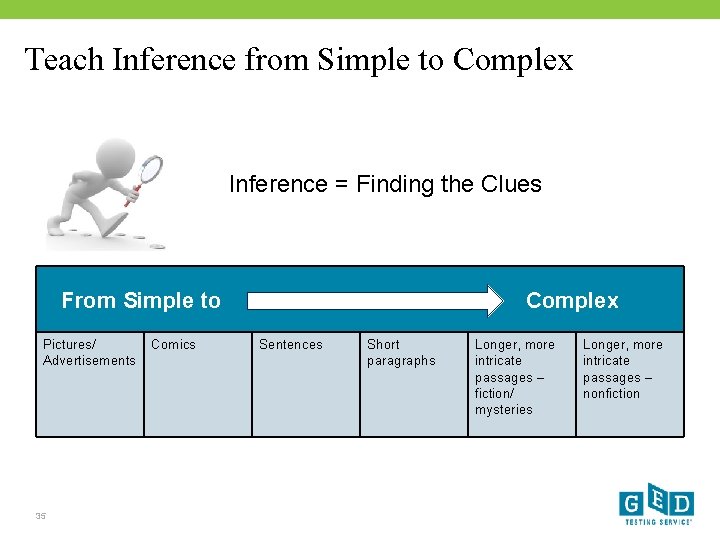
Teach Inference from Simple to Complex Inference = Finding the Clues From Simple to Complex Pictures/ Advertisements 35 Comics Sentences Short paragraphs Longer, more intricate passages – fiction/ mysteries Longer, more intricate passages – nonfiction
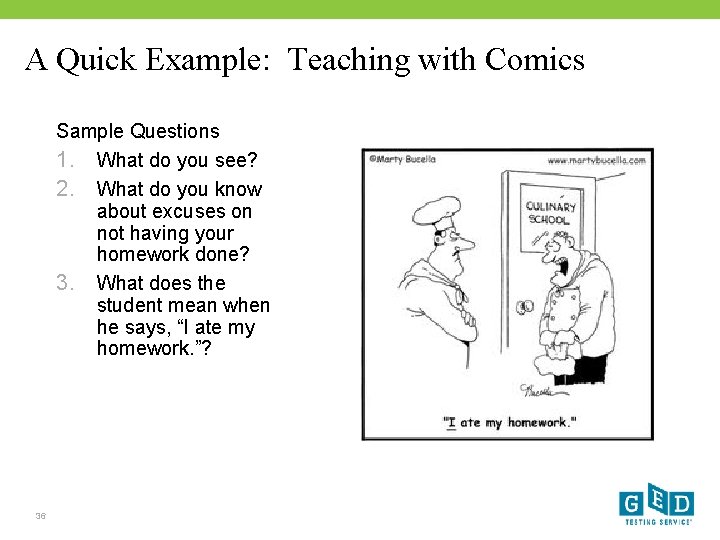
A Quick Example: Teaching with Comics Sample Questions 1. What do you see? 2. What do you know about excuses on not having your homework done? 3. What does the student mean when he says, “I ate my homework. ”? 36
How Did Our Test-Taker Fare with Operational Testing? • GED® Social Studies test score: 134 • The operational exam feedback identified the following areas as needing improvement • Reading for Meaning in Social Studies • Analyzing Historical Events and Arguments in Social Studies • Using Numbers and Graphs in Social Studies • Sound familiar? It should… 37
Questions for Reflection What Can YOU Take Away from this Session? 38
Questions to Ask Yourself…and Your Colleagues • What are the key ingredients in skill development? • What are some of the most effective ways to prompt persistence especially in students who struggle with reading, writing, or mathematical reasoning? • How can I bring these elements to the classroom? 39
A Few Takeaways… 40
Key Takeaways • Please unlearn the notion that there is ONLY one right way— whether it is writing, problem-solving, or thinking critically. • Once is not enough—if that were true, we would have legions of experts! • Flow with the plateaus—learning and skill development are not linear. • Remember that learning is both iterative and integrative. This will enable you to expect the best and have your students deliver their best. 41
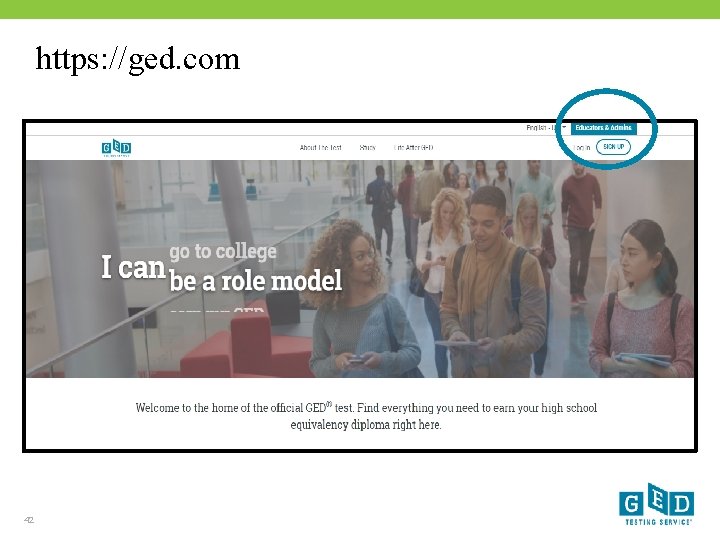
https: //ged. com 42
Questions? Debi Faucette, Senior Director Debi. Faucette@ged. com 202. 302. 6658 communications@ged. com 43
Thank you! Communicate with GED Testing Service® communications@ged. com 44