
SCOR Primer Overview of Model Structure Revision 3
- Slides: 80
SCOR Primer Overview of Model Structure Revision 3. 0 European Conference Hotel Metropole, Brussels October 25 -27, 1998
The Supply Chain Operations Reference-model (SCOR) has been developed and endorsed by the Supply-Chain Council (SCC), an independent not-for-profit corporation, as the crossindustry standard for supply-chain management (SCM) SCOR is freely available to all who wish to use the standard reference model The SCC was organized in 1996 by Pittiglio Rabin Todd & Mc. Grath (PRTM) and Advanced Manufacturing Research (AMR), and initially included 69 voluntary member companies Council membership is now open to all companies and organizations interested in applying and advancing state-of-the-art supply-chain management systems and practices Member companies pay a modest annual fee to support Council activities All who use the SCOR model are asked to acknowledge the SCC in all documents describing or depicting the SCOR model and its use All who use SCOR are encouraged to join the SCC, both to further model development and to obtain the full benefits of membership Further information regarding the Council and SCOR can be found at the Council’s web site, www. supply-chain. org © Copyright 1998 Supply-Chain Council 3651 MV—SCOR Overview 1
Session objectives and take-aways ä Introduce you to the Supply Chain Operations Reference -model (SCOR) developed by the Supply-Chain Council ä Educate you on how to apply SCOR – To configure your supply chain ä Help you understand next steps toward supply-chain improvement © Copyright 1998 Supply-Chain Council 3651 MV—SCOR Overview 2
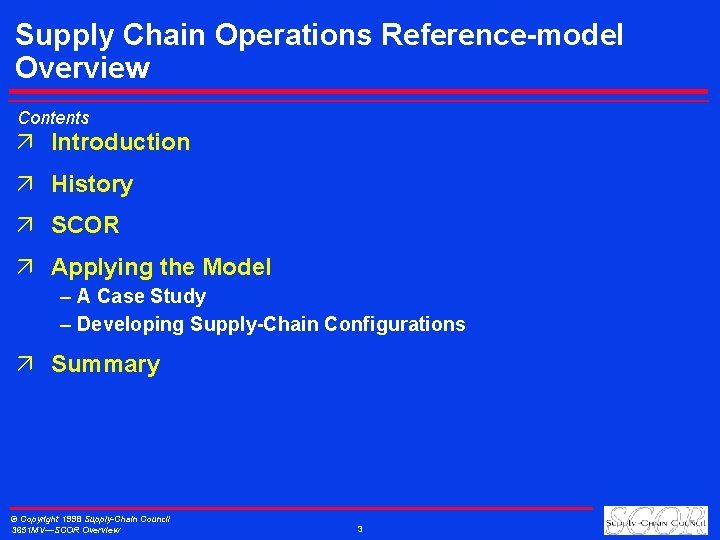
Supply Chain Operations Reference-model Overview Contents ä Introduction ä History ä SCOR ä Applying the Model – A Case Study – Developing Supply-Chain Configurations ä Summary © Copyright 1998 Supply-Chain Council 3651 MV—SCOR Overview 3
Introduction to the Supply Chain Operations Reference-model (SCOR) ä This document provides a basic overview of the Supply Chain Operations Reference-model (SCOR) ä This document is intended for use in a comprehensive SCOR training program ä Please review SCOR materials carefully—we need your feedback. Feedback may be: – Posted on the appropriate Supply-Chain Council web forums at www. supply-chain. org • Integration • Plan • Source • Make • Deliver © Copyright 1998 Supply-Chain Council 3651 MV—SCOR Overview 4
Introduction to the Supply Chain Operations Reference-model (SCOR) Continued ä SCOR feedback may be: – Emailed or faxed to Bill Hakanson, Executive Director of the Supply-Chain Council • Email address: bill@hakanson. com • Tel: (412) 781 - 4101 • Fax: (412) 781 -2871 – Please include your name and contact information so SCC technical committees may clarify your feedback or questions © Copyright 1998 Supply-Chain Council 3651 MV—SCOR Overview 5
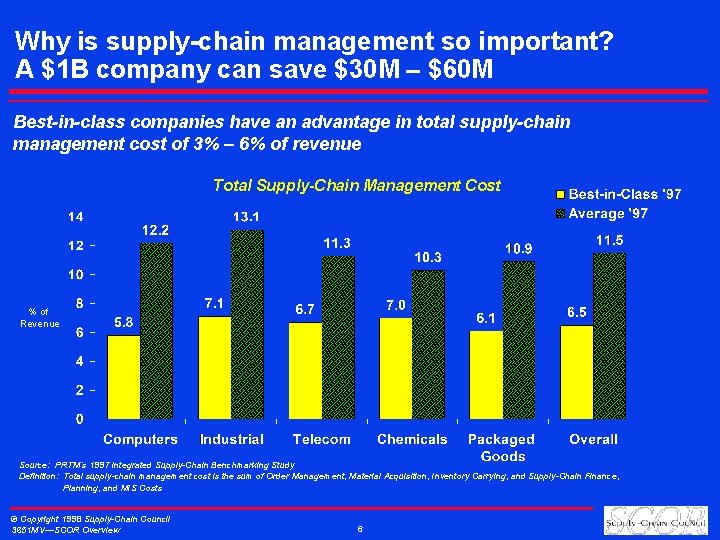
Why is supply-chain management so important? A $1 B company can save $30 M – $60 M Best-in-class companies have an advantage in total supply-chain management cost of 3% – 6% of revenue Total Supply-Chain Management Cost % of Revenue Source: PRTM’s 1997 Integrated Supply-Chain Benchmarking Study Definition: Total supply-chain management cost is the sum of Order Management, Material Acquisition, Inventory Carrying, and Supply-Chain Finance, Planning, and MIS Costs © Copyright 1998 Supply-Chain Council 3651 MV—SCOR Overview 6
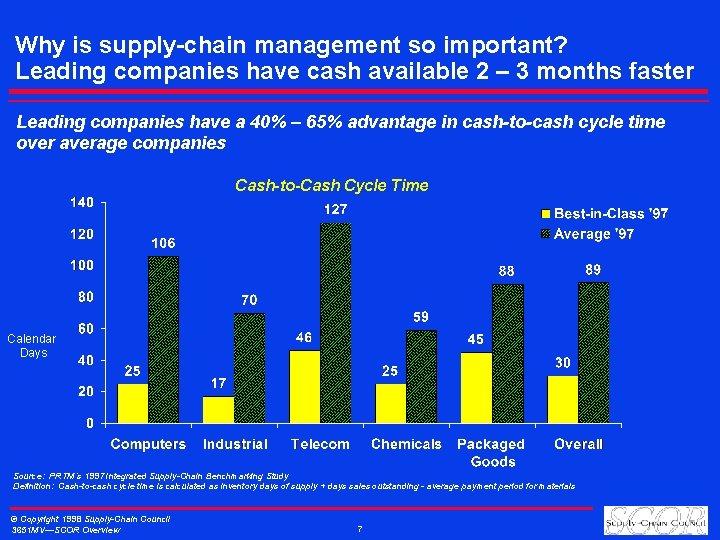
Why is supply-chain management so important? Leading companies have cash available 2 – 3 months faster Leading companies have a 40% – 65% advantage in cash-to-cash cycle time over average companies Cash-to-Cash Cycle Time Calendar Days Source: PRTM’s 1997 Integrated Supply-Chain Benchmarking Study Definition: Cash-to-cash cycle time is calculated as inventory days of supply + days sales outstanding - average payment period for materials © Copyright 1998 Supply-Chain Council 3651 MV—SCOR Overview 7
Supply Chain Operations Reference-model (SCOR) History © Copyright 1998 Supply-Chain Council 3651 MV—SCOR Overview 8
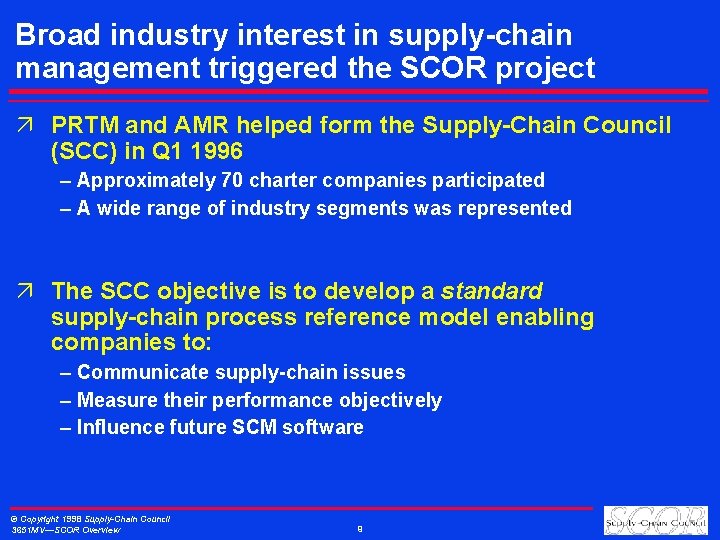
Broad industry interest in supply-chain management triggered the SCOR project ä PRTM and AMR helped form the Supply-Chain Council (SCC) in Q 1 1996 – Approximately 70 charter companies participated – A wide range of industry segments was represented ä The SCC objective is to develop a standard supply-chain process reference model enabling companies to: – Communicate supply-chain issues – Measure their performance objectively – Influence future SCM software © Copyright 1998 Supply-Chain Council 3651 MV—SCOR Overview 9
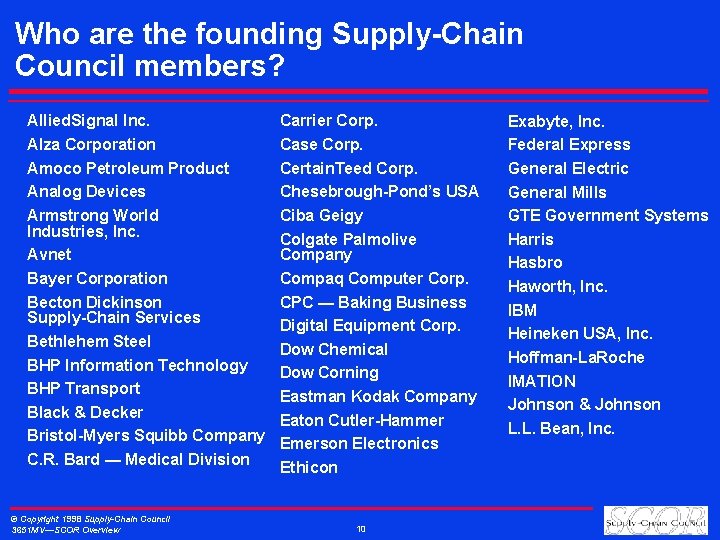
Who are the founding Supply-Chain Council members? Allied. Signal Inc. Alza Corporation Amoco Petroleum Product Analog Devices Armstrong World Industries, Inc. Avnet Bayer Corporation Becton Dickinson Supply-Chain Services Bethlehem Steel BHP Information Technology BHP Transport Black & Decker Bristol-Myers Squibb Company C. R. Bard — Medical Division © Copyright 1998 Supply-Chain Council 3651 MV—SCOR Overview Carrier Corp. Case Corp. Certain. Teed Corp. Chesebrough-Pond’s USA Ciba Geigy Colgate Palmolive Company Compaq Computer Corp. CPC — Baking Business Digital Equipment Corp. Dow Chemical Dow Corning Eastman Kodak Company Eaton Cutler-Hammer Emerson Electronics Ethicon 10 Exabyte, Inc. Federal Express General Electric General Mills GTE Government Systems Harris Hasbro Haworth, Inc. IBM Heineken USA, Inc. Hoffman-La. Roche IMATION Johnson & Johnson L. L. Bean, Inc.
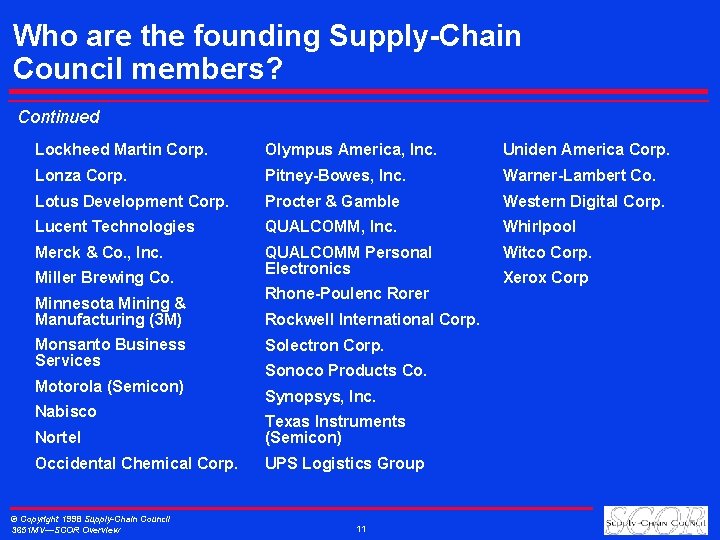
Who are the founding Supply-Chain Council members? Continued Lockheed Martin Corp. Olympus America, Inc. Uniden America Corp. Lonza Corp. Pitney-Bowes, Inc. Warner-Lambert Co. Lotus Development Corp. Procter & Gamble Western Digital Corp. Lucent Technologies QUALCOMM, Inc. Whirlpool Merck & Co. , Inc. QUALCOMM Personal Electronics Witco Corp. Miller Brewing Co. Minnesota Mining & Manufacturing (3 M) Monsanto Business Services Motorola (Semicon) Nabisco Rhone-Poulenc Rorer Rockwell International Corp. Solectron Corp. Sonoco Products Co. Synopsys, Inc. Nortel Texas Instruments (Semicon) Occidental Chemical Corp. UPS Logistics Group © Copyright 1998 Supply-Chain Council 3651 MV—SCOR Overview 11 Xerox Corp
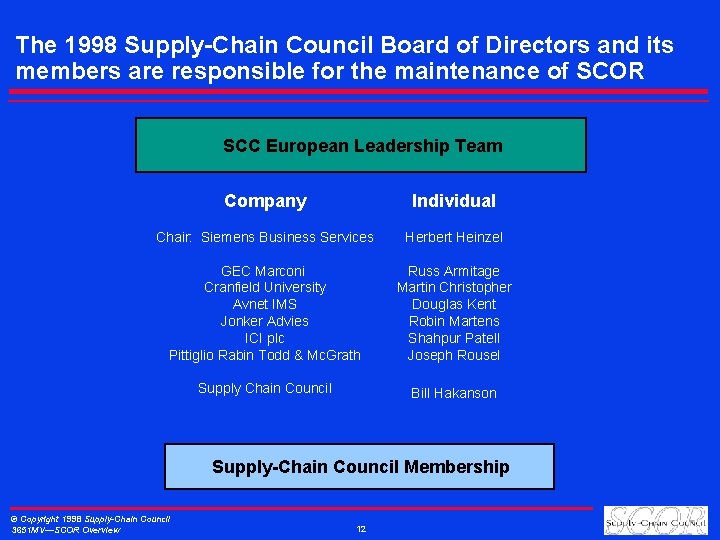
The 1998 Supply-Chain Council Board of Directors and its members are responsible for the maintenance of SCOR SCC European Leadership Team Company Individual Chair: Siemens Business Services Herbert Heinzel GEC Marconi Cranfield University Avnet IMS Jonker Advies ICI plc Pittiglio Rabin Todd & Mc. Grath Russ Armitage Martin Christopher Douglas Kent Robin Martens Shahpur Patell Joseph Rousel Supply Chain Council Bill Hakanson Supply-Chain Council Membership © Copyright 1998 Supply-Chain Council 3651 MV—SCOR Overview 12
What is a Process Reference Model? © Copyright 1998 Supply-Chain Council 3651 MV—SCOR Overview 13
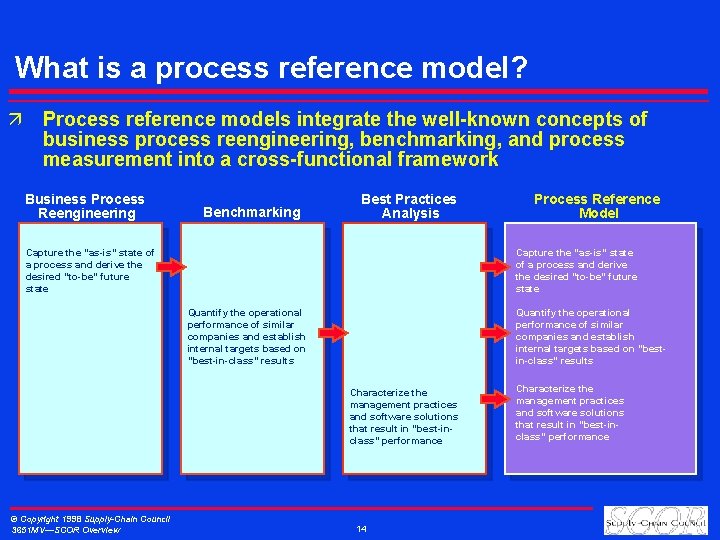
What is a process reference model? ä Process reference models integrate the well-known concepts of business process reengineering, benchmarking, and process measurement into a cross-functional framework Business Process Reengineering Benchmarking Best Practices Analysis Capture the “as-is” state of a process and derive the desired “to-be” future state Quantify the operational performance of similar companies and establish internal targets based on “best-in-class” results Quantify the operational performance of similar companies and establish internal targets based on “bestin-class” results Characterize the management practices and software solutions that result in “best-inclass” performance © Copyright 1998 Supply-Chain Council 3651 MV—SCOR Overview Process Reference Model 14 Characterize the management practices and software solutions that result in “best-inclass” performance
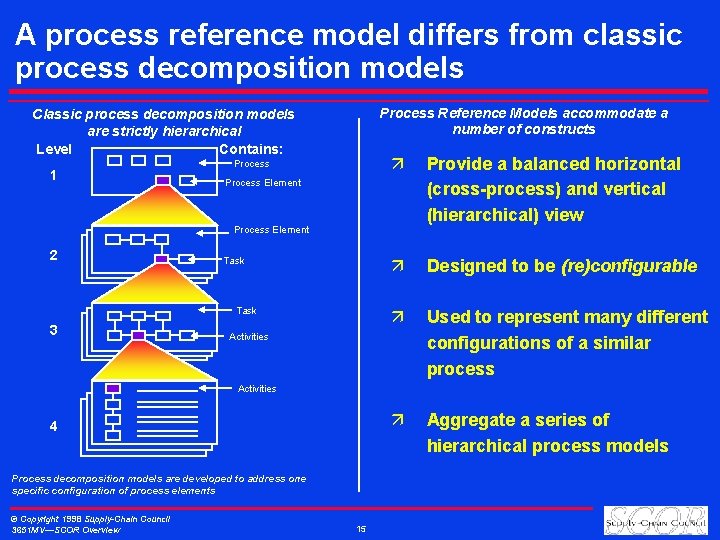
A process reference model differs from classic process decomposition models Process Reference Models accommodate a number of constructs Classic process decomposition models are strictly hierarchical Level Contains: 1 Process ä Provide a balanced horizontal (cross-process) and vertical (hierarchical) view ä Designed to be (re)configurable ä Used to represent many different configurations of a similar process ä Aggregate a series of hierarchical process models Process Element 2 Task 3 Activities 4 Process decomposition models are developed to address one specific configuration of process elements © Copyright 1998 Supply-Chain Council 3651 MV—SCOR Overview 15
What is a process reference model? A Process Reference Model describes ä Standard descriptions of management processes ä A framework of relationships among the standard processes ä Standard metrics to measure process performance ä Management practices that produce best-in-class performance ä Software tools that enable best practices © Copyright 1998 Supply-Chain Council 3651 MV—SCOR Overview 16
Why use a process reference model? ä A process reference model allows companies to: – Communicate, using common terminology and standard descriptions of the process elements – Leverage metrics and benchmarking to determine performance goals, set priorities, and quantify the benefits of process changes – Understand the best practices that yield the best performance – Understand the overall SCM process and evaluate overall performance – Identify the software tools best suited for their process requirements ä Once a business process has been “captured” in a process reference model it can be: – – Described unambiguously Communicated consistently (Re)designed to achieve competitive advantage Measured, managed, controlled, and refined to meet specific purposes © Copyright 1998 Supply-Chain Council 3651 MV—SCOR Overview 17
Supply Chain Operations Reference-model: The Basics © Copyright 1998 Supply-Chain Council 3651 MV—SCOR Overview 18
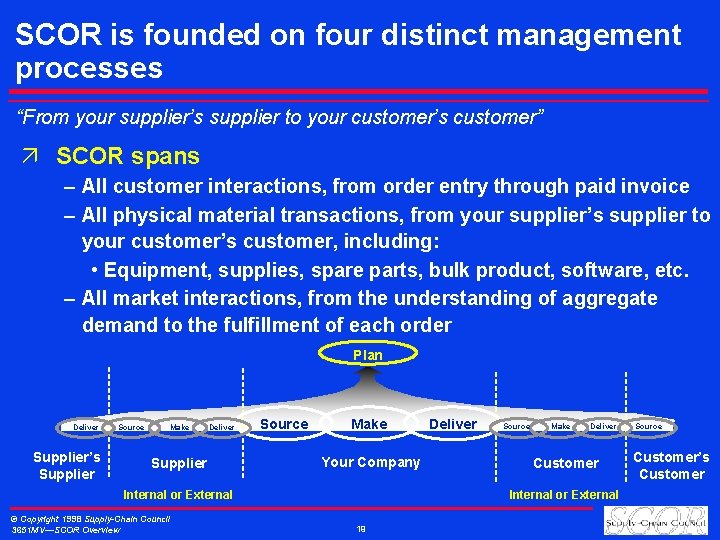
SCOR is founded on four distinct management processes “From your supplier’s supplier to your customer’s customer” ä SCOR spans – All customer interactions, from order entry through paid invoice – All physical material transactions, from your supplier’s supplier to your customer’s customer, including: • Equipment, supplies, spare parts, bulk product, software, etc. – All market interactions, from the understanding of aggregate demand to the fulfillment of each order Plan Deliver Supplier’s Supplier Source Make Deliver Supplier Source Make Your Company Internal or External © Copyright 1998 Supply-Chain Council 3651 MV—SCOR Overview Deliver Source Make Deliver Customer Internal or External 19 Source Customer’s Customer
The boundaries of any model must be carefully defined ä SCOR does not include – Sales administration processes – Technology development processes – Product and process design and development processes – Post-delivery customer support operations including technical support processes ä Links to processes not included within the model’s scope, such as product development, are noted in SCOR © Copyright 1998 Supply-Chain Council 3651 MV—SCOR Overview 20
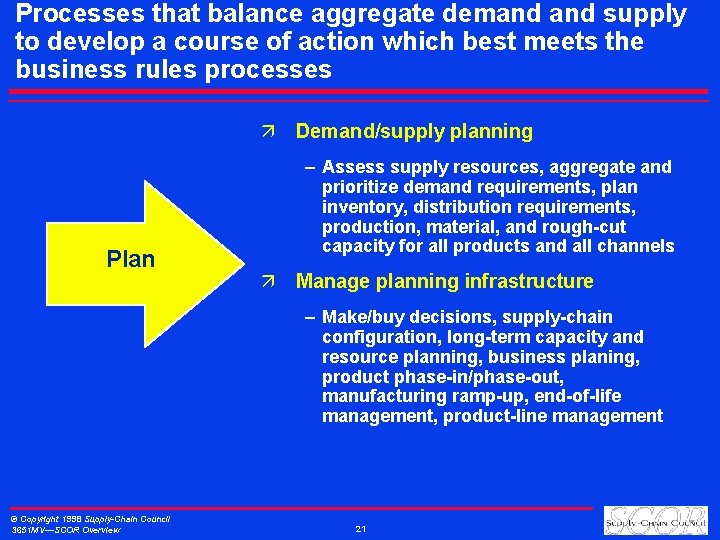
Processes that balance aggregate demand supply to develop a course of action which best meets the business rules processes ä Demand/supply planning Plan – Assess supply resources, aggregate and prioritize demand requirements, plan inventory, distribution requirements, production, material, and rough-cut capacity for all products and all channels ä Manage planning infrastructure – Make/buy decisions, supply-chain configuration, long-term capacity and resource planning, business planing, product phase-in/phase-out, manufacturing ramp-up, end-of-life management, product-line management © Copyright 1998 Supply-Chain Council 3651 MV—SCOR Overview 21
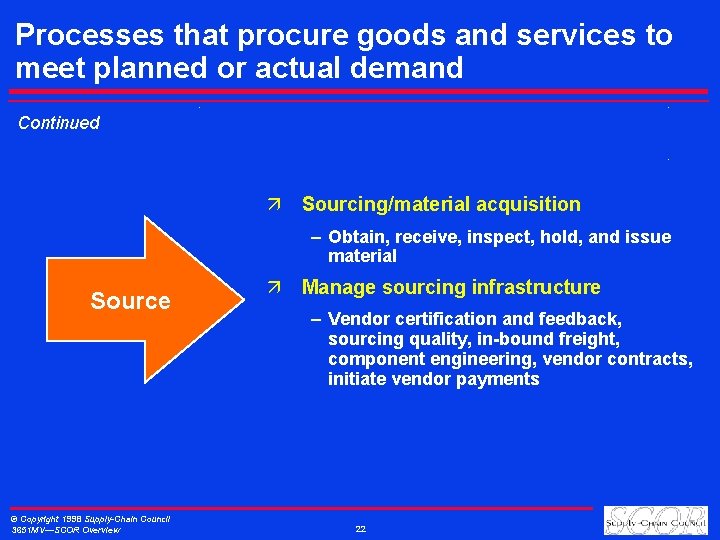
Processes that procure goods and services to meet planned or actual demand Continued ä Sourcing/material acquisition – Obtain, receive, inspect, hold, and issue material Source © Copyright 1998 Supply-Chain Council 3651 MV—SCOR Overview ä Manage sourcing infrastructure – Vendor certification and feedback, sourcing quality, in-bound freight, component engineering, vendor contracts, initiate vendor payments 22
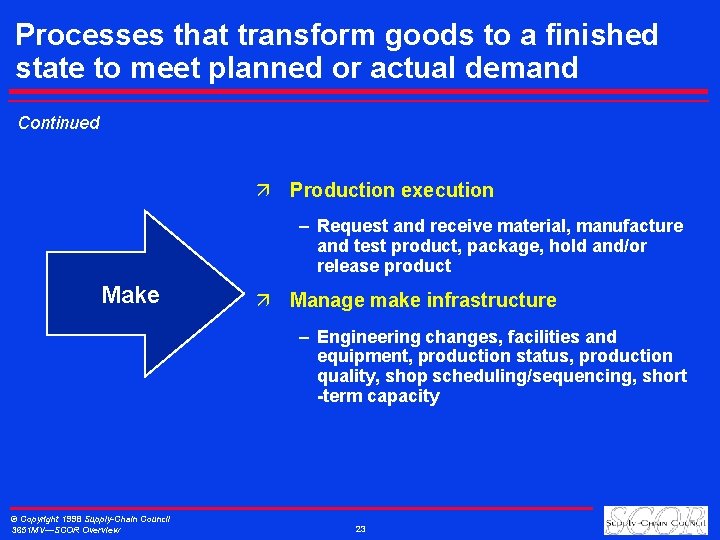
Processes that transform goods to a finished state to meet planned or actual demand Continued ä Production execution – Request and receive material, manufacture and test product, package, hold and/or release product Make ä Manage make infrastructure – Engineering changes, facilities and equipment, production status, production quality, shop scheduling/sequencing, short -term capacity © Copyright 1998 Supply-Chain Council 3651 MV—SCOR Overview 23
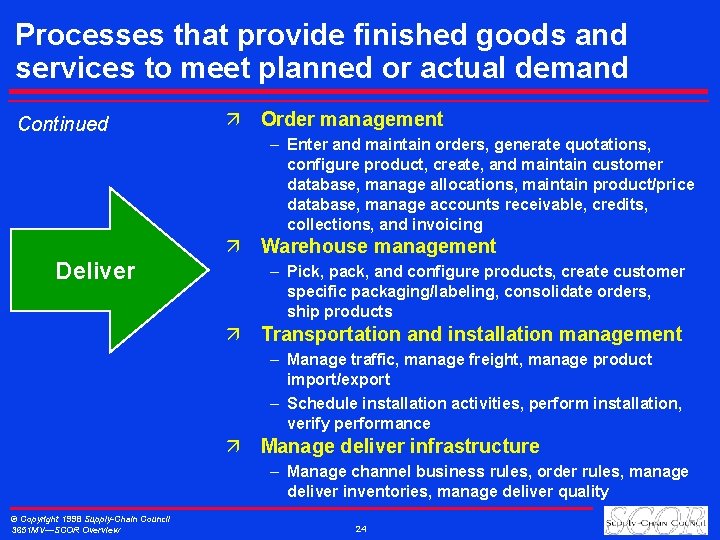
Processes that provide finished goods and services to meet planned or actual demand Continued Deliver ä Order management – Enter and maintain orders, generate quotations, configure product, create, and maintain customer database, manage allocations, maintain product/price database, manage accounts receivable, credits, collections, and invoicing ä Warehouse management – Pick, pack, and configure products, create customer specific packaging/labeling, consolidate orders, ship products ä Transportation and installation management – Manage traffic, manage freight, manage product import/export – Schedule installation activities, perform installation, verify performance ä Manage deliver infrastructure – Manage channel business rules, order rules, manage deliver inventories, manage deliver quality © Copyright 1998 Supply-Chain Council 3651 MV—SCOR Overview 24
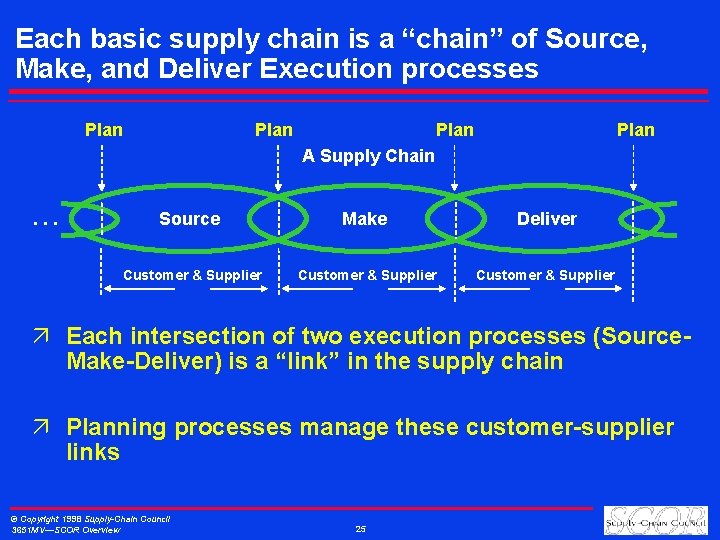
Each basic supply chain is a “chain” of Source, Make, and Deliver Execution processes Plan A Supply Chain. . . Source Make Deliver Customer & Supplier ä Each intersection of two execution processes (Source. Make-Deliver) is a “link” in the supply chain ä Planning processes manage these customer-supplier links © Copyright 1998 Supply-Chain Council 3651 MV—SCOR Overview 25
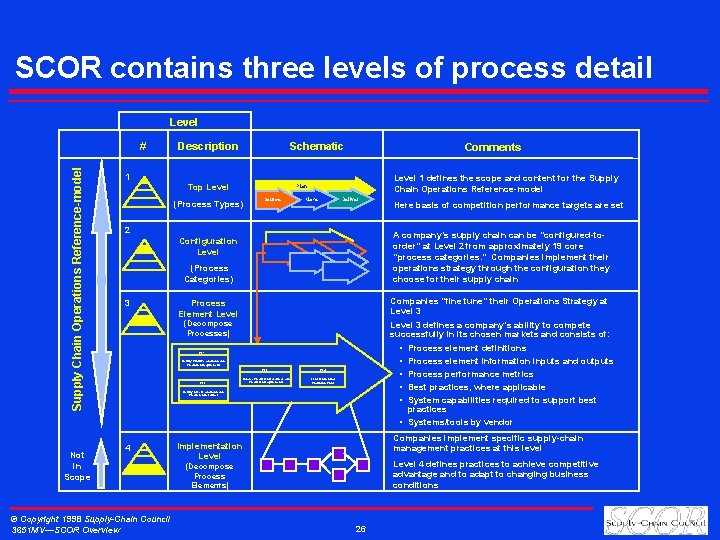
SCOR contains three levels of process detail Level Supply Chain Operations Reference-model # Not in Scope Description Schematic Comments 1 Top Level 1 defines the scope and content for the Supply Chain Operations Reference-model Plan (Process Types) Source Deliver Make 2 (Process Categories) A company’s supply chain can be “configured-toorder” at Level 2 from approximately 19 core “process categories. ” Companies implement their operations strategy through the configuration they choose for their supply chain Process Element Level Companies “fine tune” their Operations Strategy at Level 3 (Decompose Processes) Level 3 defines a company’s ability to compete successfully in its chosen markets and consists of: • Process element definitions • Process element information inputs and outputs • Process performance metrics • Best practices, where applicable • System capabilities required to support best practices • Systems/tools by vendor Configuration Level 3 P 3. 1 Identify, Prioritize, and Aggregate Production Requirements P 3. 3 P 3. 2 Balance Production Resources with Production Requirements P 3. 4 Establish Detailed Production Plans Identify, Assess, and Aggregate Production Resources 4 © Copyright 1998 Supply-Chain Council 3651 MV—SCOR Overview Here basis of competition performance targets are set Companies implement specific supply-chain management practices at this level Implementation Level 4 defines practices to achieve competitive advantage and to adapt to changing business conditions (Decompose Process Elements) 26
At Level 1, SCOR is based on four core management processes © Copyright 1998 Supply-Chain Council 3651 MV—SCOR Overview 27 1
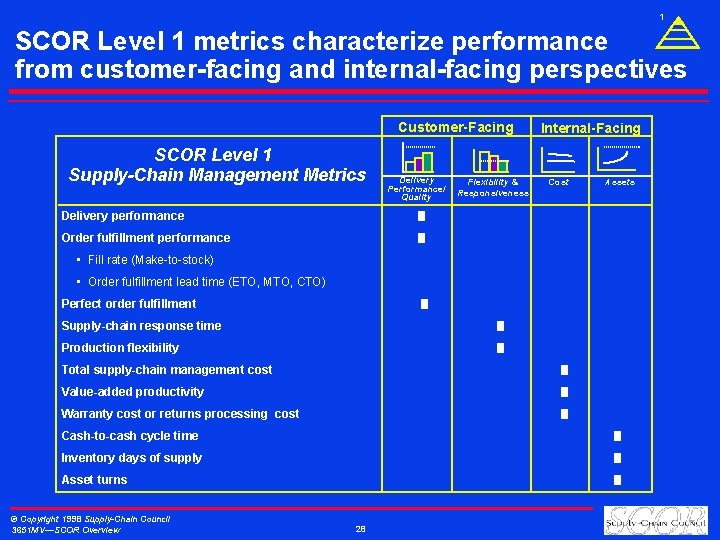
1 SCOR Level 1 metrics characterize performance from customer-facing and internal-facing perspectives Customer-Facing SCOR Level 1 Supply-Chain Management Metrics Delivery Performance/ Quality Delivery performance Order fulfillment performance Flexibility & Responsiveness Internal-Facing Cost Assets • Fill rate (Make-to-stock) • Order fulfillment lead time (ETO, MTO, CTO) Perfect order fulfillment Supply-chain response time Production flexibility Total supply-chain management cost Value-added productivity Warranty cost or returns processing cost Cash-to-cash cycle time Inventory days of supply Asset turns © Copyright 1998 Supply-Chain Council 3651 MV—SCOR Overview 28
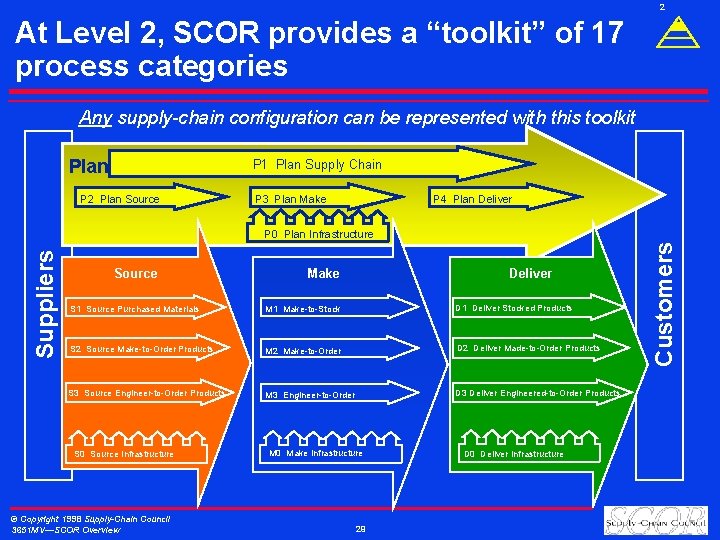
2 At Level 2, SCOR provides a “toolkit” of 17 process categories Any supply-chain configuration can be represented with this toolkit Plan P 1 Plan Supply Chain P 2 Plan Source P 3 Plan Make P 4 Plan Deliver Source Make Deliver S 1 Source Purchased Materials M 1 Make-to-Stock D 1 Deliver Stocked Products S 2 Source Make-to-Order Products M 2 Make-to-Order D 2 Deliver Made-to-Order Products S 3 Source Engineer-to-Order Products M 3 Engineer-to-Order D 3 Deliver Engineered-to-Order Products S 0 Source Infrastructure © Copyright 1998 Supply-Chain Council 3651 MV—SCOR Overview M 0 Make Infrastructure 29 D 0 Deliver Infrastructure Customers Suppliers P 0 Plan Infrastructure
2 At Level 2, each SCOR process can be further described by process type © Copyright 1998 Supply-Chain Council 3651 MV—SCOR Overview 30
2 For each “SCOR Process, ” Level 2 “Process Categories” represent supply-chain variations ä SCOR process categories reflect distinctions in how products are planned, sourced, made, and delivered © Copyright 1998 Supply-Chain Council 3651 MV—SCOR Overview 31
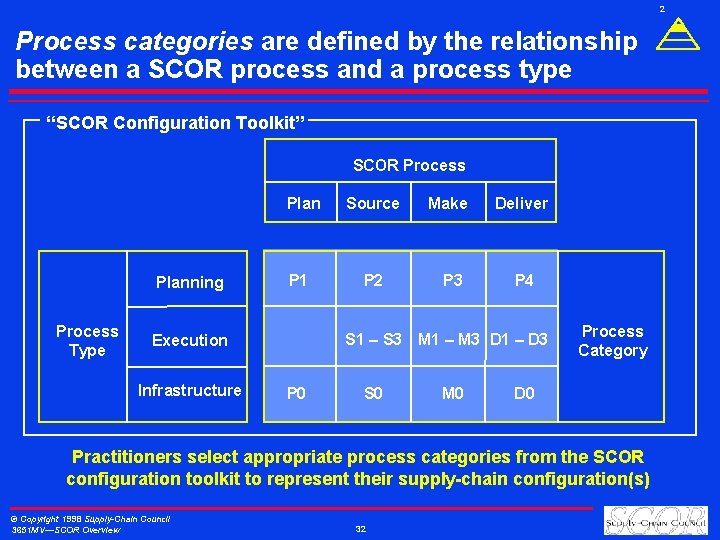
2 Process categories are defined by the relationship between a SCOR process and a process type “SCOR Configuration Toolkit” SCOR Process Planning Process Type P 1 P 2 Make P 3 Deliver P 4 S 1 – S 3 M 1 – M 3 D 1 – D 3 Execution Infrastructure Source P 0 S 0 M 0 Process Category D 0 Practitioners select appropriate process categories from the SCOR configuration toolkit to represent their supply-chain configuration(s) © Copyright 1998 Supply-Chain Council 3651 MV—SCOR Overview 32
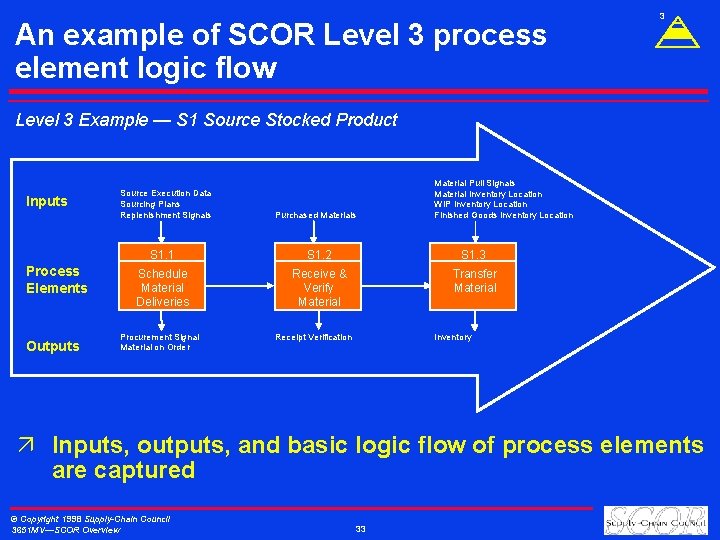
An example of SCOR Level 3 process element logic flow 3 Level 3 Example — S 1 Source Stocked Product Inputs Process Elements Outputs Source Execution Data Sourcing Plans Replenishment Signals Purchased Materials Material Pull Signals Material Inventory Location WIP Inventory Location Finished Goods Inventory Location S 1. 1 S 1. 2 S 1. 3 Schedule Material Deliveries Receive & Verify Material Transfer Material Procurement Signal Material on Order Receipt Verification Inventory ä Inputs, outputs, and basic logic flow of process elements are captured © Copyright 1998 Supply-Chain Council 3651 MV—SCOR Overview 33
3 An example of a SCOR Level 3 standard process element definition and standard performance metrics © Copyright 1998 Supply-Chain Council 3651 MV—SCOR Overview 34
An example of SCOR Level 3 best practices, software features, and vendors © Copyright 1998 Supply-Chain Council 3651 MV—SCOR Overview 35 3
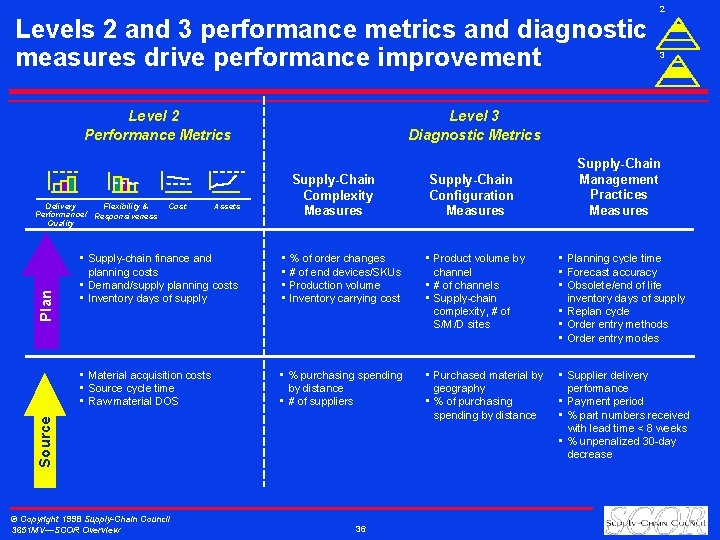
2 Levels 2 and 3 performance metrics and diagnostic measures drive performance improvement Level 2 Performance Metrics Cost Level 3 Diagnostic Metrics Assets Supply-Chain Configuration Measures % of order changes # of end devices/SKUs Production volume Inventory carrying cost • Product volume by channel • # of channels • Supply-chain complexity, # of S/M/D sites • Planning cycle time • Forecast accuracy • Obsolete/end of life inventory days of supply • Replan cycle • Order entry methods • Order entry modes • Purchased material by geography • % of purchasing spending by distance • Supplier delivery performance • Payment period • % part numbers received with lead time < 8 weeks • % unpenalized 30 -day decrease • Supply-chain finance and planning costs • Demand/supply planning costs • Inventory days of supply • • • Material acquisition costs • Source cycle time • Raw material DOS • % purchasing spending by distance • # of suppliers © Copyright 1998 Supply-Chain Council 3651 MV—SCOR Overview Supply-Chain Management Practices Measures Supply-Chain Complexity Measures Source Plan Delivery Flexibility & Performance/ Responsiveness Quality 3 36
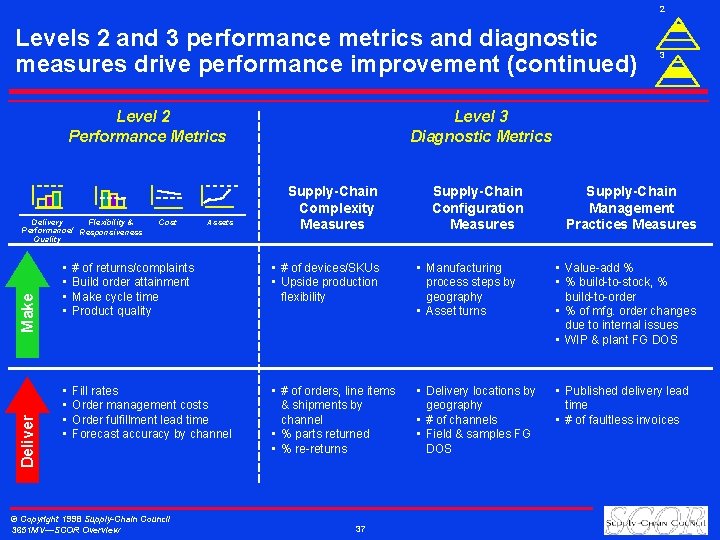
2 Levels 2 and 3 performance metrics and diagnostic measures drive performance improvement (continued) Level 2 Performance Metrics Deliver Make Delivery Flexibility & Performance/ Responsiveness Quality Cost Assets 3 Level 3 Diagnostic Metrics Supply-Chain Complexity Measures Supply-Chain Configuration Measures Supply-Chain Management Practices Measures • • # of returns/complaints Build order attainment Make cycle time Product quality • # of devices/SKUs • Upside production flexibility • Manufacturing process steps by geography • Asset turns • Value-add % • % build-to-stock, % build-to-order • % of mfg. order changes due to internal issues • WIP & plant FG DOS • • Fill rates Order management costs Order fulfillment lead time Forecast accuracy by channel • # of orders, line items & shipments by channel • % parts returned • % re-returns • Delivery locations by geography • # of channels • Field & samples FG DOS • Published delivery lead time • # of faultless invoices © Copyright 1998 Supply-Chain Council 3651 MV—SCOR Overview 37
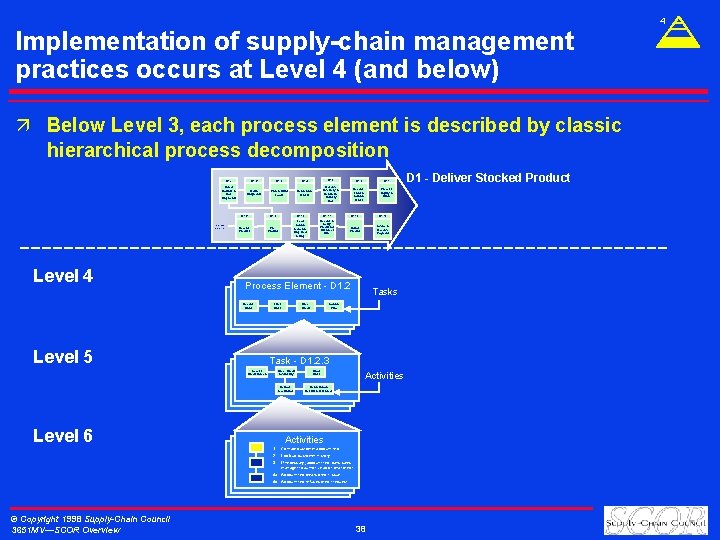
4 Implementation of supply-chain management practices occurs at Level 4 (and below) ä Below Level 3, each process element is described by classic hierarchical process decomposition D 1. 7 D 1. 6 D 1. 5 D 1. 4 D 1. 3 D 1. 2 D 1. 1 Select Carriers & Rate Shipments Route Shipments Plan & Build Loads Consolidate Orders Reserve Inventory & Determine Delivery Date Receive, Enter & Validate Order Process Inquiry & Quote From Make or Source Level 4 D 1. 8 D 1. 9 D 1. 10 D 1. 11 Receive Product Pick Product Load Vehicle Generate Ship Docs & Ship Receive & Verify Product at Customer Site D 1. 13 Install Product Invoice & Receive Payment Process Element - D 1. 2 Receive Order Level 5 Enter Order Check Credit Tasks Validate Price Task - D 1. 2. 3 Access Credit Screen Check Credit Availability Contact Accounting Level 6 D 1. 12 Clear Order Activities Communicate Results to Customer Activities 1. Contact customer account rep. 2. Look up customer history 3. If necessary, account rep. calls sales manager to authorize additional credit 4 a. Account rep clears credit issue 4 b. Account rep refuses credit request © Copyright 1998 Supply-Chain Council 3651 MV—SCOR Overview 38 D 1 - Deliver Stocked Product
Applying the Model © Copyright 1998 Supply-Chain Council 3651 MV—SCOR Overview 39
SCOR can be used to achieve many objectives ä Rapidly map own or others’ supply chain – Illustrate current supply-chain configurations – Establish common reference point and definitions – Communicate effectively with suppliers and customers ä Compare process performance to targets – Benchmark metrics across multiple industries – Compare existing practices to industry best practices ä Determine required information systems capabilities – Identify software vendors providing required capabilities © Copyright 1998 Supply-Chain Council 3651 MV—SCOR Overview 40
SCOR can be used to achieve many objectives Continued ä Identify supply-chain management improvement opportunities – Identify gaps in current processes – Quantify the potential benefits of specific process improvements – Provide data for project financial justifications ä Implement supply-chain process improvements – Design to meet strategic objectives – “Fine tune” based on pilot results and changing market needs ä Influence creation of desired software products – Communicate needed product features to software vendors © Copyright 1998 Supply-Chain Council 3651 MV—SCOR Overview 41
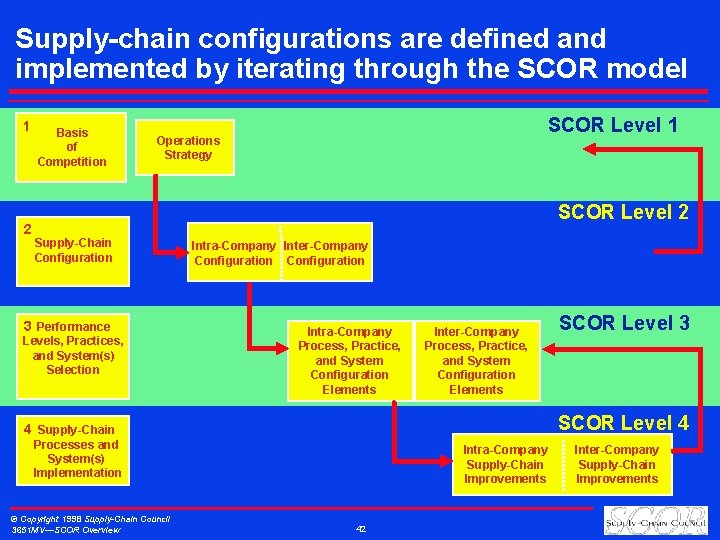
Supply-chain configurations are defined and implemented by iterating through the SCOR model 1 2 Basis of Competition SCOR Level 1 Operations Strategy SCOR Level 2 Supply-Chain Configuration 3 Performance Levels, Practices, and System(s) Selection Intra-Company Inter-Company Configuration Intra-Company Process, Practice, and System Configuration Elements Inter-Company Process, Practice, and System Configuration Elements SCOR Level 4 4 Supply-Chain Processes and System(s) Implementation © Copyright 1998 Supply-Chain Council 3651 MV—SCOR Overview SCOR Level 3 Intra-Company Supply-Chain Improvements 42 Inter-Company Supply-Chain Improvements
Applying the Model: A Case Study © Copyright 1998 Supply-Chain Council 3651 MV—SCOR Overview 43
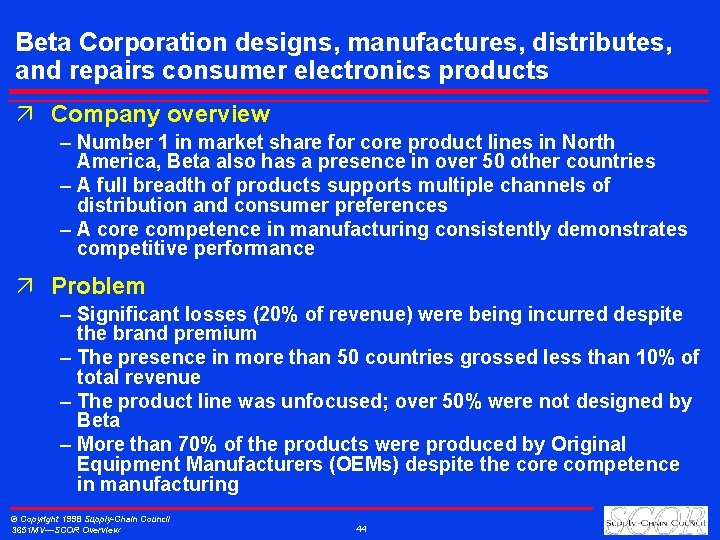
Beta Corporation designs, manufactures, distributes, and repairs consumer electronics products ä Company overview – Number 1 in market share for core product lines in North America, Beta also has a presence in over 50 other countries – A full breadth of products supports multiple channels of distribution and consumer preferences – A core competence in manufacturing consistently demonstrates competitive performance ä Problem – Significant losses (20% of revenue) were being incurred despite the brand premium – The presence in more than 50 countries grossed less than 10% of total revenue – The product line was unfocused; over 50% were not designed by Beta – More than 70% of the products were produced by Original Equipment Manufacturers (OEMs) despite the core competence in manufacturing © Copyright 1998 Supply-Chain Council 3651 MV—SCOR Overview 44
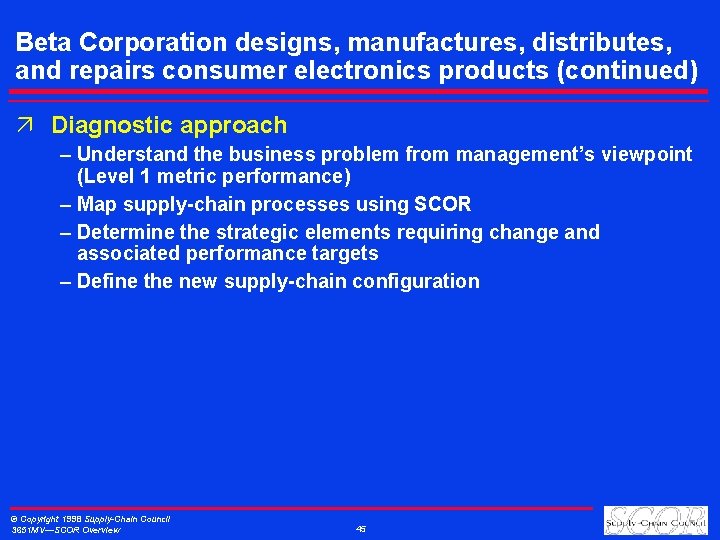
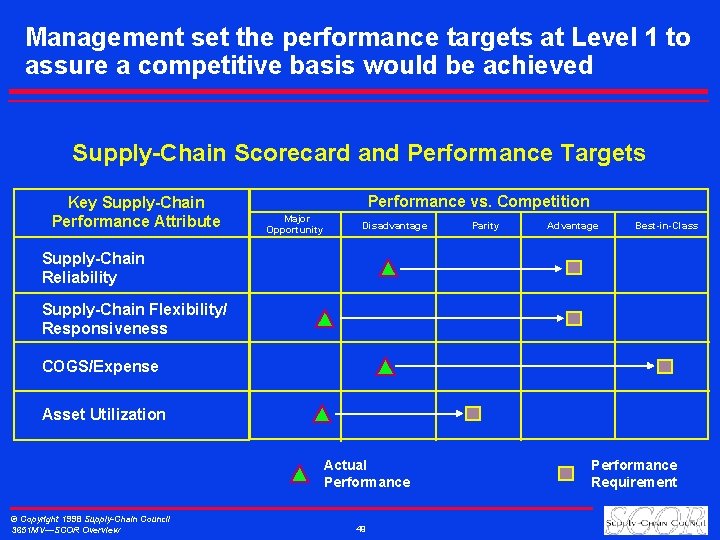
Beta Corporation designs, manufactures, distributes, and repairs consumer electronics products (continued) ä Diagnostic approach – Understand the business problem from management’s viewpoint (Level 1 metric performance) – Map supply-chain processes using SCOR – Determine the strategic elements requiring change and associated performance targets – Define the new supply-chain configuration © Copyright 1998 Supply-Chain Council 3651 MV—SCOR Overview 45
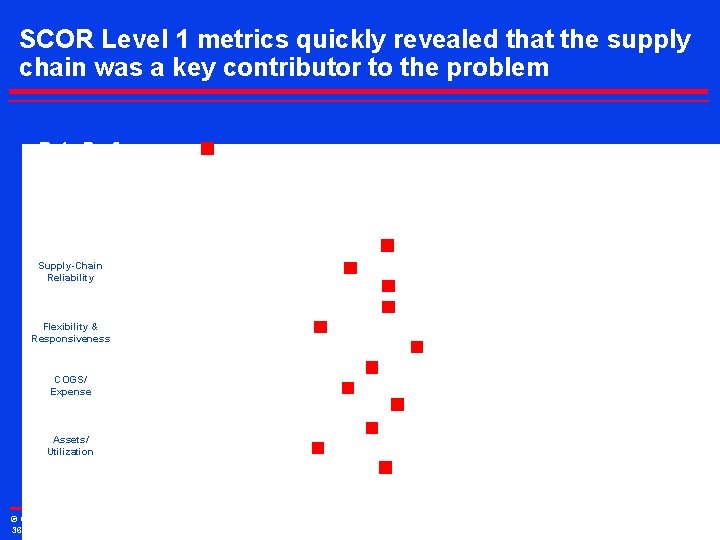
SCOR Level 1 metrics quickly revealed that the supply chain was a key contributor to the problem Beta Performance Supply-Chain Reliability Flexibility & Responsiveness COGS/ Expense Assets/ Utilization © Copyright 1998 Supply-Chain Council 3651 MV—SCOR Overview 46
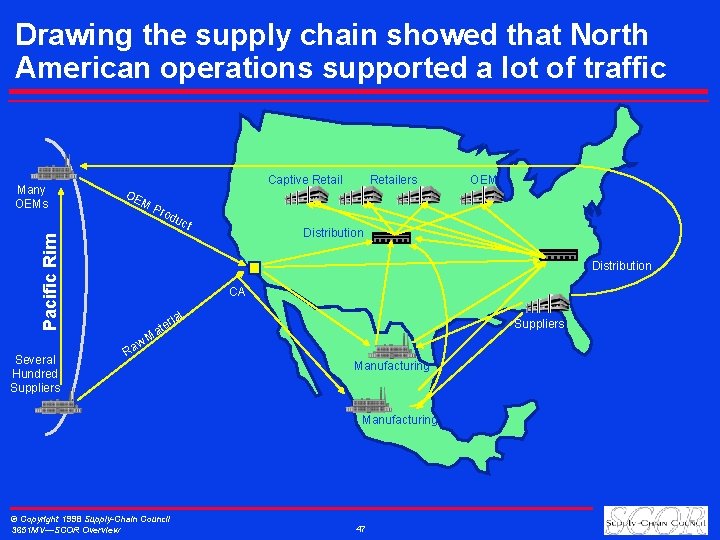
Drawing the supply chain showed that North American operations supported a lot of traffic Captive Retail OE M Several Hundred Suppliers Retailers OEM Pro du ct Pacific Rim Many OEMs Distribution CA w Ra r ate ial Suppliers M Manufacturing © Copyright 1998 Supply-Chain Council 3651 MV—SCOR Overview 47
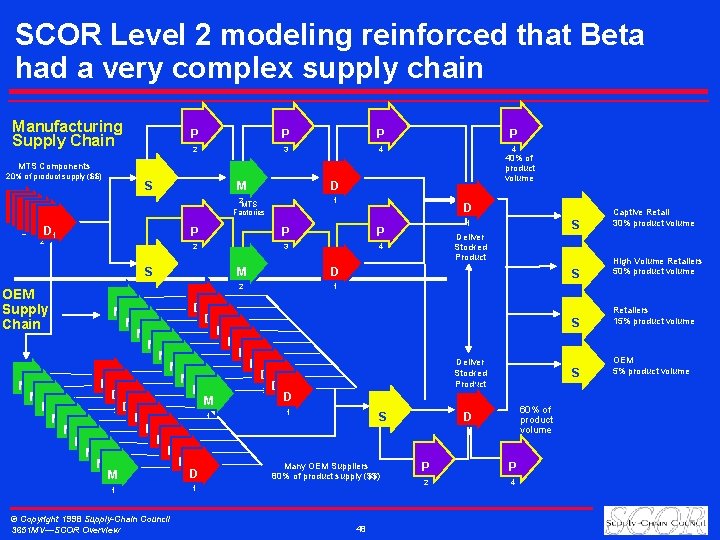
SCOR Level 2 modeling reinforced that Beta had a very complex supply chain Manufacturing Supply Chain MTS Components P P P 2 3 4 M S 20% of product supply ($$) D 2 D DD 1 D 2 D 2 1 1 P 2 S 2 M 2 1 OEM Supply Chain 2 MTS Factories © Copyright 1998 Supply-Chain Council 3651 MV—SCOR Overview 4 40% of product volume D D 1 P P 3 4 D S 1 Deliver Stocked Product 1 48 Captive Retail 30% product volume 1 S 1 D M 2 D 1 M D 2 1 M D 2 M 1 D M 2 D 1 M D 2 1 M 2 D 1 M 2 D 1 M 1 1 S 2 D 1 M D M 1 2 1 2 D 1 M 2 D Many OEM Suppliers 1 M 80% of product supply ($$) 2 D 1 M 1 P High Volume Retailers 50% product volume 1 S Retailers 15% product volume 1 S Deliver Stocked Product 1 D 60% of product volume 1 P P 2 4 OEM 5% product volume
Management set the performance targets at Level 1 to assure a competitive basis would be achieved Supply-Chain Scorecard and Performance Targets Key Supply-Chain Performance Attribute Performance vs. Competition Major Opportunity Disadvantage Parity Advantage Best-in-Class Supply-Chain Reliability Supply-Chain Flexibility/ Responsiveness COGS/Expense Asset Utilization Actual Performance © Copyright 1998 Supply-Chain Council 3651 MV—SCOR Overview 49 Performance Requirement
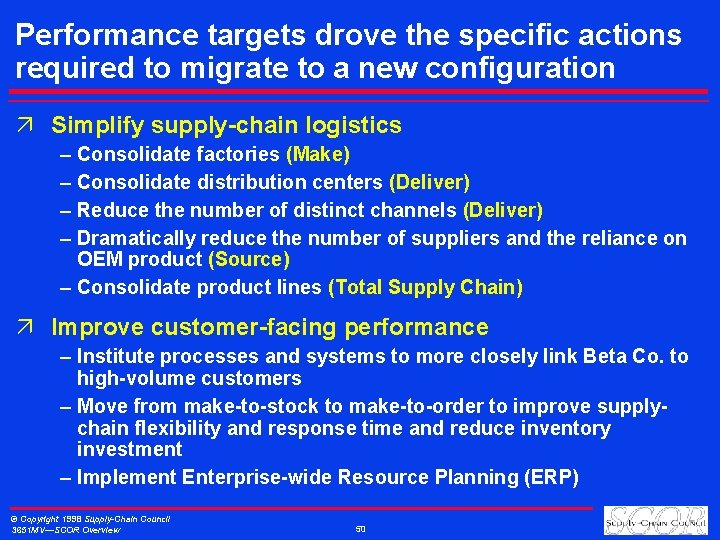
Performance targets drove the specific actions required to migrate to a new configuration ä Simplify supply-chain logistics – Consolidate factories (Make) – Consolidate distribution centers (Deliver) – Reduce the number of distinct channels (Deliver) – Dramatically reduce the number of suppliers and the reliance on OEM product (Source) – Consolidate product lines (Total Supply Chain) ä Improve customer-facing performance – Institute processes and systems to more closely link Beta Co. to high-volume customers – Move from make-to-stock to make-to-order to improve supplychain flexibility and response time and reduce inventory investment – Implement Enterprise-wide Resource Planning (ERP) © Copyright 1998 Supply-Chain Council 3651 MV—SCOR Overview 50
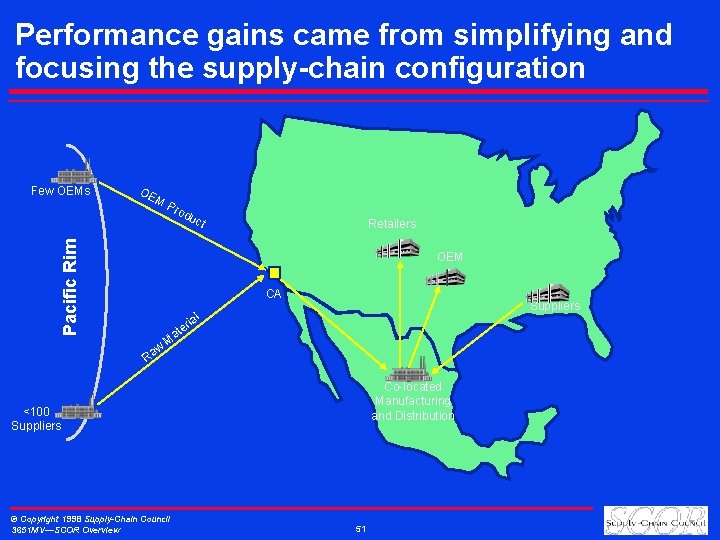
Performance gains came from simplifying and focusing the supply-chain configuration Few OEMs OE M Pro Pacific Rim du ct Retailers OEM CA w Ra M e at Suppliers l ria Co-located Manufacturing and Distribution <100 Suppliers © Copyright 1998 Supply-Chain Council 3651 MV—SCOR Overview 51
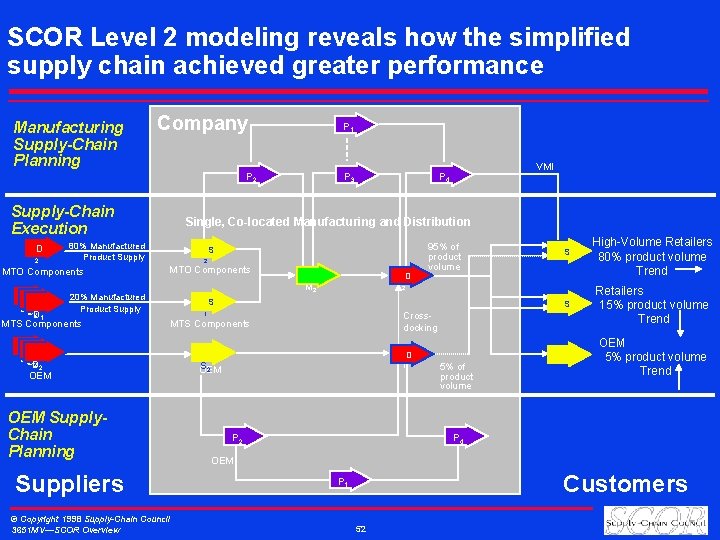
SCOR Level 2 modeling reveals how the simplified supply chain achieved greater performance Manufacturing Supply-Chain Planning Company P 1 P 2 Supply-Chain Execution D 2 Single, Co-located Manufacturing and Distribution 80% Manufactured Product Supply MTO Components 20% Manufactured DD Product Supply 2 2 D 1 MTS Components VMI P 4 P 3 S 2 MTO Components M 2 D 95% of product volume S Crossdocking 1 MTS Components OEM Supply. Chain Planning Suppliers © Copyright 1998 Supply-Chain Council 3651 MV—SCOR Overview 2 2 S DD 2 2 D 2 OEM S S 2 OEM 2 D 1 5% of product volume S 2 High-Volume Retailers 80% product volume Trend Retailers 15% product volume Trend OEM 5% product volume Trend P 4 P 2 OEM Customers P 1 52
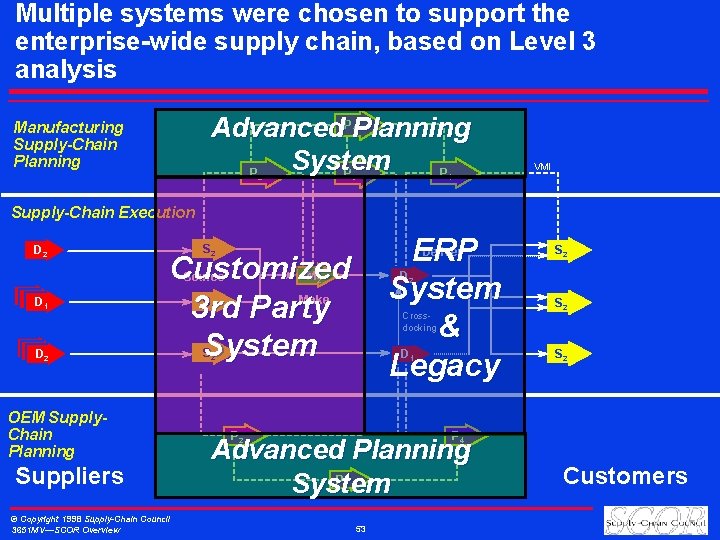
Multiple systems were chosen to support the enterprise-wide supply chain, based on Level 3 analysis Advanced. PPlanning System P P P Manufacturing Supply-Chain Planning 1 2 3 VMI 4 Supply-Chain Execution D 2 D D 22 D 2 Deliver Customized 3 rd Party System M 2 Source D D 22 D 1 ERP System & Legacy S 2 OEM Supply. Chain Planning Suppliers © Copyright 1998 Supply-Chain Council 3651 MV—SCOR Overview D 2 Make S 1 S 2 Crossdocking S 2 D 1 P 2 S 2 P 4 Advanced Planning P System 1 53 Customers
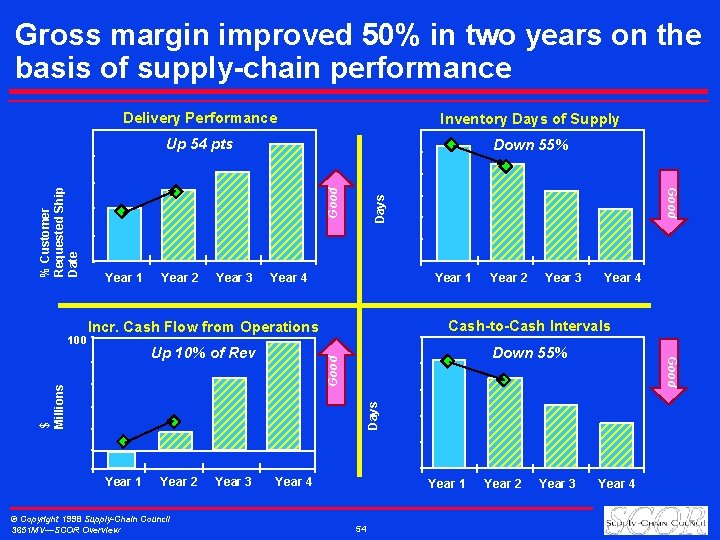
Up 54 pts Down 55% Year 1 Year 2 Year 3 Days Good Inventory Days of Supply Year 1 Year 4 Year 2 Year 3 Year 4 Up 10% of Rev Down 55% Good Cash-to-Cash Intervals Days Good Incr. Cash Flow from Operations $ Millions 100 Delivery Performance Good % Customer Requested Ship Date Gross margin improved 50% in two years on the basis of supply-chain performance Year 1 Year 2 © Copyright 1998 Supply-Chain Council 3651 MV—SCOR Overview Year 3 Year 4 Year 1 54 Year 2 Year 3 Year 4
Applying the Model: Developing Supply-Chain Configurations © Copyright 1998 Supply-Chain Council 3651 MV—SCOR Overview 55
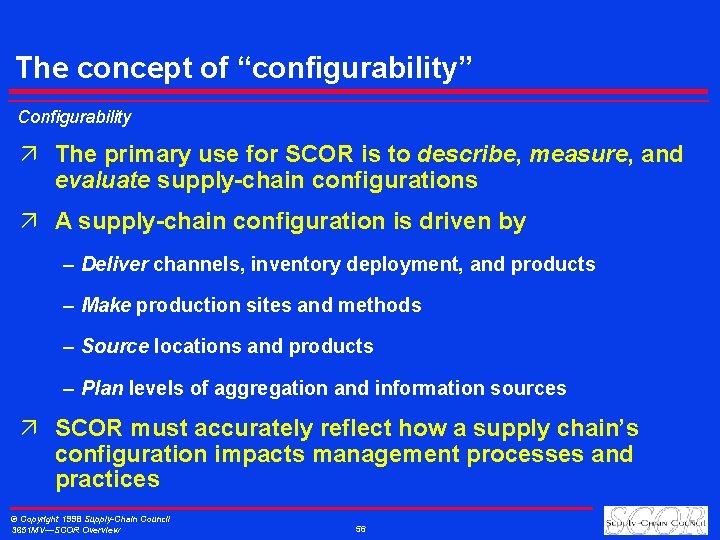
The concept of “configurability” Configurability ä The primary use for SCOR is to describe, measure, and evaluate supply-chain configurations ä A supply-chain configuration is driven by – Deliver channels, inventory deployment, and products – Make production sites and methods – Source locations and products – Plan levels of aggregation and information sources ä SCOR must accurately reflect how a supply chain’s configuration impacts management processes and practices © Copyright 1998 Supply-Chain Council 3651 MV—SCOR Overview 56
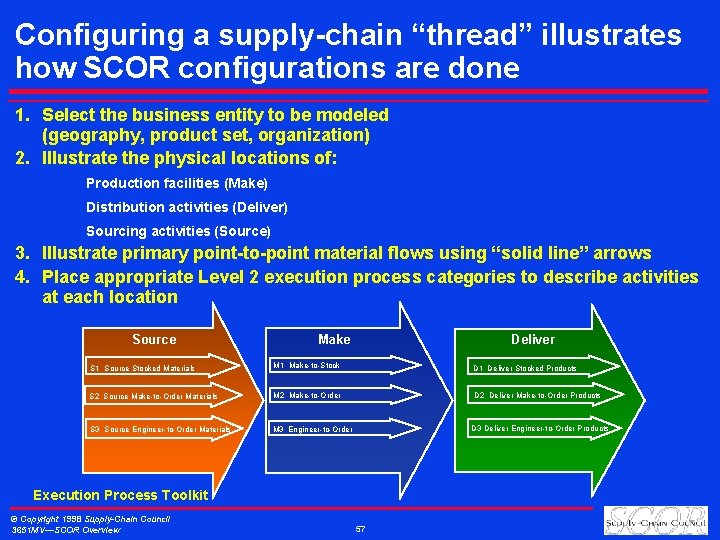
Configuring a supply-chain “thread” illustrates how SCOR configurations are done 1. Select the business entity to be modeled (geography, product set, organization) 2. Illustrate the physical locations of: Production facilities (Make) Distribution activities (Deliver) Sourcing activities (Source) 3. Illustrate primary point-to-point material flows using “solid line” arrows 4. Place appropriate Level 2 execution process categories to describe activities at each location Source Make Deliver S 1 Source Stocked Materials M 1 Make-to-Stock D 1 Deliver Stocked Products S 2 Source Make-to-Order Materials M 2 Make-to-Order D 2 Deliver Make-to-Order Products S 3 Source Engineer-to-Order Materials M 3 Engineer-to-Order D 3 Deliver Engineer-to-Order Products Execution Process Toolkit © Copyright 1998 Supply-Chain Council 3651 MV—SCOR Overview 57
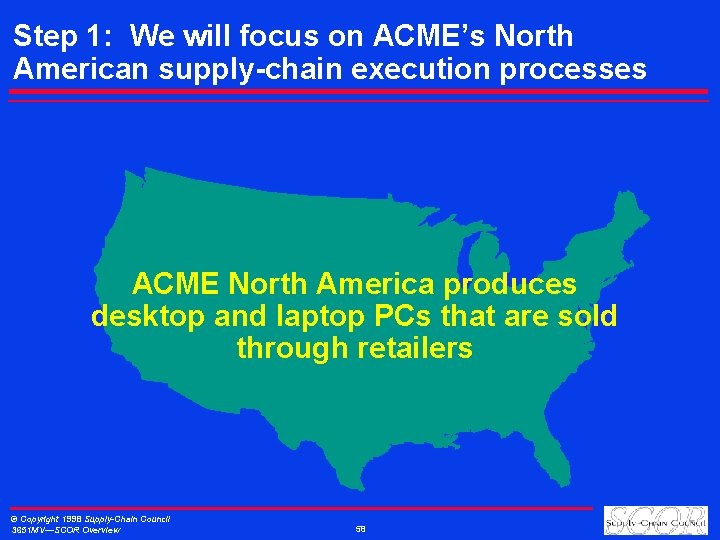
Step 1: We will focus on ACME’s North American supply-chain execution processes ACME North America produces desktop and laptop PCs that are sold through retailers © Copyright 1998 Supply-Chain Council 3651 MV—SCOR Overview 58
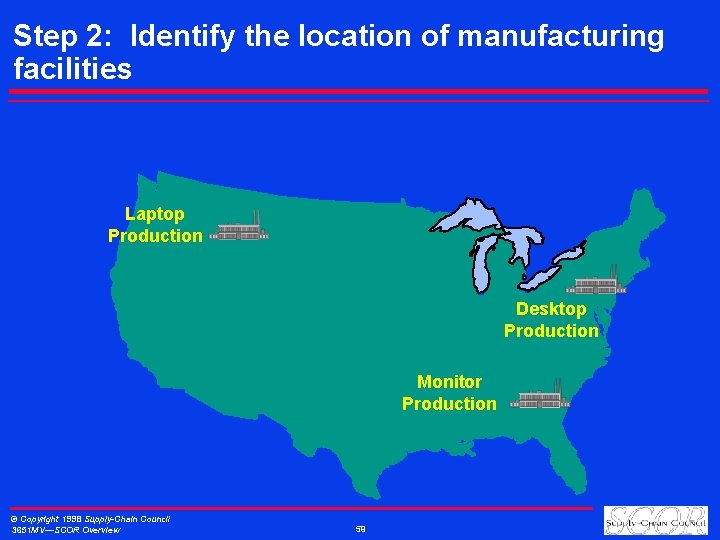
Step 2: Identify the location of manufacturing facilities Laptop Production Desktop Production Monitor Production © Copyright 1998 Supply-Chain Council 3651 MV—SCOR Overview 59
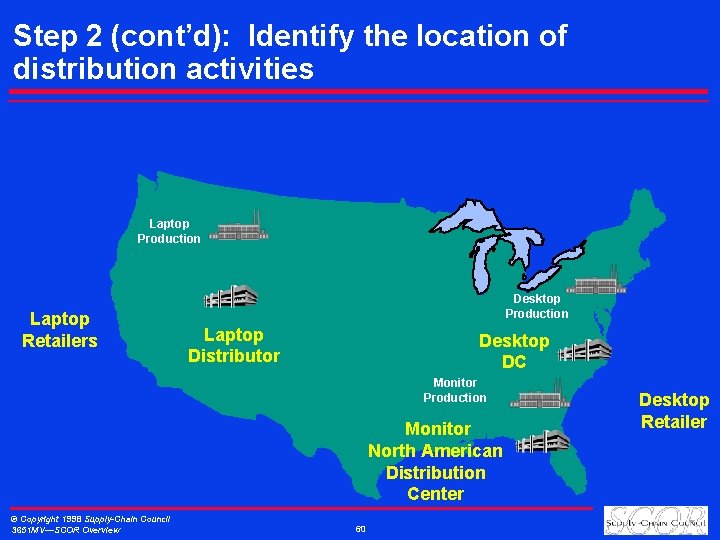
Step 2 (cont’d): Identify the location of distribution activities Laptop Production Laptop Retailers Desktop Production Laptop Distributor Desktop DC Monitor Production Monitor North American Distribution Center © Copyright 1998 Supply-Chain Council 3651 MV—SCOR Overview 60 Desktop Retailer
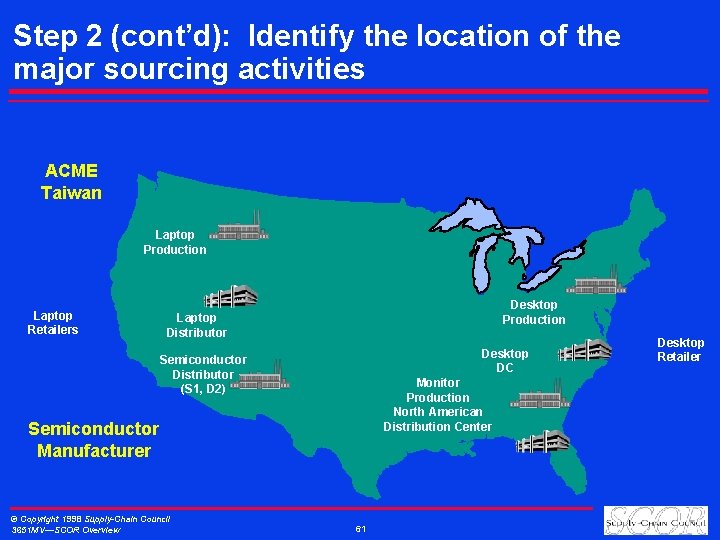
Step 2 (cont’d): Identify the location of the major sourcing activities ACME Taiwan Laptop Production Laptop Retailers Desktop Production Laptop Distributor Desktop DC Semiconductor Distributor (S 1, D 2) Monitor Production North American Distribution Center Semiconductor Manufacturer © Copyright 1998 Supply-Chain Council 3651 MV—SCOR Overview 61 Desktop Retailer
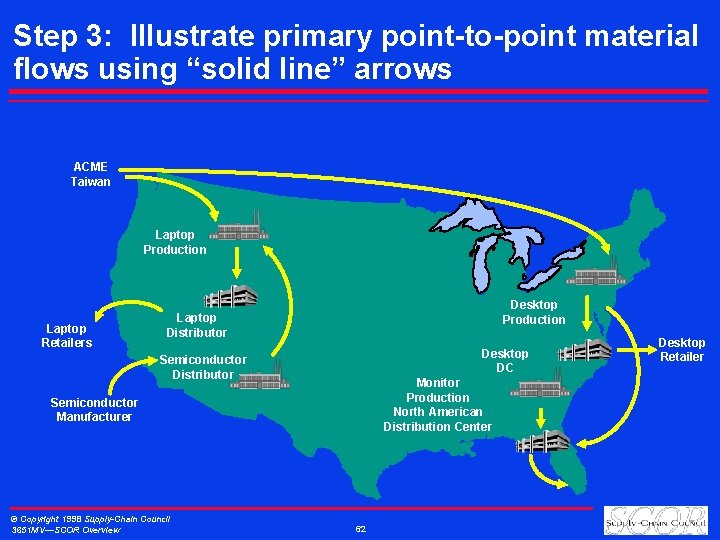
Step 3: Illustrate primary point-to-point material flows using “solid line” arrows ACME Taiwan Laptop Production Laptop Retailers Desktop Production Laptop Distributor Desktop DC Semiconductor Distributor Monitor Production North American Distribution Center Semiconductor Manufacturer © Copyright 1998 Supply-Chain Council 3651 MV—SCOR Overview 62 Desktop Retailer
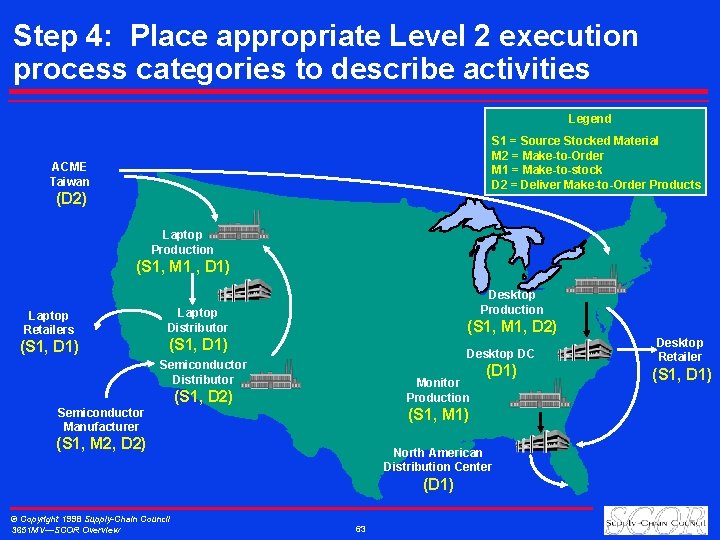
Step 4: Place appropriate Level 2 execution process categories to describe activities Legend S 1 = Source Stocked Material M 2 = Make-to-Order M 1 = Make-to-stock D 2 = Deliver Make-to-Order Products ACME Taiwan (D 2) Laptop Production (S 1, M 1 , D 1) Laptop Retailers (S 1, D 1) Desktop Production Laptop Distributor (S 1, M 1, D 2) (S 1, D 1) Desktop DC Semiconductor Distributor (D 1) Monitor Production (S 1, D 2) (S 1, M 1) Semiconductor Manufacturer (S 1, M 2, D 2) North American Distribution Center (D 1) © Copyright 1998 Supply-Chain Council 3651 MV—SCOR Overview 63 Desktop Retailer (S 1, D 1)
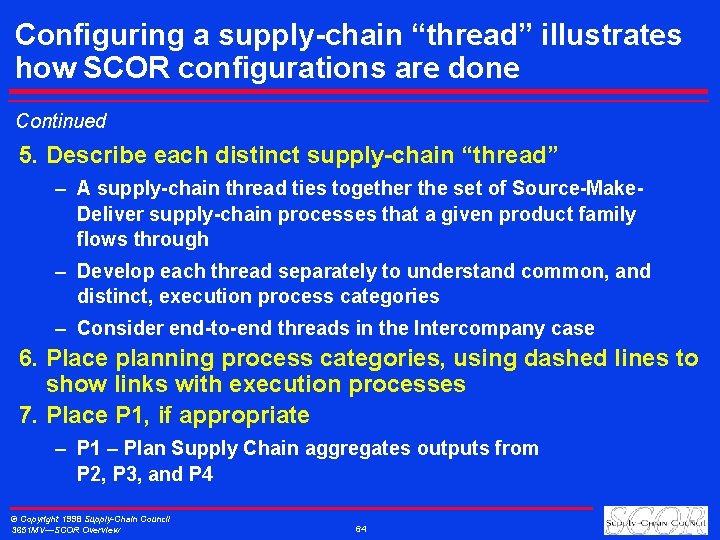
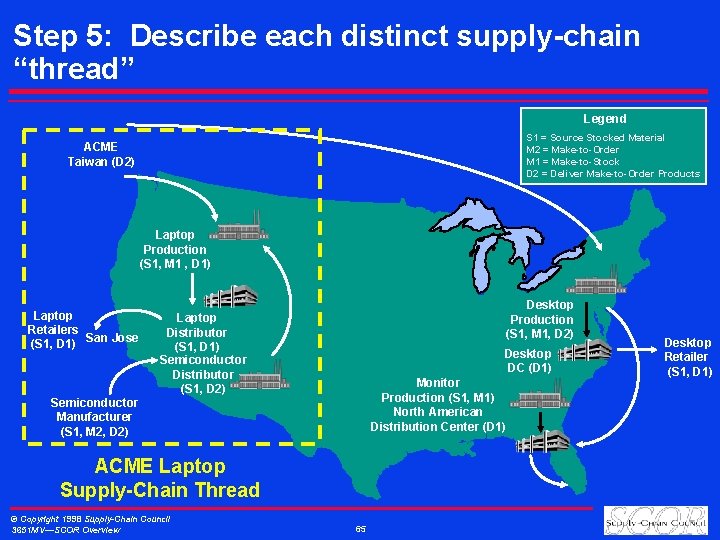
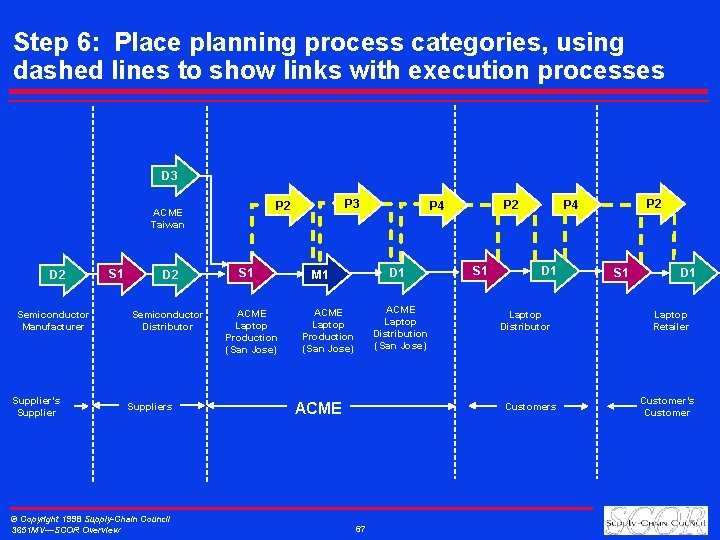
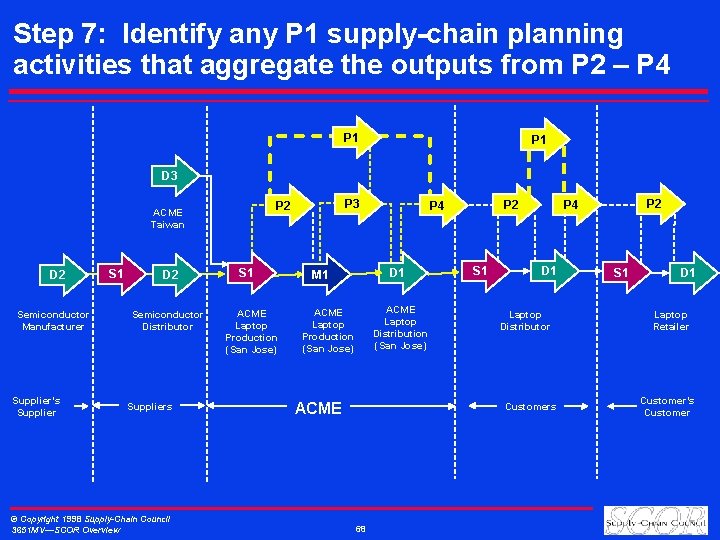
Configuring a supply-chain “thread” illustrates how SCOR configurations are done Continued 5. Describe each distinct supply-chain “thread” – A supply-chain thread ties together the set of Source-Make. Deliver supply-chain processes that a given product family flows through – Develop each thread separately to understand common, and distinct, execution process categories – Consider end-to-end threads in the Intercompany case 6. Place planning process categories, using dashed lines to show links with execution processes 7. Place P 1, if appropriate – P 1 – Plan Supply Chain aggregates outputs from P 2, P 3, and P 4 © Copyright 1998 Supply-Chain Council 3651 MV—SCOR Overview 64
Step 5: Describe each distinct supply-chain “thread” Legend S 1 = Source Stocked Material M 2 = Make-to-Order M 1 = Make-to-Stock D 2 = Deliver Make-to-Order Products ACME Taiwan (D 2) Laptop Production (S 1, M 1 , D 1) Laptop Retailers (S 1, D 1) San Jose Desktop Production (S 1, M 1, D 2) Laptop Distributor (S 1, D 1) Semiconductor Distributor (S 1, D 2) Desktop DC (D 1) Monitor Production (S 1, M 1) North American Distribution Center (D 1) Semiconductor Manufacturer (S 1, M 2, D 2) ACME Laptop Supply-Chain Thread © Copyright 1998 Supply-Chain Council 3651 MV—SCOR Overview 65 Desktop Retailer (S 1, D 1)
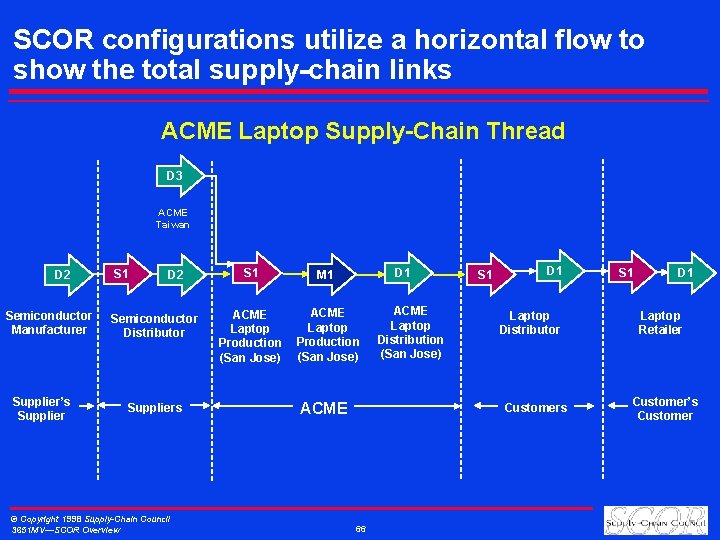
SCOR configurations utilize a horizontal flow to show the total supply-chain links ACME Laptop Supply-Chain Thread D 3 ACME Taiwan D 2 Semiconductor Manufacturer Supplier’s Supplier S 1 D 2 Semiconductor Distributor Suppliers © Copyright 1998 Supply-Chain Council 3651 MV—SCOR Overview S 1 D 1 M 1 ACME Laptop Production (San Jose) ACME Laptop Distribution (San Jose) S 1 D 1 Laptop Distributor Customers 66 S 1 D 1 Laptop Retailer Customer’s Customer
Step 6: Place planning process categories, using dashed lines to show links with execution processes D 3 D 2 Semiconductor Manufacturer Supplier’s Supplier S 1 D 2 Semiconductor Distributor Suppliers © Copyright 1998 Supply-Chain Council 3651 MV—SCOR Overview P 3 P 2 ACME Taiwan S 1 ACME Laptop Production (San Jose) D 1 M 1 ACME Laptop Production (San Jose) ACME P 2 P 4 ACME Laptop Distribution (San Jose) S 1 D 1 Laptop Distributor Customers 67 P 2 P 4 S 1 D 1 Laptop Retailer Customer’s Customer
Step 7: Identify any P 1 supply-chain planning activities that aggregate the outputs from P 2 – P 4 P 1 D 3 D 2 Semiconductor Manufacturer Supplier’s Supplier S 1 D 2 Semiconductor Distributor Suppliers © Copyright 1998 Supply-Chain Council 3651 MV—SCOR Overview P 3 P 2 ACME Taiwan S 1 ACME Laptop Production (San Jose) D 1 M 1 ACME Laptop Production (San Jose) ACME P 2 P 4 ACME Laptop Distribution (San Jose) S 1 D 1 Laptop Distributor Customers 68 P 2 P 4 S 1 D 1 Laptop Retailer Customer’s Customer
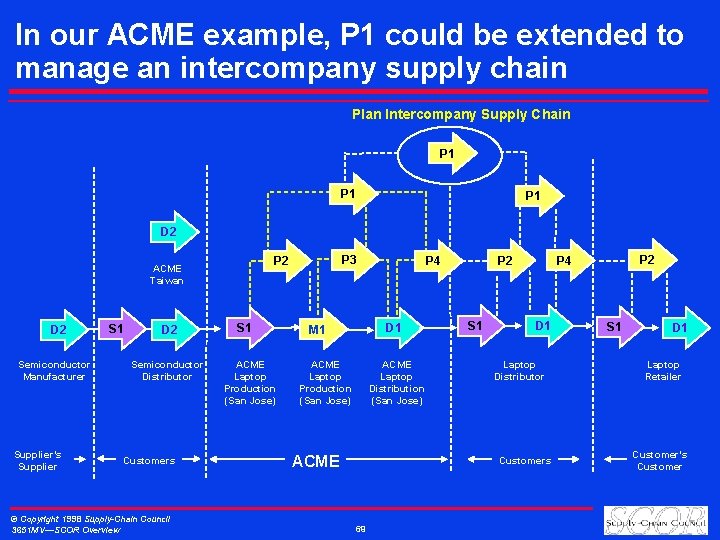
In our ACME example, P 1 could be extended to manage an intercompany supply chain Plan Intercompany Supply Chain P 1 P 1 D 2 Semiconductor Manufacturer Supplier’s Supplier S 1 D 2 Semiconductor Distributor Customers © Copyright 1998 Supply-Chain Council 3651 MV—SCOR Overview P 3 P 2 ACME Taiwan S 1 ACME Laptop Production (San Jose) D 1 M 1 ACME Laptop Production (San Jose) ACME Laptop Distribution (San Jose) ACME P 2 P 4 S 1 D 1 Laptop Distributor Customers 69 P 2 P 4 S 1 D 1 Laptop Retailer Customer’s Customer
Supply Chain Operations Reference-model: Summary © Copyright 1998 Supply-Chain Council 3651 MV—SCOR Overview 70
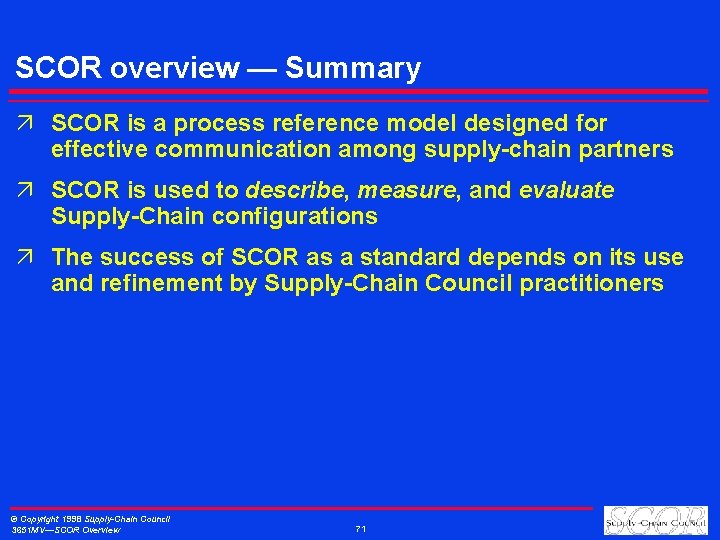
SCOR overview — Summary ä SCOR is a process reference model designed for effective communication among supply-chain partners ä SCOR is used to describe, measure, and evaluate Supply-Chain configurations ä The success of SCOR as a standard depends on its use and refinement by Supply-Chain Council practitioners © Copyright 1998 Supply-Chain Council 3651 MV—SCOR Overview 71
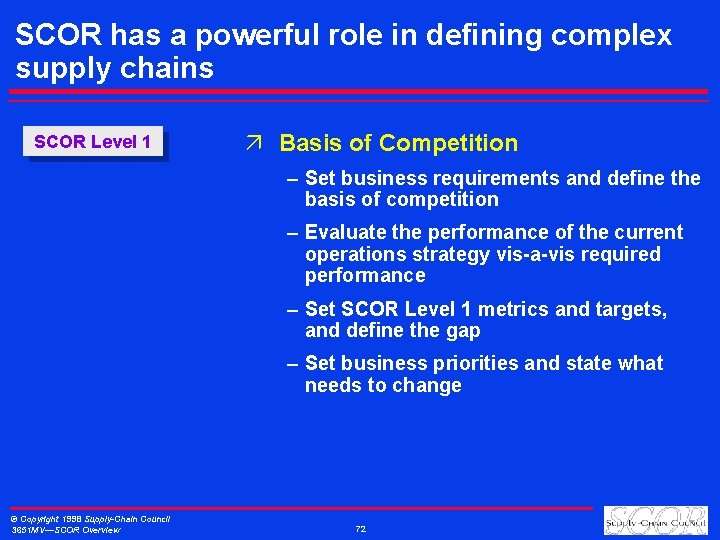
SCOR has a powerful role in defining complex supply chains SCOR Level 1 ä Basis of Competition – Set business requirements and define the basis of competition – Evaluate the performance of the current operations strategy vis-a-vis required performance – Set SCOR Level 1 metrics and targets, and define the gap – Set business priorities and state what needs to change © Copyright 1998 Supply-Chain Council 3651 MV—SCOR Overview 72
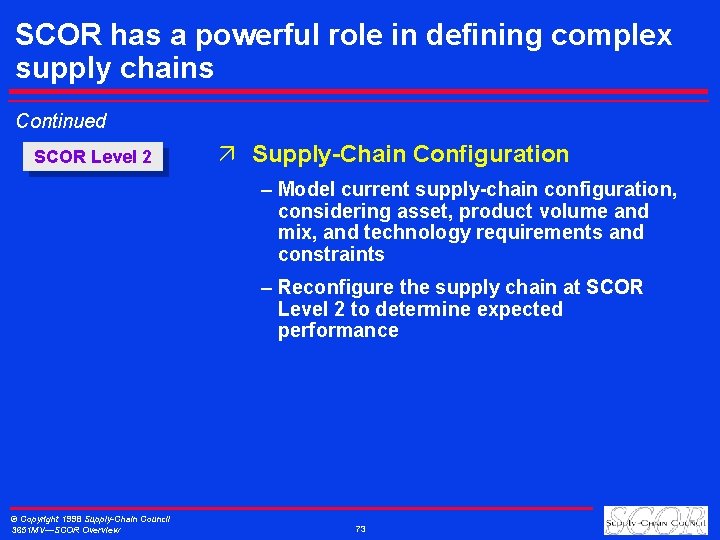
SCOR has a powerful role in defining complex supply chains Continued SCOR Level 2 ä Supply-Chain Configuration – Model current supply-chain configuration, considering asset, product volume and mix, and technology requirements and constraints – Reconfigure the supply chain at SCOR Level 2 to determine expected performance © Copyright 1998 Supply-Chain Council 3651 MV—SCOR Overview 73
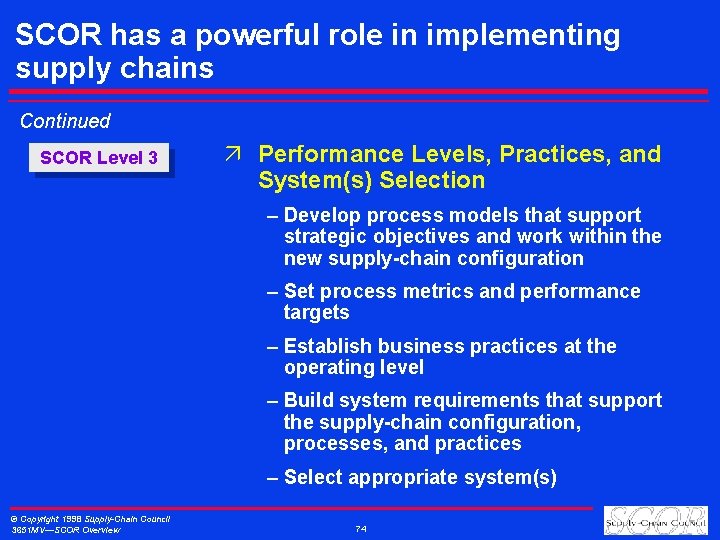
SCOR has a powerful role in implementing supply chains Continued SCOR Level 3 ä Performance Levels, Practices, and System(s) Selection – Develop process models that support strategic objectives and work within the new supply-chain configuration – Set process metrics and performance targets – Establish business practices at the operating level – Build system requirements that support the supply-chain configuration, processes, and practices – Select appropriate system(s) © Copyright 1998 Supply-Chain Council 3651 MV—SCOR Overview 74
SCOR has a powerful role in implementing supply chains Continued SCOR Level 4 ä Supply-Chain Process and System(s) Implementation – Implement best practices to achieve results © Copyright 1998 Supply-Chain Council 3651 MV—SCOR Overview 75
A note on additional SCOR educational materials…to learn more about SCOR ä The Supply-Chain council has published a curriculum of SCOR-based SCM improvement tips and techniques: – Module 1: Using SCOR to support Supply-Chain Education and Training – Module 2: Using SCOR to understand implications of a shift in Operations Strategy – Module 3: Using SCOR metrics to frame and justify supplychain improvement programs – Module 4: Using SCOR to integrate your supplier’s supplier into your supply chain – Module 5: Using SCOR to integrate your customer’s customer into your supply chain ä This material is fully available to SCC members at www. supply-chain. org. The current format is Adobe. pdf © Copyright 1998 Supply-Chain Council 3651 MV—SCOR Overview 76
A note on the Supply-Chain Council…to learn more about the SCC ä The SCC is a member-company managed, not-for-profit corporation based in Pittsburgh, PA ä The SCC maintains a web page at www. supply-chain. org – Membership list – Schedule of events – The SCOR model content – Email discussion forums © Copyright 1998 Supply-Chain Council 3651 MV—SCOR Overview 77
The SCC mission statement describes the purposes and approaches of the Supply-Chain Council A non-profit, member-supported trade organization, the Supply-Chain Council (SCC) enables the discussion, definition, and dissemination of best practice in the rapidly evolving field of supply-chain management (SCM). The Council promotes the Supply Chain Operations Referencemodel (SCOR), which embodies a common standard language, consistent metrics, practical models, and analytic tools to expand enhance leading SCM practices. The SCC provides executive management opportunities to network with peers from all SCM constituencies and share lessons learned to define the frontiers of best practice and enabling software applications. The SCC supports the practical application of best practices through education. © Copyright 1998 Supply-Chain Council 3651 MV—SCOR Overview 78
SCOR Primer Conclusion