
Scopes Scientists Review ARISTOTLE Special vital forces brought
‘Scopes & Scientists Review
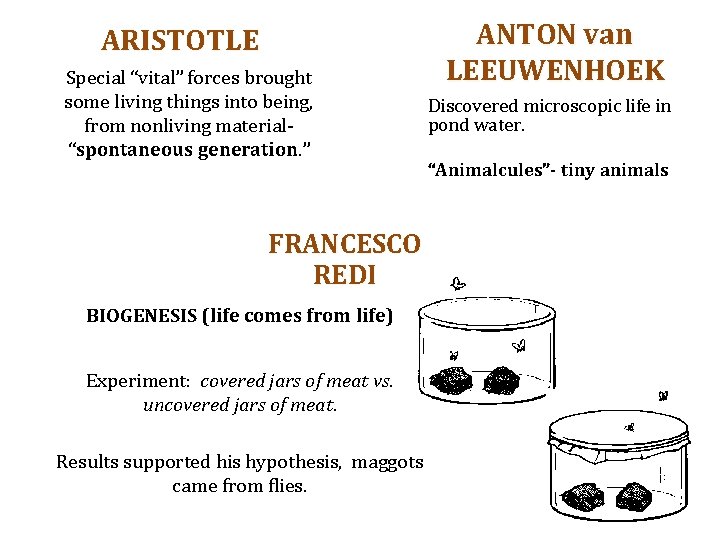
ARISTOTLE Special “vital” forces brought some living things into being, from nonliving material“spontaneous generation. ” FRANCESCO REDI BIOGENESIS (life comes from life) Experiment: covered jars of meat vs. uncovered jars of meat. Results supported his hypothesis, maggots came from flies. ANTON van LEEUWENHOEK Discovered microscopic life in pond water. “Animalcules”- tiny animals

JOHN NEEDHAM Tried to prove spontaneous generation. Flaw with his experiment: the flask was not sealed and was exposed to the air. LAZZARO SPALLANZANI Boiled flasks of gravy to kill life, sealed one jar, left other jar open. Open jar had living microorganisms, sealed jar did not. Concluded that gravy did not produce life, organisms entered through the air. NEEDham = NEEDed to fix his experiment
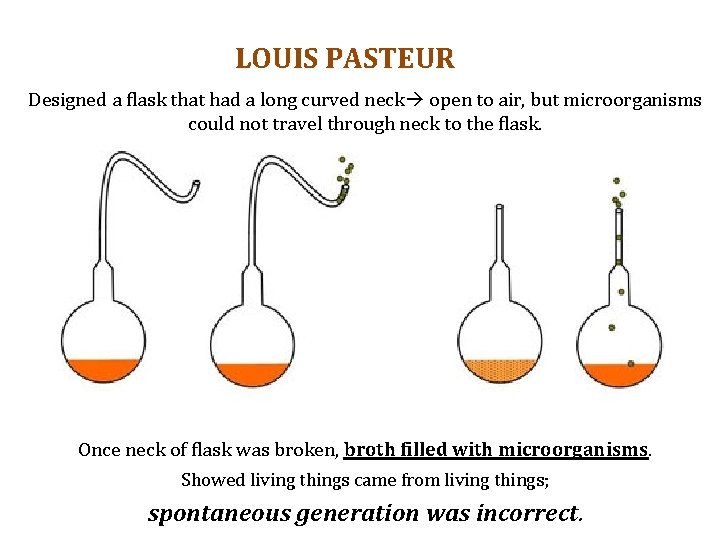
LOUIS PASTEUR Designed a flask that had a long curved neck open to air, but microorganisms could not travel through neck to the flask. Once neck of flask was broken, broth filled with microorganisms. Showed living things came from living things; spontaneous generation was incorrect.
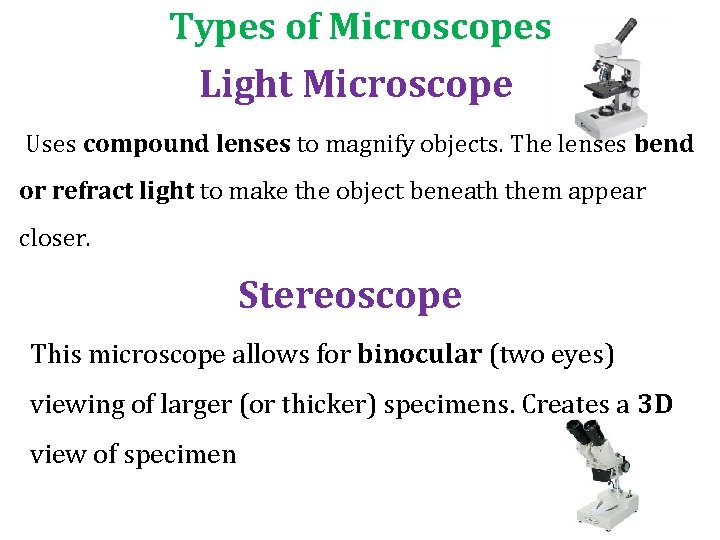
Types of Microscopes Light Microscope Uses compound lenses to magnify objects. The lenses bend or refract light to make the object beneath them appear closer. Stereoscope This microscope allows for binocular (two eyes) viewing of larger (or thicker) specimens. Creates a 3 D view of specimen
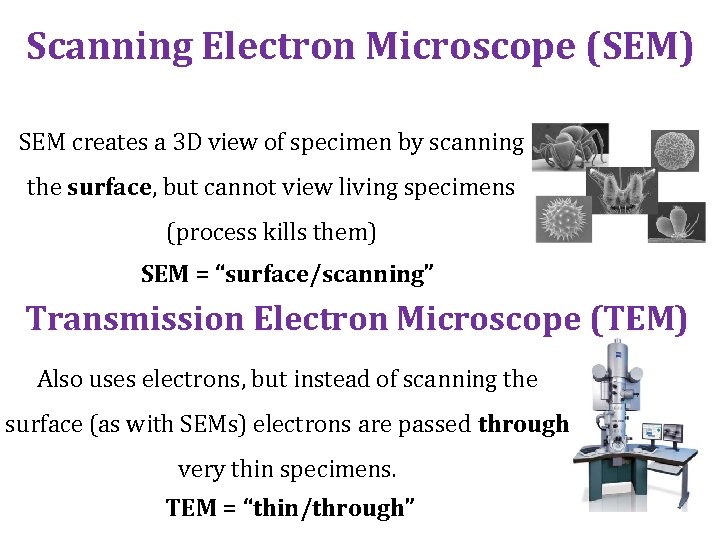
Scanning Electron Microscope (SEM) SEM creates a 3 D view of specimen by scanning the surface, but cannot view living specimens (process kills them) SEM = “surface/scanning” Transmission Electron Microscope (TEM) Also uses electrons, but instead of scanning the surface (as with SEMs) electrons are passed through very thin specimens. TEM = “thin/through”
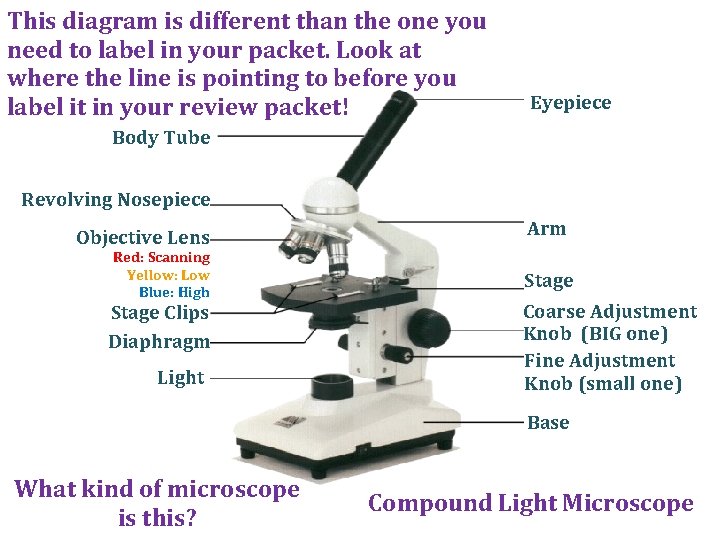
This diagram is different than the one you need to label in your packet. Look at where the line is pointing to before you label it in your review packet! Eyepiece Body Tube Revolving Nosepiece Objective Lens Red: Scanning Yellow: Low Blue: High Stage Clips Diaphragm Light Arm Stage Coarse Adjustment Knob (BIG one) Fine Adjustment Knob (small one) Base What kind of microscope is this? Compound Light Microscope
- Slides: 7