
ScopeLifetime Review 5 5 Scope and Lifetime of

- Slides: 14
Scope/Lifetime Review
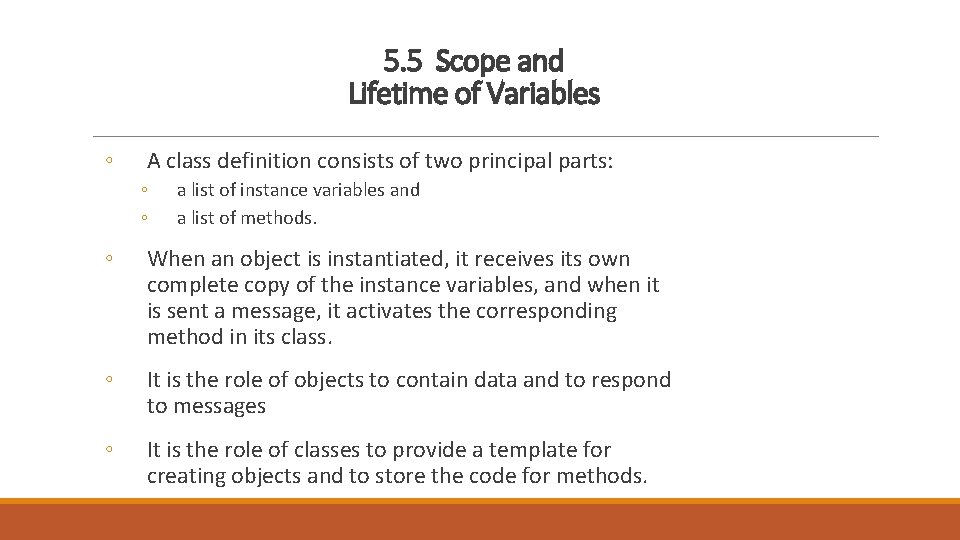
5. 5 Scope and Lifetime of Variables ◦ A class definition consists of two principal parts: ◦ ◦ a list of instance variables and a list of methods. ◦ When an object is instantiated, it receives its own complete copy of the instance variables, and when it is sent a message, it activates the corresponding method in its class. ◦ It is the role of objects to contain data and to respond to messages ◦ It is the role of classes to provide a template for creating objects and to store the code for methods.
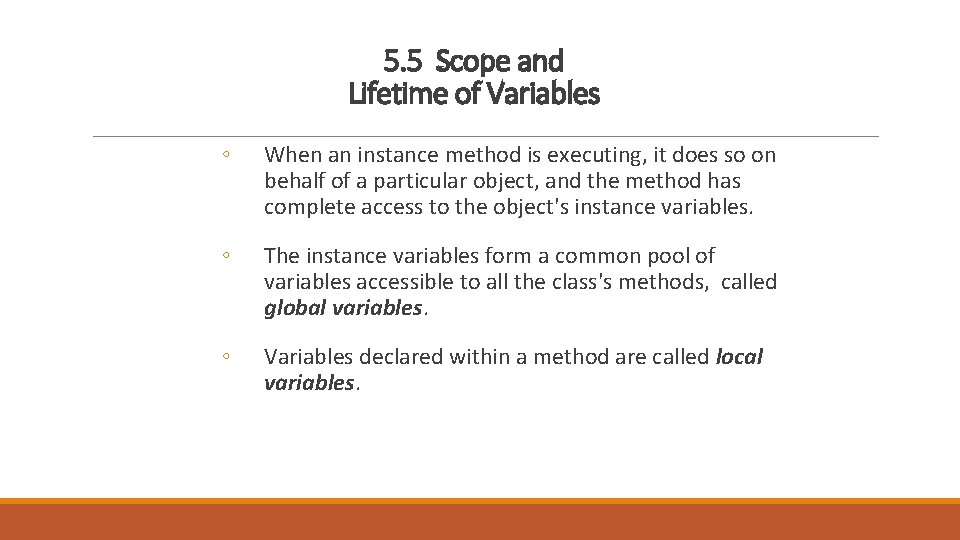
5. 5 Scope and Lifetime of Variables ◦ When an instance method is executing, it does so on behalf of a particular object, and the method has complete access to the object's instance variables. ◦ The instance variables form a common pool of variables accessible to all the class's methods, called global variables. ◦ Variables declared within a method are called local variables.
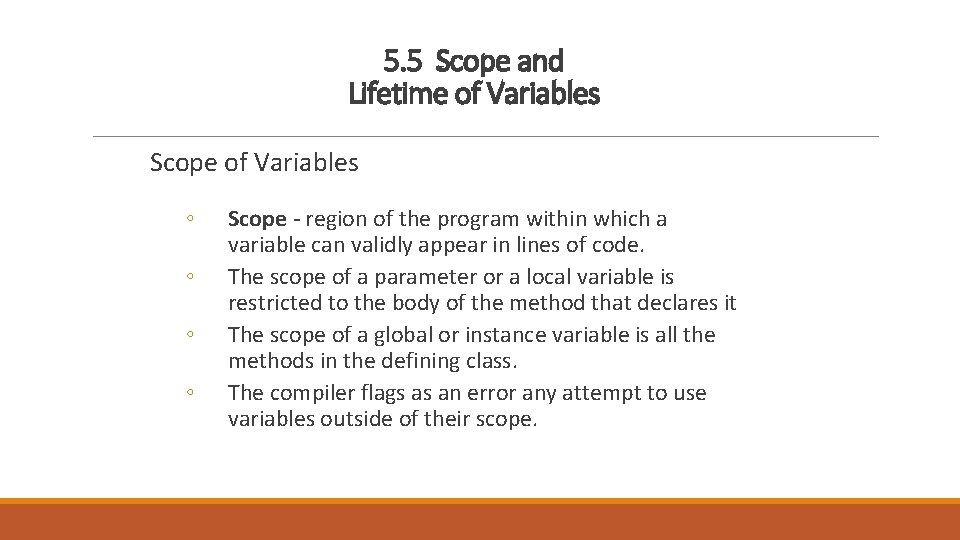
5. 5 Scope and Lifetime of Variables Scope of Variables ◦ ◦ Scope - region of the program within which a variable can validly appear in lines of code. The scope of a parameter or a local variable is restricted to the body of the method that declares it The scope of a global or instance variable is all the methods in the defining class. The compiler flags as an error any attempt to use variables outside of their scope.
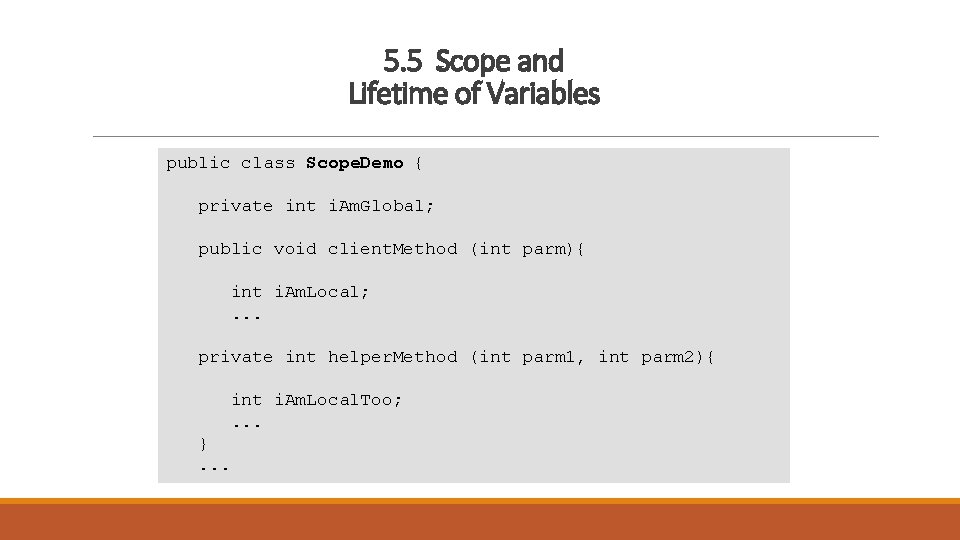
5. 5 Scope and Lifetime of Variables public class Scope. Demo { private int i. Am. Global; public void client. Method (int parm){ int i. Am. Local; . . . private int helper. Method (int parm 1, int parm 2){ int i. Am. Local. Too; . . . }. . .
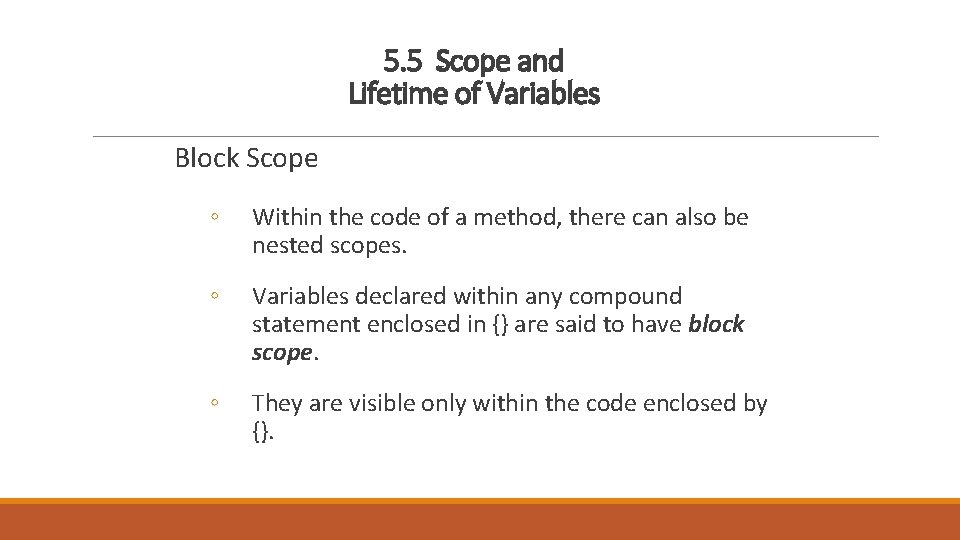
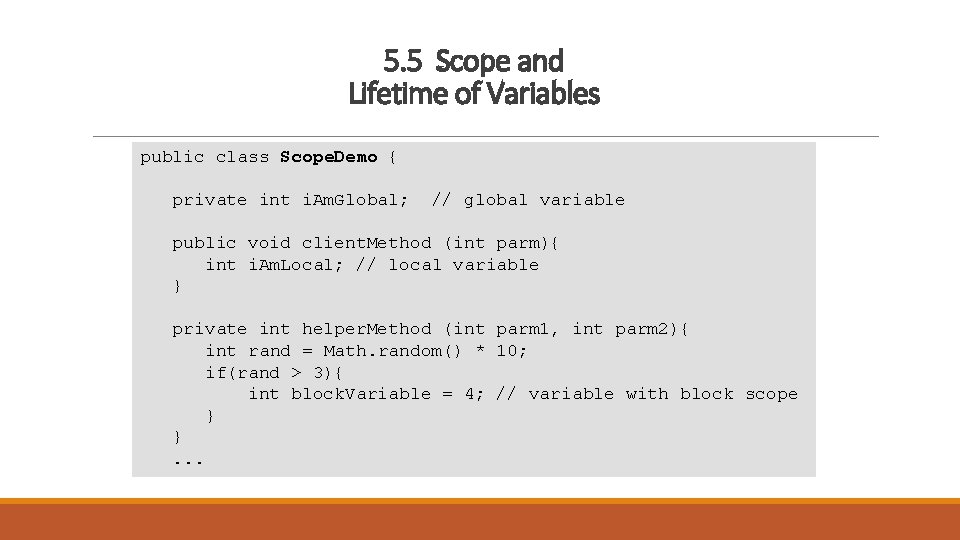
5. 5 Scope and Lifetime of Variables Block Scope ◦ Within the code of a method, there can also be nested scopes. ◦ Variables declared within any compound statement enclosed in {} are said to have block scope. ◦ They are visible only within the code enclosed by {}.
5. 5 Scope and Lifetime of Variables public class Scope. Demo { private int i. Am. Global; // global variable public void client. Method (int parm){ int i. Am. Local; // local variable } private int helper. Method (int parm 1, int parm 2){ int rand = Math. random() * 10; if(rand > 3){ int block. Variable = 4; // variable with block scope } }. . .
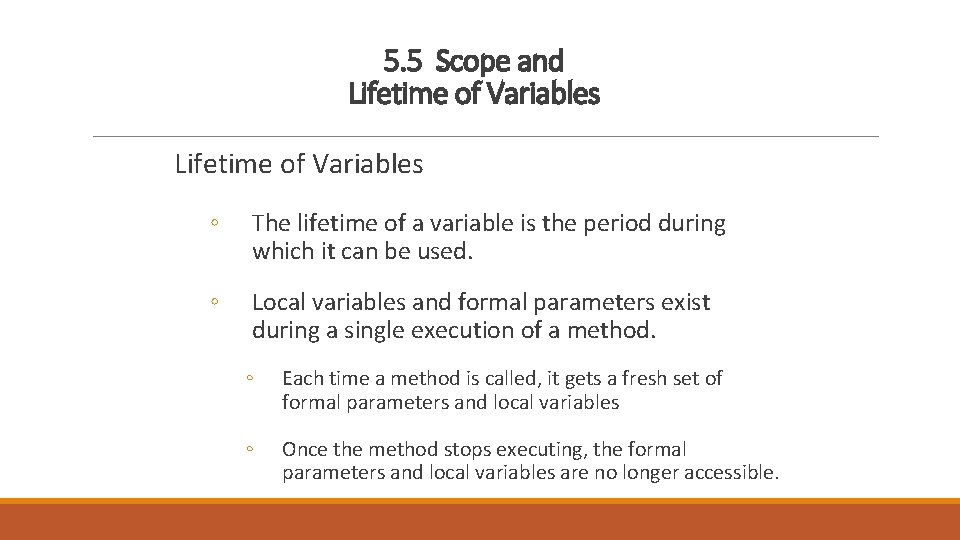
5. 5 Scope and Lifetime of Variables ◦ The lifetime of a variable is the period during which it can be used. ◦ Local variables and formal parameters exist during a single execution of a method. ◦ Each time a method is called, it gets a fresh set of formal parameters and local variables ◦ Once the method stops executing, the formal parameters and local variables are no longer accessible.
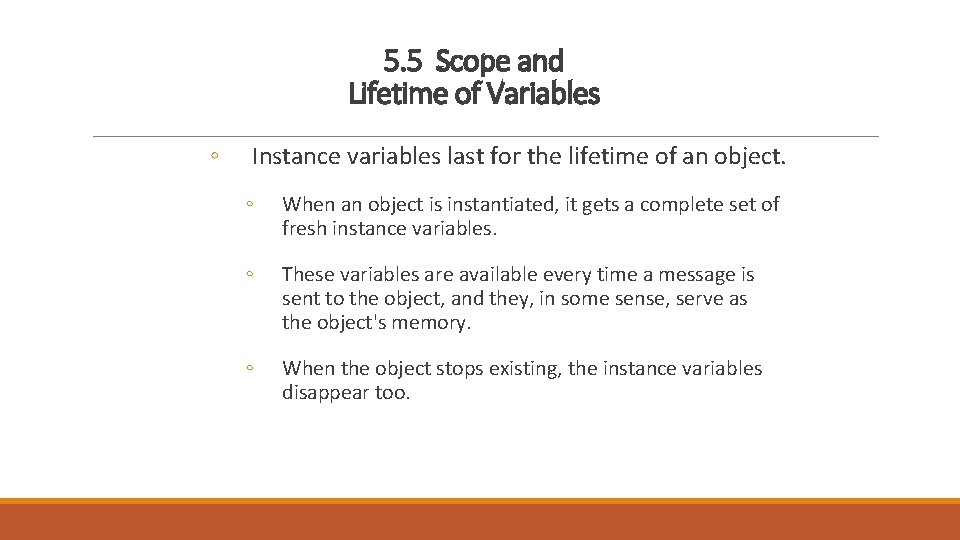
5. 5 Scope and Lifetime of Variables ◦ Instance variables last for the lifetime of an object. ◦ When an object is instantiated, it gets a complete set of fresh instance variables. ◦ These variables are available every time a message is sent to the object, and they, in some sense, serve as the object's memory. ◦ When the object stops existing, the instance variables disappear too.
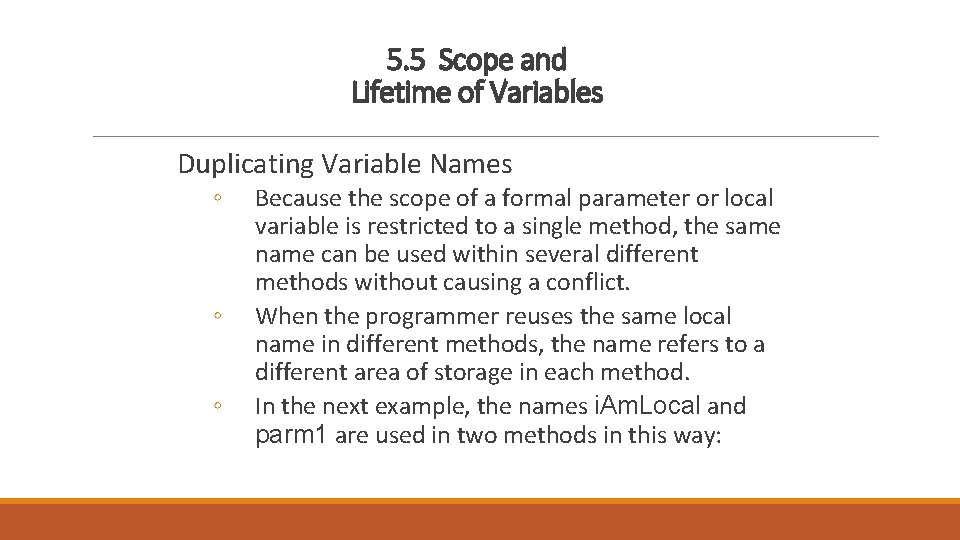
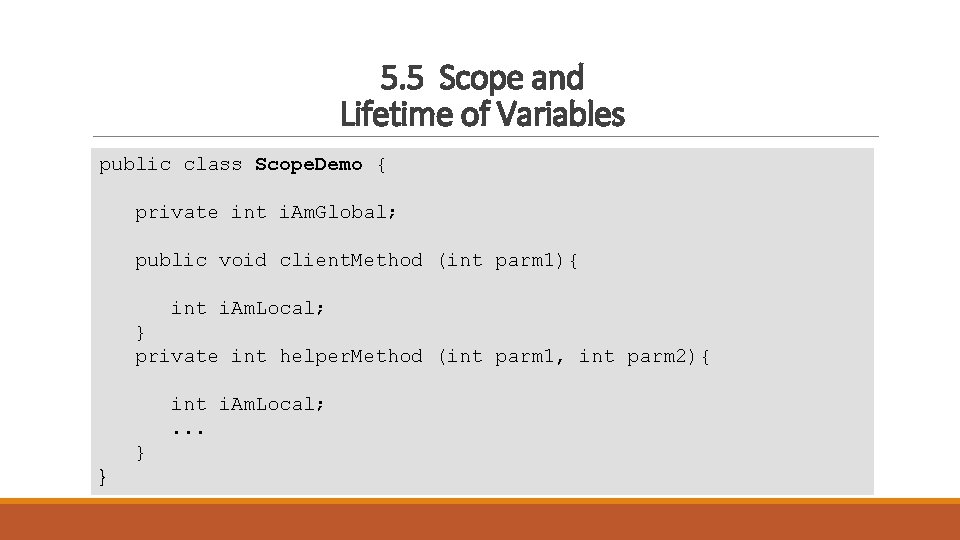
5. 5 Scope and Lifetime of Variables Duplicating Variable Names ◦ ◦ ◦ Because the scope of a formal parameter or local variable is restricted to a single method, the same name can be used within several different methods without causing a conflict. When the programmer reuses the same local name in different methods, the name refers to a different area of storage in each method. In the next example, the names i. Am. Local and parm 1 are used in two methods in this way:
5. 5 Scope and Lifetime of Variables public class Scope. Demo { private int i. Am. Global; public void client. Method (int parm 1){ int i. Am. Local; } private int helper. Method (int parm 1, int parm 2){ int i. Am. Local; . . . } }
5. 5 Scope and Lifetime of Variables When to Use Instance Variables, Parameters, and Local Variables ◦ ◦ The only reason to use an instance variable is to remember information within an object. The only reason to use a parameter is to transmit information to a method. The only reason to use a local variable is for temporary working storage within a method. A very common mistake is to misuse one kind of variable for another.
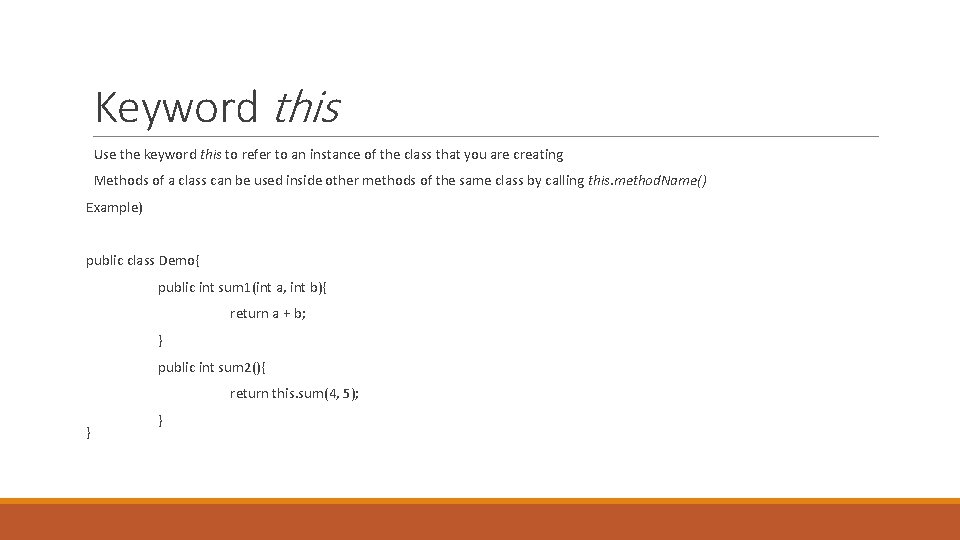
Keyword this Use the keyword this to refer to an instance of the class that you are creating Methods of a class can be used inside other methods of the same class by calling this. method. Name() Example) public class Demo{ public int sum 1(int a, int b){ return a + b; } public int sum 2(){ return this. sum(4, 5); } }
Shadowing Using the same name for both an instance variable and a local variable can be accomplished with Shadowing This practice is frowned upon because it greatly increases the chances of referencing an incorrect variable public class House(){ private String type; public House(String type){ // Local type is a shadow this. type = type; } }