
Scope when variables are born and die Variablesparameters

Scope (when variables are born and die)
Variables/parameters and memory Variables and parameters take up space in memory. C++ (and most languages) don’t want anything taking up unnecessary space in memory Thus, when c++ thinks we’re done with the variables and parameters, the space they were taking in memory is freed The smaller a memory footprint of a program, the faster it will likely run! C++ makes seriously fast, small footprint programs! Probably the best of any language!
Compiler: • • “a program that converts instructions into a machine-code or lower-level form so that they can be read and executed by a computer. ” • Converts the stuff you’re writing into something the computer can actually execute! • (you’ve seen the. exe extension – that’s the executable version of code written in c++/java/etc. created by the compiler) Why compilers are likeable: • • They can look at all of your code at once before turning it into executable code • (so notice redundancies, things used frequently, more efficient ways to execute a loop, etc. ) • MAKES EXTREMELY EFFICIENT, FAST, SMALL MEMORY FOOTPRINT Execuable code! They make. exe files that companies can sell to people without selling the actual code • So people have to buy it – they can’t modify or make their own executable.

Scope and Compilers: For most variables and parameters, the compiler controls the scope Compiler controls the STACK memory Compiler controls when memory is set aside in the STACK for a parameter, a variable, etc. Compiler controls when the memory in the stack is freed so that other variables and parameters can use that space. “The life and death cycle of a variable – nature’s misunderstood bits” – coming soon to the National Geographic Channel
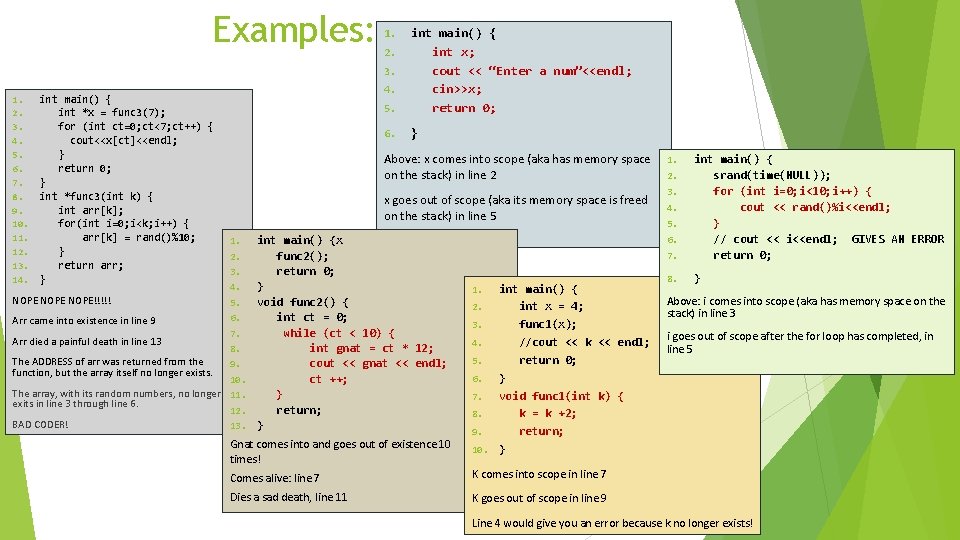
Examples: 5. int main() { int x; cout << “Enter a num”<<endl; cin>>x; return 0; 6. } 1. 2. 3. 4. 5. 6. 7. 8. 9. 10. 11. 12. 13. 14. int main() { int *x = func 3(7); for (int ct=0; ct<7; ct++) { cout<<x[ct]<<endl; } return 0; } int *func 3(int k) { int arr[k]; for(int i=0; i<k; i++) { arr[k] = rand()%10; } return arr; } 4. Above: x comes into scope (aka has memory space on the stack) in line 2 x goes out of scope (aka its memory space is freed on the stack) in line 5 1. 2. 3. 4. NOPE!!!!! 5. Arr came into existence in line 9 6. Arr died a painful death in line 13 The ADDRESS of arr was returned from the function, but the array itself no longer exists. 7. 8. 9. 10. The array, with its random numbers, no longer 11. exits in line 3 through line 6. 12. BAD CODER! 13. int main() {x func 2(); return 0; } void func 2() { int ct = 0; while (ct < 10) { int gnat = ct * 12; cout << gnat << endl; ct ++; } return; } Gnat comes into and goes out of existence 10 times! 7. int main() { srand(time(NULL)); for (int i=0; i<10; i++) { cout << rand()%i<<endl; } // cout << i<<endl; GIVES AN ERROR return 0; 8. } 1. 2. 3. 4. 5. 6. int main() { 2. int x = 4; 3. func 1(x); 4. //cout << k << endl; 5. return 0; 6. } 7. void func 1(int k) { 8. k = k +2; 9. return; 10. } 1. Comes alive: line 7 K comes into scope in line 7 Dies a sad death, line 11 K goes out of scope in line 9 Above: i comes into scope (aka has memory space on the stack) in line 3 i goes out of scope after the for loop has completed, in line 5 Line 4 would give you an error because k no longer exists!
Compiles make efficient executable files! Take-aways: Files that your machine can execute, . exe files To do that, compilers control a part of the memory known as the stack Compilers control when space is set aside in the stack for a variable/ parameter and when it is freed Scope: from when a variable has space set aside in memory until that memory is freed and the variable no longer exists The compiler tries to keep variables/parameters in scope (existing on the stack) for as short of a period as possible so that the memory footprint of the executable is small.
- Slides: 6