
Scope describes the region where an identifier is

Scope describes the region where an identifier is known, and semantic rules for this. 1

Scope The scope of a declaration or scope of a binding is the region of the program to which a binding applies. q Every language has scope rules which define the scope of declarations, definitions, etc. q Two broad classes of scope rules: n Static or lexical scope - scope determined by structure of program n Dynamic scope - scope determined by path of execution q 2

Scope Example: C /* what are the scopes int n = 999; int sub 1( ) { int n = 10; printf("sub 1: n = sub 2( ); } int sub 2( ) { printf("sub 2: n = } int main( ) { printf("main: n = int n = 50; sub 1( ); sub 2( ); printf("main: n = } of vars? */ %dn", n); "n" has global scope "n" has local scope which "n" has scope here? "n" has local scope %dn", n); 3
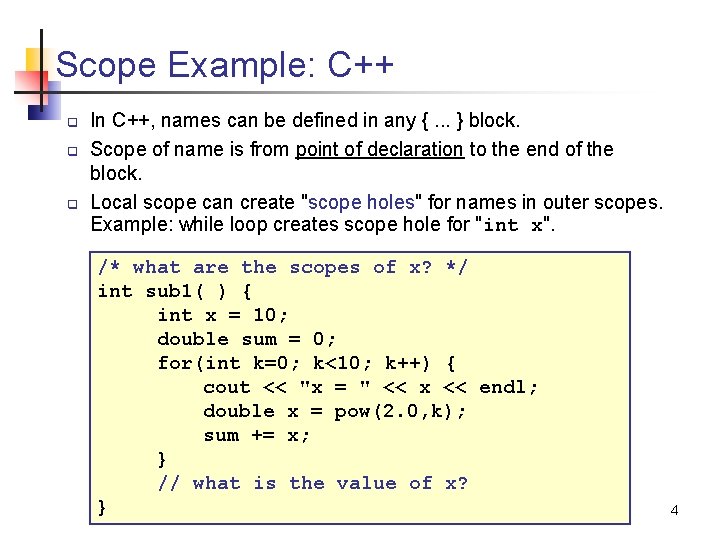
Scope Example: C++ q q q In C++, names can be defined in any {. . . } block. Scope of name is from point of declaration to the end of the block. Local scope can create "scope holes" for names in outer scopes. Example: while loop creates scope hole for "int x". /* what are the scopes of x? */ int sub 1( ) { int x = 10; double sum = 0; for(int k=0; k<10; k++) { cout << "x = " << x << endl; double x = pow(2. 0, k); sum += x; } // what is the value of x? } 4
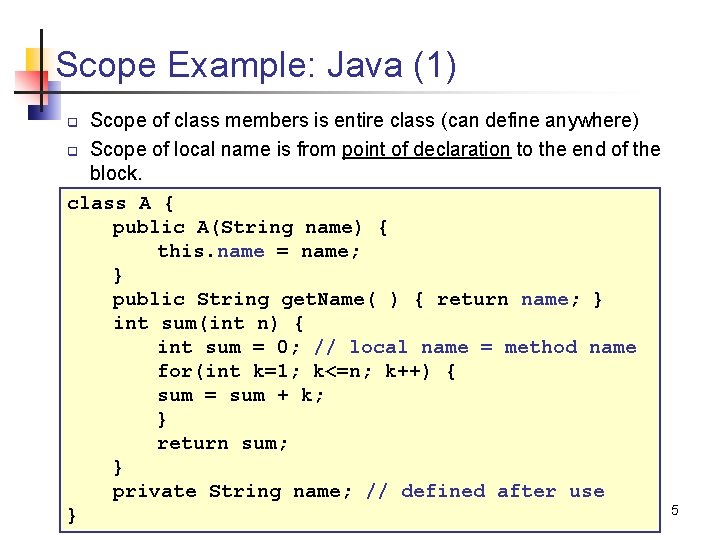
Scope Example: Java (1) Scope of class members is entire class (can define anywhere) q Scope of local name is from point of declaration to the end of the block. class A { public A(String name) { this. name = name; } public String get. Name( ) { return name; } int sum(int n) { int sum = 0; // local name = method name for(int k=1; k<=n; k++) { sum = sum + k; } return sum; } private String name; // defined after use } q 5
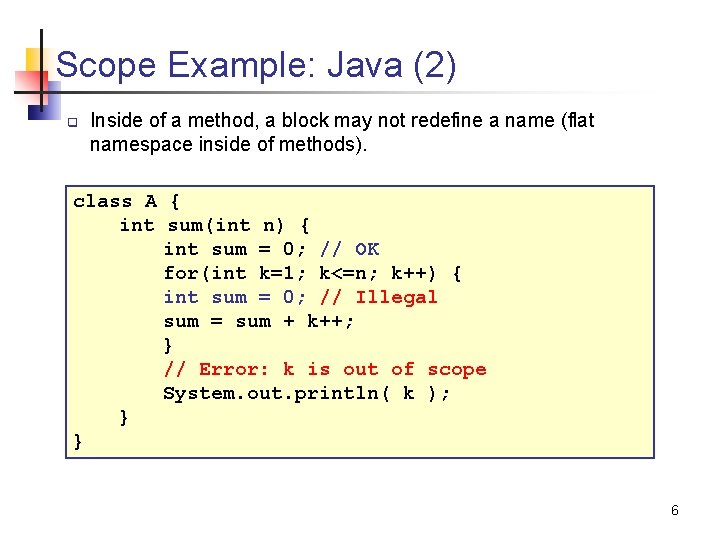
Scope Example: Java (2) q Inside of a method, a block may not redefine a name (flat namespace inside of methods). class A { int sum(int n) { int sum = 0; // OK for(int k=1; k<=n; k++) { int sum = 0; // Illegal sum = sum + k++; } // Error: k is out of scope System. out. println( k ); } } 6

Scope Example: multiple files In C and C++ external variables have global scope unless declared "static", which indicates file scope. File 1. c File 2. c static char *s = "dog"; static char *s = "cat"; // external var & funcn int n = 10; extern int n; extern int sub 2( ); int sub 2( ) { printf("%s %d", s, n); int sub 1( ) { n = 1000; printf("%s %d", s, n); return s; } } int main( ) { What values of s and n will be int s = 0, n = 0; used in each function? printf("%d", sub 2( )); printf("%d", sub 1( )); } 7
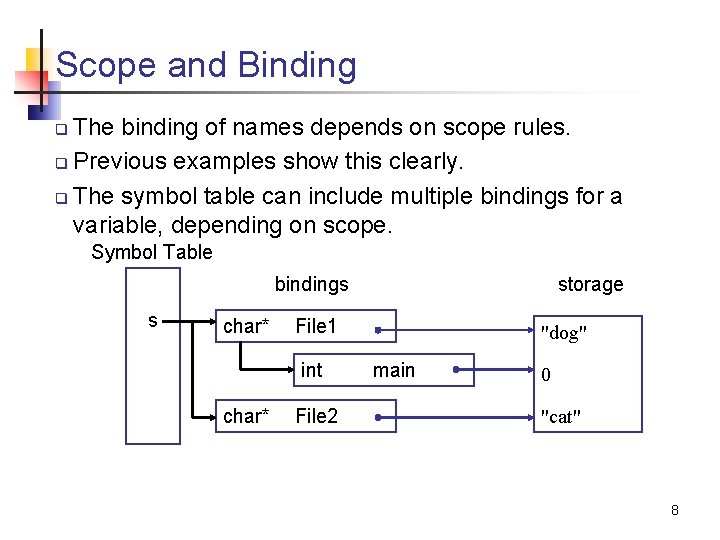
Scope and Binding The binding of names depends on scope rules. q Previous examples show this clearly. q The symbol table can include multiple bindings for a variable, depending on scope. q Symbol Table bindings s char* File 1 int char* storage File 2 "dog" main 0 "cat" 8
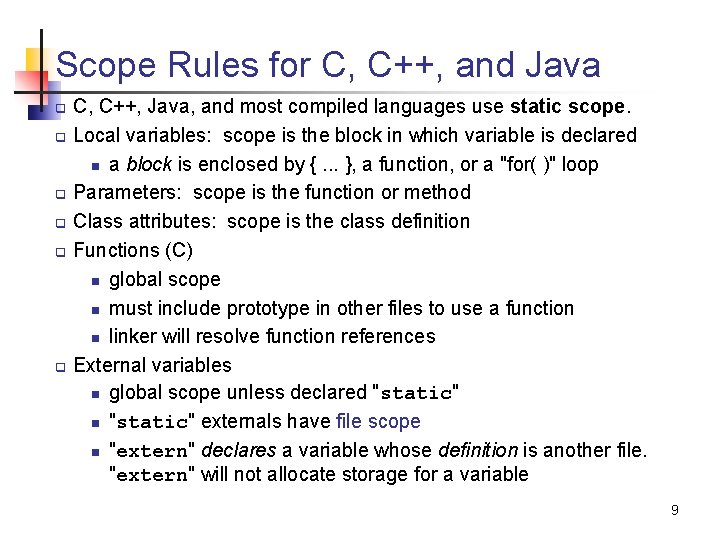
Scope Rules for C, C++, and Java q q q C, C++, Java, and most compiled languages use static scope. Local variables: scope is the block in which variable is declared n a block is enclosed by {. . . }, a function, or a "for( )" loop Parameters: scope is the function or method Class attributes: scope is the class definition Functions (C) n global scope n must include prototype in other files to use a function n linker will resolve function references External variables n global scope unless declared "static" n "static" externals have file scope n "extern" declares a variable whose definition is another file. "extern" will not allocate storage for a variable 9
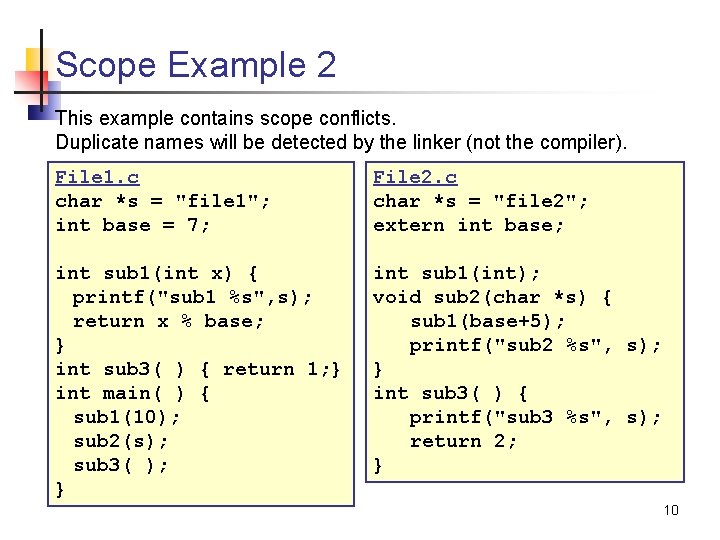
Scope Example 2 This example contains scope conflicts. Duplicate names will be detected by the linker (not the compiler). File 1. c char *s = "file 1"; int base = 7; File 2. c char *s = "file 2"; extern int base; int sub 1(int x) { printf("sub 1 %s", s); return x % base; } int sub 3( ) { return 1; } int main( ) { sub 1(10); sub 2(s); sub 3( ); } int sub 1(int); void sub 2(char *s) { sub 1(base+5); printf("sub 2 %s", s); } int sub 3( ) { printf("sub 3 %s", s); return 2; } 10
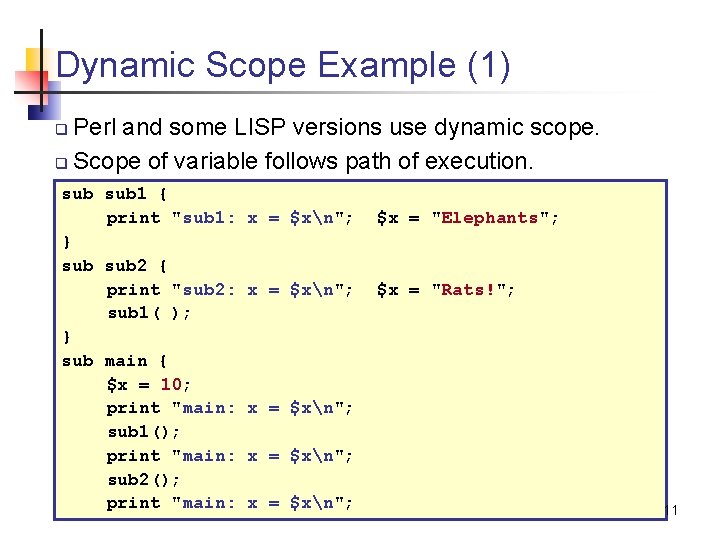
Dynamic Scope Example (1) Perl and some LISP versions use dynamic scope. q Scope of variable follows path of execution. q sub 1 { print "sub 1: } sub 2 { print "sub 2: sub 1( ); } sub main { $x = 10; print "main: sub 1(); print "main: sub 2(); print "main: x = $xn"; $x = "Elephants"; x = $xn"; $x = "Rats!"; x = $xn"; 11
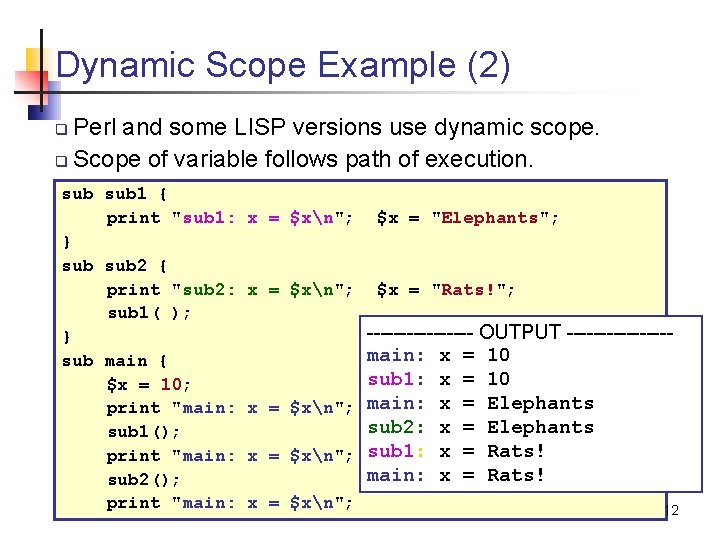
Dynamic Scope Example (2) Perl and some LISP versions use dynamic scope. q Scope of variable follows path of execution. q sub 1 { print "sub 1: } sub 2 { print "sub 2: sub 1( ); } sub main { $x = 10; print "main: sub 1(); print "main: sub 2(); print "main: x = $xn"; $x = "Elephants"; x = $xn"; $x = "Rats!"; -------- OUTPUT --------main: x = 10 sub 1: x = 10 x = $xn"; main: x = Elephants sub 2: x = Elephants x = $xn"; sub 1: x = Rats! main: x = Rats! x = $xn"; 12
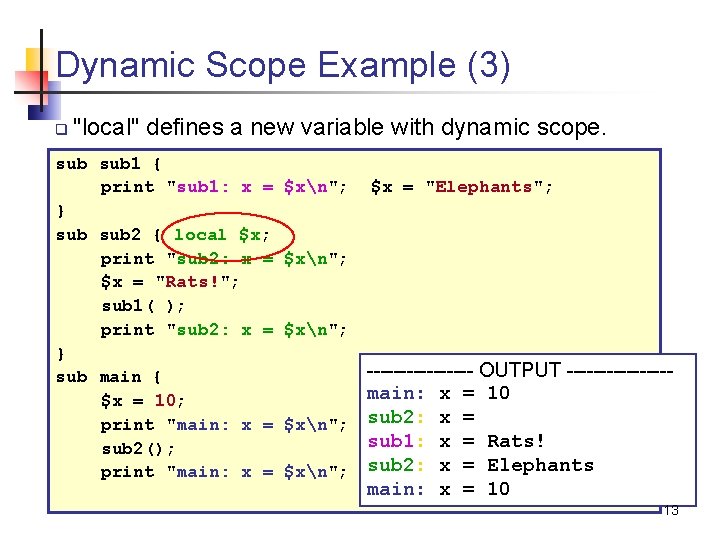
Dynamic Scope Example (3) q "local" defines a new variable with dynamic scope. sub 1 { print "sub 1: x = } sub 2 { local $x; print "sub 2: x = $x = "Rats!"; sub 1( ); print "sub 2: x = } sub main { $x = 10; print "main: x = sub 2(); print "main: x = $xn"; $x = "Elephants"; $xn"; -------- OUTPUT --------main: x = 10 $xn"; sub 2: x = sub 1: x = Rats! $xn"; sub 2: x = Elephants main: x = 10 13
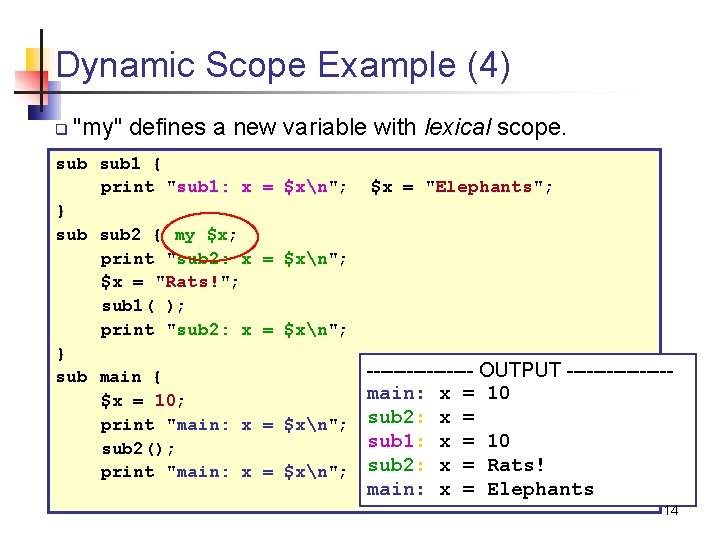
Dynamic Scope Example (4) q "my" defines a new variable with lexical scope. sub 1 { print "sub 1: x } sub 2 { my $x; print "sub 2: x $x = "Rats!"; sub 1( ); print "sub 2: x } sub main { $x = 10; print "main: x sub 2(); print "main: x = $xn"; $x = "Elephants"; = $xn"; -------- OUTPUT --------main: x = 10 = $xn"; sub 2: x = sub 1: x = 10 = $xn"; sub 2: x = Rats! main: x = Elephants 14
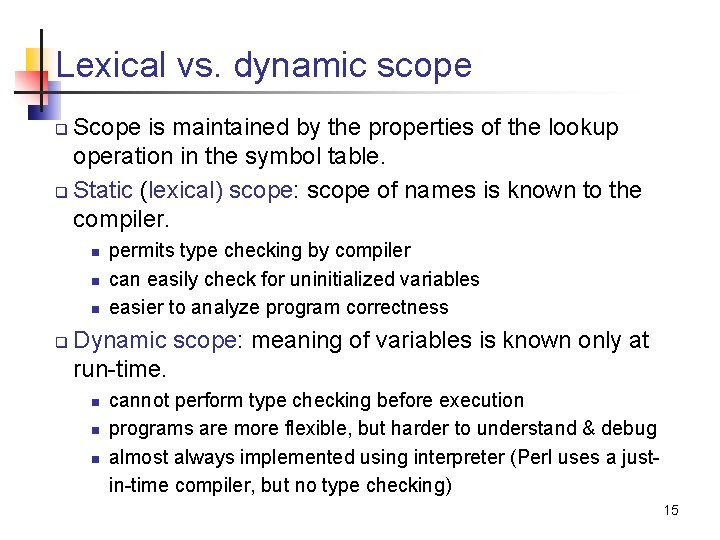
Lexical vs. dynamic scope Scope is maintained by the properties of the lookup operation in the symbol table. q Static (lexical) scope: scope of names is known to the compiler. q n n n q permits type checking by compiler can easily check for uninitialized variables easier to analyze program correctness Dynamic scope: meaning of variables is known only at run-time. n n n cannot perform type checking before execution programs are more flexible, but harder to understand & debug almost always implemented using interpreter (Perl uses a justin-time compiler, but no type checking) 15
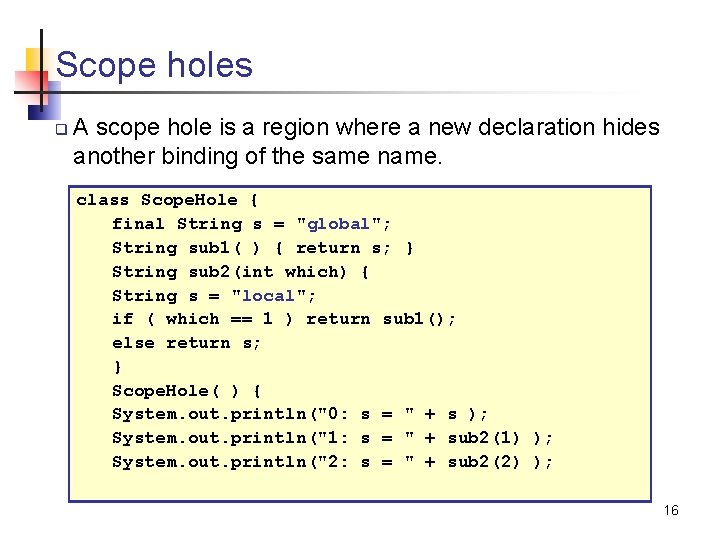
Scope holes q A scope hole is a region where a new declaration hides another binding of the same name. class Scope. Hole { final String s = "global"; String sub 1( ) { return s; } String sub 2(int which) { String s = "local"; if ( which == 1 ) return sub 1(); else return s; } Scope. Hole( ) { System. out. println("0: s = " + s ); System. out. println("1: s = " + sub 2(1) ); System. out. println("2: s = " + sub 2(2) ); 16
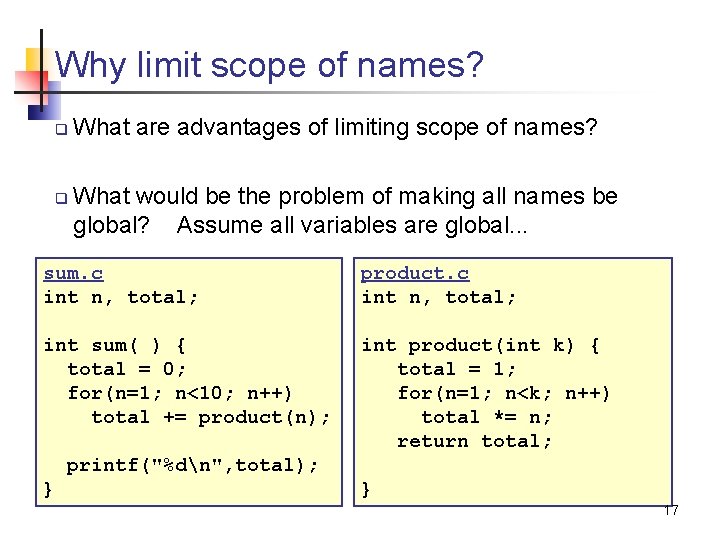
Why limit scope of names? q q What are advantages of limiting scope of names? What would be the problem of making all names be global? Assume all variables are global. . . sum. c int n, total; product. c int n, total; int sum( ) { total = 0; for(n=1; n<10; n++) total += product(n); int product(int k) { total = 1; for(n=1; n<k; n++) total *= n; return total; printf("%dn", total); } } 17
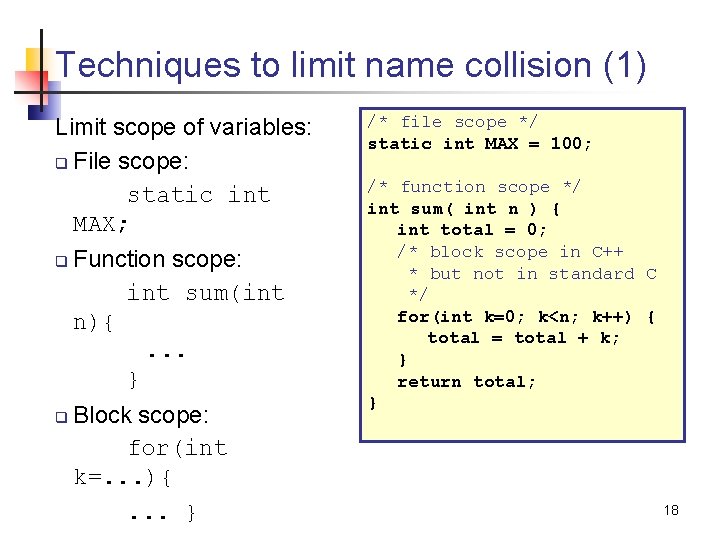
Techniques to limit name collision (1) Limit scope of variables: q File scope: static int MAX; q q Function scope: int sum(int n){. . . } Block scope: for(int k=. . . ){. . . } /* file scope */ static int MAX = 100; /* function scope */ int sum( int n ) { int total = 0; /* block scope in C++ * but not in standard C */ for(int k=0; k<n; k++) { total = total + k; } return total; } 18
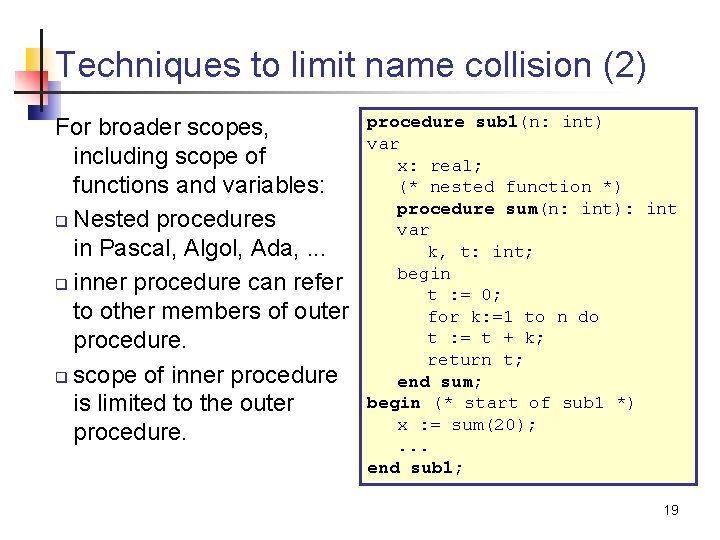
Techniques to limit name collision (2) For broader scopes, including scope of functions and variables: q Nested procedures in Pascal, Algol, Ada, . . . q inner procedure can refer to other members of outer procedure. q scope of inner procedure is limited to the outer procedure sub 1(n: int) var x: real; (* nested function *) procedure sum(n: int): int var k, t: int; begin t : = 0; for k: =1 to n do t : = t + k; return t; end sum; begin (* start of sub 1 *) x : = sum(20); . . . end sub 1; 19
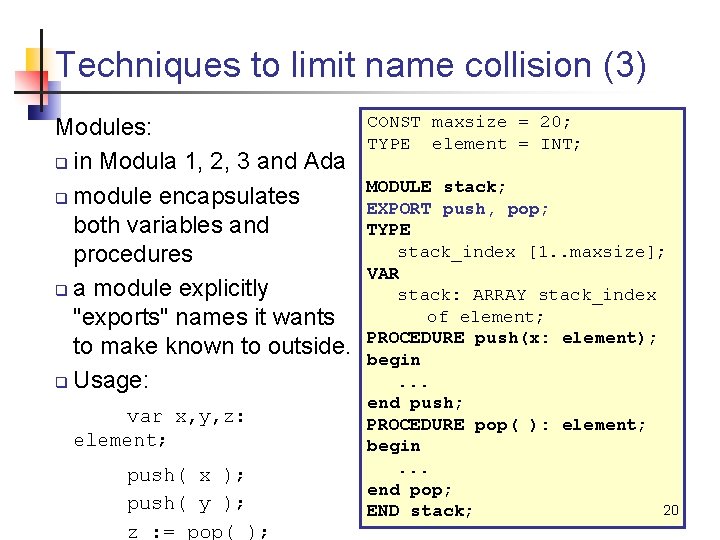
Techniques to limit name collision (3) Modules: q in Modula 1, 2, 3 and Ada q module encapsulates both variables and procedures q a module explicitly "exports" names it wants to make known to outside. q Usage: var x, y, z: element; push( x ); push( y ); z : = pop( ); CONST maxsize = 20; TYPE element = INT; MODULE stack; EXPORT push, pop; TYPE stack_index [1. . maxsize]; VAR stack: ARRAY stack_index of element; PROCEDURE push(x: element); begin. . . end push; PROCEDURE pop( ): element; begin. . . end pop; 20 END stack;
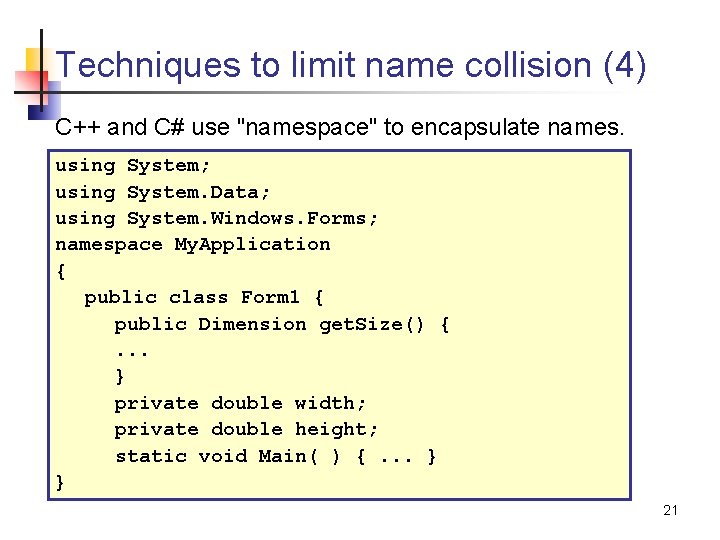
Techniques to limit name collision (4) C++ and C# use "namespace" to encapsulate names. using System; using System. Data; using System. Windows. Forms; namespace My. Application { public class Form 1 { public Dimension get. Size() {. . . } private double width; private double height; static void Main( ) {. . . } } 21
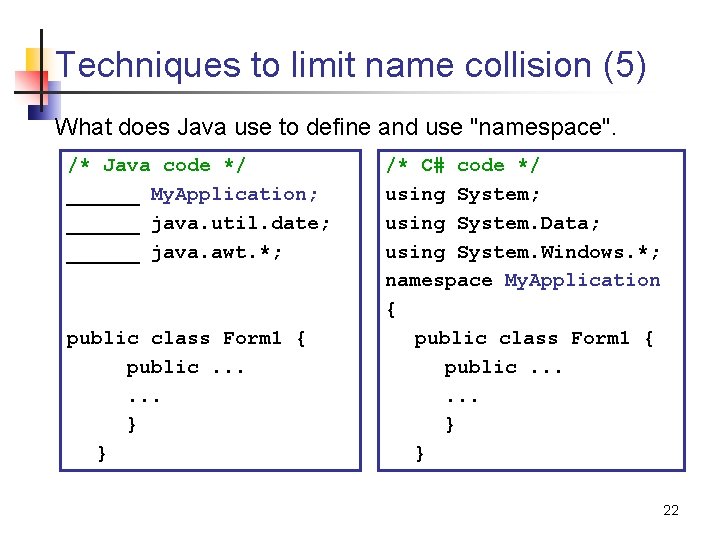
Techniques to limit name collision (5) What does Java use to define and use "namespace". /* Java code */ ______ My. Application; ______ java. util. date; ______ java. awt. *; public class Form 1 { public. . . } } /* C# code */ using System; using System. Data; using System. Windows. *; namespace My. Application { public class Form 1 { public. . . } } 22
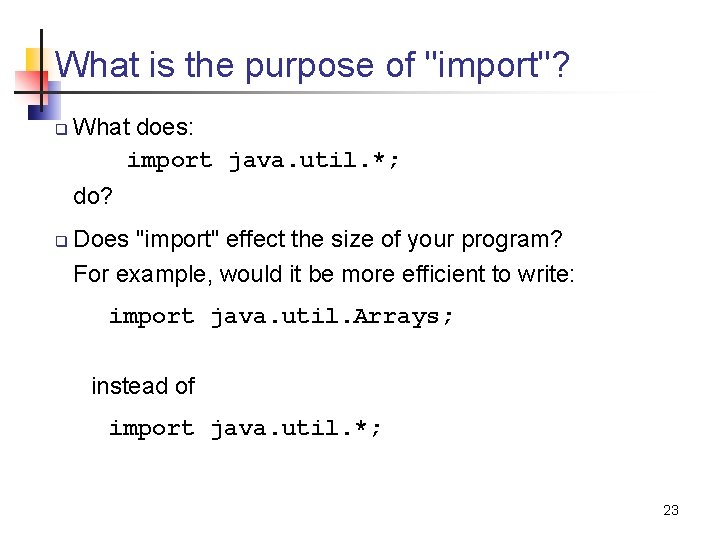
What is the purpose of "import"? q What does: import java. util. *; do? q Does "import" effect the size of your program? For example, would it be more efficient to write: import java. util. Arrays; instead of import java. util. *; 23
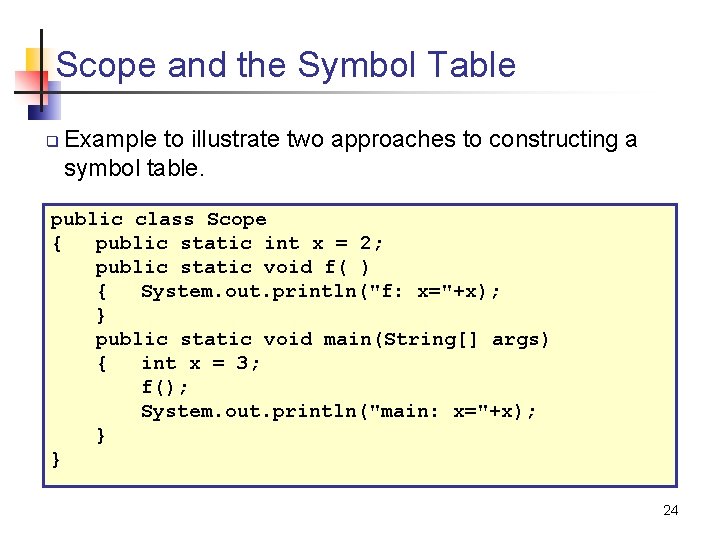
Scope and the Symbol Table q Example to illustrate two approaches to constructing a symbol table. public class Scope { public static int x = 2; public static void f( ) { System. out. println("f: x="+x); } public static void main(String[] args) { int x = 3; f(); System. out. println("main: x="+x); } } 24
- Slides: 24