
Scope and Safety Concepts of SSR 6 L05

- Slides: 22
Scope and Safety Concepts of SSR 6 (L-05)
Objective of the presentation END To understand: – the scope of IAEA Regulation – the main elements of the safety concept of SSR -6 based on which adequate protection of persons and environment is provided. – the concept of the safe package and the graded approach to package types to provide the same level of safety for the transport of all types of radioactive materials. February 2022 2 Contents
Contents END • Objective and scope of SSR-6 • Basic principles for safety for all packages • Package types • Graded approach of package types • Summary February 2022 3 Contents
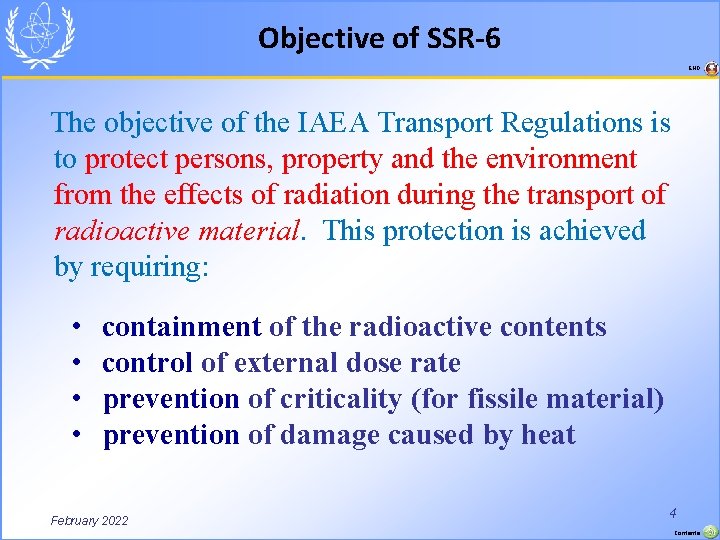
Objective of SSR-6 END The objective of the IAEA Transport Regulations is to protect persons, property and the environment from the effects of radiation during the transport of radioactive material. This protection is achieved by requiring: • • containment of the radioactive contents control of external dose rate prevention of criticality (for fissile material) prevention of damage caused by heat February 2022 4 Contents
Objective of SSR-6 END These requirements are satisfied by: • applying a graded approach to : 4 performance standards applied to package designs 4 contents limits for packages and conveyances depending upon the hazard of the radioactive contents • imposing conditions on : 4 design and operation of packages 4 maintenance of packagings considering the nature of the radioactive contents • requiring administrative controls including, where appropriate, approval by a competent authority • making arrangements for planning and preparing emergency response. February 2022 5 Contents
Objective of SSR-6 END Safety in transport of radioactive material is assured when these IAEA Transport Regulations are complied with. Confidence in this regard is achieved through management systems and compliance assurance programmes. February 2022 6 Contents
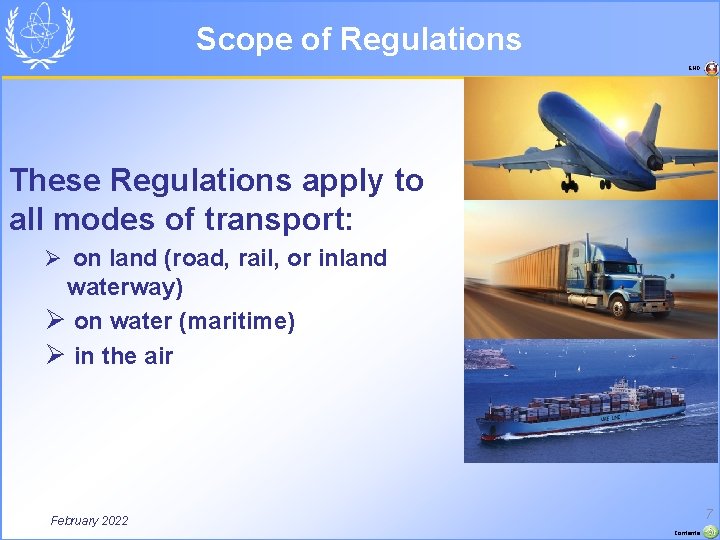
Scope of Regulations END These Regulations apply to all modes of transport: Ø on land (road, rail, or inland waterway) Ø on water (maritime) Ø in the air 7 February 2022 Contents
Scope of Regulations END Transport comprises all operations and conditions associated with and involved in the movement of radioactive material, including: design, manufacture, maintenance and repair of packaging, and the preparation, consigning, loading, carriage, including in-transit storage unloading, and receipt at the final destination of loads of radioactive material and packages (para 106) February 2022 8 Contents
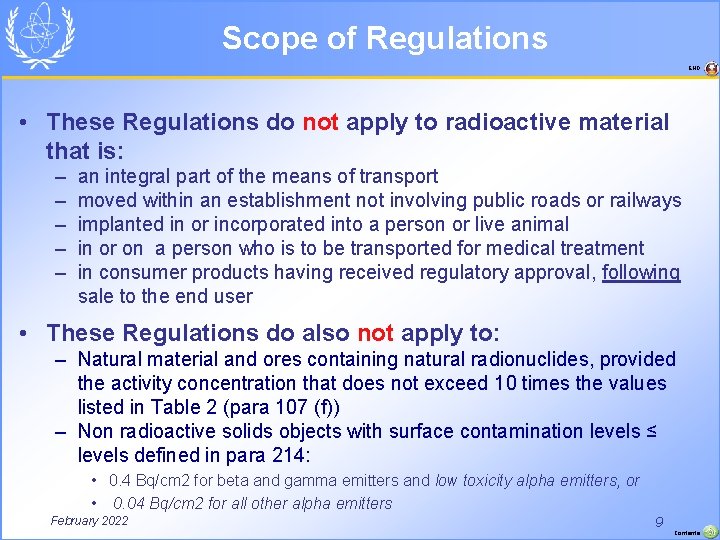
Scope of Regulations END • These Regulations do not apply to radioactive material that is: – – – an integral part of the means of transport moved within an establishment not involving public roads or railways implanted in or incorporated into a person or live animal in or on a person who is to be transported for medical treatment in consumer products having received regulatory approval, following sale to the end user • These Regulations do also not apply to: – Natural material and ores containing natural radionuclides, provided the activity concentration that does not exceed 10 times the values listed in Table 2 (para 107 (f)) – Non radioactive solids objects with surface contamination levels ≤ levels defined in para 214: • 0. 4 Bq/cm 2 for beta and gamma emitters and low toxicity alpha emitters, or • 0. 04 Bq/cm 2 for all other alpha emitters February 2022 9 Contents
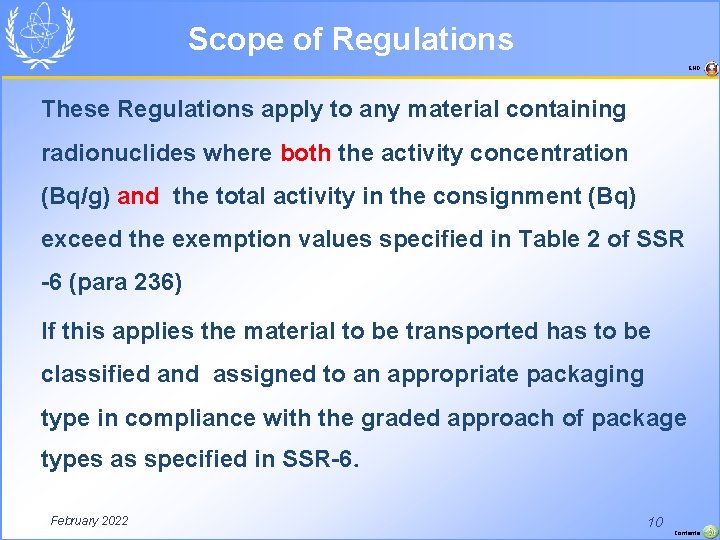
Scope of Regulations END These Regulations apply to any material containing radionuclides where both the activity concentration (Bq/g) and the total activity in the consignment (Bq) exceed the exemption values specified in Table 2 of SSR -6 (para 236) If this applies the material to be transported has to be classified and assigned to an appropriate packaging type in compliance with the graded approach of package types as specified in SSR-6. February 2022 10 Contents
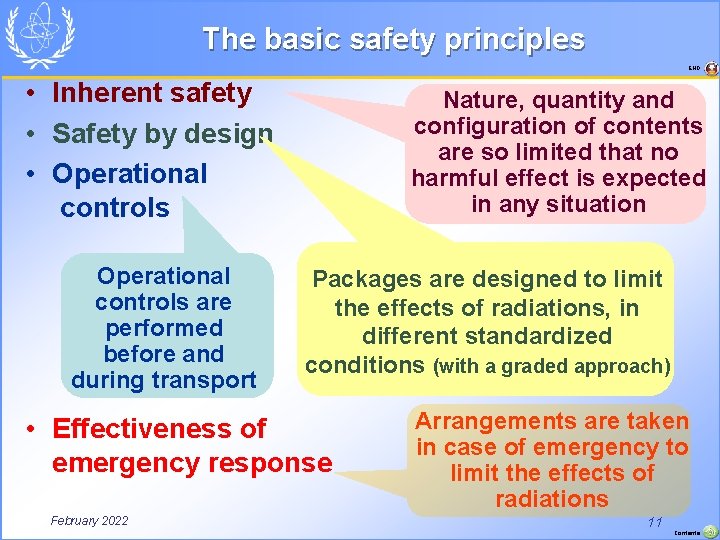
The basic safety principles END • Inherent safety • Safety by design • Operational controls are performed before and during transport Nature, quantity and configuration of contents are so limited that no harmful effect is expected in any situation Packages are designed to limit the effects of radiations, in different standardized conditions (with a graded approach) • Effectiveness of emergency response February 2022 Arrangements are taken in case of emergency to limit the effects of radiations 11 Contents
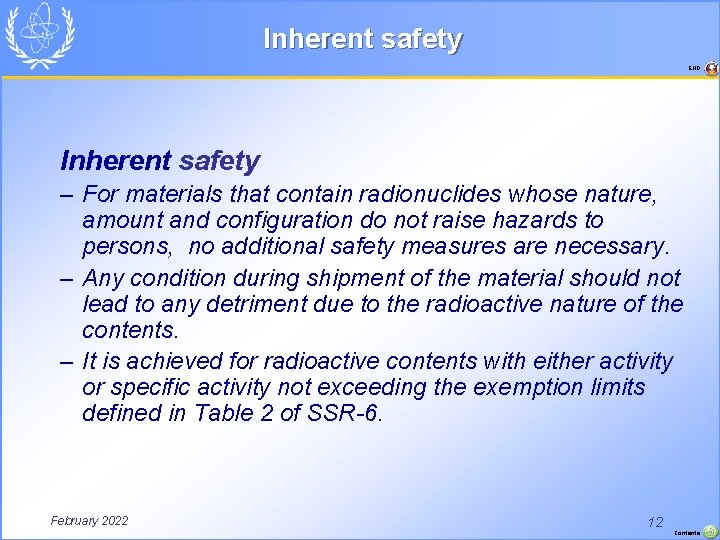
Inherent safety END Inherent safety – For materials that contain radionuclides whose nature, amount and configuration do not raise hazards to persons, no additional safety measures are necessary. – Any condition during shipment of the material should not lead to any detriment due to the radioactive nature of the contents. – It is achieved for radioactive contents with either activity or specific activity not exceeding the exemption limits defined in Table 2 of SSR-6. February 2022 12 Contents
Safety by design END – Design requirements are defined for packages to ensure no radiological detriment in the following three categories of transport conditions: • “routine conditions” (incident free), • “normal conditions” (minor mishaps), • “accident conditions” (including severe accidents). – A graded approach is adopted to restrict the need for design requirements to the only situations with potential radiological detriment, taking into account the activity and nature of the radioactive contents. – Safety functions of packages are achieved by passive components that do not need any energy supply. February 2022 13 Contents
Operational controls END Operational controls ensures: – Compliance with authorized design documentation • Preparation of package • Making measurements of radioactive contamination and dose rates – Compliance with operational regulatory requirements • Implementing requirements for labelling, marking, placarding, loading, stowage and segregation • Ensuring adherence to transport documents • Implementing a Management System • Implementing a Radiation Protection Plan to prevent any non-compliance that could contribute to generate radiological effects. February 2022 14 Contents
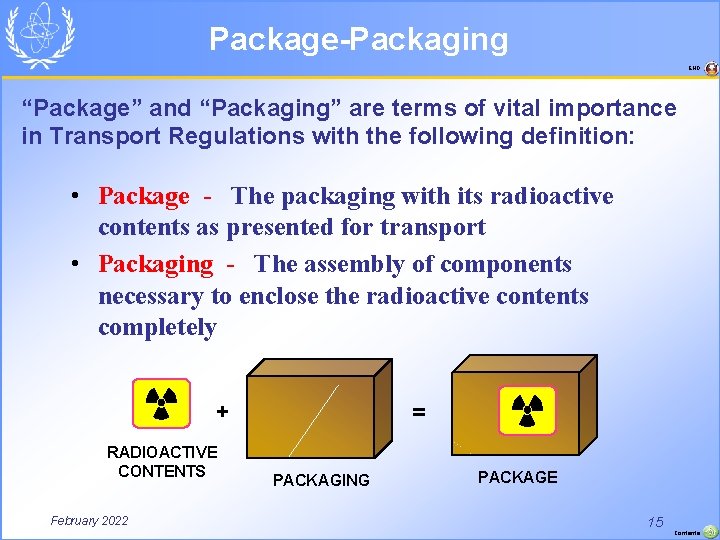
Package-Packaging END “Package” and “Packaging” are terms of vital importance in Transport Regulations with the following definition: • Package - The packaging with its radioactive contents as presented for transport • Packaging - The assembly of components necessary to enclose the radioactive contents completely + RADIOACTIVE CONTENTS February 2022 = PACKAGING PACKAGE 15 Contents
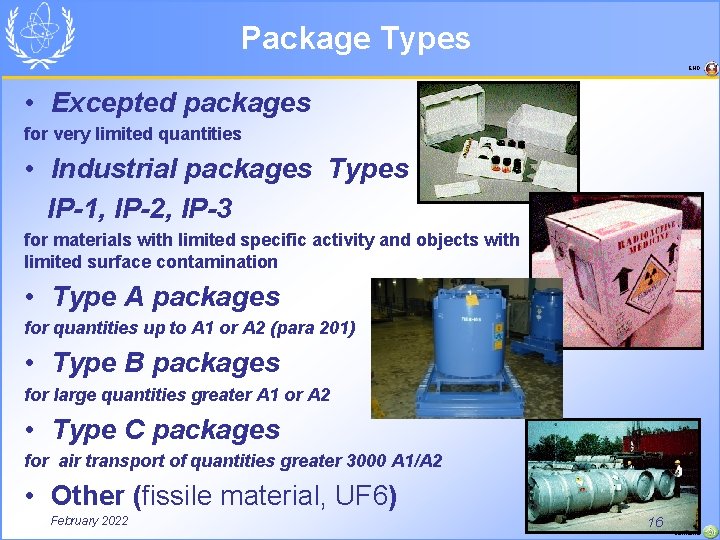
Package Types END • Excepted packages for very limited quantities • Industrial packages Types IP-1, IP-2, IP-3 for materials with limited specific activity and objects with limited surface contamination • Type A packages for quantities up to A 1 or A 2 (para 201) • Type B packages for large quantities greater A 1 or A 2 • Type C packages for air transport of quantities greater 3000 A 1/A 2 • Other (fissile material, UF 6) February 2022 16 Contents
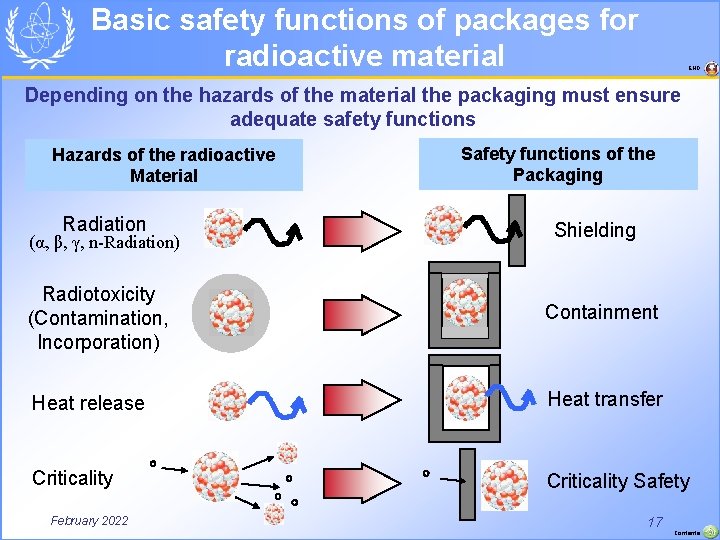
Basic safety functions of packages for radioactive material END Depending on the hazards of the material the packaging must ensure adequate safety functions Hazards of the radioactive Material Radiation (α, β, γ, n-Radiation) Safety functions of the Packaging Shielding Radiotoxicity (Contamination, Incorporation) Containment Heat release Heat transfer Criticality Safety February 2022 17 Contents
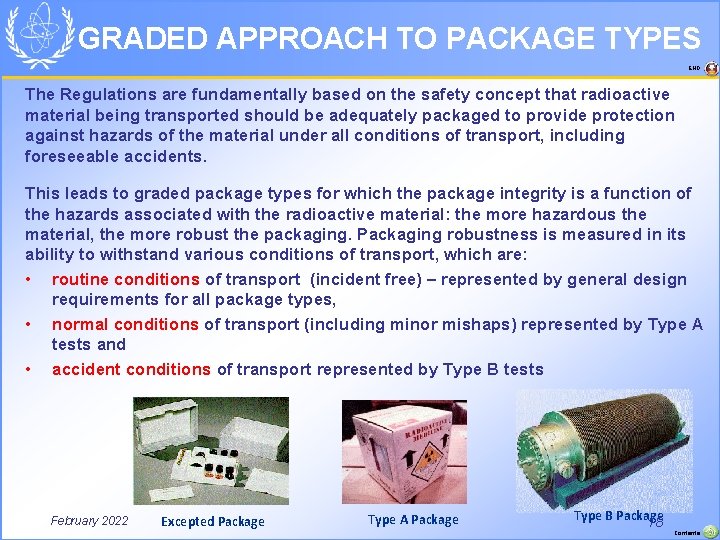
GRADED APPROACH TO PACKAGE TYPES END The Regulations are fundamentally based on the safety concept that radioactive material being transported should be adequately packaged to provide protection against hazards of the material under all conditions of transport, including foreseeable accidents. This leads to graded package types for which the package integrity is a function of the hazards associated with the radioactive material: the more hazardous the material, the more robust the packaging. Packaging robustness is measured in its ability to withstand various conditions of transport, which are: • routine conditions of transport (incident free) – represented by general design requirements for all package types, • normal conditions of transport (including minor mishaps) represented by Type A tests and • accident conditions of transport represented by Type B tests February 2022 Excepted Package Type A Package Type B Package 18 Contents
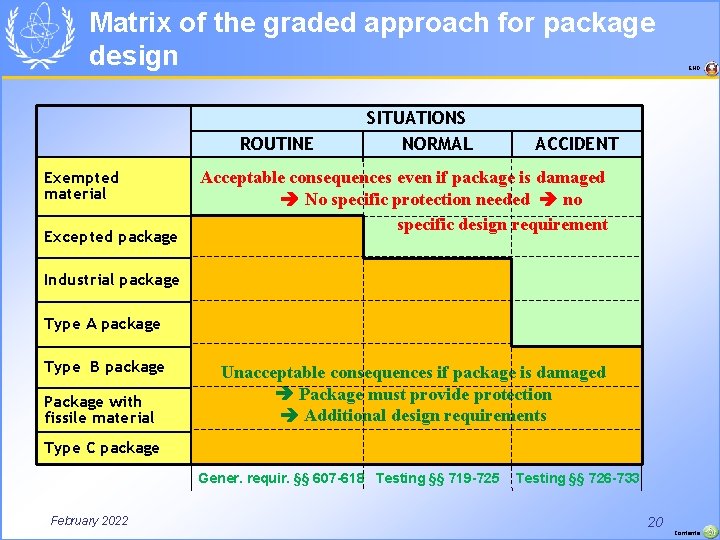
GRADED APPROACH TO PACKAGE TYPES END • The material to be transported has to be classified and assigned to an appropriate packaging type in compliance with the graded approach of package types as specified in the regulation. • Based on this concept, safety during transport is ensured primarily by the package itself. Ensuring compliance of package preparation and transport operations is also essential to safety. • Packages of radioactive material should be dealt with in the same way as other hazardous goods. As for all other dangerous goods, UN numbers are also assigned to radioactive materials (Class 7). • The design and testing requirements for the package types are progressively more stringent as content activity levels increase to provide the same level of safety for all package types • In the following matrix the main provisions regarding design and test requirements are summarized for all package types according to the graded approach. February 2022 19 Contents
Matrix of the graded approach for package design ROUTINE Exempted material Excepted package SITUATIONS NORMAL END ACCIDENT Acceptable consequences even if package is damaged No specific protection needed no specific design requirement Industrial package Type A package Type B package Package with fissile material Unacceptable consequences if package is damaged Package must provide protection Additional design requirements Type C package Gener. requir. §§ 607 -618 Testing §§ 719 -725 February 2022 Testing §§ 726 -733 20 Contents
Summary END • Safety in transport of radioactive material is achieved when the applicable requirements of the Regulations are complied with. • Any radioactive material to be transported has to be classified and assigned to an appropriate packaging type. • The Regulations are based on the safety concept that the radioactive material should be adequately packaged to provide protection against the hazards of the material under all conditions of transport, including foreseeable accidents. • Safety during transport is ensured primarily by the package itself. Ensuring compliance of package preparation and transport operations is also essential to safety. • A graded approach to package types provides the same level of safety for the transport of all types of radioactive materials by relating the hazard of the material to be transported with graded package integrity requirements such that the greater the hazard the stronger the package. February 2022 21 Contents
END Thank you for your attention…. . Questions…. . ? 22 February 2022 Contents