
Scope and potential of Integrative Medicine in current


- Slides: 25
Scope and potential of Integrative Medicine in current Healthcare Scenario Dr. Ashwinikumar A. Raut MD (Ayurveda-Kayachikitsa) Director Clinical Research & Integrative Medicine Medical Research Centre of Kasturba Health Society ICMR Advanced Centre of Reverse Pharmacology in Traditional Medicine Vile-Parle, Mumbai – 400056, India ashuraut@gmail. com Samyukti 2013 An Evidence Based Approach in integrating Ayurveda and Allopathy Organized by MS Ramaiah Academy of Health and Applied Sciences, Bangalore Institute of Transdisciplinary Health Science and Technology (IHST) - FRLHT, Bangalore 1/8/2013 Samyukti 2013 Bangalore/AAR 1
Presentation structure �Integration of Ayurveda & Allopathy: A Tale of Two Centuries �Current Healthcare Scenario: Facts and Figures �Evidence Based Medicine: Complementary to Ayurveda Ethos �Integrative Drug Development: Reverse Pharmacology Path �Renaissance in Ayurveda: Integrative Endeavour �Conclusion and Future Path 1/8/2013 Samyukti 2013 Bangalore/AAR 2
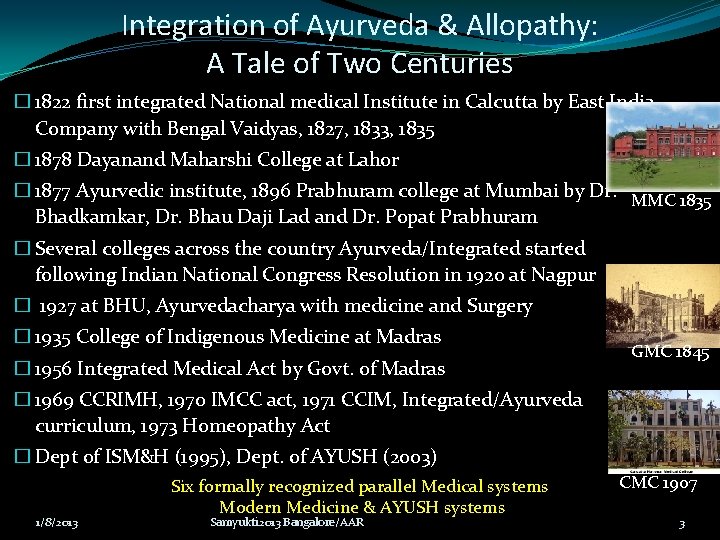
Integration of Ayurveda & Allopathy: A Tale of Two Centuries � 1822 first integrated National medical Institute in Calcutta by East India Company with Bengal Vaidyas, 1827, 1833, 1835 � 1878 Dayanand Maharshi College at Lahor � 1877 Ayurvedic institute, 1896 Prabhuram college at Mumbai by Dr. MMC 1835 Bhadkamkar, Dr. Bhau Daji Lad and Dr. Popat Prabhuram � Several colleges across the country Ayurveda/Integrated started following Indian National Congress Resolution in 1920 at Nagpur � 1927 at BHU, Ayurvedacharya with medicine and Surgery � 1935 College of Indigenous Medicine at Madras � 1956 Integrated Medical Act by Govt. of Madras GMC 1845 � 1969 CCRIMH, 1970 IMCC act, 1971 CCIM, Integrated/Ayurveda curriculum, 1973 Homeopathy Act � Dept of ISM&H (1995), Dept. of AYUSH (2003) 1/8/2013 Six formally recognized parallel Medical systems Modern Medicine & AYUSH systems Samyukti 2013 Bangalore/AAR CMC 1907 3
Current Healthcare Scenario: Facts & Figures � Western Allopathy Medicine transformed into Mainstream Modern Medicine � Global uniformity in Allopathy practices, education, research & its publications � Most of the advancing biomedical & paramedical branches subscribe to the tenets of Allopathy � Global spending on prescription drugs; US $ 954 billion (2011), expected to reach $ 1. 1 trillion (2014) � Iatrogenic diseases 3 rd leading cause of deaths in US, estimated annual mortality (783, 936), medical cost ($282 billion) � Approximately 56 percent of the population of the United States, have been treated unnecessarily by the medical industry � In many developed countries, 70% to 80% of the population has used some form of alternative or complementary medicine 1/8/2013 Samyukti 2013 Bangalore/AAR 4
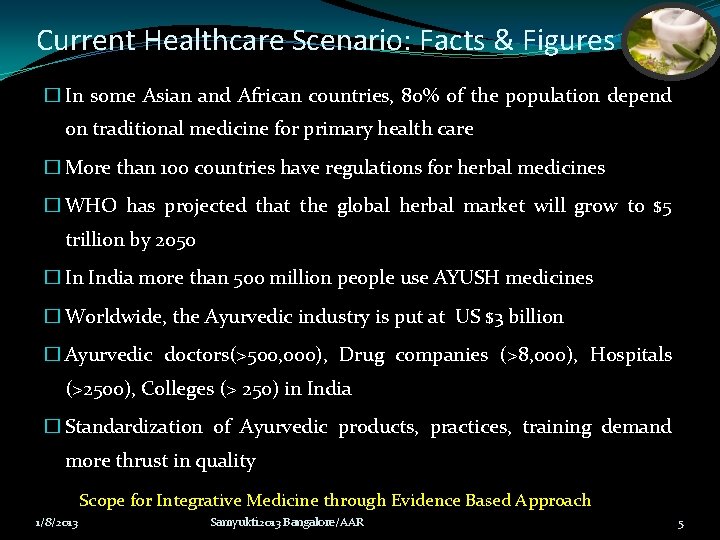
Current Healthcare Scenario: Facts & Figures � In some Asian and African countries, 80% of the population depend on traditional medicine for primary health care � More than 100 countries have regulations for herbal medicines � WHO has projected that the global herbal market will grow to $5 trillion by 2050 � In India more than 500 million people use AYUSH medicines � Worldwide, the Ayurvedic industry is put at US $3 billion � Ayurvedic doctors(>500, 000), Drug companies (>8, 000), Hospitals (>2500), Colleges (> 250) in India � Standardization of Ayurvedic products, practices, training demand more thrust in quality Scope for Integrative Medicine through Evidence Based Approach 1/8/2013 Samyukti 2013 Bangalore/AAR 5
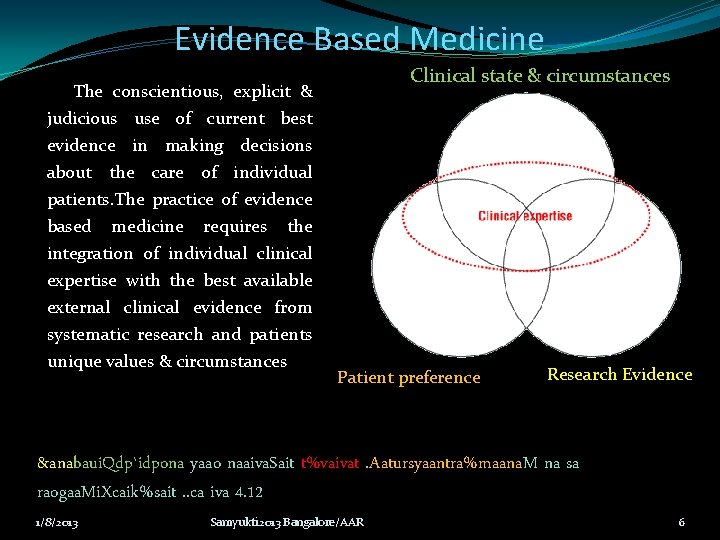
Evidence Based Medicine The conscientious, explicit & judicious use of current best evidence in making decisions about the care of individual patients. The practice of evidence based medicine requires the integration of individual clinical expertise with the best available external clinical evidence from systematic research and patients unique values & circumstances Clinical state & circumstances Patient preference Research Evidence &anabaui. Qdp`idpona yaao naaiva. Sait t%vaivat. Aatursyaantra%maana. M na sa raogaa. Mi. Xcaik%sait. . ca iva 4. 12 1/8/2013 Samyukti 2013 Bangalore/AAR 6
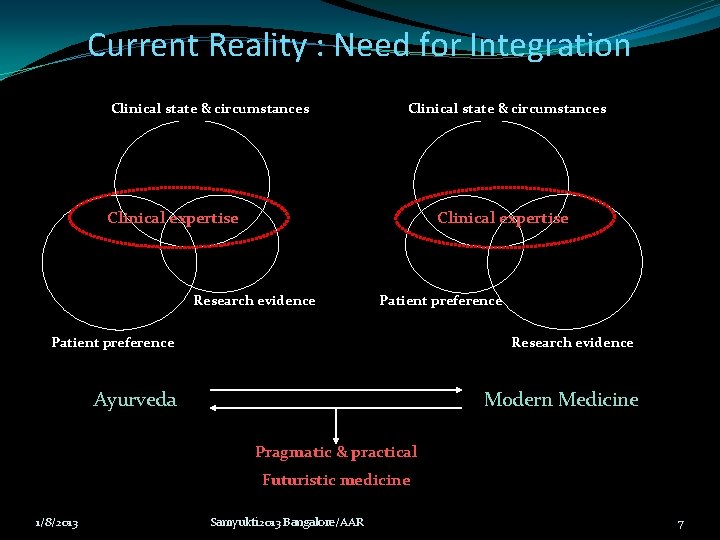
Current Reality : Need for Integration Clinical state & circumstances Clinical expertise Research evidence Patient preference Research evidence Ayurveda Modern Medicine Pragmatic & practical Futuristic medicine 1/8/2013 Samyukti 2013 Bangalore/AAR 7
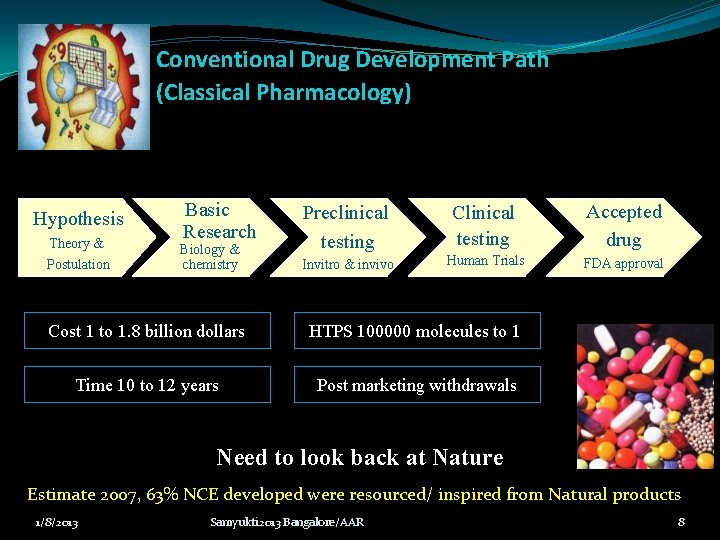
Conventional Drug Development Path (Classical Pharmacology) Hypothesis Theory & Postulation Basic Research Biology & chemistry Preclinical testing Clinical testing Accepted drug Invitro & invivo Human Trials FDA approval Cost 1 to 1. 8 billion dollars HTPS 100000 molecules to 1 Time 10 to 12 years Post marketing withdrawals Need to look back at Nature Estimate 2007, 63% NCE developed were resourced/ inspired from Natural products 1/8/2013 Samyukti 2013 Bangalore/AAR 8
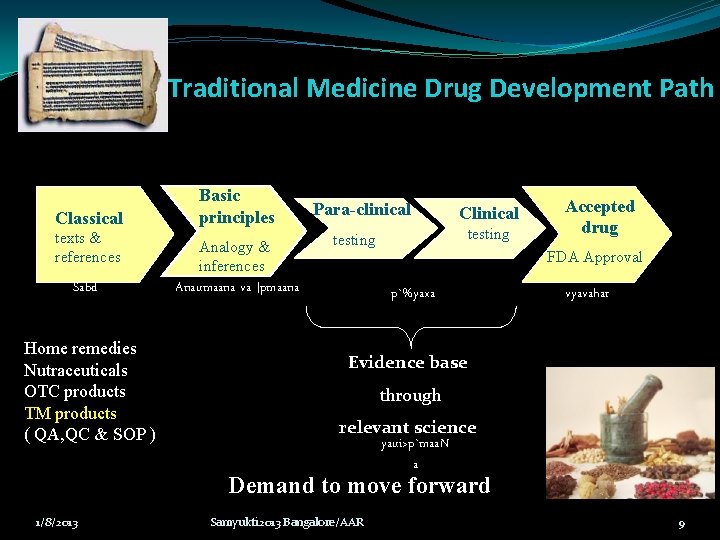
Traditional Medicine Drug Development Path Classical texts & references Sabd Home remedies Nutraceuticals OTC products TM products ( QA, QC & SOP ) Basic principles Analogy & inferences Para-clinical Clinical testing Accepted drug FDA Approval Anaumaana va ]pmaana p`%yaxa vyavahar Evidence base through relevant science yaui>p`maa. N a Demand to move forward 1/8/2013 Samyukti 2013 Bangalore/AAR 9
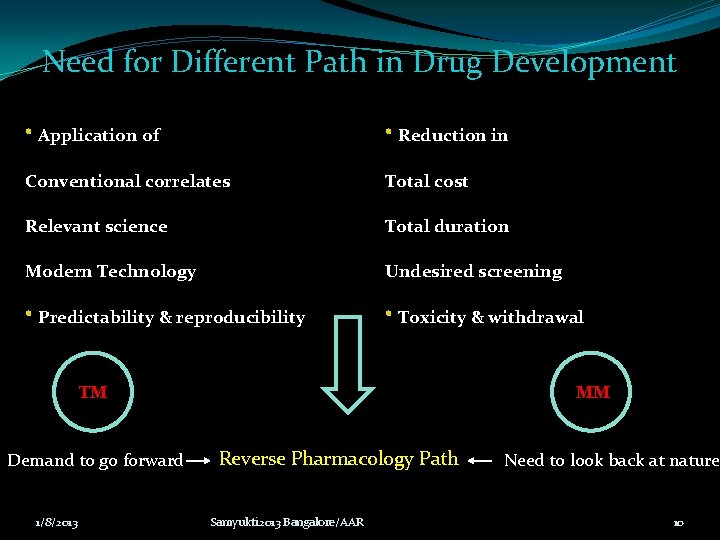
Need for Different Path in Drug Development • Application of • Reduction in Conventional correlates Total cost Relevant science Total duration Modern Technology Undesired screening • Predictability & reproducibility • Toxicity & withdrawal TM Demand to go forward 1/8/2013 MM Reverse Pharmacology Path Samyukti 2013 Bangalore/AAR Need to look back at nature 10
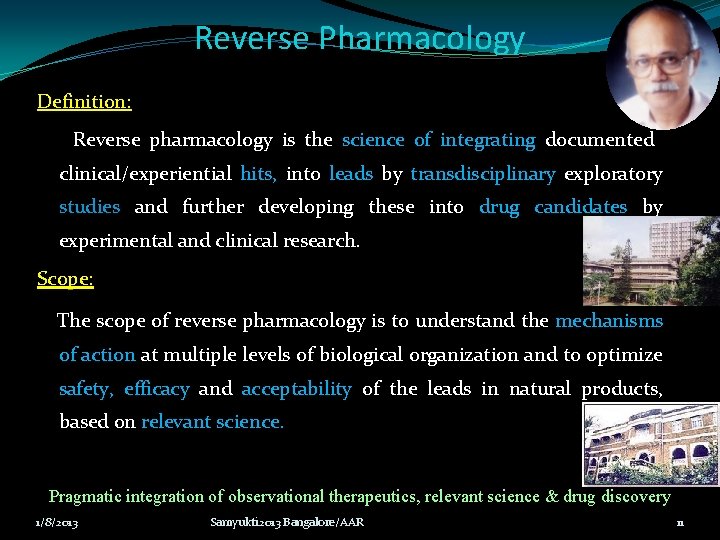
Reverse Pharmacology Definition: Reverse pharmacology is the science of integrating documented clinical/experiential hits, into leads by transdisciplinary exploratory studies and further developing these into drug candidates by experimental and clinical research. Scope: The scope of reverse pharmacology is to understand the mechanisms of action at multiple levels of biological organization and to optimize safety, efficacy and acceptability of the leads in natural products, based on relevant science. Pragmatic integration of observational therapeutics, relevant science & drug discovery 1/8/2013 Samyukti 2013 Bangalore/AAR 11
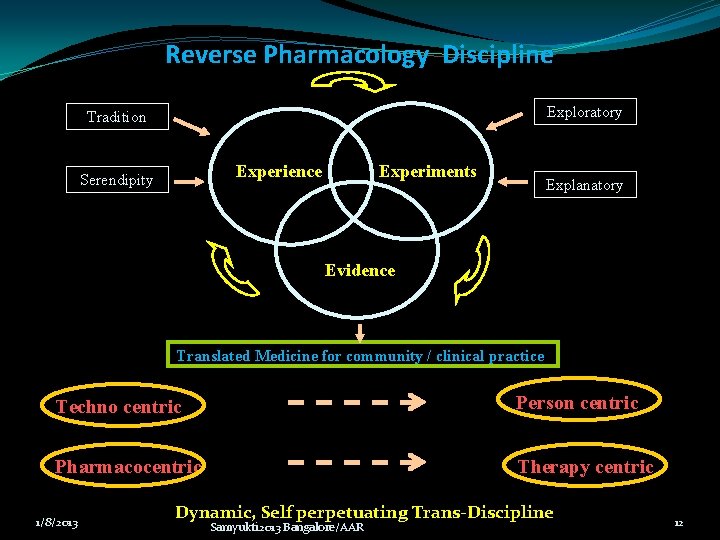
Reverse Pharmacology Discipline Exploratory Tradition Experience Serendipity Experiments Explanatory Evidence Translated Medicine for community / clinical practice Techno centric Person centric Pharmacocentric Therapy centric 1/8/2013 Dynamic, Self perpetuating Trans-Discipline Samyukti 2013 Bangalore/AAR 12
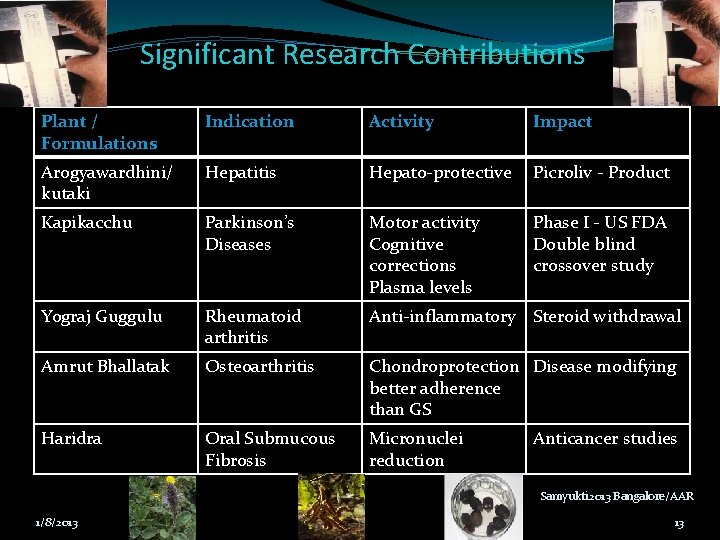
Significant Research Contributions Plant / Formulations Indication Activity Impact Arogyawardhini/ kutaki Hepatitis Hepato-protective Picroliv - Product Kapikacchu Parkinson’s Diseases Motor activity Cognitive corrections Plasma levels Phase I - US FDA Double blind crossover study Yograj Guggulu Rheumatoid arthritis Anti-inflammatory Steroid withdrawal Amrut Bhallatak Osteoarthritis Chondroprotection Disease modifying better adherence than GS Haridra Oral Submucous Fibrosis Micronuclei reduction Anticancer studies Samyukti 2013 Bangalore/AAR 1/8/2013 13
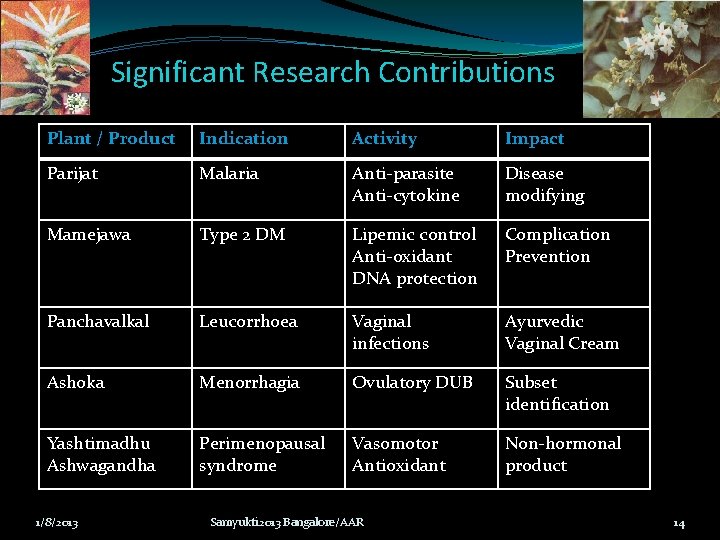
Significant Research Contributions Plant / Product Indication Activity Impact Parijat Malaria Anti-parasite Anti-cytokine Disease modifying Mamejawa Type 2 DM Lipemic control Anti-oxidant DNA protection Complication Prevention Panchavalkal Leucorrhoea Vaginal infections Ayurvedic Vaginal Cream Ashoka Menorrhagia Ovulatory DUB Subset identification Yashtimadhu Ashwagandha Perimenopausal syndrome Vasomotor Antioxidant Non-hormonal product 1/8/2013 Samyukti 2013 Bangalore/AAR 14
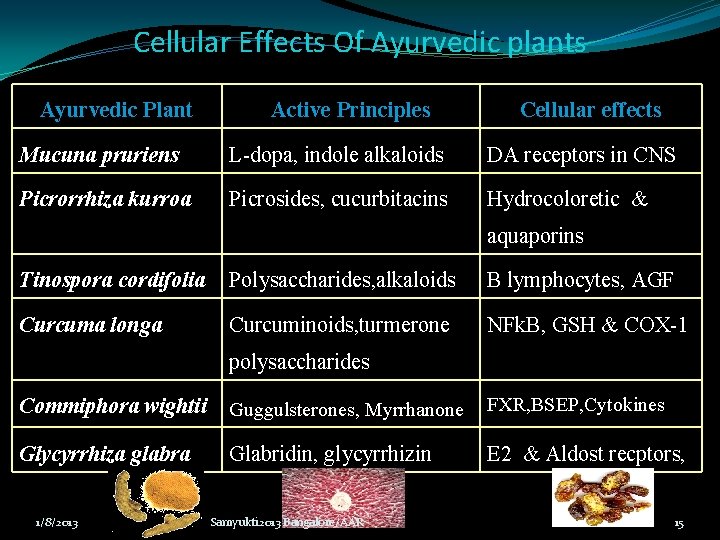
Cellular Effects Of Ayurvedic plants Ayurvedic Plant Active Principles Cellular effects Mucuna pruriens L-dopa, indole alkaloids DA receptors in CNS Picrorrhiza kurroa Picrosides, cucurbitacins Hydrocoloretic & aquaporins Tinospora cordifolia Polysaccharides, alkaloids B lymphocytes, AGF Curcuma longa Curcuminoids, turmerone NFk. B, GSH & COX-1 polysaccharides Commiphora wightii Guggulsterones, Myrrhanone FXR, BSEP, Cytokines FXR, Glycyrrhiza glabra E 2 & Aldost recptors, 1/8/2013 Glabridin, glycyrrhizin Samyukti 2013 Bangalore/AAR 15
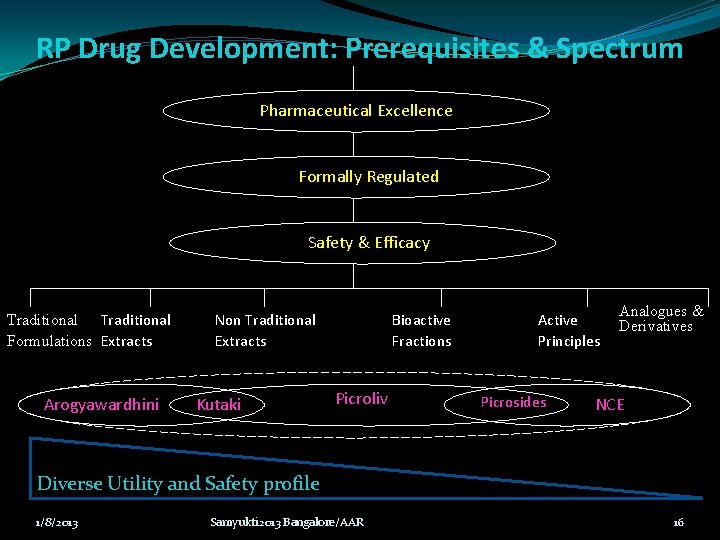
RP Drug Development: Prerequisites & Spectrum Pharmaceutical Excellence Formally Regulated Safety & Efficacy Traditional Formulations Extracts Arogyawardhini Non Traditional Extracts Kutaki Bioactive Fractions Picroliv Active Principles Picrosides Analogues & Derivatives NCE Diverse Utility and Safety profile 1/8/2013 Samyukti 2013 Bangalore/AAR 16
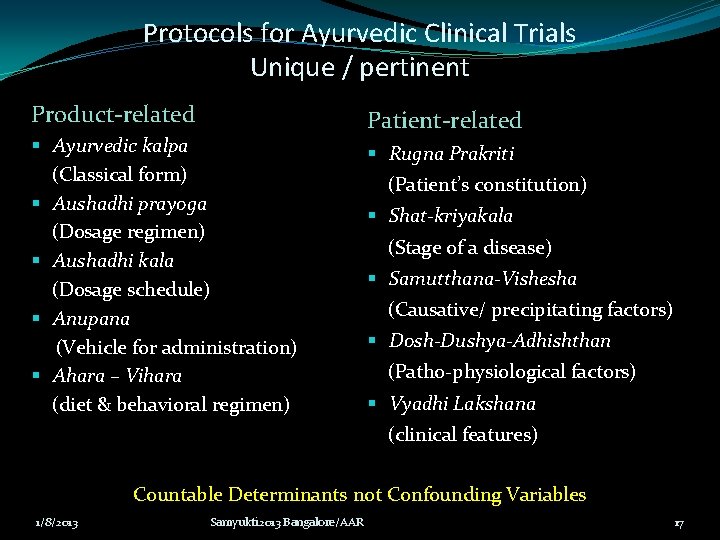
Protocols for Ayurvedic Clinical Trials Unique / pertinent Product-related § Ayurvedic kalpa (Classical form) § Aushadhi prayoga (Dosage regimen) § Aushadhi kala (Dosage schedule) § Anupana (Vehicle for administration) § Ahara – Vihara (diet & behavioral regimen) Patient-related § Rugna Prakriti (Patient’s constitution) § Shat-kriyakala (Stage of a disease) § Samutthana-Vishesha (Causative/ precipitating factors) § Dosh-Dushya-Adhishthan (Patho-physiological factors) § Vyadhi Lakshana (clinical features) Countable Determinants not Confounding Variables 1/8/2013 Samyukti 2013 Bangalore/AAR 17
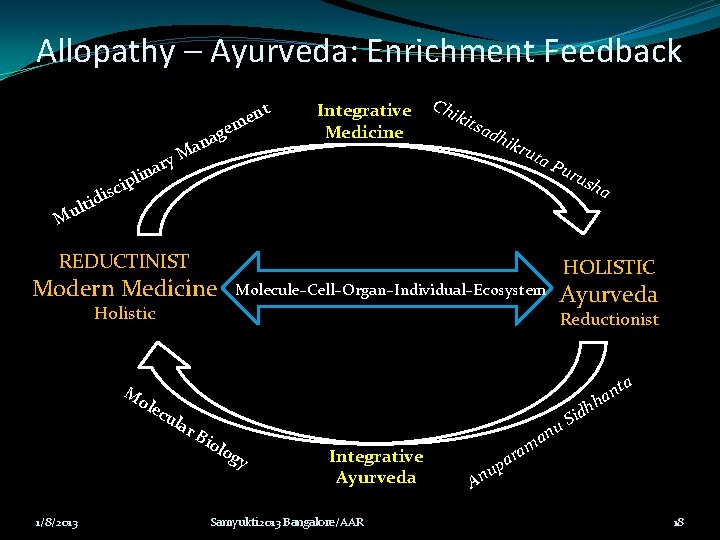
Allopathy – Ayurveda: Enrichment Feedback r ina pl i c s i ltid Mu a y. M nt e m e g a n Integrative Medicine Ch ik itsa dhi kru ta REDUCTINIST Modern Medicine Molecule–Cell–Organ–Individual–Ecosystem Holistic rus h a HOLISTIC Ayurveda Reductionist ta Mo lec ula 1/8/2013 Pu r. B iol og y Integrative Ayurveda Samyukti 2013 Bangalore/AAR nu a ram an h idh S a up n A 18
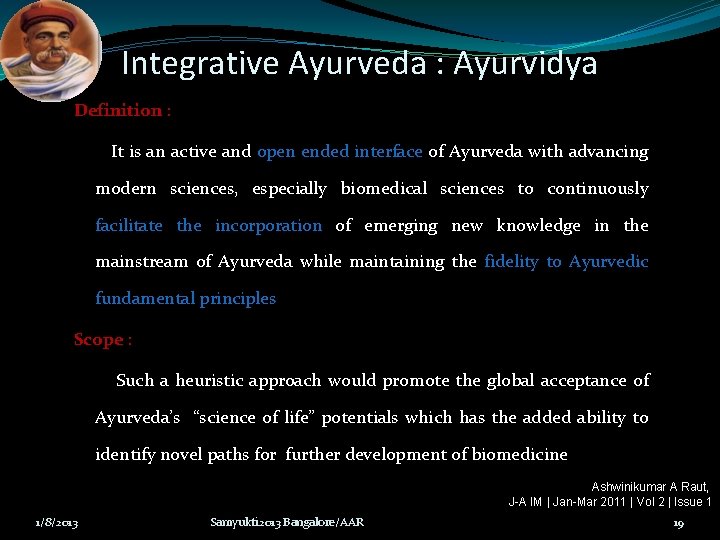
Integrative Ayurveda : Ayurvidya Definition : It is an active and open ended interface of Ayurveda with advancing modern sciences, especially biomedical sciences to continuously facilitate the incorporation of emerging new knowledge in the mainstream of Ayurveda while maintaining the fidelity to Ayurvedic fundamental principles Scope : Such a heuristic approach would promote the global acceptance of Ayurveda’s “science of life” potentials which has the added ability to identify novel paths for further development of biomedicine Ashwinikumar A Raut, J-A IM | Jan-Mar 2011 | Vol 2 | Issue 1 1/8/2013 Samyukti 2013 Bangalore/AAR 19
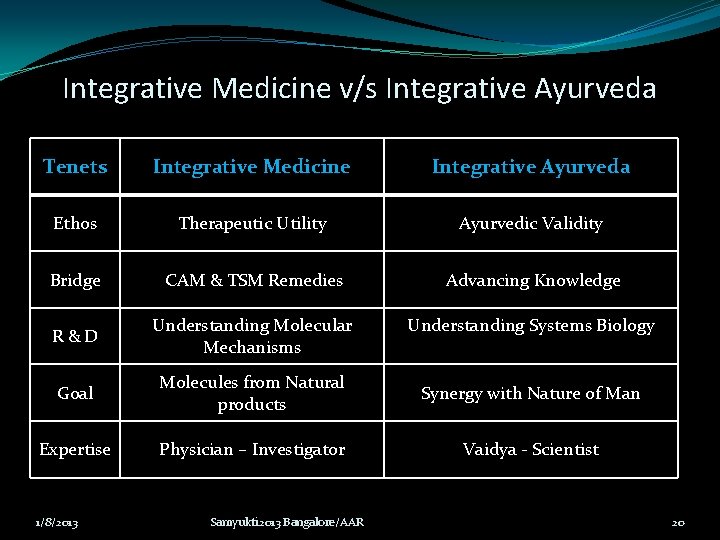
Integrative Medicine v/s Integrative Ayurveda Tenets Integrative Medicine Integrative Ayurveda Ethos Therapeutic Utility Ayurvedic Validity Bridge CAM & TSM Remedies Advancing Knowledge R&D Understanding Molecular Mechanisms Understanding Systems Biology Goal Molecules from Natural products Synergy with Nature of Man Expertise Physician – Investigator Vaidya - Scientist 1/8/2013 Samyukti 2013 Bangalore/AAR 20
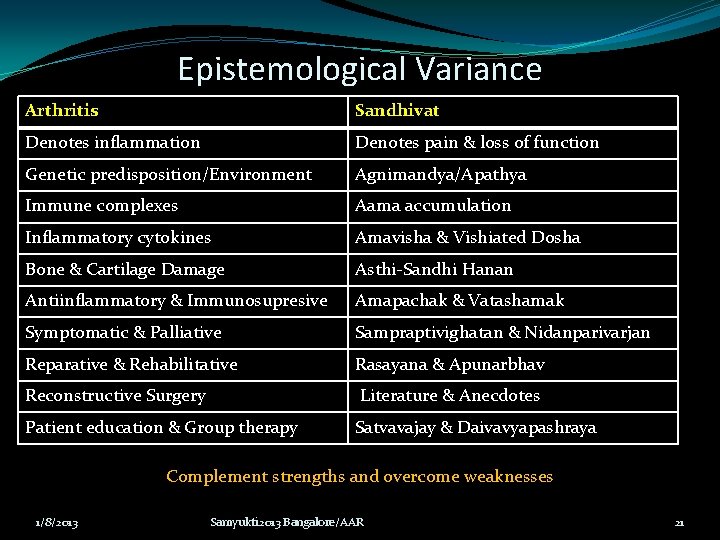
Epistemological Variance Arthritis Sandhivat Denotes inflammation Denotes pain & loss of function Genetic predisposition/Environment Agnimandya/Apathya Immune complexes Aama accumulation Inflammatory cytokines Amavisha & Vishiated Dosha Bone & Cartilage Damage Asthi-Sandhi Hanan Antiinflammatory & Immunosupresive Amapachak & Vatashamak Symptomatic & Palliative Sampraptivighatan & Nidanparivarjan Reparative & Rehabilitative Rasayana & Apunarbhav Reconstructive Surgery Literature & Anecdotes Patient education & Group therapy Satvavajay & Daivavyapashraya Complement strengths and overcome weaknesses 1/8/2013 Samyukti 2013 Bangalore/AAR 21
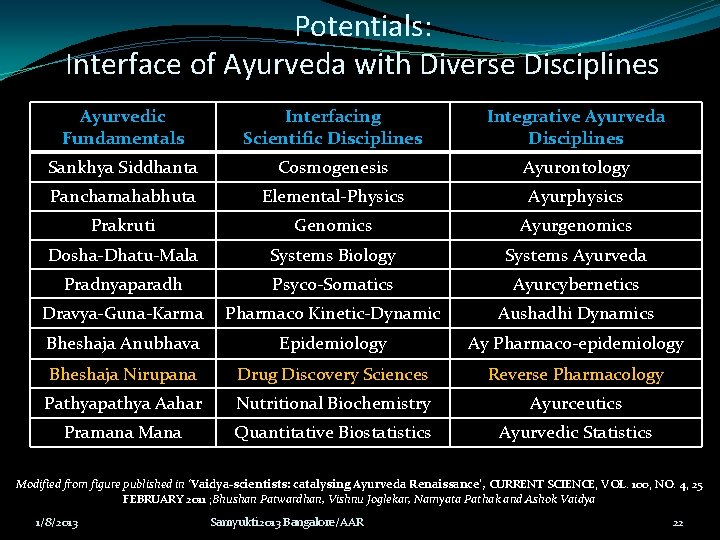
Potentials: Interface of Ayurveda with Diverse Disciplines Ayurvedic Fundamentals Interfacing Scientific Disciplines Integrative Ayurveda Disciplines Sankhya Siddhanta Cosmogenesis Ayurontology Panchamahabhuta Elemental-Physics Ayurphysics Prakruti Genomics Ayurgenomics Dosha-Dhatu-Mala Systems Biology Systems Ayurveda Pradnyaparadh Psyco-Somatics Ayurcybernetics Dravya-Guna-Karma Pharmaco Kinetic-Dynamic Aushadhi Dynamics Bheshaja Anubhava Epidemiology Ay Pharmaco-epidemiology Bheshaja Nirupana Drug Discovery Sciences Reverse Pharmacology Pathyapathya Aahar Nutritional Biochemistry Ayurceutics Pramana Mana Quantitative Biostatistics Ayurvedic Statistics Modified from figure published in ‘Vaidya-scientists: catalysing Ayurveda Renaissance’, CURRENT SCIENCE, VOL. 100, NO. 4, 25 FEBRUARY 2011 ; Bhushan Patwardhan, Vishnu Joglekar, Namyata Pathak and Ashok Vaidya 1/8/2013 Samyukti 2013 Bangalore/AAR 22
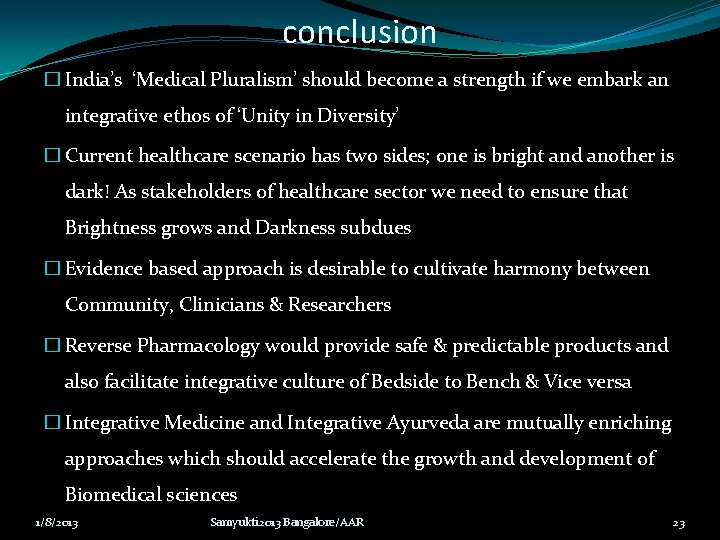
conclusion � India’s ‘Medical Pluralism’ should become a strength if we embark an integrative ethos of ‘Unity in Diversity’ � Current healthcare scenario has two sides; one is bright and another is dark! As stakeholders of healthcare sector we need to ensure that Brightness grows and Darkness subdues � Evidence based approach is desirable to cultivate harmony between Community, Clinicians & Researchers � Reverse Pharmacology would provide safe & predictable products and also facilitate integrative culture of Bedside to Bench & Vice versa � Integrative Medicine and Integrative Ayurveda are mutually enriching approaches which should accelerate the growth and development of Biomedical sciences 1/8/2013 Samyukti 2013 Bangalore/AAR 23
Aa naao Bad`a: k``tvaao yantu iva. Svat: 1/8/2013 Samyukti 2013 Bangalore/AAR 24
1/8/2013 Samyukti 2013 Bangalore/AAR Thank You ! 25