
Scoliosis Convexity is Related to Organ Anatomy Tom



- Slides: 12
Scoliosis Convexity is Related to Organ Anatomy Tom P. C. Schlösser, Tom Semple, Siobhán B. Carr, Simon Padley, Michael Loebinger, Claire Hogg, René M. Castelein ICEOS 2016
80 -99% of AIS is right convex Theories on scoliosis convexity are: Brain asymmetry Asymmetrical organ distribution Right handedness
Rotation of the normal spine is to the right and matches with scoliosis convexity
Kouwenhoven et al. , 2007: Rotation of the normal spine is related to organ anatomy! Normal anatomy versus Situs inversus:
Hypothesis AIS curve convexity is to the right in patients with normal anatomy and to the left in situs inversus Optimal design: Normal situs Situs inversus
Prevalence of AIS with situs inversus is nihil AIS 2% Situs Inversus 0, 005% SI+Scoliosis 1/3. 000
Primary Cilliary Dyskinesia is a pulmonary syndrome with 50/50 distribution of organ anatomy 50%
Study population: Retrospective review of annual X-chest screening of 196 PCD patients: - 108 Normal anatomy - 84 Situs inversus - 4 Dextrocardia
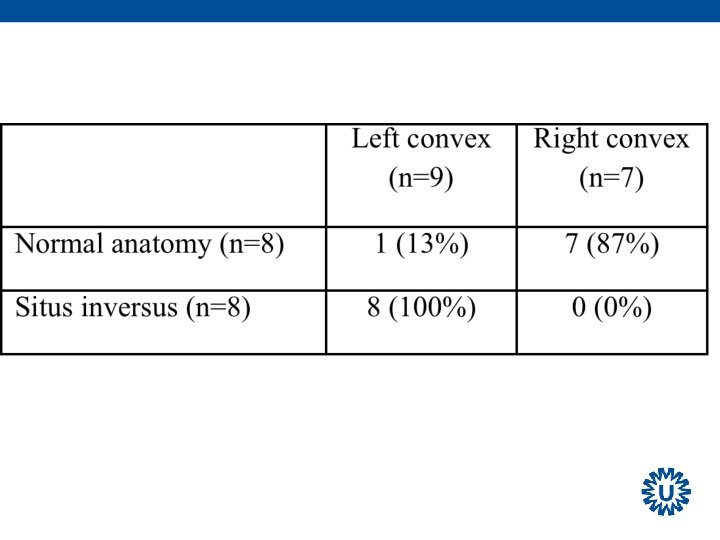
196 PCD patients 46 (23%) Cobb >5° 16 (8%) Cobb >10 ° • 8 Situs solitus • 8 Situs inversus 7 of 8 right convex! 8 of 8 left convex! Chi-square P=0. 001
2 examples of PCD patients with scoliosis, with and without situs inversus
Conclusions: • Higher prevalence of scoliosis in PCD (8%), but data support the hypothesis that: • Distribution of organ mass appears to determine curve convexity in scoliosis