
SCIFSAPF Development Process JOSH GODKNECHT President Adamo Adamo
- Slides: 24
SCIF/SAPF Development Process JOSH GODKNECHT President, Adamo
Adamo History • Established 1962
Adamo History • Established 1962 • Focused on high security environments and classified program related services for the last 35+ years
Adamo History • Established 1962 • Focused on high security environments and classified program related services for the last 35+ years • Designed and constructed over 700 classified spaces (SCIF/SAPF/Collateral)
Adamo’s Team On average Adamo’s teams engage anywhere from 25 -35 security professionals, programs and requirements per year. Over 35 years, this has developed into a wealth of understanding in security. Additionally this experience has provided our team members access to a very insightful perspective on both Government and the National Security Industrial base.
SCIF/SAPF Standards • SCIF and SAPF are both built to Technical Specifications for Construction and Management of Sensitive Compartmented Information Facilities. (v 1. 4) • The goal is reciprocity across all agencies.
SCIF/SAPF Project Roles Key Roles and Responsibilities
SCIF/SAPF Project Roles Key Roles and Responsibilities • Accrediting Official (AO) • The individual appointed by the head of an IC element to accredit the space and input the facility’s information into the national repository.
SCIF/SAPF Project Roles Key Roles and Responsibilities • Accrediting Official (AO) • Site Security Manager (SSM) • The individual (approved by the AO) to oversee/manage the security of the project. • Primary contractor/command contact that interfaces upstream with the accrediting agency.
SCIF/SAPF Project Roles Key Roles and Responsibilities • Accrediting Official (AO) • Site Security Manager (SSM) • Certified Technical TEMPEST Authority (CTTA) • Government contact with oversight to emanation security related items of the space. • Often unavailable or very limited for CONUS projects.
SCIF/SAPF Construction Types 1. Conventional Construction
SCIF/SAPF Construction Types 1. Conventional Construction 2. Modular
SCIF/SAPF Construction Types 1. Conventional Construction 2. Modular • Roll-On • Panelized • Containerized - ISO container (Conex Box) or custom fabricated.
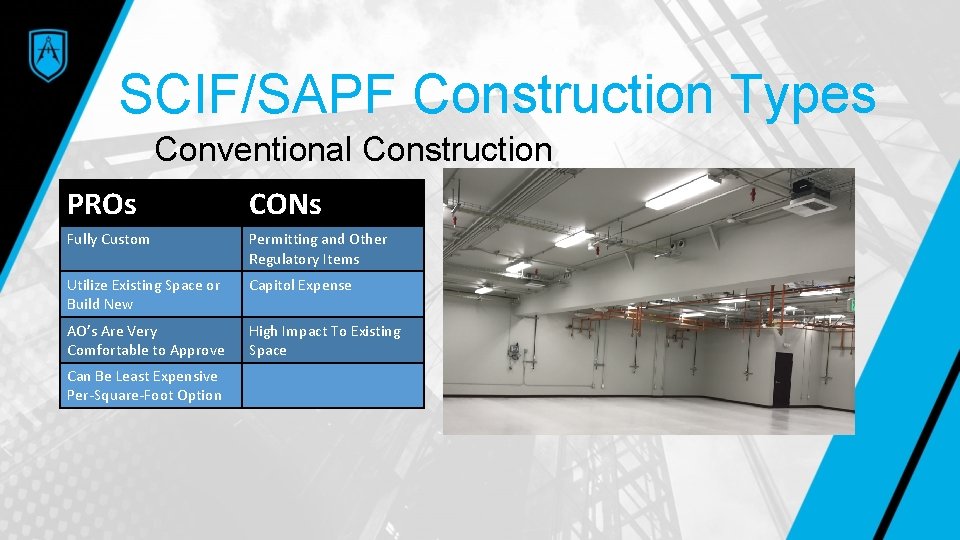
SCIF/SAPF Construction Types Conventional Construction PROs CONs Fully Custom Permitting and Other Regulatory Items Utilize Existing Space or Build New Capitol Expense AO’s Are Very Comfortable to Approve High Impact To Existing Space Can Be Least Expensive Per-Square-Foot Option
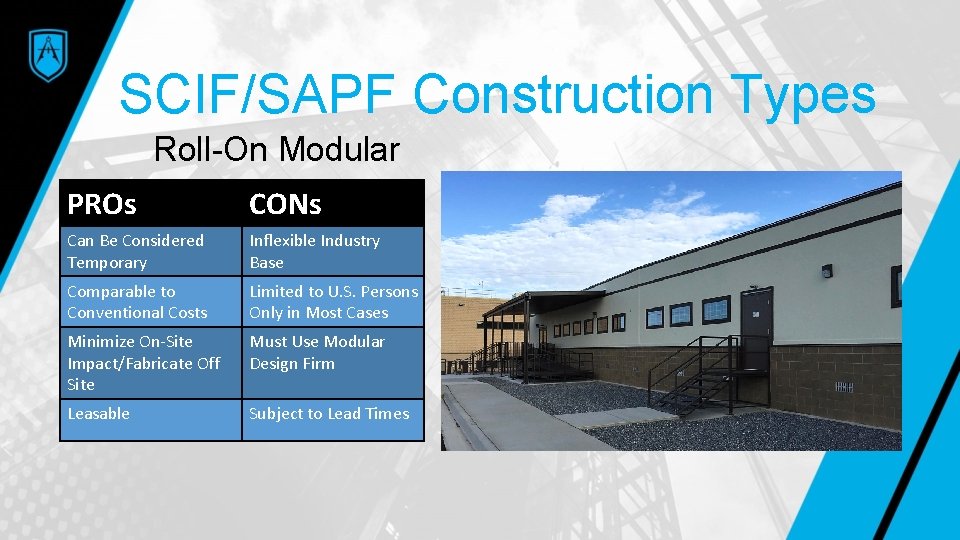
SCIF/SAPF Construction Types Roll-On Modular PROs CONs Can Be Considered Temporary Inflexible Industry Base Comparable to Conventional Costs Limited to U. S. Persons Only in Most Cases Minimize On-Site Impact/Fabricate Off Site Must Use Modular Design Firm Leasable Subject to Lead Times
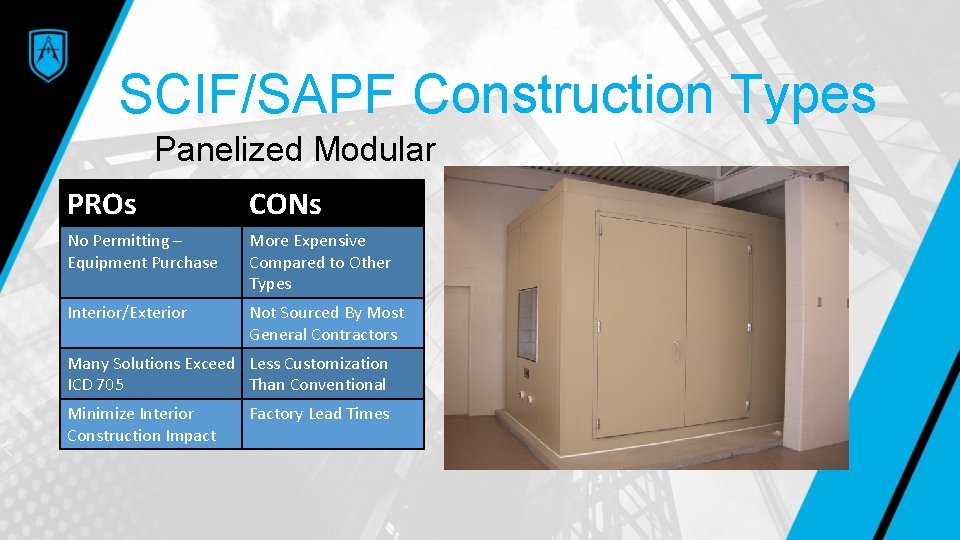
SCIF/SAPF Construction Types Panelized Modular PROs CONs No Permitting – Equipment Purchase More Expensive Compared to Other Types Interior/Exterior Not Sourced By Most General Contractors Many Solutions Exceed Less Customization ICD 705 Than Conventional Minimize Interior Construction Impact Factory Lead Times
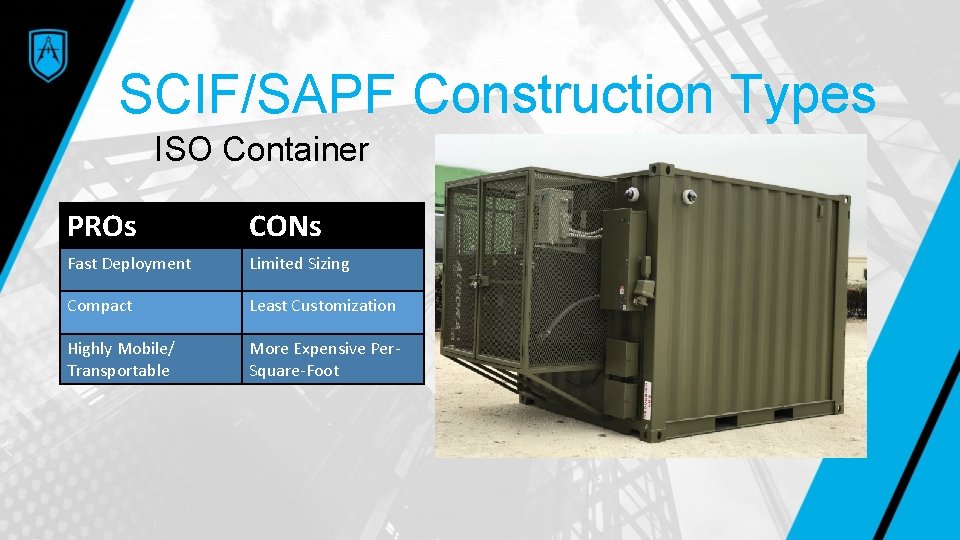
SCIF/SAPF Construction Types ISO Container PROs CONs Fast Deployment Limited Sizing Compact Least Customization Highly Mobile/ Transportable More Expensive Per. Square-Foot
SCIF/SAPF Critical Steps 1. Sponsorship - Do we have a need?
SCIF/SAPF Critical Steps 1. Sponsorship - Do we have a need? 2. Get agency input and approval for the design.
SCIF/SAPF Critical Steps 1. Sponsorship - Do we have a need? 2. Get agency input and approval for the design. 3. Construct or fabricate/install (modular) the project.
SCIF/SAPF Critical Steps 1. Sponsorship - Do we have a need? 2. Get agency input and approval for the design. 3. Construct or fabricate/install (modular) the project. 4. Submit the final accreditation package.
SCIF/SAPF Critical Steps 1. Sponsorship - Do we have a need? 2. Get agency input and approval for the design. 3. Construct or fabricate/install (modular) the project. 4. Submit the final accreditation package. 5. Move in (Includes classified networks) and operate!
QUESTIONS/ Discussion