
SCIENTIFIC WRITING LESSON I SUBJECTS AND ACTIONS CREDIT
SCIENTIFIC WRITING LESSON I: SUBJECTS AND ACTIONS CREDIT: DUKE GRADUATE SCHOOL SCIENTIFIC WRITING RESOURCE
INTRODUCTION Two main pieces of information in sentences 1. Who is the sentence about? 2. What did they do? • You can help readers find this information using cues in your sentence structure. For example, • Character • Intended action Grammatical subject Sentence’s verb
THREE PRINCIPLES 1. 2. 3. Put actions in verbs Put characters in subjects Keep subjects near verbs
PRINCIPLE 1: PUT ACTIONS IN VERBS • Verbs are action words: they describe motion, like to explore, to examine, or to observe. • Verbs can be turned into nouns, which changes the word from an action to a thing. • A noun that is formed from a verb like this is called a nominalization. Nominalizations are nouns that contain a hidden action.
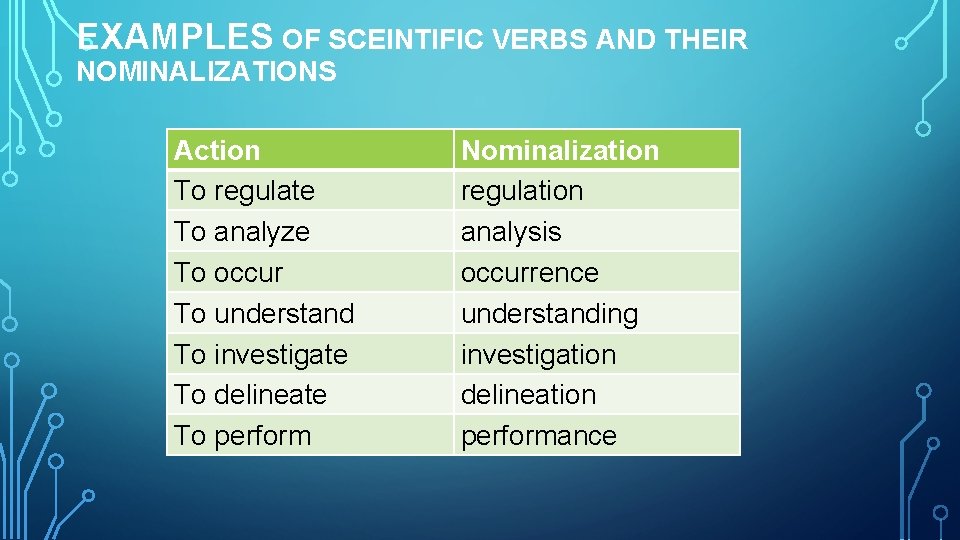
EXAMPLES OF SCEINTIFIC VERBS AND THEIR NOMINALIZATIONS Action To regulate To analyze To occur To understand To investigate To delineate To perform Nominalization regulation analysis occurrence understanding investigation delineation performance
COMMENTS ON NOMINALIZATION • There is nothing wrong with nominalizations, but many scientific writers misuse them by using abstract nouns to convey action. • This creates a disconnect between structure and meaning — the intended action is no longer found in the verb. • Most readers expect the main action of a clause to be found in a verb.
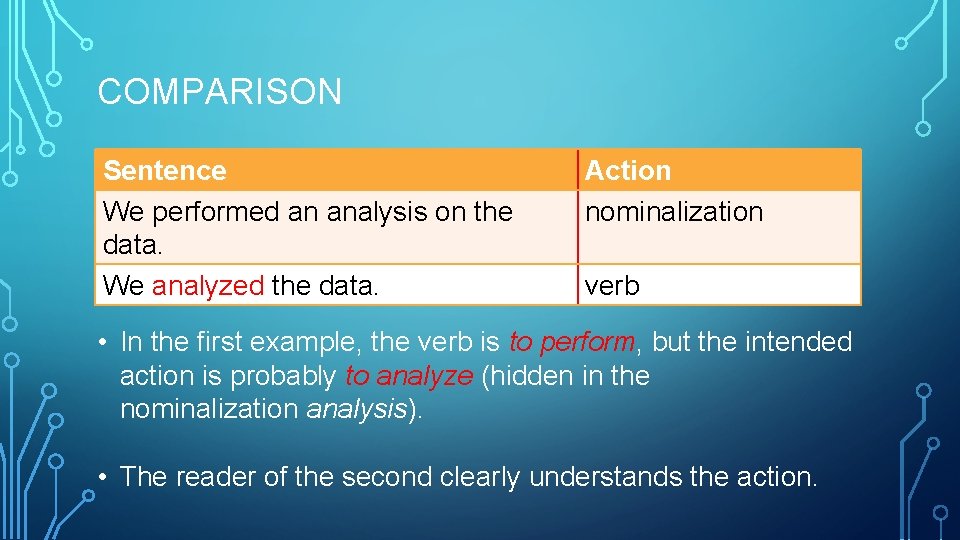
COMPARISON Sentence We performed an analysis on the data. We analyzed the data. Action nominalization verb • In the first example, the verb is to perform, but the intended action is probably to analyze (hidden in the nominalization analysis). • The reader of the second clearly understands the action.
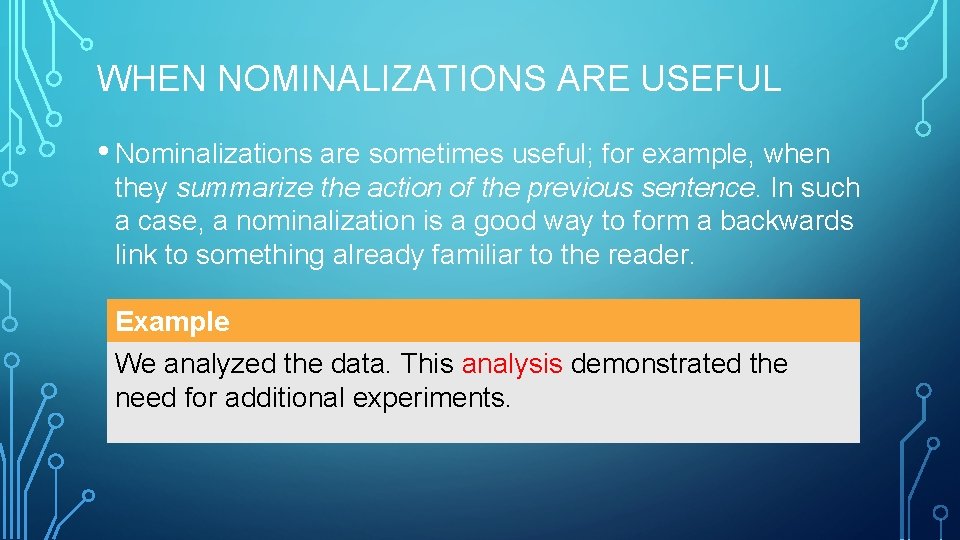
WHEN NOMINALIZATIONS ARE USEFUL • Nominalizations are sometimes useful; for example, when they summarize the action of the previous sentence. In such a case, a nominalization is a good way to form a backwards link to something already familiar to the reader. Example We analyzed the data. This analysis demonstrated the need for additional experiments.
REVISION TECHNIQUES • Go through your manuscript and underline all nominalizations. Take a closer look at these words to see if they should be changed to verbs. • Or, it may be easier to do the opposite: Go through the manuscript and underline all the verbs. For each verb, ask yourself this question: Does this verb capture the action in the sentence?
PRINCIPLE 2: PUT CHARACTERS IN SUBJECTS • The character is the actor (the entity performing the action). • Readers expect the main character in a clause to be found in the subject. • Characters can be (and often are) abstract nouns, like expression level or exon usage.
TWO EXAMPLES OF USING SUBJECTS DIFFERENTLY Example 1: The movement in the liquid medium of the bacteria was accomplished by microflagella. • There is a disconnect between subject and intended main character. The grammatical subject was an abstract noun (movement), which is really describing the action of the main character.
TWO EXAMPLES OF USING SUBJECTS DIFFERENTLY Example 2: The bacteria move themselves in the liquid medium with microflagella. • The main character is now found in the subject. This example is clea because the intended actor (what's the sentence about? ) is the same as the grammatical subject (bacteria). • The grammatical subject of the sentence should be the answer to the question: What is this sentence about?
SUBJECTS SHIFTING • Scientific writing often has the problem of subject shifting — subjects change erratically throughout a paragraph. • It's fine to change the grammatical subject from one sentence to the next if you intend to change the topic. • Writing is easier to follow when the string of subjects in a paragraph reflects the topics.

MOST EFFECTIVE PARAGRAPH UNITS Either 1) discuss a single topic, Or 2) discuss a series of related topics that build on one another.
LOGICAL FLOW OF GRAMMATICAL SUBJECTS • Two ways to maintain a logical flow of grammatical subjects in a paragraph: 1. Maintain a common subject throughout a one-topic paragraph. 2. Shift the subject appropriately according to the story.
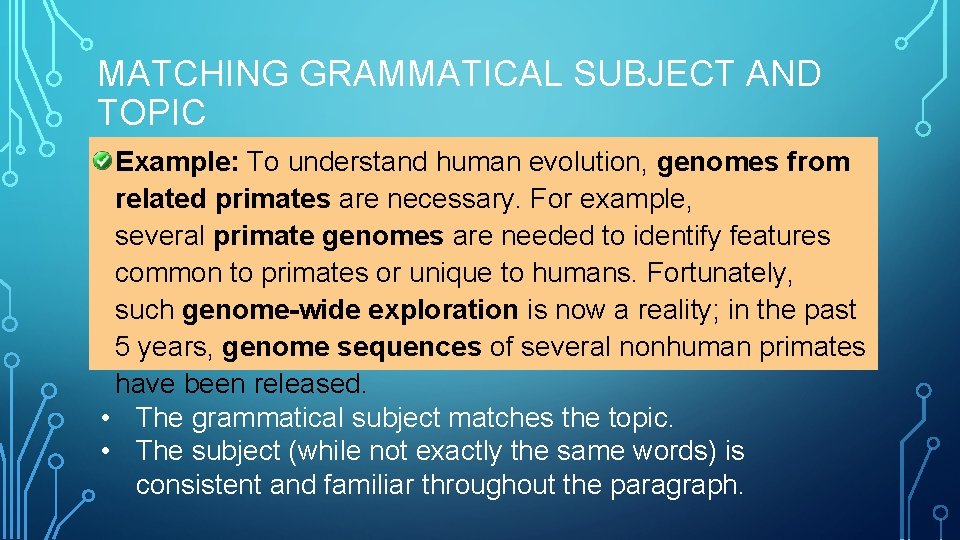
MATCHING GRAMMATICAL SUBJECT AND TOPIC • Example: To understand human evolution, genomes from related primates are necessary. For example, several primate genomes are needed to identify features common to primates or unique to humans. Fortunately, such genome-wide exploration is now a reality; in the past 5 years, genome sequences of several nonhuman primates have been released. • The grammatical subject matches the topic. • The subject (while not exactly the same words) is consistent and familiar throughout the paragraph.
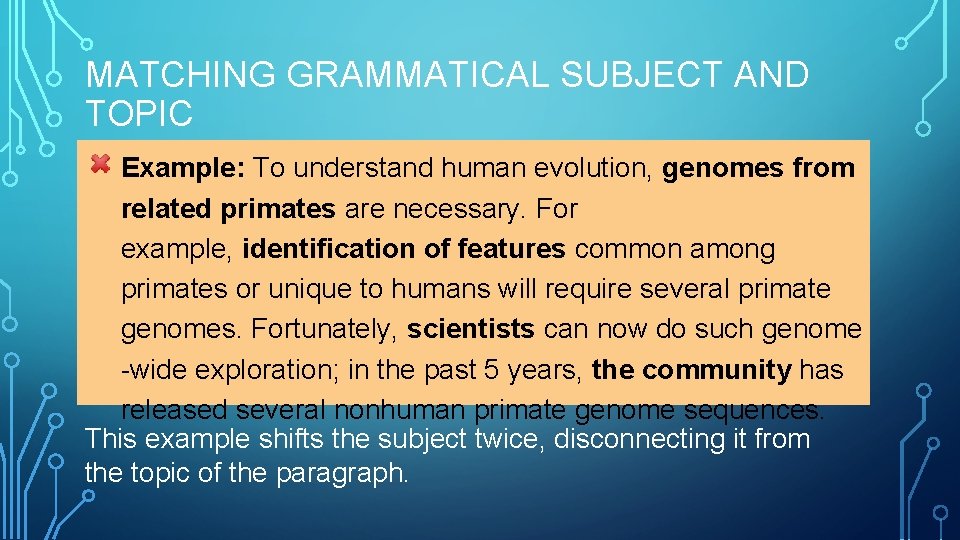
MATCHING GRAMMATICAL SUBJECT AND TOPIC Example: To understand human evolution, genomes from related primates are necessary. For example, identification of features common among primates or unique to humans will require several primate genomes. Fortunately, scientists can now do such genome -wide exploration; in the past 5 years, the community has released several nonhuman primate genome sequences. This example shifts the subject twice, disconnecting it from the topic of the paragraph.
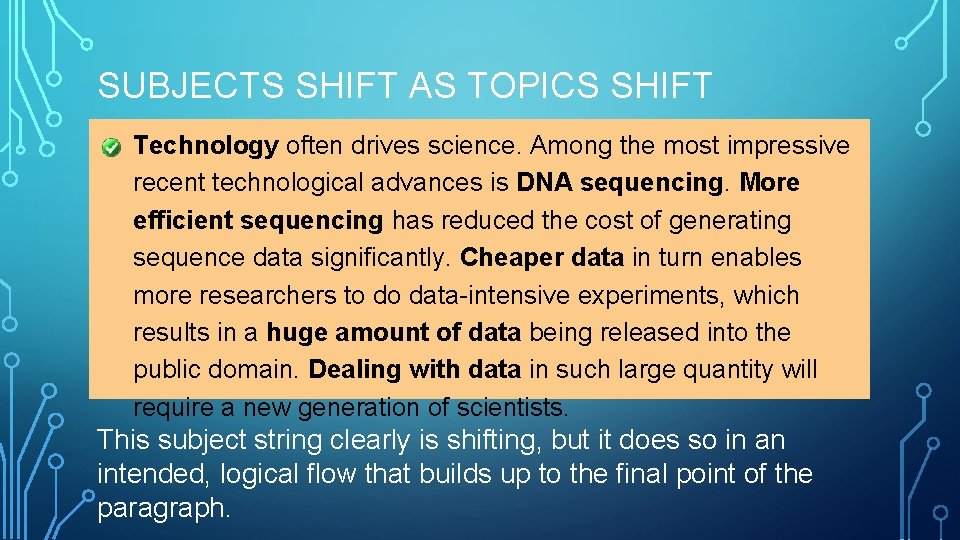
SUBJECTS SHIFT AS TOPICS SHIFT Technology often drives science. Among the most impressive recent technological advances is DNA sequencing. More efficient sequencing has reduced the cost of generating sequence data significantly. Cheaper data in turn enables more researchers to do data-intensive experiments, which results in a huge amount of data being released into the public domain. Dealing with data in such large quantity will require a new generation of scientists. This subject string clearly is shifting, but it does so in an intended, logical flow that builds up to the final point of the paragraph.
LESSONS • The point of this example is to illustrate that you don't need every paragraph to have exactly 1 topic and subject. • Instead, just be aware of what your subjects are, and if they match the structure of the idea you intend to communicate.
REVISION TECHNIQUES • Highlight the subject of each sentence. Does the structure of your subjects match the information you intend to convey? In other words, are the subjects of the sentences jumping from one thing to another, or do they shift only when you intend to shift the topic under discussion? • Note: One problem that frequently makes scientific writing confusing is a sentence without a character; such sentences can be caused by passive voice, which can leave a reader to guess the actor (that's a Bad Thing). More on this in the section on passive voice.
PRINCIPLE 3: KEEP SUBJECTS NEAR VERBS • Two primary pieces of information a reader looks for: 1. Who is the sentence about? 2. What are they doing? • When these two pieces of information are far apart, that usually means one of them isn't arriving until the end of the sentence. • In scientific writing, this is often caused by long, complex subjects.
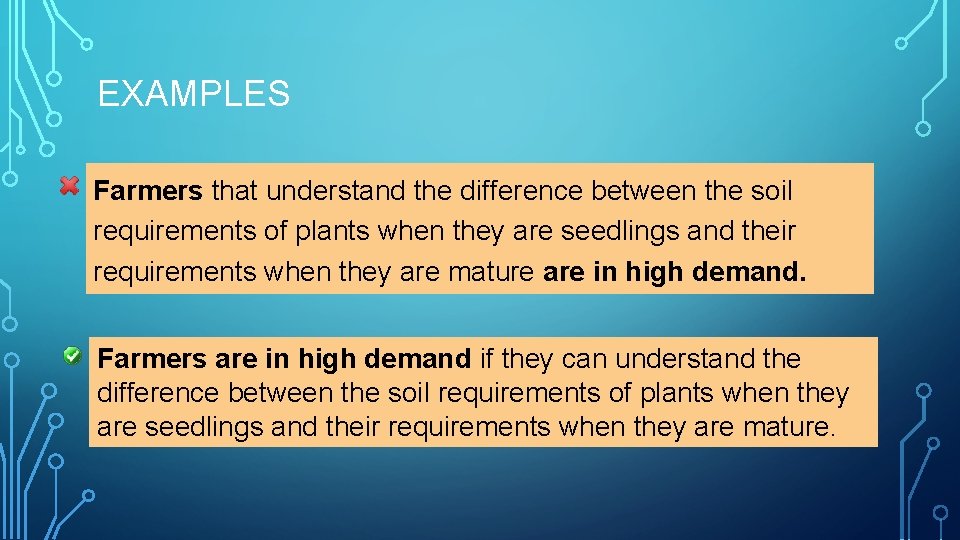
EXAMPLES Farmers that understand the difference between the soil requirements of plants when they are seedlings and their requirements when they are mature are in high demand. Farmers are in high demand if they can understand the difference between the soil requirements of plants when they are seedlings and their requirements when they are mature.
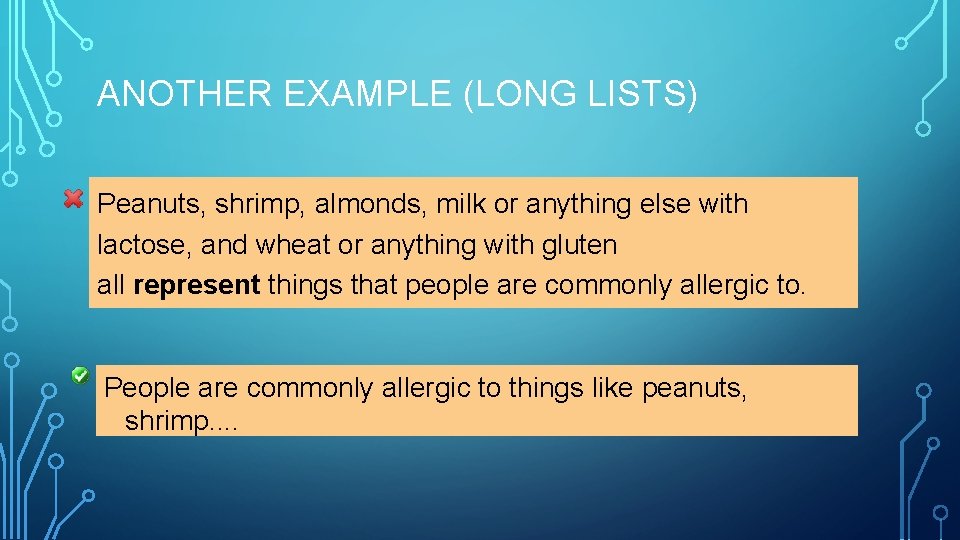
ANOTHER EXAMPLE (LONG LISTS) Peanuts, shrimp, almonds, milk or anything else with lactose, and wheat or anything with gluten all represent things that people are commonly allergic to. People are commonly allergic to things like peanuts, shrimp. .
REVISION TECHNIQUE Identify the main subject and its verb in your sentence. If they are far apart, rephrase the sentence to bring them closer together.
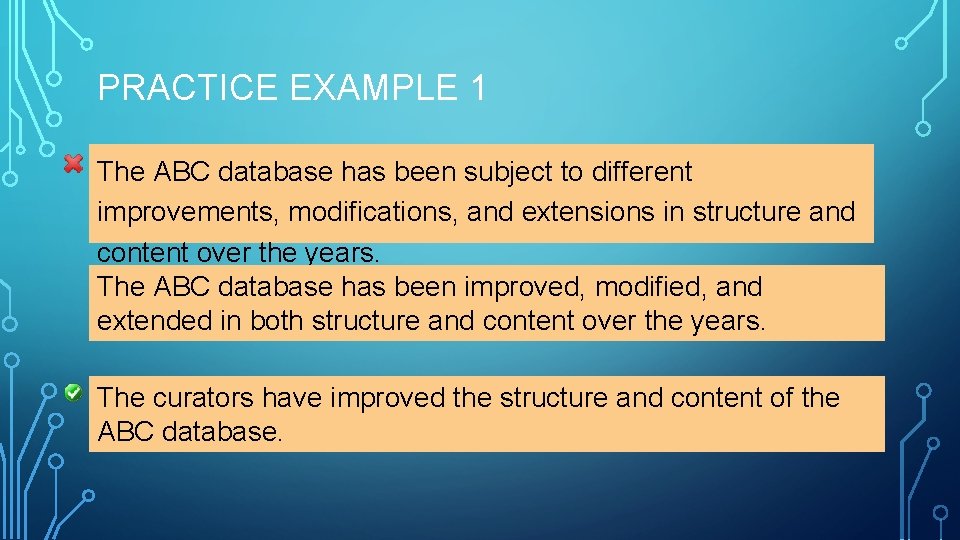
PRACTICE EXAMPLE 1 The ABC database has been subject to different improvements, modifications, and extensions in structure and content over the years. The ABC database has been improved, modified, and extended in both structure and content over the years. The curators have improved the structure and content of the ABC database.
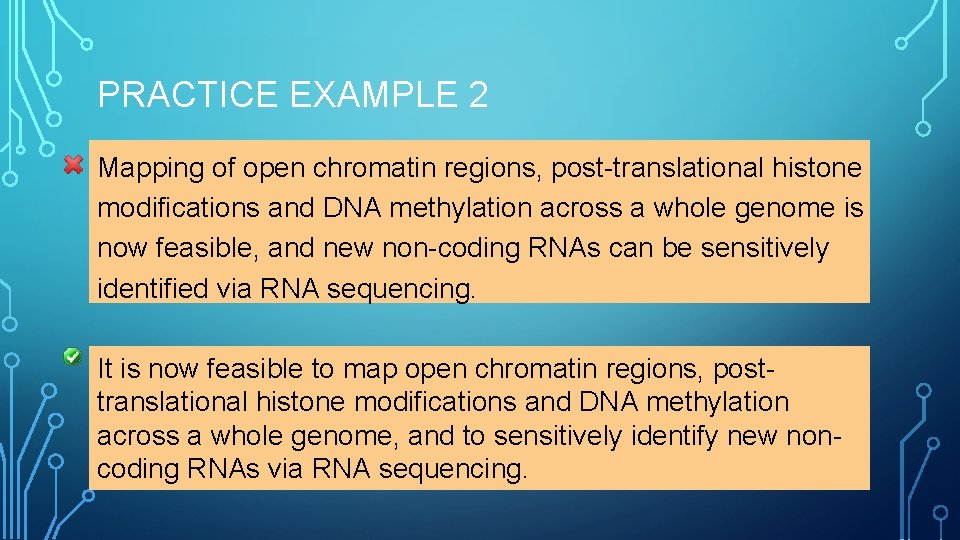
PRACTICE EXAMPLE 2 Mapping of open chromatin regions, post-translational histone modifications and DNA methylation across a whole genome is now feasible, and new non-coding RNAs can be sensitively identified via RNA sequencing. It is now feasible to map open chromatin regions, posttranslational histone modifications and DNA methylation across a whole genome, and to sensitively identify new noncoding RNAs via RNA sequencing.
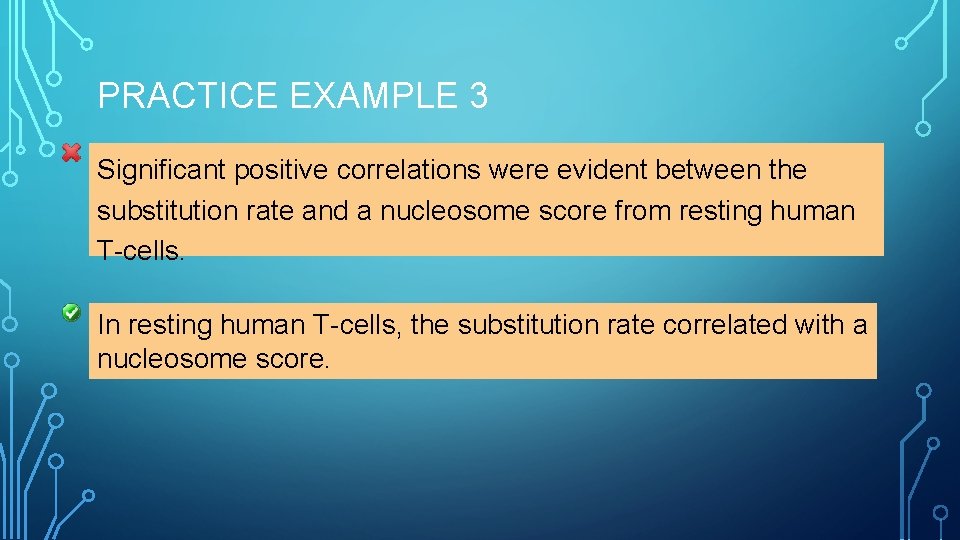
PRACTICE EXAMPLE 3 Significant positive correlations were evident between the substitution rate and a nucleosome score from resting human T-cells. In resting human T-cells, the substitution rate correlated with a nucleosome score.
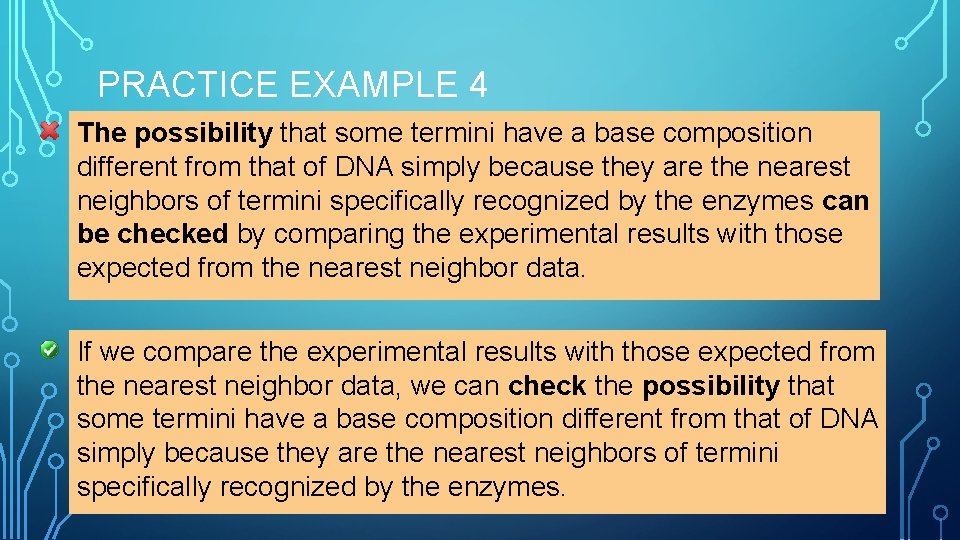
PRACTICE EXAMPLE 4 The possibility that some termini have a base composition different from that of DNA simply because they are the nearest neighbors of termini specifically recognized by the enzymes can be checked by comparing the experimental results with those expected from the nearest neighbor data. If we compare the experimental results with those expected from the nearest neighbor data, we can check the possibility that some termini have a base composition different from that of DNA simply because they are the nearest neighbors of termini specifically recognized by the enzymes.
- Slides: 28