
Scientific Writing DCU Student Learning Overview 1 2

- Slides: 39
Scientific Writing DCU Student Learning
Overview: 1. 2. 3. Key Definitions How to write scientifically? How to write a scientific paper/report /review?
Key Definitions
Scientific writing v’s Science writing: Scientific writing. . is writing about scientific topics aimed at specialists in a particular scientific field. . i. e. your lecturer, peer reviewed journals, book chapters, grant proposals Science writing. . is writing about scientific topics to non-specialists. . i. e. newspaper reports, blogs for the general public
Scientific Writing: Why do we do it? • To communicate the results of scientific inquiry (bench work or literature review results) • To present information to others that is easy to access • To present enough information that the reader can duplicate the scientific study • To spread knowledge and insight through the scientific community • To promote the achievements of lab/university/company • To attract interest and funding to the field to enable more research • To allow the reader to evaluate the validity of the results and conclusions based on the facts presented
How to Write Scientifically?
Key Elements to Writing Scientifically: Precision: ambiguities in writing cause confusion and may prevent a reader from grasping crucial aspects of the methodology and results Clarity: concepts and methods in the sciences can often be complex; writing that is difficult to follow greatly amplifies any confusion on the part of the reader Objectivity: any claims that you make need to be based on facts, not intuition or emotion
Key Elements to Writing Scientifically: Precision is achieved by Sciences are based upon precise mathematical models, paying attention to: specific empirical (primary) data sets, or some combination of the two. 1. Words & Phrasing Scientists must use precise, concrete language to evaluate 2. Figurative and explain such theories, whether mathematical or Language conceptual. 3. Level of Detail 4. Quantification
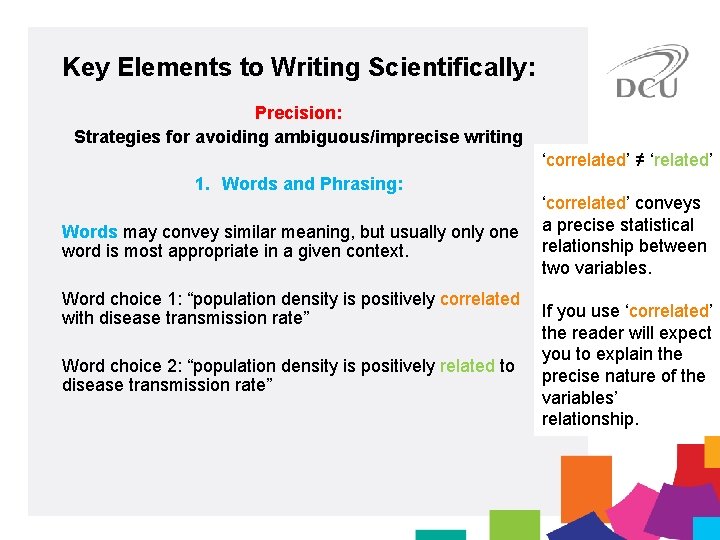
Key Elements to Writing Scientifically: Precision: Strategies for avoiding ambiguous/imprecise writing ‘correlated’ ≠ ‘related’ 1. Words and Phrasing: Words may convey similar meaning, but usually one word is most appropriate in a given context. ‘correlated’ conveys a precise statistical relationship between two variables. Word choice 1: “population density is positively correlated If you use ‘correlated’ with disease transmission rate” the reader will expect you to explain the Word choice 2: “population density is positively related to precise nature of the disease transmission rate” variables’ relationship.
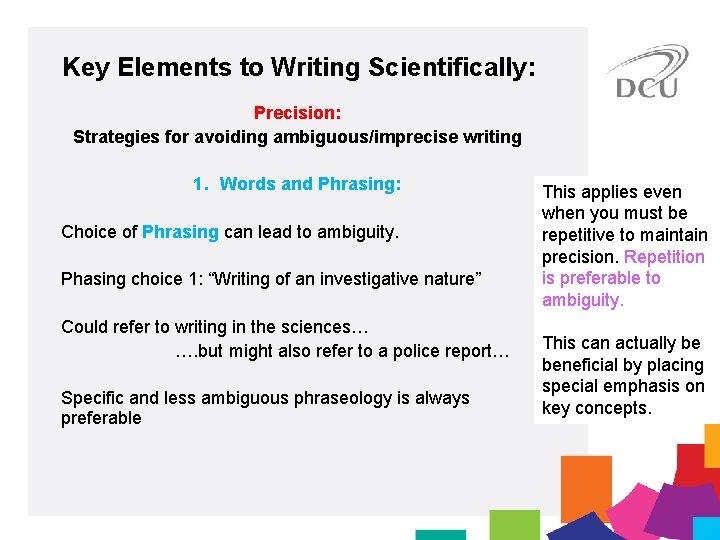
Key Elements to Writing Scientifically: Precision: Strategies for avoiding ambiguous/imprecise writing 1. Words and Phrasing: Choice of Phrasing can lead to ambiguity. Phasing choice 1: “Writing of an investigative nature” Could refer to writing in the sciences… …. but might also refer to a police report… Specific and less ambiguous phraseology is always preferable This applies even when you must be repetitive to maintain precision. Repetition is preferable to ambiguity. This can actually be beneficial by placing special emphasis on key concepts.
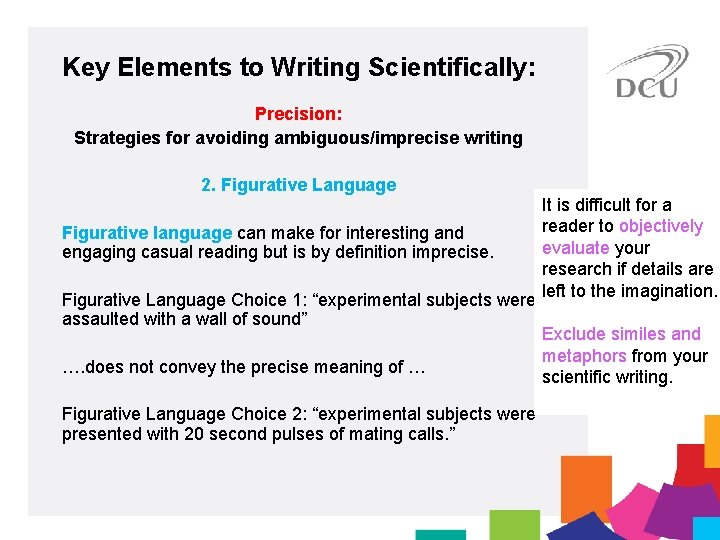
Key Elements to Writing Scientifically: Precision: Strategies for avoiding ambiguous/imprecise writing 2. Figurative Language It is difficult for a reader to objectively Figurative language can make for interesting and evaluate your engaging casual reading but is by definition imprecise. research if details are Figurative Language Choice 1: “experimental subjects were left to the imagination. assaulted with a wall of sound” …. does not convey the precise meaning of … Figurative Language Choice 2: “experimental subjects were presented with 20 second pulses of mating calls. ” Exclude similes and metaphors from your scientific writing.
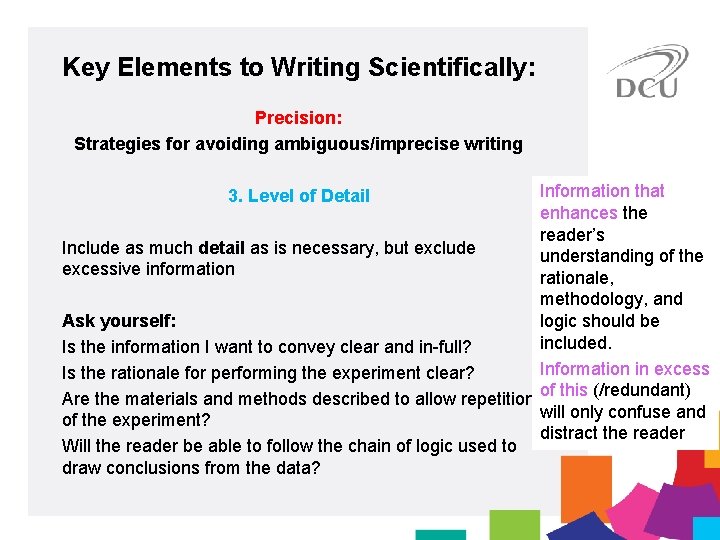
Key Elements to Writing Scientifically: Precision: Strategies for avoiding ambiguous/imprecise writing Information that enhances the reader’s Include as much detail as is necessary, but exclude understanding of the excessive information rationale, methodology, and Ask yourself: logic should be included. Is the information I want to convey clear and in-full? Information in excess Is the rationale for performing the experiment clear? Are the materials and methods described to allow repetition of this (/redundant) will only confuse and of the experiment? distract the reader Will the reader be able to follow the chain of logic used to draw conclusions from the data? 3. Level of Detail
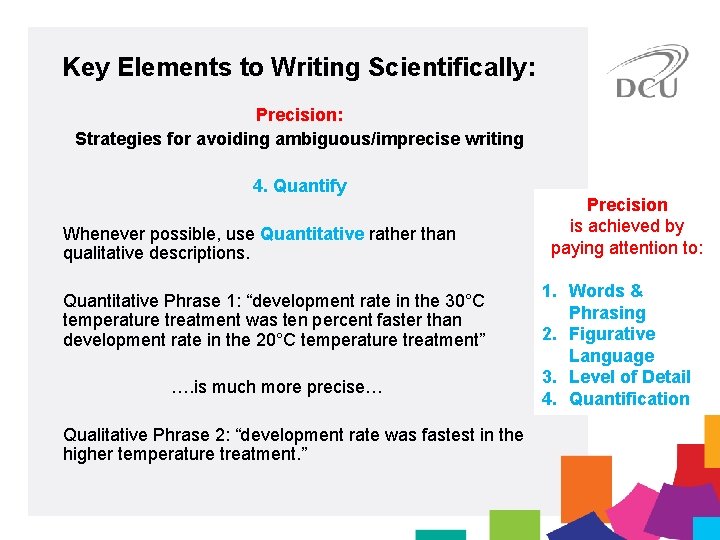
Key Elements to Writing Scientifically: Precision: Strategies for avoiding ambiguous/imprecise writing 4. Quantify Whenever possible, use Quantitative rather than qualitative descriptions. Quantitative Phrase 1: “development rate in the 30°C temperature treatment was ten percent faster than development rate in the 20°C temperature treatment” …. is much more precise… Qualitative Phrase 2: “development rate was fastest in the higher temperature treatment. ” Precision is achieved by paying attention to: 1. Words & Phrasing 2. Figurative Language 3. Level of Detail 4. Quantification
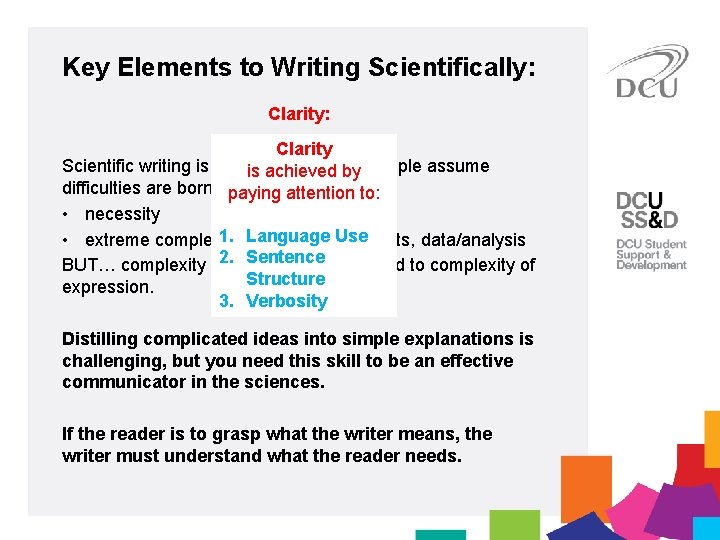
Key Elements to Writing Scientifically: Clarity Scientific writing is often hard to read. People assume is achieved by difficulties are born out of paying attention to: • necessity 1. Language Use • extreme complexity of scientific concepts, data/analysis 2. Sentence BUT… complexity of thought need not lead to complexity of Structure expression. 3. Verbosity Distilling complicated ideas into simple explanations is challenging, but you need this skill to be an effective communicator in the sciences. If the reader is to grasp what the writer means, the writer must understand what the reader needs.
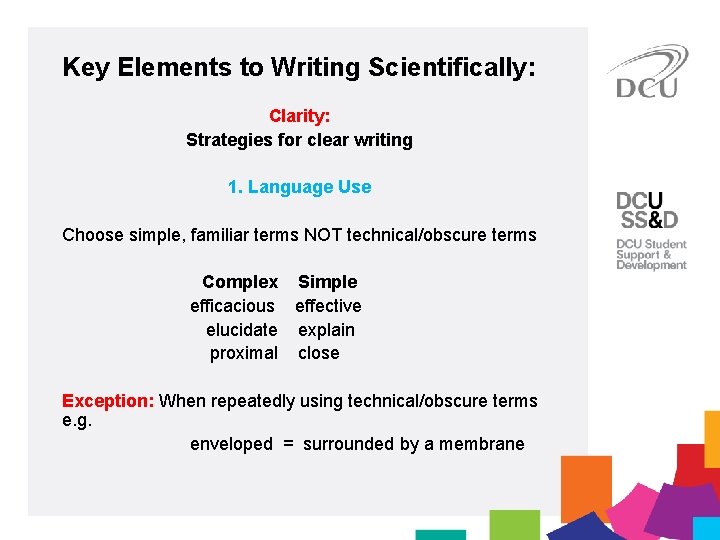
Key Elements to Writing Scientifically: Clarity: Strategies for clear writing 1. Language Use Choose simple, familiar terms NOT technical/obscure terms Complex Simple efficacious effective elucidate explain proximal close Exception: When repeatedly using technical/obscure terms e. g. enveloped = surrounded by a membrane
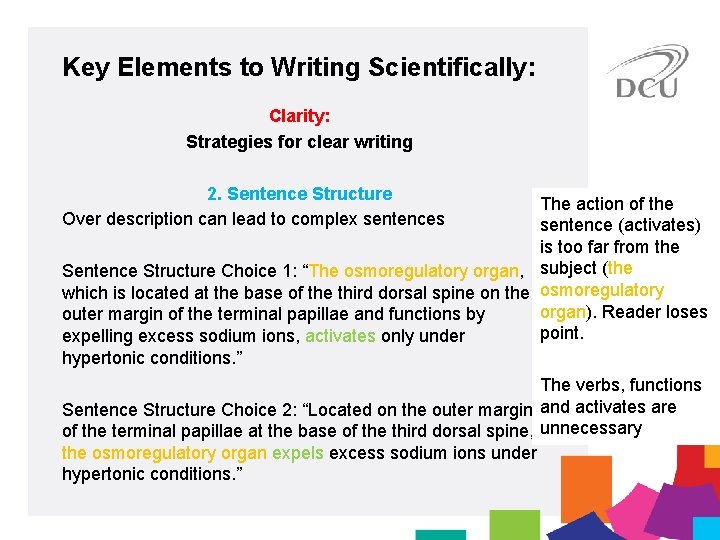
Key Elements to Writing Scientifically: Clarity: Strategies for clear writing 2. Sentence Structure The action of the Over description can lead to complex sentences sentence (activates) is too far from the Sentence Structure Choice 1: “The osmoregulatory organ, subject (the which is located at the base of the third dorsal spine on the osmoregulatory organ). Reader loses outer margin of the terminal papillae and functions by point. expelling excess sodium ions, activates only under hypertonic conditions. ” The verbs, functions Sentence Structure Choice 2: “Located on the outer margin and activates are of the terminal papillae at the base of the third dorsal spine, unnecessary the osmoregulatory organ expels excess sodium ions under hypertonic conditions. ”
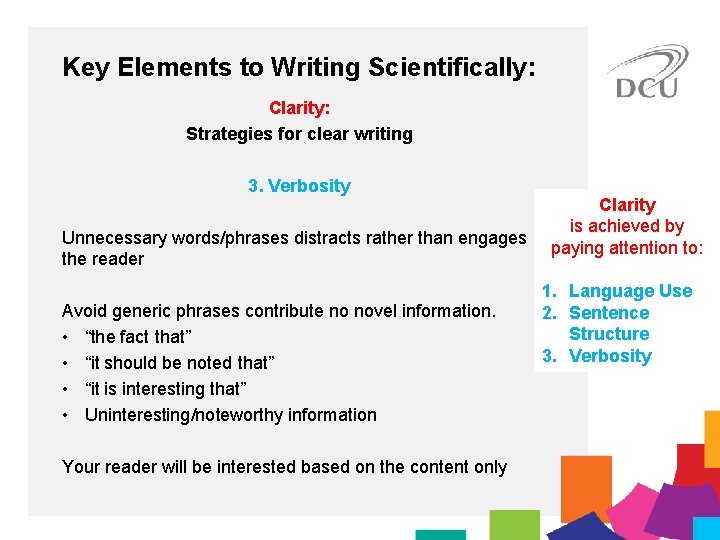
Key Elements to Writing Scientifically: Clarity: Strategies for clear writing 3. Verbosity Unnecessary words/phrases distracts rather than engages the reader Avoid generic phrases contribute no novel information. • “the fact that” • “it should be noted that” • “it is interesting that” • Uninteresting/noteworthy information Your reader will be interested based on the content only Clarity is achieved by paying attention to: 1. Language Use 2. Sentence Structure 3. Verbosity
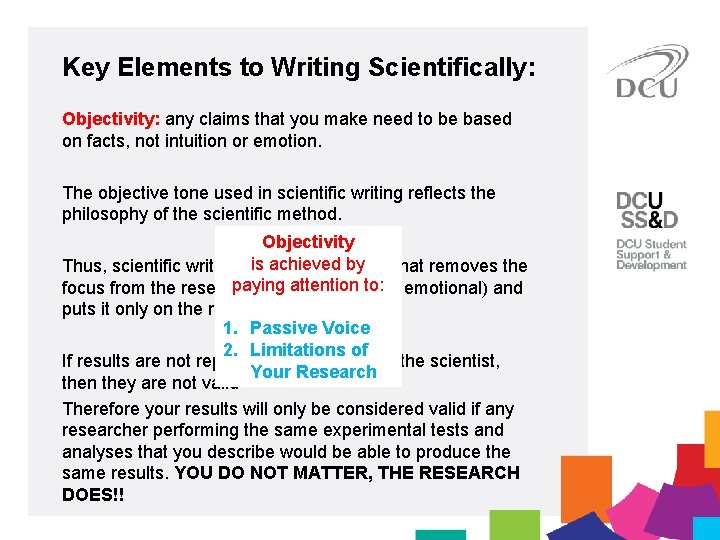
Key Elements to Writing Scientifically: Objectivity: any claims that you make need to be based on facts, not intuition or emotion. The objective tone used in scientific writing reflects the philosophy of the scientific method. Objectivity is achieved by Thus, scientific writers try to adopt a tone that removes the paying attention to: focus from the researcher (figuratively and emotional) and puts it only on the research itself. 1. Passive Voice 2. Limitations of If results are not repeatable, regardless of the scientist, Your Research then they are not valid Therefore your results will only be considered valid if any researcher performing the same experimental tests and analyses that you describe would be able to produce the same results. YOU DO NOT MATTER, THE RESEARCH DOES!!
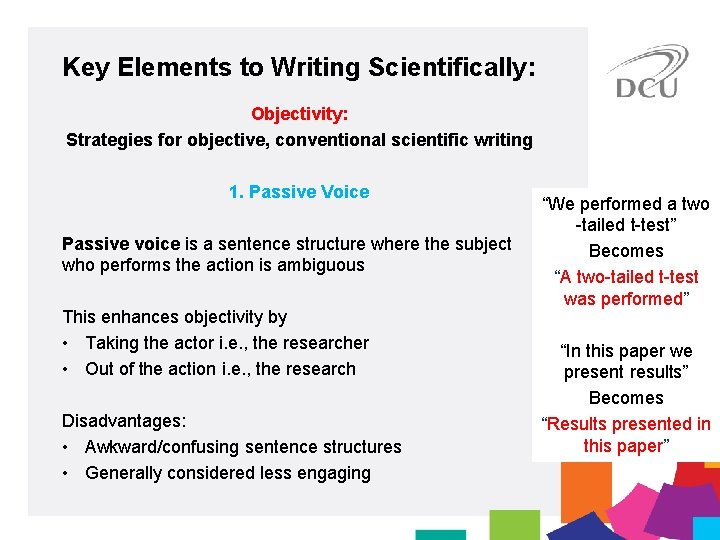
Key Elements to Writing Scientifically: Objectivity: Strategies for objective, conventional scientific writing 1. Passive Voice Passive voice is a sentence structure where the subject who performs the action is ambiguous This enhances objectivity by • Taking the actor i. e. , the researcher • Out of the action i. e. , the research Disadvantages: • Awkward/confusing sentence structures • Generally considered less engaging “We performed a two -tailed t-test” Becomes “A two-tailed t-test was performed” “In this paper we present results” Becomes “Results presented in this paper”
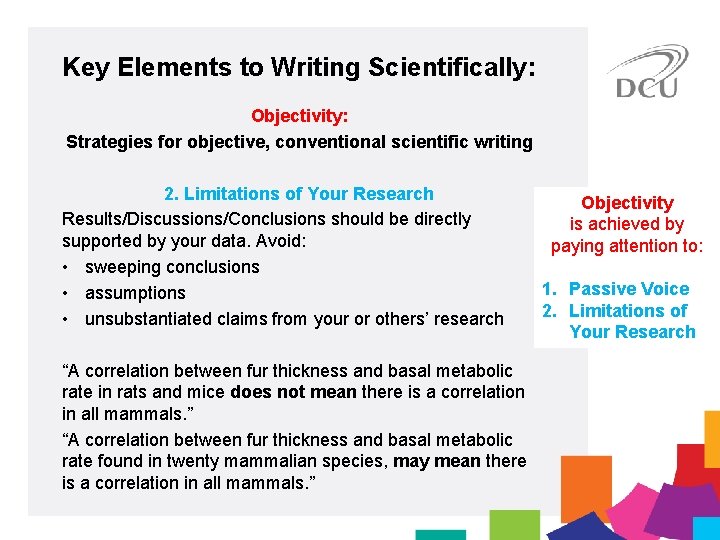
Key Elements to Writing Scientifically: Objectivity: Strategies for objective, conventional scientific writing 2. Limitations of Your Research Results/Discussions/Conclusions should be directly supported by your data. Avoid: • sweeping conclusions • assumptions • unsubstantiated claims from your or others’ research “A correlation between fur thickness and basal metabolic rate in rats and mice does not mean there is a correlation in all mammals. ” “A correlation between fur thickness and basal metabolic rate found in twenty mammalian species, may mean there is a correlation in all mammals. ” Objectivity is achieved by paying attention to: 1. Passive Voice 2. Limitations of Your Research
Writing Scientific Papers/Reports/ Thesis
Writing a Scientific Paper/Report/Thesis: The scientific paper has developed over the past three centuries into a tool to communicate the results of scientific inquiry. The main audience for scientific papers is extremely specialized. The purpose is twofold: • to present information so that it is easy to retrieve, • to present enough information that the reader can duplicate the scientific study.
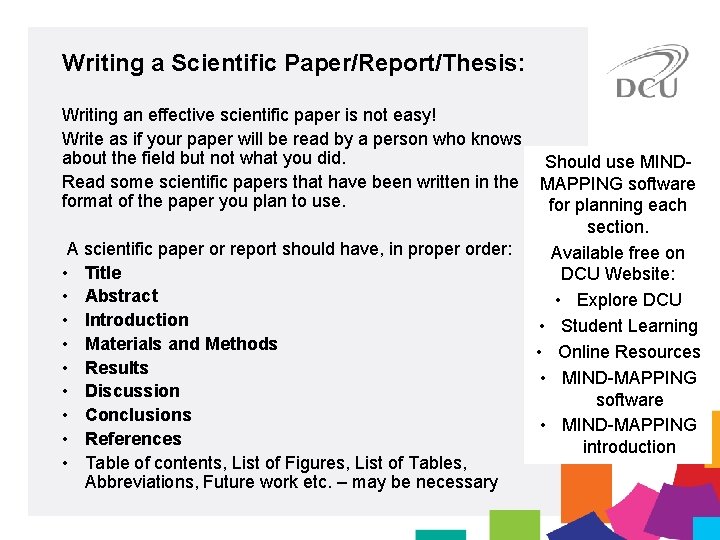
Writing a Scientific Paper/Report/Thesis: Writing an effective scientific paper is not easy! Write as if your paper will be read by a person who knows about the field but not what you did. Should use MINDRead some scientific papers that have been written in the MAPPING software format of the paper you plan to use. for planning each section. A scientific paper or report should have, in proper order: Available free on • Title DCU Website: • Abstract • Explore DCU • Introduction • Student Learning • Materials and Methods • Online Resources • Results • MIND-MAPPING • Discussion software • Conclusions • MIND-MAPPING • References introduction • Table of contents, List of Figures, List of Tables, Abbreviations, Future work etc. – may be necessary
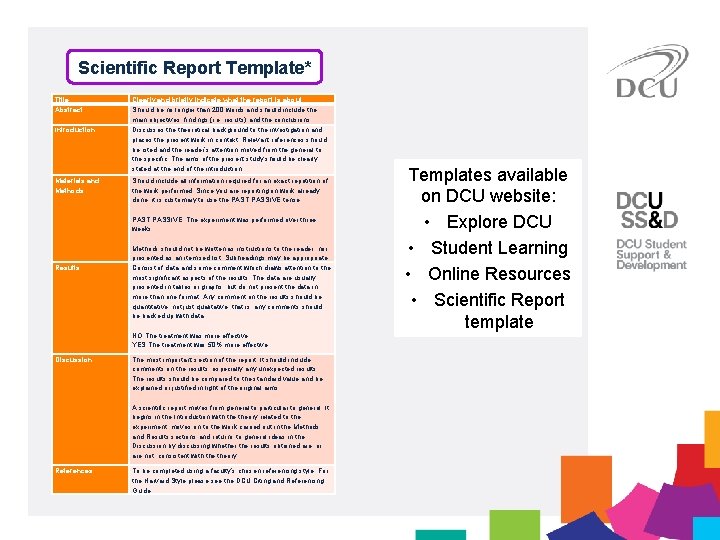
Scientific Report Template* Title Abstract Clearly and briefly indicate what the report is about. Should be no longer than 200 words and should include the main objectives, findings (i. e. results) and the conclusions Introduction Discusses theoretical background to the investigation and places the present work in context. Relevant references should be cited and the reader’s attention moved from the general to the specific. The aims of the present study should be clearly stated at the end of the introduction. Materials and Methods Should include all information required for an exact repetition of the work performed. Since you are reporting on work already done, it is customary to use the PAST PASSIVE tense. PAST PASSIVE: The experiment was performed over three weeks Methods should not be written as instructions to the reader, nor presented as an itemised list. Subheadings may be appropriate Consist of data and some comment which draws attention to the most significant aspects of the results. The data are usually presented in tables or graphs, but do not present the data in more than one format. Any comment on the results should be quantitative, not just qualitative; that is, any comments should be backed up with data. NO The treatment was more effective. YES The treatment was 50% more effective. Results Discussion The most important section of the report. It should include comments on the results, especially any unexpected results. The results should be compared to the standard value and be explained or justified in light of the original aims. A scientific report moves from general to particular to general. It begins in the Introduction with theory related to the experiment, moves on to the work carried out in the Methods and Results sections and returns to general ideas in the Discussion by discussing whether the results obtained are, or are not, consistent with theory. References To be completed using a faculty’s chosen referencing style. For the Harvard Style please see the DCU Citing and Referencing Guide. Templates available on DCU website: • Explore DCU • Student Learning • Online Resources • Scientific Report template
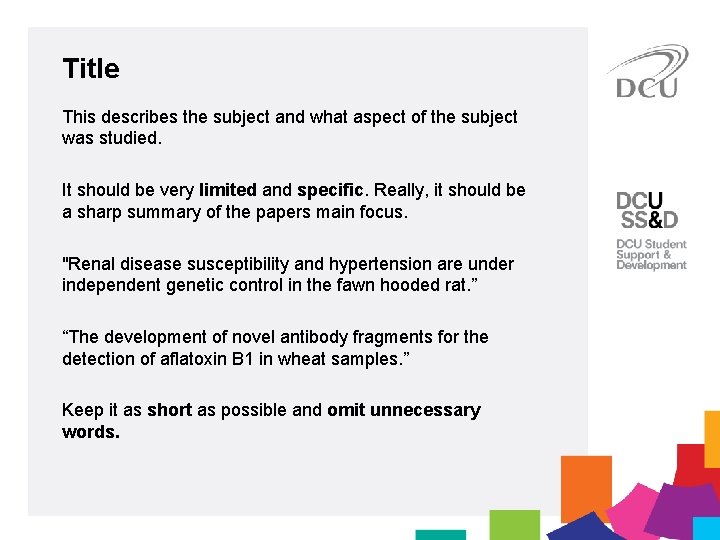
Title This describes the subject and what aspect of the subject was studied. It should be very limited and specific. Really, it should be a sharp summary of the papers main focus. "Renal disease susceptibility and hypertension are under independent genetic control in the fawn hooded rat. ” “The development of novel antibody fragments for the detection of aflatoxin B 1 in wheat samples. ” Keep it as short as possible and omit unnecessary words.
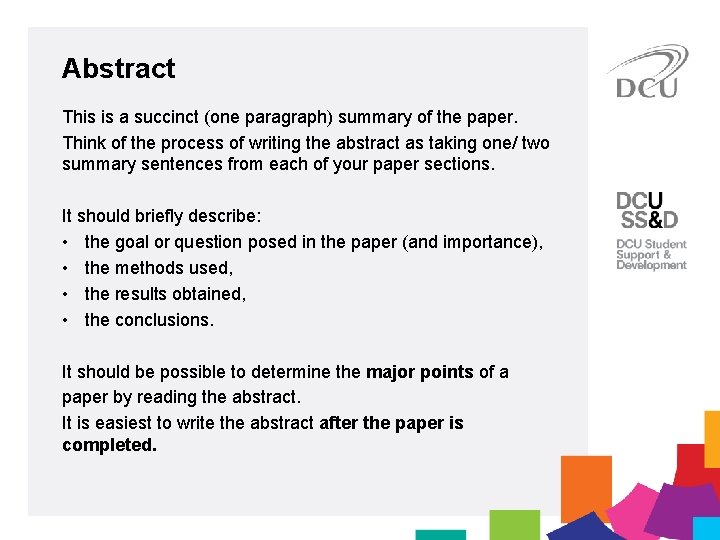
Abstract This is a succinct (one paragraph) summary of the paper. Think of the process of writing the abstract as taking one/ two summary sentences from each of your paper sections. It should briefly describe: • the goal or question posed in the paper (and importance), • the methods used, • the results obtained, • the conclusions. It should be possible to determine the major points of a paper by reading the abstract. It is easiest to write the abstract after the paper is completed.
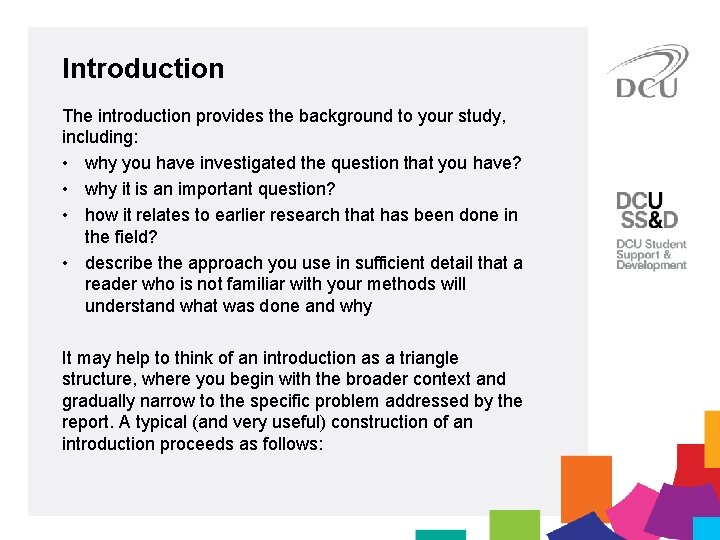
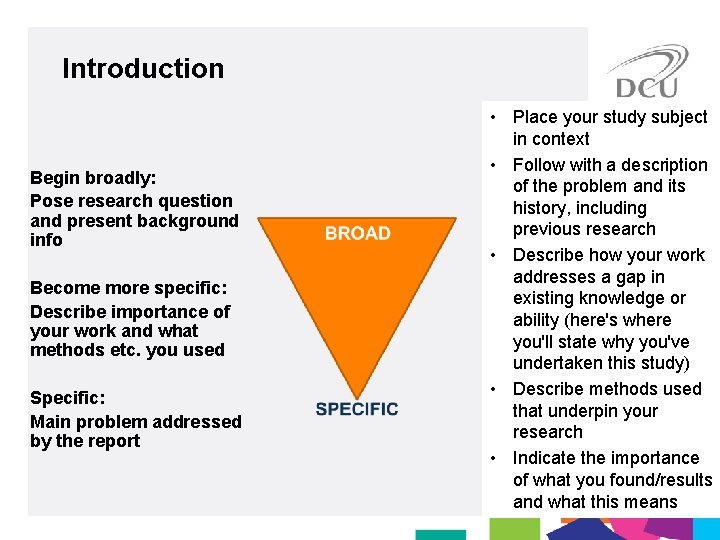
Introduction The introduction provides the background to your study, including: • why you have investigated the question that you have? • why it is an important question? • how it relates to earlier research that has been done in the field? • describe the approach you use in sufficient detail that a reader who is not familiar with your methods will understand what was done and why It may help to think of an introduction as a triangle structure, where you begin with the broader context and gradually narrow to the specific problem addressed by the report. A typical (and very useful) construction of an introduction proceeds as follows:
Introduction Begin broadly: Pose research question and present background info Become more specific: Describe importance of your work and what methods etc. you used Specific: Main problem addressed by the report • Place your study subject in context • Follow with a description of the problem and its history, including previous research • Describe how your work addresses a gap in existing knowledge or ability (here's where you'll state why you've undertaken this study) • Describe methods used that underpin your research • Indicate the importance of what you found/results and what this means
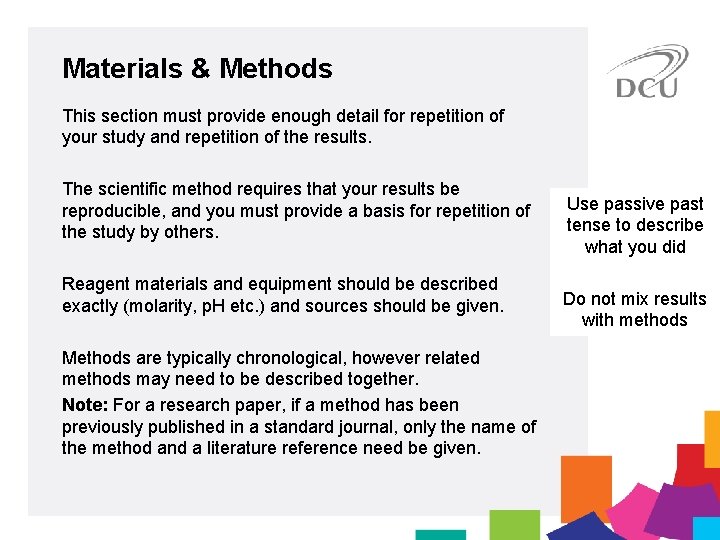
Materials & Methods This section must provide enough detail for repetition of your study and repetition of the results. The scientific method requires that your results be reproducible, and you must provide a basis for repetition of the study by others. Reagent materials and equipment should be described exactly (molarity, p. H etc. ) and sources should be given. Methods are typically chronological, however related methods may need to be described together. Note: For a research paper, if a method has been previously published in a standard journal, only the name of the method and a literature reference need be given. Use passive past tense to describe what you did Do not mix results with methods
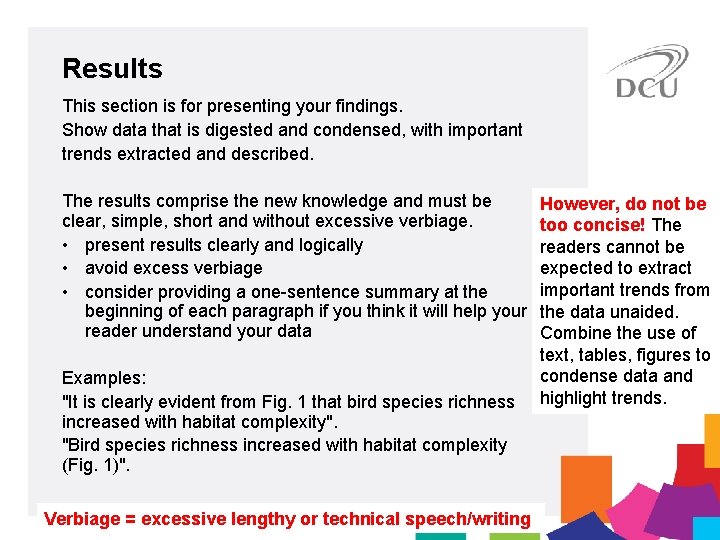
Results This section is for presenting your findings. Show data that is digested and condensed, with important trends extracted and described. The results comprise the new knowledge and must be clear, simple, short and without excessive verbiage. • present results clearly and logically • avoid excess verbiage • consider providing a one-sentence summary at the beginning of each paragraph if you think it will help your reader understand your data Examples: "It is clearly evident from Fig. 1 that bird species richness increased with habitat complexity". "Bird species richness increased with habitat complexity (Fig. 1)". Verbiage = excessive lengthy or technical speech/writing However, do not be too concise! The readers cannot be expected to extract important trends from the data unaided. Combine the use of text, tables, figures to condense data and highlight trends.
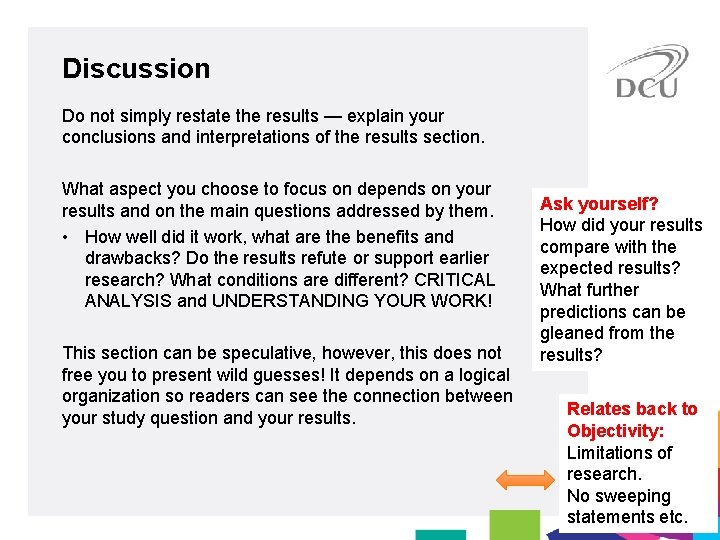
Discussion Do not simply restate the results — explain your conclusions and interpretations of the results section. What aspect you choose to focus on depends on your results and on the main questions addressed by them. • How well did it work, what are the benefits and drawbacks? Do the results refute or support earlier research? What conditions are different? CRITICAL ANALYSIS and UNDERSTANDING YOUR WORK! This section can be speculative, however, this does not free you to present wild guesses! It depends on a logical organization so readers can see the connection between your study question and your results. Ask yourself? How did your results compare with the expected results? What further predictions can be gleaned from the results? Relates back to Objectivity: Limitations of research. No sweeping statements etc.
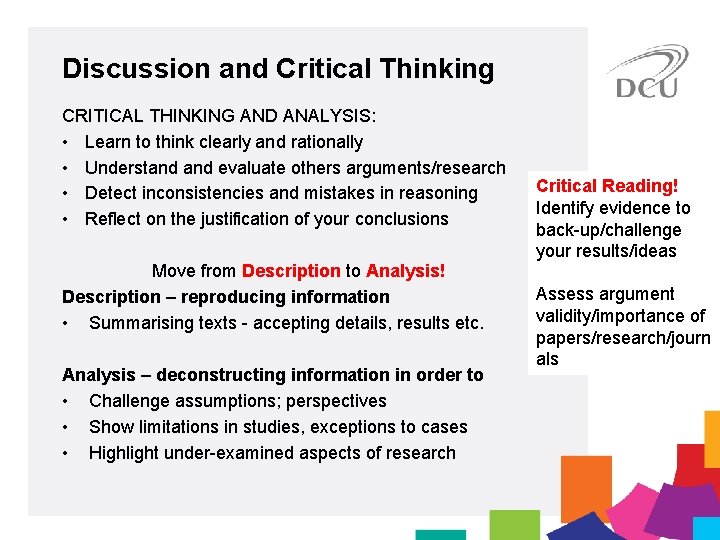
Discussion and Critical Thinking CRITICAL THINKING AND ANALYSIS: • Learn to think clearly and rationally • Understand evaluate others arguments/research • Detect inconsistencies and mistakes in reasoning • Reflect on the justification of your conclusions Move from Description to Analysis! Description – reproducing information • Summarising texts - accepting details, results etc. Analysis – deconstructing information in order to • Challenge assumptions; perspectives • Show limitations in studies, exceptions to cases • Highlight under-examined aspects of research Critical Reading! Identify evidence to back-up/challenge your results/ideas Assess argument validity/importance of papers/research/journ als
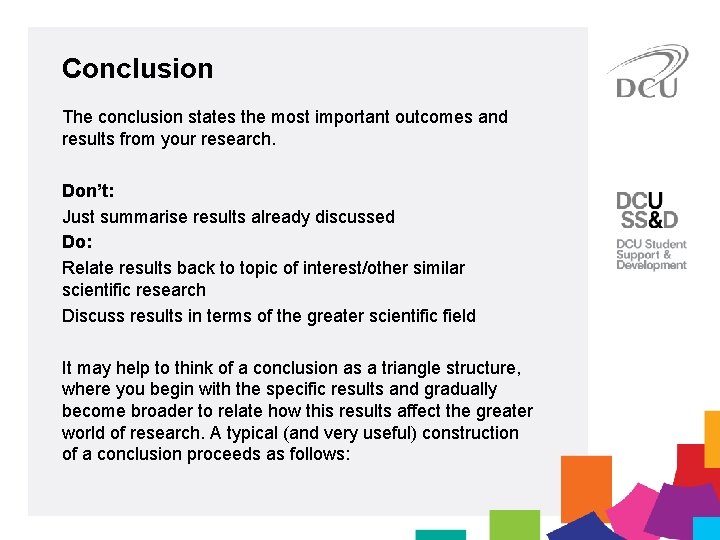
Conclusion The conclusion states the most important outcomes and results from your research. Don’t: Just summarise results already discussed Do: Relate results back to topic of interest/other similar scientific research Discuss results in terms of the greater scientific field It may help to think of a conclusion as a triangle structure, where you begin with the specific results and gradually become broader to relate how this results affect the greater world of research. A typical (and very useful) construction of a conclusion proceeds as follows:
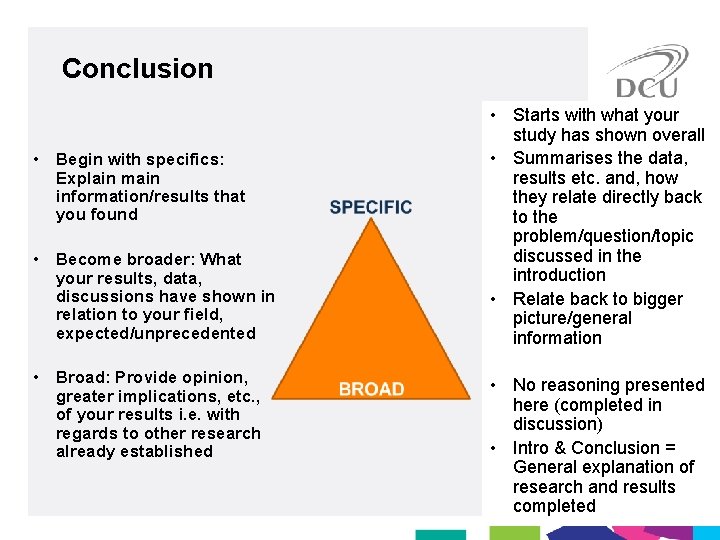
Conclusion • Begin with specifics: Explain main information/results that you found • Become broader: What your results, data, discussions have shown in relation to your field, expected/unprecedented • Broad: Provide opinion, greater implications, etc. , of your results i. e. with regards to other research already established • Starts with what your study has shown overall • Summarises the data, results etc. and, how they relate directly back to the problem/question/topic discussed in the introduction • Relate back to bigger picture/general information • No reasoning presented here (completed in discussion) • Intro & Conclusion = General explanation of research and results completed
References It is essential to credit published papers for work mentioned in your manuscript. • In-text • Reference List/Bibliography There a variety of ways of citing references in text and in a reference list. Please familiarize yourself with referencing style necessary for you!! Typically Harvard for Sciences but can vary. Enrol in Ref. Works courses in the library to learn how to use this reference list generator.
TIPS!!! There are many ways to approach the writing of a scientific paper, and no one way is right! Drafting chunks can help in the following order: Results, Discussion, Introduction, Materials & Methods, Abstract, and, finally, Title. You, the writer, must practice writing and thinking within a scientific structure • learn by example from the writings of others • learn nuances of style and format will be enhanced as you read the scientific literature • pay attention to how professional scientists write about their work • improvement in scientific writing skills comes by repeatedly practicing reading, writing, and critiquing of other’s writing.
QUESTIONS ? ? ?
Acknowledgements This presentation was prepared based on the resources kindly made available online by: • American Scientist Website http: //www. americanscientist. org/issues/pub/the-science-ofscientific-writing/1 • University of Arizona http: //cbc. arizona. edu/sites/default/files/marc/Sci-Writing. pdf • Colarado State University Writing Centre http: //writing. colostate. edu/guides/guide. cfm? guideid=83 • The University of North Carolina Writing Centre http: //writingcenter. unc. edu/handouts/sciences • Bates College http: //abacus. bates. edu/~ganderso/biology/resources/writing/ HTWgeneral. html • San Diego State University http: //www. sci. sdsu. edu/~smaloy/Microbial. Genetics/topics/sc ientific-writing. pdf