
Scientific Workforce Diversity in Extramural Research After Hours
- Slides: 28
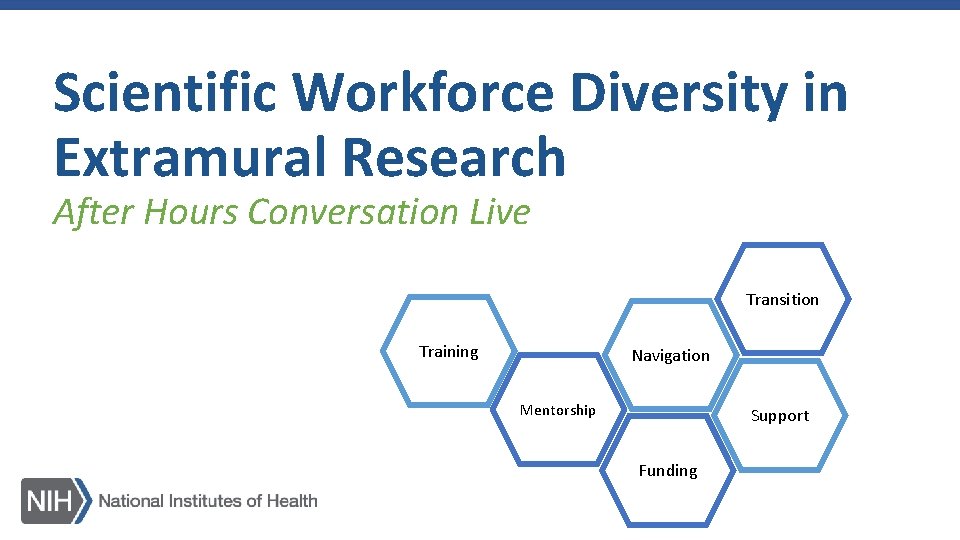
Scientific Workforce Diversity in Extramural Research After Hours Conversation Live Transition Training Navigation Mentorship Support Funding
Issue in Diversifying Workforce • Opportunity • Transition • Support for Research • Mentors/Champions • Institutional Support
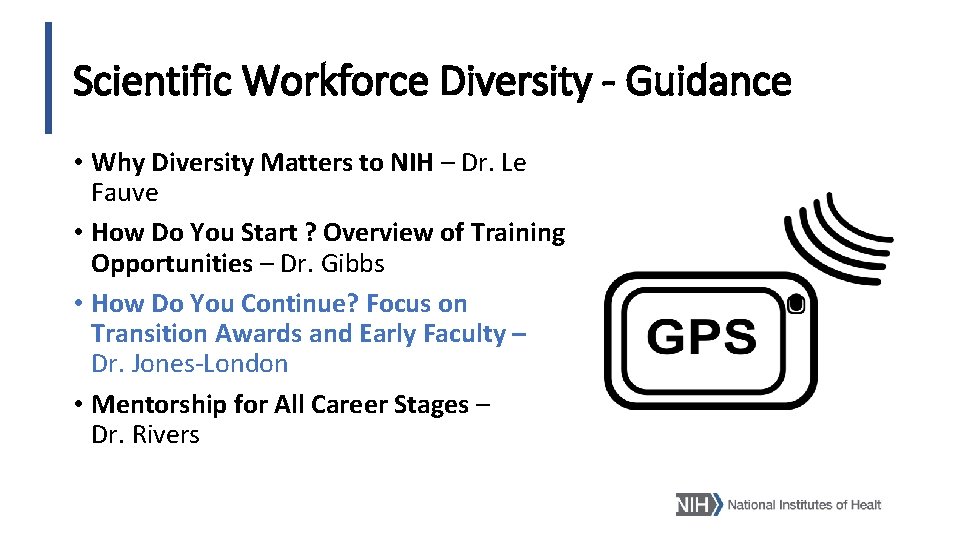
Scientific Workforce Diversity - Guidance • Why Diversity Matters to NIH – Dr. Le Fauve • How Do You Start? Overview of Training Opportunities – Dr. Gibbs • How Do You Continue? Focus on Transition Awards and Early Faculty – Dr. Jones-London • Mentorship for All Career Stages – Dr. Rivers
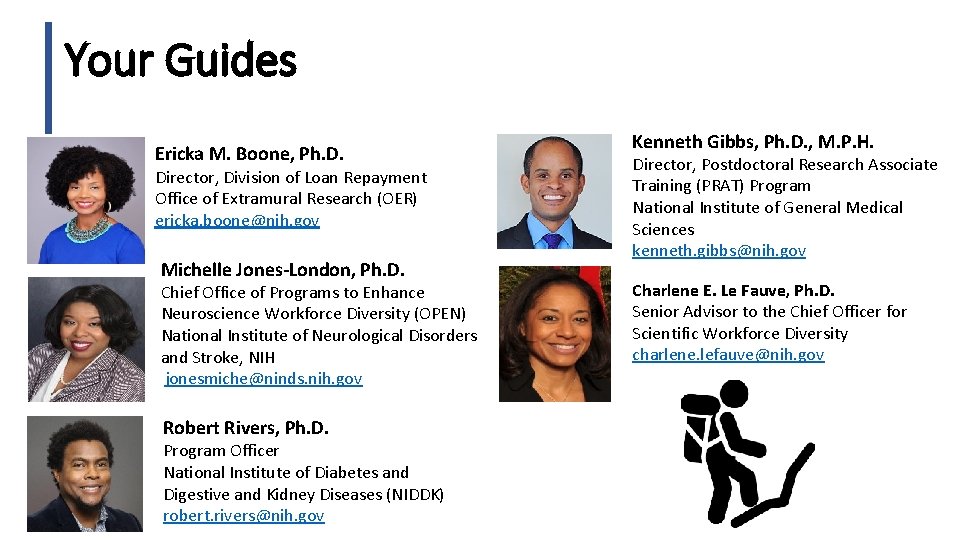
Your Guides Ericka M. Boone, Ph. D. Director, Division of Loan Repayment Office of Extramural Research (OER) ericka. boone@nih. gov Michelle Jones-London, Ph. D. Chief Office of Programs to Enhance Neuroscience Workforce Diversity (OPEN) National Institute of Neurological Disorders and Stroke, NIH jonesmiche@ninds. nih. gov Robert Rivers, Ph. D. Program Officer National Institute of Diabetes and Digestive and Kidney Diseases (NIDDK) robert. rivers@nih. gov Kenneth Gibbs, Ph. D. , M. P. H. Director, Postdoctoral Research Associate Training (PRAT) Program National Institute of General Medical Sciences kenneth. gibbs@nih. gov Charlene E. Le Fauve, Ph. D. Senior Advisor to the Chief Officer for Scientific Workforce Diversity charlene. lefauve@nih. gov
Scientific Workforce Diversity - Guidance • Why Diversity Matters to NIH – Dr. Le Fauve • How Do You Start? Overview of Training Opportunities – Dr. Gibbs • How Do You Continue? Focus on Transition Awards and Early Faculty – Dr. Jones-London • Mentorship for All Career Stages – Dr. Rivers
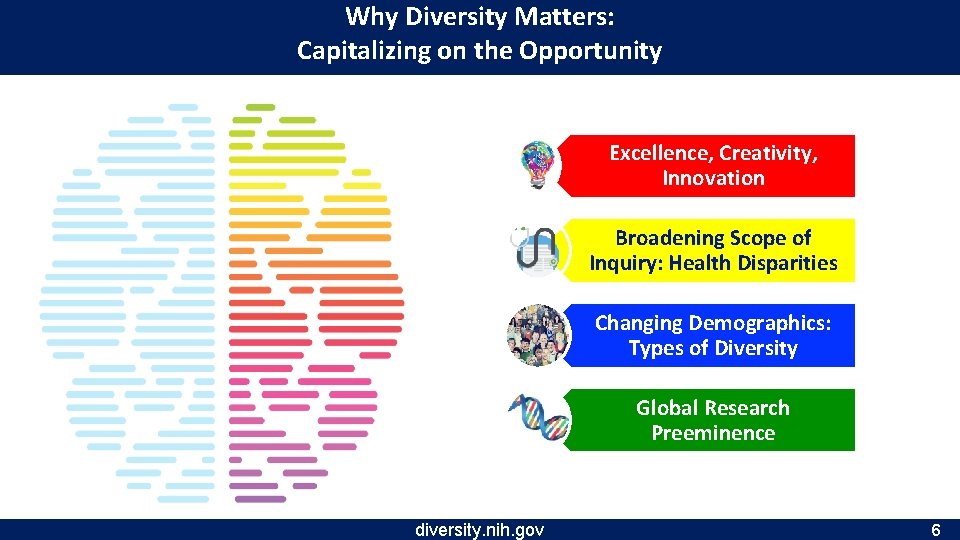
Why Diversity Matters: Capitalizing on the Opportunity Excellence, Creativity, Innovation Broadening Scope of Inquiry: Health Disparities Changing Demographics: Types of Diversity Global Research Preeminence diversity. nih. gov www. diversity. nih. gov 6
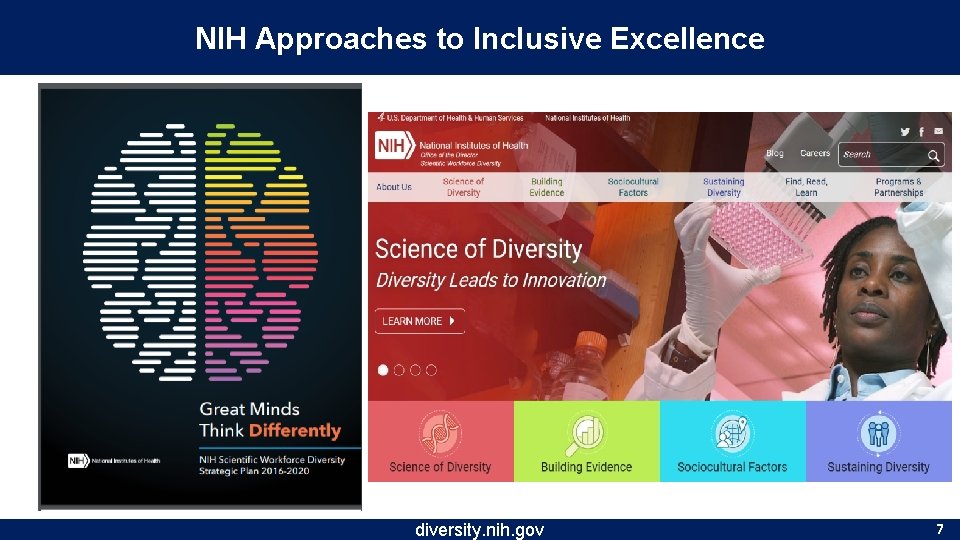
NIH Approaches to Inclusive Excellence diversity. nih. gov www. diversity. nih. gov 7
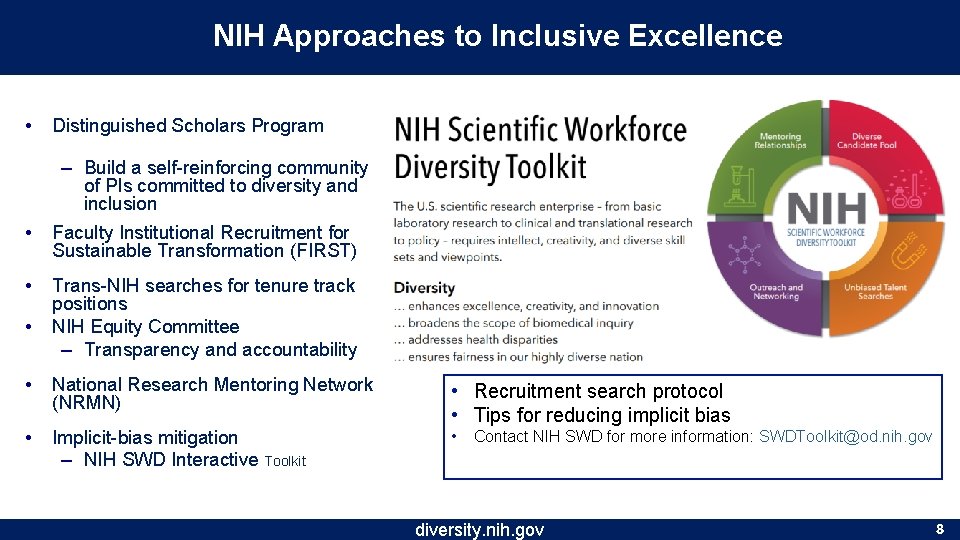
NIH Approaches to Inclusive Excellence • • • Distinguished Scholars Program – Build a self-reinforcing community of PIs committed to diversity and inclusion Faculty Institutional Recruitment for Sustainable Transformation (FIRST) • Trans-NIH searches for tenure track positions NIH Equity Committee – Transparency and accountability • National Research Mentoring Network (NRMN) • Implicit-bias mitigation – NIH SWD Interactive Toolkit • Recruitment search protocol • Tips for reducing implicit bias • Contact NIH SWD for more information: SWDToolkit@od. nih. gov diversity. nih. gov www. diversity. nih. gov 8
Scientific Workforce Diversity - Guidance • Why Diversity Matters to NIH – Dr. Le Fauve • How Do You Start ? Overview of Training Opportunities – Dr. Gibbs • How Do You Continue? Focus on Transition Awards and Early Faculty – Dr. Jones-London • Mentorship for All Career Stages – Dr. Rivers www. diversity. nih. gov
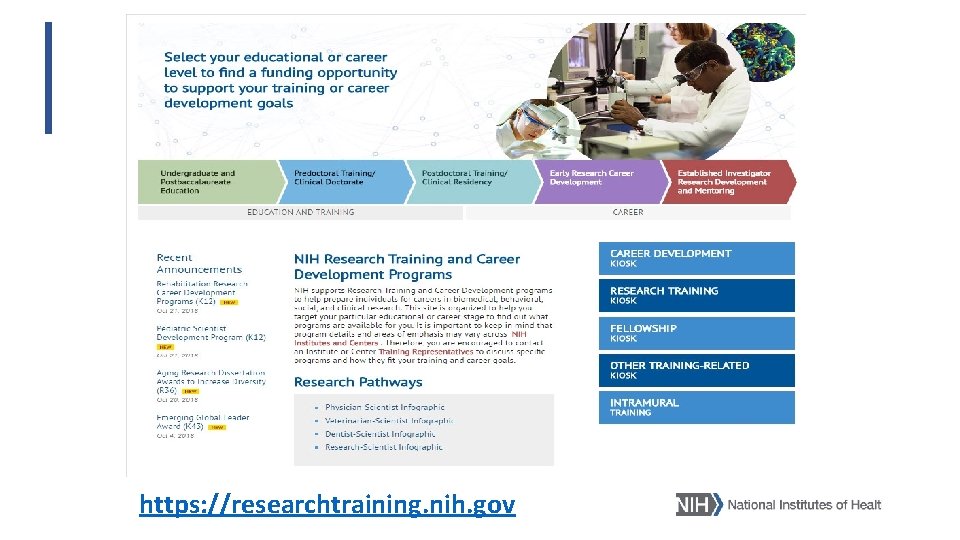
https: //researchtraining. nih. gov
Contact Program Officers when applying for NIH funding • Contact the Program Officer early in the process • Send biosketch and specific aims page • Helpful to determine eligibility and responsiveness of proposal to IC’s mission • Reach out after summary statement is released to discuss possibility for funding 11
Research Supplements to Promote Diversity • Administrative supplements to existing NIH research grants (e. g. , R, P, U) high school to faculty level • Supplements provide salary and fringe benefits; funds for supplies and travel • Sets up mentoring relationships with individual development plans • Typically 1 -3 years of funding to allow the supplement awardee to gain the research experience, preliminary data, and other requirements to develop an application for other avenues of NIH funding. • Feeder program for our Diversity Fs and Ks IC Specific Contacts and Information 12
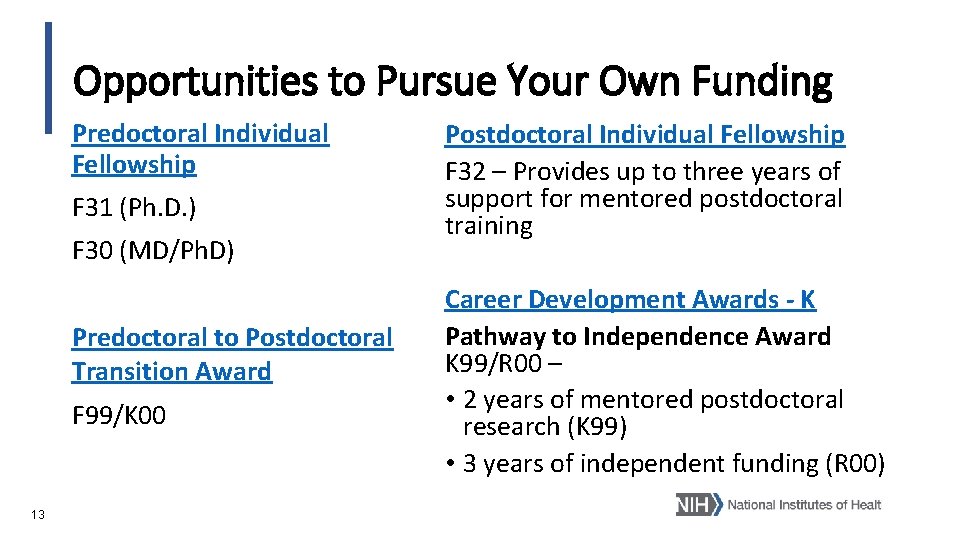
Opportunities to Pursue Your Own Funding Predoctoral Individual Fellowship F 31 (Ph. D. ) F 30 (MD/Ph. D) Predoctoral to Postdoctoral Transition Award F 99/K 00 13 Postdoctoral Individual Fellowship F 32 – Provides up to three years of support for mentored postdoctoral training Career Development Awards - K Pathway to Independence Award K 99/R 00 – • 2 years of mentored postdoctoral research (K 99) • 3 years of independent funding (R 00)
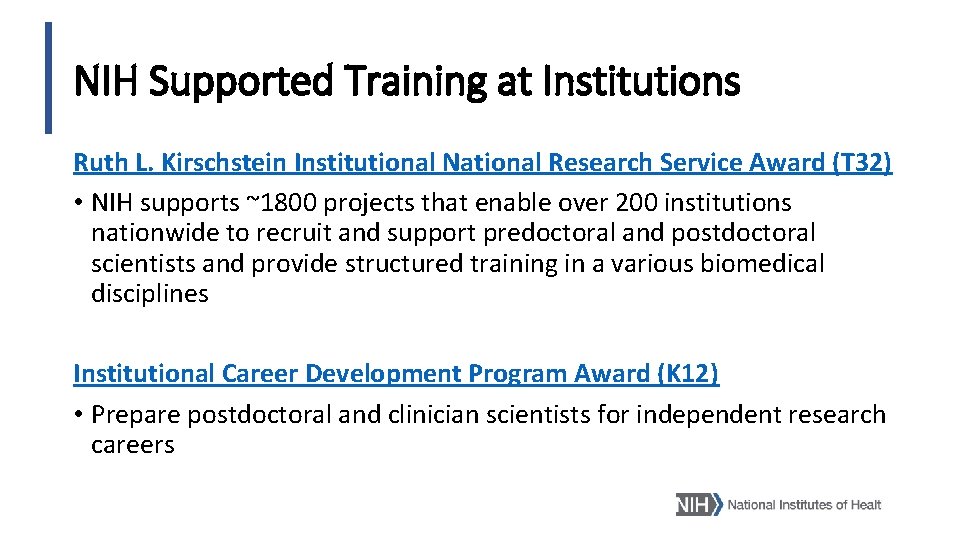
NIH Supported Training at Institutions Ruth L. Kirschstein Institutional National Research Service Award (T 32) • NIH supports ~1800 projects that enable over 200 institutions nationwide to recruit and support predoctoral and postdoctoral scientists and provide structured training in a various biomedical disciplines Institutional Career Development Program Award (K 12) • Prepare postdoctoral and clinician scientists for independent research careers
Scientific Workforce Diversity - Guidance • Why Diversity Matters to NIH – Dr. Le Fauve • How Do You Start ? Overview of Training Opportunities – Dr. Gibbs • How Do You Continue? Focus on Transition Awards and Early Faculty – Dr. Jones-London • Mentorship for All Career Stages – Dr. Rivers
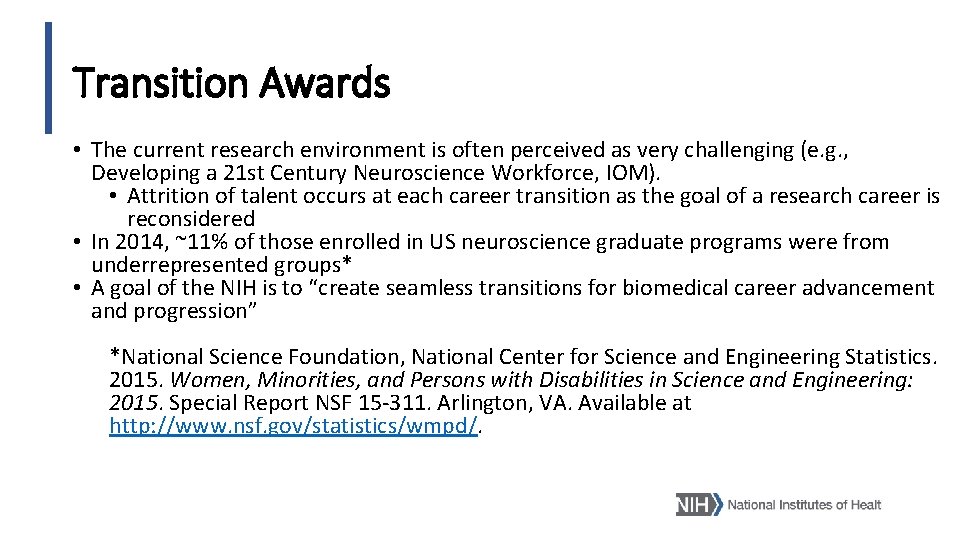
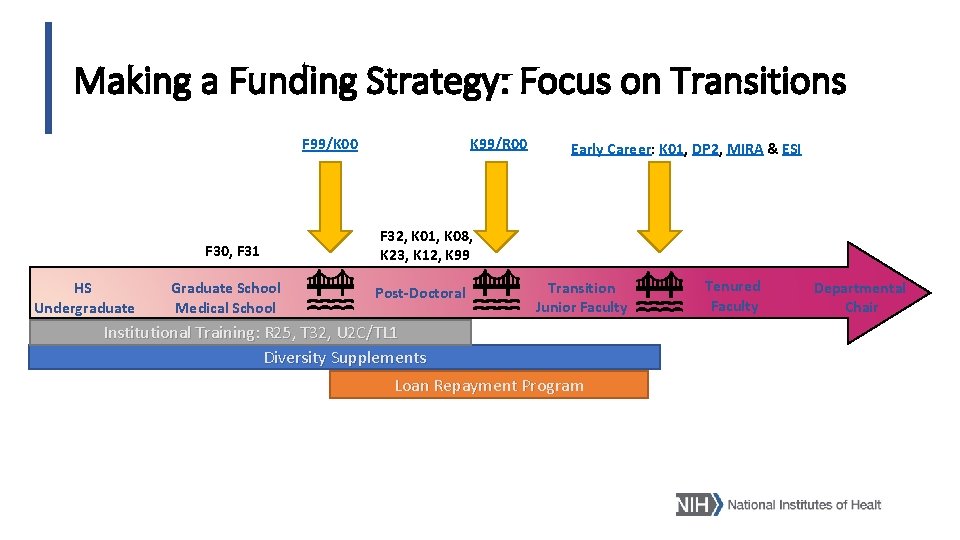
Transition Awards • The current research environment is often perceived as very challenging (e. g. , Developing a 21 st Century Neuroscience Workforce, IOM). • Attrition of talent occurs at each career transition as the goal of a research career is reconsidered • In 2014, ~11% of those enrolled in US neuroscience graduate programs were from underrepresented groups* • A goal of the NIH is to “create seamless transitions for biomedical career advancement and progression” *National Science Foundation, National Center for Science and Engineering Statistics. 2015. Women, Minorities, and Persons with Disabilities in Science and Engineering: 2015. Special Report NSF 15 -311. Arlington, VA. Available at http: //www. nsf. gov/statistics/wmpd/.
Making a Funding Strategy: Focus on Transitions K 99/R 00 F 99/K 00 F 30, F 31 HS Undergraduate Graduate School Medical School Early Career: K 01, DP 2, MIRA & ESI F 32, K 01, K 08, K 23, K 12, K 99 Post-Doctoral Transition Junior Faculty Institutional Training: R 25, T 32, U 2 C/TL 1 Diversity Supplements Loan Repayment Program Tenured Faculty Departmental Chair
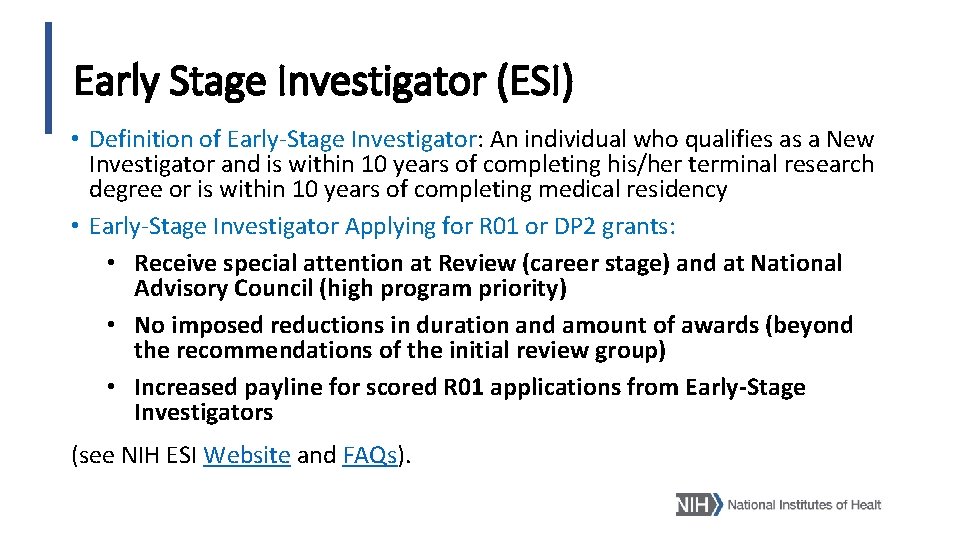
Early Stage Investigator (ESI) • Definition of Early-Stage Investigator: An individual who qualifies as a New Investigator and is within 10 years of completing his/her terminal research degree or is within 10 years of completing medical residency • Early-Stage Investigator Applying for R 01 or DP 2 grants: • Receive special attention at Review (career stage) and at National Advisory Council (high program priority) • No imposed reductions in duration and amount of awards (beyond the recommendations of the initial review group) • Increased payline for scored R 01 applications from Early-Stage Investigators (see NIH ESI Website and FAQs). IDe. A SW Regional Meeting 2019 18
Early Career Reviewer Program • One of the best ways to build your grant writing skills is to serve as a reviewer. • The NIH Center for Scientific Review (CSR) Early Career Reviewer (ECR) program was developed to: – train qualified scientists without prior CSR review experience so that they may become effective reviewers, – help emerging researchers advance their careers by exposing them to peer review, and – enrich the existing pool of NIH reviewers by including scientists from less researchintensive institutions as well as those from traditionally research- intensive institutions. • Prior NIH funding is NOT a requirement. https: //public. csr. nih. gov/For. Reviewers/Become. AReviewer/ECR/Becomean. Early. Career. Reviewer
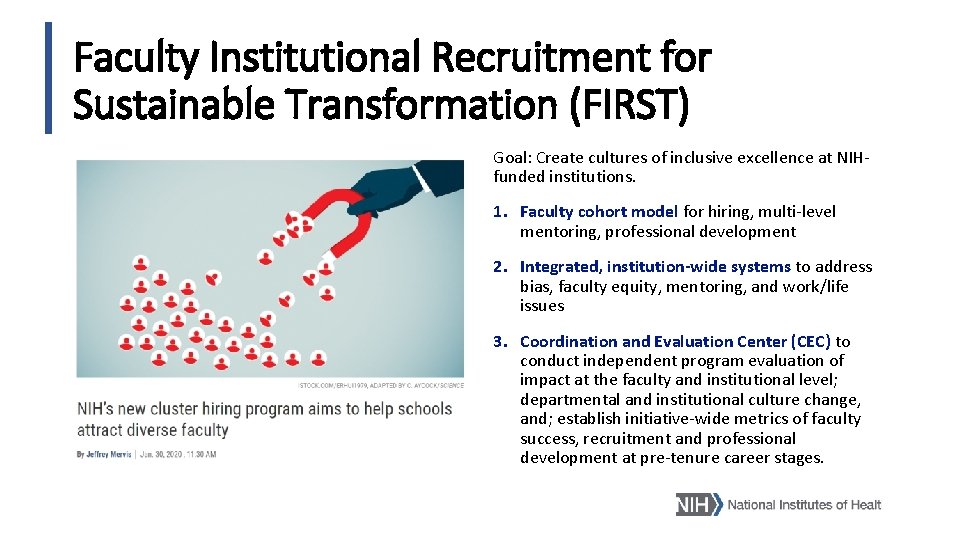
Faculty Institutional Recruitment for Sustainable Transformation (FIRST) Goal: Create cultures of inclusive excellence at NIHfunded institutions. 1. Faculty cohort model for hiring, multi-level mentoring, professional development 2. Integrated, institution-wide systems to address bias, faculty equity, mentoring, and work/life issues 3. Coordination and Evaluation Center (CEC) to conduct independent program evaluation of impact at the faculty and institutional level; departmental and institutional culture change, and; establish initiative-wide metrics of faculty success, recruitment and professional development at pre-tenure career stages. IDe. A SW Regional Meeting 2019 20
Scientific Workforce Diversity - Guidance • Why Diversity Matters to NIH – Dr. Le Fauve • How Do You Start ? Overview of Training Opportunities – Dr. Gibbs • How Do You Continue? (Postdoc to Early Faculty) – Dr. Jones-London • Mentorship for All Career Stages – Dr. Rivers
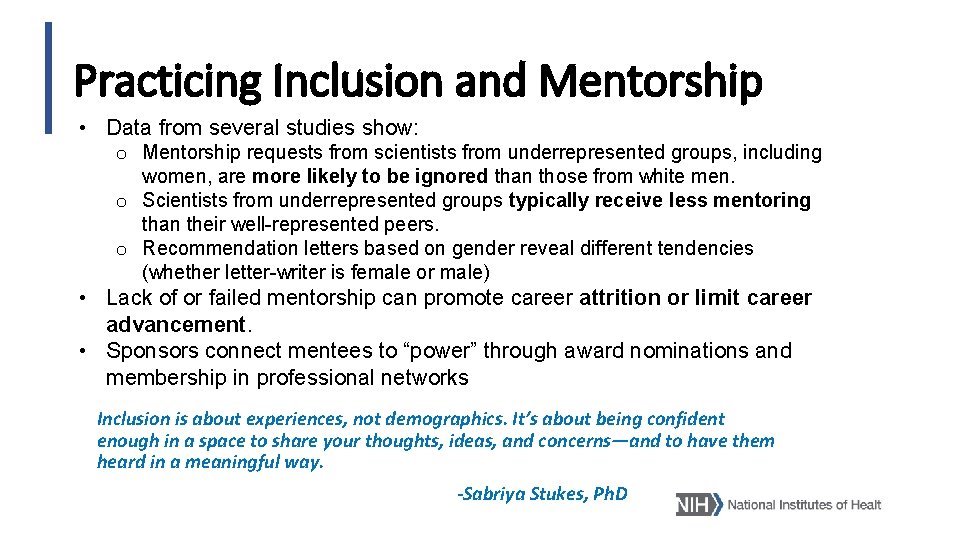
Practicing Inclusion and Mentorship • Data from several studies show: o Mentorship requests from scientists from underrepresented groups, including women, are more likely to be ignored than those from white men. o Scientists from underrepresented groups typically receive less mentoring than their well-represented peers. o Recommendation letters based on gender reveal different tendencies (whether letter-writer is female or male) • Lack of or failed mentorship can promote career attrition or limit career advancement. • Sponsors connect mentees to “power” through award nominations and membership in professional networks Inclusion is about experiences, not demographics. It’s about being confident enough in a space to share your thoughts, ideas, and concerns—and to have them heard in a meaningful way. -Sabriya Stukes, Ph. D IDe. A SW Regional Meeting 2019 22
After-Hours Conversation on Mentoring and NRMN session After-Hours Conversation – Auditorium A Thursday, October 29, 2020 5: 00 PM to 5: 45 PM EDT Mentoring: NIH and the National Research Mentoring Network
Please Contact Us Program officers can provide insight into NIH funding process Each of the NIH Institutes and Centers use the basic funding mechanisms in different ways relevant to their mission • Different missions & research and funding priorities • Different budgets • Different ways of deciding which grants to fund ***There are lots of opportunities – go for it!
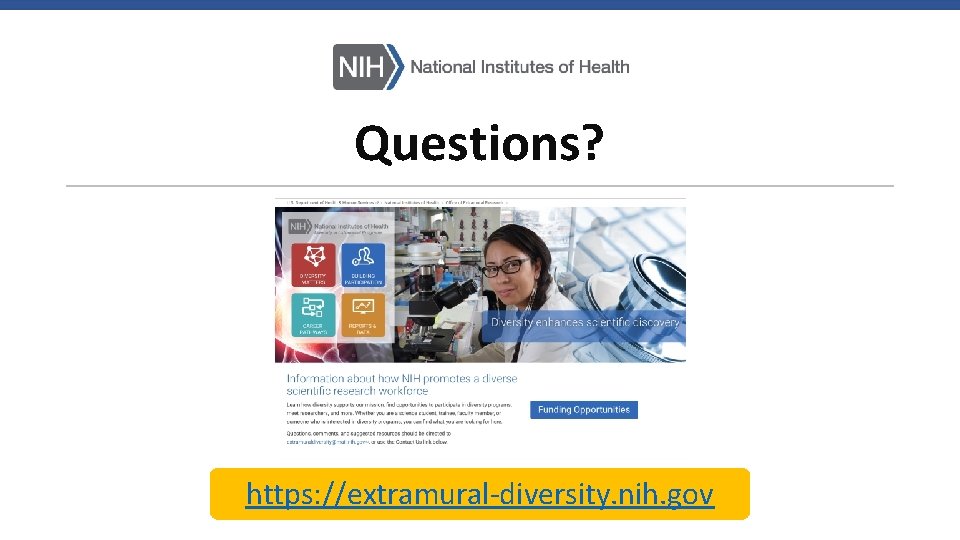
Questions? https: //extramural-diversity. nih. gov
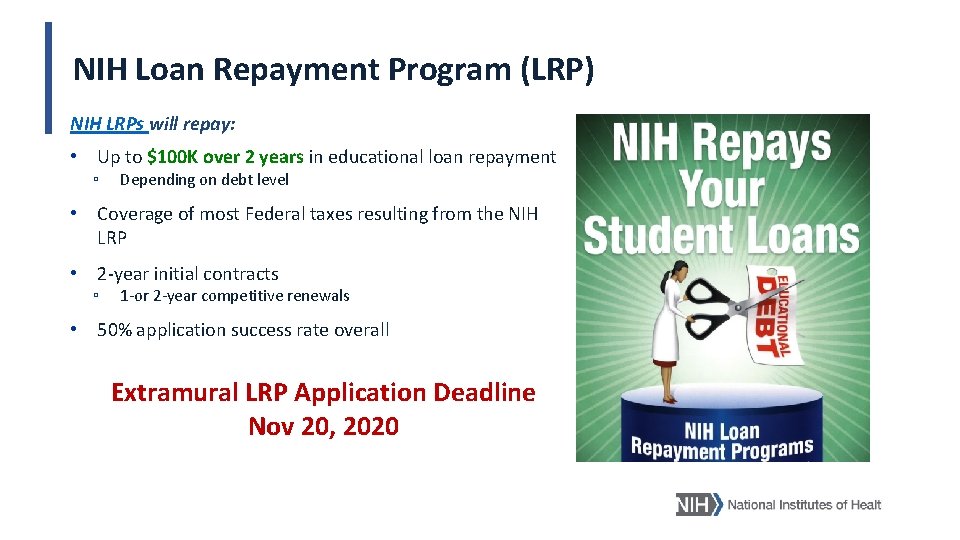
NIH Loan Repayment Program (LRP) NIH LRPs will repay: • Up to $100 K over 2 years in educational loan repayment ▫ Depending on debt level • Coverage of most Federal taxes resulting from the NIH LRP • 2 -year initial contracts ▫ 1 -or 2 -year competitive renewals • 50% application success rate overall Extramural LRP Application Deadline Nov 20, 2020
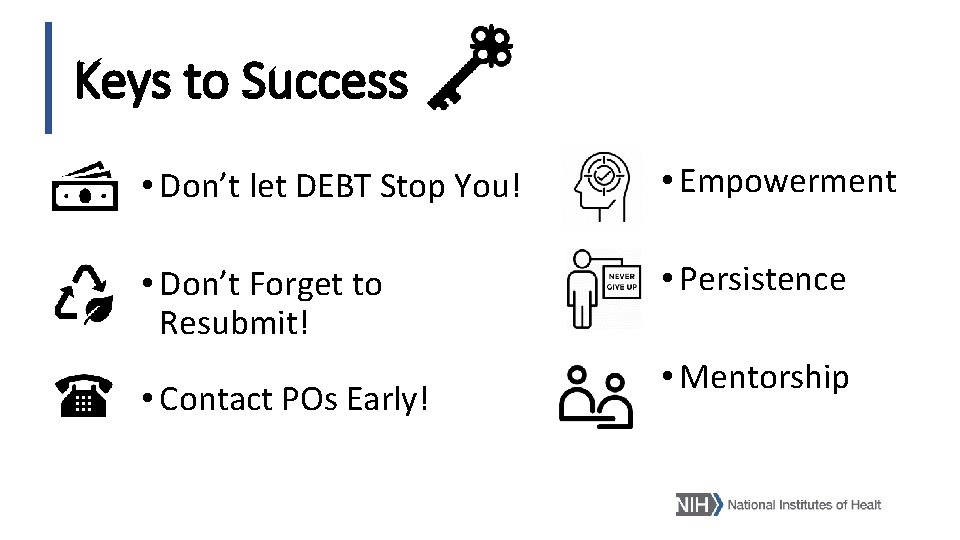
Keys to Success • Don’t let DEBT Stop You! • Empowerment • Don’t Forget to Resubmit! • Persistence • Contact POs Early! • Mentorship