
Scientific Theory Lesson 1 4 A scientific theory
- Slides: 14
Scientific Theory Lesson 1 -4 • A scientific theory is an explanation of observations or events that is based on knowledge gained from many observations and investigations. • A scientific theory does not develop from just one hypothesis, but from many hypotheses that are connected by a common idea.
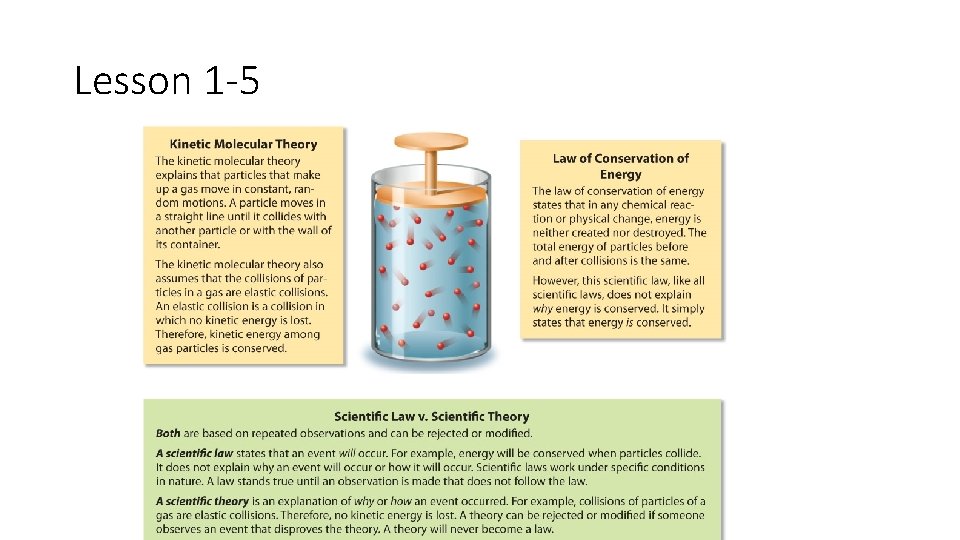
Scientific Law Lesson 1 -5 • A scientific law is a rule that describes a repeatable pattern in nature. • A scientific law does not explain why or how the pattern happens, it only states that it will happen.
Lesson 1 -5
Results of Scientific Inquiry Lesson 1 -6 • Most often, the purpose of a scientific investigation is to develop new materials and technology, discover new objects, or find answers to questions. • Technology is the practical use of scientific knowledge, especially for industrial or commercial use.
Evaluating Scientific Information Lesson 1 -6 • Whether you are reading printed media or watching commercials on TV, it is important that you are skeptical, identify facts and opinions, and think critically about the information. • Critical thinking is comparing what you already know with the information you are given in order to decide whether you agree with it.
Science cannot answer all questions. Lesson 1 -6 • There are some questions that science cannot answer. • Questions that deal with beliefs, values, personal opinions, and feelings cannot be answered scientifically.
Safety in Science Lesson 1 -6 • When you begin scientific inquiry, you should always wear protective equipment. • You also should learn the meaning of safety symbols, listen to your teacher’s instructions, and learn to recognize potential hazards.
Controlled Experiments (cont. ) Lesson 3 -2 • A variable is any factor that can have more than one value. • The independent variable is the factor that you want to test. It is changed by the investigator to observe how it affects a dependent variable.
Controlled Experiments (cont. ) Lesson 3 -2 • The dependent variable is the factor you observe or measure during an experiment. • Constants are the factors in an experiment that do not change.
Controlled Experiments (cont. ) Lesson 3 -2 • A controlled experiment usually has at least two groups: the experimental group and the control group. • The experimental group is used to study how a change in the independent variable changes the dependent variable. • The control group contains the same factors as the experimental group, but the independent variable is not changed.
Asking Questions (cont. ) Lesson 3 -6 • Qualitative data use words to describe what is observed. • Quantitative data use numbers to describe what is observed.
Lesson 1: Scientific Inquiry Key Concepts 1 • Some steps used during scientific inquiry are making observations and inferences, developing a hypothesis, analyzing results, and drawing conclusions. These steps, among others, can be performed in any order. • There are many results of scientific inquiry, and a few possible outcomes are the development of new materials and new technology, the discovery of new objects and events, and answers to basic questions. • Critical thinking is comparing what you already know about something to new information and deciding whether or not you agree with the new information.
Lesson 2: Measurement and Scientific Tools Key Concepts 2 • Scientists developed one universal system of units, the international System of Units (SI), to improve communication among scientists. • Scientific notation is a useful tool for writing large and small numbers in a shorter form. • Tools such as graduated cylinders and triple-beam balances make scientific investigation easier, more accurate, and repeatable.
Lesson 3: Case Study Key Concepts 3 • Evaluation and testing are important in the design process for the safety of the consumer and to keep costs of building or manufacturing the product at a reasonable level. • Scientific inquiry was used throughout the process of determining why the bridge collapsed, including hypothesizing potential reasons for the bridge failure and testing those hypotheses.