
SCIENTIFIC TECHNICAL WRITING METHODOLOGY EXPERIMENTAL APPARATUS AND PROCEDURE

- Slides: 26
SCIENTIFIC & TECHNICAL WRITING METHODOLOGY: EXPERIMENTAL APPARATUS AND PROCEDURE Prof. R. L. Boxman Tel Aviv University R. L. Boxman, 9/2000 TEL AVIV UNIVERSITY 1
EXPERIMENTAL APPARATUS AND PROCEDURE • Basic questions: – What did I do? – How did I do it? • Part of “how” is equipment, apparatus, materials, samples, procedures, etc. TEL AVIV UNIVERSITY 2
Experimental Apparatus and Procedure continued • Alternative Titles: – “Methods and Materials” (chem, bio) – “Experimental Set-up and Method”, etc. – Don’t call this section “Experimental” • (adjective - titles must have noun!). – In theoretical work; the same basic question might be answered in sections called “Model Assumptions”, “Development of the Model”, “Derivation of the Model Equations”, etc. TEL AVIV UNIVERSITY 3
DETAIL – how much? • ENOUGH DETAIL TO PERMIT DUPLICATION ELSEWHERE !!!!!!! – Fundamental requirement for scientific publication: provide enough detail so that a skilled worker elsewhere can duplicate your results !!! – All details of apparatus and procedure necessary for obtaining the results must be given – Some judgment necessary: • Your choice may depend on what your understanding of the mechanism of action • It is best to err on the side of too much detail TEL AVIV UNIVERSITY 4
Detail – how much? continued – Recommended to give additional details that will make duplication easier e. g. – unusual tricks and procedures that save time – Omit superfluous detail from text: – Example: “The arc electrodes were mounted in vacuum chamber fabricated from 316 L stainless steel. ” (would the choice of chamber material influence the results? ) • And in particular from diagrams e. g. – location of nuts, bolts, o-rings, etc. TEL AVIV UNIVERSITY 5
APPARATUS • Applies to: – – – – – equipment, materials, samples, specimens, subjects (laboratory or natural fauna/flora, human subjects), computer programs, algorithms, terrain, questionnaires and surveys, etc. TEL AVIV UNIVERSITY 6
Apparatus continued • Standard Equipment • Identify standard or well-known equipment • If the choice of a particular equipment might influence the results, either – Specify the manufacturer and model number, • example: “A Hewlett-Packard Laser Jet IIIP printer was used to print the processed image. ” Use if you think the choice might be critical, but you don’t know why, or if you think the manufacturer information might be helpful to the reader. – Or give the specifications or parameters which might influence the results. This is the preferred form. • example: “A laser printer with a spatial resolution of 300 lines/inch was used to print the processed image. ” TEL AVIV UNIVERSITY 7
Apparatus continued – or both • Example: “A Hewlitt-Packard Laser Jet IIIP printer with a spatial resolution of 300 lines/inch was used to print the processed image. ” – If the choice of model is not critical, a generic identification is sufficient • Example: “A laser printer was used to print the processed image. ” TEL AVIV UNIVERSITY 8
Apparatus continued • Specially Designed Apparatus • Describe specially designed apparatus – 3 organizational steps: • A. Overview – 1 -2 sentences giving the general idea, and purpose of the apparatus • B. Description of principal parts – describe each major part in some logical order • C. Functional description – how do the parts work together? TEL AVIV UNIVERSITY 9
Special Apparatus continued • Use a Diagram (especially if complicated) – All parts described in text should appear and be labeled in the diagram – All parts appearing in the diagram should either be obvious, or described in the text – Omit unnecessary detail • don’t use shop drawings!!! TEL AVIV UNIVERSITY 10
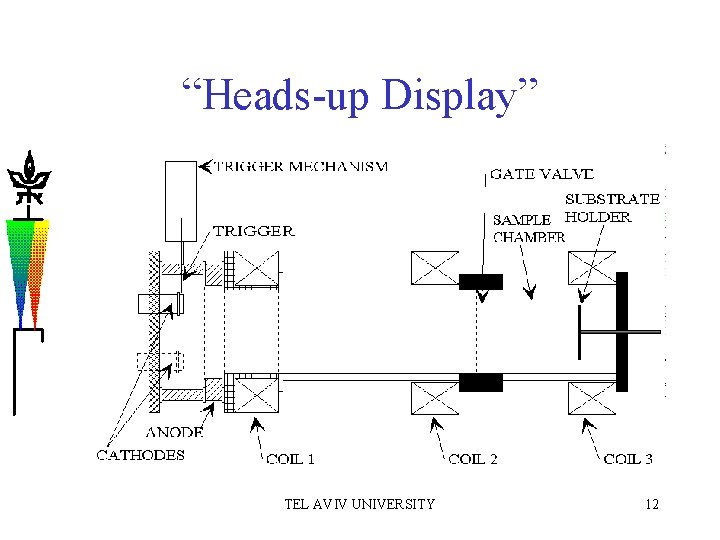
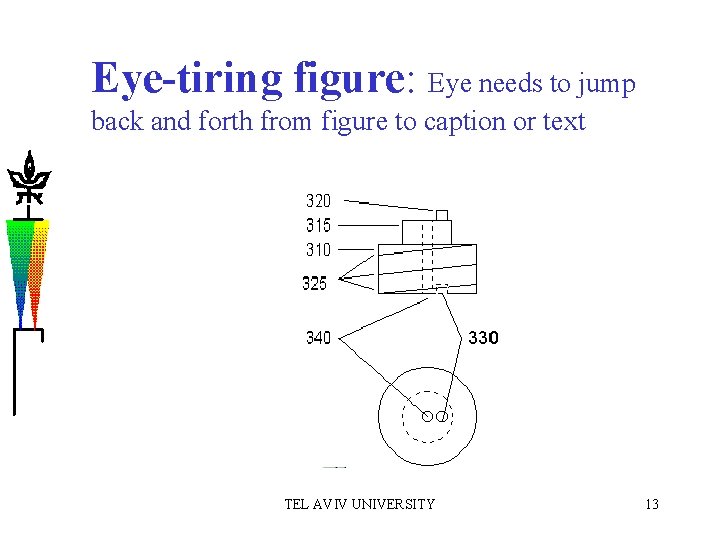
Special Apparatus continued – “Heads-up Display” – give all essential information needed to understand figure directly on the figure – Label features directly on the diagram with words or obvious abbreviations • Use numbers defined in the caption (or worse yet, in the text) only if necessary for clarity • Numbers force the readers’ eyes to jump back and forth between the diagram and the explanation – This was standard, however, in the former USSR, and in patents – Don’t use this method in Western Journals, unless absolutely necessary TEL AVIV UNIVERSITY 11
“Heads-up Display” TEL AVIV UNIVERSITY 12
Eye-tiring figure: Eye needs to jump back and forth from figure to caption or text TEL AVIV UNIVERSITY 13
Special Apparatus – orientation and arrangement – Orientation and arrangement in the diagram should be consistent with the textual description – If possible, maintain the orientation and/or arrangement from figure to figure, if the same or similar parts appear TEL AVIV UNIVERSITY 14
Special Apparatus Step B: Description of Principal Parts • Order of the Description – Spatial arrangement: • Top to bottom, • Left to right, • Center to outside, etc. – Functional arrangement: • In the order in which the parts operate, from beginning to end TEL AVIV UNIVERSITY 15
Description of Apparatus: Tense • Usually simple past – ex: “The radar receiver consisted of four principle parts: an RF amplifier, a mixer, a local oscillator, and a detector. ” • Present can be used to describe general truths, or sometimes to describe standard apparatus – ex: “Waves reflected from approaching aircraft are processed by radar receivers. ” TEL AVIV UNIVERSITY 16
Description of Apparatus: Voice • Human Agent - manipulation by the experimenter – Avoid 1 st person “I, we” • unless specific journal so instructs – Use passive voice. • Ex: “The arc current was controlled by varying the phase angle of the SCR ignition. ” TEL AVIV UNIVERSITY 17
Description of Apparatus: Voice continued • No Human Agent - agent is the equipment or materials – Active voice • Ex: “The frame grabber sampled the video signal at 5 MHz. ” – Passive voice • Ex: “The video signal was sampled by the frame grabber at a rate of 5 MHz. ” – Choose the voice according to whether you wish to emphasize • The agent (active voice), or • The recipient of the action (passive voice) TEL AVIV UNIVERSITY 18
Description of Apparatus: Articles • First mention of a new part – use indefinite articles “a/an” • Subsequent mention, or if the part is obviously known - use the definite article “the” – Ex: “The plasma jet was directed through a hollow anode by a strong magnetic field. The anode was water cooled, and constructed from OFHC copper. ” TEL AVIV UNIVERSITY 19
Description of Apparatus: Word Order • Where possible, mention first old information, then new information. TEL AVIV UNIVERSITY 20
C. Functional description • Describe how each of the principle parts described in step B work together. • Description focusses on what the parts do, not on their construction (which is described in step B). • Order should follow flow of material or information through the apparatus TEL AVIV UNIVERSITY 21
PROCEDURE • Applicable also to: – Method, – Derivation of equations, – Numerical method, etc. • Order the information sequentially TEL AVIV UNIVERSITY 22
Procedure -Tense • Simple past tense usually preferred – Ex: “The samples were washed with alcohol prior to mounting. ” • Though rare in physics/engineering, some journals may prefer the simple present tense – look in previous articles and style manual for guidance TEL AVIV UNIVERSITY 23
Procedure - Voice • Avoid 1 st person “I/we”. • Generally preferred to use passive voice – Ex: “A sequence of pulses with the peak voltages increased in steps of 1 k. V was applied to the test gap. ” • Use active voice if needed to place old information first in a sentence. TEL AVIV UNIVERSITY 24
Procedure - Voice – Ex: “The arcs (presumably already defined) were generated with a (note use of indefinite article, first time when info introduced) welding power supply. The welder (subject introduced in previous sentence – old info, use ‘the’. ) produced (active voice) d. c. current of 0 -400 A, with an open circuit voltage of 70 V. The (old info introduced in previous sent. – use ‘the’) current was terminated when the computer generated enable signal (using ‘the’ here is proper only if the reader already knows about this signal) was removed (passive voice) from the supply. ” TEL AVIV UNIVERSITY 25
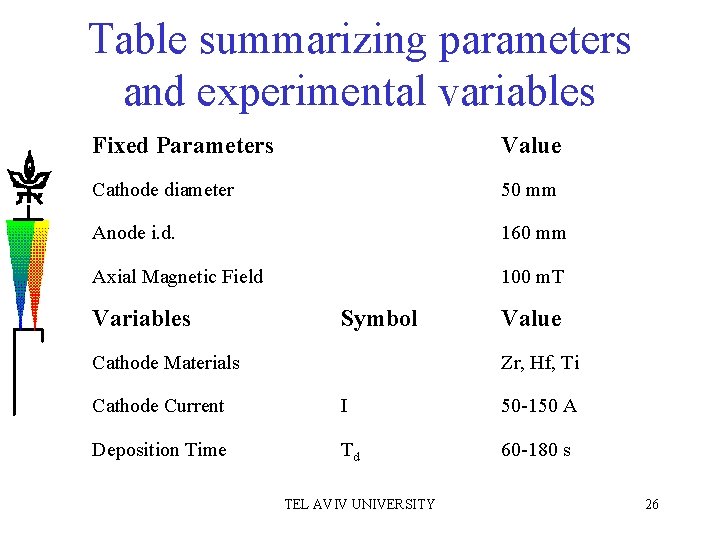
Table summarizing parameters and experimental variables Fixed Parameters Value Cathode diameter 50 mm Anode i. d. 160 mm Axial Magnetic Field 100 m. T Variables Symbol Cathode Materials Value Zr, Hf, Ti Cathode Current I 50 -150 A Deposition Time Td 60 -180 s TEL AVIV UNIVERSITY 26