
Scientific Spelling TrainingRefresher Teaching students to spell words


- Slides: 28
Scientific Spelling Training/Refresher “Teaching students to spell words can enhance students’ ability to read those words, to read novel words containing phonemes in the instructed words, and to spell words with similar alphabetic patterns” (e. g. , de Rose, de Souza, & Hanna, 1996; Harper, Mallette, Maheady, Parkes, & Moore, 1993; Okyere, Heron, & Goddard, 1997). ” (Noell, et al, 2006)
o What do we need out of a spelling program?
Why it works o The problem-solving aspect o Multi-sensory aspect o Discovery aspect
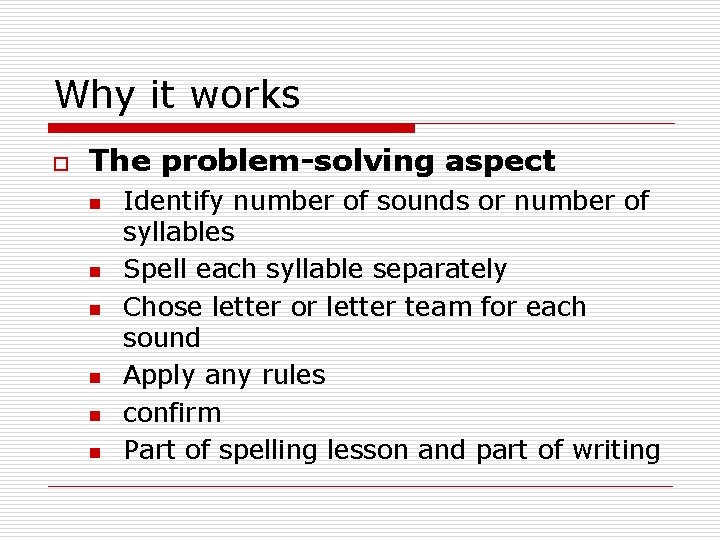
Why it works o The problem-solving aspect n n n Identify number of sounds or number of syllables Spell each syllable separately Chose letter or letter team for each sound Apply any rules confirm Part of spelling lesson and part of writing
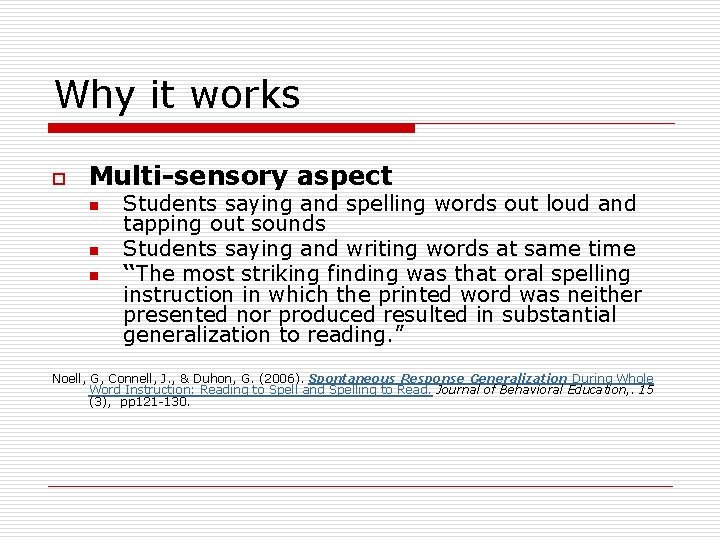
Why it works o Multi-sensory aspect n n n Students saying and spelling words out loud and tapping out sounds Students saying and writing words at same time “The most striking finding was that oral spelling instruction in which the printed word was neither presented nor produced resulted in substantial generalization to reading. ” Noell, G, Connell, J. , & Duhon, G. (2006). Spontaneous Response Generalization During Whole Word Instruction: Reading to Spell and Spelling to Read. Journal of Behavioral Education, . 15 (3), pp 121 -130.
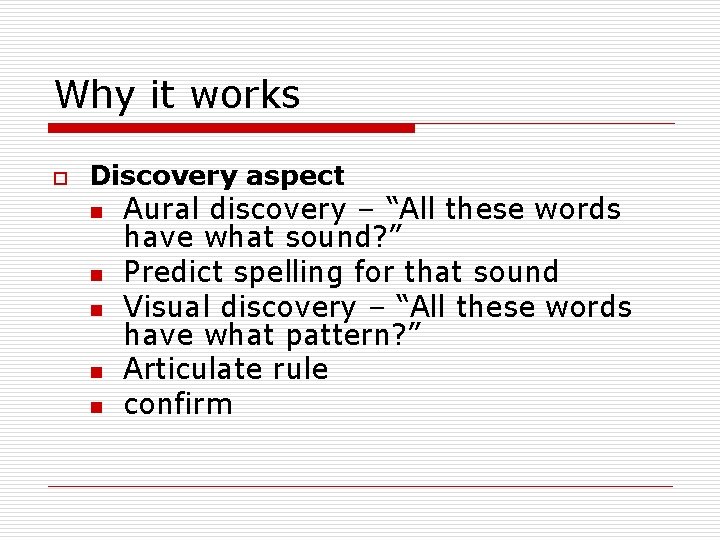
Why it works o Discovery aspect n n n Aural discovery – “All these words have what sound? ” Predict spelling for that sound Visual discovery – “All these words have what pattern? ” Articulate rule confirm
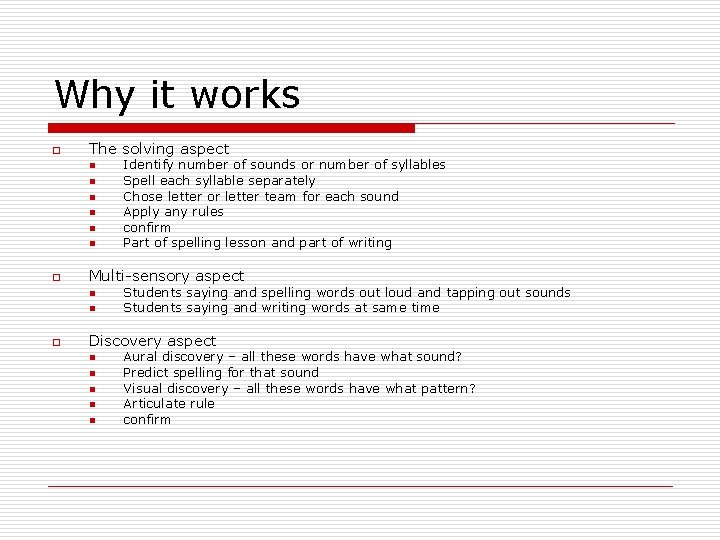
Why it works o The solving aspect n n n o Multi-sensory aspect n n o Identify number of sounds or number of syllables Spell each syllable separately Chose letter or letter team for each sound Apply any rules confirm Part of spelling lesson and part of writing Students saying and spelling words out loud and tapping out sounds Students saying and writing words at same time Discovery aspect n n n Aural discovery – all these words have what sound? Predict spelling for that sound Visual discovery – all these words have what pattern? Articulate rule confirm
Scientific Spelling week #16 (er) Sound = er or or
I am going to say some words. I want you to repeat each word after me and listen for the sound that is the same in all of the words. _____ _____
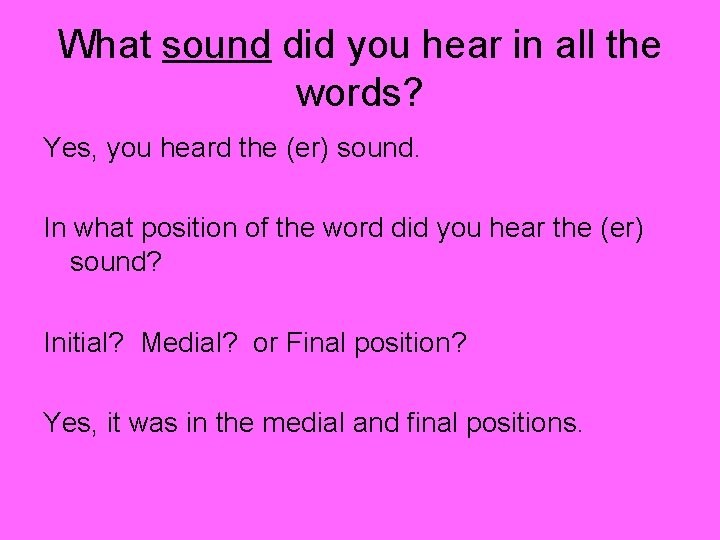
What sound did you hear in all the words? Yes, you heard the (er) sound. In what position of the word did you hear the (er) sound? Initial? Medial? or Final position? Yes, it was in the medial and final positions.
Let’s make a prediction about how this sound might be spelled. Think about what you know about the language. How do you think this sound might be spelled? The (er) sound has more than one spelling. Let’s see if you can discover the different spellings and when to use them.
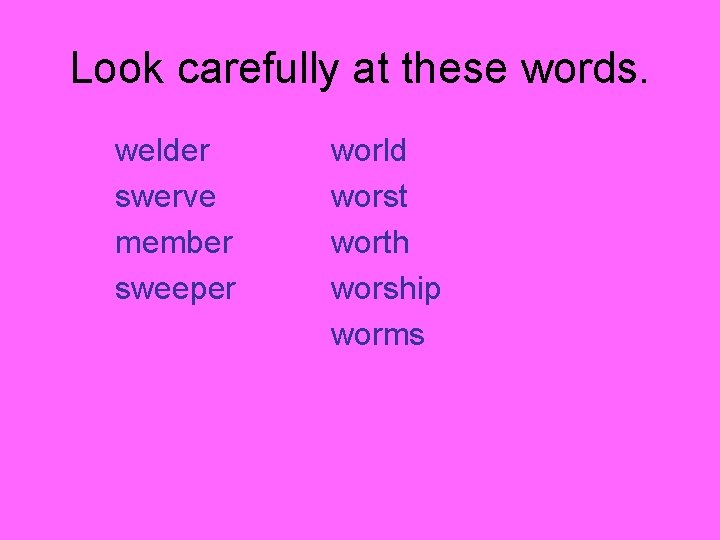
Look carefully at these words. welder swerve member sweeper world worst worth worship worms
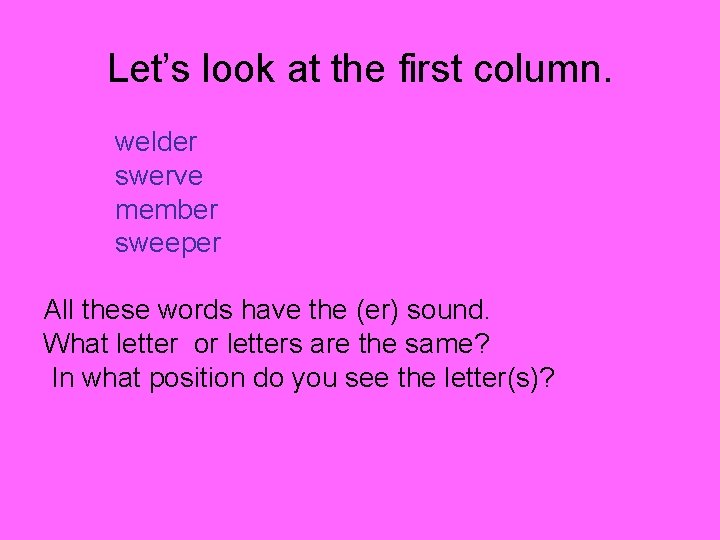
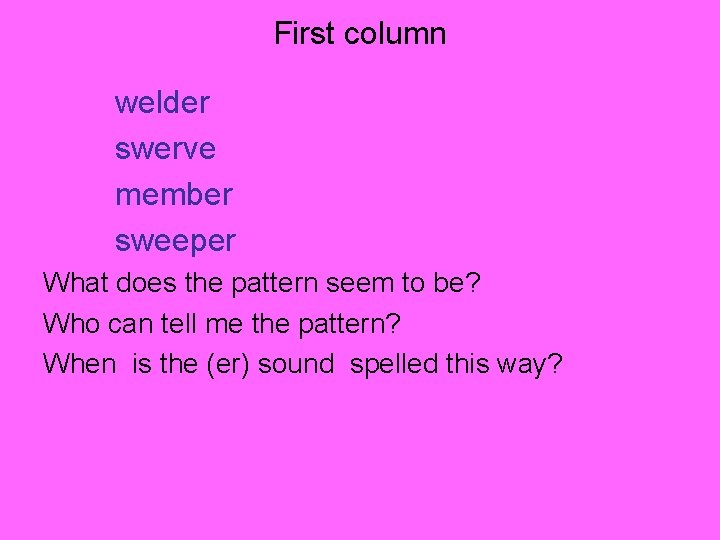
Let’s look at the first column. welder swerve member sweeper All these words have the (er) sound. What letter or letters are the same? In what position do you see the letter(s)?
First column welder swerve member sweeper What does the pattern seem to be? Who can tell me the pattern? When is the (er) sound spelled this way?
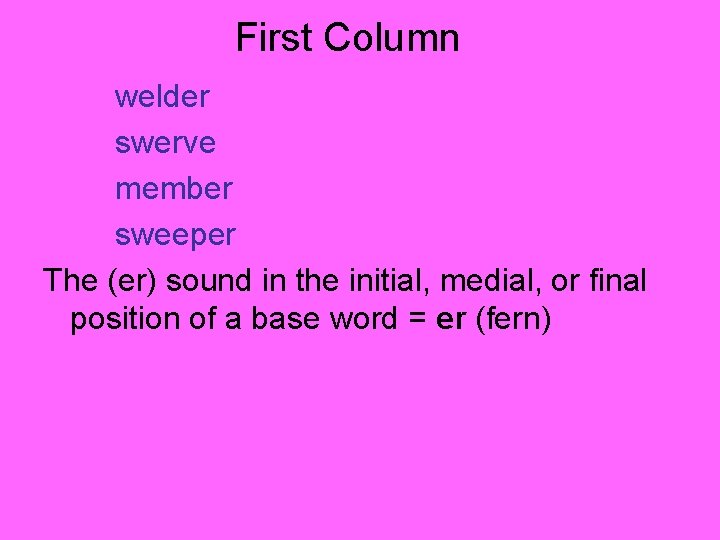
First Column welder swerve member sweeper The (er) sound in the initial, medial, or final position of a base word = er (fern)
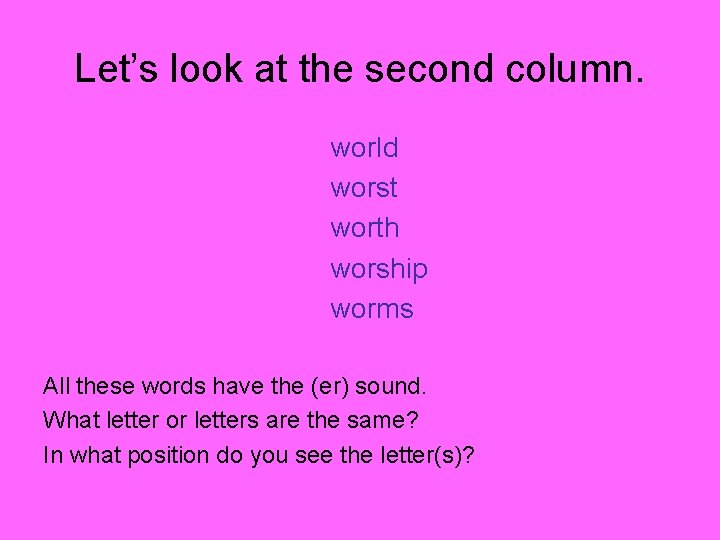
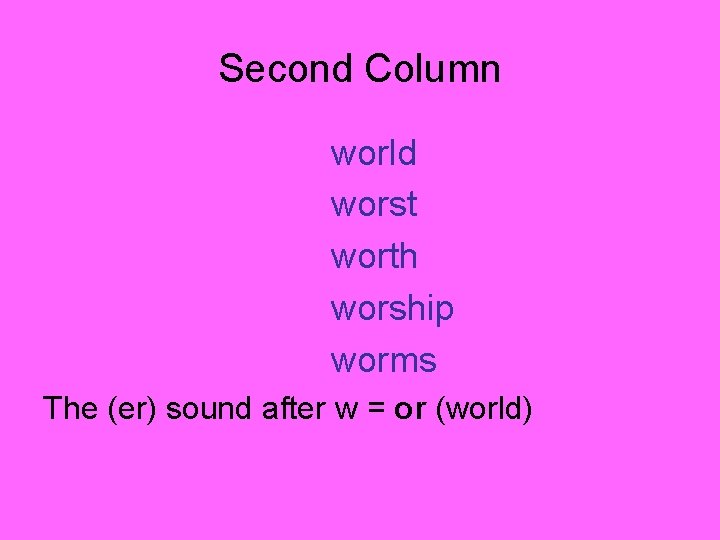
Let’s look at the second column. world worst worth worship worms All these words have the (er) sound. What letter or letters are the same? In what position do you see the letter(s)?
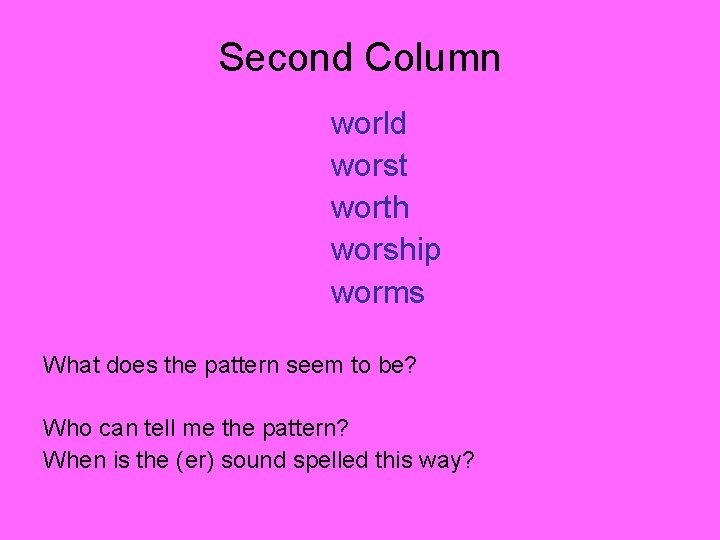
Second Column world worst worth worship worms What does the pattern seem to be? Who can tell me the pattern? When is the (er) sound spelled this way?
Second Column world worst worth worship worms The (er) sound after w = or (world)
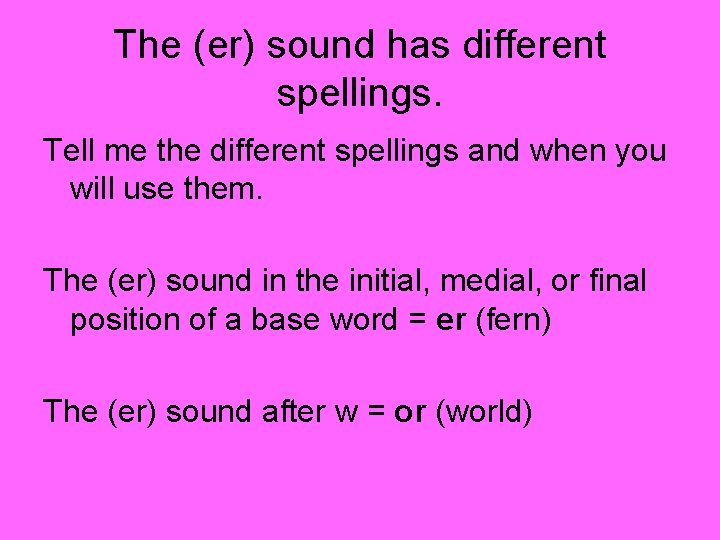
The (er) sound has different spellings. Tell me the different spellings and when you will use them. The (er) sound in the initial, medial, or final position of a base word = er (fern) The (er) sound after w = or (world)
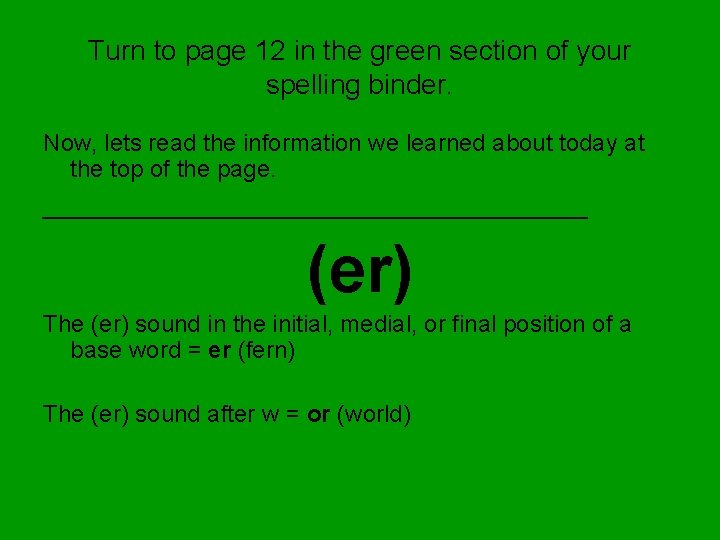
Turn to page 12 in the green section of your spelling binder. Now, lets read the information we learned about today at the top of the page. __________________ (er) The (er) sound in the initial, medial, or final position of a base word = er (fern) The (er) sound after w = or (world)
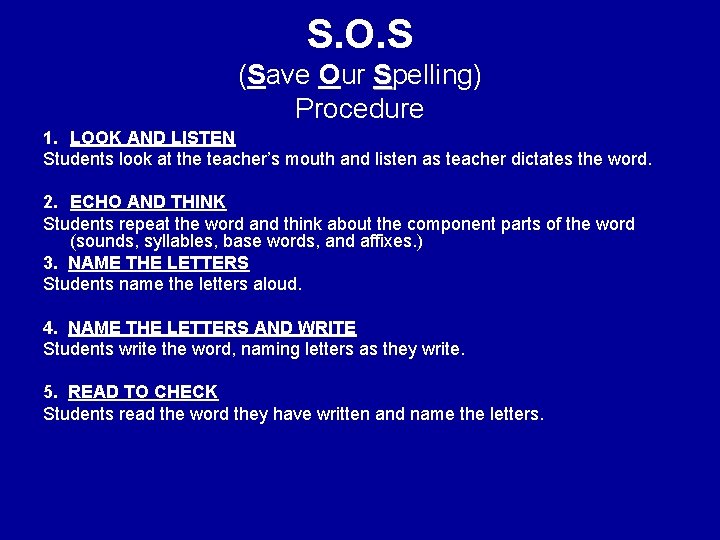
S. O. S (Save Our Spelling) Procedure 1. LOOK AND LISTEN Students look at the teacher’s mouth and listen as teacher dictates the word. 2. ECHO AND THINK Students repeat the word and think about the component parts of the word (sounds, syllables, base words, and affixes. ) 3. NAME THE LETTERS Students name the letters aloud. 4. NAME THE LETTERS AND WRITE Students write the word, naming letters as they write. 5. READ TO CHECK Students read the word they have written and name the letters.
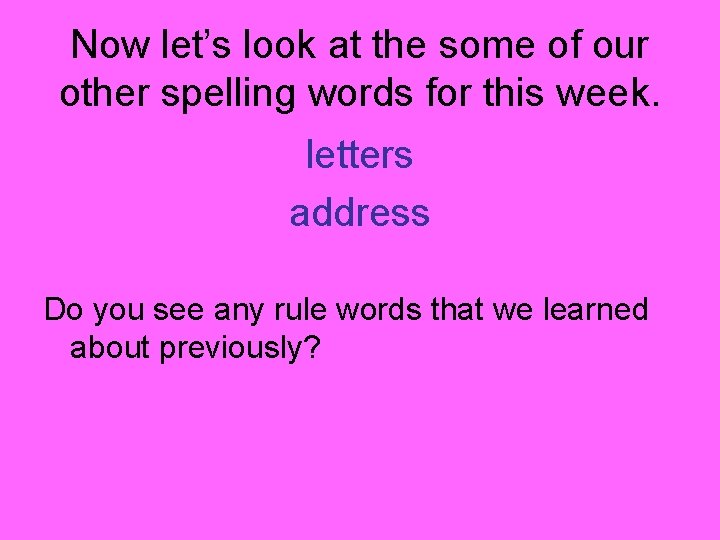
Now let’s look at the some of our other spelling words for this week. letters address Do you see any rule words that we learned about previously?
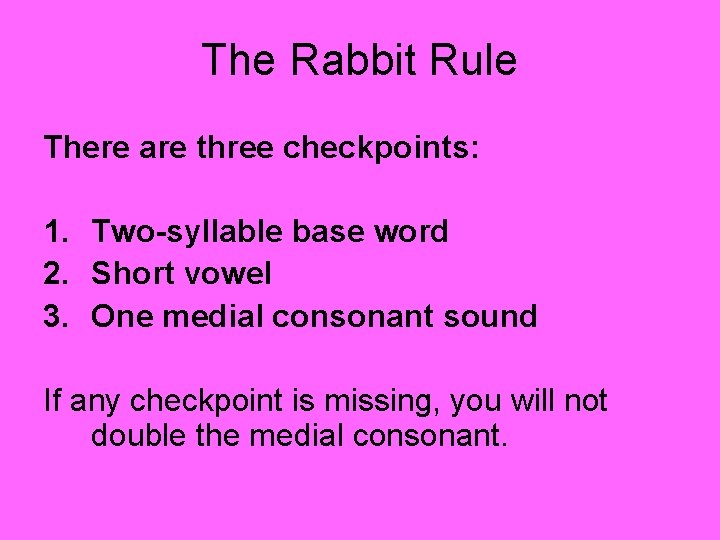
The Rabbit Rule There are three checkpoints: 1. Two-syllable base word 2. Short vowel 3. One medial consonant sound If any checkpoint is missing, you will not double the medial consonant.
Turn to page 2 in the yellow section of your spelling binder. Add these words: letters address
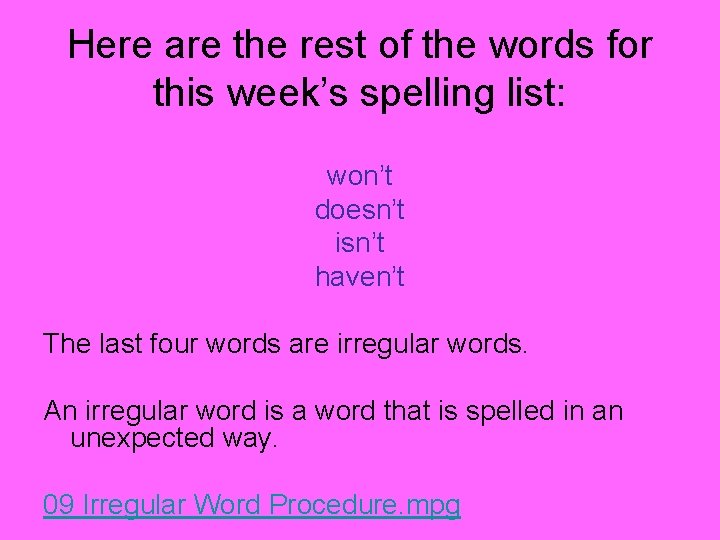
Here are the rest of the words for this week’s spelling list: won’t doesn’t isn’t haven’t The last four words are irregular words. An irregular word is a word that is spelled in an unexpected way. 09 Irregular Word Procedure. mpg
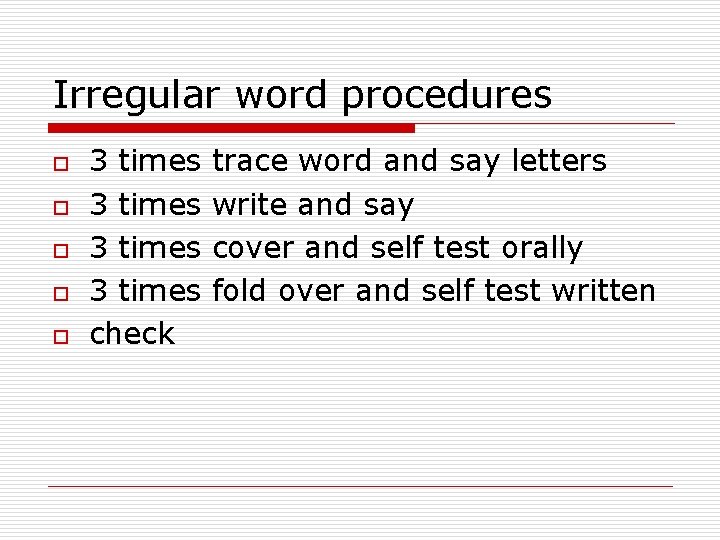
Irregular word procedures o o o 3 times check trace word and say letters write and say cover and self test orally fold over and self test written
“Teachable spelling moments” o o “Most researchers agree that it is good practice to encourage invented spelling and teach correct spelling. The two go hand-inhand. ” (Gentry, 2001). Reiben, et al (2005) found that inventive spelling coupled with feedback was more effective in promoting word reading than inventive spelling alone or copied spelling. Gentry, J. R. (2001). 5 myths about spelling DISPELLED! Instructor, 11( 3), pp 31 -33. Rieben, L. , Ntamakiliro, L. , Gonthier, B. , & Fayol, M. (2005). Effects of Various Early Writing Practices on Reading and Spelling. Scientific Studies of Reading, 9(2), p 145 -166.
Tasks o List for next week o Techniques to apply next week o Schedule for in-class demonstrations for next week