
Scientific Roadmap towards Height System Unification with GOCE
- Slides: 23
Scientific Roadmap towards Height System Unification with GOCE Th. Gruber(1), R. Rummel(1), M. Sideris(2), E. Rangelova(2), P. Woodworth(3), C. Hughes(3), J. Ihde(4), G. Liebsch(4), A. Rülke(4), Ch. Gerlach(5), R. Haagmans(6) (1) (2) (3) (4) (5) (6) Institute for Astronomical and Physical Geodesy, Technical University Munich, Germany Department of Geomatics Engineering, University of Calgary, Canada National Oceanography Centre, Liverpool, United Kingdom Bundesamt für Kartographie und Geodäsie (BKG), Frankfurt/Main, Germany Kommission für Erdmessung und Glaziologie, Bayerische Akademie der Wissenschaften, Munich Germany European Space Agency, The European Space Research and Technology Centre, Noordwijk, The Netherlands ESA Project: Support to Science Element (STSE) GOCE+ Theme 1: Height System Unification (HSU) 5 th International GOCE User Workshop, Paris, 27. 11. 2014
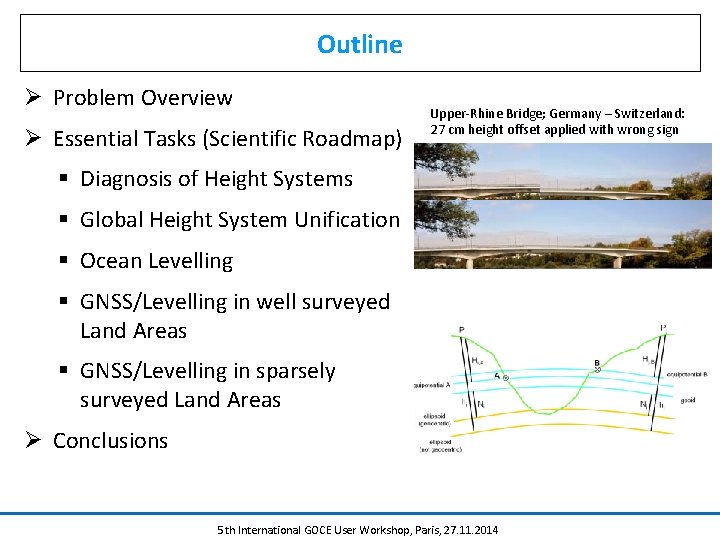
Outline Ø Problem Overview Ø Essential Tasks (Scientific Roadmap) Upper-Rhine Bridge; Germany – Switzerland: 27 cm height offset applied with wrong sign § Diagnosis of Height Systems § Global Height System Unification § Ocean Levelling § GNSS/Levelling in well surveyed Land Areas § GNSS/Levelling in sparsely surveyed Land Areas Ø Conclusions 5 th International GOCE User Workshop, Paris, 27. 11. 2014
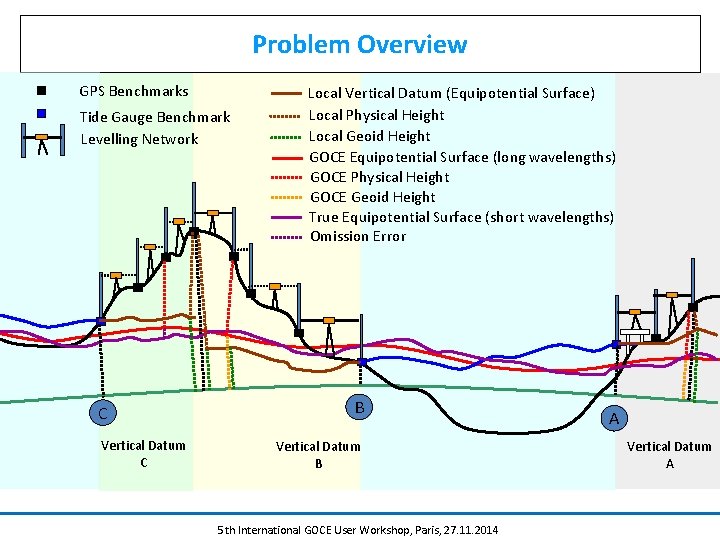
Problem Overview GPS Benchmarks Tide Gauge Benchmark Levelling Network C Vertical Datum C Local Vertical Datum (Equipotential Surface) Local Physical Height Local Geoid Height GOCE Equipotential Surface (long wavelengths) GOCE Physical Height GOCE Geoid Height True Equipotential Surface (short wavelengths) Omission Error B Vertical Datum B 5 th International GOCE User Workshop, Paris, 27. 11. 2014 A Vertical Datum A
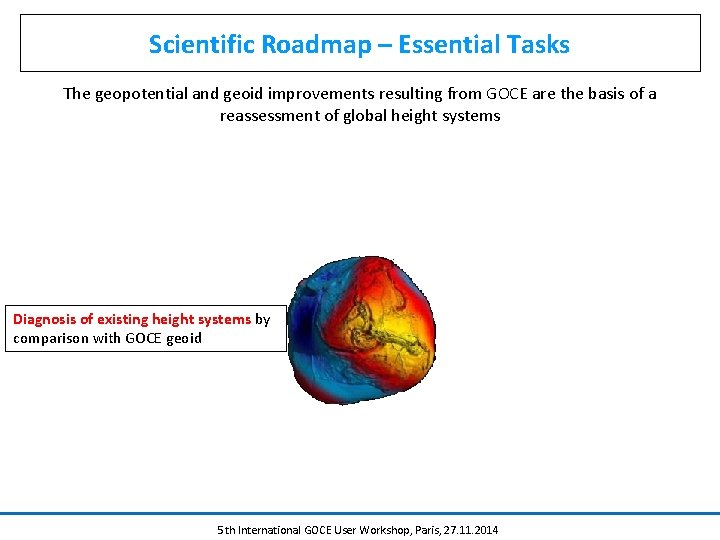
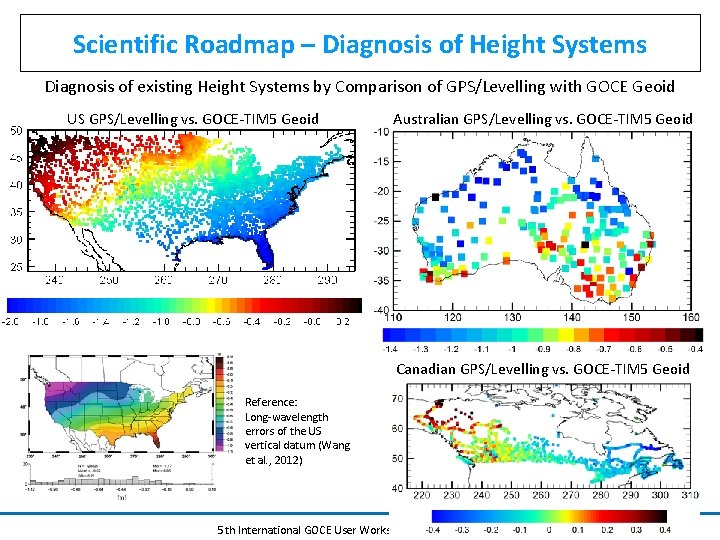
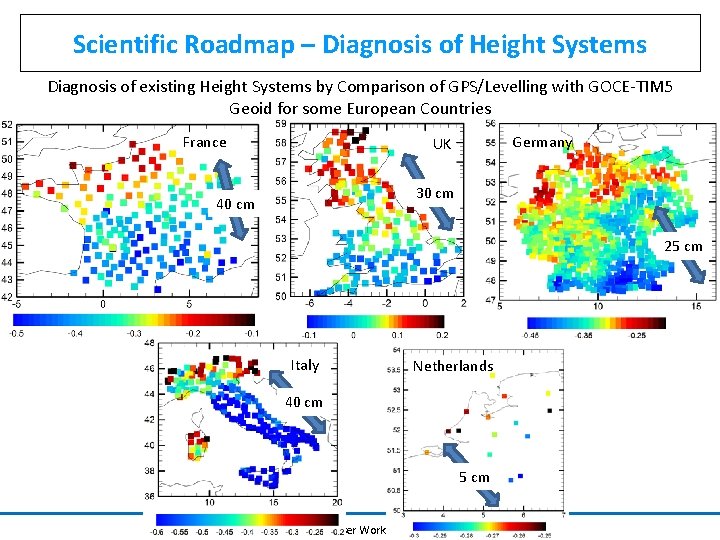
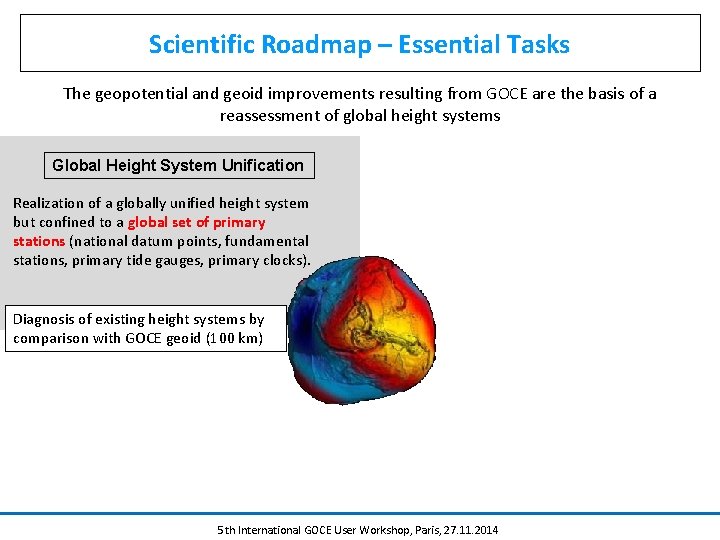
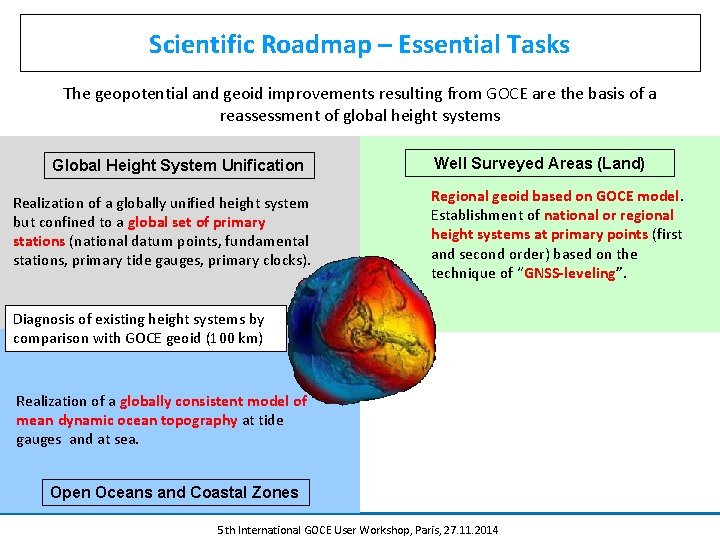
Scientific Roadmap – Essential Tasks The geopotential and geoid improvements resulting from GOCE are the basis of a reassessment of global height systems Diagnosis of existing height systems by comparison with GOCE geoid 5 th International GOCE User Workshop, Paris, 27. 11. 2014
Scientific Roadmap – Diagnosis of Height Systems Diagnosis of existing Height Systems by Comparison of GPS/Levelling with GOCE Geoid US GPS/Levelling vs. GOCE-TIM 5 Geoid Australian GPS/Levelling vs. GOCE-TIM 5 Geoid Canadian GPS/Levelling vs. GOCE-TIM 5 Geoid Reference: Long-wavelength errors of the US vertical datum (Wang et al. , 2012) 5 th International GOCE User Workshop, Paris, 27. 11. 2014
Scientific Roadmap – Diagnosis of Height Systems Diagnosis of existing Height Systems by Comparison of GPS/Levelling with GOCE-TIM 5 Geoid for some European Countries France Germany UK 30 cm 40 cm 25 cm Italy Netherlands 40 cm 5 th International GOCE User Workshop, Paris, 27. 11. 2014
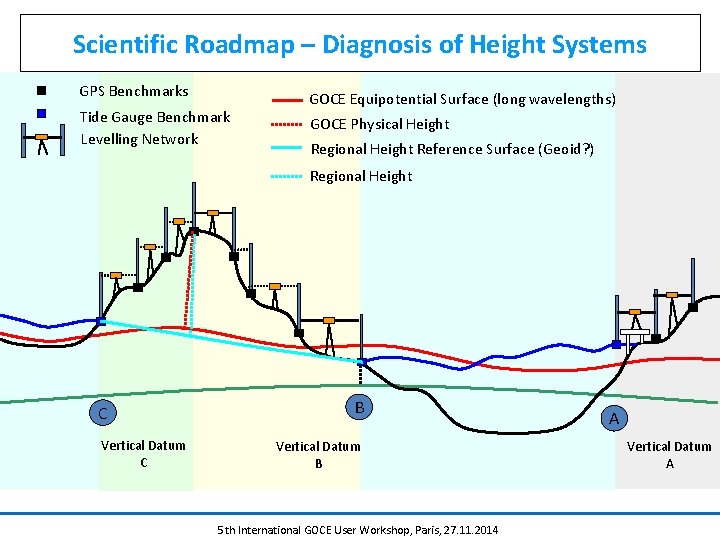
Scientific Roadmap – Diagnosis of Height Systems GPS Benchmarks Tide Gauge Benchmark Levelling Network GOCE Equipotential Surface (long wavelengths) GOCE Physical Height Regional Height Reference Surface (Geoid? ) Regional Height C Vertical Datum C B Vertical Datum B 5 th International GOCE User Workshop, Paris, 27. 11. 2014 A Vertical Datum A
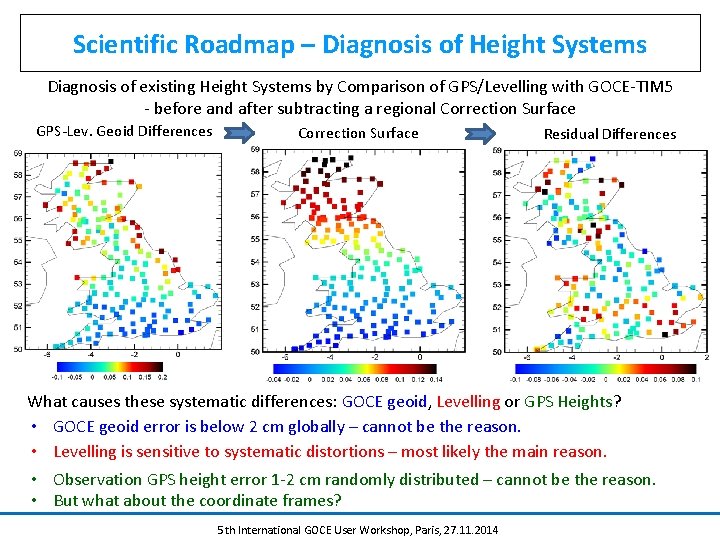
Scientific Roadmap – Diagnosis of Height Systems Diagnosis of existing Height Systems by Comparison of GPS/Levelling with GOCE-TIM 5 - before and after subtracting a regional Correction Surface GPS-Lev. Geoid Differences Correction Surface Residual Differences What causes these systematic differences: GOCE geoid, Levelling or GPS Heights? • GOCE geoid error is below 2 cm globally – cannot be the reason. • Levelling is sensitive to systematic distortions – most likely the main reason. • Observation GPS height error 1 -2 cm randomly distributed – cannot be the reason. • But what about the coordinate frames? 5 th International GOCE User Workshop, Paris, 27. 11. 2014
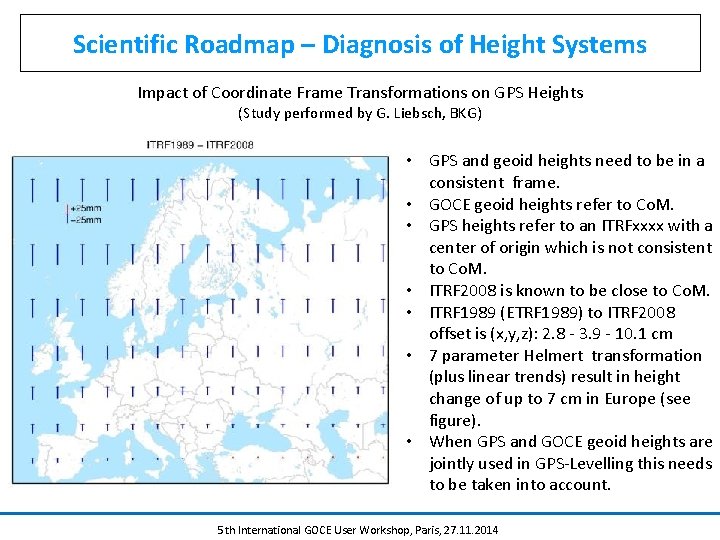
Scientific Roadmap – Diagnosis of Height Systems Impact of Coordinate Frame Transformations on GPS Heights (Study performed by G. Liebsch, BKG) • GPS and geoid heights need to be in a consistent frame. • GOCE geoid heights refer to Co. M. • GPS heights refer to an ITRFxxxx with a center of origin which is not consistent to Co. M. • ITRF 2008 is known to be close to Co. M. • ITRF 1989 (ETRF 1989) to ITRF 2008 offset is (x, y, z): 2. 8 - 3. 9 - 10. 1 cm • 7 parameter Helmert transformation (plus linear trends) result in height change of up to 7 cm in Europe (see figure). • When GPS and GOCE geoid heights are jointly used in GPS-Levelling this needs to be taken into account. 5 th International GOCE User Workshop, Paris, 27. 11. 2014
Scientific Roadmap – Essential Tasks The geopotential and geoid improvements resulting from GOCE are the basis of a reassessment of global height systems Global Height System Unification Realization of a globally unified height system but confined to a global set of primary stations (national datum points, fundamental stations, primary tide gauges, primary clocks). Diagnosis of existing height systems by comparison with GOCE geoid (100 km) 5 th International GOCE User Workshop, Paris, 27. 11. 2014
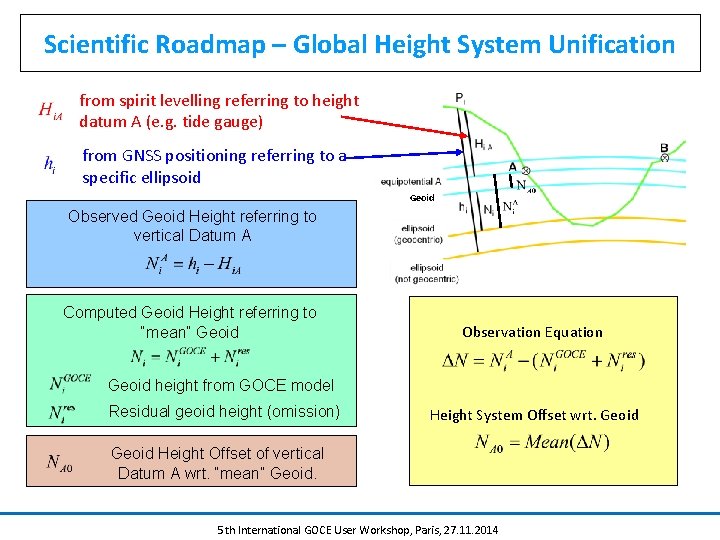
Scientific Roadmap – Global Height System Unification from spirit levelling referring to height datum A (e. g. tide gauge) from GNSS positioning referring to a specific ellipsoid Geoid Observed Geoid Height referring to vertical Datum A Computed Geoid Height referring to “mean” Geoid Observation Equation Geoid height from GOCE model Residual geoid height (omission) Height System Offset wrt. Geoid Height Offset of vertical Datum A wrt. “mean” Geoid. 5 th International GOCE User Workshop, Paris, 27. 11. 2014
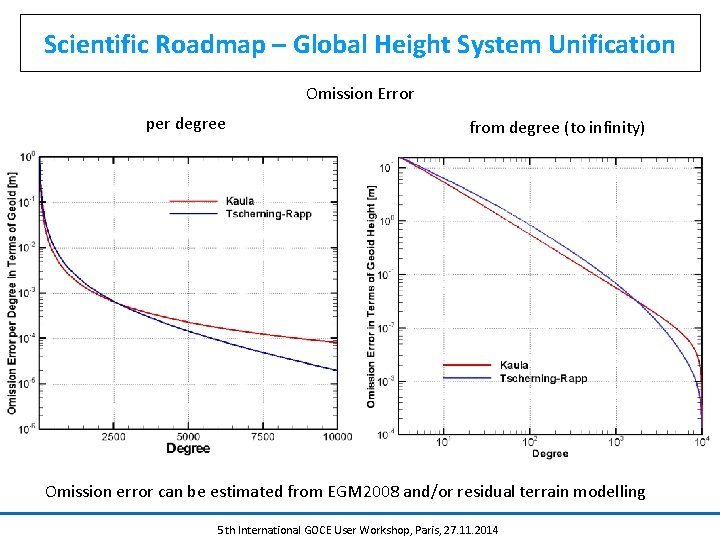
Scientific Roadmap – Global Height System Unification Omission Error per degree from degree (to infinity) Omission error can be estimated from EGM 2008 and/or residual terrain modelling 5 th International GOCE User Workshop, Paris, 27. 11. 2014
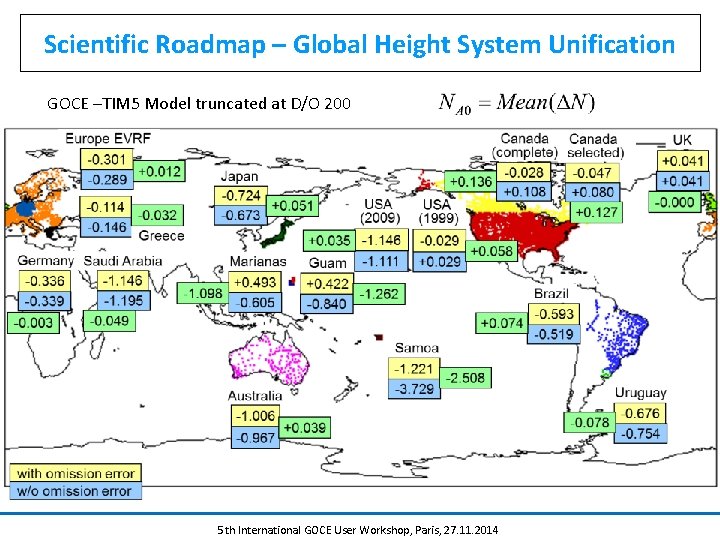
Scientific Roadmap – Global Height System Unification GOCE –TIM 5 Model truncated at D/O 200 5 th International GOCE User Workshop, Paris, 27. 11. 2014
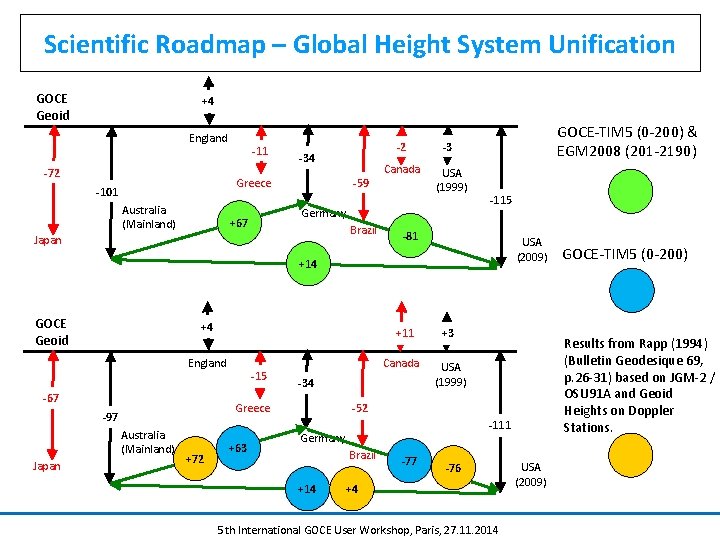
Scientific Roadmap – Global Height System Unification GOCE Geoid +4 England -72 -11 -2 -34 Greece -101 Australia (Mainland) -59 Canada USA (1999) Germany +67 Brazil Japan GOCE-TIM 5 (0 -200) & EGM 2008 (201 -2190) -3 -115 -81 USA (2009) +14 GOCE Geoid +4 +11 England -67 -34 Greece -97 Australia (Mainland) Japan -15 Canada +72 +63 +3 Results from Rapp (1994) (Bulletin Geodesique 69, p. 26 -31) based on JGM-2 / OSU 91 A and Geoid Heights on Doppler Stations. USA (1999) -52 -111 Germany Brazil +14 -77 -76 +4 5 th International GOCE User Workshop, Paris, 27. 11. 2014 GOCE-TIM 5 (0 -200) USA (2009)
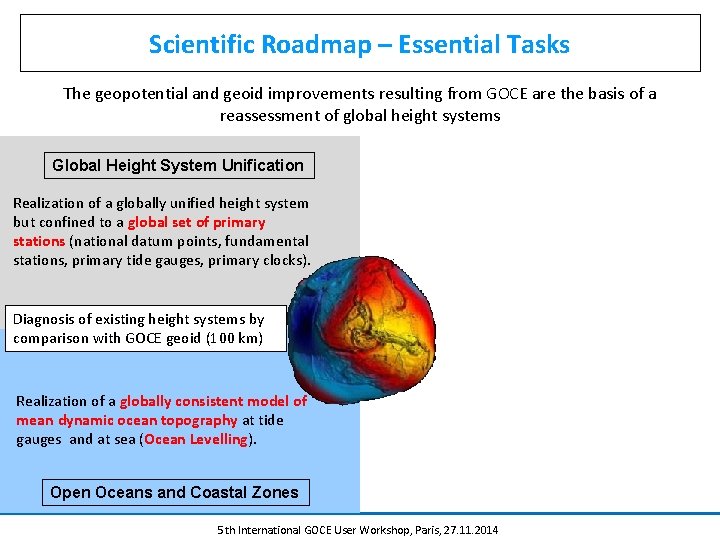
Scientific Roadmap – Essential Tasks The geopotential and geoid improvements resulting from GOCE are the basis of a reassessment of global height systems Global Height System Unification Realization of a globally unified height system but confined to a global set of primary stations (national datum points, fundamental stations, primary tide gauges, primary clocks). Diagnosis of existing height systems by comparison with GOCE geoid (100 km) Realization of a globally consistent model of mean dynamic ocean topography at tide gauges and at sea (Ocean Levelling). Open Oceans and Coastal Zones 5 th International GOCE User Workshop, Paris, 27. 11. 2014
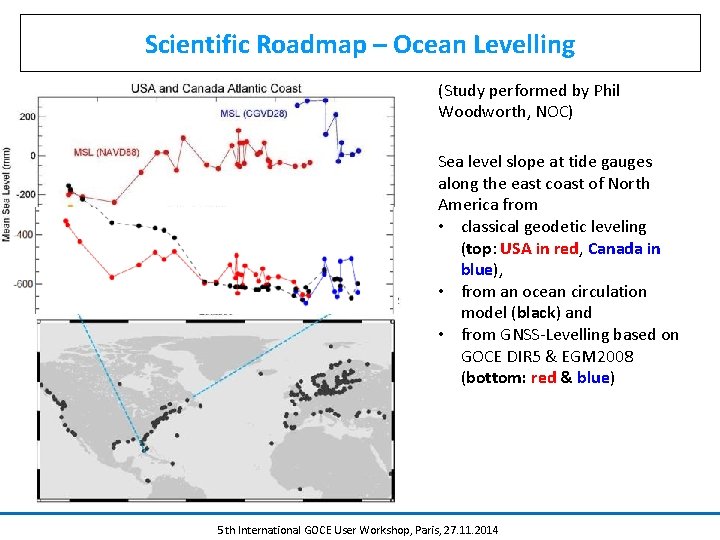
Scientific Roadmap – Ocean Levelling (Study performed by Phil Woodworth, NOC) Sea level slope at tide gauges along the east coast of North America from • classical geodetic leveling (top: USA in red, Canada in blue), • from an ocean circulation model (black) and • from GNSS-Levelling based on GOCE DIR 5 & EGM 2008 (bottom: red & blue) 5 th International GOCE User Workshop, Paris, 27. 11. 2014
Scientific Roadmap – Essential Tasks The geopotential and geoid improvements resulting from GOCE are the basis of a reassessment of global height systems Global Height System Unification Realization of a globally unified height system but confined to a global set of primary stations (national datum points, fundamental stations, primary tide gauges, primary clocks). Well Surveyed Areas (Land) Regional geoid based on GOCE model. Establishment of national or regional height systems at primary points (first and second order) based on the technique of “GNSS-leveling”. Diagnosis of existing height systems by comparison with GOCE geoid (100 km) Realization of a globally consistent model of mean dynamic ocean topography at tide gauges and at sea. Open Oceans and Coastal Zones 5 th International GOCE User Workshop, Paris, 27. 11. 2014
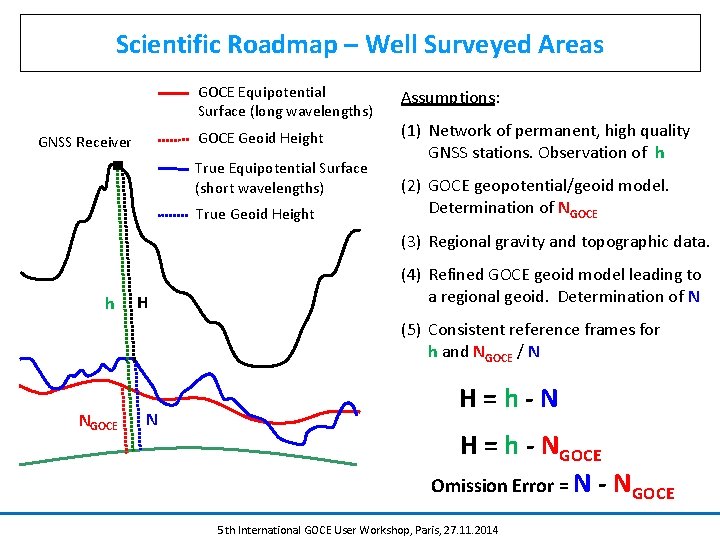
Scientific Roadmap – Well Surveyed Areas GOCE Equipotential Surface (long wavelengths) GOCE Geoid Height GNSS Receiver True Equipotential Surface (short wavelengths) True Geoid Height Assumptions: (1) Network of permanent, high quality GNSS stations. Observation of h (2) GOCE geopotential/geoid model. Determination of NGOCE (3) Regional gravity and topographic data. h H (4) Refined GOCE geoid model leading to a regional geoid. Determination of N (5) Consistent reference frames for h and NGOCE / N NGOCE N H=h-N H = h - NGOCE Omission Error = N - NGOCE 5 th International GOCE User Workshop, Paris, 27. 11. 2014
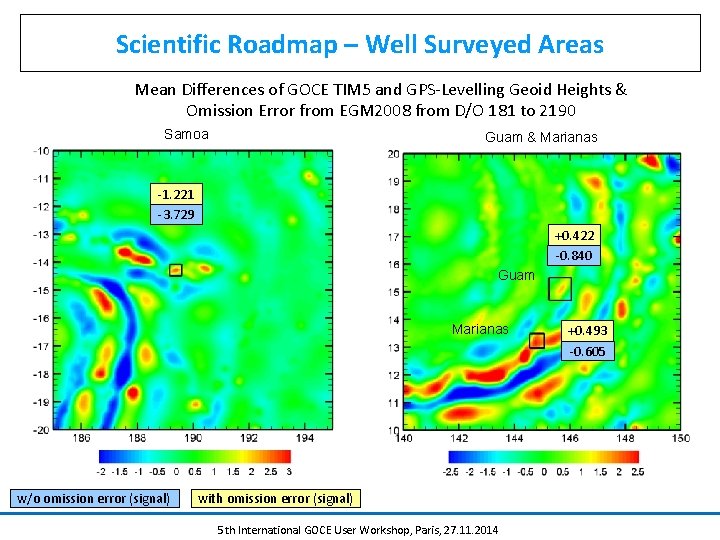
Scientific Roadmap – Well Surveyed Areas Mean Differences of GOCE TIM 5 and GPS-Levelling Geoid Heights & Omission Error from EGM 2008 from D/O 181 to 2190 Samoa Guam & Marianas -1. 221 -3. 729 +0. 422 -0. 840 Guam Marianas w/o omission error (signal) with omission error (signal) 5 th International GOCE User Workshop, Paris, 27. 11. 2014 +0. 493 -0. 605
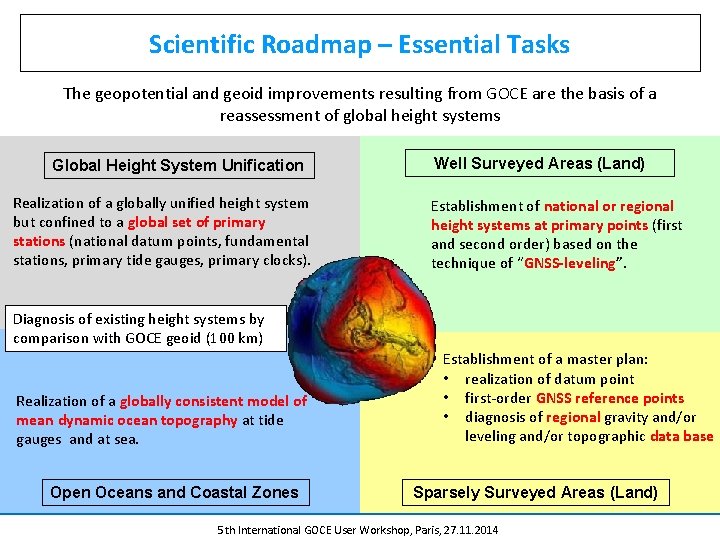
Scientific Roadmap – Essential Tasks The geopotential and geoid improvements resulting from GOCE are the basis of a reassessment of global height systems Global Height System Unification Realization of a globally unified height system but confined to a global set of primary stations (national datum points, fundamental stations, primary tide gauges, primary clocks). Well Surveyed Areas (Land) Establishment of national or regional height systems at primary points (first and second order) based on the technique of “GNSS-leveling”. Diagnosis of existing height systems by comparison with GOCE geoid (100 km) Realization of a globally consistent model of mean dynamic ocean topography at tide gauges and at sea. Open Oceans and Coastal Zones Establishment of a master plan: • realization of datum point • first-order GNSS reference points • diagnosis of regional gravity and/or leveling and/or topographic data base Sparsely Surveyed Areas (Land) 5 th International GOCE User Workshop, Paris, 27. 11. 2014
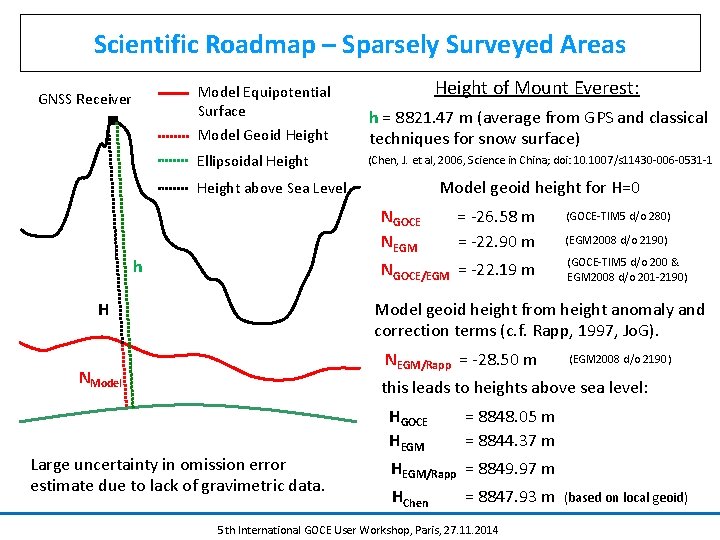
Scientific Roadmap – Sparsely Surveyed Areas GNSS Receiver Height of Mount Everest: Model Equipotential Surface Model Geoid Height h = 8821. 47 m (average from GPS and classical techniques for snow surface) Ellipsoidal Height (Chen, J. et al, 2006, Science in China; doi: 10. 1007/s 11430 -006 -0531 -1 Model geoid height for H=0 Height above Sea Level NGOCE NEGM h = -26. 58 m = -22. 90 m NGOCE/EGM = -22. 19 m H (GOCE-TIM 5 d/o 280) (EGM 2008 d/o 2190) (GOCE-TIM 5 d/o 200 & EGM 2008 d/o 201 -2190) Model geoid height from height anomaly and correction terms (c. f. Rapp, 1997, Jo. G). NEGM/Rapp = -28. 50 m NModel (EGM 2008 d/o 2190) this leads to heights above sea level: Large uncertainty in omission error estimate due to lack of gravimetric data. HGOCE HEGM = 8848. 05 m = 8844. 37 m HEGM/Rapp = 8849. 97 m HChen = 8847. 93 m 5 th International GOCE User Workshop, Paris, 27. 11. 2014 (based on local geoid)
Conclusions Ø The GOCE geoid represents a reference for global and regional height systems with unprecedented spatial resolution. Ø GOCE enables the diagnosis of systematic distortions in existing height systems. Ø GOCE enables global height system unification if the omission error at height reference stations can be quantified. Ø The GOCE geoid supports results obtained from ocean models at tide gauges. Ø GOCE supports GNSS/Levelling. § In well surveyed areas a GOCE based regional geoid and consistent reference frames shall be used. § In sparsely surveyed areas the GOCE geoid in many cases represents the best possible reference surface. Data for regional geoid modelling have to be acquired. 5 th International GOCE User Workshop, Paris, 27. 11. 2014
Final Remark Project results are available at the following web-site: http: //www. goceplushsu. eu 5 th International GOCE User Workshop, Paris, 27. 11. 2014