
Scientific Revolution Astronomy captures the imagination Copernicus to
- Slides: 13
Scientific Revolution Astronomy captures the imagination Copernicus to Newton Thesis: Describe the new astronomy of the sixteenth and seventeenth centuries and analyze the ways in which it changed scientific thought and methods.
16 th and 17 th Century • Sweeping change in the view of the universe – Led to change in moral and religious matters • Change in the method of science – New knowledge and new science • New inventions – Telescope, microscope • Is this a revolution in science (Scientific revolution? )
Was it a Revolution? • Normal definition rapid, collective change involving large numbers of people • It was a complex movement – Not rapid – Many ideas • Medicine, chemistry, natural history and astronomy – False starts – Involved new and old ideas and different parts of society
• Nicolaus Copernicus 1473 -1543 • Tycho Brahe 1546 -1601 • Johannes Kepler 1571 -1630 • Galileo Galilei 1564 -1642 • Isaac Newton 1642 -1727
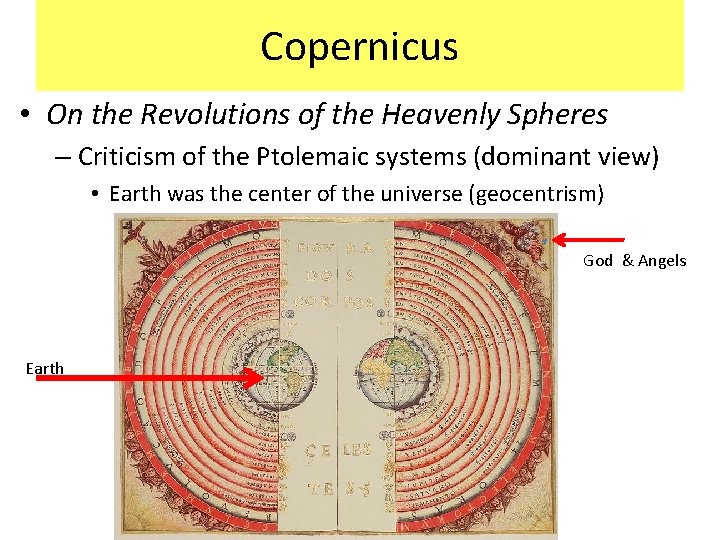
Copernicus • On the Revolutions of the Heavenly Spheres – Criticism of the Ptolemaic systems (dominant view) • Earth was the center of the universe (geocentrism) God & Angels Earth
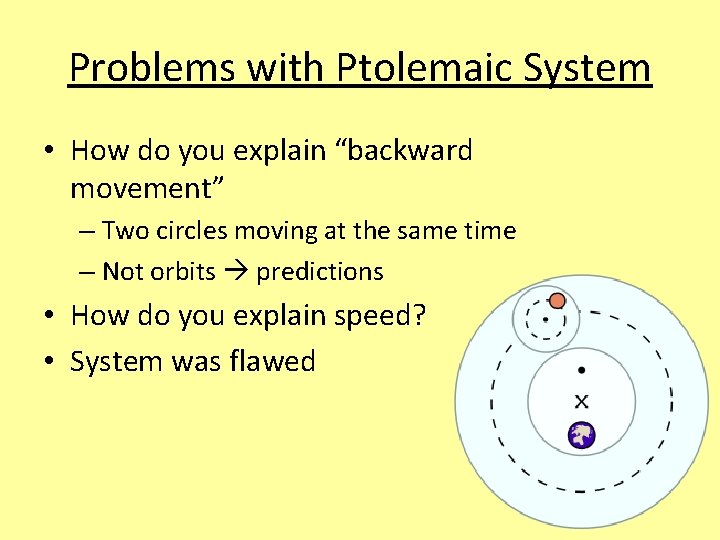
Problems with Ptolemaic System • How do you explain “backward movement” – Two circles moving at the same time – Not orbits predictions • How do you explain speed? • System was flawed
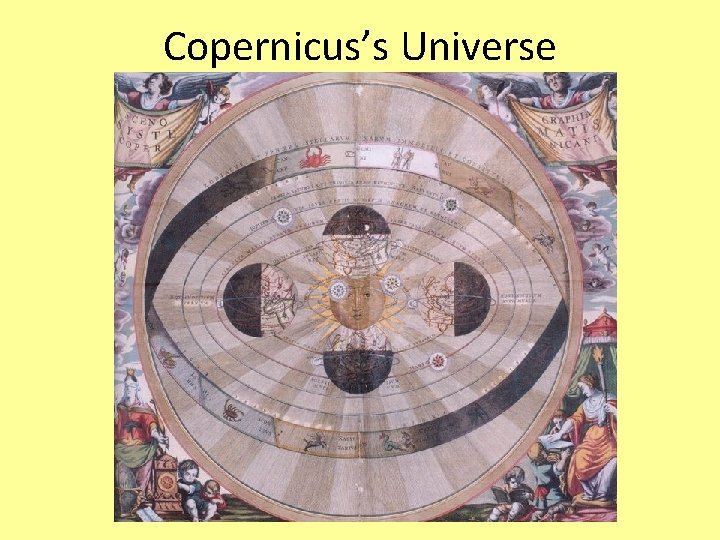
Copernicus’s Universe
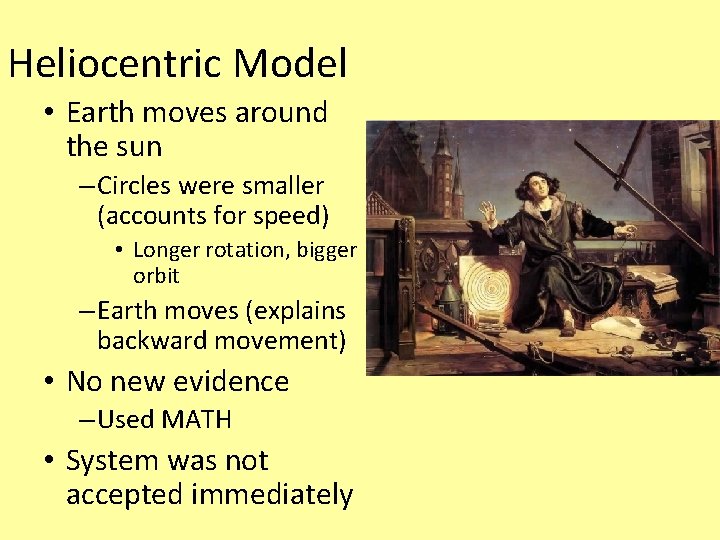
Heliocentric Model • Earth moves around the sun – Circles were smaller (accounts for speed) • Longer rotation, bigger orbit – Earth moves (explains backward movement) • No new evidence – Used MATH • System was not accepted immediately
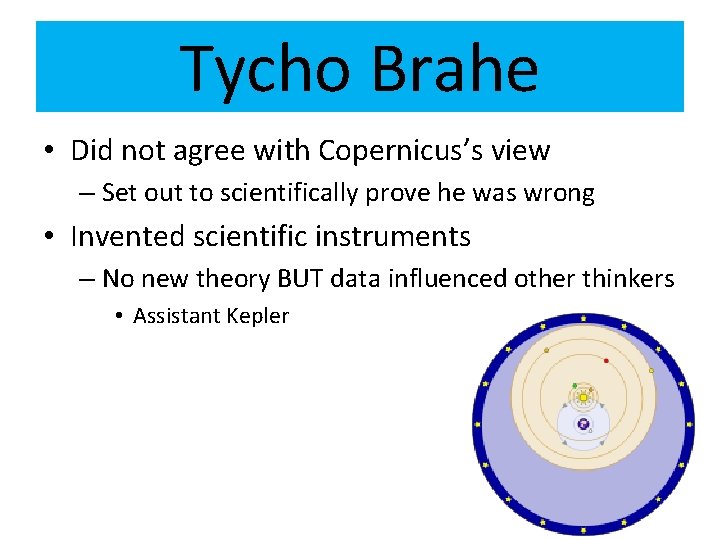
Tycho Brahe • Did not agree with Copernicus’s view – Set out to scientifically prove he was wrong • Invented scientific instruments – No new theory BUT data influenced other thinkers • Assistant Kepler
Johannes Kepler • Rigorous support of heliocentric theory – Epicycles vs. elliptical • The New Astronomy – Elliptical orbits around the sun – Did not answer • Why elliptical? • Why orbits? – Later answered by Newton
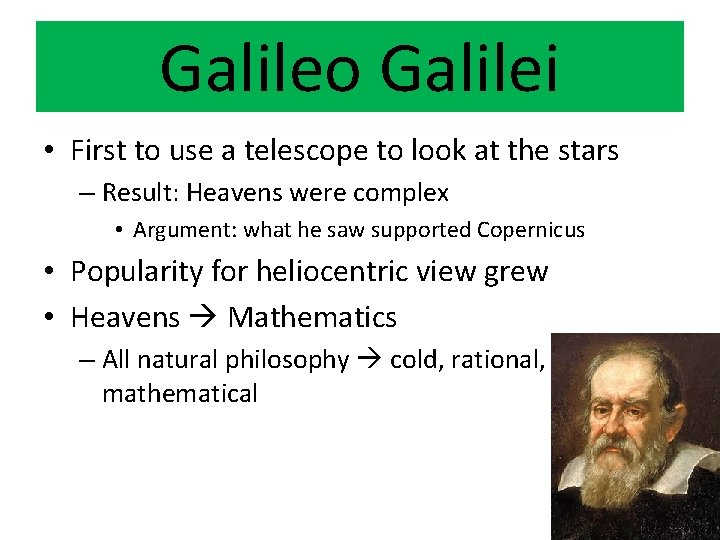
Galileo Galilei • First to use a telescope to look at the stars – Result: Heavens were complex • Argument: what he saw supported Copernicus • Popularity for heliocentric view grew • Heavens Mathematics – All natural philosophy cold, rational, mathematical
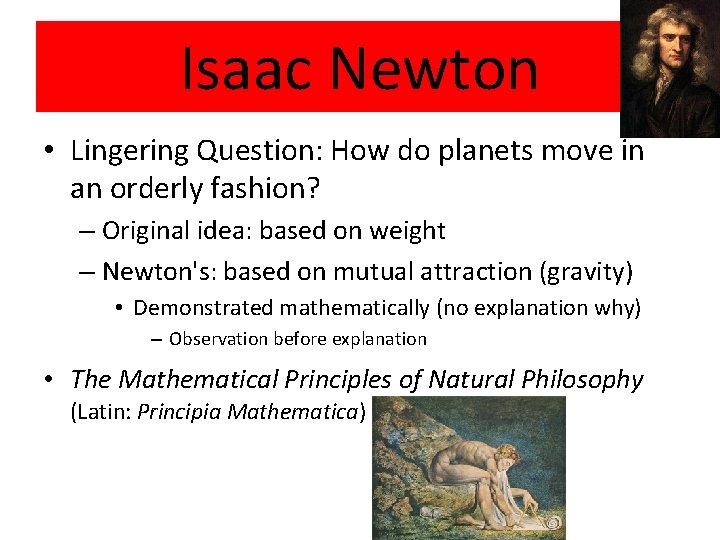
Isaac Newton • Lingering Question: How do planets move in an orderly fashion? – Original idea: based on weight – Newton's: based on mutual attraction (gravity) • Demonstrated mathematically (no explanation why) – Observation before explanation • The Mathematical Principles of Natural Philosophy (Latin: Principia Mathematica)
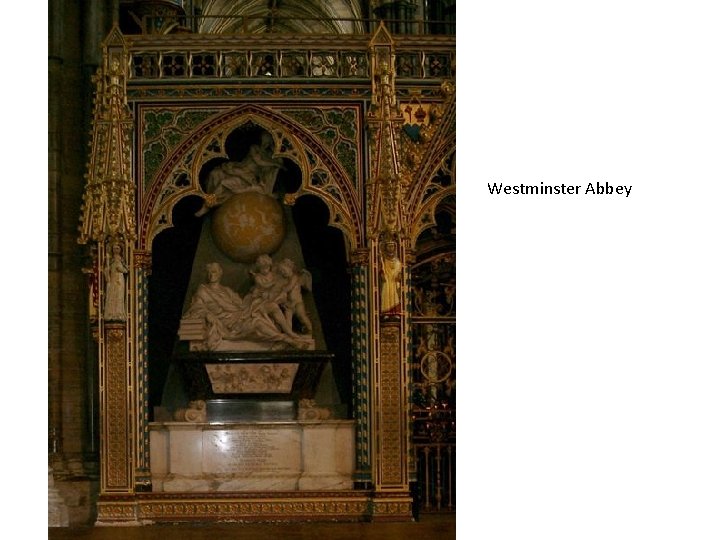
Westminster Abbey