
Scientific Revolution and the Age of Enlightenment Renaissance
- Slides: 6
Scientific Revolution and the Age of Enlightenment
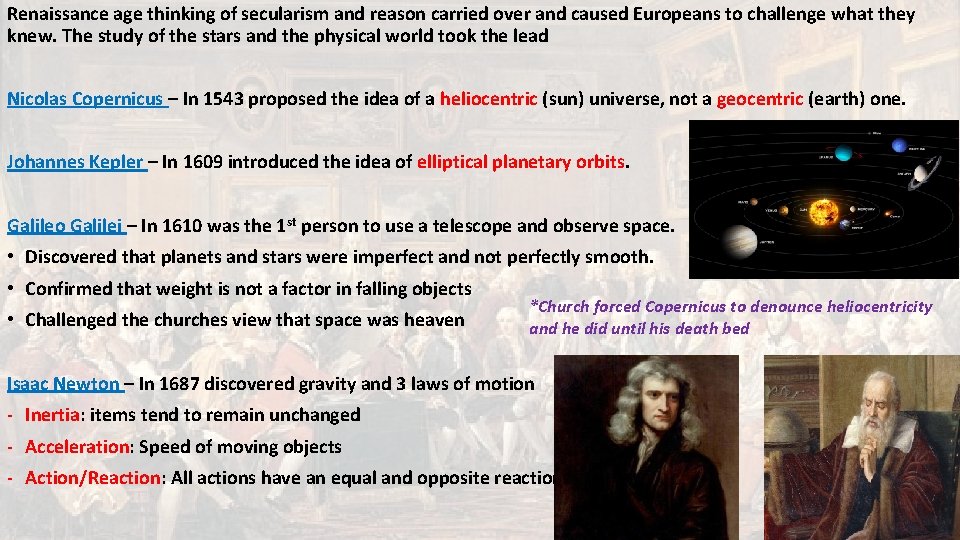
Renaissance age thinking of secularism and reason carried over and caused Europeans to challenge what they knew. The study of the stars and the physical world took the lead Nicolas Copernicus – In 1543 proposed the idea of a heliocentric (sun) universe, not a geocentric (earth) one. Johannes Kepler – In 1609 introduced the idea of elliptical planetary orbits. Galileo Galilei – In 1610 was the 1 st person to use a telescope and observe space. • Discovered that planets and stars were imperfect and not perfectly smooth. • Confirmed that weight is not a factor in falling objects • Challenged the churches view that space was heaven *Church forced Copernicus to denounce heliocentricity and he did until his death bed Isaac Newton – In 1687 discovered gravity and 3 laws of motion - Inertia: items tend to remain unchanged - Acceleration: Speed of moving objects - Action/Reaction: All actions have an equal and opposite reaction
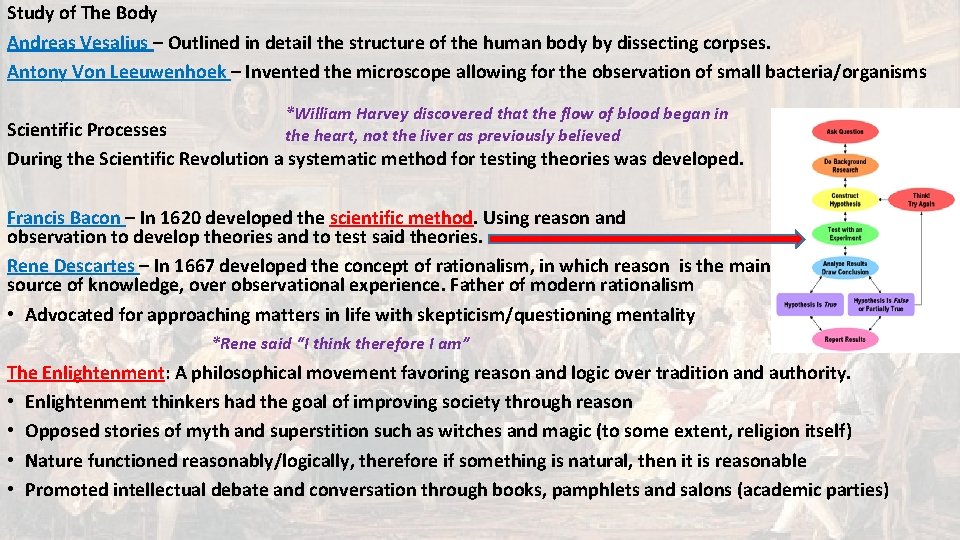
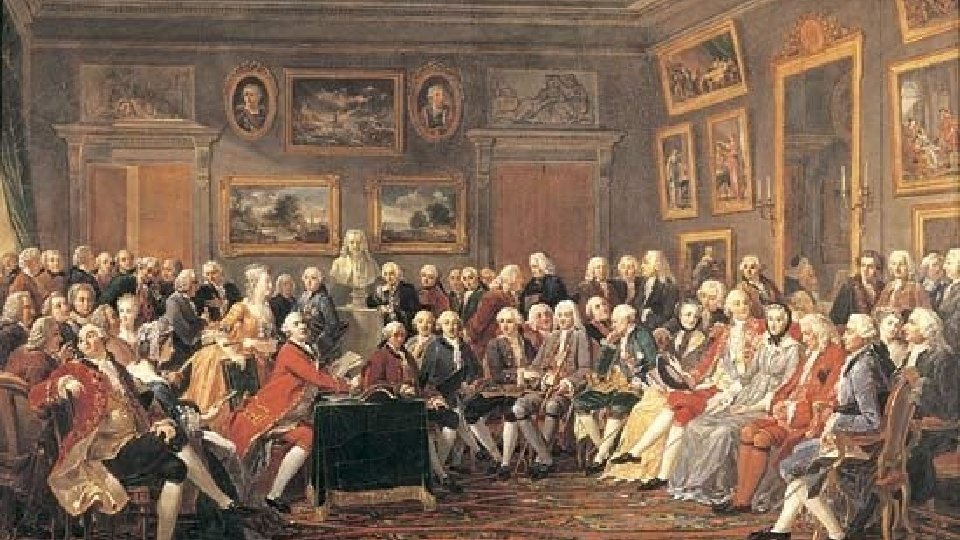
Study of The Body Andreas Vesalius – Outlined in detail the structure of the human body by dissecting corpses. Antony Von Leeuwenhoek – Invented the microscope allowing for the observation of small bacteria/organisms *William Harvey discovered that the flow of blood began in the heart, not the liver as previously believed Scientific Processes During the Scientific Revolution a systematic method for testing theories was developed. Francis Bacon – In 1620 developed the scientific method. Using reason and observation to develop theories and to test said theories. Rene Descartes – In 1667 developed the concept of rationalism, in which reason is the main source of knowledge, over observational experience. Father of modern rationalism • Advocated for approaching matters in life with skepticism/questioning mentality *Rene said “I think therefore I am” The Enlightenment: A philosophical movement favoring reason and logic over tradition and authority. • Enlightenment thinkers had the goal of improving society through reason • Opposed stories of myth and superstition such as witches and magic (to some extent, religion itself) • Nature functioned reasonably/logically, therefore if something is natural, then it is reasonable • Promoted intellectual debate and conversation through books, pamphlets and salons (academic parties)
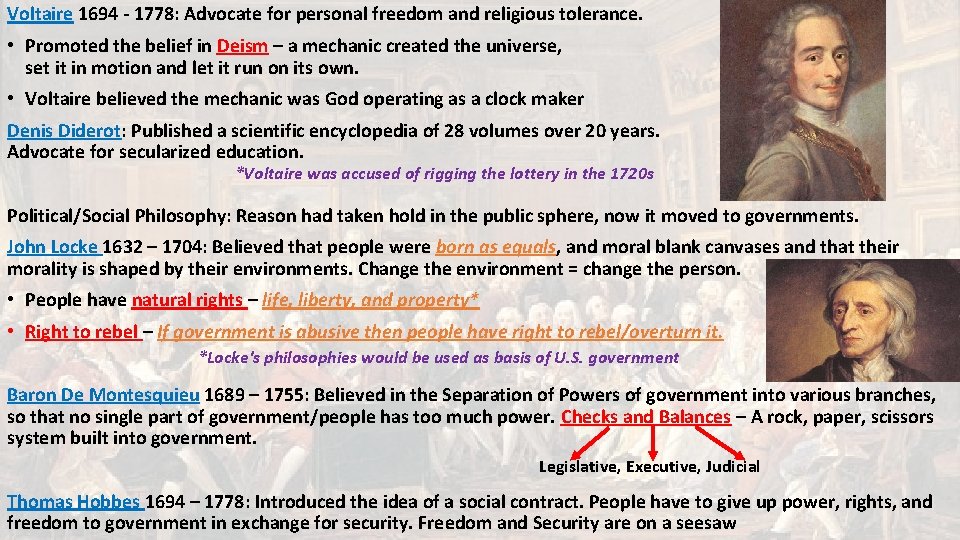
Voltaire 1694 - 1778: Advocate for personal freedom and religious tolerance. • Promoted the belief in Deism – a mechanic created the universe, set it in motion and let it run on its own. • Voltaire believed the mechanic was God operating as a clock maker Denis Diderot: Published a scientific encyclopedia of 28 volumes over 20 years. Advocate for secularized education. *Voltaire was accused of rigging the lottery in the 1720 s Political/Social Philosophy: Reason had taken hold in the public sphere, now it moved to governments. John Locke 1632 – 1704: Believed that people were born as equals, and moral blank canvases and that their morality is shaped by their environments. Change the environment = change the person. • People have natural rights – life, liberty, and property* • Right to rebel – If government is abusive then people have right to rebel/overturn it. *Locke's philosophies would be used as basis of U. S. government Baron De Montesquieu 1689 – 1755: Believed in the Separation of Powers of government into various branches, so that no single part of government/people has too much power. Checks and Balances – A rock, paper, scissors system built into government. Legislative, Executive, Judicial Thomas Hobbes 1694 – 1778: Introduced the idea of a social contract. People have to give up power, rights, and freedom to government in exchange for security. Freedom and Security are on a seesaw
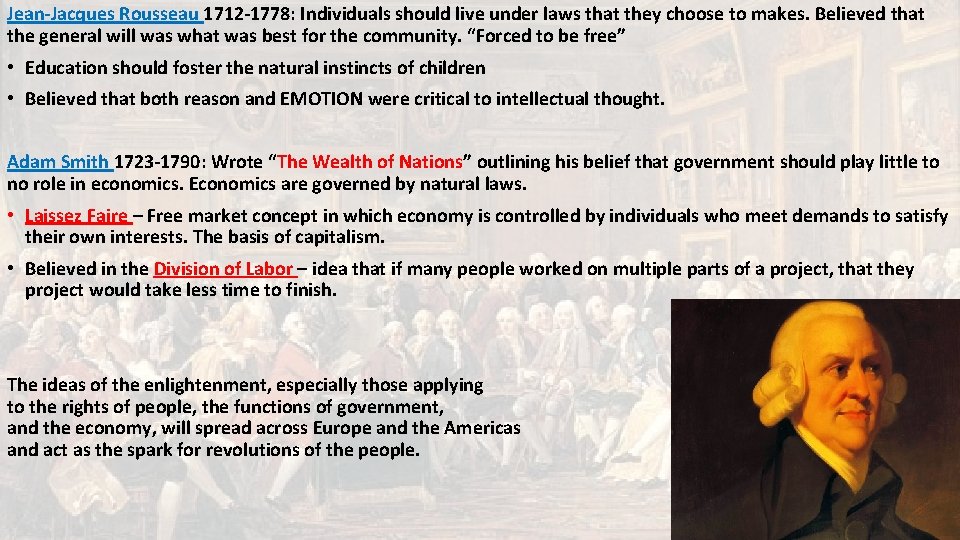
Jean-Jacques Rousseau 1712 -1778: Individuals should live under laws that they choose to makes. Believed that the general will was what was best for the community. “Forced to be free” • Education should foster the natural instincts of children • Believed that both reason and EMOTION were critical to intellectual thought. Adam Smith 1723 -1790: Wrote “The Wealth of Nations” outlining his belief that government should play little to no role in economics. Economics are governed by natural laws. • Laissez Faire – Free market concept in which economy is controlled by individuals who meet demands to satisfy their own interests. The basis of capitalism. • Believed in the Division of Labor – idea that if many people worked on multiple parts of a project, that they project would take less time to finish. The ideas of the enlightenment, especially those applying to the rights of people, the functions of government, and the economy, will spread across Europe and the Americas and act as the spark for revolutions of the people.