
Scientific Reasoning Forensic Science The Cycle of Science
- Slides: 7
Scientific Reasoning Forensic Science
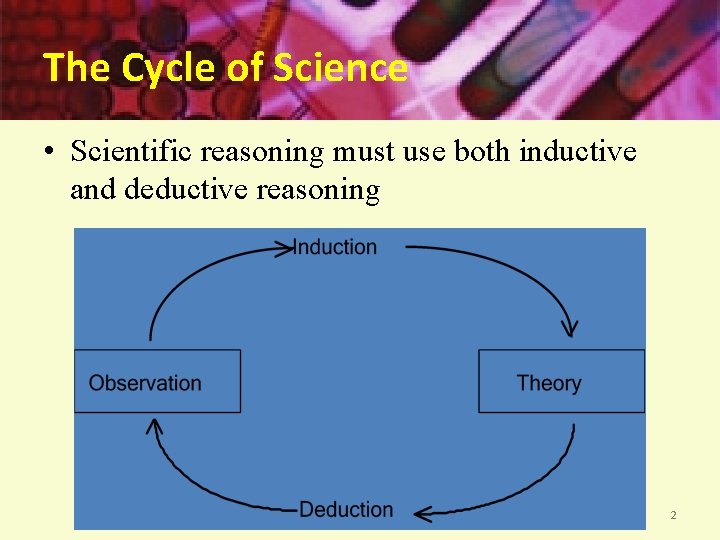
The Cycle of Science • Scientific reasoning must use both inductive and deductive reasoning Copyright © Texas Education Agency 2011. All rights reserved. Images and other multimedia content used with permission. 2
The Cycle of Science (continued) • Inductive reasoning – moving from specific observations to broader generalizations and theories – Begins with specific observations and measurements – Then formulate a hypothesis that can be explored – Finally develop some general conclusions or theories Copyright © Texas Education Agency 2011. All rights reserved. Images and other multimedia content used with permission. 3
The Cycle of Science (continued) • A few episodes of a particular sitcom make you laugh • You conclude that the sitcom is very funny. Copyright © Texas Education Agency 2011. All rights reserved. Images and other multimedia content used with permission. 4
The Cycle of Science (continued) • Deductive reasoning – works from general to specific – Begin with creating a theory about a topic of interest – Narrow that down into a more specific hypothesis that we can test – Narrow that down even further when we collect observations to address the hypothesis – Test the hypothesis with specific data Copyright © Texas Education Agency 2011. All rights reserved. Images and other multimedia content used with permission. 5
The Cycle of Science (continued) • An example of a deductive argument: – All men are mortal. – Johnny is a man. – Therefore, Johnny is mortal. • The first premise states that all objects classified as "men" have the attribute "mortal". • The second premise states that “Johnny" is classified as a "man" – a member of the set "men". • The conclusion then states that “Johnny" must be "mortal" because he inherits this attribute from his classification as a "man". Copyright © Texas Education Agency 2011. All rights reserved. Images and other multimedia content used with permission. 6
Observation • Observations are recorded facts about what you see • There are two types of observations – Quantitative – results in a numerical form, with a unit – Qualitative – results in a descriptive form Copyright © Texas Education Agency 2011. All rights reserved. Images and other multimedia content used with permission. 7