
Scientific Process Basic Steps The Cricket Experiment Definition

Scientific Process Basic Steps (The Cricket Experiment)
Definition ►Scientific process (method): basic steps that scientists follow in uncovering facts and solving scientific problems
Basic Parts of Scientific Process ► Make an Observation ► Ask a Question and gather information ► Make a Hypothesis (educated guess) ► Design the experiment ► Perform the experiment ► Collect data and results (charts, graphs) ► Analyze data and state conclusions ► Share results

Make an Observation ►On several hikes into the forest you come across the same noisy cricket. ►Howevery time you hear it, it is chirping at different rates. ► 6 am Slow ► 2 pm Fast ► 8 pm Medium
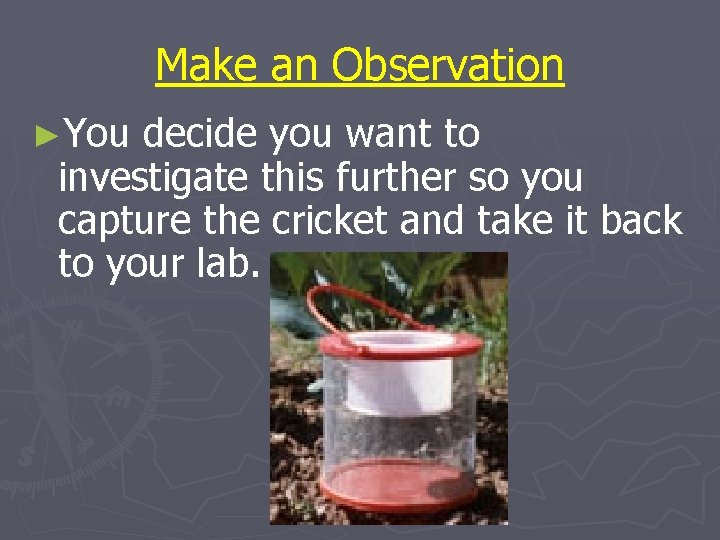
Make an Observation ►You decide you want to investigate this further so you capture the cricket and take it back to your lab.

Ask a Question and gather information ► Why are the chirps faster and slower on different days and at different times? Information Only male crickets chirp. They do so by rubbing one wing against the other, or by rubbing their legs against their wings. 2. Crickets have several chirp patterns. The one we usually hear is the “calling song” used by males to attract females. 1.
Hypothesis ►Should be in the If…. then…format. ►If the temperature changes then the crickets chirping rate will change according to the temperature change.
Design the Experiment ► You recreate the lab conditions to match the field conditions. § § Atmospheric Pressure 760 mm Humidity 15% Nearby Crickets 5 Wind Speed 2 m/sec This is the control group- there are no experimental changes. ► You will change the temperature during your experiments. This is the independent variable. ►
Design the Experiment ► The number of chirps with each experiment will be the dependant variable.
Recap ► Control Group- the group that receives no experimental treatment ► Experimental Group- the group that receives the experimental treatment. ► Variable- what is being changed. ► Independent Variable- what is being manipulated or variable changed (cause). ► Dependent Variable- the variable that is being measured (effect).
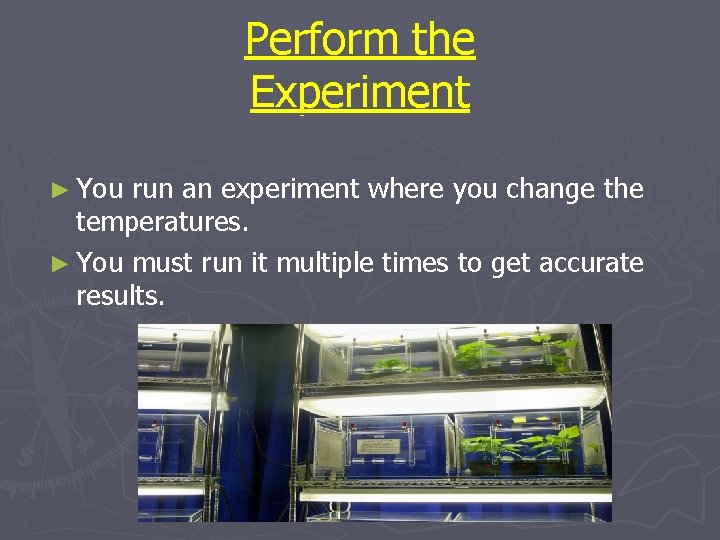
Perform the Experiment ► You run an experiment where you change the temperatures. ► You must run it multiple times to get accurate results.
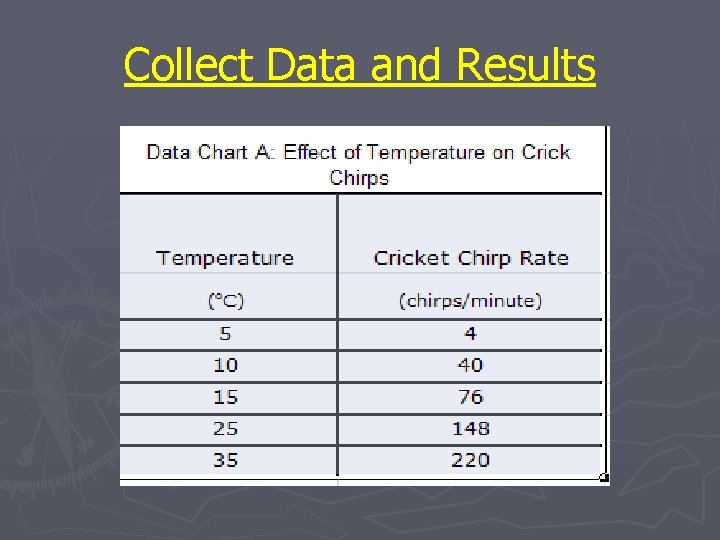
Collect Data and Results
Analyze Data and Results and State Conclusions ►You can make 2 conclusions about the data that you collect from experiment. § 1. It supports your hypothesis § 2. It does not support your hypothesis. ►Data concludes that it is indeed the temperature that effects the chirps per minute in a cricket.
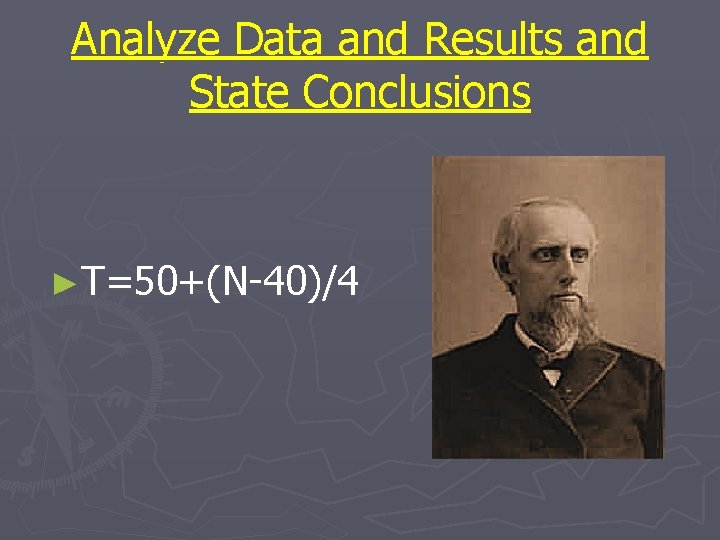
Analyze Data and Results and State Conclusions ►T=50+(N-40)/4
Share Results ►You would then share your results with the scientific community or your classroom. ► If your hypothesis is well tested it becomes a theory. ►If it gets tested over and over again and is not contradicted it
Share Results ►Theory- set of related hypothesis that have been tested and confirmed many times by many scientists. ►Law- Statement that summarizes a pattern found in nature. It is tested over and over again and has not been contradicted.
- Slides: 16