
Scientific Name Pisum sativum L Chromosome No 14
- Slides: 18
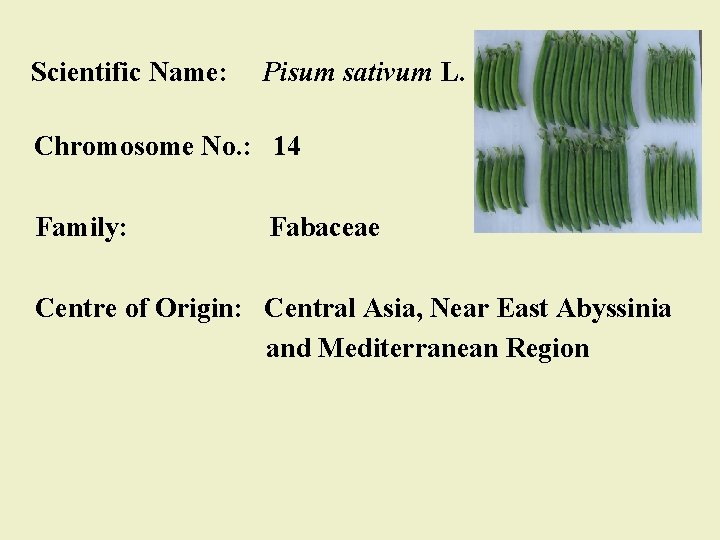
Scientific Name: Pisum sativum L. Chromosome No. : 14 Family: Fabaceae Centre of Origin: Central Asia, Near East Abyssinia and Mediterranean Region
Importance • Pea is a nutritious vegetable rich in protein, amino acids, carbohydrates and sugars besides it also contain a higher proportion of mineral matter. • It is an excellent food for human consumption taken either as a vegetable or in soup, canned, frozen or dehydrated. It ranks next to tomato as a processed vegetable. • Being biological nitrogen fixing legume, its value has long been recognized for maintaining and restoring soil fertility, conservation and improvement of physical properties of the soil.
Area and distribution • At the global level, garden pea is cultivated over an area of 1, 164. 15 thousand hectares with the production of 9168. 67 thousand tonnes • It is a leading vegetable crop in the North-Western Himalayan region of India comprising the states of Himachal Pradesh, Jammu & Kashmir and Uttarakhand. • In India, it occupies an area of 370. 0 thousand hectares with the production of 3, 517. 0 thousand tonnes • In Himachal Pradesh garden pea occupies more than one-fourth of the total area under vegetable crops and ranks first in acreage of 22. 8 thousand hectares and annual production of 254. 2 thousand tonnes
Grouping of garden pea cultivars/ varieties • According to seed: i. Round / smooth seeded ii. Wrinkle seeded • According to plant height: i. Dwarf/ bush ii. Medium iii. Tall
• According to maturity: i. Early maturing: 65 -80 days ii. Medium season: 90 -100 days iii. Main season: 110 -120 days • According to use of pods: i. Fresh Market ii. Canning types iii. Dehydration types iv. Freezing types
Types of Pea • P. formosum : Perennial; mountainous regions of Caucasus and Persia • annual, yellow flowers; Asia minor and Syria P. fulvum: • P. sativum: annual, flowers white, violet, mountainous regions of Ethiopia, Egypt and some parts of Europe • P. sativum subsp. arvense includes both field pea and “Austrian” winter pea; both possess coloured flowers and variously pigmented seeds • P. sativum subsp. abyssinicum derived from Ethiopia and has narrow genetic base • P. humile early dwarf pea • P. sativum var. macrocarpon: edible podded/ snow pea (lack parchment layer, flat pods, has thin pericarp, broad in width and seeds are not allowed to develop ) • P. sativum var. sachharatum : sugar snap pea / snap pea (pods are like green bean with thick wall / pericarp and seeds are allowed to develop a bit only) • P. sativum var. umbellatum : crown / mummy pea ( very small pods)
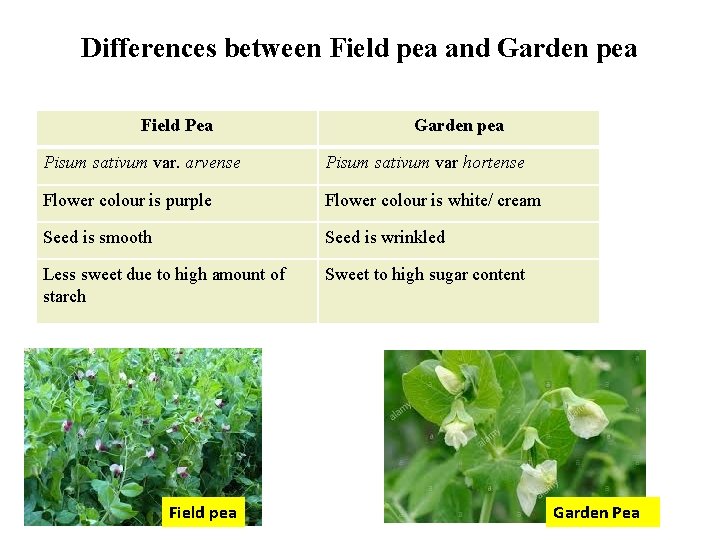
Differences between Field pea and Garden pea Field Pea Garden pea Pisum sativum var. arvense Pisum sativum var hortense Flower colour is purple Flower colour is white/ cream Seed is smooth Seed is wrinkled Less sweet due to high amount of starch Sweet to high sugar content Field pea Garden Pea
Climatic requirements • In contrast to beans peas are able to withstand low temperatures especially during the seedling stage • Flowers and young pods are badly affected by frost • Hot dry weather interferes with the setting of seed and quality • Peas grow best where there is slow transition from cool to warm weather in the spring • The seeds can germinate at a minimum temperature of 5°C and optimum being 22°C Pea is highly self–pollinated as it has Cleistogamous flower structure and thus has less than one percent out crossing
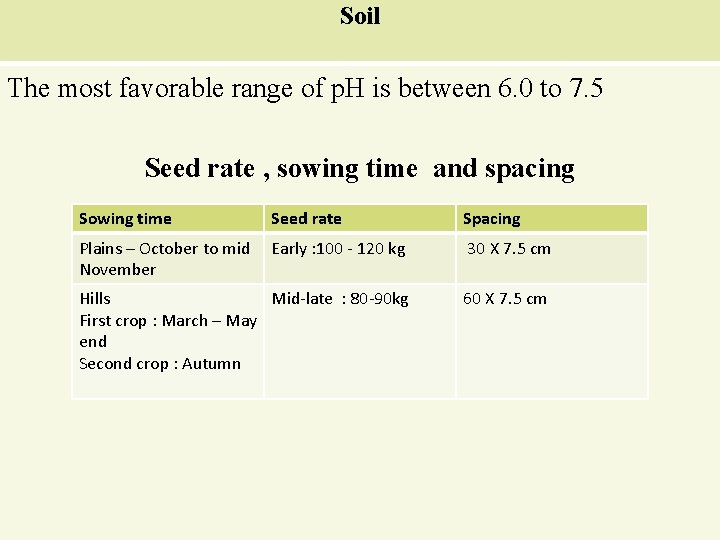
Soil The most favorable range of p. H is between 6. 0 to 7. 5 Seed rate , sowing time and spacing Sowing time Seed rate Spacing Plains – October to mid November Early : 100 - 120 kg 30 X 7. 5 cm Hills Mid-late : 80 -90 kg First crop : March – May end Second crop : Autumn 60 X 7. 5 cm
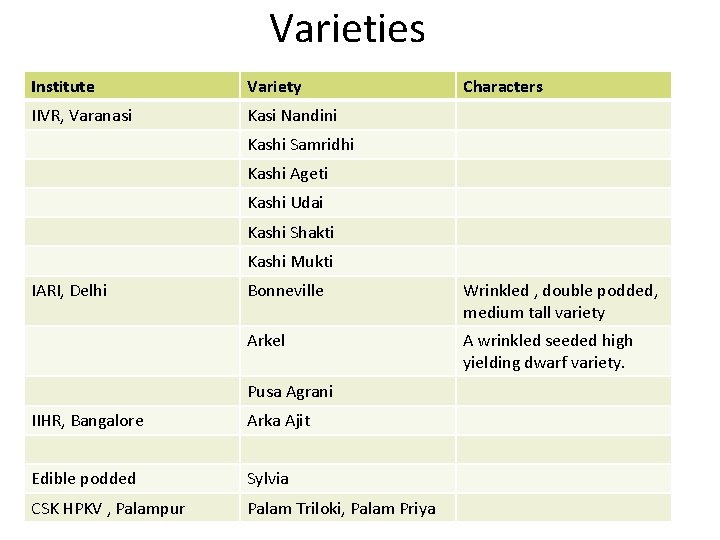
Varieties Institute Variety IIVR, Varanasi Kasi Nandini Characters Kashi Samridhi Kashi Ageti Kashi Udai Kashi Shakti Kashi Mukti IARI, Delhi Bonneville Wrinkled , double podded, medium tall variety Arkel A wrinkled seeded high yielding dwarf variety. Pusa Agrani IIHR, Bangalore Arka Ajit Edible podded Sylvia CSK HPKV , Palampur Palam Triloki, Palam Priya
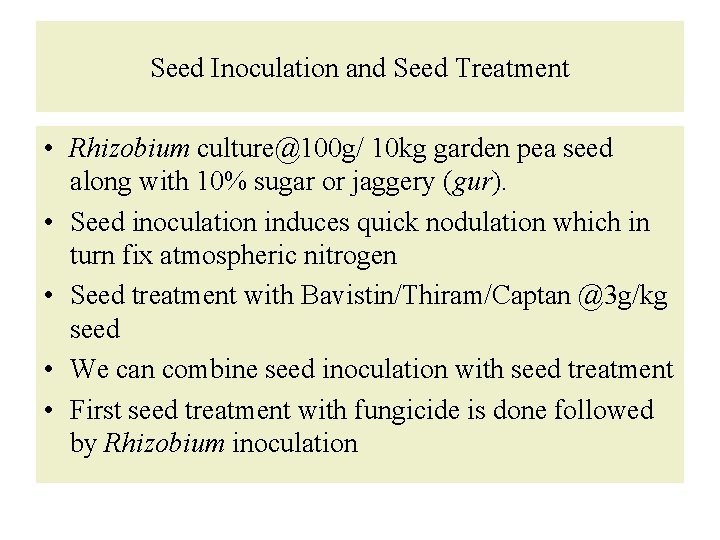
Seed Inoculation and Seed Treatment • Rhizobium culture@100 g/ 10 kg garden pea seed along with 10% sugar or jaggery (gur). • Seed inoculation induces quick nodulation which in turn fix atmospheric nitrogen • Seed treatment with Bavistin/Thiram/Captan @3 g/kg seed • We can combine seed inoculation with seed treatment • First seed treatment with fungicide is done followed by Rhizobium inoculation
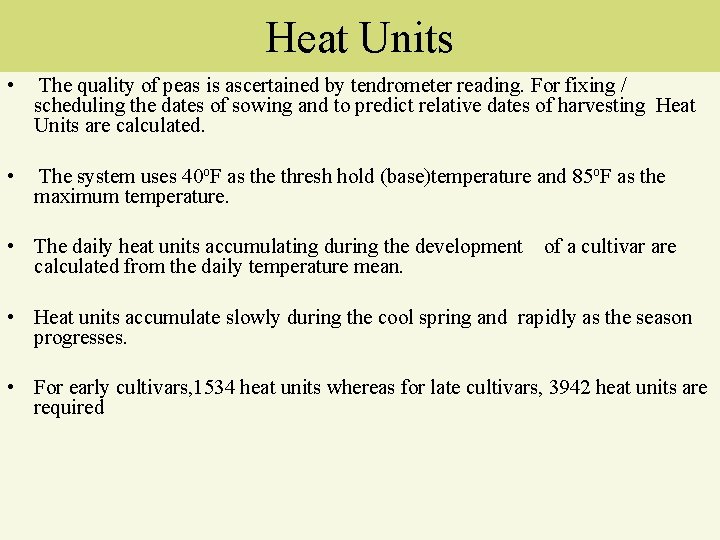
Heat Units • The quality of peas is ascertained by tendrometer reading. For fixing / scheduling the dates of sowing and to predict relative dates of harvesting Heat Units are calculated. • The system uses 40 o. F as the thresh hold (base)temperature and 85 o. F as the maximum temperature. • The daily heat units accumulating during the development of a cultivar are calculated from the daily temperature mean. • Heat units accumulate slowly during the cool spring and rapidly as the season progresses. • For early cultivars, 1534 heat units whereas for late cultivars, 3942 heat units are required
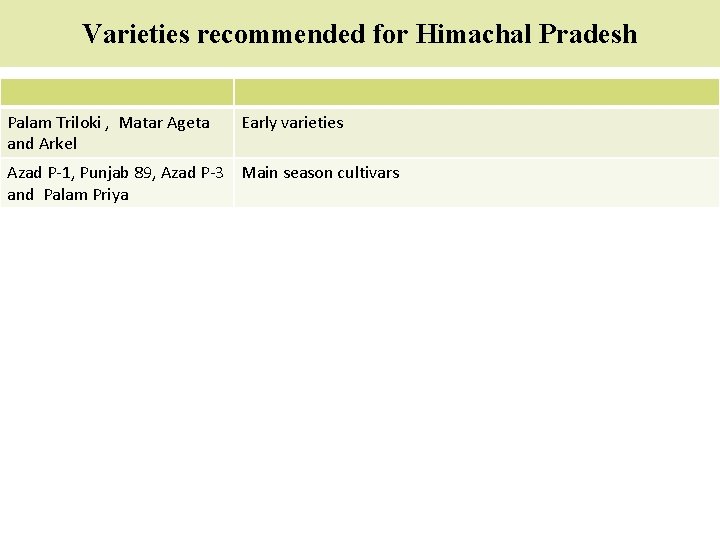
Varieties recommended for Himachal Pradesh Palam Triloki , Matar Ageta and Arkel Early varieties Azad P-1, Punjab 89, Azad P-3 Main season cultivars and Palam Priya
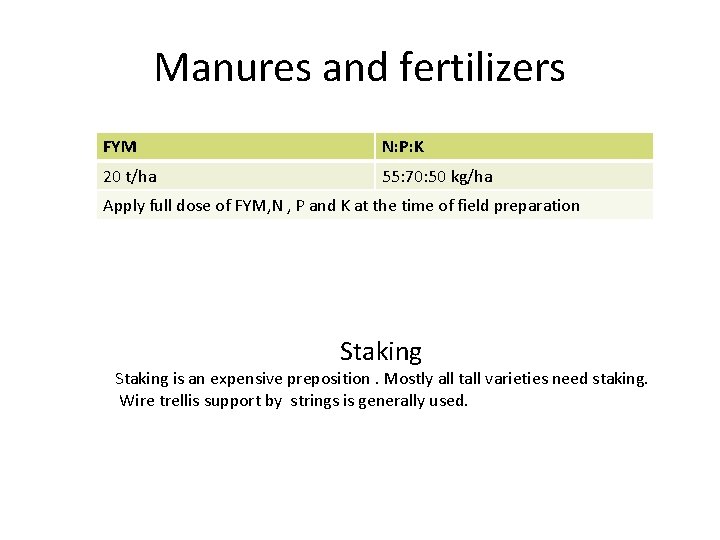
Manures and fertilizers FYM N: P: K 20 t/ha 55: 70: 50 kg/ha Apply full dose of FYM, N , P and K at the time of field preparation Staking is an expensive preposition. Mostly all tall varieties need staking. Wire trellis support by strings is generally used.
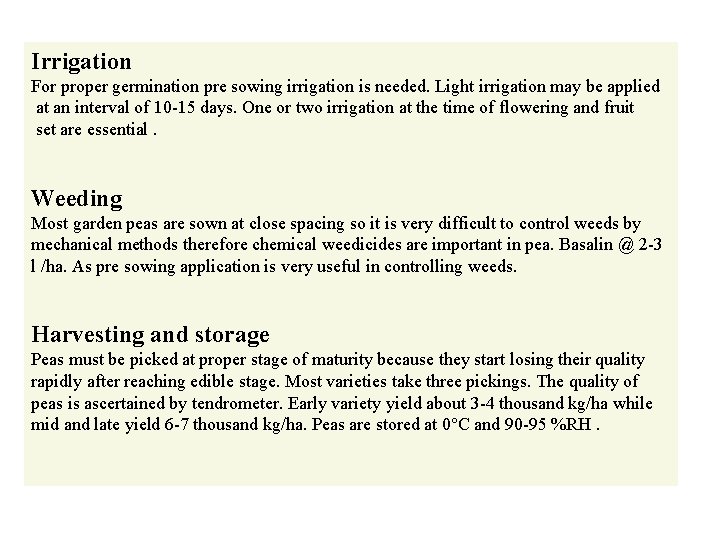
Irrigation For proper germination pre sowing irrigation is needed. Light irrigation may be applied at an interval of 10 -15 days. One or two irrigation at the time of flowering and fruit set are essential. Weeding Most garden peas are sown at close spacing so it is very difficult to control weeds by mechanical methods therefore chemical weedicides are important in pea. Basalin @ 2 -3 l /ha. As pre sowing application is very useful in controlling weeds. Harvesting and storage Peas must be picked at proper stage of maturity because they start losing their quality rapidly after reaching edible stage. Most varieties take three pickings. The quality of peas is ascertained by tendrometer. Early variety yield about 3 -4 thousand kg/ha while mid and late yield 6 -7 thousand kg/ha. Peas are stored at 0°C and 90 -95 %RH.
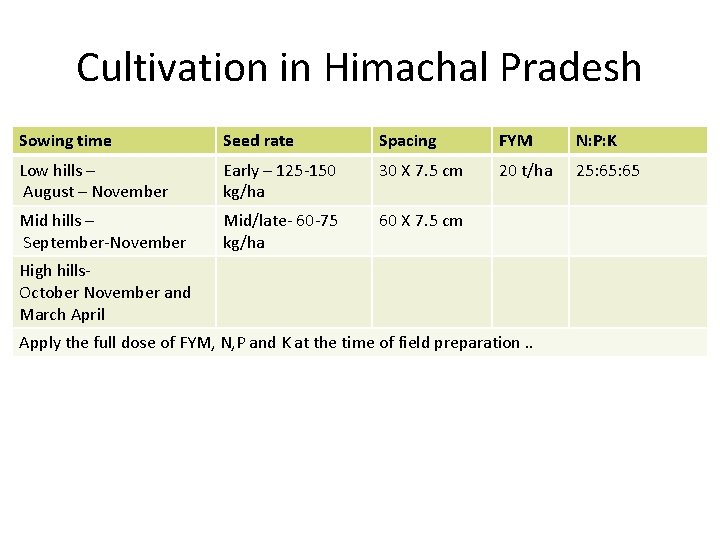
Cultivation in Himachal Pradesh Sowing time Seed rate Spacing FYM N: P: K Low hills – August – November Early – 125 -150 kg/ha 30 X 7. 5 cm 20 t/ha 25: 65 Mid hills – September-November Mid/late- 60 -75 kg/ha 60 X 7. 5 cm High hills. October November and March April Apply the full dose of FYM, N, P and K at the time of field preparation. .
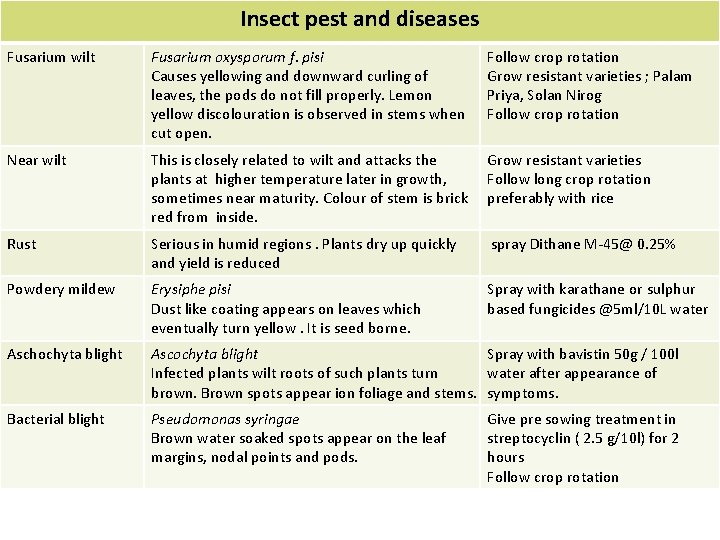
Insect pest and diseases Fusarium wilt Fusarium oxysporum f. pisi Causes yellowing and downward curling of leaves, the pods do not fill properly. Lemon yellow discolouration is observed in stems when cut open. Follow crop rotation Grow resistant varieties ; Palam Priya, Solan Nirog Follow crop rotation Near wilt This is closely related to wilt and attacks the plants at higher temperature later in growth, sometimes near maturity. Colour of stem is brick red from inside. Grow resistant varieties Follow long crop rotation preferably with rice Rust Serious in humid regions. Plants dry up quickly and yield is reduced spray Dithane M-45@ 0. 25% Powdery mildew Erysiphe pisi Dust like coating appears on leaves which eventually turn yellow. It is seed borne. Spray with karathane or sulphur based fungicides @5 ml/10 L water Aschochyta blight Ascochyta blight Spray with bavistin 50 g / 100 l Infected plants wilt roots of such plants turn water after appearance of brown. Brown spots appear ion foliage and stems. symptoms. Bacterial blight Pseudomonas syringae Brown water soaked spots appear on the leaf margins, nodal points and pods. Give pre sowing treatment in streptocyclin ( 2. 5 g/10 l) for 2 hours Follow crop rotation
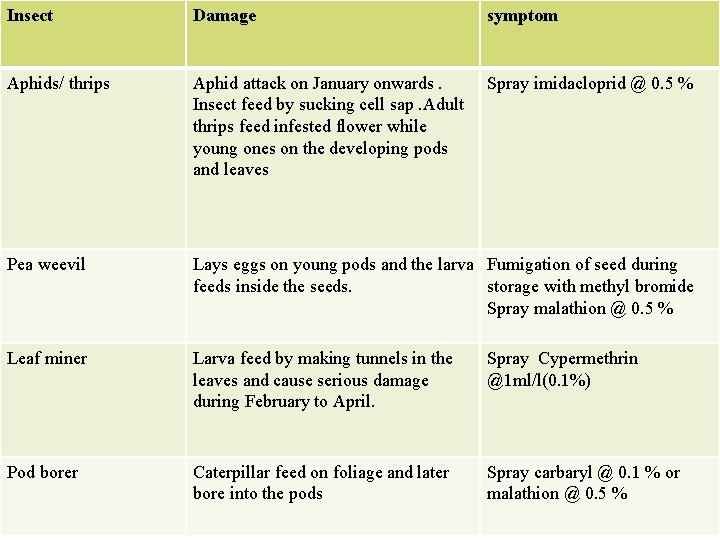
Insect Damage symptom Aphids/ thrips Aphid attack on January onwards. Insect feed by sucking cell sap. Adult thrips feed infested flower while young ones on the developing pods and leaves Spray imidacloprid @ 0. 5 % Pea weevil Lays eggs on young pods and the larva Fumigation of seed during feeds inside the seeds. storage with methyl bromide Spray malathion @ 0. 5 % Leaf miner Larva feed by making tunnels in the leaves and cause serious damage during February to April. Spray Cypermethrin @1 ml/l(0. 1%) Pod borer Caterpillar feed on foliage and later bore into the pods Spray carbaryl @ 0. 1 % or malathion @ 0. 5 %