
SCIENTIFIC MODELS SC 7 N 1 5 DESCRIBE
SCIENTIFIC MODELS SC. 7. N. 1. 5 DESCRIBE THE METHODS USED IN THE PURSUIT OF A SCIENTIFIC EXPLANATION AS SEEN IN DIFFERENT FIELDS OF SCIENCE SUCH AS BIOLOGY, GEOLOGY, AND PHYSICS. SC. 7. N. 3. 2 IDENTIFY THE BENEFITS AND LIMITATIONS OF THE USE OF SCIENTIFIC MODELS. ESSENTIAL QUESTION: What are the benefits and limitations of scientific models that can be used to represent data gathered from experiments and investigations?
BELLRINGER Francesca creates a model that shows the movements of the tectonic plates of Earth’s surface. If she wants to use the model to understand the concept of how a mountain is formed, how does that model help her? A. It shows all of the plates in there correct layout. B. It explains in detail how mountains are formed. C. It displays details that cannot be seen in a drawing. D. It speeds up a process that takes millions of years.

I DO GUIDED NOTES

WHAT ARE SCIENTIFIC MODELS? Models are a representation or description designed to make a particular part/feature of the world easier to understand, define, quantify, visualize, or simulate by using multiple forms of data. Models help us understand. Explain or analyze concepts. Represent things too small or too large. Explain past or the present; predict the future.
SCIENTISTS DEVELOP MODELS ABOUT MANY DIFFERENT NATURAL Proton particles in light. PHENOMENA Weather systems How muscles move – like when you shoot a basketball How dinosaurs behaved on the planet before humans When earthquakes hit or volcanoes erupt How different ecosystems work – deserts, oceans,
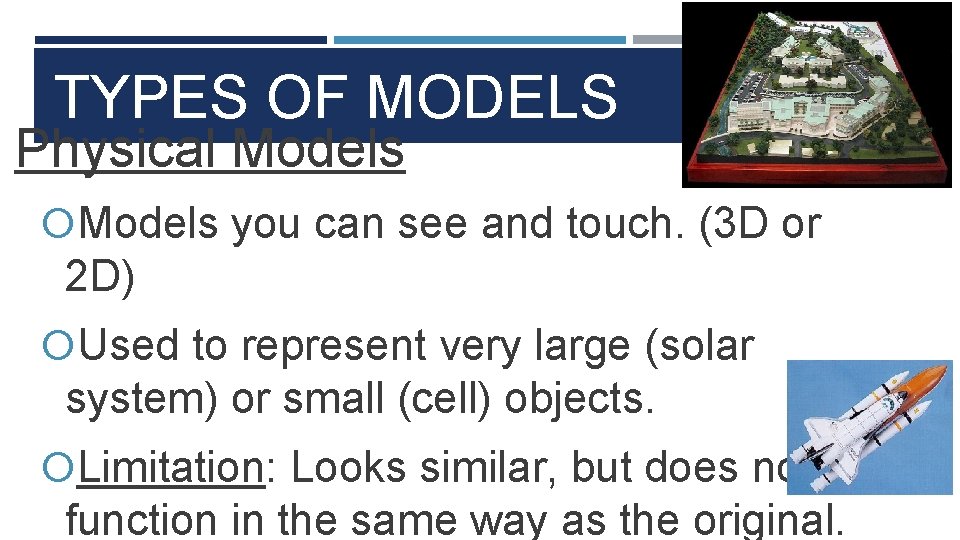
TYPES OF MODELS Physical Models you can see and touch. (3 D or 2 D) Used to represent very large (solar system) or small (cell) objects. Limitation: Looks similar, but does not function in the same way as the original.
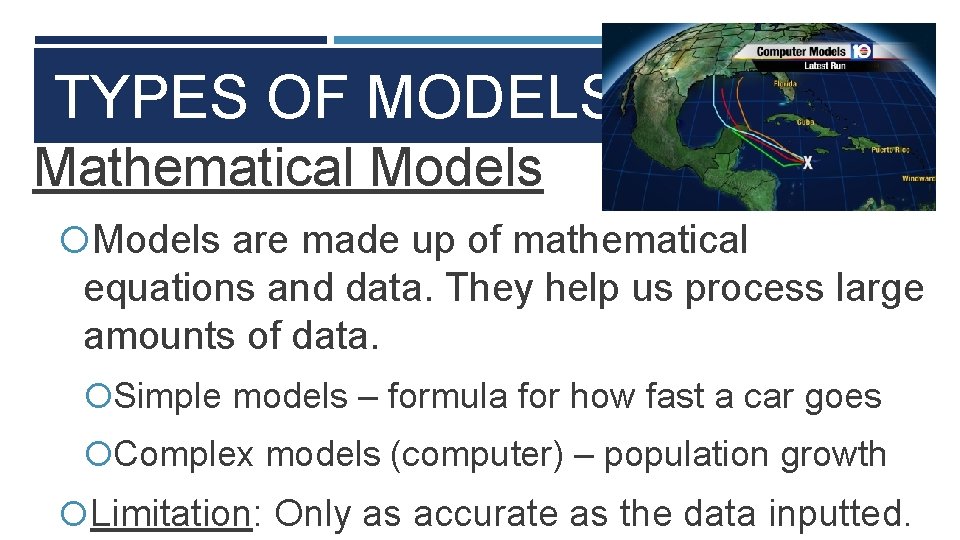
TYPES OF MODELS Mathematical Models are made up of mathematical equations and data. They help us process large amounts of data. Simple models – formula for how fast a car goes Complex models (computer) – population growth Limitation: Only as accurate as the data inputted.
TYPES OF MODELS Conceptual (Diagram) Models Used to understand large and complex processes and how they work. Carbon Cycle Diagram Plate Tectonics Map Water Cycle Diagram Limitations: Gives limited information, shown in 2 D.
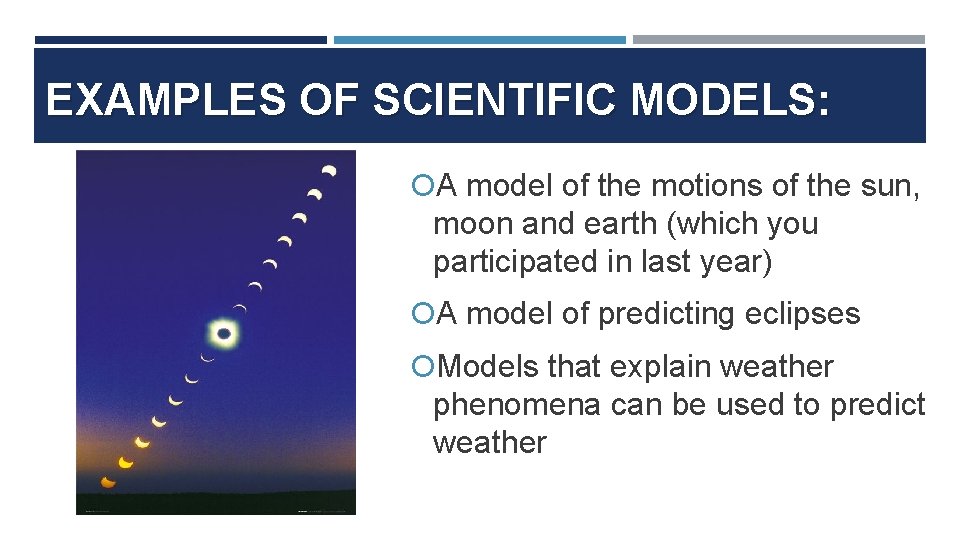
EXAMPLES OF SCIENTIFIC MODELS: A model of the motions of the sun, moon and earth (which you participated in last year) A model of predicting eclipses Models that explain weather phenomena can be used to predict weather

WE DO COLLABORATIVE ACTIVITY
BELLRINGER Francesca creates a model that shows the movements of the tectonic plates of Earth’s surface. If she wants to use the model to understand the concept of how a mountain is formed, how does that model help her? A. It shows all of the plates in there correct layout. B. It explains in detail how mountains are formed. C. It displays details that cannot be seen in a drawing. D. It speeds up a process that takes millions of years. *
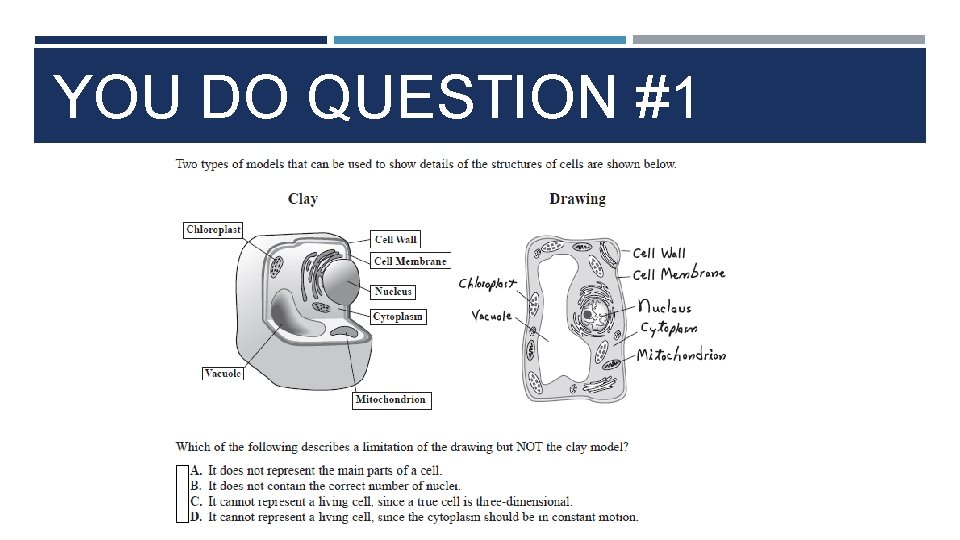
YOU DO QUESTION #1
YOU DO QUESTION #2 A group of scientists has been asked to conduct a study on how an oil spill will affect the surrounding sea life. The scientists decide that the best way to complete the study is to create a model. Which of the following is the most likely reason that the scientists will use a model instead of creating an actual oil spill study? a) They think using a model will provide them with more accurate results. b) They can study the effects of an oil spill without harming surrounding sea life. c) They can use different species that the plants and animals found in the real ecosystem. d) They expect the oil spill in their model to have a much greater effect than an oil spill in the natural environment.
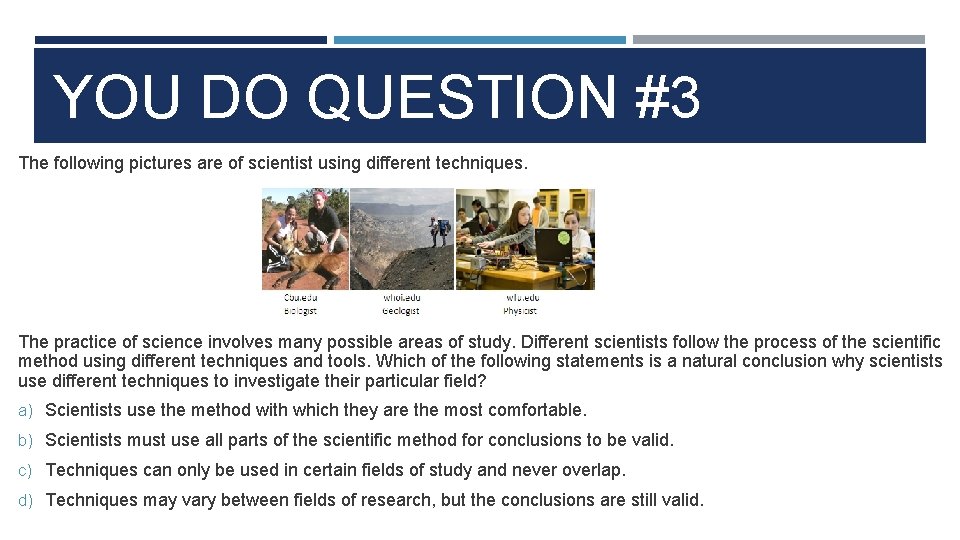
YOU DO QUESTION #3 The following pictures are of scientist using different techniques. The practice of science involves many possible areas of study. Different scientists follow the process of the scientific method using different techniques and tools. Which of the following statements is a natural conclusion why scientists use different techniques to investigate their particular field? a) Scientists use the method with which they are the most comfortable. b) Scientists must use all parts of the scientific method for conclusions to be valid. c) Techniques can only be used in certain fields of study and never overlap. d) Techniques may vary between fields of research, but the conclusions are still valid.
- Slides: 14