
Scientific Methods The scientific method is A series
- Slides: 14
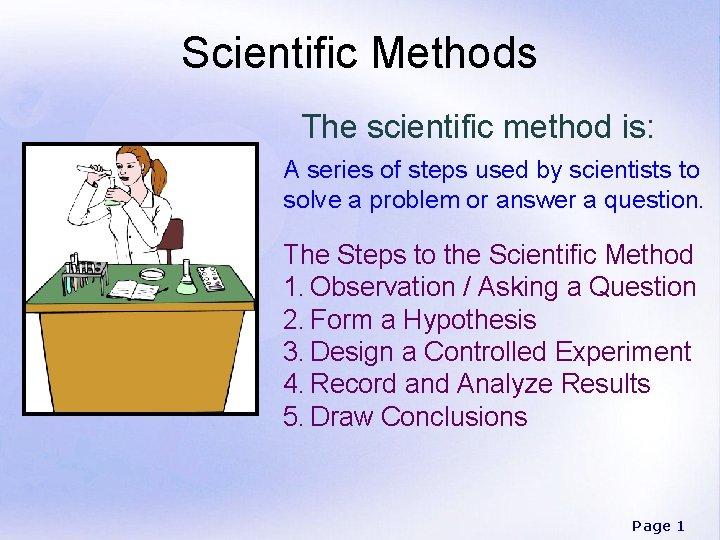
Scientific Methods The scientific method is: A series of steps used by scientists to solve a problem or answer a question. The Steps to the Scientific Method 1. Observation / Asking a Question 2. Form a Hypothesis 3. Design a Controlled Experiment 4. Record and Analyze Results 5. Draw Conclusions Page 1
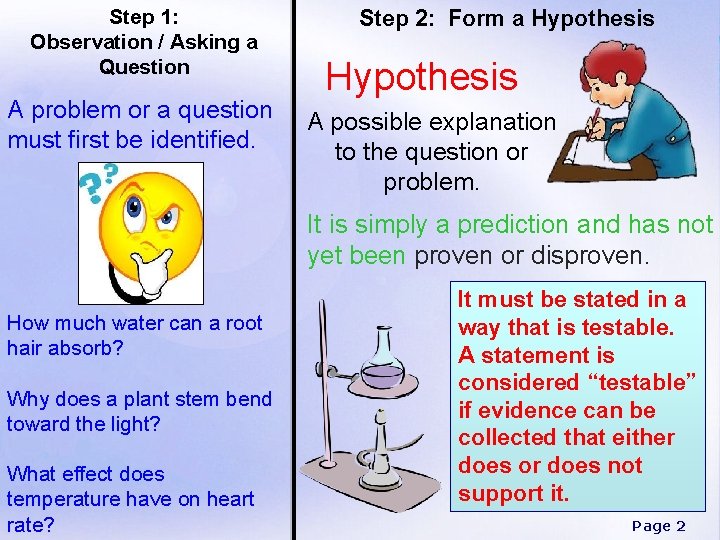
Step 1: Observation / Asking a Question A problem or a question must first be identified. Step 2: Form a Hypothesis A possible explanation to the question or problem. It is simply a prediction and has not yet been proven or disproven. How much water can a root hair absorb? Why does a plant stem bend toward the light? What effect does temperature have on heart rate? It must be stated in a way that is testable. A statement is considered “testable” if evidence can be collected that either does or does not support it. Page 2
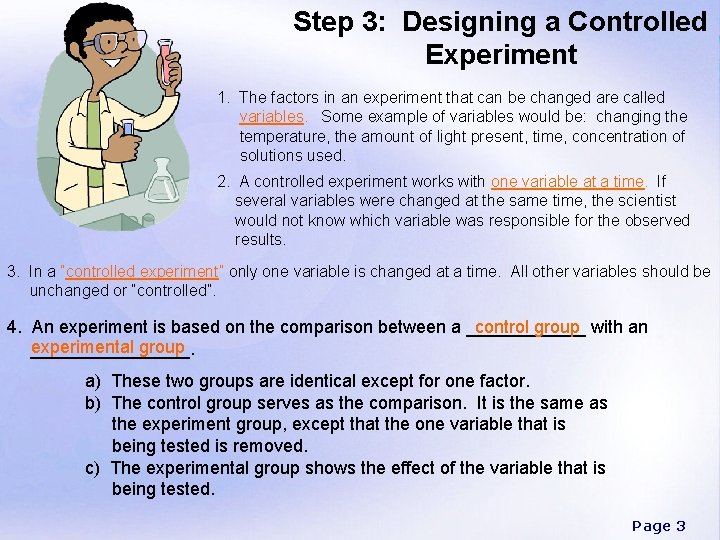
Step 3: Designing a Controlled Experiment 1. The factors in an experiment that can be changed are called variables. Some example of variables would be: changing the temperature, the amount of light present, time, concentration of solutions used. 2. A controlled experiment works with one variable at a time. If several variables were changed at the same time, the scientist would not know which variable was responsible for the observed results. 3. In a “controlled experiment” only one variable is changed at a time. All other variables should be unchanged or “controlled”. 4. An experiment is based on the comparison between a ______ control group with an experimental group ________. a) These two groups are identical except for one factor. b) The control group serves as the comparison. It is the same as the experiment group, except that the one variable that is being tested is removed. c) The experimental group shows the effect of the variable that is being tested. Page 3
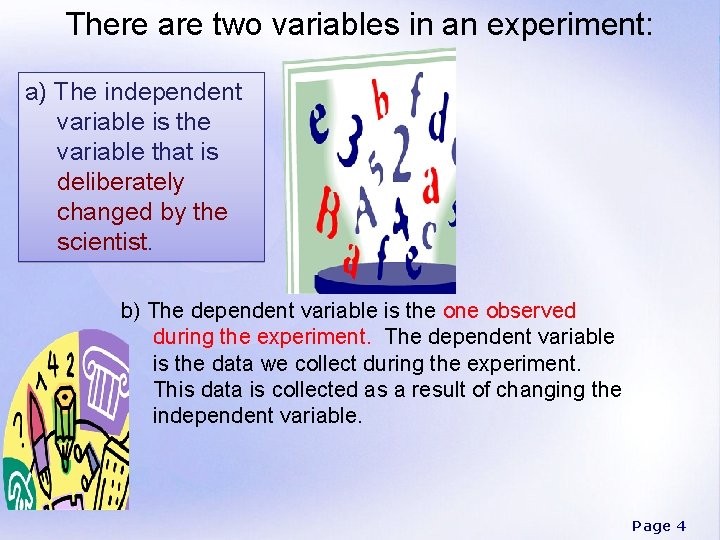
There are two variables in an experiment: a) The independent variable is the variable that is deliberately changed by the scientist. b) The dependent variable is the one observed during the experiment. The dependent variable is the data we collect during the experiment. This data is collected as a result of changing the independent variable. Page 4
Step 4: Recording and Analyzing Results 1. The data that has been collected must be organized analyzed to determine whether the data are reliable. 2. Does the data support or not support the hypothesis? Page 5
Step 5: Drawing Conclusions The evidence from the experiment is used to determine if the hypothesis is proven or disproven. Experiments must be repeated over and over. When repeated, the results should always be the same before a valid conclusion can be reached. Page 6
Forming a Theory A theory may be formed after the hypothesis has been tested many times and is supported by much evidence. Theory: A broad and comprehensive statement of what is thought to be true. A theory is supported by considerable evidence. Page 7
Analysis Questions Why is it important to have a large sample size in any experiment? It is important to test a large sample in order to get a true picture of the results of the experiment. If the sample size is too small, an inaccurate conclusion may be reached. Results obtained by testing a large number of individuals would be much more accurate than if only a few individuals had been tested. Page 8
Analysis Questions Why is it important to repeat the experiment many times? Experiments should be repeated to see if the same results are obtained each time. This gives validity to the test results. Page 9
Analysis Questions What is the importance of the control? The control shows what will happen when the experimental factor is omitted. Without the control, there would be no basis for comparison and you would not know how the experimental factor affected the results. Page 10
Analysis Questions How is a theory different than a hypothesis? A hypothesis is an “educated guess” that is testable through observations and experimentation. A theory is a broad statement of what is believed to be true based on many experiments and considerable amounts of data. Page 11
Analysis Questions Why is it so important that a scientist accurately describes the procedure used in the experiment? It allows other scientists to repeat the experiment and verify the results. Page 12
Analysis Questions What is the difference between the independent and the dependent variables in an experiment? The independent variable is the variable that is deliberately changed by the scientist. The dependent variable is the one observed during the experiment. The dependent variable is the data we collect during the experiment. Page 13
Analysis Questions In a “controlled experiment”, why must all of the variables, except one, be kept constant throughout the experiment? If several variables were changed at the same time, the scientist would not know which variable was responsible for the observed results. Page 14