
Scientific Method What is the Scientific Method The
- Slides: 11
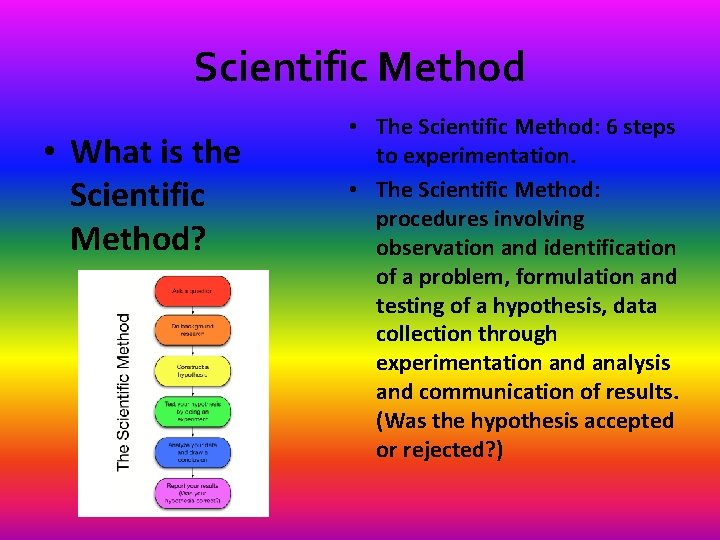
Scientific Method • What is the Scientific Method? • The Scientific Method: 6 steps to experimentation. • The Scientific Method: procedures involving observation and identification of a problem, formulation and testing of a hypothesis, data collection through experimentation and analysis and communication of results. (Was the hypothesis accepted or rejected? )
Step 1 - Ask question • Ask a question/purpose • Purpose: pick a topic that interests you. • Question: Put your topic into a question that will be answered by research. This is also called “writing a problem”.
Step 2 - Research • Research • What do you already know about the topic? Do you need to find more info? • How do I write a problem? • Should be written in the form of a question. • Open-ended (cannot answer with a yes or no) • Can be based on research, the results of a previous experiment, or observations of the world around you.
Step 2 - Research • Observations • Qualitative – Using your senses to make an appropriate description of an object. Qualitative observations are general in nature. • Quantitative – Observations involving the measurement of quantity or an amount. Specific in nature.
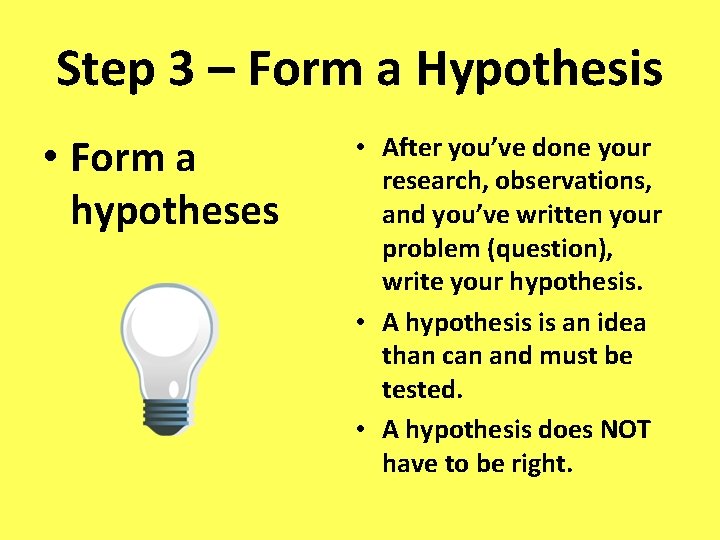
Step 3 – Form a Hypothesis • Form a hypotheses • After you’ve done your research, observations, and you’ve written your problem (question), write your hypothesis. • A hypothesis is an idea than can and must be tested. • A hypothesis does NOT have to be right.
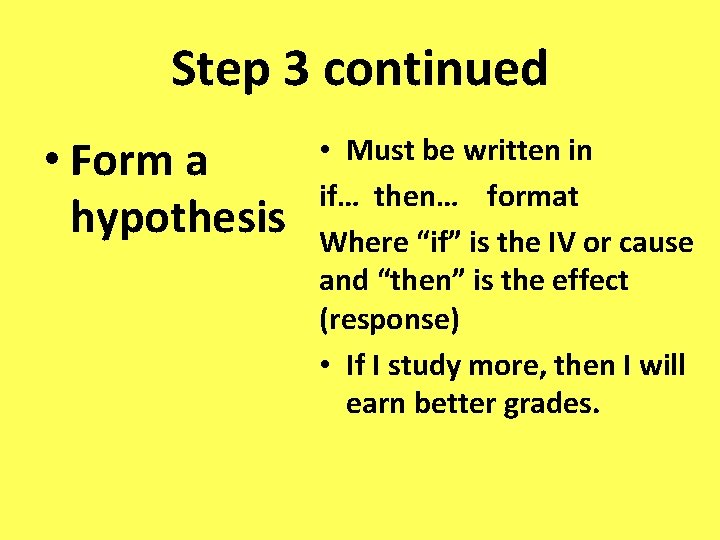
Step 3 continued • Form a hypothesis • Must be written in if… then… format Where “if” is the IV or cause and “then” is the effect (response) • If I study more, then I will earn better grades.
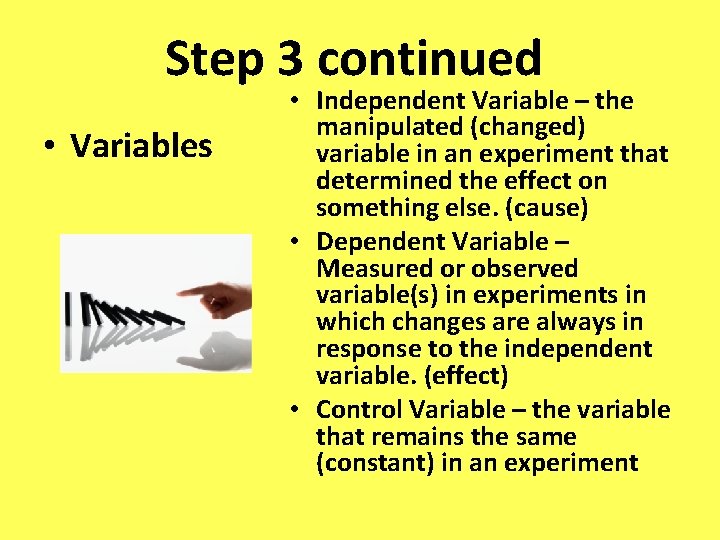
Step 3 continued • Variables • Independent Variable – the manipulated (changed) variable in an experiment that determined the effect on something else. (cause) • Dependent Variable – Measured or observed variable(s) in experiments in which changes are always in response to the independent variable. (effect) • Control Variable – the variable that remains the same (constant) in an experiment
Step 4 - Experiment • Experiment • An actual experiment that you will conduct. • Contain step-by-step procedures. • Gather info and test hypothesis
Step 4 continued • Develop a procedure • Written in short, easy to follow steps • Have steps that begin with verbs. • Be clear and detailed enough so someone can reproduce your study. (like a recipe!)
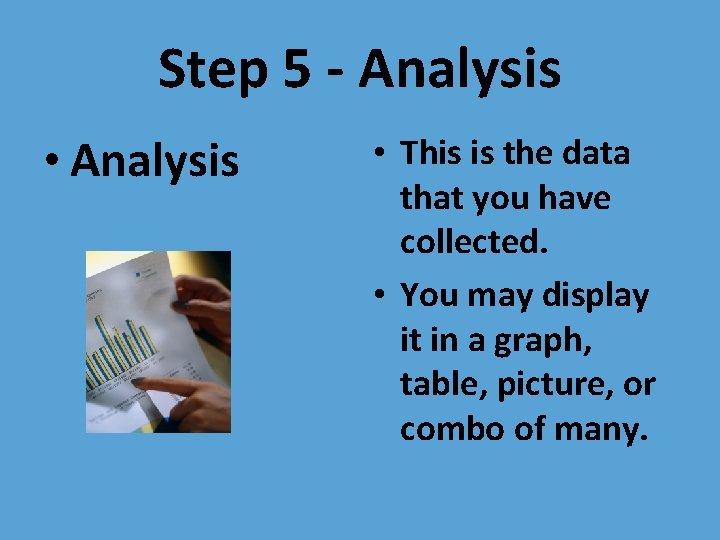
Step 5 - Analysis • Analysis • This is the data that you have collected. • You may display it in a graph, table, picture, or combo of many.
Step 6 - Conclusion • Conclusion • Evaluate your data and communicate results • Don’t worry about negative or unexpected results • Answer the original question. • What would you do differently? • Finally, was hypothesis accepted or rejected? If not, why?