
Scientific Method Steps 1 2 A logical and

- Slides: 6
Scientific Method – Steps 1 -2 ▪ A logical and organized method to solve a problem or answer a question 1) Problem - a question needing an answer � � 2) What do you want to know or explain? Typically, observations are used to write a question about a topic. Background Information – conduct research from reliable sources � You want to know as much about your topic as possible.
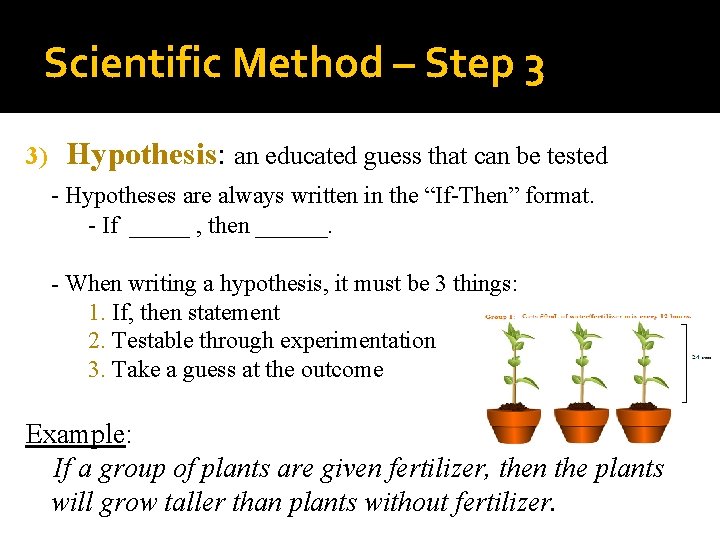
Scientific Method – Step 3 3) Hypothesis: an educated guess that can be tested - Hypotheses are always written in the “If-Then” format. - If _____ , then ______. - When writing a hypothesis, it must be 3 things: 1. If, then statement 2. Testable through experimentation 3. Take a guess at the outcome Example: If a group of plants are given fertilizer, then the plants will grow taller than plants without fertilizer.
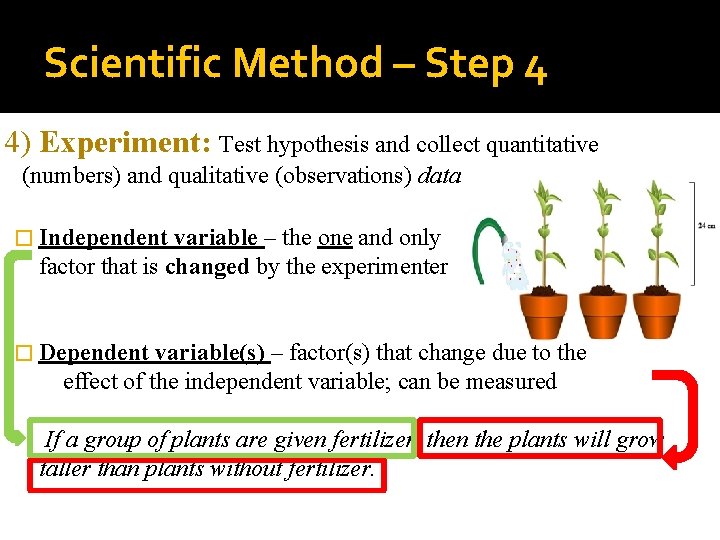
Scientific Method – Step 4 4) Experiment: Test hypothesis and collect quantitative (numbers) and qualitative (observations) data � Independent variable – the one and only factor that is changed by the experimenter � Dependent variable(s) – factor(s) that change due to the effect of the independent variable; can be measured If a group of plants are given fertilizer, then the plants will grow taller than plants without fertilizer.
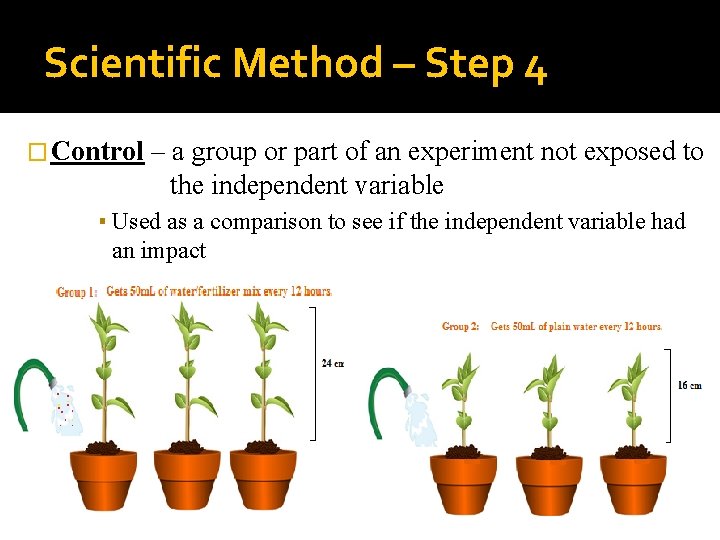
Scientific Method – Step 4 � Control – a group or part of an experiment not exposed to the independent variable ▪ Used as a comparison to see if the independent variable had an impact
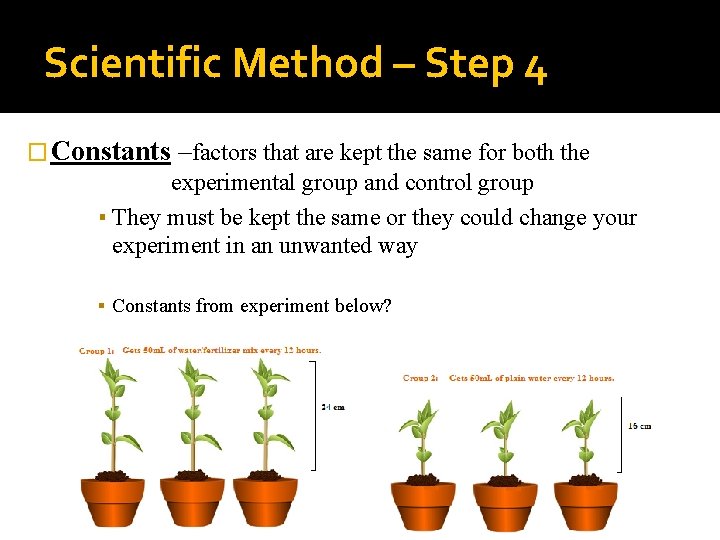
Scientific Method – Step 4 � Constants –factors that are kept the same for both the experimental group and control group ▪ They must be kept the same or they could change your experiment in an unwanted way ▪ Constants from experiment below? Plant type, amt. of water, soil type, pot size/type, sunlight, temperature, etc…
Scientific Method – Steps 5 & 6 5) Analysis– Look at trends, patterns, differences, or similarities in the collected data 6) Conclusion – Is the hypothesis accepted or rejected? - Use data as evidence If hypothesis is rejected, what should you do next? …. . proceed back to step 2 and try again