
Scientific Method Step 1 State the Problem What
Scientific Method

Step 1 State the Problem What exactly do you want to find out. Stated in the form of a question Usually created as a result of observations Needs to be “testable”
Step 1 State the problem How come there are no pests or parasites in the leaf cutter ant’s nests? Why does the temperature in my classroom increase during the day?
Step 2 Form a Hypothesis Possible answer to the problem, formed after problem has been researched “Educated” guess Gives direction
Step 2 Form a Hypothesis I think the white waxy substance on I think as more students enter my the back of the ants is controlling the mold. room during the day the temperature rises.
Step 3 Test the hypothesis Gathering data and evidence to support hypothesis through the use of controlled experiments. “controlled” means the person running the experiment has control over all the variables.
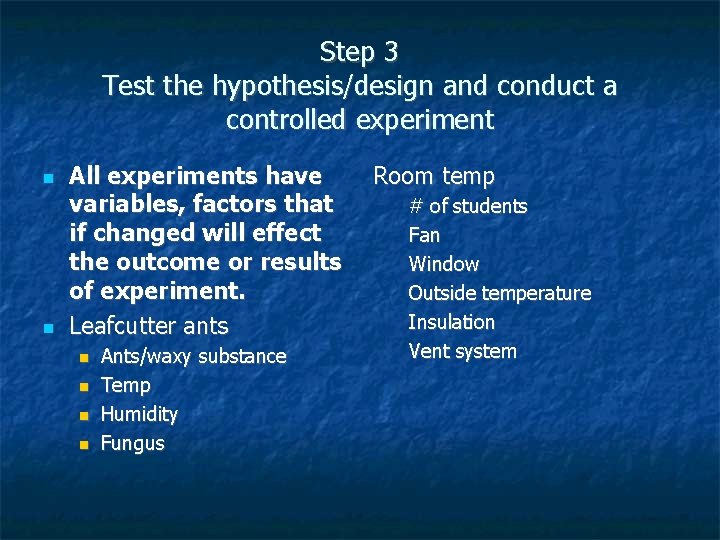
Step 3 Test the hypothesis/design and conduct a controlled experiment All experiments have variables, factors that if changed will effect the outcome or results of experiment. Leafcutter ants Ants/waxy substance Temp Humidity Fungus Room temp # of students Fan Window Outside temperature Insulation Vent system
The Independent Variable Experimental Variable The independent variable or test variable is the one variable you are testing or changing to bring about a desired result. Should be pointed out in hypothesis. Can only have one Leafcutter ants----White waxy substance on ant’s backs Room Temperature---- # of students in room
Dependent Variable The variable being measured, often the data being collected at the end of the experiment. Results, outcome Depends on independent variable. If mold is present Temperature
Controlled Variables All variables not being tested must be kept constant, unchanged, the same, or Controlled. Leafcutter ants---- Fungus, temperature, humidity Room Temperature---- fan, window, outside temp, insulation
VARIABLE GROUP Group which receives the variable being tested, or the independent variable. Fungus crops with ants.
Control Group that does not get the variable being tested. Used for comparison. Fungus without ants.
Data is any observations or measurements taken during the experiment. Leafcutter ants--- how much mold is present in each culture Room temperature--- the temperature throughout the day
Step 4 Analyze Data What does the data tell us? Do I have enough data? How should I present the data?
Step 5 State the Conclusion The conclusion tells you if the data supports your hypothesis. Was your hypothesis correct? Based on the analysis of data. May lead to repeat of experiment or entire scientific method process.
Conclusions Leafcutter ant- Based on my observations of the fungus cultures the waxy substance on the backs of the ants is acting as an antibiotic which kills any mold in the nests. Room temperature- the data suggests that as more students occupy my classroom, the higher the temperature.
Theory After a scientific explanation has been subjected to the scientific method process many times, enough evidence may be present to lead to a theory. A theory has not been proven, and is still challenged. Examples Big Bang Theory of Evolution Global Warming
Scientific law or fact Once a scientific explanation can no longer be challenged it may become a scientific law. Examples Leaf cutter ants cut leafs to cultivate fungus gardens.
- Slides: 18