
Scientific Method Senses Lab Procedure n In pairs
Scientific Method- Senses Lab Procedure n In pairs n One drops ruler, one reacts n Repeat each sense 5 times (5 trials), for each of the 3 senses (Sight, Touch, Sound) n Record data as you go, switch once you are finished
Scientific Method- Senses Lab Catcher: Start with top of index finger at 0 cm (ruler should have measurements on index finger side); fingers close to ruler but NOT touching n Highest point where index finger lands is recorded on worksheet, repeat each trial 5 times n IT IS OK if the catcher does NOT catch the ruler (null result) n
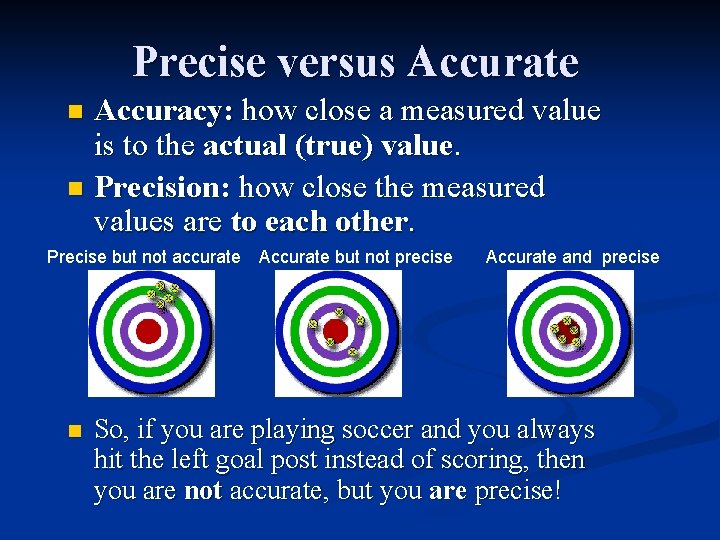
Precise versus Accurate Accuracy: how close a measured value is to the actual (true) value. n Precision: how close the measured values are to each other. n Precise but not accurate n Accurate but not precise Accurate and precise So, if you are playing soccer and you always hit the left goal post instead of scoring, then you are not accurate, but you are precise!
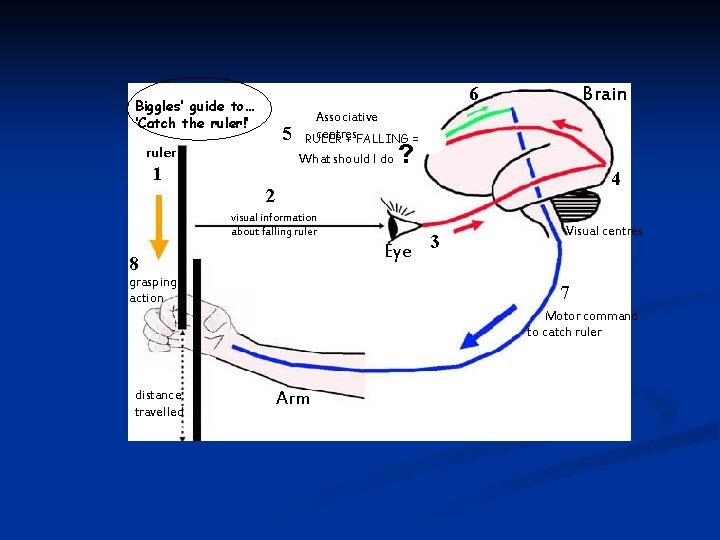
Brain 6 Biggles’ guide to… ‘Catch the ruler!’ 5 ruler Associative centres RULER + FALLING = What should I do 1 ? 4 2 visual information about falling ruler 8 grasping action Eye 3 Visual centres 7 Motor command to catch ruler distance travelled Arm

Calculating Average n n For each trial you are required to calculate average or mean of your trials n Mean= T 1+T 2+T 3+T 4+T 5 5 If you had a “dropped” ruler you add it as 30 cm Extension: Calculate reaction time in milliseconds n t= n n n 2 d g X 1000 Where: t = Reaction time (milliseconds) d = Distance ruler dropped (cm) g = Acceleration due to gravity (980 cm/sec 2) X 1000 = To convert the time from seconds to milliseconds.
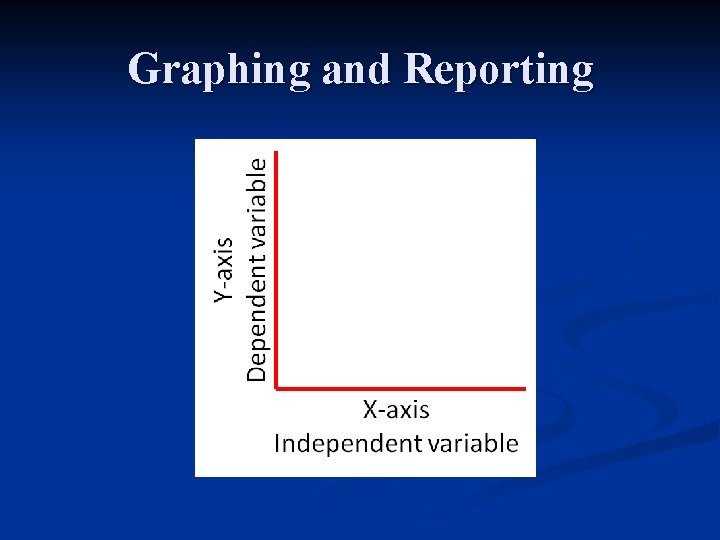
Graphing and Reporting
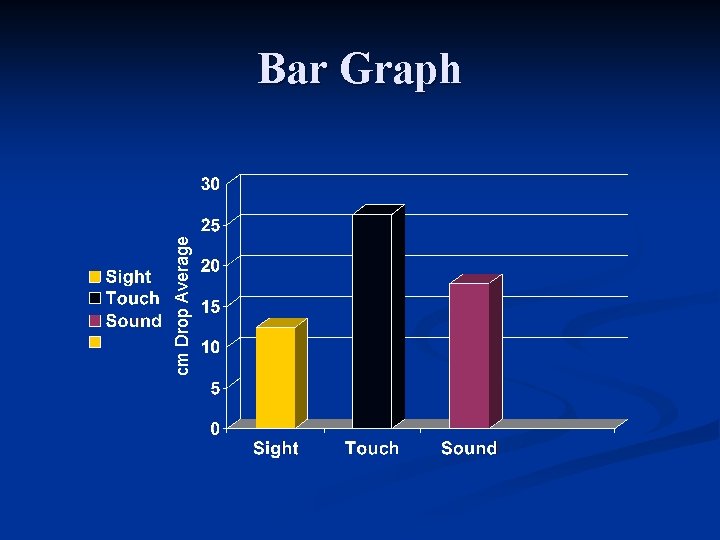
cm Drop Average Bar Graph
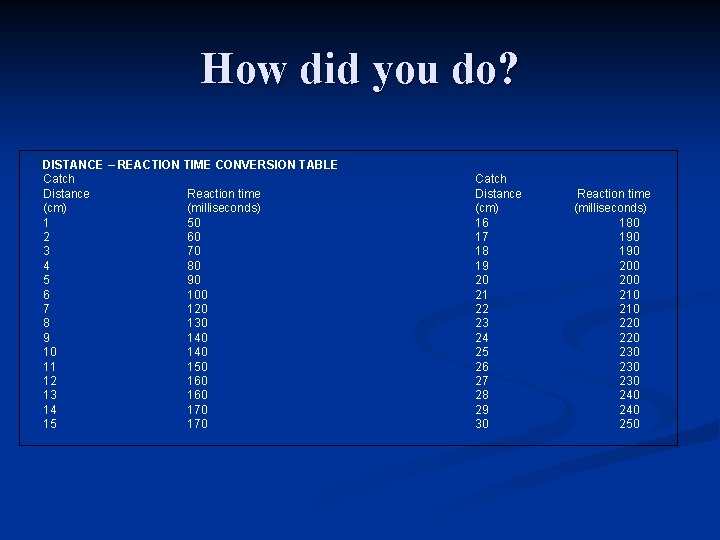
How did you do? DISTANCE – REACTION TIME CONVERSION TABLE Catch Distance Reaction time (cm) (milliseconds) 1 50 2 60 3 70 4 80 5 90 6 100 7 120 8 130 9 140 10 140 11 150 12 160 13 160 14 170 15 170 Catch Distance (cm) 16 17 18 19 20 21 22 23 24 25 26 27 28 29 30 Reaction time (milliseconds) 180 190 200 210 220 230 230 240 250
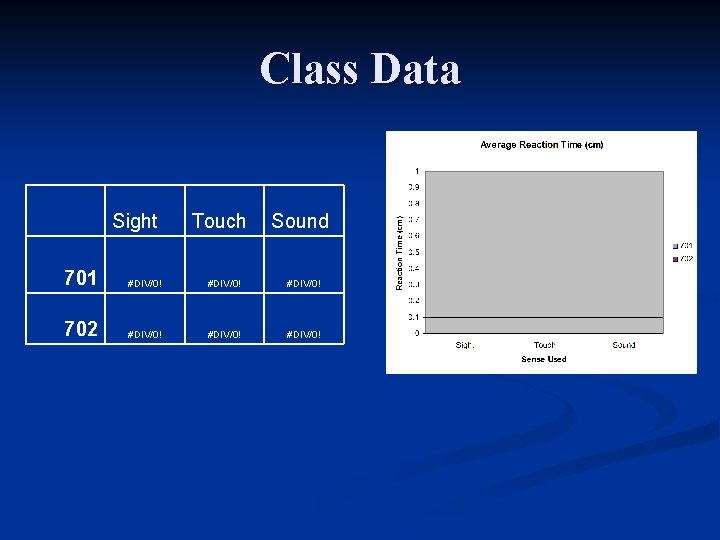
Class Data Sight Touch Sound 701 #DIV/0! 702 #DIV/0!
Think about it… n After you’ve tested yourself, why not experiment further. Here’s a few suggestions, do reaction times vary: for people of different ages (children versus adults)? n if you use your dominant hand versus nondominant hand? n if you are tired or alert? n for men or women? n depending on your mood? n after an alcoholic drink? n
Conclusion Statement- RERUN n n n Restate: Restate the lab experiment. Describe the assignment. (include your independent, dependent and controlled variables) Explain: Explain the purpose of the lab. What were you trying to figure out or discover? Talk briefly about the procedure you followed to complete the lab. Results: Explain your results. Confirm whether or not your hypothesis was supported by the results. (Use simple language such as, “The results supported the hypothesis, ” or “The results did not support the hypothesis. ”) Uncertainties: Account for uncertainties and errors. Explain, for example, if there were other circumstances beyond your control that impacted the experiment (“Controlled Variables” that weren’t controlled) New: Discuss new questions or discoveries that emerged from the experiment.
Some Thoughts… n n n generally the older you are the longer your reaction time (that ruler keeps hitting my foot!) as you might expect, the dominant hand has a faster reaction time. in ‘Catch the ruler’, it helps to pay attention – so being alert is a great asset. who is faster ‘men or women’? …you tell me? mood affects attention and therefore reaction times. alcohol greatly increases reaction times.
- Slides: 12