
Scientific Method Review Branches of Science Life Science
Scientific Method Review
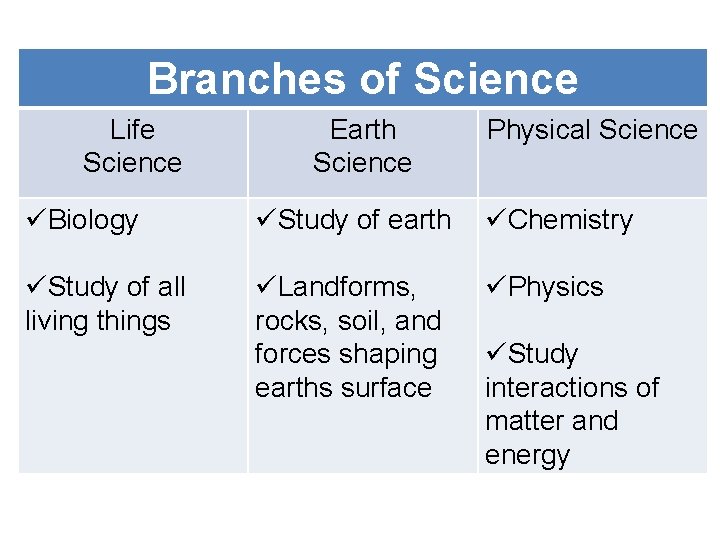
Branches of Science Life Science Earth Science Physical Science üBiology üStudy of earth üChemistry üStudy of all living things üLandforms, rocks, soil, and forces shaping earths surface üPhysics üStudy interactions of matter and energy
What are the steps to the Scientific Method? 1. 2. 3. 4. 5. 6. 7. 8. 9. Observation (using the 5 senses) Ask a question Hypothesize & predict Test hypothesis (Experiment) 1. Materials 2. Procedures 3. Data (journal, pictures, charts) Analyze results Draw conclusions Communicate results Further scientific inquiry A successful hypothesis becomes a Scientific Theory.
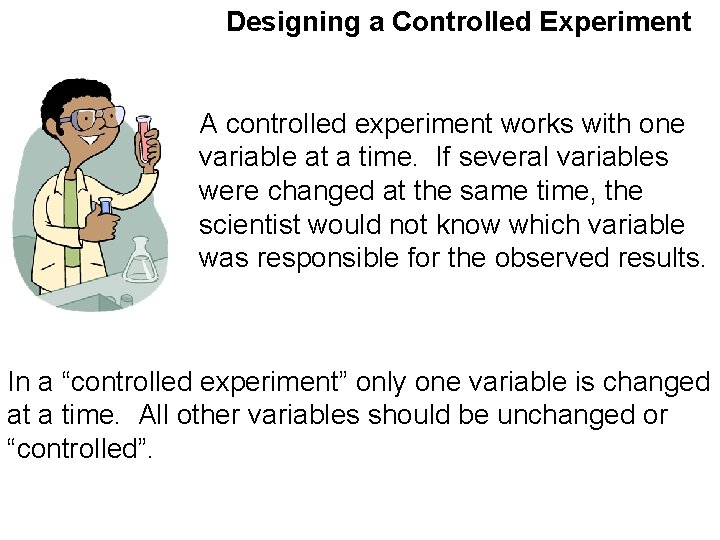
Designing a Controlled Experiment A controlled experiment works with one variable at a time. If several variables were changed at the same time, the scientist would not know which variable was responsible for the observed results. In a “controlled experiment” only one variable is changed at a time. All other variables should be unchanged or “controlled”.
Match the definitions: Variable c a. The factor you want to test/changed by the investigator Independent Variable a b. The factor you observe or measure during an experiment. Dependent Variable b c. A factor that can have more than one value
What are Scientific Theory & Scientific Law? Scientific Theory • An explanation of events that is based on repeated observations and investigations. • If information does not support theory, it will be modified or rejected • Attempts to explain why something happens • More complex than a scientific law and contains many well supported hypothesis Scientific Law • Observations of similar events that have been observed repeatedly • If observations do not follow a law, it is not a law • States that something will happen • Contains one well supported hypothesis that states something will happen
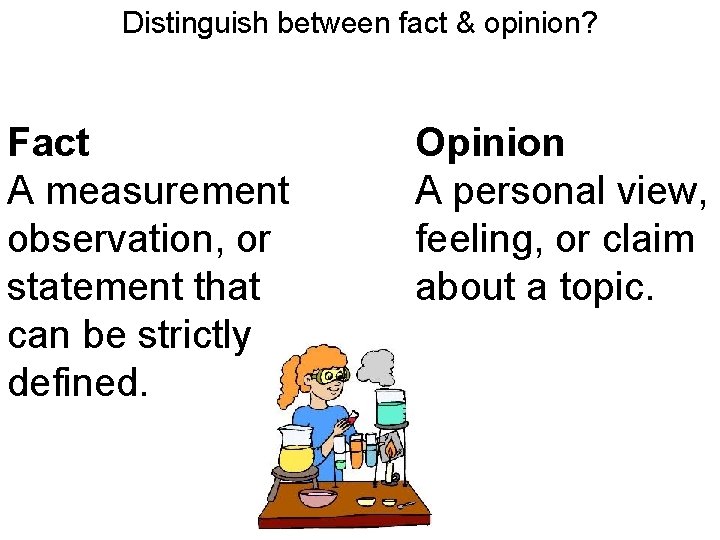
Distinguish between fact & opinion? Fact A measurement observation, or statement that can be strictly defined. Opinion A personal view, feeling, or claim about a topic.
Distinguish between description& explanation? Description A spoken or written summary of an observation Explanation An interpretation ( ) of observations explain the meaning of
What is the name of the system of measurements adopted by Scientists called? The International System of Units (SI) What is a Significant digit? The number of digits in a measurement that you know with a degree of certainty.
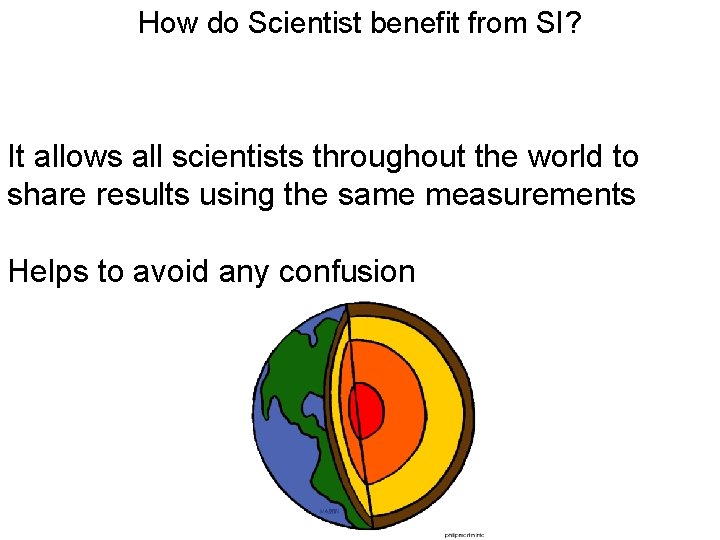
How do Scientist benefit from SI? It allows all scientists throughout the world to share results using the same measurements Helps to avoid any confusion
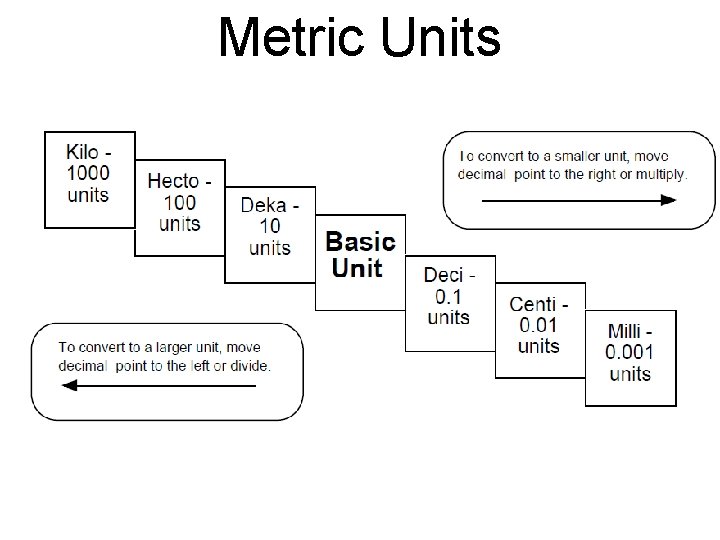
Metric Units
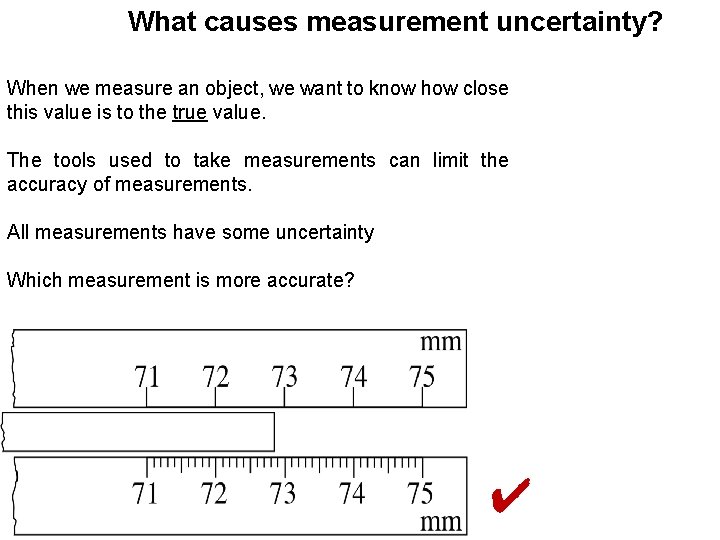
What causes measurement uncertainty? When we measure an object, we want to know how close this value is to the true value. The tools used to take measurements can limit the accuracy of measurements. All measurements have some uncertainty Which measurement is more accurate? ✔
Accuracy: a measure of how close a measurement is to the true value of the quantity being measured Precision: a measure of how close a series of measurements are to one another. A measure of how exact a measurement is. 7 th grade only!
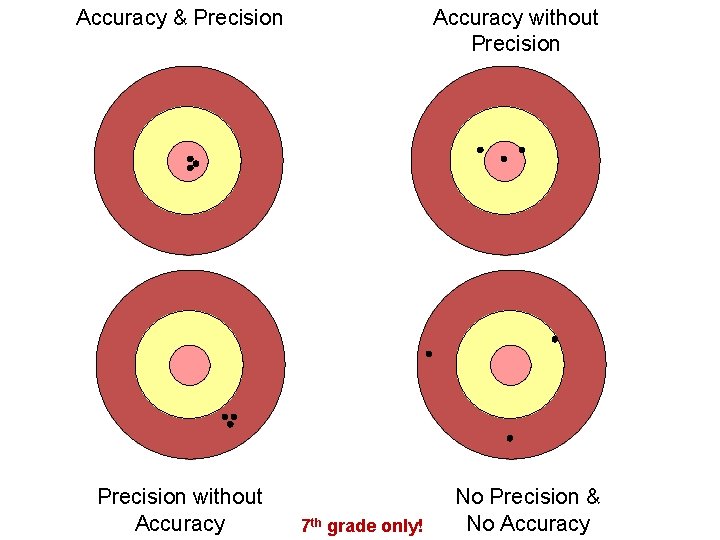
Accuracy & Precision without Accuracy without Precision 7 th grade only! No Precision & No Accuracy
Mean the average of a set of data. To calculate the mean, find the sum of the data and then divide by the number of data Median the middle number in a set of data when the data is arranged from least to greatest. 6 th grade only! Mode the number that occurs the most. Range the difference between the largest and the smallest number in the set.
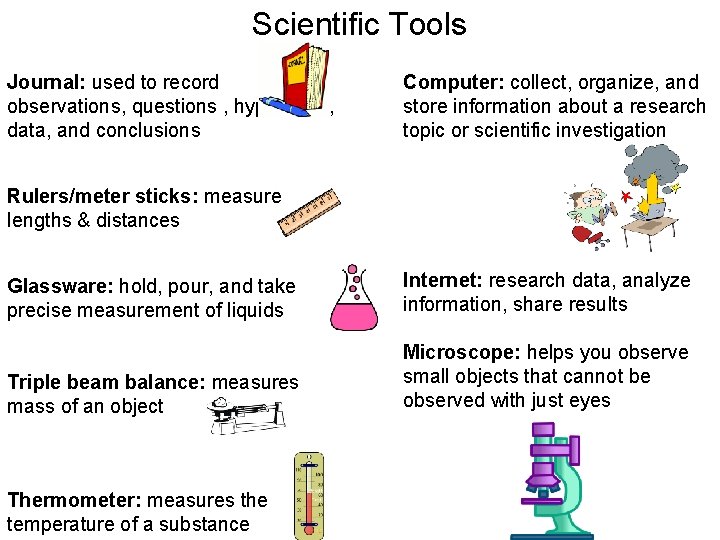
Scientific Tools Journal: used to record observations, questions , hypothesis, data, and conclusions Computer: collect, organize, and store information about a research topic or scientific investigation Rulers/meter sticks: measure lengths & distances Glassware: hold, pour, and take precise measurement of liquids Internet: research data, analyze information, share results Triple beam balance: measures mass of an object Microscope: helps you observe small objects that cannot be observed with just eyes Thermometer: measures the temperature of a substance
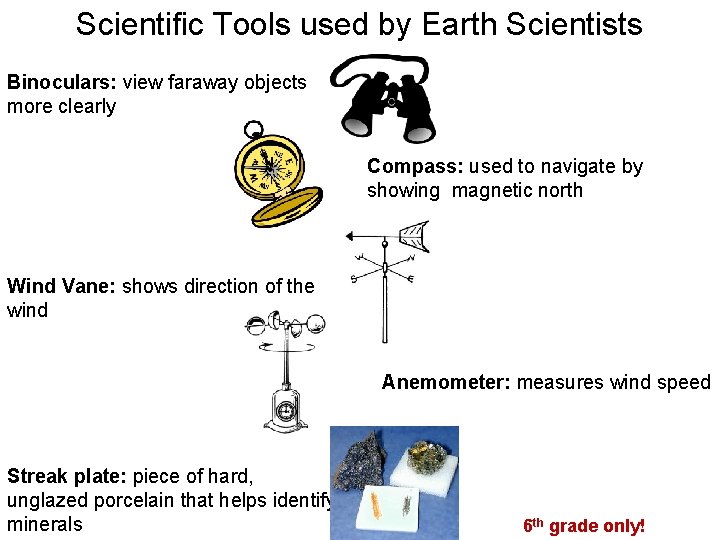
Scientific Tools used by Earth Scientists Binoculars: view faraway objects more clearly Compass: used to navigate by showing magnetic north Wind Vane: shows direction of the wind Anemometer: measures wind speed Streak plate: piece of hard, unglazed porcelain that helps identify minerals 6 th grade only!
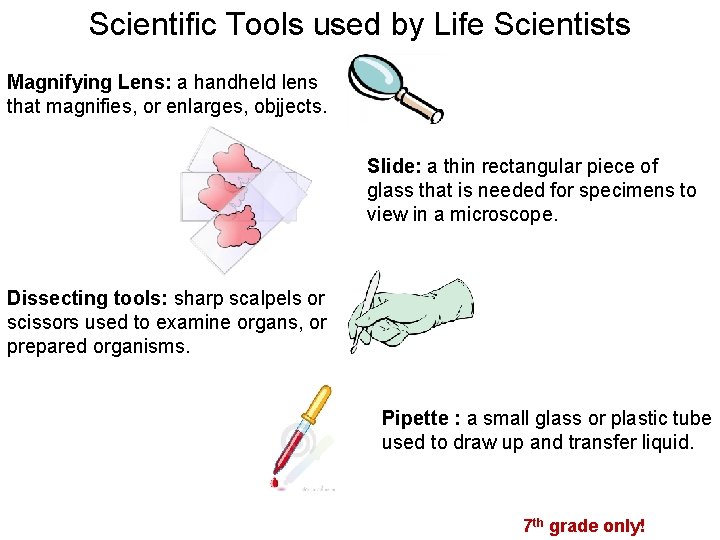
Scientific Tools used by Life Scientists Magnifying Lens: a handheld lens that magnifies, or enlarges, objjects. Slide: a thin rectangular piece of glass that is needed for specimens to view in a microscope. Dissecting tools: sharp scalpels or scissors used to examine organs, or prepared organisms. Pipette : a small glass or plastic tube used to draw up and transfer liquid. 7 th grade only!
- Slides: 19