
Scientific Method Part 2 Organizing and Analyzing Data
- Slides: 8
Scientific Method Part 2
Organizing and Analyzing Data • Data is any pieces of information acquired through observation or experimentation. • Organizing data into tables and graphic illustrations helps scientists analyze the data and explain the data clearly to others. • Graphs are often used by scientists to display relationships or trends in the data.
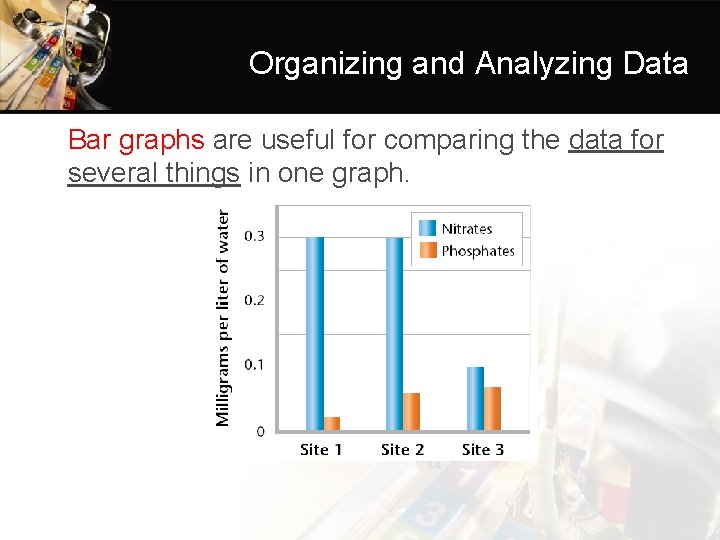
Organizing and Analyzing Data • Bar graphs are useful for comparing the data for several things in one graph.
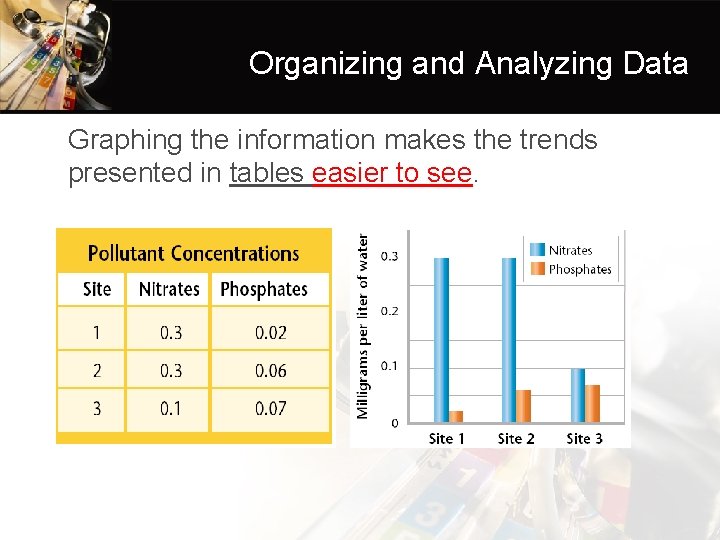
Organizing and Analyzing Data • Graphing the information makes the trends presented in tables easier to see.
Drawing Conclusions • Scientists determine the results of their experiment by analyzing their data and comparing the outcome of their experiments with their prediction. • Ideally, this comparison provides the scientist with an obvious conclusion.
Drawing Conclusions • But, often the conclusion is not obvious. • In these cases, scientists often use mathematical tools to help them determine whether the differences are meaningful or are just a coincidence.
Repeating Experiments • Scientists often repeat their experiments. • The more often an experiment can be repeated with the same results, in different places and by different people, the more sure scientists become about the reliability of their conclusions. • Scientists look for a large amount of supporting evidence before they accept a hypothesis.
Communicating Results • Scientists publish their results, sometimes in scientific articles, to share what they have learned with other scientists. • Scientific articles include the question the scientist explored, the reasons why the question is important, background information, a precise description of how the work was done, the data collected, and the scientist’s interpretation of the data.