
Scientific Method I Question Define a problem GOOD
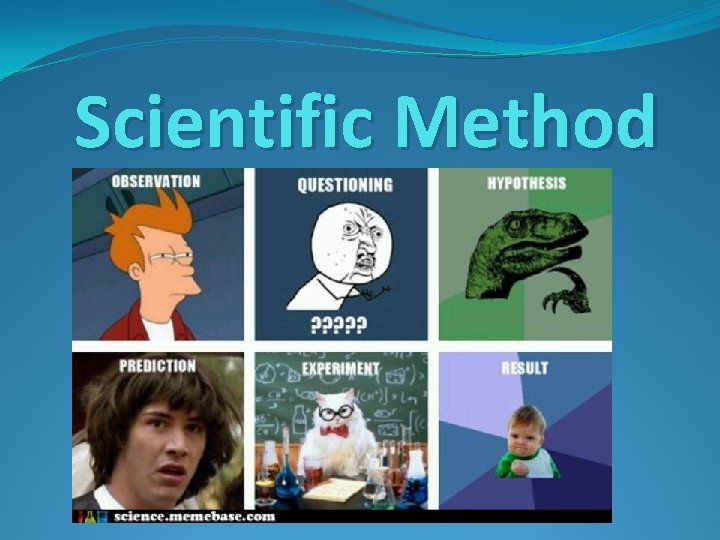
Scientific Method
I. Question �Define a problem GOOD SCIENCE QUESTIONS ARE: 1. Testable 2. Measureable 3. Observable 4. Repeatable
II. Background Information/Research �Write out any information you need to share with the reader so that they can understand what your experiment is about! �Research to see if others have done your experiment, what were their results? Gives you a better idea what to expect.
III. Hypothesis �What is going to be tested by the experiment �Based on your research what you predict will happen �Should include what you’re going to change and what will happen if you do (If… then…. )
Hypothesis Practice �If the question is… �What causes people’s toenails to grow faster? �A good hypothesis would be… �An increase of vitamin A causes toenails to grow longer
Hypothesis Practice �If the question is… �Does music affect a person’s heart rate? �A good hypothesis would be… �When exposed to music with a rapid tempo, their heart rate will increase �Your turn… If the question is… �Do pill bugs prefer moist or dry environments? �A good hypothesis would be….
IV. Experimental Procedure �This is the step by step description of exactly how to carry out the experiment 1. 2. 3. 4. …. …. …. And so on �Should be detailed enough to be � Repeatable � Done safely � Easy to adjust if something goes wrong �Multiple Trials (repeat the experiment) � The more data you have the more reliable your conclusion will be � Want to have the largest sample size/data collection possible
V. Data �Organized chart and/or graph of the information you gathered �Display appropriate units
VI. Conclusion �Restate your hypothesis �Accept, reject (nullify), or inconclusive BASED ON DATA �Include a discussion of data �Discusses the validity of the experiment

What does it mean to nullify a hypothesis? �Your results don’t support your hypothesis �DO NOT �Change your hypothesis to match your data �Change your data to match your hypothesis �Toss out your experiment as a failure
Variables �Independent (Experimental) Variable: part of the experiment that the scientist changes, ONLY ONE PER EXPERIMENT �The experimental group is the part of the experiment where you are testing something new out �Why only one independent variable?
�Dependent Variable: the part of the experiment that changes because of the independent variable, part that is measured �Control Group: done without the independent variable, something to compare to
Laws and Theories �Scientific Law: a descriptive statement or equation that reliably predicts events under certain conditions, helps us make predictions �Universal law of gravity
�Scientific Theories: explains why things work, supported by a large amount of evidence (observations) and investigations (experiments) ** Always being questioned and examined �Theory of evolution
- Slides: 14