
Scientific Method Biology 12 Design an experiment using
Scientific Method Biology 12 Design an experiment using the Scientific method.
Scientific Method, Making Observations. • Scientists believe that they can understand more of creation by observing it. • We use our senses and various instruments to make observations. • Scientists also take advantage of the knowledge and experience of others to further their understanding.
Scientific Method, Making a Hypothesis • After making observations a scientist comes up with a possible explanation of the observed event called a hypothesis. • The next step is to determine how to test the hypothesis using “if/then” logic. • The final step is to incorporate a prediction in the Hypothesis. • The hypothesis should explain what the scientist knows , ”If” and predict the results of the experiment, ”Then”.
Scientific Method, Testing the Hypothesis • • The hypothesis/prediction is tested using an experiment. Good experiments; 1. Test the hypothesis 2. Use appropriate sample sizes. 3. Are controlled. – – – Two or more comparable groups that are identical. Experimental group which has the variable to be tested. Control group that does not have that variable. 4. Are repeatable by other scientists.
Scientific Method, Collecting Data • The Results of the Experiment are referred to as Data. • These results should be observable and objective. • Report data in tables or graphs to help in its analysis.
Dependant and Independent Variables • A dependant variable is something that depends on other factors. • It changes in response to the independent variable. • An independent variable stands alone and isn't changed by the other variables you are trying to measure.
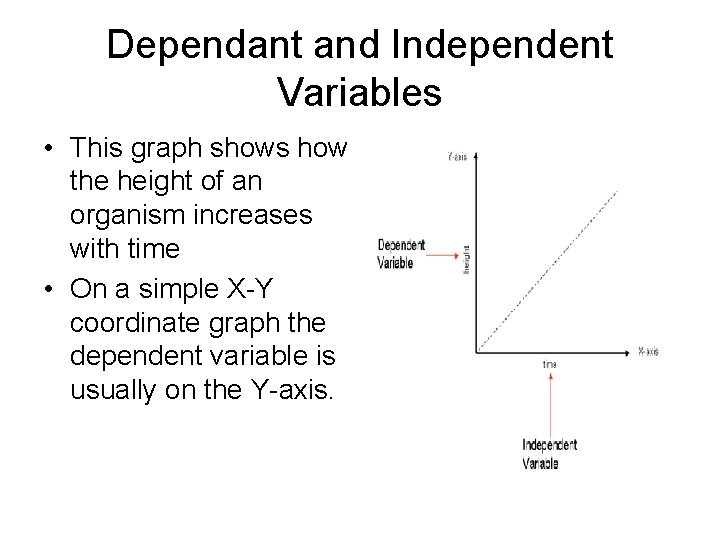
Dependant and Independent Variables • This graph shows how the height of an organism increases with time • On a simple X-Y coordinate graph the dependent variable is usually on the Y-axis.
Scientific Method, Conclusion • The analysis of the Data should result in the Hypothesis being supported or rejected. • A rejected Hypothesis may lead to a new hypothesis and an experiment designed to test it. • The experiment, results, and conclusion are reported to other scientists who can repeat the experiment to validate the results and to indicate that the experiment is reliable.
Scientific Method, Scientific Theory. • An accepted Hypothesis leads to a theory. • A Theory is a hypothesis that is supported by a broad range of observations, experiments and data. • The conclusions of many different types of related experiments enable scientists to arrive at a Scientific Theory that is generally accepted by all.
- Slides: 9