
Scientific Method 1 Observation STEP 1 n Employing
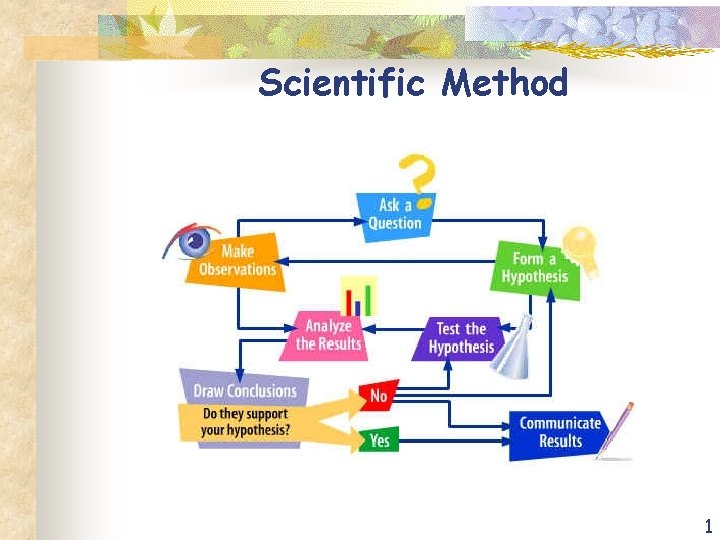
Scientific Method 1
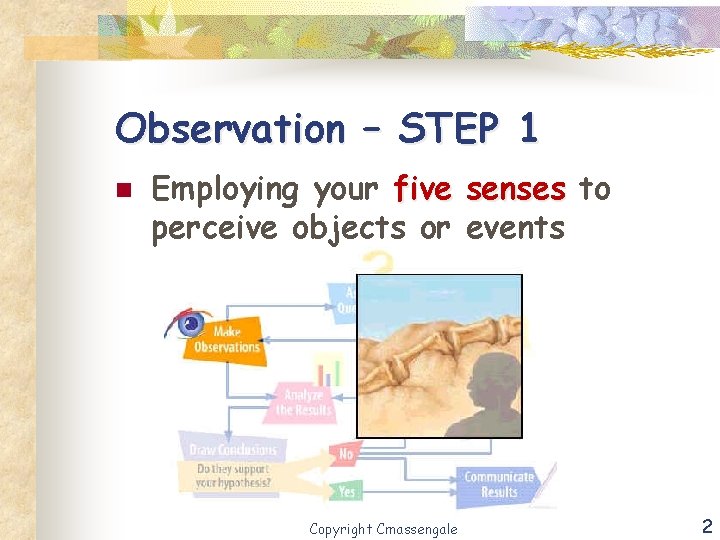
Observation – STEP 1 n Employing your five senses to perceive objects or events Copyright Cmassengale 2
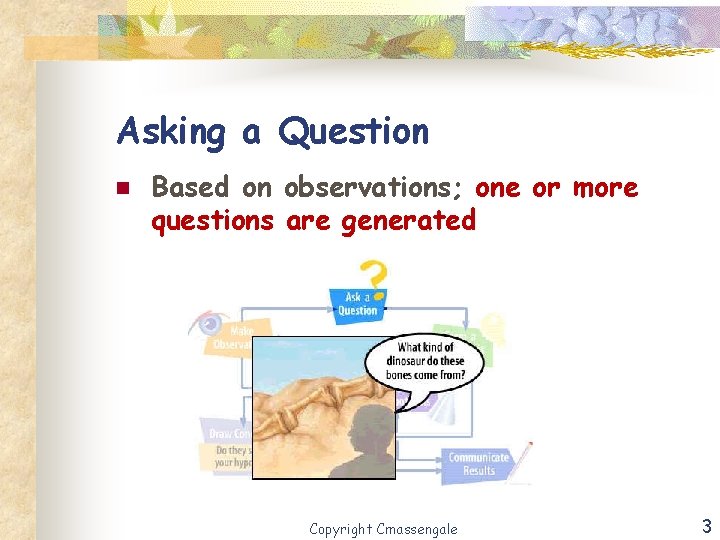
Asking a Question n Based on observations; one or more questions are generated Copyright Cmassengale 3
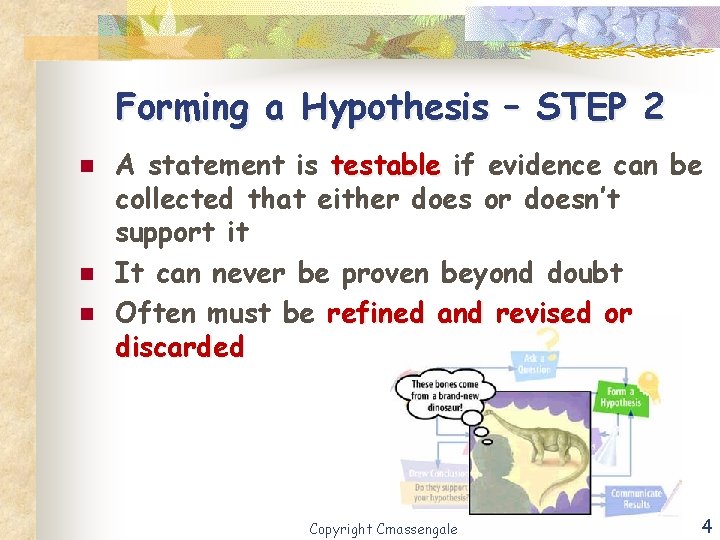
Forming a Hypothesis – STEP 2 n n n A statement is testable if evidence can be collected that either does or doesn’t support it It can never be proven beyond doubt Often must be refined and revised or discarded Copyright Cmassengale 4
The Hypothesis --n n Is a statement made in advance that states the results that will be obtained from testing the hypothesis Often written in the form of an “if-then” statement Copyright Cmassengale 5
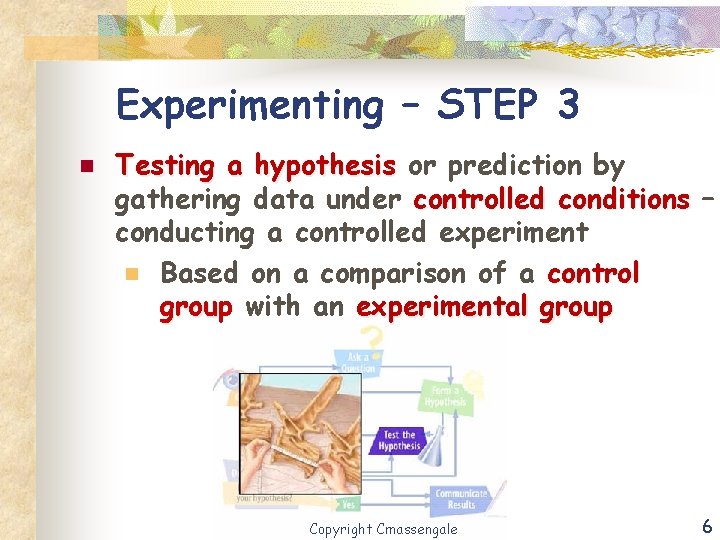
Experimenting – STEP 3 n Testing a hypothesis or prediction by gathering data under controlled conditions – conducting a controlled experiment n Based on a comparison of a control group grou with an experimental group Copyright Cmassengale 6
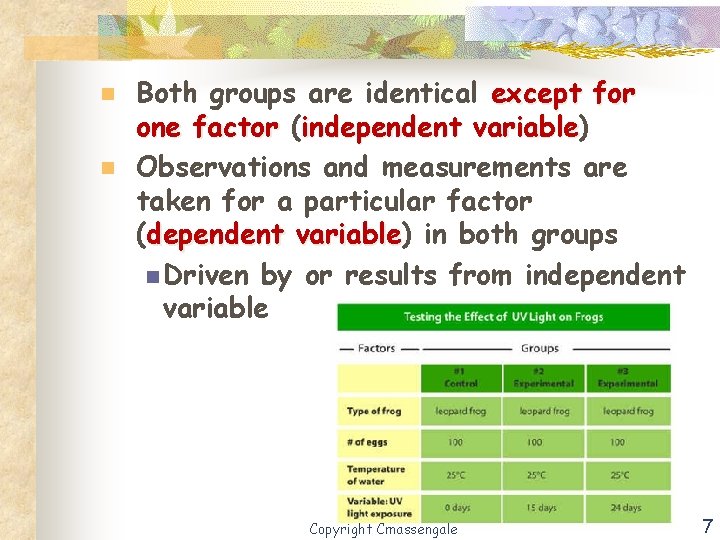
n n Both groups are identical except for one factor (independent variable) variable Observations and measurements are taken for a particular factor (dependent variable) variable in both groups n Driven by or results from independent variable Copyright Cmassengale 7
n n Measuring n Involves quantitative data that can be measured in numbers &/or qualitative data information that isn’t numbers Sampling n Technique of using a sample – a small part – to represent the entire population Copyright Cmassengale 8
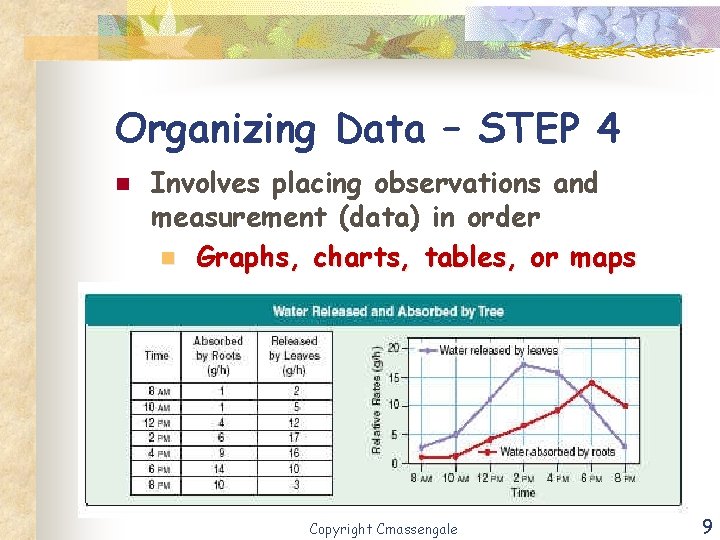
Organizing Data – STEP 4 n Involves placing observations and measurement (data) in order n Graphs, charts, tables, or maps Copyright Cmassengale 9
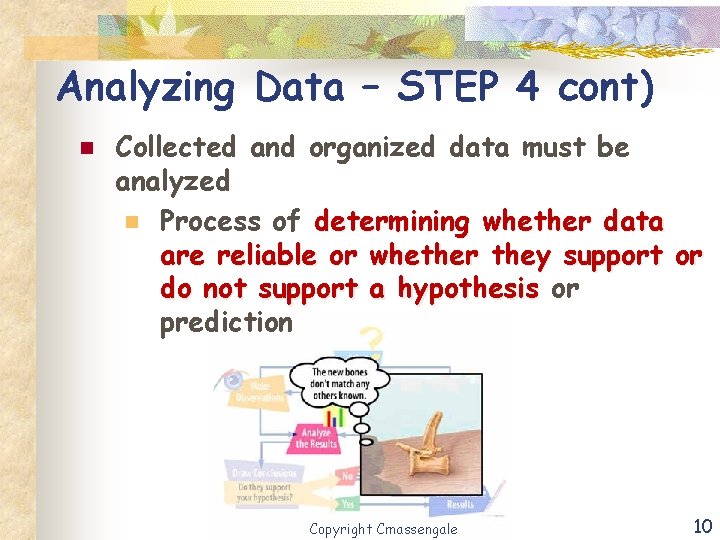
Analyzing Data – STEP 4 cont) n Collected and organized data must be analyzed n Process of determining whether data are reliable or whether they support or do not support a hypothesis or prediction Copyright Cmassengale 10
Conclusion – STEP 5 n Conclusions are made on the basis of facts, not observations n Often drawn from data gathered from a study or experiment n Should support the hypothesis n Should be re-testable Copyright Cmassengale 11
Communication – STEP 6 n n Scientists must share the results of their studies with other scientists (peers) Publish findings in journals Present their findings at scientific meetings Scientists must be unbiased n n Should not tamper with their data Only publish & report tested & proven ideas Copyright Cmassengale 12
Communication n Sharing of information is essential to scientific process Subject to examination and verification by other scientists Allows scientists to build on the work of others Copyright Cmassengale 13
Theories n n A theory may be formed after many related hypotheses have been tested and supported with experimental evidence A broad and comprehensive statement of what is thought to be true Supported by considerable evidence Ties together related hypotheses Copyright Cmassengale 14
Laws n n A Statement of fact that concisely explains an action or group of actions e. g. Law of Gravity Accepted to be true Universal May be expressed as a math equation e. g. E=mc 2 Copyright Cmassengale 15
- Slides: 15