
SCIENTIFIC MEASUREMENT INTRODUCTION TO SI UNITS SI units
- Slides: 56
SCIENTIFIC MEASUREMENT INTRODUCTION TO SI UNITS
SI units of measurement are used when performing calculations related to scientific investigations.
l. Purpose of measurement: quantify a variable (tell how much). ex: mass.
l. Value determined by measurement must be accompanied by a unit. ex: grams
SI units were adapted from the metric system. Base units…. . meter…… gram………. liter…. . . Measure Length Mass Volume
The units in the metric system are defined in multiples of 10 from the standard unit.
UNIT CONVERSIONS To convert from one unit to another in the metric system, you multiply and divide.
Multiply when changing from a greater unit to a smaller one.
Divide when changing from a smaller unit to a larger one.
STANDARD SI MEASUREMENTS
LENGTH: The SI unit of measurement to determine length is meter (m).
The tool of measurement for length is a ruler/meter stick.
Length measures the distance from one point to another. *1 meter = 3. 28 feet.
MASS: The SI measurement unit for mass is the gram (g) OR kilogram (kg)
The tool of measurement for mass is the balance.
Mass measures of the amount of matter in an object. *1 kilogram = 2. 2 pounds
Mass and Weight The terms mass and weight are sometimes used interchangeably, but they are not the same.
[Mass is a property of the object itself and measures the amount of matter in the object. ]
Weight Measures gravitational force that attracts an object to the earth (stops it from floating!)
WEIGHT: The SI measurement unit for weight is the Newton (N).
Weight varies depending on the amount of gravitational force.
On Earth a person may weigh 130 pounds (lbs).
On the moon the same person would weigh about 1/6 th of that amount or 21. 66 pounds!
Mass does not vary or change with location.
VOLUME: The SI measurement unit for volume is cubic 3 centimeters (cm or cc) or milliliters (m. L).
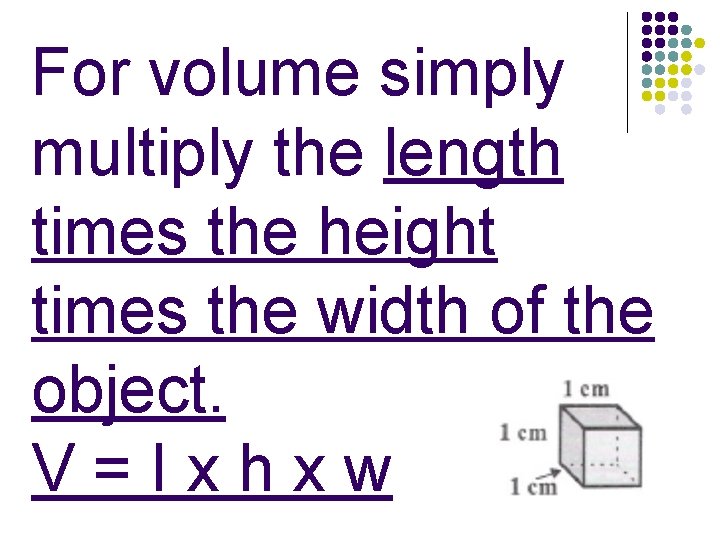
For volume simply multiply the length times the height times the width of the object. V=Ixhxw
A graduated cylinder is used to measure the volume of liquids.
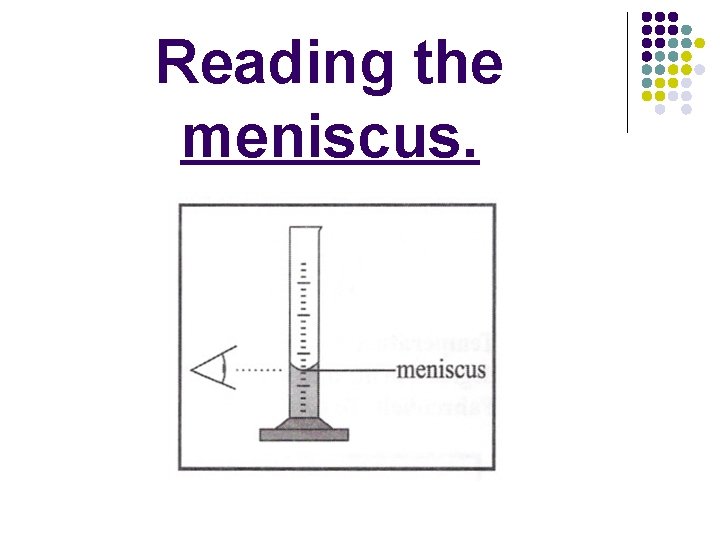
A meniscus is the curve of liquid at its surface.
Most menisci curve downwards, but a few curve up, depending on the liquid.
To read the volume of a liquid: 1. Get eye level with the meniscus
2. Measure from the bottom of the curve if it curves downward
3. Measure from the bottom of the meniscus if it curves upward
Reading the meniscus.
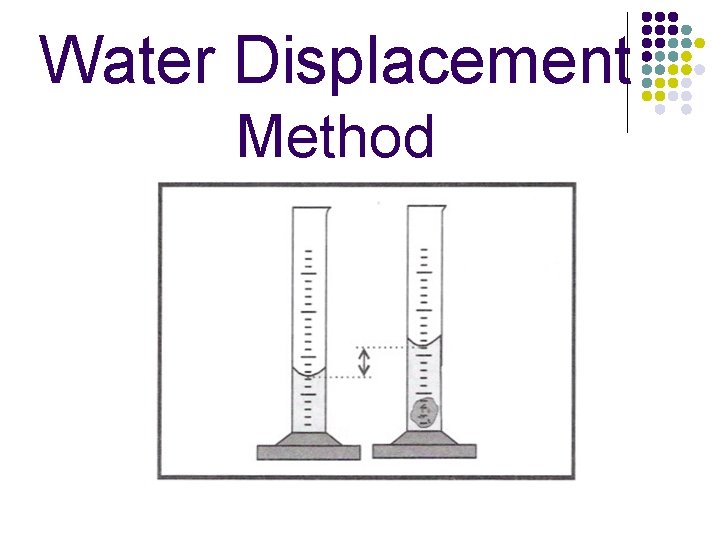
To determine volume of irregularly shaped objects, the water displacement method is used.
To measure volume by water displacement 1. Place an amount of water in a graduated cylinder.
2. Read the meniscus to measure volume. 3. Add the object.
4. Read the meniscus to measure volume again.
5. To determine the volume of the object, simply subtract the first measurement from the second.
Water Displacement Method
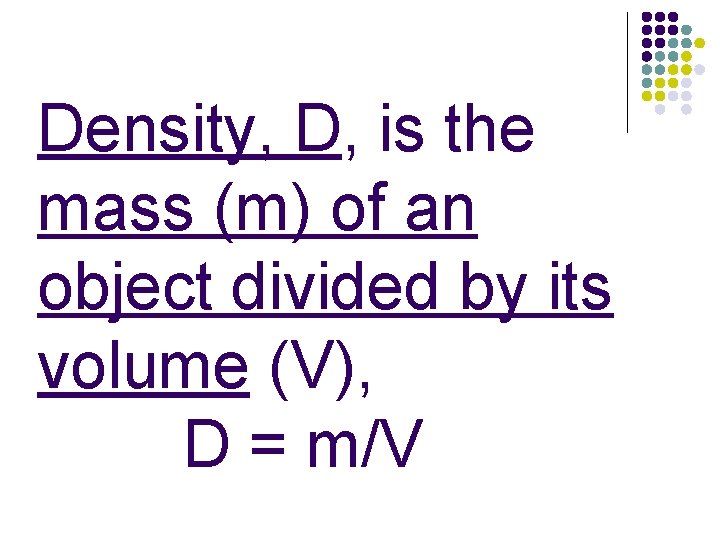
Density, D, is the mass (m) of an object divided by its volume (V), D = m/V
l. The SI unit for 3 density is kg/m , or it 3. is expressed g/cm
Density of two objects of the same material is always the same even if the objects have different masses.
For example, a gold ring and a gold brick both have the same density, because they are both made of gold.
The brick contains more matter than the gold ring, it has a greater mass (it is heavier).
Density explains why some things float, and other things sink.
Temperature measures how hot or cold something is.
All measurements for temperature are taken in degrees.
l. In the metric system, Celsius is used.
The SI unit for temperature is Kelvin, and the English unit is Fahrenheit.
To convert from one unit to another, use the following formulas:
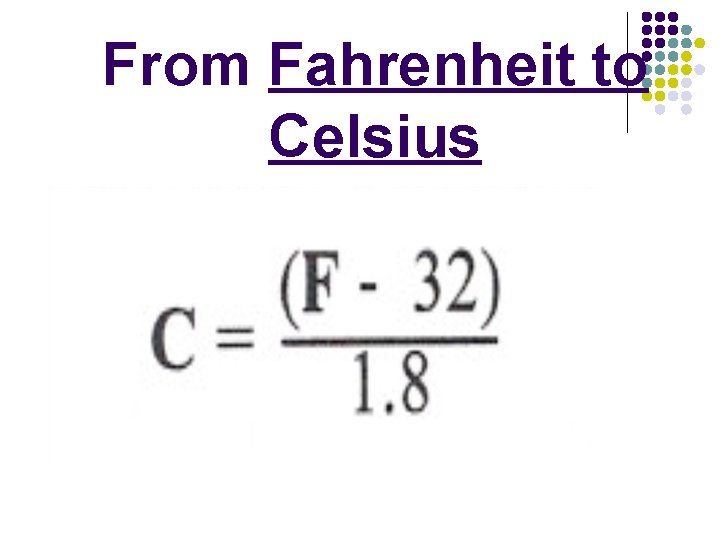
From Fahrenheit to Celsius
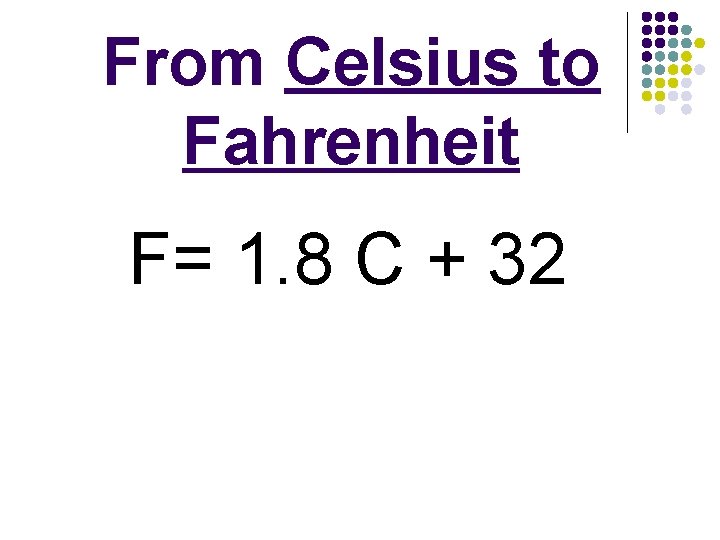
From Celsius to Fahrenheit F= 1. 8 C + 32
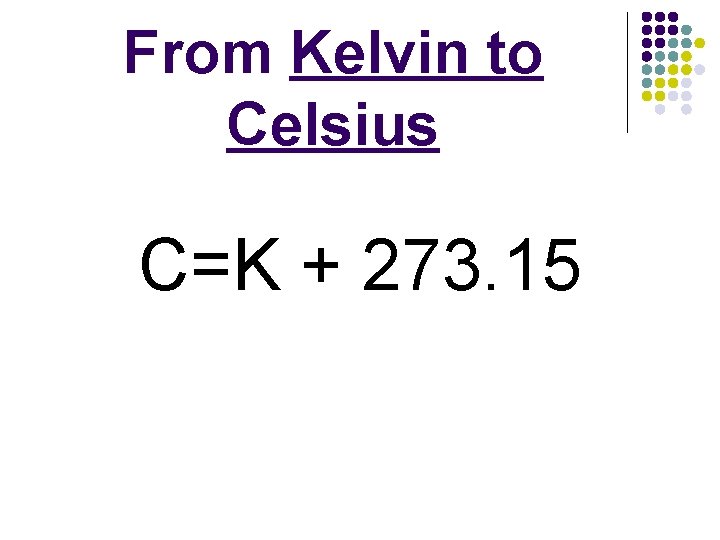
From Kelvin to Celsius C=K + 273. 15
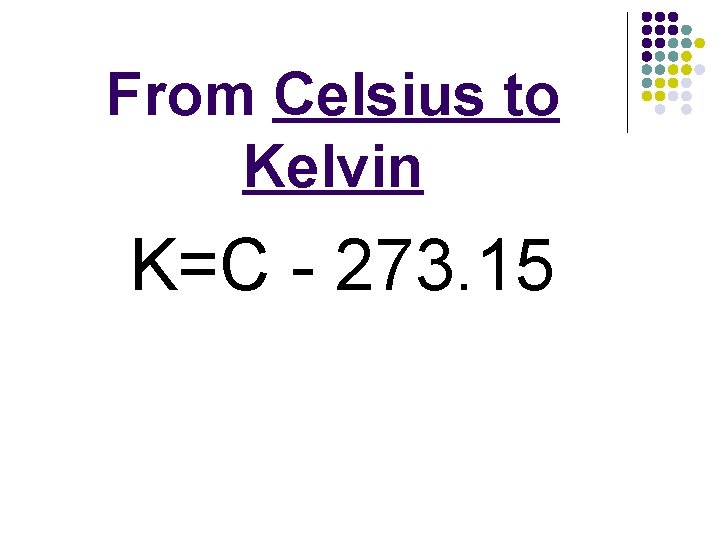
From Celsius to Kelvin K=C - 273. 15
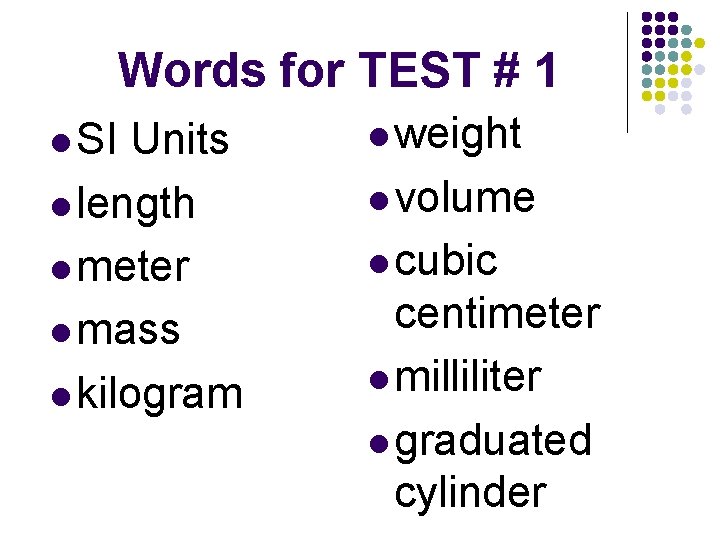
Words for TEST # 1 l SI Units l length l meter l mass l kilogram l weight l volume l cubic centimeter l milliliter l graduated cylinder
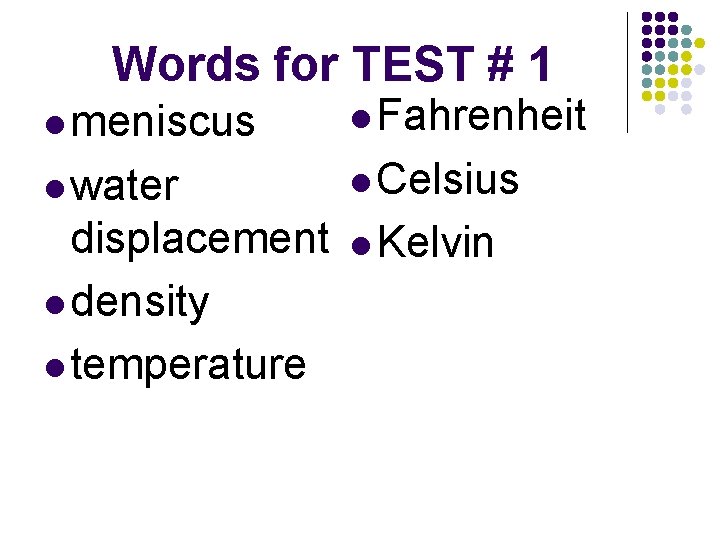
Words for TEST # 1 l meniscus l Fahrenheit l water l Celsius displacement l density l temperature l Kelvin