
Scientific Inquiry and the Scientific Method Understanding the
- Slides: 54
Scientific Inquiry and the Scientific Method Understanding the World Around Us
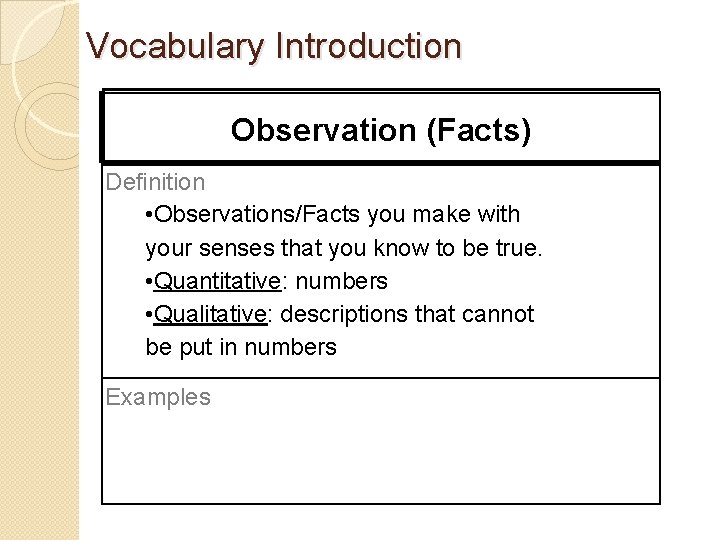
Vocabulary Introduction Observation (Facts) Definition • Observations/Facts you make with your senses that you know to be true. • Quantitative: numbers • Qualitative: descriptions that cannot be put in numbers Examples
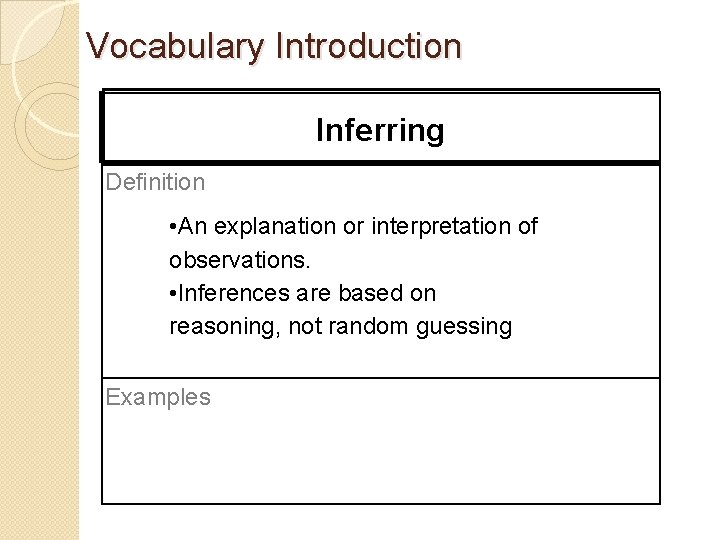
Vocabulary Introduction Inferring Definition • An explanation or interpretation of observations. • Inferences are based on reasoning, not random guessing Examples
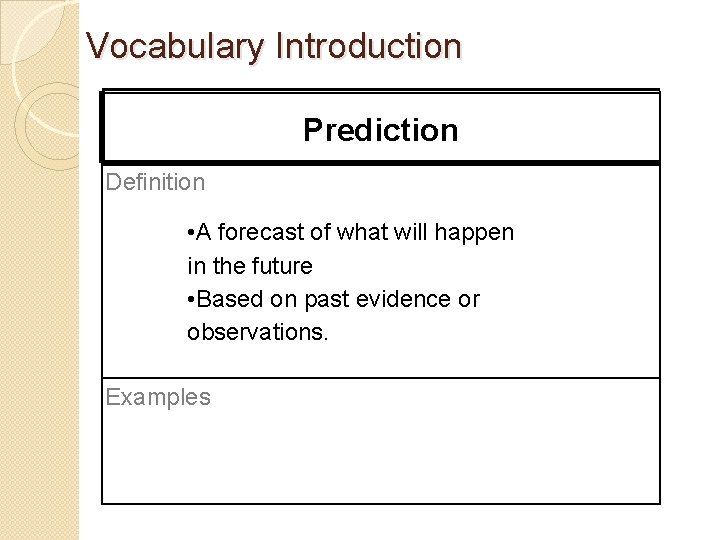
Vocabulary Introduction Prediction Definition • A forecast of what will happen in the future • Based on past evidence or observations. Examples
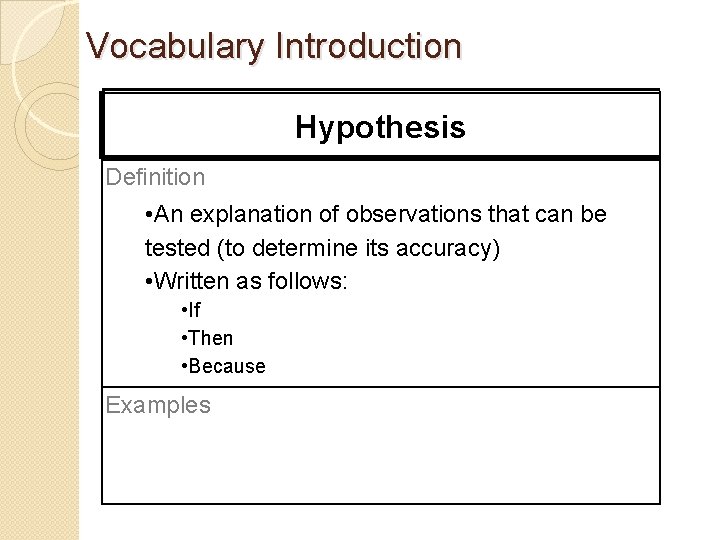
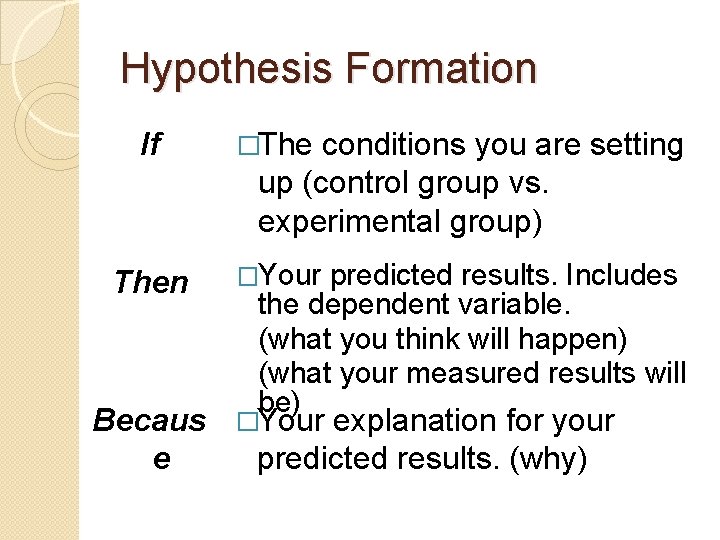
Vocabulary Introduction Hypothesis Definition • An explanation of observations that can be tested (to determine its accuracy) • Written as follows: • If • Then • Because Examples
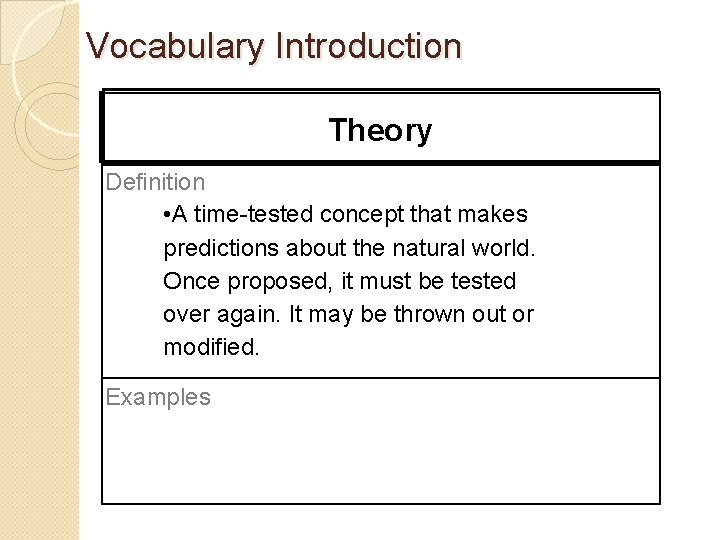
Vocabulary Introduction Theory Definition • A time-tested concept that makes predictions about the natural world. Once proposed, it must be tested over again. It may be thrown out or modified. Examples
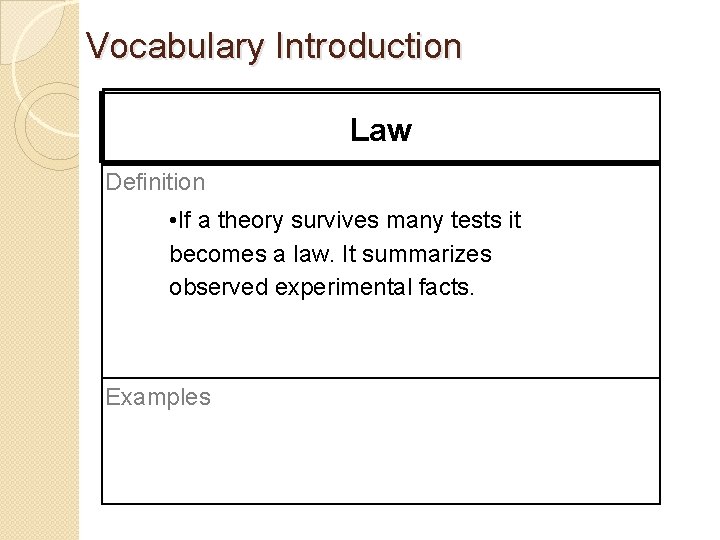
Vocabulary Introduction Law Definition • If a theory survives many tests it becomes a law. It summarizes observed experimental facts. Examples
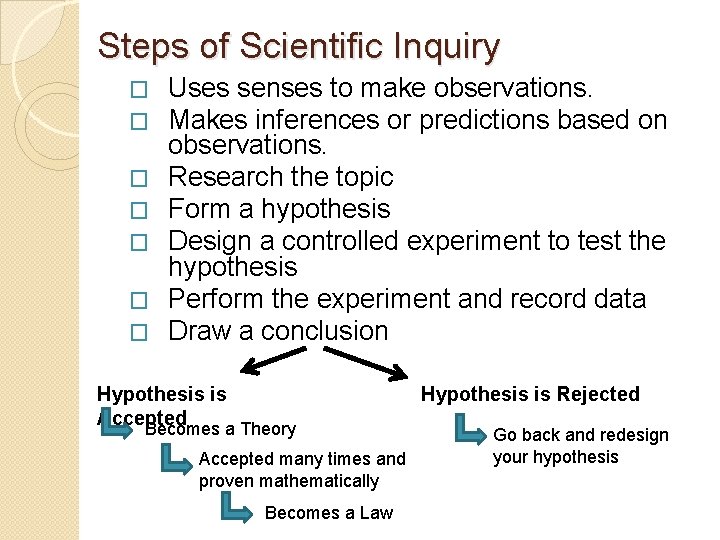
Steps of Scientific Inquiry � � � � Uses senses to make observations. Makes inferences or predictions based on observations. Research the topic Form a hypothesis Design a controlled experiment to test the hypothesis Perform the experiment and record data Draw a conclusion Hypothesis is Accepted Hypothesis is Rejected Becomes a Theory Accepted many times and proven mathematically Becomes a Law Go back and redesign your hypothesis
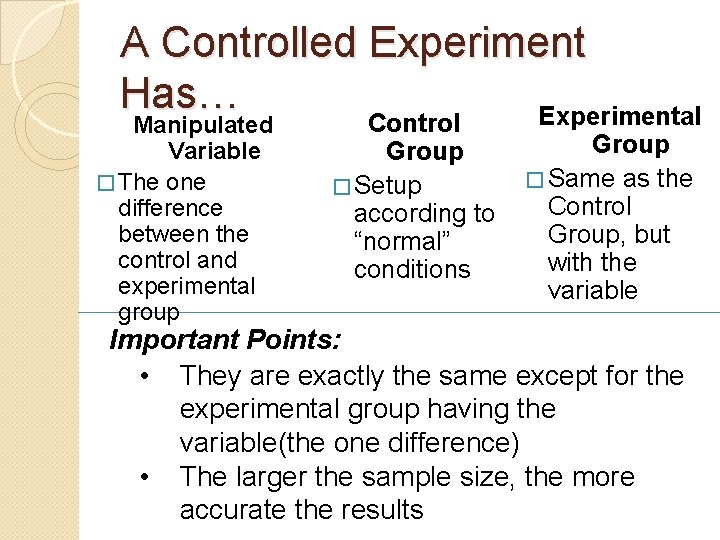
A Controlled Experiment Has… Experimental Manipulated Variable � The one difference between the control and experimental group Control Group � Setup according to “normal” conditions Group � Same as the Control Group, but with the variable Important Points: • They are exactly the same except for the experimental group having the variable(the one difference) • The larger the sample size, the more accurate the results
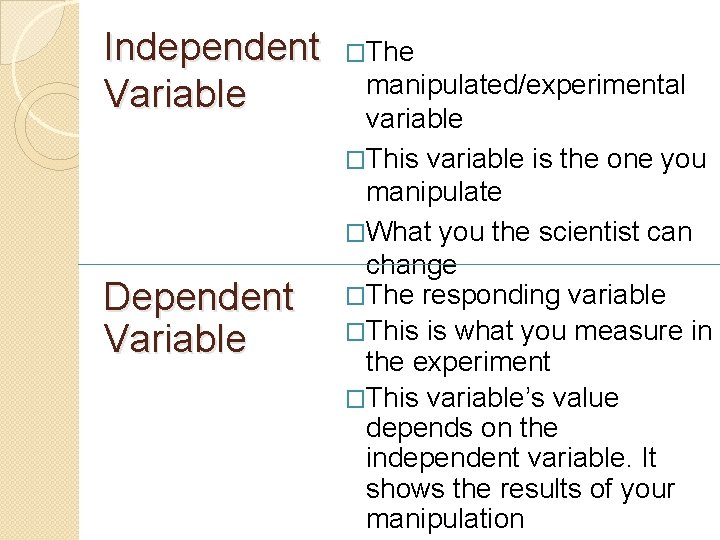
Independent Variable Dependent Variable �The manipulated/experimental variable �This variable is the one you manipulate �What you the scientist can change �The responding variable �This is what you measure in the experiment �This variable’s value depends on the independent variable. It shows the results of your manipulation
Hypothesis Formation If �The conditions you are setting up (control group vs. experimental group) Then �Your predicted results. Includes the dependent variable. (what you think will happen) (what your measured results will be) Becaus �Your explanation for your e predicted results. (why)
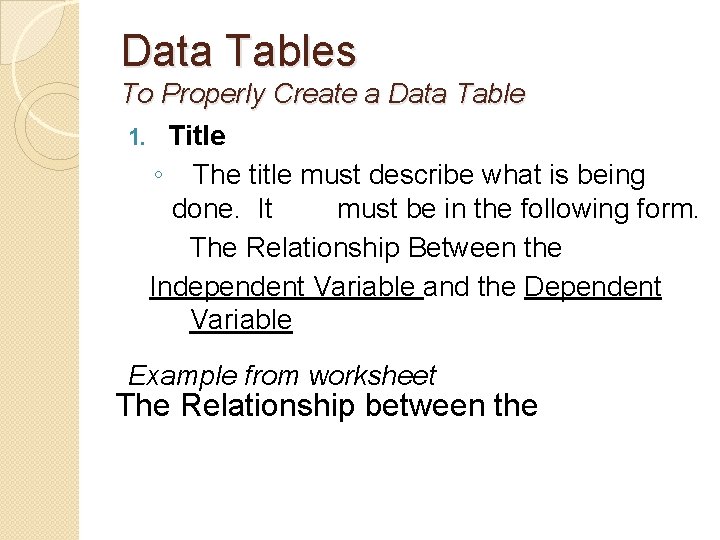
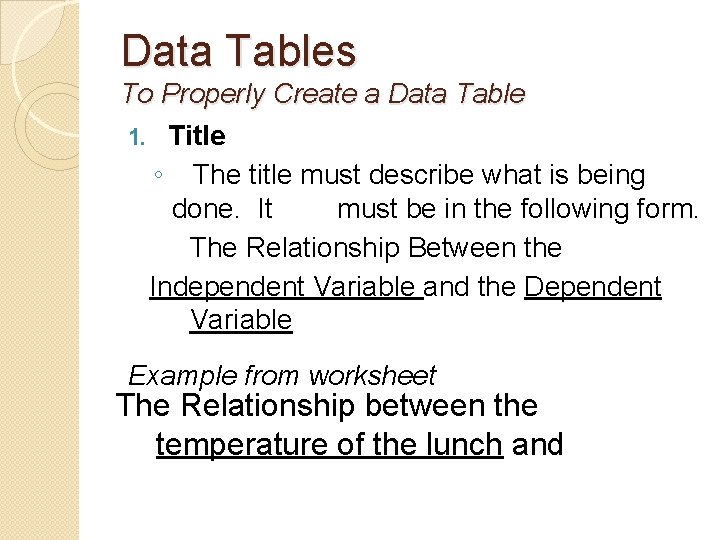
Data Tables To Properly Create a Data Table 1. Title ◦ The title must describe what is being done. It must be in the following form. The Relationship Between the Independent Variable and the Dependent Variable Example from worksheet The Relationship between the
Data Tables To Properly Create a Data Table 1. Title ◦ The title must describe what is being done. It must be in the following form. The Relationship Between the Independent Variable and the Dependent Variable Example from worksheet The Relationship between the temperature of the lunch and
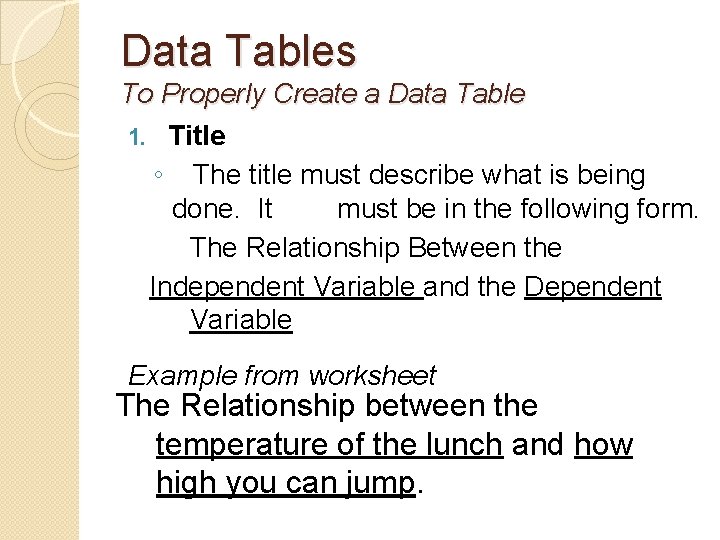
Data Tables To Properly Create a Data Table 1. Title ◦ The title must describe what is being done. It must be in the following form. The Relationship Between the Independent Variable and the Dependent Variable Example from worksheet The Relationship between the temperature of the lunch and how high you can jump.
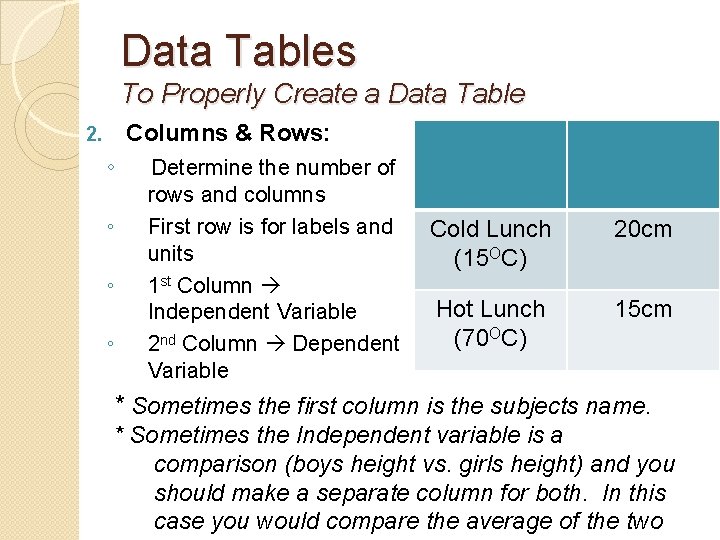
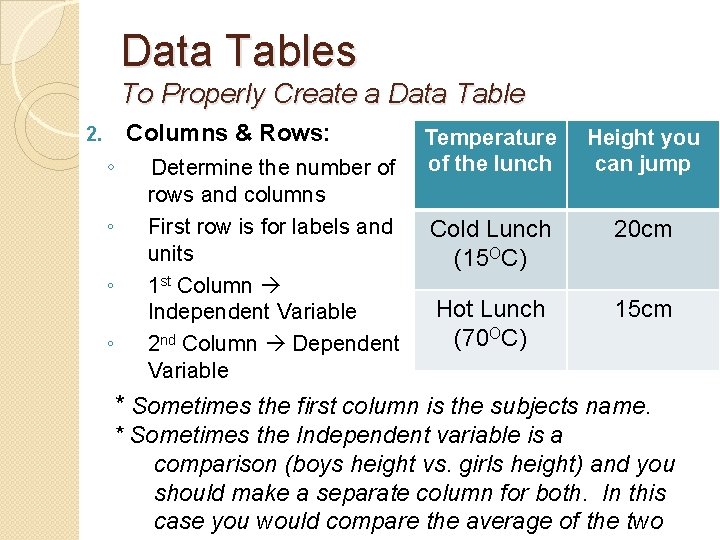
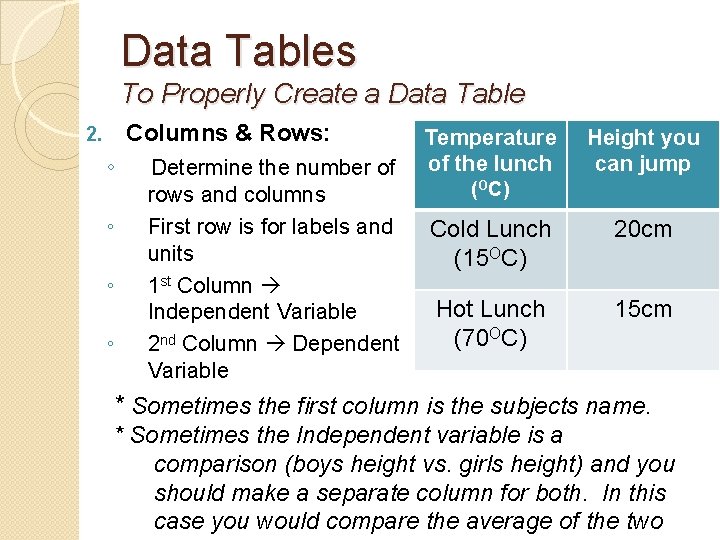
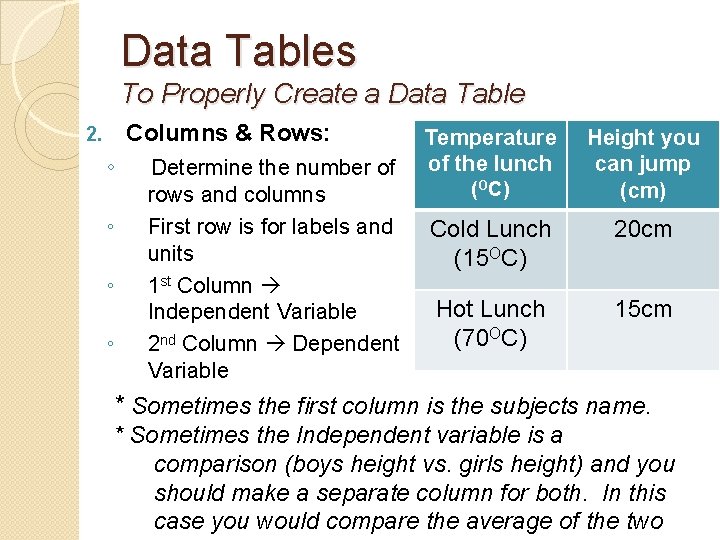
Data Tables To Properly Create a Data Table Columns & Rows: 2. ◦ ◦ Determine the number of rows and columns First row is for labels and units 1 st Column Independent Variable 2 nd Column Dependent Variable Cold Lunch (15 OC) 20 cm Hot Lunch (70 OC) 15 cm * Sometimes the first column is the subjects name. * Sometimes the Independent variable is a comparison (boys height vs. girls height) and you should make a separate column for both. In this case you would compare the average of the two
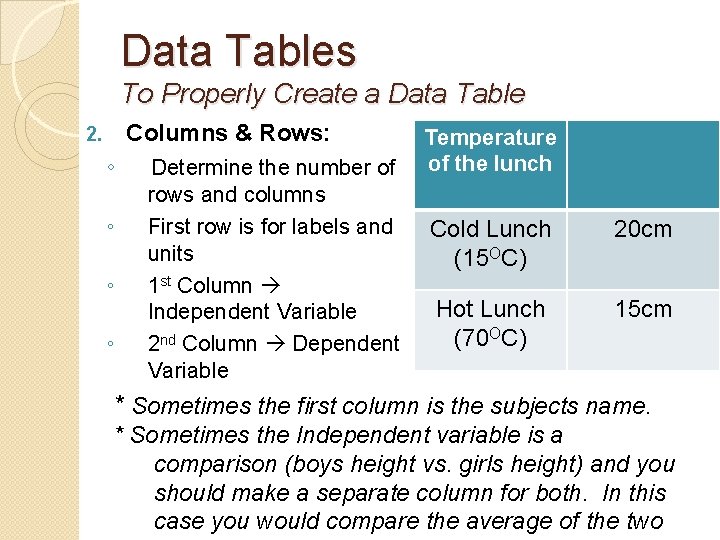
Data Tables To Properly Create a Data Table Columns & Rows: 2. ◦ ◦ Determine the number of rows and columns First row is for labels and units 1 st Column Independent Variable 2 nd Column Dependent Variable Temperature of the lunch Cold Lunch (15 OC) 20 cm Hot Lunch (70 OC) 15 cm * Sometimes the first column is the subjects name. * Sometimes the Independent variable is a comparison (boys height vs. girls height) and you should make a separate column for both. In this case you would compare the average of the two
Data Tables To Properly Create a Data Table Columns & Rows: 2. ◦ ◦ Determine the number of rows and columns First row is for labels and units 1 st Column Independent Variable 2 nd Column Dependent Variable Temperature of the lunch Height you can jump Cold Lunch (15 OC) 20 cm Hot Lunch (70 OC) 15 cm * Sometimes the first column is the subjects name. * Sometimes the Independent variable is a comparison (boys height vs. girls height) and you should make a separate column for both. In this case you would compare the average of the two
Data Tables To Properly Create a Data Table Columns & Rows: 2. ◦ ◦ Determine the number of rows and columns First row is for labels and units 1 st Column Independent Variable 2 nd Column Dependent Variable Temperature of the lunch Height you can jump (OC) Cold Lunch (15 OC) 20 cm Hot Lunch (70 OC) 15 cm * Sometimes the first column is the subjects name. * Sometimes the Independent variable is a comparison (boys height vs. girls height) and you should make a separate column for both. In this case you would compare the average of the two
Data Tables To Properly Create a Data Table Columns & Rows: 2. ◦ ◦ Determine the number of rows and columns First row is for labels and units 1 st Column Independent Variable 2 nd Column Dependent Variable Temperature of the lunch (OC) Height you can jump (cm) Cold Lunch (15 OC) 20 cm Hot Lunch (70 OC) 15 cm * Sometimes the first column is the subjects name. * Sometimes the Independent variable is a comparison (boys height vs. girls height) and you should make a separate column for both. In this case you would compare the average of the two
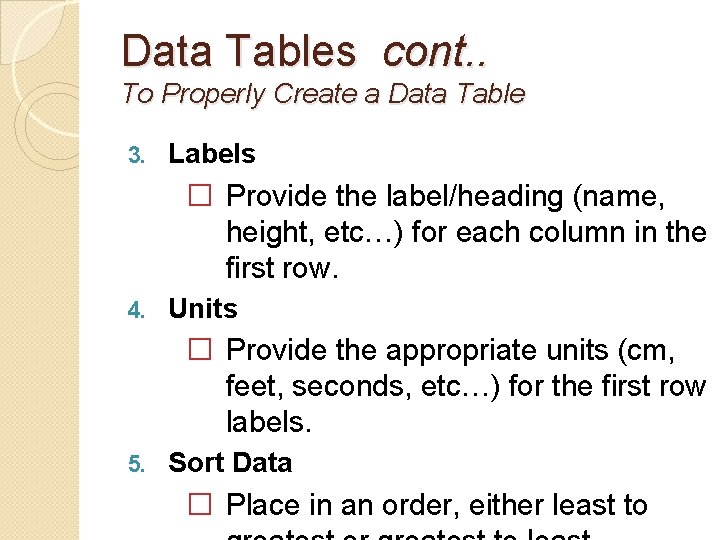
Data Tables cont. . To Properly Create a Data Table 3. Labels � Provide the label/heading (name, height, etc…) for each column in the first row. 4. Units � Provide the appropriate units (cm, feet, seconds, etc…) for the first row labels. 5. Sort Data � Place in an order, either least to
The Relationship Between ________ and _______
The Relationship Between A teacher’s hair color and _______
The Relationship Between A teacher’s hair color and how fast they run
The Relationship Between A teacher’s hair color and how fast they run Teachers Hair
The Relationship Between A teacher’s hair color and how fast they run Teachers Hair Speed
The Relationship Between A teacher’s hair color and how fast they run Teachers Hair (color) Speed
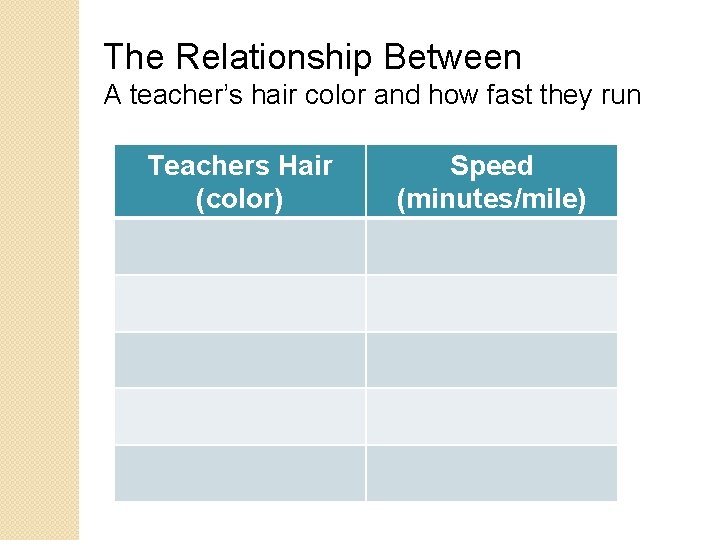
The Relationship Between A teacher’s hair color and how fast they run Teachers Hair (color) Speed (minutes/mile)
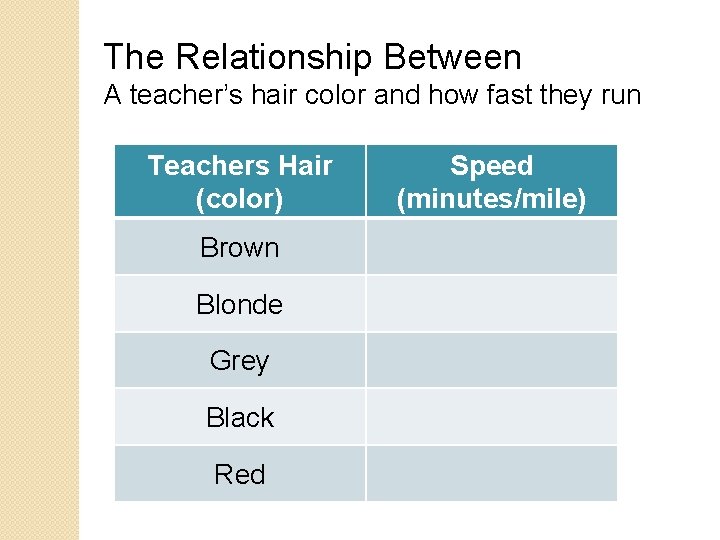
The Relationship Between A teacher’s hair color and how fast they run Teachers Hair (color) Brown Blonde Grey Black Red Speed (minutes/mile)
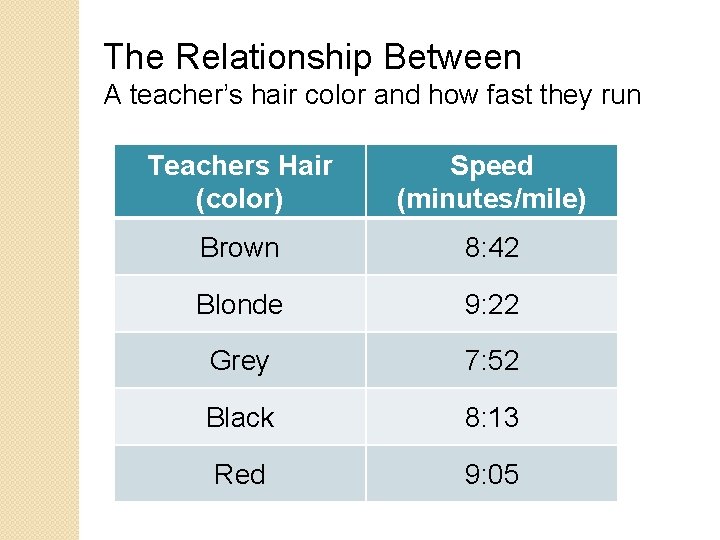
The Relationship Between A teacher’s hair color and how fast they run Teachers Hair (color) Speed (minutes/mile) Brown 8: 42 Blonde 9: 22 Grey 7: 52 Black 8: 13 Red 9: 05
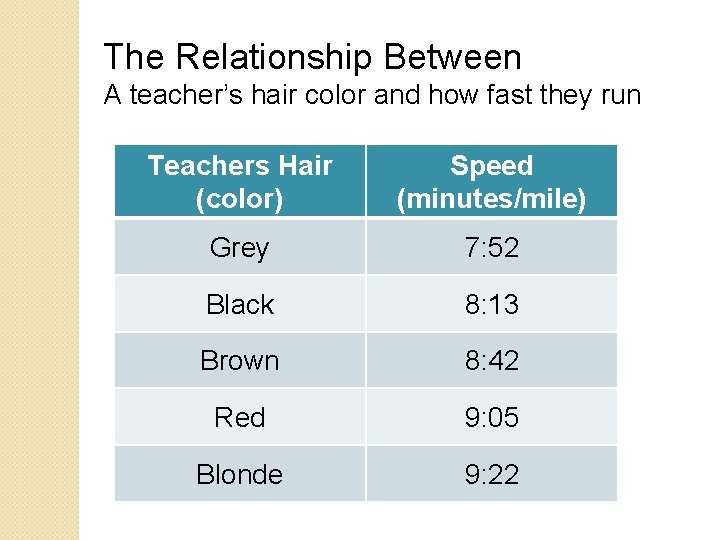
The Relationship Between A teacher’s hair color and how fast they run Teachers Hair (color) Speed (minutes/mile) Grey 7: 52 Black 8: 13 Brown 8: 42 Red 9: 05 Blonde 9: 22
The Relationship between ______ and _______
The Relationship between Pam cooking oil and _______
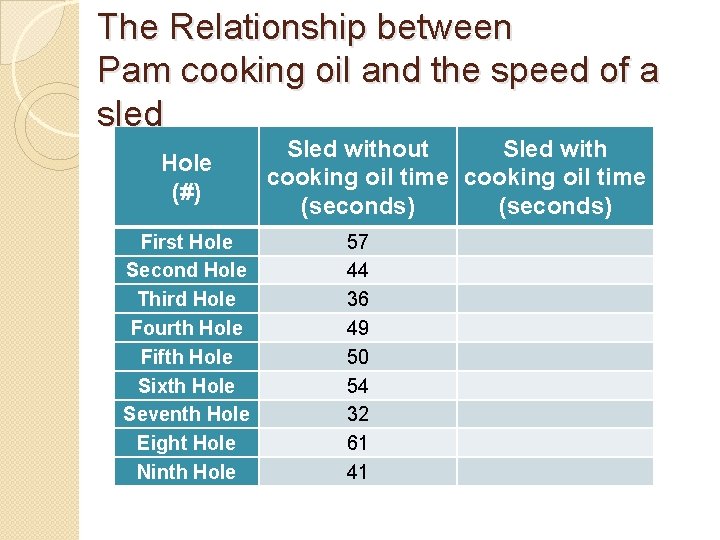
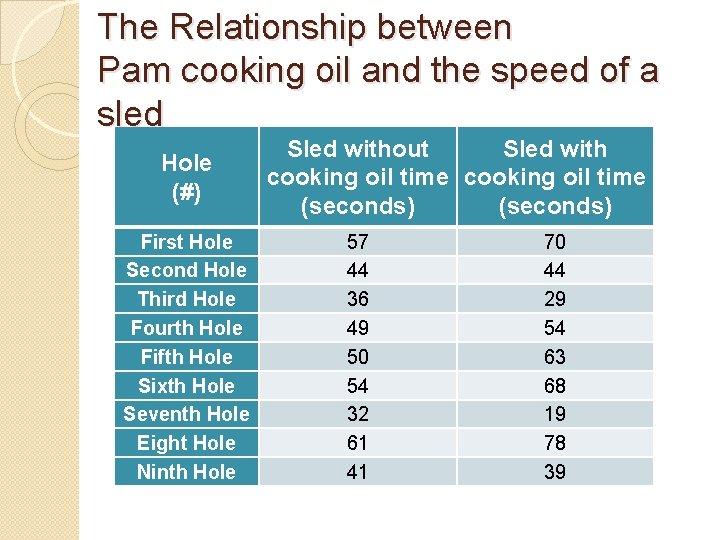
The Relationship between Pam cooking oil and the speed of a sled
The Relationship between Pam cooking oil and the speed of a sled Hole
The Relationship between Pam cooking oil and the speed of a sled Hole Sled without cooking oil time
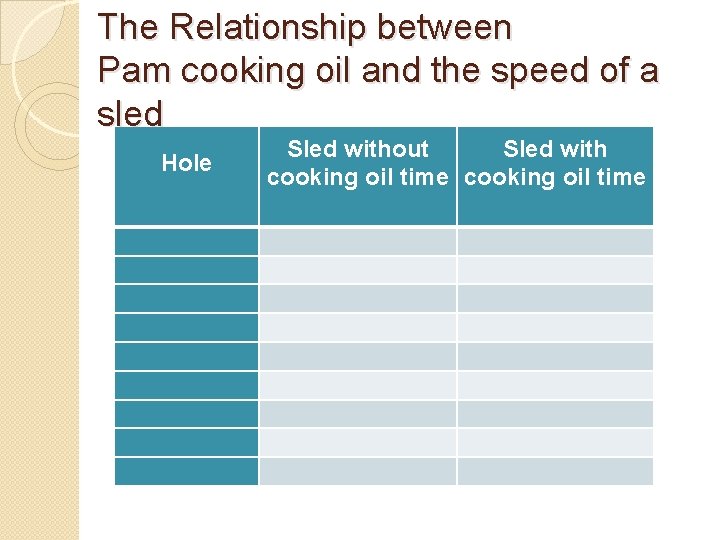
The Relationship between Pam cooking oil and the speed of a sled Hole Sled without Sled with cooking oil time
The Relationship between Pam cooking oil and the speed of a sled Hole (#) Sled without Sled with cooking oil time
The Relationship between Pam cooking oil and the speed of a sled Hole (#) Sled without Sled with cooking oil time (seconds)
The Relationship between Pam cooking oil and the speed of a sled Hole (#) Sled without Sled with cooking oil time (seconds)
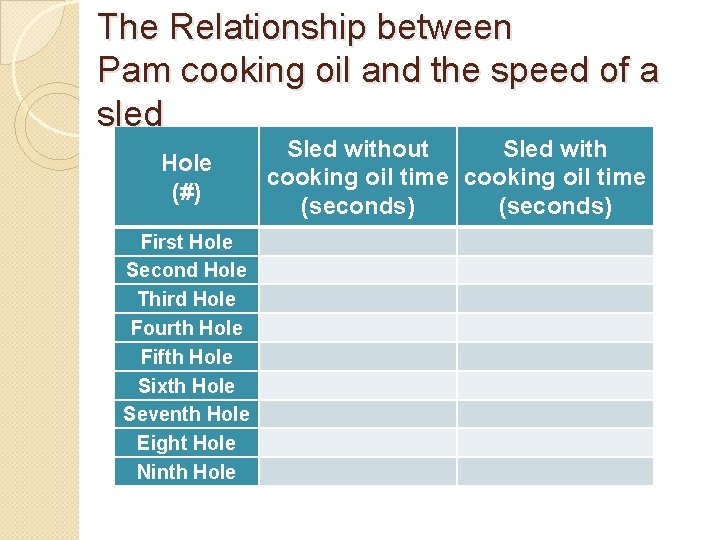
The Relationship between Pam cooking oil and the speed of a sled Hole (#) First Hole Second Hole Third Hole Fourth Hole Fifth Hole Sixth Hole Seventh Hole Eight Hole Ninth Hole Sled without Sled with cooking oil time (seconds)
The Relationship between Pam cooking oil and the speed of a sled Hole (#) First Hole Second Hole Third Hole Fourth Hole Fifth Hole Sixth Hole Seventh Hole Eight Hole Ninth Hole Sled without Sled with cooking oil time (seconds) 57 44 36 49 50 54 32 61 41
The Relationship between Pam cooking oil and the speed of a sled Hole (#) First Hole Second Hole Third Hole Fourth Hole Fifth Hole Sixth Hole Seventh Hole Eight Hole Ninth Hole Sled without Sled with cooking oil time (seconds) 57 44 36 49 50 54 32 61 41 70 44 29 54 63 68 19 78 39
Constructing a Graph �Graphs and charts are great because they communicate information visually. Graphs are often used in newspapers, magazines and businesses around the world.
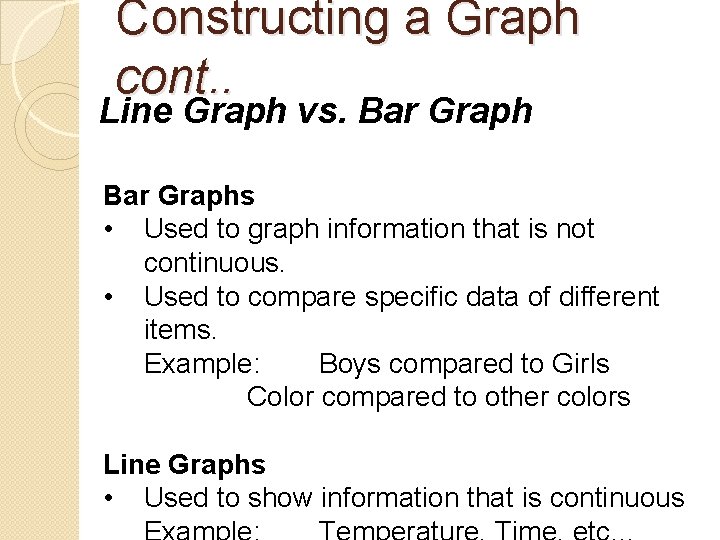
Constructing a Graph cont. . Line Graph vs. Bar Graphs • Used to graph information that is not continuous. • Used to compare specific data of different items. Example: Boys compared to Girls Color compared to other colors Line Graphs • Used to show information that is continuous
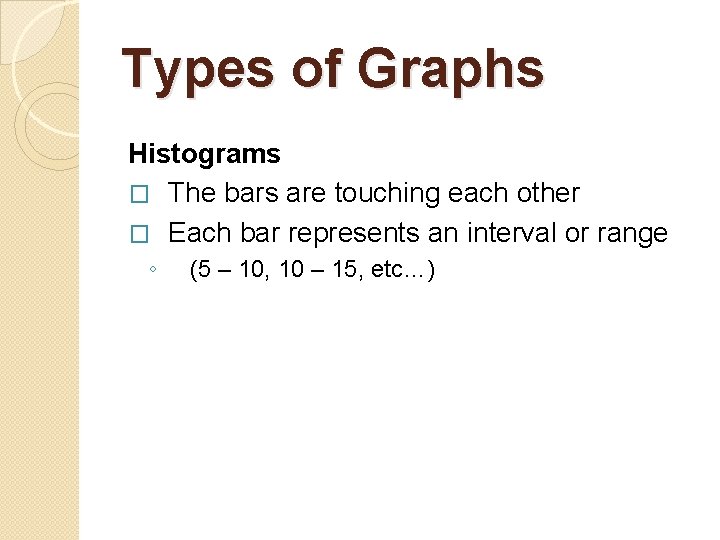
Types of Graphs Histograms � The bars are touching each other � Each bar represents an interval or range ◦ (5 – 10, 10 – 15, etc…)
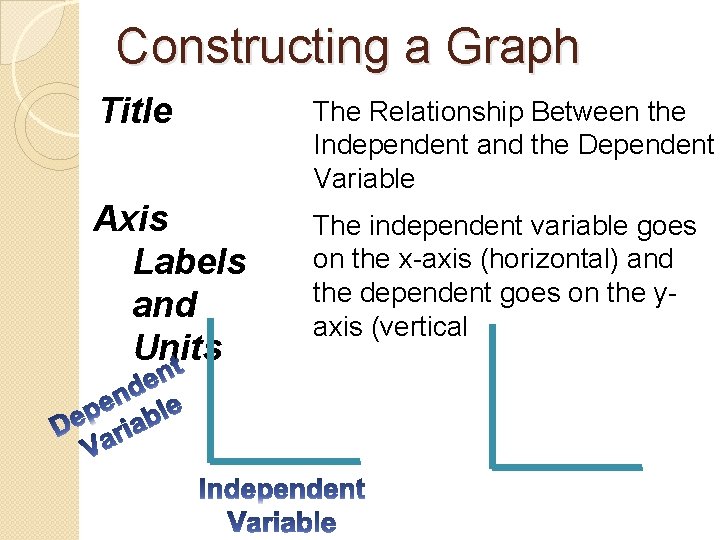
Constructing a Graph Title The Relationship Between the Independent and the Dependent Variable Axis Labels and Units The independent variable goes on the x-axis (horizontal) and the dependent goes on the yaxis (vertical
Constructing a Graph… Title: Relationship between the independent variable and the dependent variable. Axis: Independent Variable goes on the x-axis (horizontal) Dependent Variable goes on the y-axis (vertical) Labels & Units: Each axis must have a label and include the units in which you are measuring.
Constructing a Graph… Scaling: Numbering the Grid How to Scale A Graph 1. Count the Spaces in each axis 2. Divide the upper range of data by the number of spaces to get equal intervals on each line.
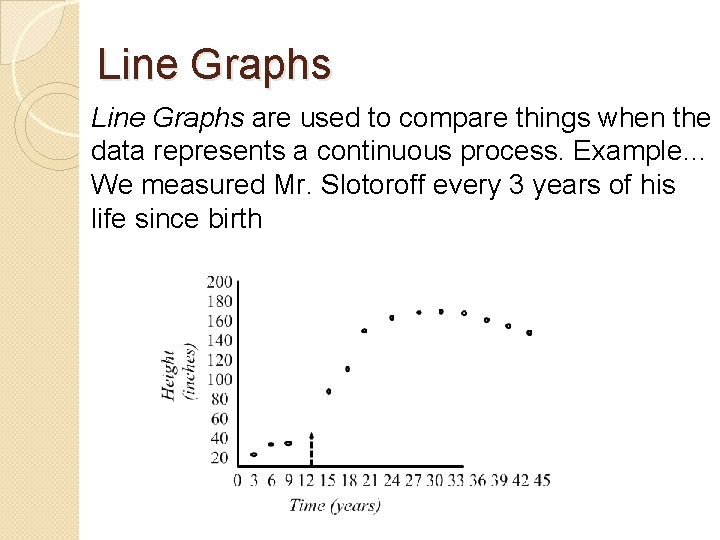
Line Graphs are used to compare things when the data represents a continuous process. Example… We measured Mr. Slotoroff every 3 years of his life since birth
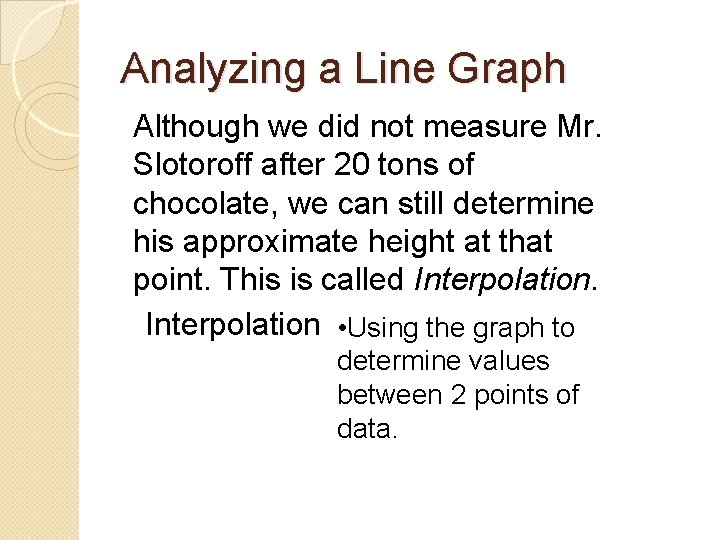
Analyzing a Line Graph Although we did not measure Mr. Slotoroff after 20 tons of chocolate, we can still determine his approximate height at that point. This is called Interpolation • Using the graph to determine values between 2 points of data.
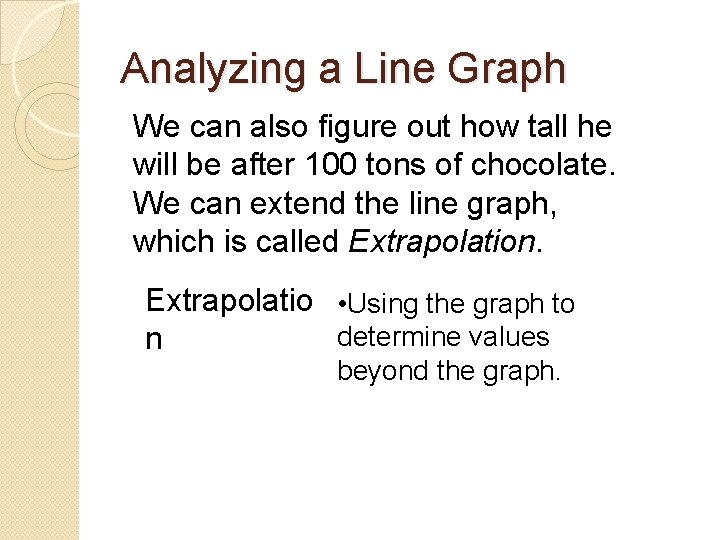
Analyzing a Line Graph We can also figure out how tall he will be after 100 tons of chocolate. We can extend the line graph, which is called Extrapolation. Extrapolatio • Using the graph to determine values n beyond the graph.
Trend Line The points on a line graph can be connected with a line because they represent a continuous relationship. When connecting the dots you are assuming that what happens between the dots is the same pattern as the dots themselves The dots make a pattern or trend. Scientists look at the trend of data, not the individual data points. To better represent the trend of data, they draw a trend line. This line is a better representation of the trend in the data than you would get connecting the dots
Old
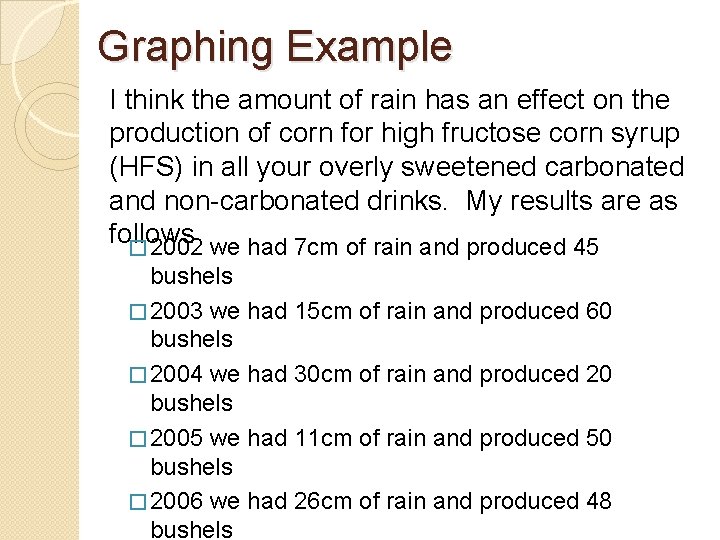
Graphing Example I think the amount of rain has an effect on the production of corn for high fructose corn syrup (HFS) in all your overly sweetened carbonated and non-carbonated drinks. My results are as follows � 2002 we had 7 cm of rain and produced 45 bushels � 2003 we had 15 cm of rain and produced 60 bushels � 2004 we had 30 cm of rain and produced 20 bushels � 2005 we had 11 cm of rain and produced 50 bushels � 2006 we had 26 cm of rain and produced 48 bushels