
SCIENTIFIC FOUNDATIONS OF PSYCHOLOGY CHAPTER 1 HISTORY AND

- Slides: 64
SCIENTIFIC FOUNDATIONS OF PSYCHOLOGY CHAPTER 1 HISTORY AND APPROACHES RESEARCH METHODS
WHAT IS PSYCHOLOGY? CHAPTER 1, SECTION 1 A, PAGES 1 -4 PURPLE BOOK: CHAPTER 1, SECTION 1 A, PAGES 4 -9
WHAT IS PSYCHOLOGY? • The scientific study of behavior and mental processes • Pseudopsychologies • Psychics, mediums, palmistry, psychometry, psychokinesis, astrology • It explains learning, remembering, communication, relating to others • Attempts to understand, measure, and explain the nature of intelligence, motivation, and personality
THE RANDI CHALLENGE • Uri Geller: https: //www. youtube. com/watch? v=N 3 v. GGf-ZIkc • https: //www. youtube. com/watch? v=x_Nu. ZDa. R 46 I • https: //web. randi. org/ • 1964 -2015 • 1, 000 -1, 000
GOALS OF PSYCHOLOGY • Describe, explain, predict, change/influence • Description- gather info about behavior and present conclusions • purely observational or correlational • Explanation- explain why people behave as they do • Able to manipulate variables to explain • Prediction- predict (from knowledge) what people will think or feel in different situations • Influence- influence behaviors in helpful ways • Basic science-research for its own sake • Applied science- use psychological findings to solve immediate problems • All accomplished using the scientific method
QUESTION • Imagine that you are a psychologist and a patient has arrived at your office to discuss their problem (shyness). Using the four goals of psychology, outline a possible plan to help the patient. Your plan should meet all the goals.
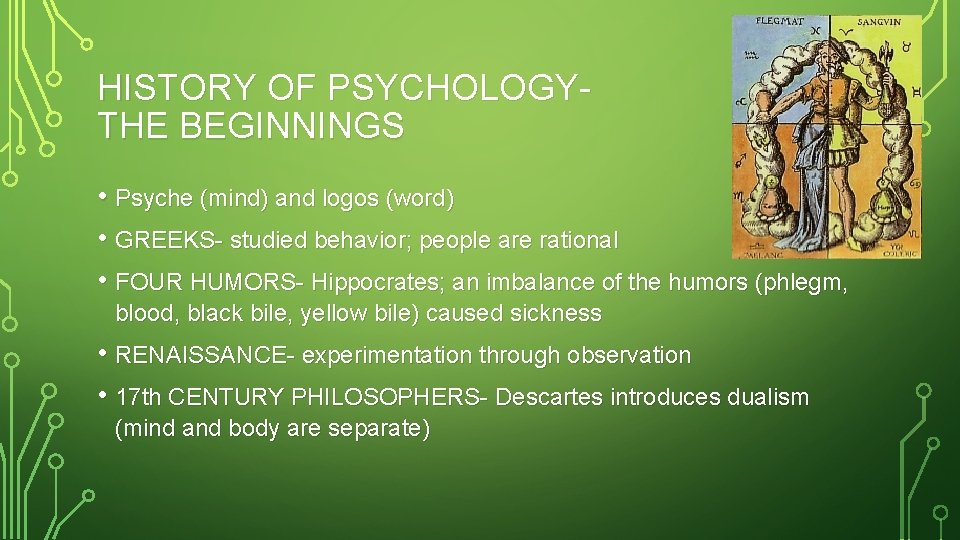
HISTORY OF PSYCHOLOGYTHE BEGINNINGS • Psyche (mind) and logos (word) • GREEKS- studied behavior; people are rational • FOUR HUMORS- Hippocrates; an imbalance of the humors (phlegm, blood, black bile, yellow bile) caused sickness • RENAISSANCE- experimentation through observation • 17 th CENTURY PHILOSOPHERS- Descartes introduces dualism (mind and body are separate)
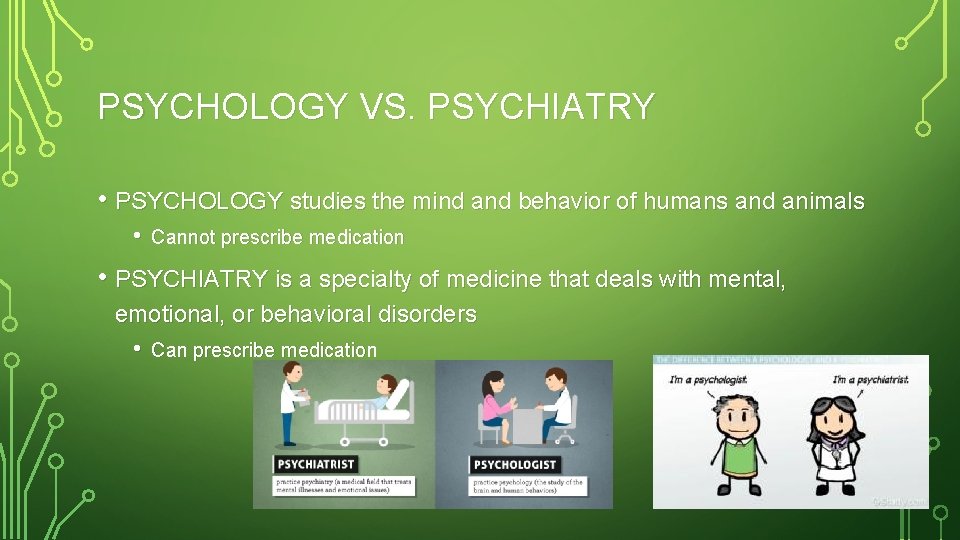
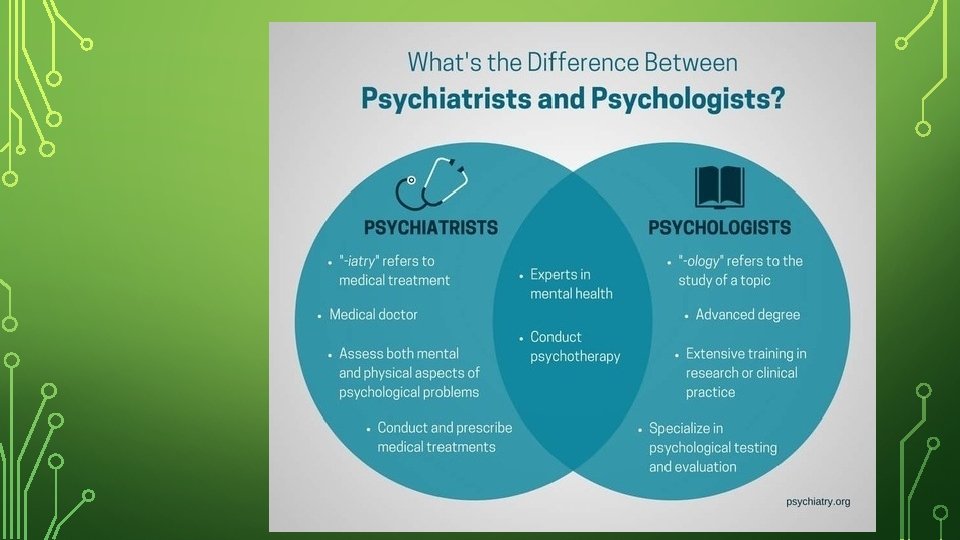
PSYCHOLOGY VS. PSYCHIATRY • PSYCHOLOGY studies the mind and behavior of humans and animals • Cannot prescribe medication • PSYCHIATRY is a specialty of medicine that deals with mental, emotional, or behavioral disorders • Can prescribe medication
ORIGINS OF PSYCHOLOGY: APPROACHES AND PERSPECTIVES OF PSYCHOLOGY CHAPTER 1, SECTION 1 B, PAGES 5 -12 PURPLE BOOK: CHAPTER 1, SECTION 2, PAGES 9 -15
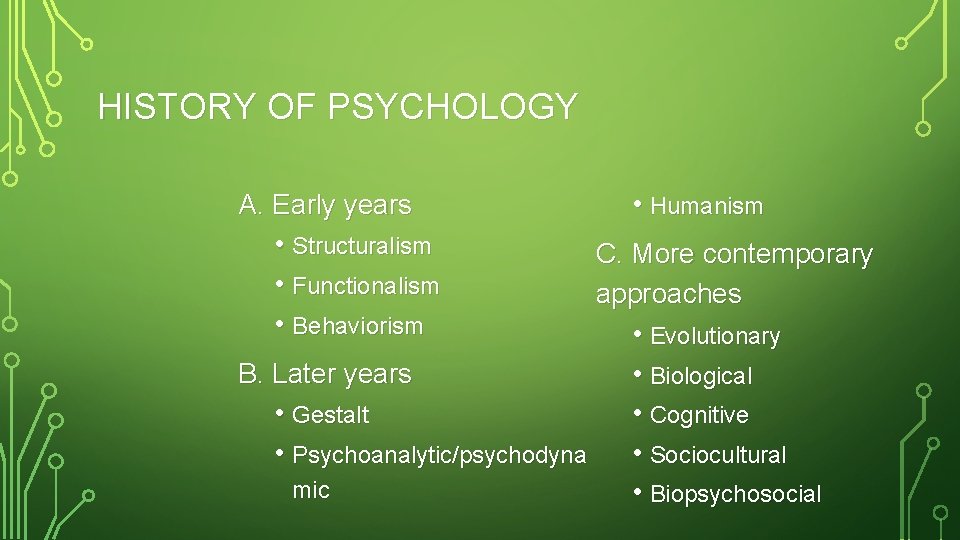
HISTORY OF PSYCHOLOGY A. Early years • Structuralism • Functionalism • Behaviorism B. Later years • Gestalt • Psychoanalytic/psychodyna mic • Humanism C. More contemporary approaches • Evolutionary • Biological • Cognitive • Sociocultural • Biopsychosocial
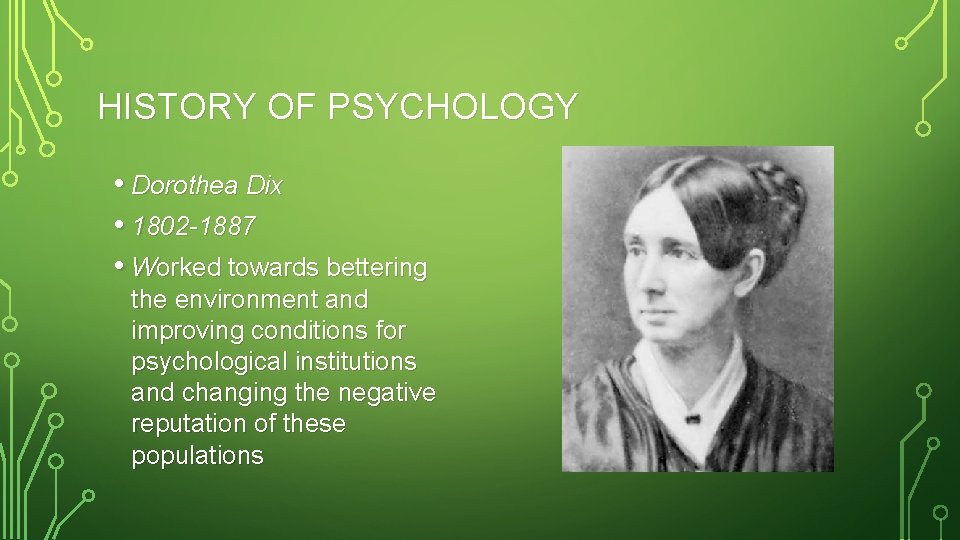
HISTORY OF PSYCHOLOGY • Dorothea Dix • 1802 -1887 • Worked towards bettering the environment and improving conditions for psychological institutions and changing the negative reputation of these populations
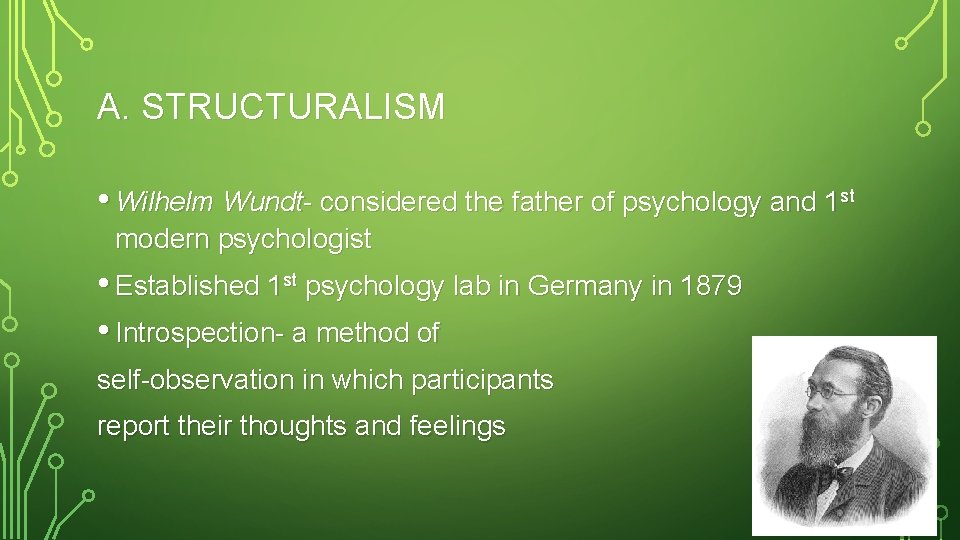
A. STRUCTURALISM • Wilhelm Wundt- considered the father of psychology and 1 st modern psychologist • Established 1 st psychology lab in Germany in 1879 • Introspection- a method of self-observation in which participants report their thoughts and feelings
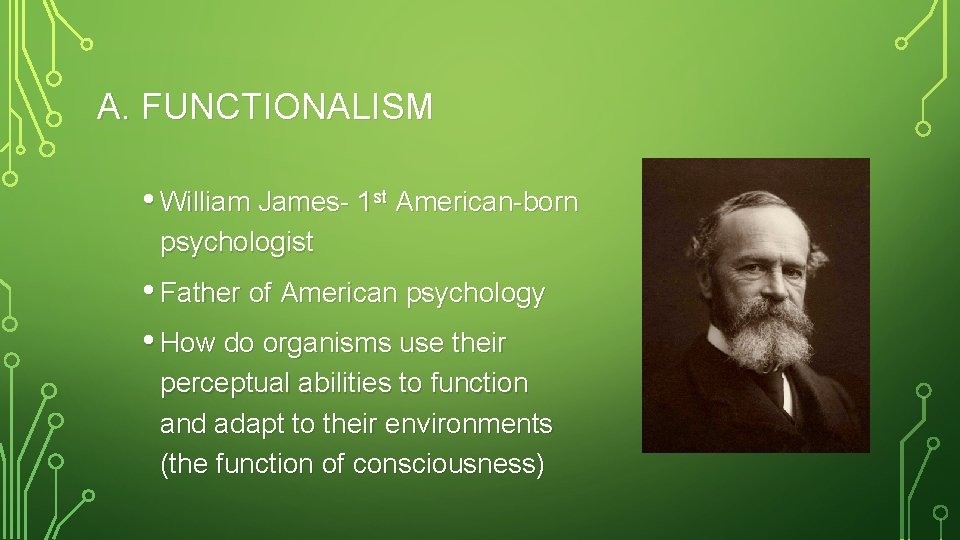
A. FUNCTIONALISM • William James- 1 st American-born psychologist • Father of American psychology • How do organisms use their perceptual abilities to function and adapt to their environments (the function of consciousness)
A. STRUCTURALISM VS. FUNCTIONALISM • • Structuralism- focus on the basic elements that make up conscious mental experiences • • Wilhelm Wundt and Edward Titchener • Self-observation led to disagreement, cannot study animals, failed except for leading to study scientifically Identify the elements of thoughts, then determine how these elements combine to form the whole experience Functionalism- how the mind functions to adapt human and nonhumans to the environment • • William James Ask why do we have the emotion of anger? What function does it serve? How does it help us adapt to the environment?
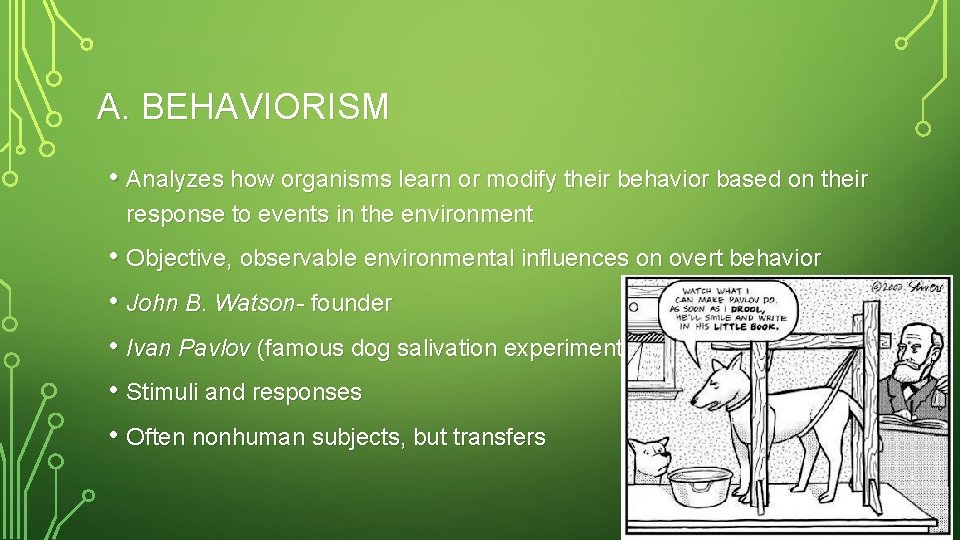
A. BEHAVIORISM • Analyzes how organisms learn or modify their behavior based on their response to events in the environment • Objective, observable environmental influences on overt behavior • John B. Watson- founder • Ivan Pavlov (famous dog salivation experiment) • Stimuli and responses • Often nonhuman subjects, but transfers
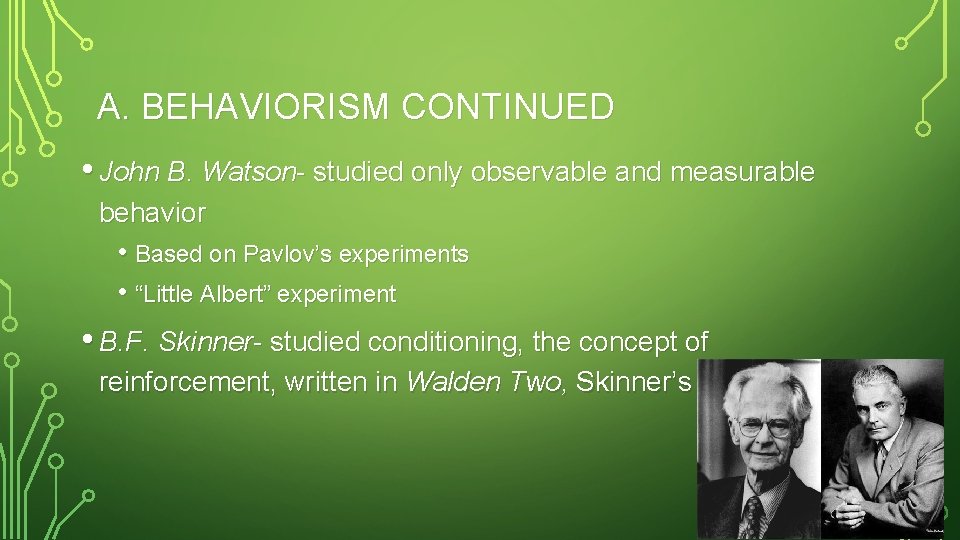
A. BEHAVIORISM CONTINUED • John B. Watson- studied only observable and measurable behavior • Based on Pavlov’s experiments • “Little Albert” experiment • B. F. Skinner- studied conditioning, the concept of reinforcement, written in Walden Two, Skinner’s box with rat
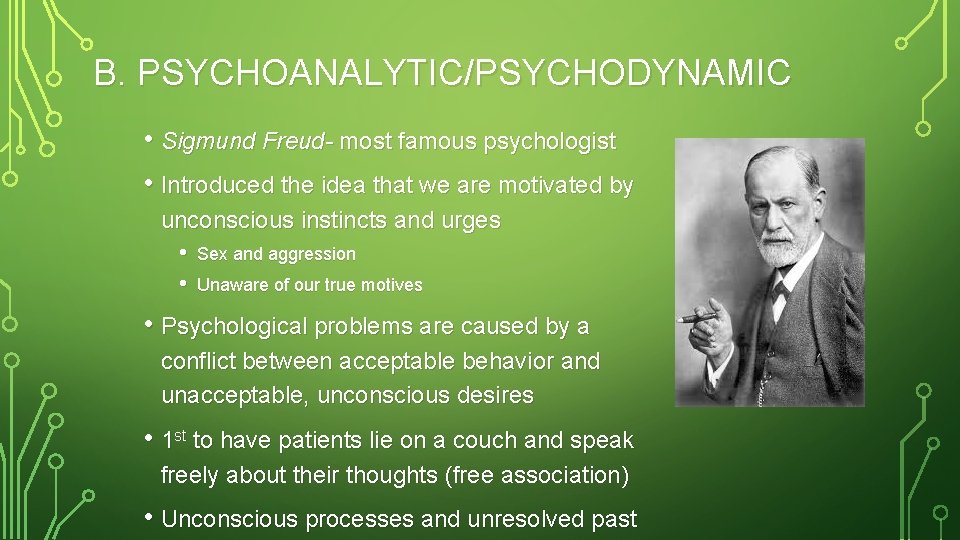
B. PSYCHOANALYTIC/PSYCHODYNAMIC • Sigmund Freud- most famous psychologist • Introduced the idea that we are motivated by unconscious instincts and urges • Sex and aggression • Unaware of our true motives • Psychological problems are caused by a conflict between acceptable behavior and unacceptable, unconscious desires • 1 st to have patients lie on a couch and speak freely about their thoughts (free association) • Unconscious processes and unresolved past
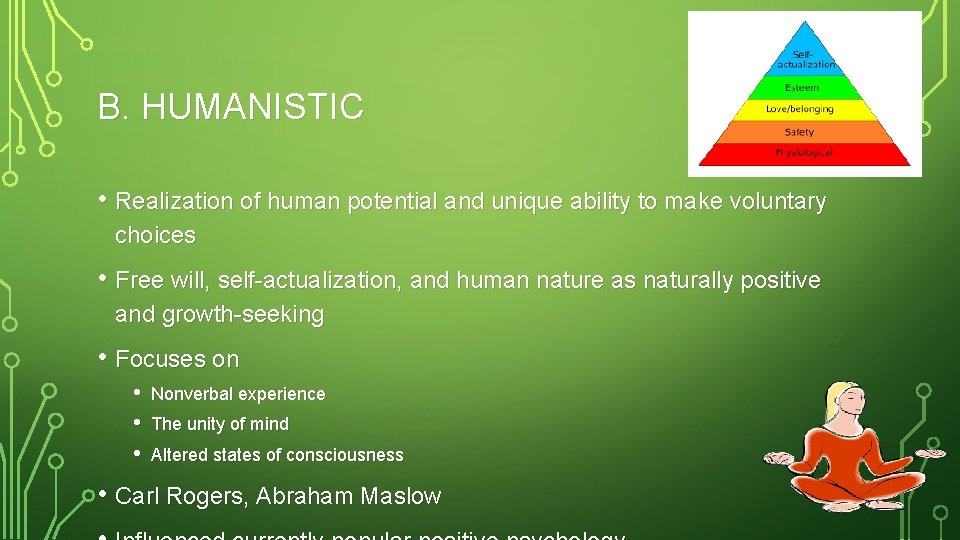
B. HUMANISTIC • Realization of human potential and unique ability to make voluntary choices • Free will, self-actualization, and human nature as naturally positive and growth-seeking • Focuses on • • • Nonverbal experience The unity of mind Altered states of consciousness • Carl Rogers, Abraham Maslow
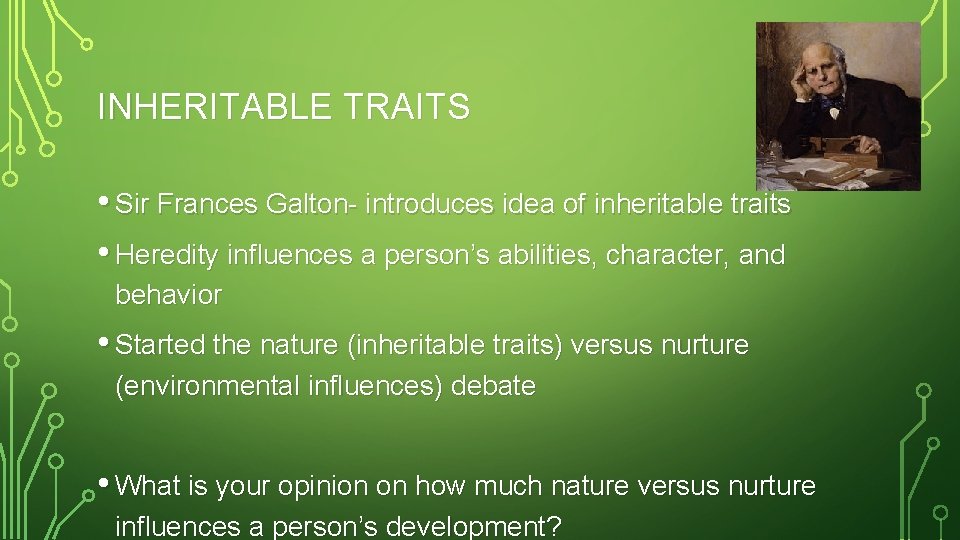
INHERITABLE TRAITS • Sir Frances Galton- introduces idea of inheritable traits • Heredity influences a person’s abilities, character, and behavior • Started the nature (inheritable traits) versus nurture (environmental influences) debate • What is your opinion on how much nature versus nurture influences a person’s development?
B. GESTALT • Studied how people perceive and experience objects as whole patterns • Emphasizes that the whole of anything is greater than its parts, we cannot deduce the value of the whole by just looking at the individual traits • Uses phenomenology- description of direct psychological experience, adding a humanistic approach • Max Wertheimer, Wolfgang Kohler, Kurt Koffka
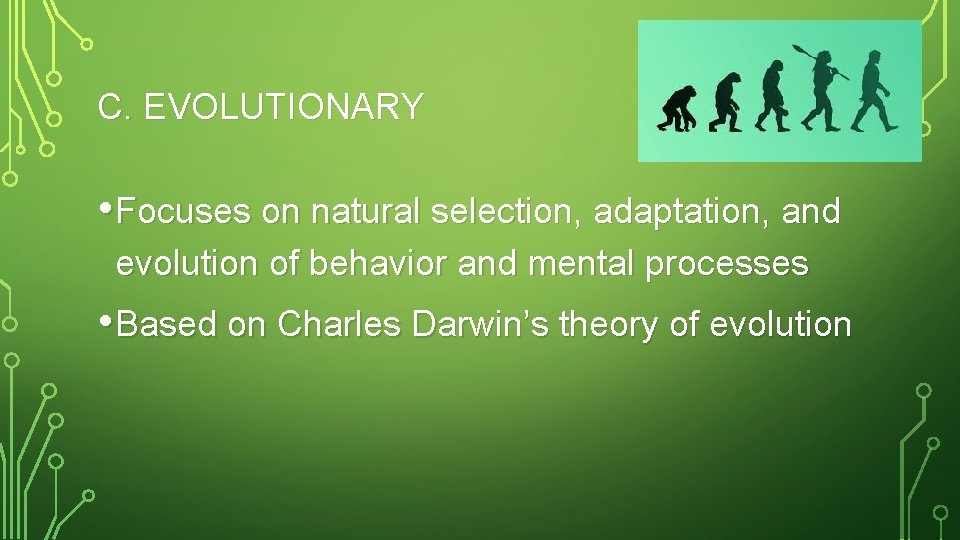
C. EVOLUTIONARY • Focuses on natural selection, adaptation, and evolution of behavior and mental processes • Based on Charles Darwin’s theory of evolution
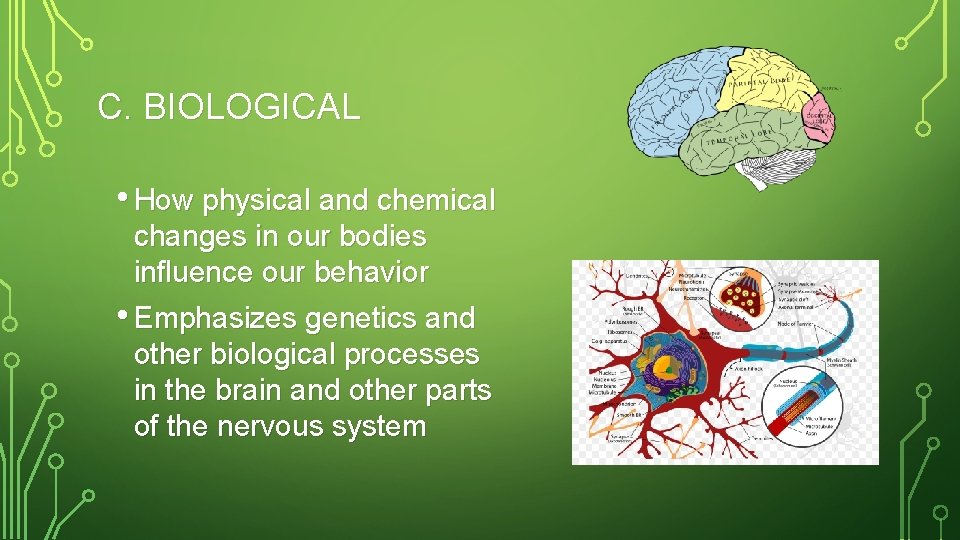
C. BIOLOGICAL • How physical and chemical changes in our bodies influence our behavior • Emphasizes genetics and other biological processes in the brain and other parts of the nervous system
C. COGNITIVE • Studies mental processes/information processing • How we process, store, retrieve, and use information and how thought processes influence our behavior • Thinking, feeling, learning, remembering, making judgements
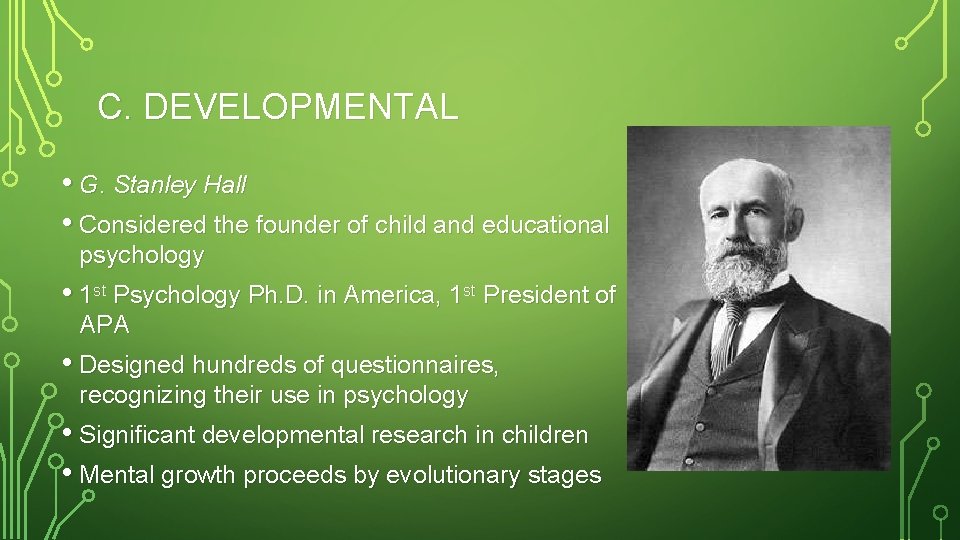
C. DEVELOPMENTAL • G. Stanley Hall • Considered the founder of child and educational psychology • 1 st Psychology Ph. D. in America, 1 st President of APA • Designed hundreds of questionnaires, recognizing their use in psychology • Significant developmental research in children • Mental growth proceeds by evolutionary stages
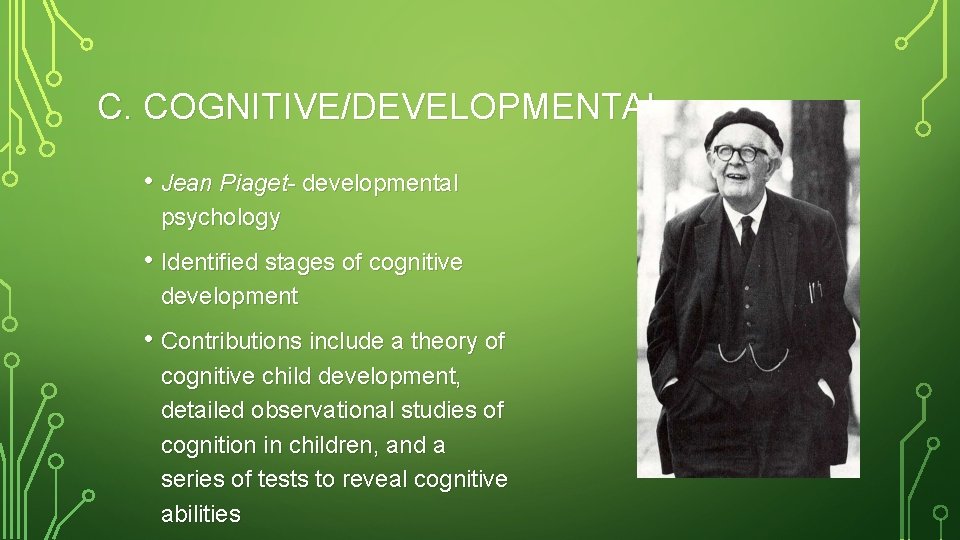
C. COGNITIVE/DEVELOPMENTAL • Jean Piaget- developmental psychology • Identified stages of cognitive development • Contributions include a theory of cognitive child development, detailed observational studies of cognition in children, and a series of tests to reveal cognitive abilities
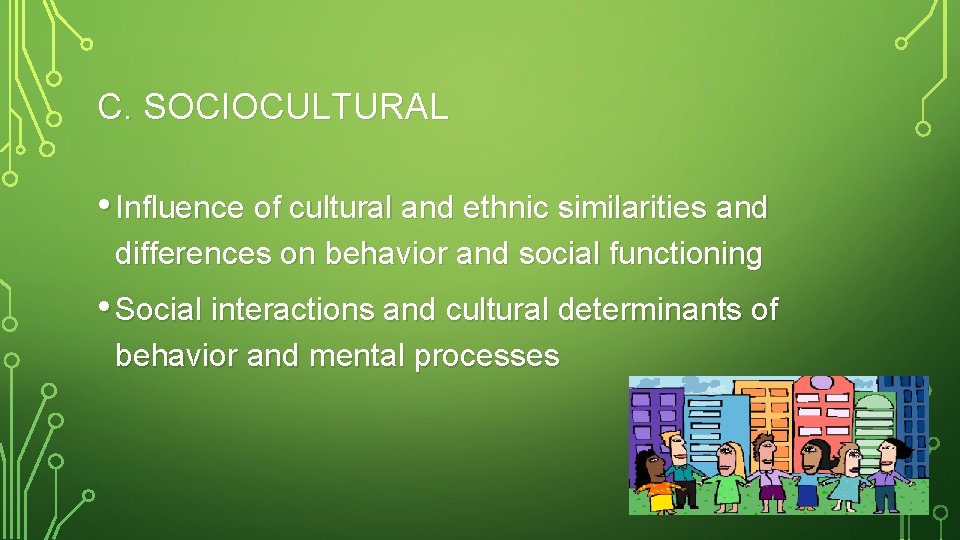
C. SOCIOCULTURAL • Influence of cultural and ethnic similarities and differences on behavior and social functioning • Social interactions and cultural determinants of behavior and mental processes
EXAMPLE OF APPROACHES: AGGRESSION • Behaviorists- we learn at an early age that it can be advantageous • Cognitive- thoughts contributing to aggressing • Biopsychologists- results from neurotransmitters, hormones, and structures • Evolutionary- conveys a survival or reproductive advantage that evolved from successfully facing pressures
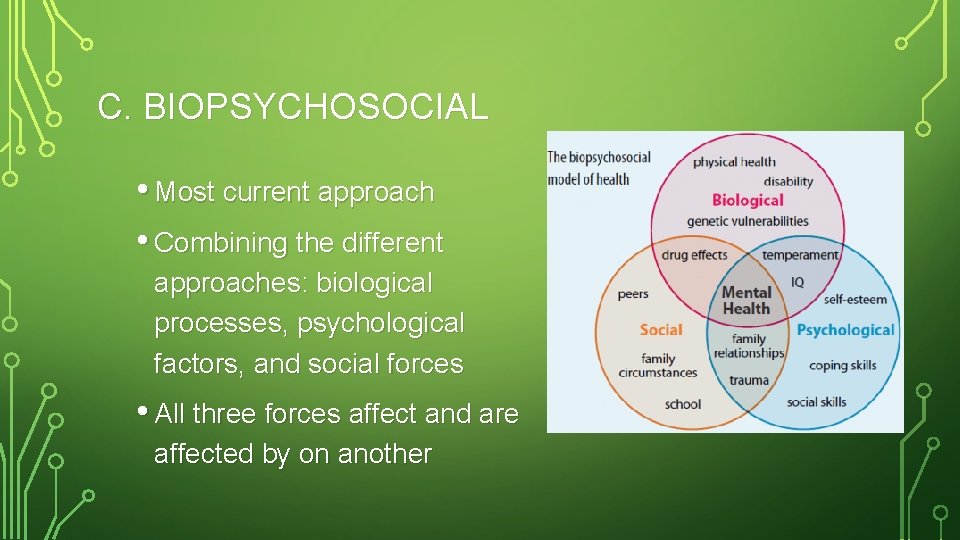
C. BIOPSYCHOSOCIAL • Most current approach • Combining the different approaches: biological processes, psychological factors, and social forces • All three forces affect and are affected by on another
APPLICATION OF PSYCHOLOGY: PSYCHOLOGY AS A PROFESSION
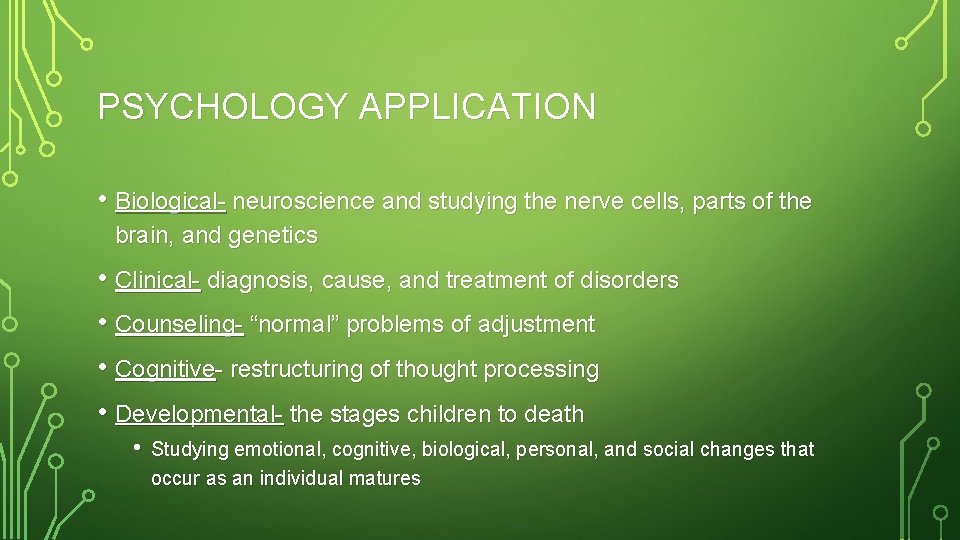
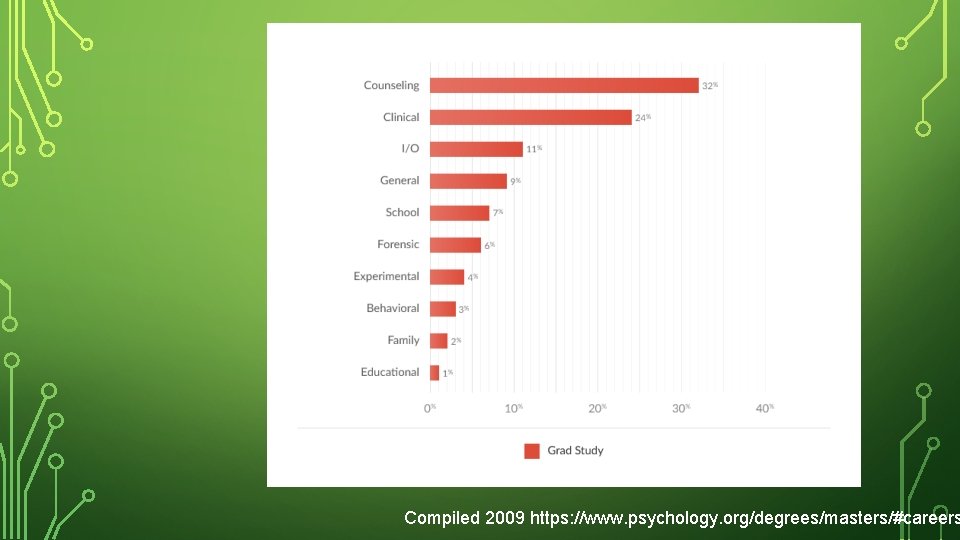
PSYCHOLOGY APPLICATION • Biological- neuroscience and studying the nerve cells, parts of the brain, and genetics • Clinical- diagnosis, cause, and treatment of disorders • Counseling- “normal” problems of adjustment • Cognitive- restructuring of thought processing • Developmental- the stages children to death • Studying emotional, cognitive, biological, personal, and social changes that occur as an individual matures
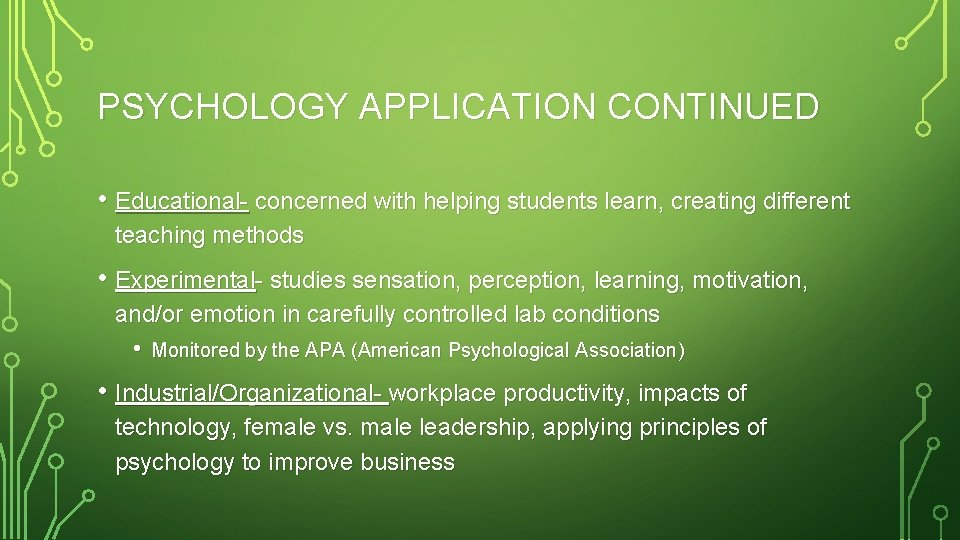
PSYCHOLOGY APPLICATION CONTINUED • Educational- concerned with helping students learn, creating different teaching methods • Experimental- studies sensation, perception, learning, motivation, and/or emotion in carefully controlled lab conditions • Monitored by the APA (American Psychological Association) • Industrial/Organizational- workplace productivity, impacts of technology, female vs. male leadership, applying principles of psychology to improve business
Compiled 2009 https: //www. psychology. org/degrees/masters/#careers
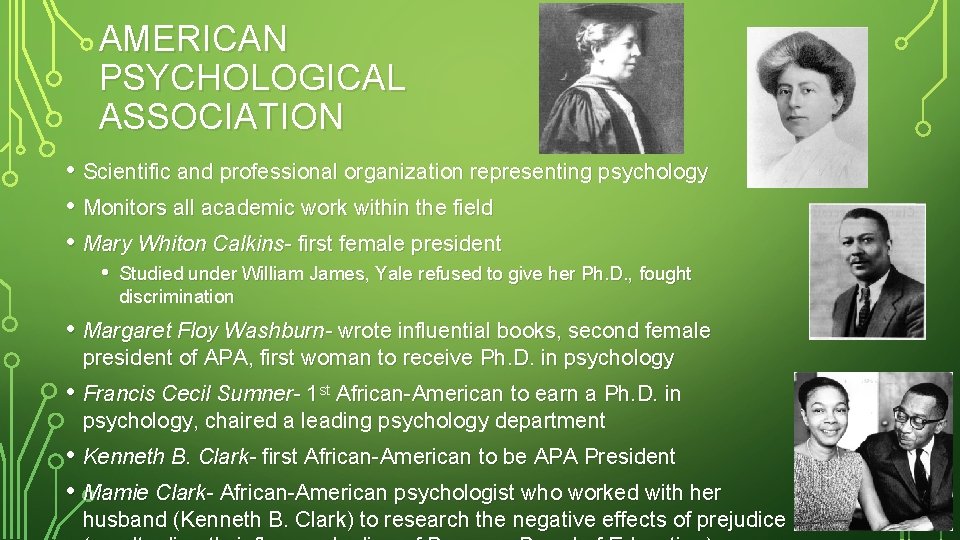
AMERICAN PSYCHOLOGICAL ASSOCIATION • Scientific and professional organization representing psychology • Monitors all academic work within the field • Mary Whiton Calkins- first female president • Studied under William James, Yale refused to give her Ph. D. , fought discrimination • Margaret Floy Washburn- wrote influential books, second female president of APA, first woman to receive Ph. D. in psychology • Francis Cecil Sumner- 1 st African-American to earn a Ph. D. in psychology, chaired a leading psychology department • Kenneth B. Clark- first African-American to be APA President • Mamie Clark- African-American psychologist who worked with her husband (Kenneth B. Clark) to research the negative effects of prejudice
THE SCIENCE OF PSYCHOLOGY CHAPTER 1, SECTION 2, PAGES 13 -19 CHAPTER 1, SECTION 3, PAGES 16 -20
BASIC VS. APPLIED • Basic research- knowledge for its own sake • Applied research- using that knowledge to change existing world problems
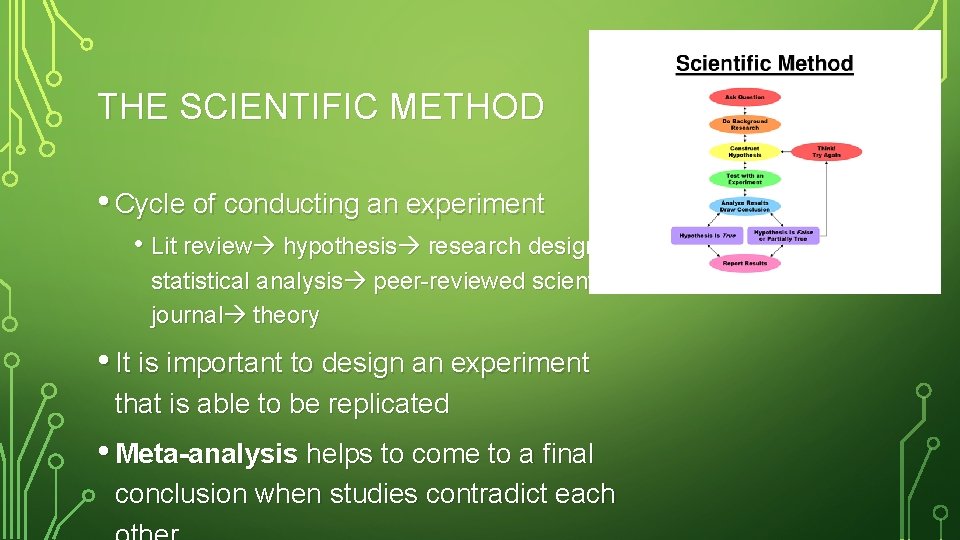
THE SCIENTIFIC METHOD • Cycle of conducting an experiment • Lit review hypothesis research design statistical analysis peer-reviewed scientific journal theory • It is important to design an experiment that is able to be replicated • Meta-analysis helps to come to a final conclusion when studies contradict each
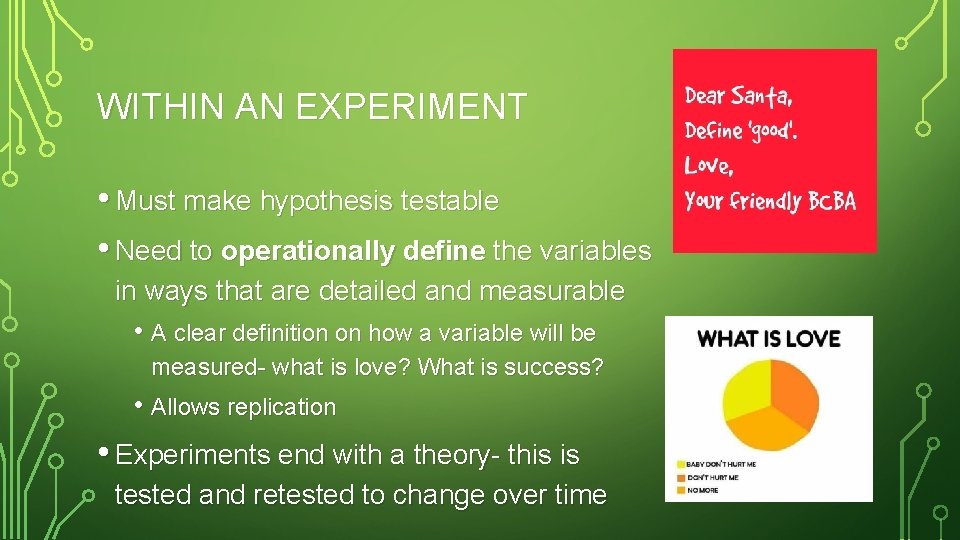
WITHIN AN EXPERIMENT • Must make hypothesis testable • Need to operationally define the variables in ways that are detailed and measurable • A clear definition on how a variable will be measured- what is love? What is success? • Allows replication • Experiments end with a theory- this is tested and retested to change over time
ETHICAL GUIDELINES FROM THE APA: HUMAN PARTICIPANTS • Informed consent • Voluntary participation • Restricted use of deception and debriefing • Confidentiality • Alternative activities
ETHICAL GUIDELINES FROM THE APA: NONHUMAN PARTICIPANTS (ANIMALS) • Beneficial for comparative psychology- animals can be studied for a long time and have aspects of their lives controlled that would be unethical on humans • Much advancement has been made with animal research for human and animal
ETHICAL GUIDELINES FROM THE APA: CLIENTS IN THERAPY • In general, therapists must keep all information about a client private • They may break this in certain cases • The client threatens violence to him/herself or others • A criminal case- abusing a child, etc. • Public safety comes first • Anyone who violates APA codes can face varying consequences
RESEARCH METHODS CHAPTER 1, SECTION 3, PAGES 20 -31 PURPLE BOOK: CHAPTER 1, SECTION 4, PAGES 21 -36
TYPES OF RESEARCH • Experimental • Descriptive • Correlational • Biological
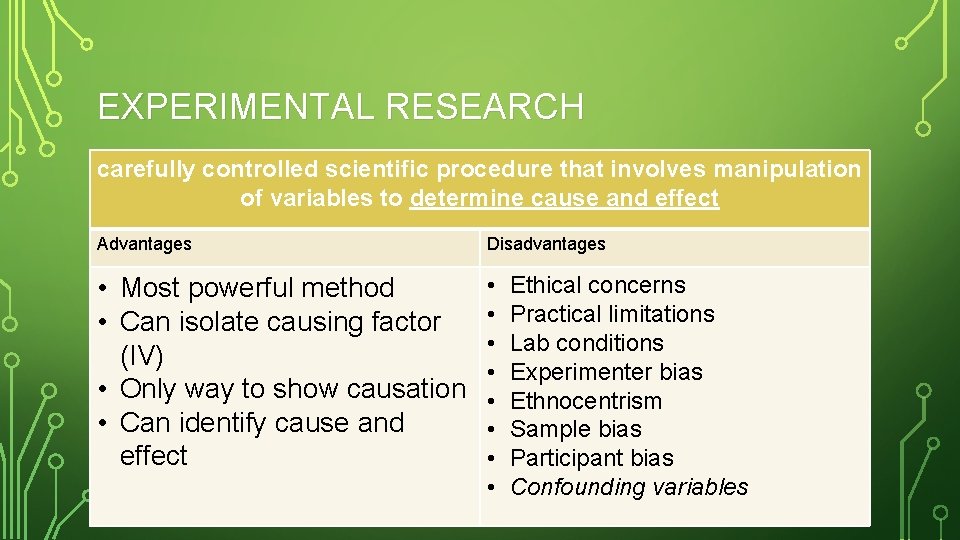
EXPERIMENTAL RESEARCH carefully controlled scientific procedure that involves manipulation of variables to determine cause and effect Advantages Disadvantages • Most powerful method • Can isolate causing factor (IV) • Only way to show causation • Can identify cause and effect • • Ethical concerns Practical limitations Lab conditions Experimenter bias Ethnocentrism Sample bias Participant bias Confounding variables
EXPERIMENTAL RESEARCH • Independent variable- the factor that is being changed by the experimenter, applied to the experimental group • Dependent variable- the factor that is being measured by the experimenter to see if it changed by the IV • Experimental group- gets the IV • Control group- does not get the IV, may be given placebo • Goal- Does the IV cause the predicted change in the DV? Did I prove or disprove my hypothesis?
EXPERIMENTAL RESEARCH • Confounding variable- variables that you cannot control for (e. g. age) • Operational definitions- important for replication • in behavioral research, operational definitions are important for measuring accurately
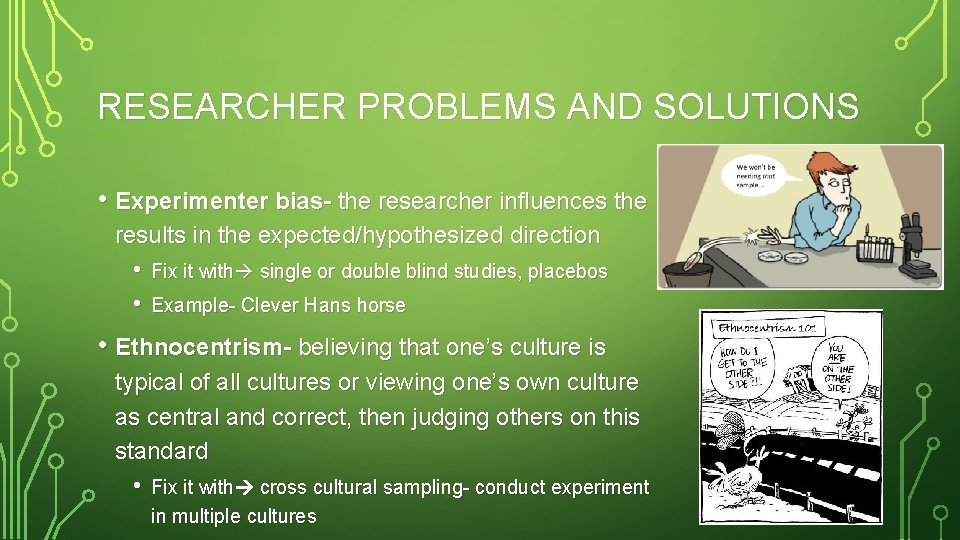
RESEARCHER PROBLEMS AND SOLUTIONS • Experimenter bias- the researcher influences the results in the expected/hypothesized direction • • Fix it with single or double blind studies, placebos Example- Clever Hans horse • Ethnocentrism- believing that one’s culture is typical of all cultures or viewing one’s own culture as central and correct, then judging others on this standard • Fix it with cross cultural sampling- conduct experiment in multiple cultures
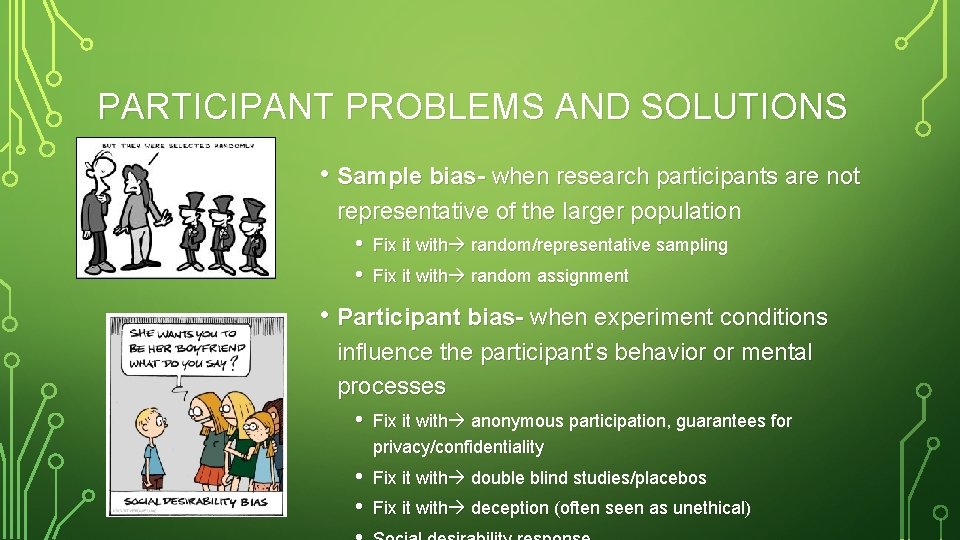
PARTICIPANT PROBLEMS AND SOLUTIONS • Sample bias- when research participants are not representative of the larger population • Fix it with random/representative sampling • Fix it with random assignment • Participant bias- when experiment conditions influence the participant’s behavior or mental processes • Fix it with anonymous participation, guarantees for privacy/confidentiality • • Fix it with double blind studies/placebos Fix it with deception (often seen as unethical)
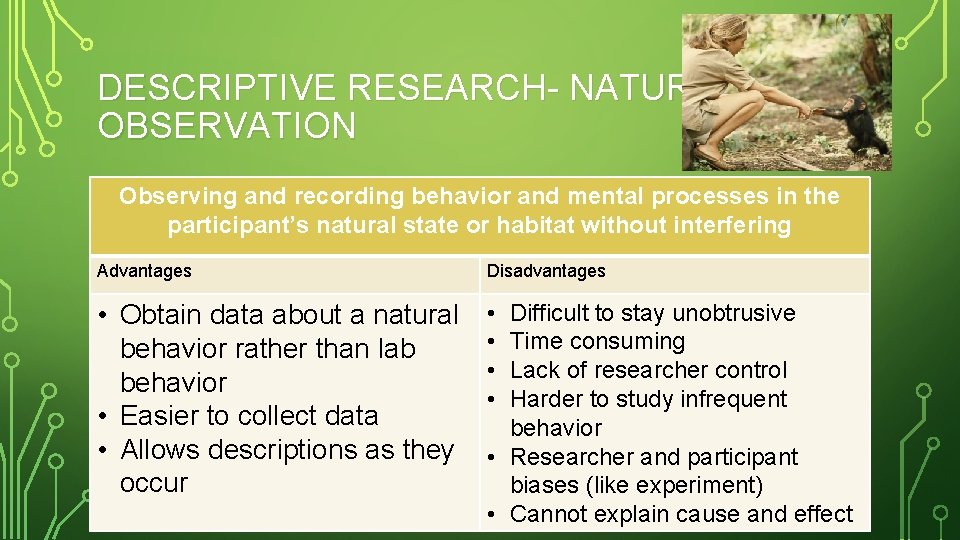
DESCRIPTIVE RESEARCH- NATURALISTIC OBSERVATION Observing and recording behavior and mental processes in the participant’s natural state or habitat without interfering Advantages Disadvantages • Obtain data about a natural behavior rather than lab behavior • Easier to collect data • Allows descriptions as they occur • • Difficult to stay unobtrusive Time consuming Lack of researcher control Harder to study infrequent behavior • Researcher and participant biases (like experiment) • Cannot explain cause and effect
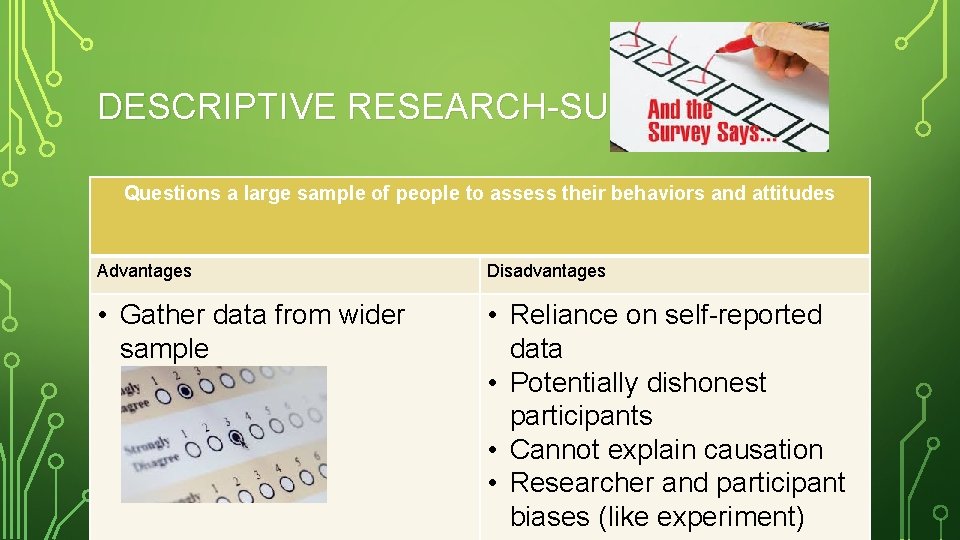
DESCRIPTIVE RESEARCH-SURVEYS Questions a large sample of people to assess their behaviors and attitudes Advantages Disadvantages • Gather data from wider sample • Reliance on self-reported data • Potentially dishonest participants • Cannot explain causation • Researcher and participant biases (like experiment)
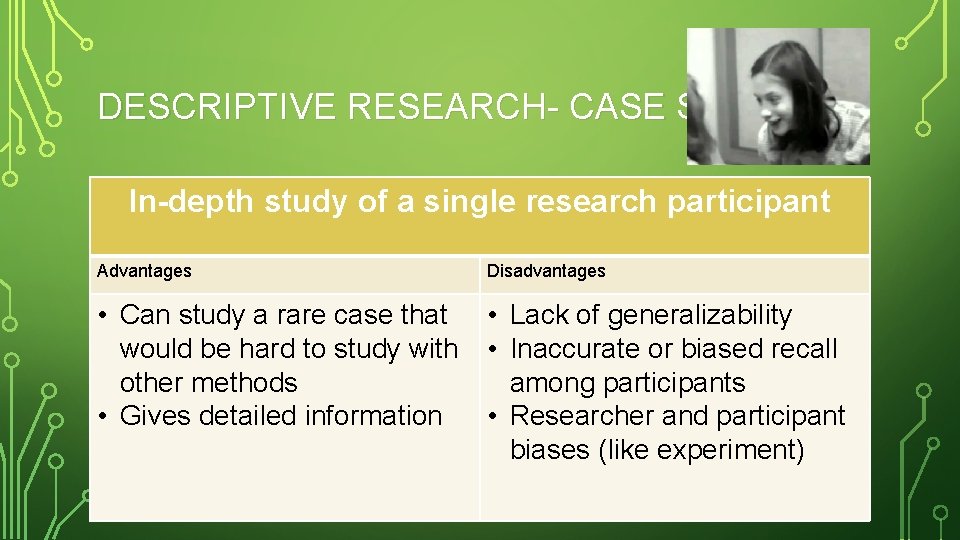
DESCRIPTIVE RESEARCH- CASE STUDIES In-depth study of a single research participant Advantages Disadvantages • Can study a rare case that • Lack of generalizability would be hard to study with • Inaccurate or biased recall other methods among participants • Gives detailed information • Researcher and participant biases (like experiment)
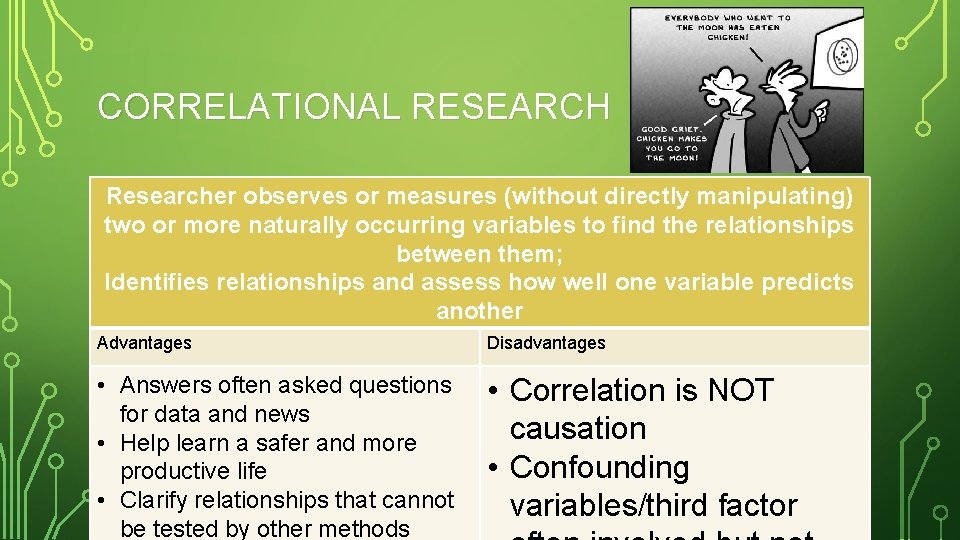
CORRELATIONAL RESEARCH Researcher observes or measures (without directly manipulating) two or more naturally occurring variables to find the relationships between them; Identifies relationships and assess how well one variable predicts another Advantages Disadvantages • Answers often asked questions for data and news • Help learn a safer and more productive life • Clarify relationships that cannot be tested by other methods • Correlation is NOT causation • Confounding variables/third factor
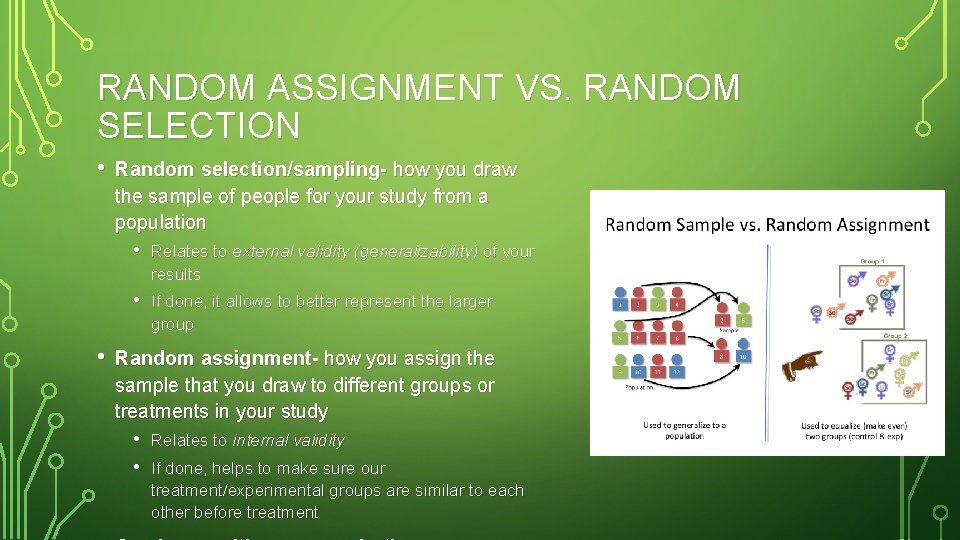
RANDOM ASSIGNMENT VS. RANDOM SELECTION • • Random selection/sampling- how you draw the sample of people for your study from a population • Relates to external validity (generalizability) of your results • If done, it allows to better represent the larger group Random assignment- how you assign the sample that you draw to different groups or treatments in your study • • Relates to internal validity If done, helps to make sure our treatment/experimental groups are similar to each other before treatment
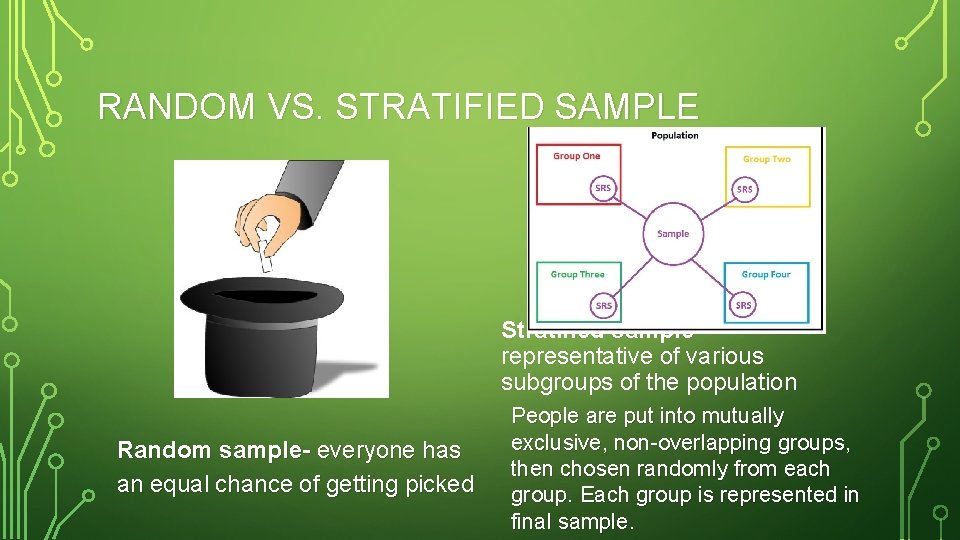
RANDOM VS. STRATIFIED SAMPLE Stratified samplerepresentative of various subgroups of the population Random sample- everyone has an equal chance of getting picked People are put into mutually exclusive, non-overlapping groups, then chosen randomly from each group. Each group is represented in final sample.
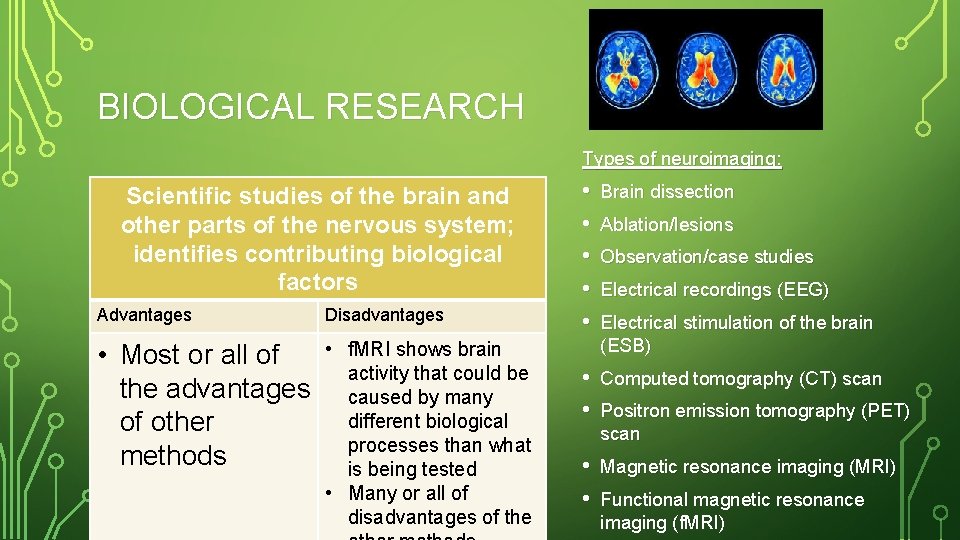
BIOLOGICAL RESEARCH Types of neuroimaging: Scientific studies of the brain and other parts of the nervous system; identifies contributing biological factors Advantages Disadvantages • Most or all of the advantages of other methods • f. MRI shows brain activity that could be caused by many different biological processes than what is being tested • Many or all of disadvantages of the • • • Brain dissection • • Computed tomography (CT) scan • • Magnetic resonance imaging (MRI) Ablation/lesions Observation/case studies Electrical recordings (EEG) Electrical stimulation of the brain (ESB) Positron emission tomography (PET) scan Functional magnetic resonance imaging (f. MRI)
STATISTICAL CONCEPTS
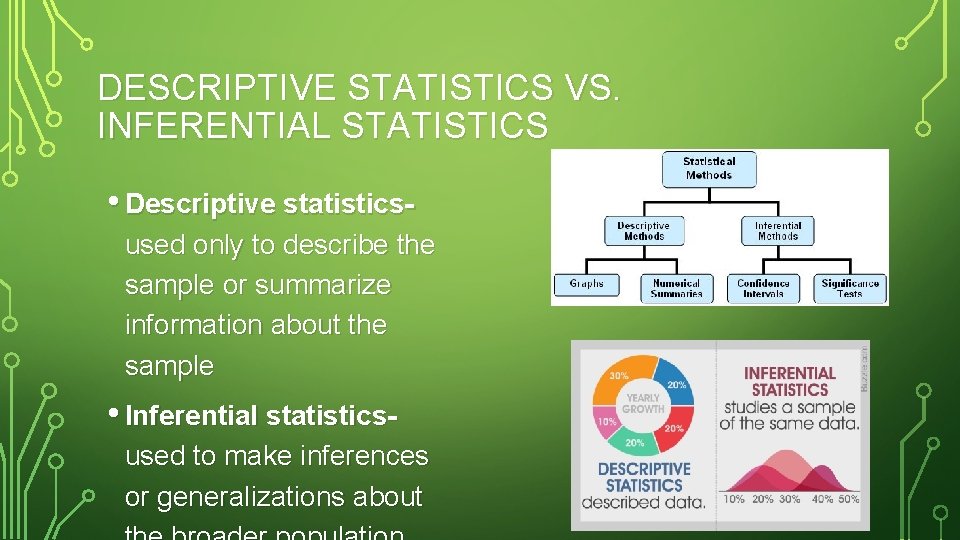
DESCRIPTIVE STATISTICS VS. INFERENTIAL STATISTICS • Descriptive statisticsused only to describe the sample or summarize information about the sample • Inferential statisticsused to make inferences or generalizations about
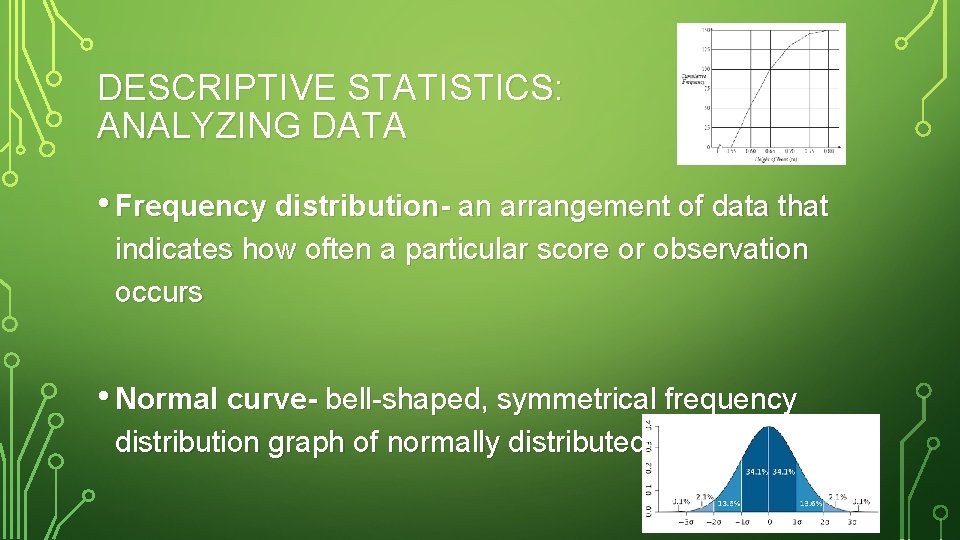
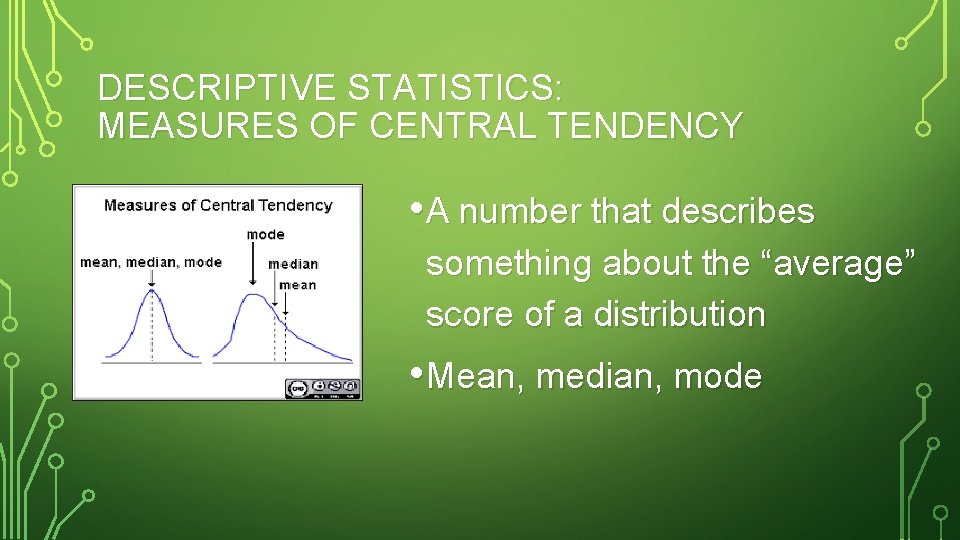
DESCRIPTIVE STATISTICS: ANALYZING DATA • Frequency distribution- an arrangement of data that indicates how often a particular score or observation occurs • Normal curve- bell-shaped, symmetrical frequency distribution graph of normally distributed data
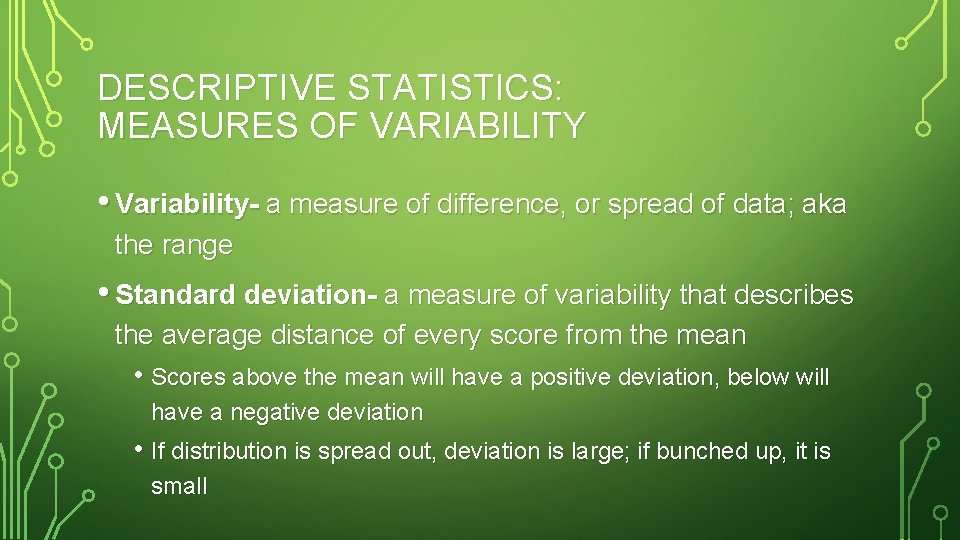
DESCRIPTIVE STATISTICS: MEASURES OF CENTRAL TENDENCY • A number that describes something about the “average” score of a distribution • Mean, median, mode
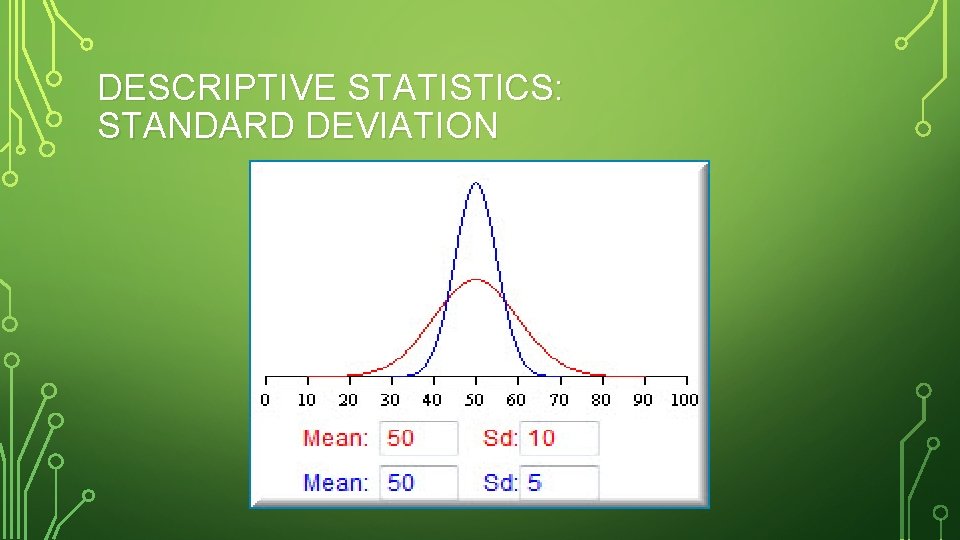
DESCRIPTIVE STATISTICS: MEASURES OF VARIABILITY • Variability- a measure of difference, or spread of data; aka the range • Standard deviation- a measure of variability that describes the average distance of every score from the mean • Scores above the mean will have a positive deviation, below will have a negative deviation • If distribution is spread out, deviation is large; if bunched up, it is small
DESCRIPTIVE STATISTICS: STANDARD DEVIATION
DESCRIPTIVE STATISTICS: CORRELATION COEFFICIENTS • Describes the direction and strength of the relationship between two sets of variables • Correlation is the degree of relatedness • Usually the Pearson correlation coefficient r • • (+) indicates positive (-) indicates inverse/negative relationships • From -1 to +1 • • ± 0. 60 to ± 1. 0 is strong ± 0. 30 to ± 0. 60 is moderate 0 to ± 0. 30 is weak 1 is a perfect correlation and rare
INFERENTIAL STATISTICS • Numerical methods used to determine whether research data support a hypothesis or whether results were due to chance • Statistical significance- evaluates the likelihood that results were due to chance • Limit is set by researcher • If researcher says the probability that their results were due to chance is less than 1 -5% (0. 01 -0. 05), it is considered statistically significant
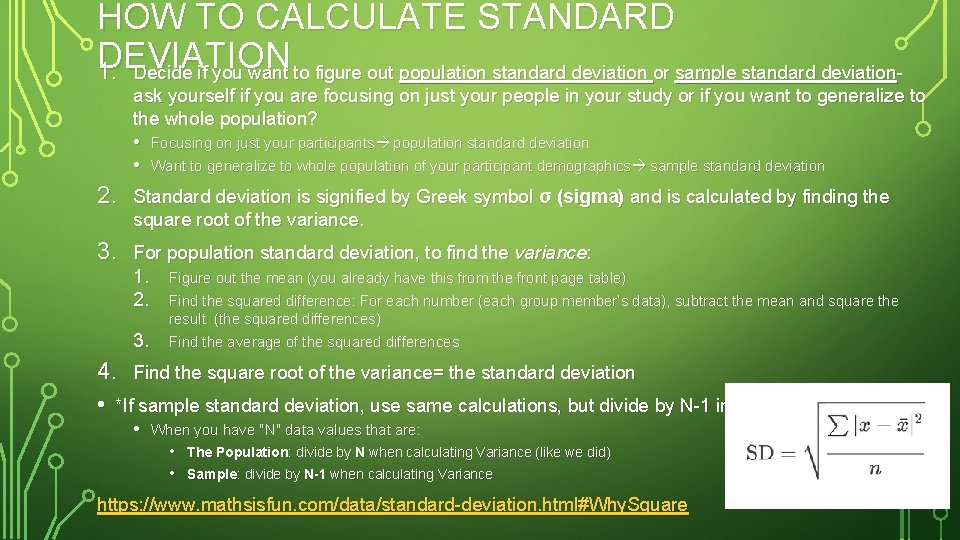
HOW TO CALCULATE STANDARD DEVIATION 1. Decide if you want to figure out population standard deviation or sample standard deviation- ask yourself if you are focusing on just your people in your study or if you want to generalize to the whole population? • Focusing on just your participants population standard deviation • Want to generalize to whole population of your participant demographics sample standard deviation 2. Standard deviation is signified by Greek symbol σ (sigma) and is calculated by finding the square root of the variance. 3. For population standard deviation, to find the variance: 1. Figure out the mean (you already have this from the front page table) 2. Find the squared difference: For each number (each group member’s data), subtract the mean and square the 3. result (the squared differences) Find the average of the squared differences 4. Find the square root of the variance= the standard deviation • *If sample standard deviation, use same calculations, but divide by N-1 instead • When you have "N" data values that are: • • The Population: divide by N when calculating Variance (like we did) Sample: divide by N-1 when calculating Variance https: //www. mathsisfun. com/data/standard-deviation. html#Why. Square