
Scientific Approaches and Limitations to Bioreactor Reduced Scale
Scientific Approaches and Limitations to Bioreactor Reduced Scale Model Qualification Brian Jackson, Untitled 6 Artwork from Reflections Art in Health Christopher Canova Janssen Pharmaceuticals Pharmaceutical Development and Manufacturing Sciences (PDMS)
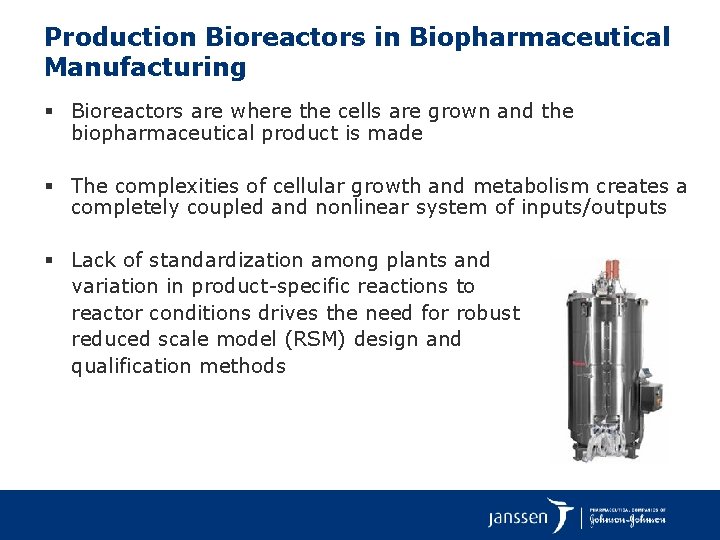
Production Bioreactors in Biopharmaceutical Manufacturing § Bioreactors are where the cells are grown and the biopharmaceutical product is made § The complexities of cellular growth and metabolism creates a completely coupled and nonlinear system of inputs/outputs § Lack of standardization among plants and variation in product-specific reactions to reactor conditions drives the need for robust reduced scale model (RSM) design and qualification methods

Sizing a Bioreactor Reduced Scale Model We need to size a reduced scale bioreactor such that it can be physically representative of the manufacturing scale. Commercial Jet Prototypes Typical Bioreactor Manufacturing Size 1, 000 – 15, 000 L Typical Qualified RSM Size 3 -5 L 3

Rationale for Reduced Scale Models #1: Design manufacturing process that will consistently produce high quality product (Quality by Design, Qb. D). S S S S S S S Critical Process Parameters (CPPs): Critical Quality Attribute (CQA) Specifications: • Bioactivity • % Aggregate • Antigen Binding … Temperature Seed Density d. CO 2 d. O 2 p. H Feed rate … Manufacturing Bioreactor Critical Quality Attributes (CQAs): ü Bioactivity ü % Aggregate ü Antigen Binding … How can we accurately establish targets and ranges for the critical process parameters without experimenting at manufacturing scale? 4

Rationale for Reduced Scale Models #1: Design manufacturing process that will consistently produce high quality product (Quality by Design, Qb. D). 50 48 Process Parameter has historical known effects on PQ: Dissolved Oxygen (%) % Aggregate Glycan Heterogeneity Etc. Dissolved Oxygen (%) Product Purity % 46 44 42 40 38 36 34 32 30 10: 04 A 4/P 4 Reduced Scale Model 12: 00 A 4/P 4 13: 55 A 4/P 4 Use RSM experimentation to establish operating ranges 5
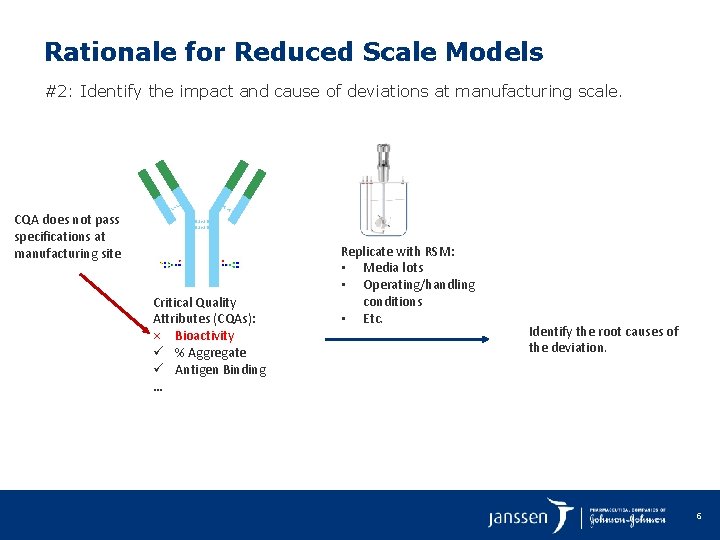
Rationale for Reduced Scale Models #2: Identify the impact and cause of deviations at manufacturing scale. CQA does not pass specifications at manufacturing site S S S S Critical Quality Attributes (CQAs): × Bioactivity ü % Aggregate ü Antigen Binding … Replicate with RSM: • Media lots • Operating/handling conditions • Etc. Identify the root causes of the deviation. 6
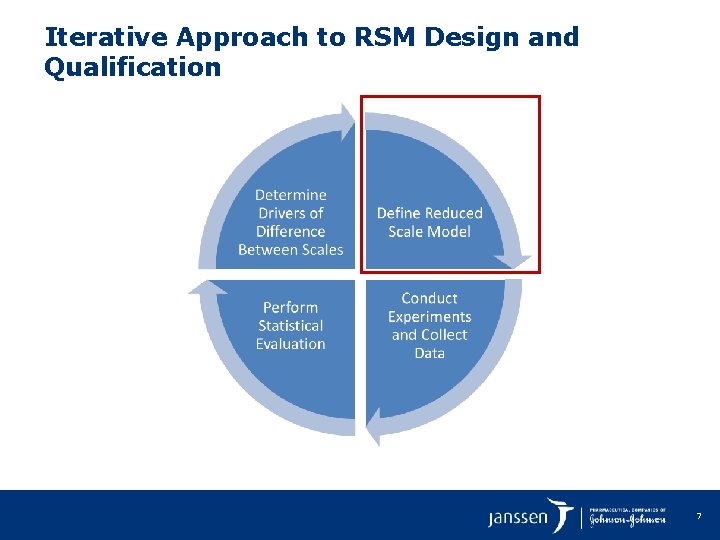
Iterative Approach to RSM Design and Qualification 7
Engineering Limitations to RSM Design • What set of operating conditions will ensure a similar kinematic and chemical environment for the cells? • Historical approaches involve matching scale independent parameters (power per unit volume, superficial air velocity, etc. ) and observing alignment. • However, not all geometric and operating parameters can be directly scaled between the RSM and manufacturing bioreactor. 8
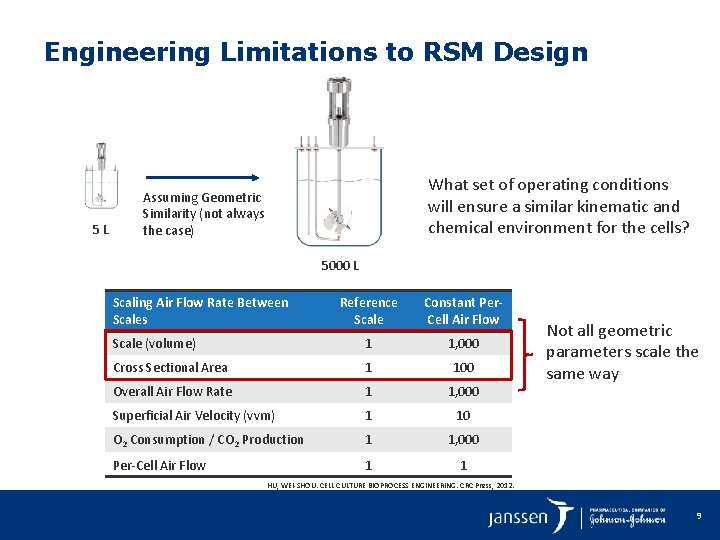
Engineering Limitations to RSM Design 5 L What set of operating conditions will ensure a similar kinematic and chemical environment for the cells? Assuming Geometric Similarity (not always the case) 5000 L Scaling Air Flow Rate Between Scales Reference Scale Constant Per. Cell Air Flow Scale (volume) 1 1, 000 Cross Sectional Area 1 100 Overall Air Flow Rate 1 1, 000 Superficial Air Velocity (vvm) 1 10 O 2 Consumption / CO 2 Production 1 1, 000 Per-Cell Air Flow 1 1 Not all geometric parameters scale the same way HU, WEI-SHOU. CELL CULTURE BIOPROCESS ENGINEERING. CRC Press, 2012. 9
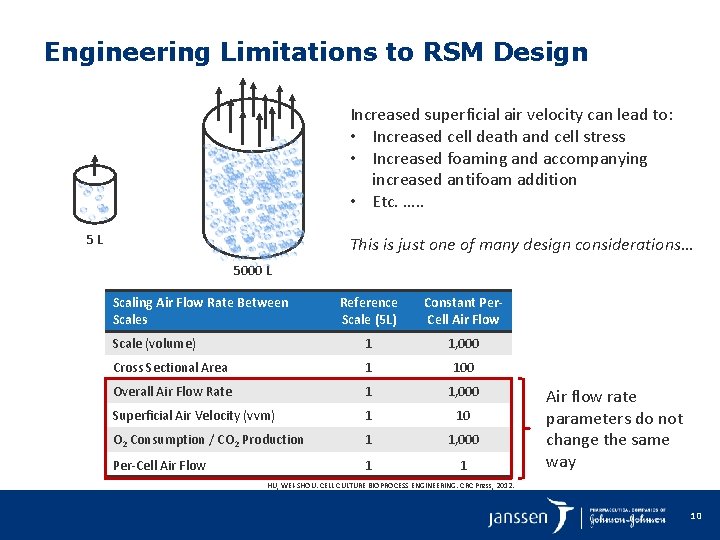
Engineering Limitations to RSM Design Increased superficial air velocity can lead to: • Increased cell death and cell stress • Increased foaming and accompanying increased antifoam addition • Etc. …. . 5 L This is just one of many design considerations… 5000 L Scaling Air Flow Rate Between Scales Reference Scale (5 L) Constant Per. Cell Air Flow Scale (volume) 1 1, 000 Cross Sectional Area 1 100 Overall Air Flow Rate 1 1, 000 Superficial Air Velocity (vvm) 1 10 O 2 Consumption / CO 2 Production 1 1, 000 Per-Cell Air Flow 1 1 Air flow rate parameters do not change the same way HU, WEI-SHOU. CELL CULTURE BIOPROCESS ENGINEERING. CRC Press, 2012. 10
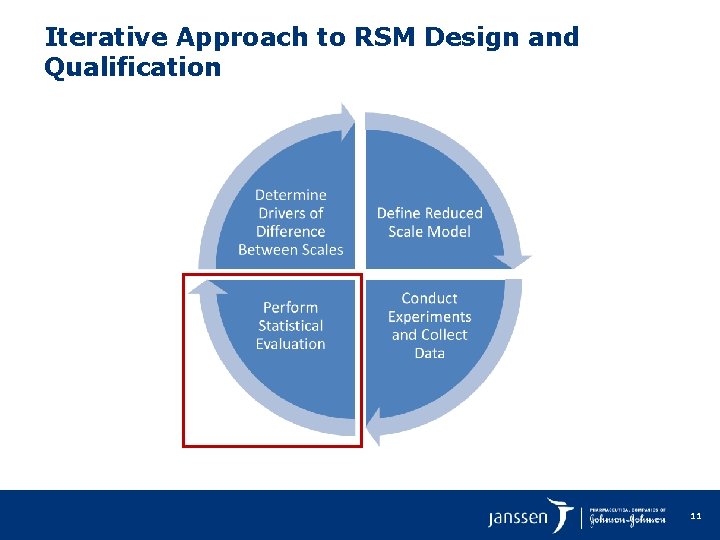
Iterative Approach to RSM Design and Qualification 11
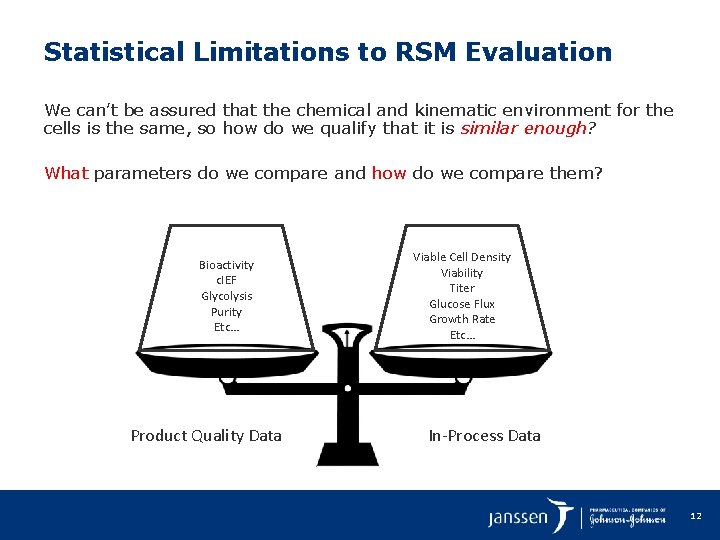
Statistical Limitations to RSM Evaluation We can’t be assured that the chemical and kinematic environment for the cells is the same, so how do we qualify that it is similar enough? What parameters do we compare and how do we compare them? Bioactivity c. IEF Glycolysis Purity Etc… Product Quality Data Viable Cell Density Viability Titer Glucose Flux Growth Rate Etc… In-Process Data 12
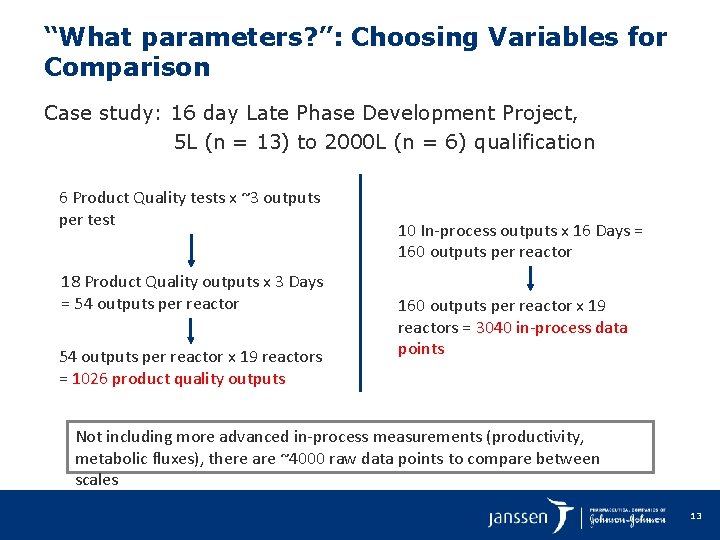
“What parameters? ”: Choosing Variables for Comparison Case study: 16 day Late Phase Development Project, 5 L (n = 13) to 2000 L (n = 6) qualification 6 Product Quality tests x ~3 outputs per test 18 Product Quality outputs x 3 Days = 54 outputs per reactor x 19 reactors = 1026 product quality outputs 10 In-process outputs x 16 Days = 160 outputs per reactor x 19 reactors = 3040 in-process data points Not including more advanced in-process measurements (productivity, metabolic fluxes), there are ~4000 raw data points to compare between scales 13
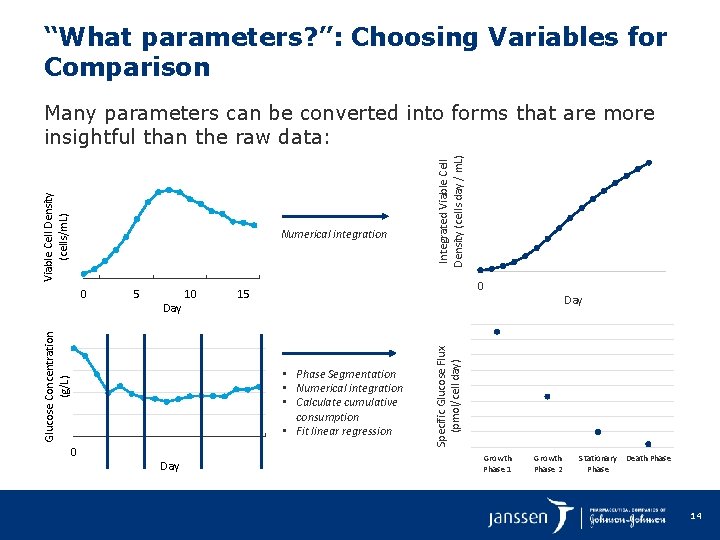
“What parameters? ”: Choosing Variables for Comparison Numerical integration Day 10 0 15 • Phase Segmentation • Numerical integration • Calculate cumulative consumption • Fit linear regression 0 Day Specific Glucose Flux (pmol/cell day) 5 Glucose Concentration (g/L) 0 Integrated Viable Cell Density (cells day / m. L) Viable Cell Density (cells/m. L) Many parameters can be converted into forms that are more insightful than the raw data: Growth Phase 1 Growth Phase 2 Stationary Death Phase 14
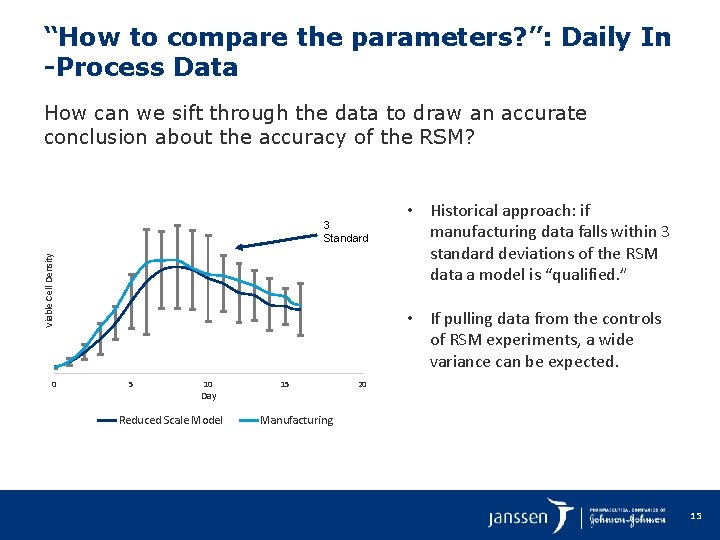
“How to compare the parameters? ”: Daily In -Process Data How can we sift through the data to draw an accurate conclusion about the accuracy of the RSM? Viable Cell Density 3 Standard 0 • Historical approach: if manufacturing data falls within 3 standard deviations of the RSM data a model is “qualified. ” • If pulling data from the controls of RSM experiments, a wide variance can be expected. 5 10 Day Reduced Scale Model 15 20 Manufacturing 15
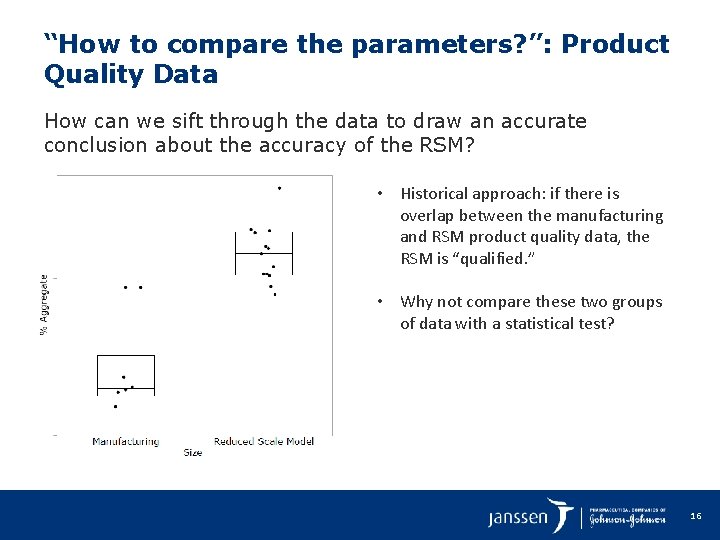
“How to compare the parameters? ”: Product Quality Data How can we sift through the data to draw an accurate conclusion about the accuracy of the RSM? • Historical approach: if there is overlap between the manufacturing and RSM product quality data, the RSM is “qualified. ” • Why not compare these two groups of data with a statistical test? 16
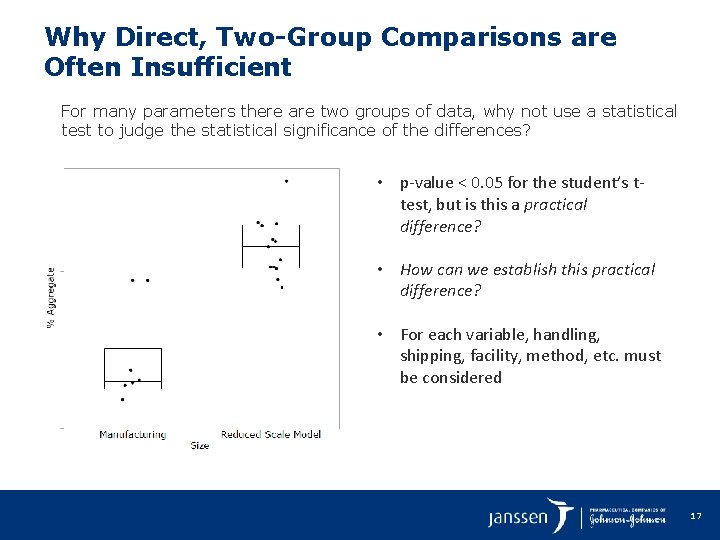
Why Direct, Two-Group Comparisons are Often Insufficient For many parameters there are two groups of data, why not use a statistical test to judge the statistical significance of the differences? • p-value < 0. 05 for the student’s ttest, but is this a practical difference? • How can we establish this practical difference? • For each variable, handling, shipping, facility, method, etc. must be considered 17
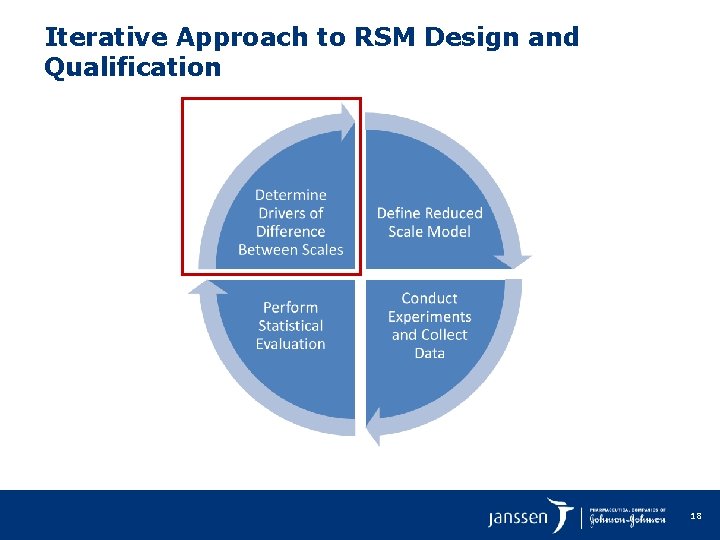
Iterative Approach to RSM Design and Qualification 18
Advanced Industry Qualification Strategies • Multivariate analysis (MVA) can used to reduce the dimensionality of the large parameter set, and identify discriminatory variables driving differences between the scales • Once identified, these discriminatory variables can be “engineered” into alignment, and the models retested. • Advanced engineering analyses of the stresses observed by the cells at each scale can bring the operating conditions into alignment prior to experimentation 19
Summary of Practical Considerations for RSM Qualification • Having an accurate bioreactor RSM is crucial for safe, consistent, and cost-effective manufacturing. • The kinematic and chemical environment will never be 100% aligned between the manufacturing bioreactor and RSM. • Different cell lines and manufacturing sites present different sets of operating inconsistencies. • Statisticians and manufacturing scientists must work together to develop and qualify RSMs. 20

Thank you Brian Jackson, Untitled 6 Artwork from Reflections Art in Health 21

- Slides: 22