
Scientific Academic Research Dr Mila Cahue Web of
Scientific & Academic Research Dr. Mila Cahue Web of Science Europe Editor V National Academic Publishing Mtng Antalya, Turkey 2 nd-3 rd November, 2017
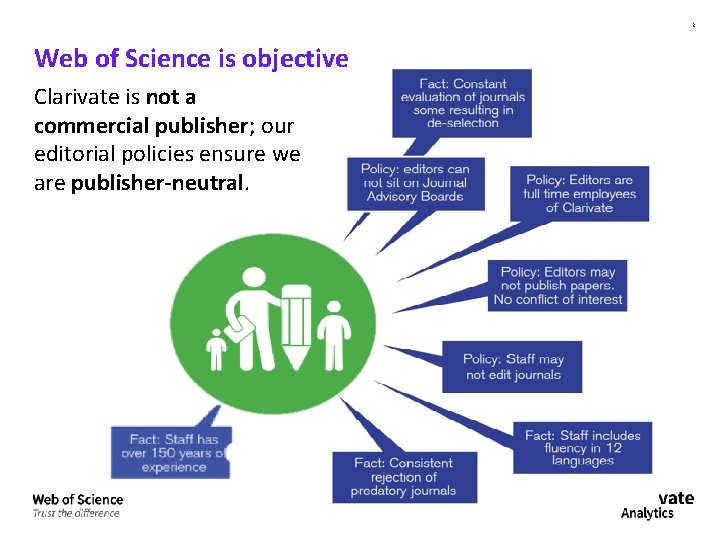
2 Web of Science is objective Clarivate is not a commercial publisher; our editorial policies ensure we are publisher-neutral.
Web of Science champions ethical publishing practices Clarivate Analytics requires strict standards of ethical publishing that include but are not limited to: Refraining from misrepresenting the names, qualifications, or involvement of editorial board members. Displaying clear and transparent statements regarding business models: subscription based or open access article processing charges (APCs) or similar fees. Refraining from all forms of plagiarism and copyright infringement. 3
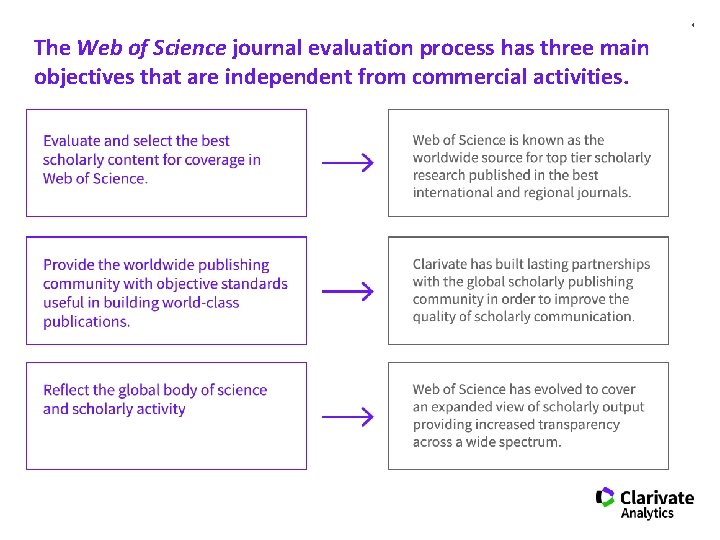
4 The Web of Science journal evaluation process has three main objectives that are independent from commercial activities.
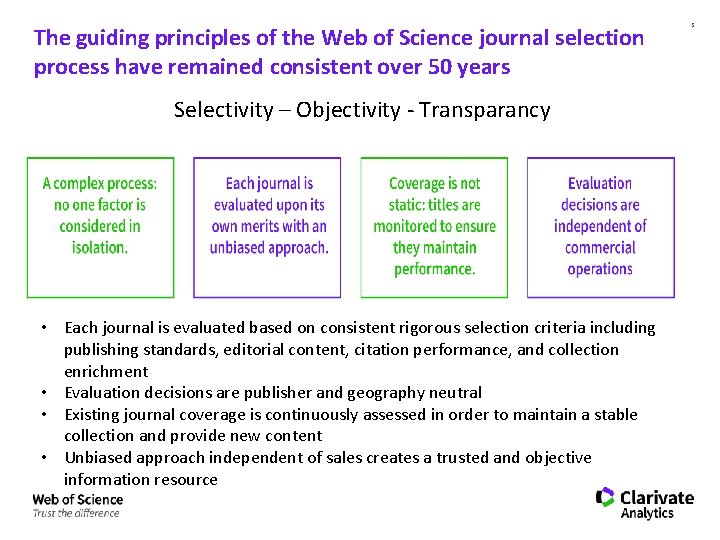
The guiding principles of the Web of Science journal selection process have remained consistent over 50 years Selectivity – Objectivity - Transparancy • Each journal is evaluated based on consistent rigorous selection criteria including publishing standards, editorial content, citation performance, and collection enrichment • Evaluation decisions are publisher and geography neutral • Existing journal coverage is continuously assessed in order to maintain a stable collection and provide new content • Unbiased approach independent of sales creates a trusted and objective information resource 5
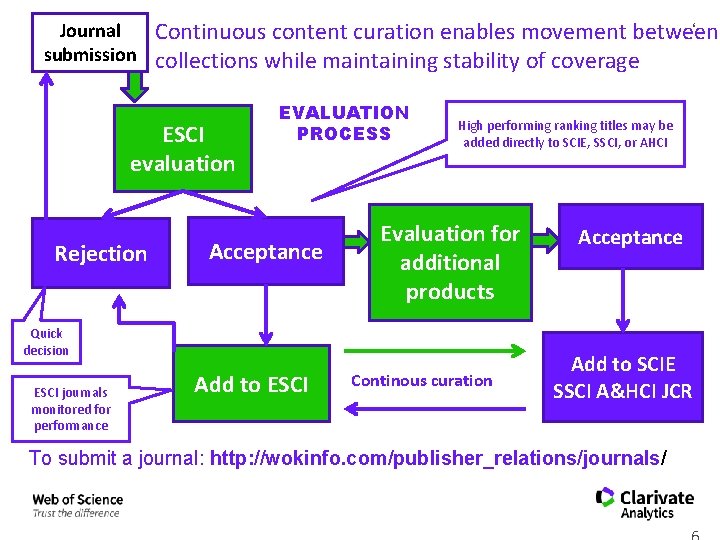
Journal submission Continuous content curation enables movement between collections while maintaining stability of coverage 6 ESCI evaluation Rejection EVALUATION PROCESS Acceptance High performing ranking titles may be added directly to SCIE, SSCI, or AHCI Evaluation for additional products Quick decision ESCI journals monitored for performance Add to ESCI Continous curation Acceptance Add to SCIE SSCI A&HCI JCR To submit a journal: http: //wokinfo. com/publisher_relations/journals/
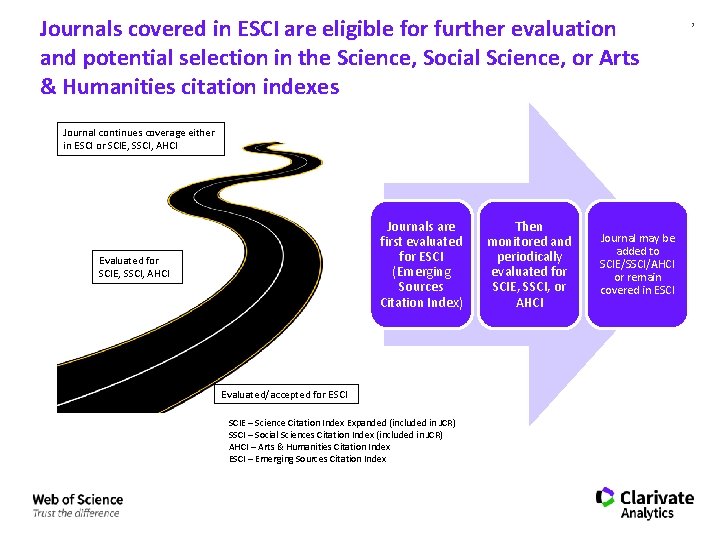
Journals covered in ESCI are eligible for further evaluation and potential selection in the Science, Social Science, or Arts & Humanities citation indexes Journal continues coverage either in ESCI or SCIE, SSCI, AHCI Journals are first evaluated for ESCI (Emerging Sources Citation Index) Evaluated for SCIE, SSCI, AHCI Evaluated/accepted for ESCI SCIE – Science Citation Index Expanded (included in JCR) SSCI – Social Sciences Citation Index (included in JCR) AHCI – Arts & Humanities Citation Index ESCI – Emerging Sources Citation Index Then monitored and periodically evaluated for SCIE, SSCI, or AHCI Journal may be added to SCIE/SSCI/AHCI or remain covered in ESCI 7
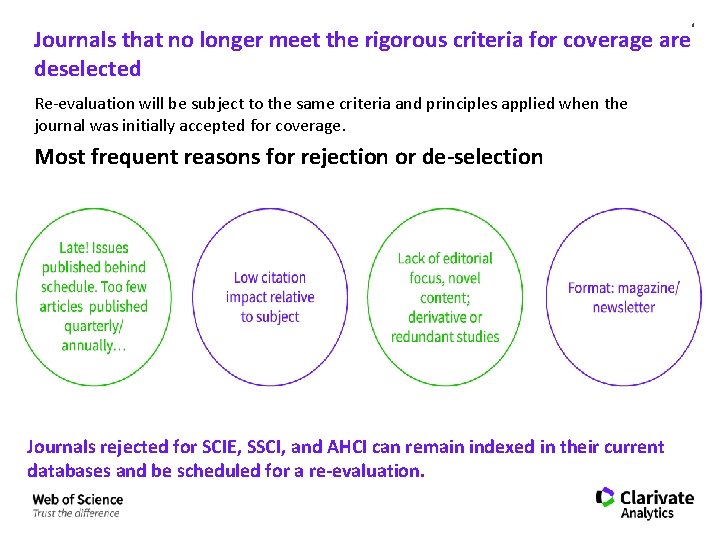
Journals that no longer meet the rigorous criteria for coverage are deselected Re-evaluation will be subject to the same criteria and principles applied when the journal was initially accepted for coverage. Most frequent reasons for rejection or de-selection Journals rejected for SCIE, SSCI, and AHCI can remain indexed in their current databases and be scheduled for a re-evaluation. 8
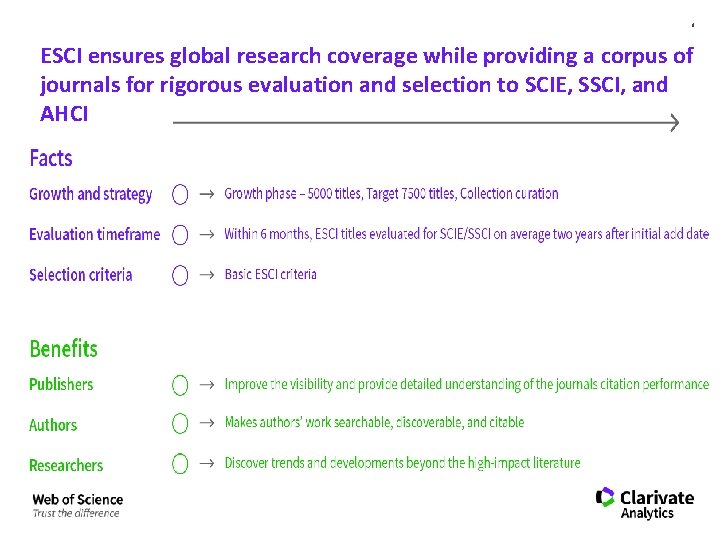
9 ESCI ensures global research coverage while providing a corpus of journals for rigorous evaluation and selection to SCIE, SSCI, and AHCI
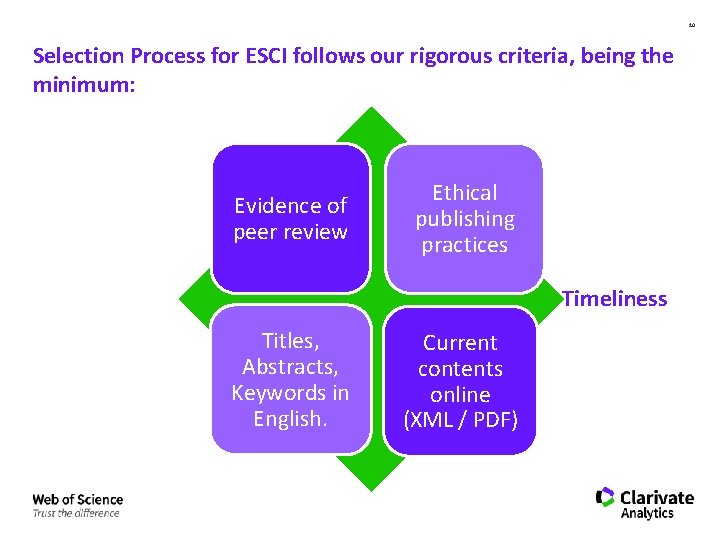
10 Selection Process for ESCI follows our rigorous criteria, being the minimum: Evidence of peer review Ethical publishing practices Timeliness Titles, Abstracts, Keywords in English. Current contents online (XML / PDF)
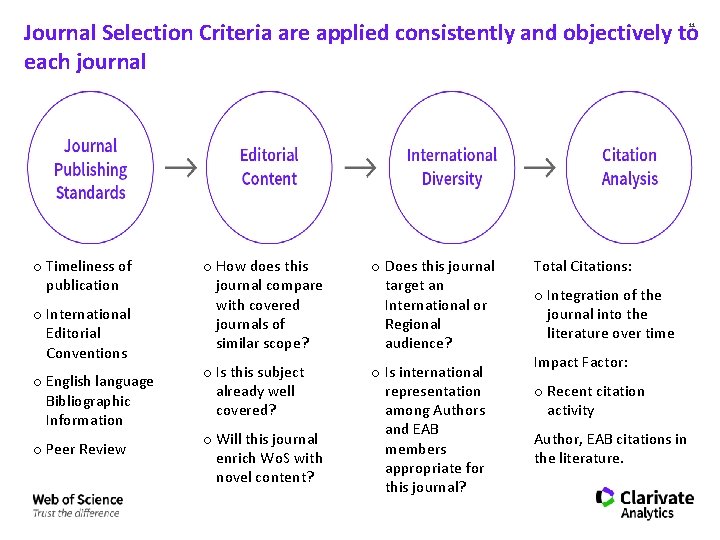
Journal Selection Criteria are applied consistently and objectively to each journal 11 o Timeliness of publication o International Editorial Conventions o English language Bibliographic Information o Peer Review o How does this journal compare with covered journals of similar scope? o Does this journal target an International or Regional audience? o Is this subject already well covered? o Is international representation among Authors and EAB members appropriate for this journal? o Will this journal enrich Wo. S with novel content? Total Citations: o Integration of the journal into the literature over time Impact Factor: o Recent citation activity Author, EAB citations in the literature.
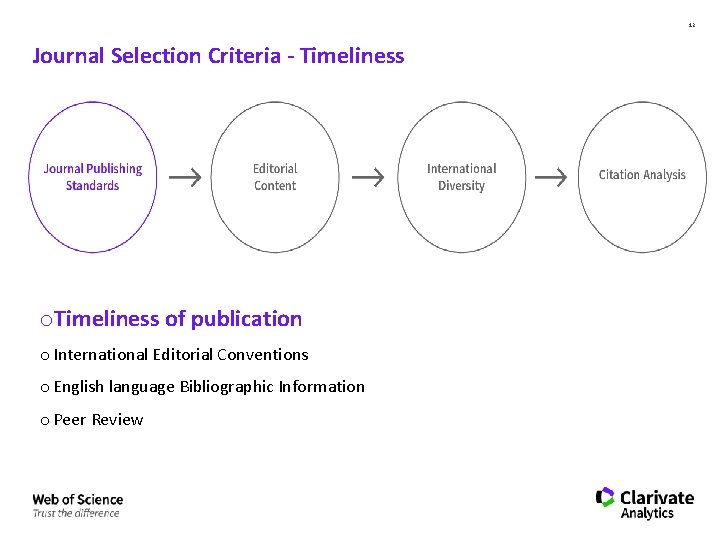
12 Journal Selection Criteria - Timeliness of publication o International Editorial Conventions o English language Bibliographic Information o Peer Review
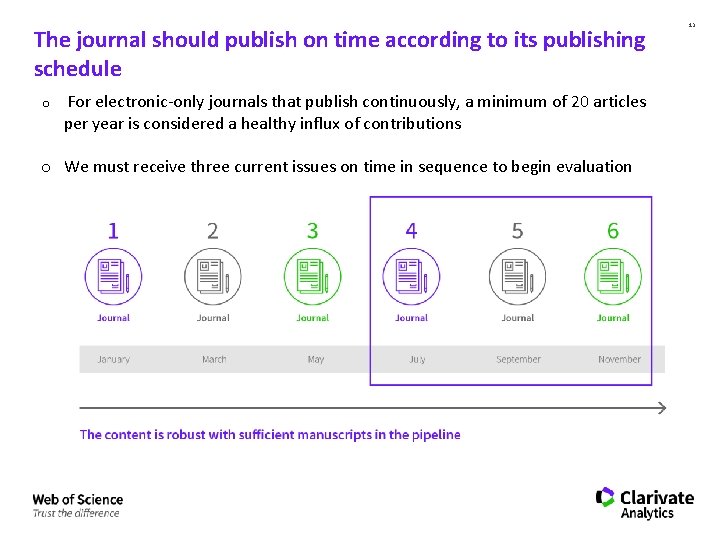
The journal should publish on time according to its publishing schedule o For electronic-only journals that publish continuously, a minimum of 20 articles per year is considered a healthy influx of contributions o We must receive three current issues on time in sequence to begin evaluation 13
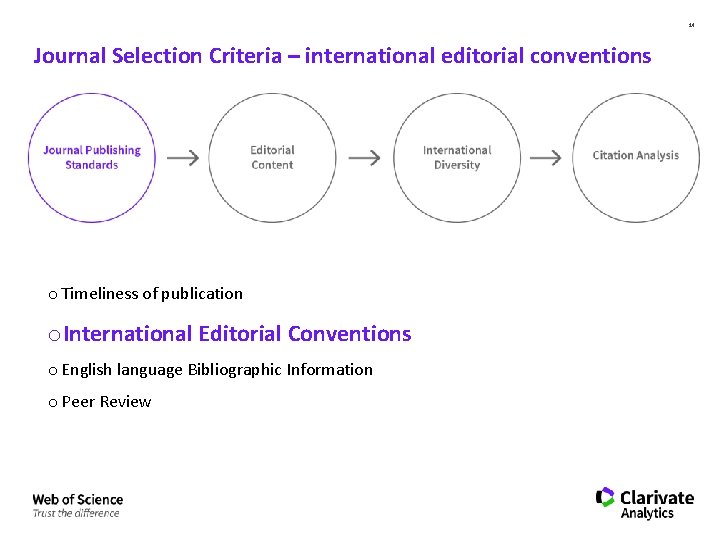
14 Journal Selection Criteria – international editorial conventions o Timeliness of publication o. International Editorial Conventions o English language Bibliographic Information o Peer Review
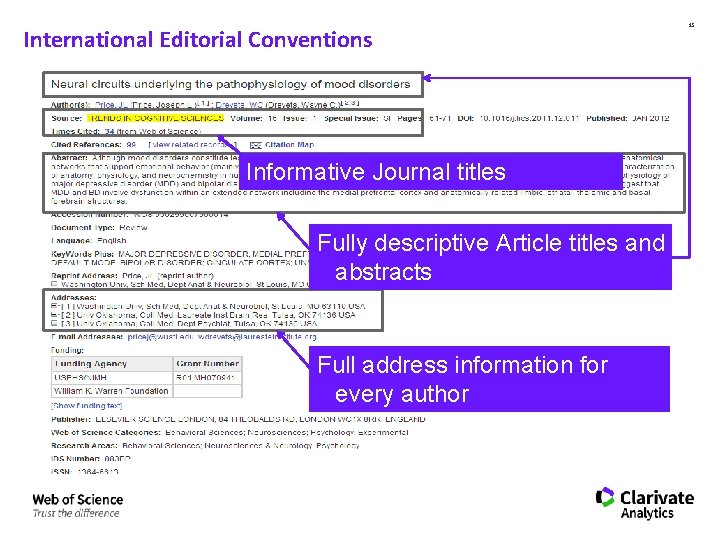
International Editorial Conventions Informative Journal titles Fully descriptive Article titles and abstracts Full address information for every author 15
16 Funding source is also recommended whenever possible
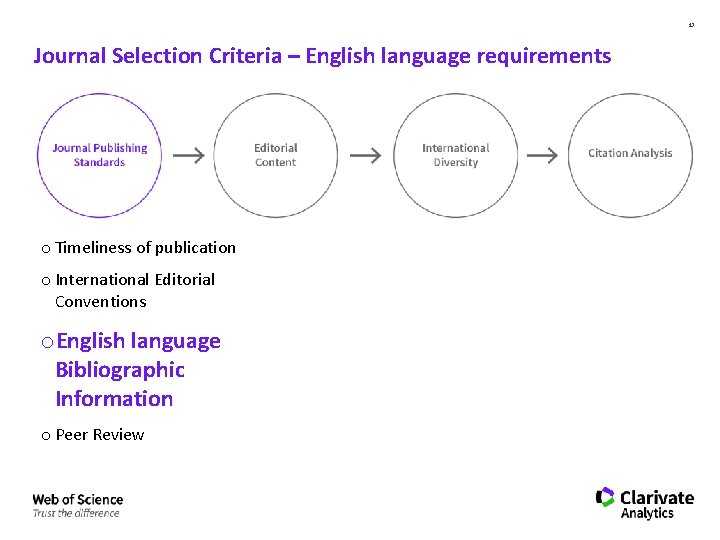
17 Journal Selection Criteria – English language requirements o Timeliness of publication o International Editorial Conventions o. English language Bibliographic Information o Peer Review
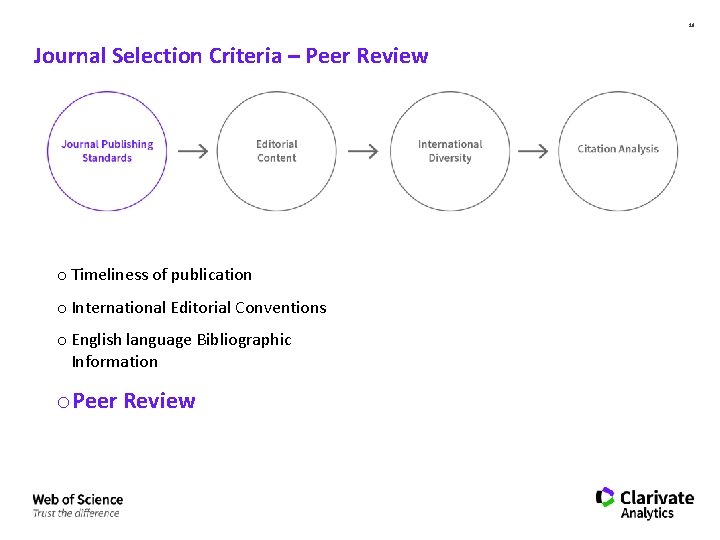
18 Journal Selection Criteria – Peer Review o Timeliness of publication o International Editorial Conventions o English language Bibliographic Information o. Peer Review
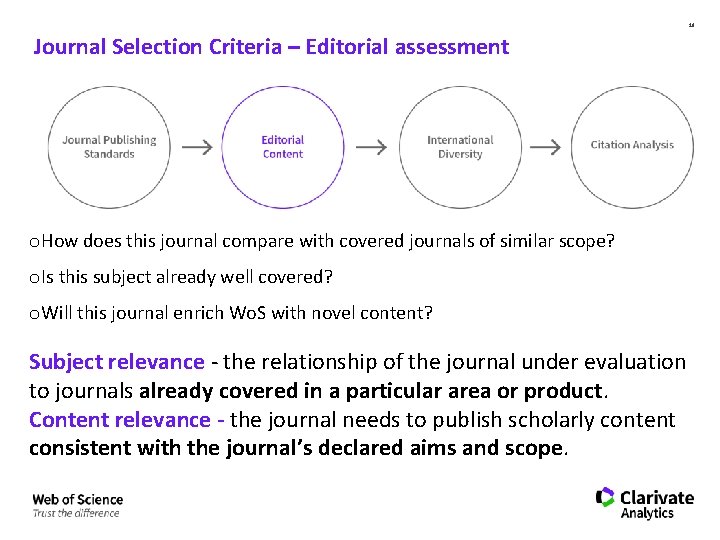
19 Journal Selection Criteria – Editorial assessment o How does this journal compare with covered journals of similar scope? o Is this subject already well covered? o Will this journal enrich Wo. S with novel content? Subject relevance - the relationship of the journal under evaluation to journals already covered in a particular area or product. Content relevance - the journal needs to publish scholarly content consistent with the journal’s declared aims and scope.
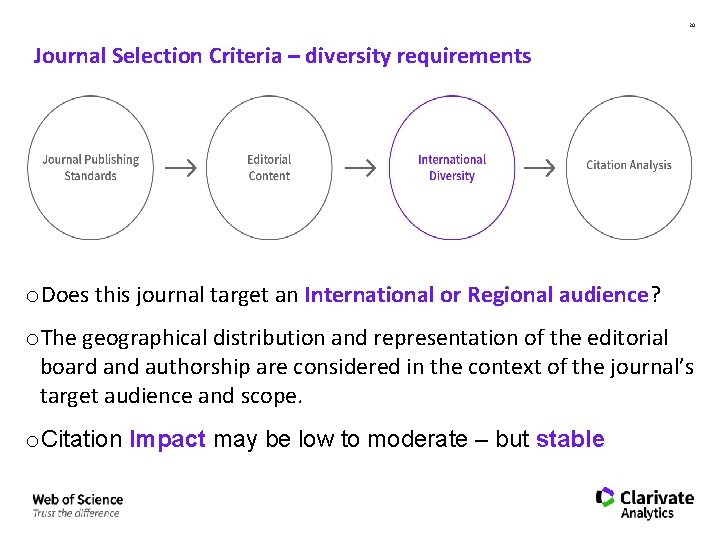
20 Journal Selection Criteria – diversity requirements o. Does this journal target an International or Regional audience? o. The geographical distribution and representation of the editorial board and authorship are considered in the context of the journal’s target audience and scope. o. Citation Impact may be low to moderate – but stable
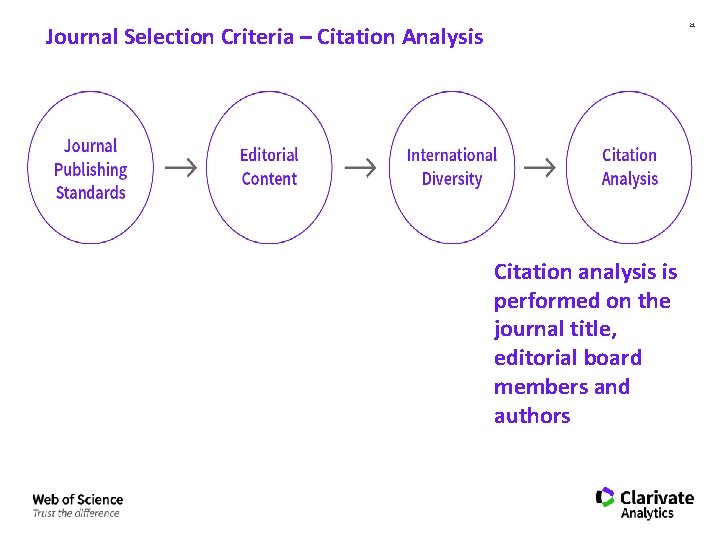
Journal Selection Criteria – Citation Analysis 21 Citation analysis is performed on the journal title, editorial board members and authors
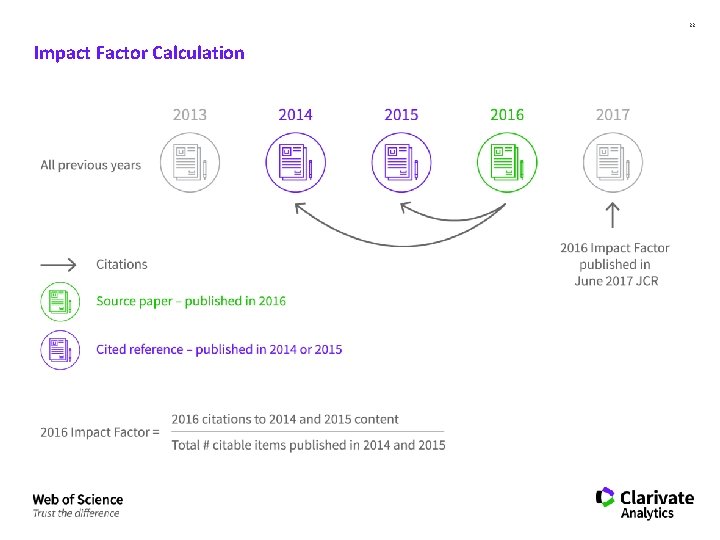
22 Impact Factor Calculation
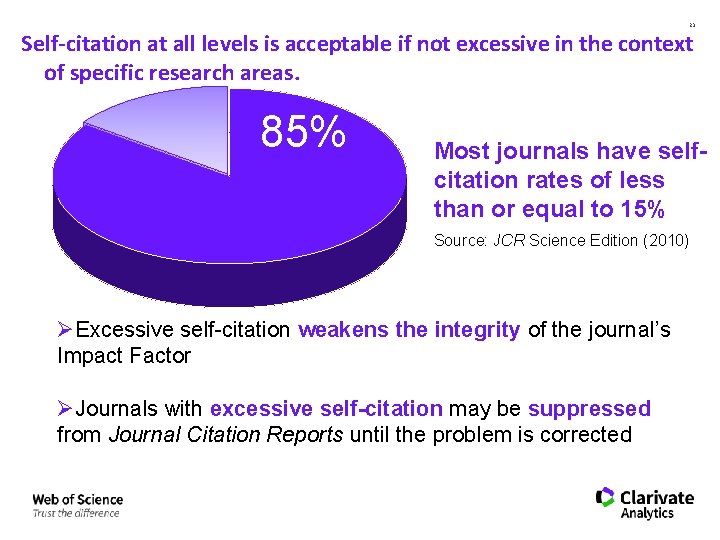
23 Self-citation at all levels is acceptable if not excessive in the context of specific research areas. 85% Most journals have selfcitation rates of less than or equal to 15% Source: JCR Science Edition (2010) ØExcessive self-citation weakens the integrity of the journal’s Impact Factor ØJournals with excessive self-citation may be suppressed from Journal Citation Reports until the problem is corrected
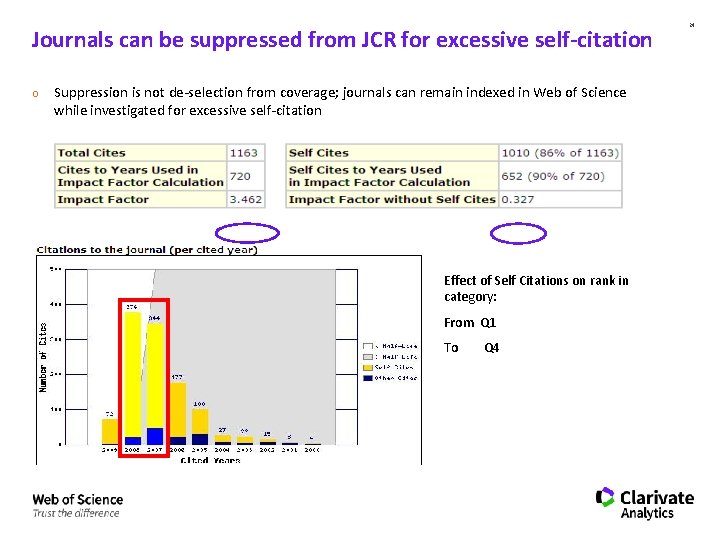
Journals can be suppressed from JCR for excessive self-citation o Suppression is not de-selection from coverage; journals can remain indexed in Web of Science while investigated for excessive self-citation Effect of Self Citations on rank in category: From Q 1 To Q 4 24
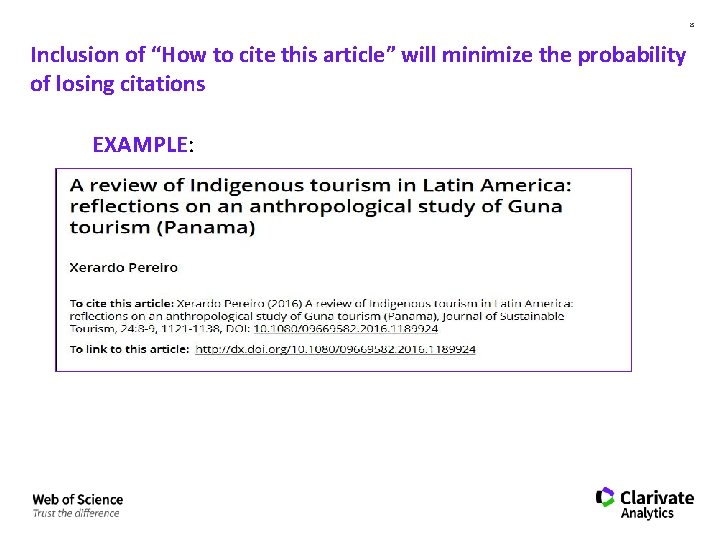
25 Inclusion of “How to cite this article” will minimize the probability of losing citations EXAMPLE:
26 Journal Publication must always be subject to improvements: 1. Enrollment of more internationally high impact researchers in journal editorial board 2. Active recruitment of high-impact articles by courting researchers 3. Article selection 4. Better services offered to authors 5. Boosting the journal’s media profile M. Chew, E. V. Villanueva, and M. B. Van Der Weyden, Journal of the Royal Society of Medicine 100 (3), 142 (2007).
27 Editors, researchers, publishers and members of the Scientific/Academic Communities are invited to join our free online OPEN HOUSE SESSIONS 1. 2. 3. 4. 5. 6. 7. Better understanding of the Journal Selection Process Answer to questions related to Journal Selection Specify the roles of different editions Monthly Frequency: in English and in Spanish One hour and a quarter duration Registration and reference required mila. cahue@clarivate. com
28 How do I submit a journal for inclusion in the Web of Science ? o Check existing coverage Ensure that the journal meets basic selection criteria outlined in the selection essay o Contact Publisher Relations and fill out the journal submission form with all required information http: //ipscience. thomsonreuters. com/info/journalsubmission-front/ o Who can submit a journal for evaluation? o Editors and publishers can submit journals; we also receive recommendations from the academic community and customers
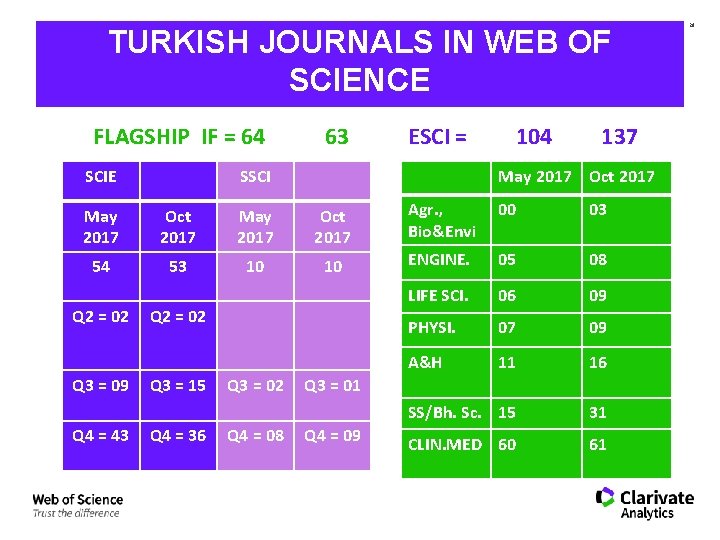
TURKISH JOURNALS IN WEB OF SCIENCE FLAGSHIP IF = 64 SCIE 63 ESCI = 104 137 May 2017 Oct 2017 SSCI May 2017 Oct 2017 Agr. , Bio&Envi 00 03 54 53 10 10 ENGINE. 05 08 LIFE SCI. 06 09 PHYSI. 07 09 A&H 11 16 SS/Bh. Sc. 15 31 CLIN. MED 60 61 Q 2 = 02 Q 3 = 09 Q 4 = 43 Q 2 = 02 Q 3 = 15 Q 4 = 36 Q 3 = 02 Q 4 = 08 Q 3 = 01 Q 4 = 09 29
- Slides: 30