
Science with a Next Generation Very Large Array
- Slides: 19
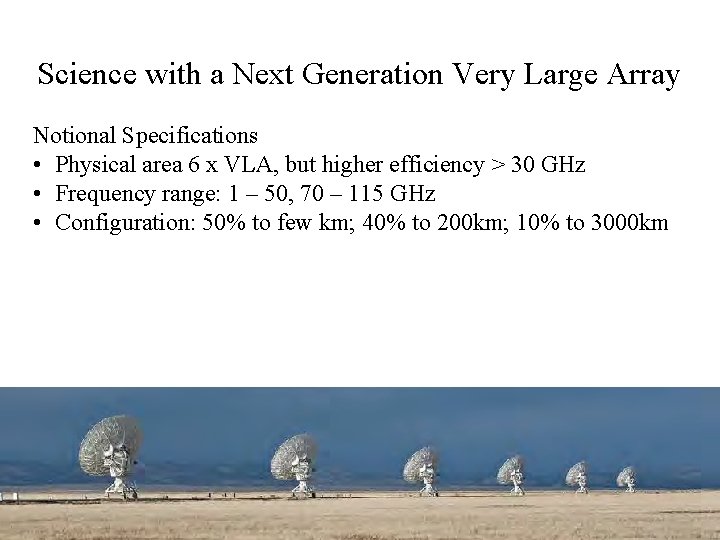
Science with a Next Generation Very Large Array Notional Specifications • Physical area 6 x VLA, but higher efficiency > 30 GHz • Frequency range: 1 – 50, 70 – 115 GHz • Configuration: 50% to few km; 40% to 200 km; 10% to 3000 km
Process to date • Jan 2015: AAS Jan community discussion https: //science. nrao. edu/science/meetings/2015/aas 225/next-gen-vla/ngvla • March 2015: Science working group white papers Ø Ø Cradle of Life (Isella, Moullet, Hull) Galaxy ecosystems (Murphy, Leroy) Galaxy assembly (Lacy, Casey, Hodge) Time domain, Cosmology, Physics (Bower, Demorest) • April 2015: Pasadena technology meeting
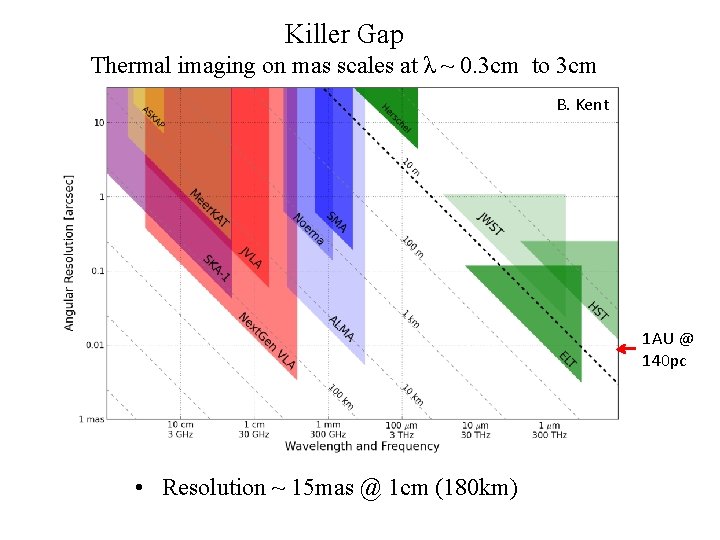
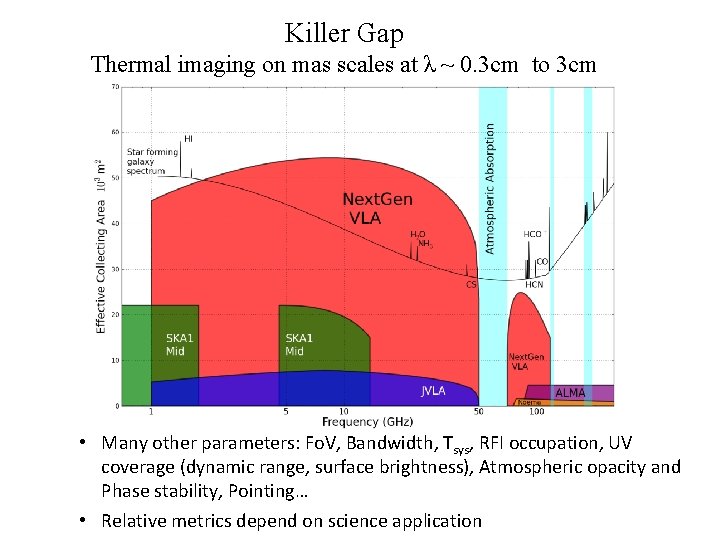
Killer Gap Thermal imaging on mas scales at λ ~ 0. 3 cm to 3 cm B. Kent 1 AU @ 140 pc • Resolution ~ 15 mas @ 1 cm (180 km)
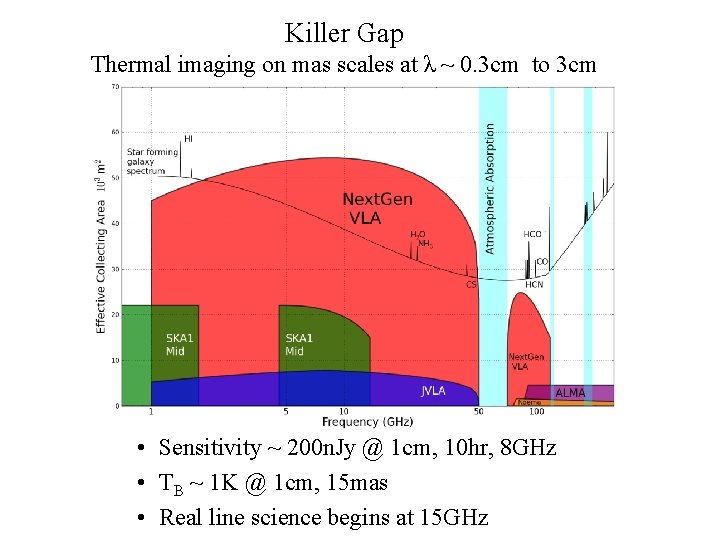
Killer Gap Thermal imaging on mas scales at λ ~ 0. 3 cm to 3 cm • Sensitivity ~ 200 n. Jy @ 1 cm, 10 hr, 8 GHz • TB ~ 1 K @ 1 cm, 15 mas • Real line science begins at 15 GHz
Killer Gap Thermal imaging on mas scales at λ ~ 0. 3 cm to 3 cm • Many other parameters: Fo. V, Bandwidth, Tsys, RFI occupation, UV coverage (dynamic range, surface brightness), Atmospheric opacity and Phase stability, Pointing… • Relative metrics depend on science application
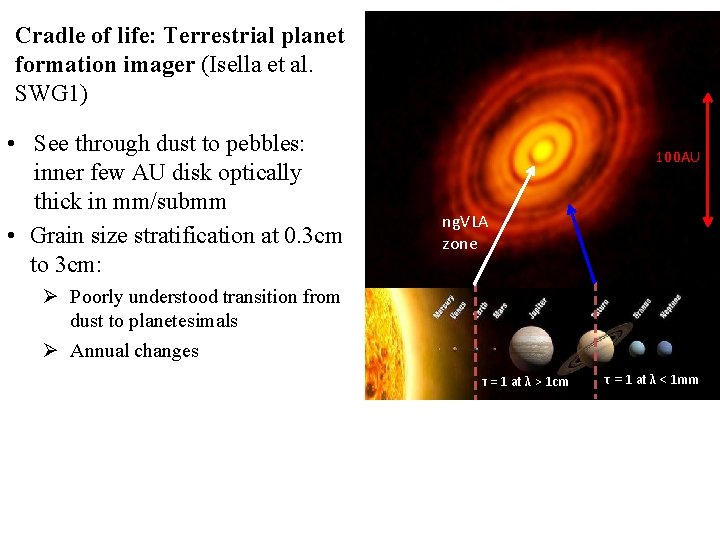
Cradle of life: Terrestrial planet formation imager (Isella et al. SWG 1) • See through dust to pebbles: inner few AU disk optically thick in mm/submm • Grain size stratification at 0. 3 cm to 3 cm: 100 AU ng. VLA zone Ø Poorly understood transition from dust to planetesimals Ø Annual changes τ = 1 at λ > 1 cm τ = 1 at λ < 1 mm
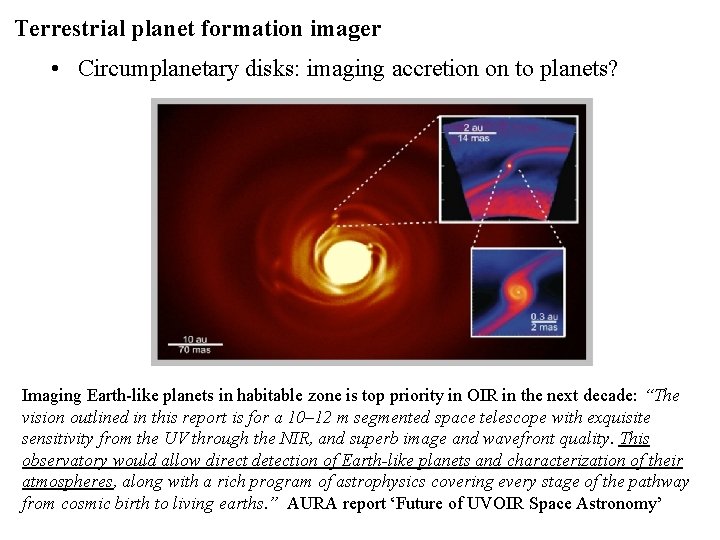
Terrestrial planet formation imager • Circumplanetary disks: imaging accretion on to planets? Imaging Earth-like planets in habitable zone is top priority in OIR in the next decade: “The vision outlined in this report is for a 10– 12 m segmented space telescope with exquisite sensitivity from the UV through the NIR, and superb image and wavefront quality. This observatory would allow direct detection of Earth-like planets and characterization of their atmospheres, along with a rich program of astrophysics covering every stage of the pathway from cosmic birth to living earths. ” AURA report ‘Future of UVOIR Space Astronomy’
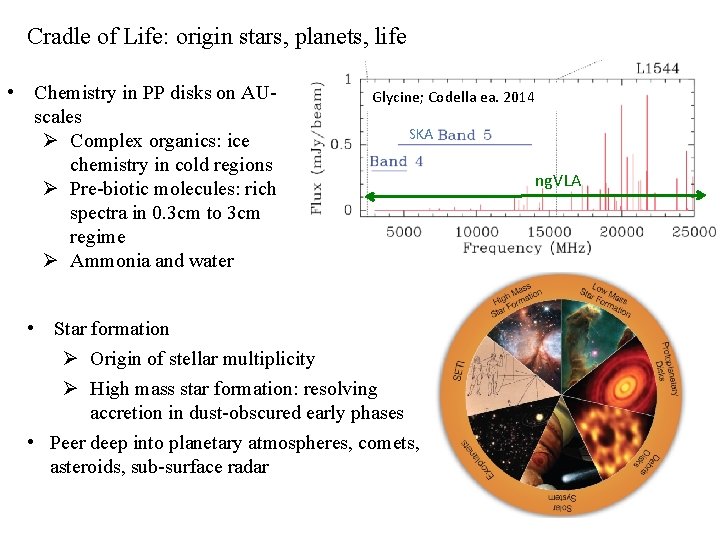
Cradle of Life: origin stars, planets, life • Chemistry in PP disks on AUscales Ø Complex organics: ice chemistry in cold regions Ø Pre-biotic molecules: rich spectra in 0. 3 cm to 3 cm regime Ø Ammonia and water Glycine; Codella ea. 2014 SKA • Star formation Ø Origin of stellar multiplicity Ø High mass star formation: resolving accretion in dust-obscured early phases • Peer deep into planetary atmospheres, comets, asteroids, sub-surface radar ng. VLA
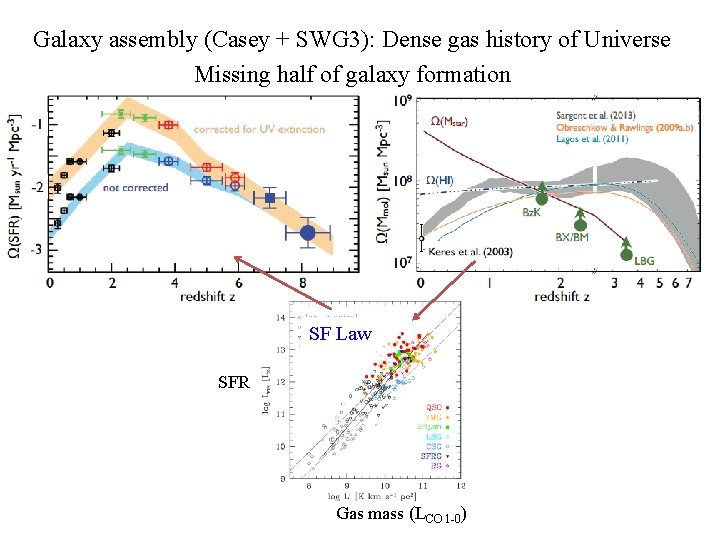
Galaxy assembly (Casey + SWG 3): Dense gas history of Universe Missing half of galaxy formation SF Law SFR Gas mass (LCO 1 -0)
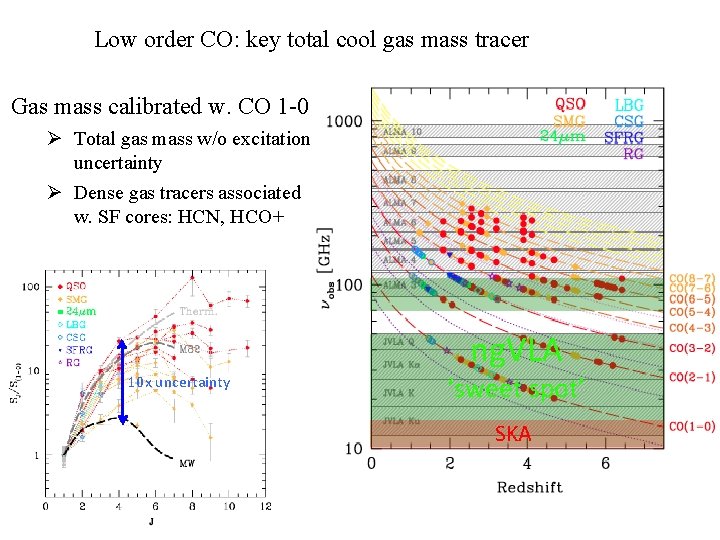
Low order CO: key total cool gas mass tracer Gas mass calibrated w. CO 1 -0 Ø Total gas mass w/o excitation uncertainty Ø Dense gas tracers associated w. SF cores: HCN, HCO+ ng. VLA 10 x uncertainty ‘sweet spot’ SKA
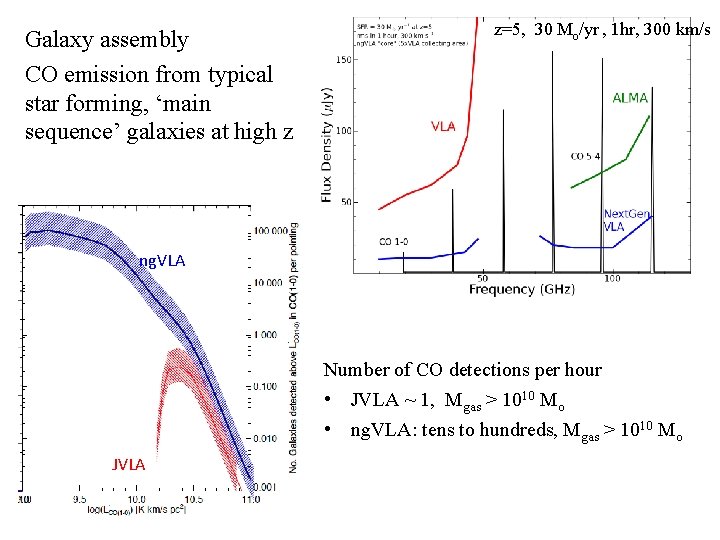
Galaxy assembly CO emission from typical star forming, ‘main sequence’ galaxies at high z z=5, 30 Mo/yr , 1 hr, 300 km/s ng. VLA Number of CO detections per hour • JVLA ~ 1, Mgas > 1010 Mo • ng. VLA: tens to hundreds, Mgas > 1010 Mo JVLA
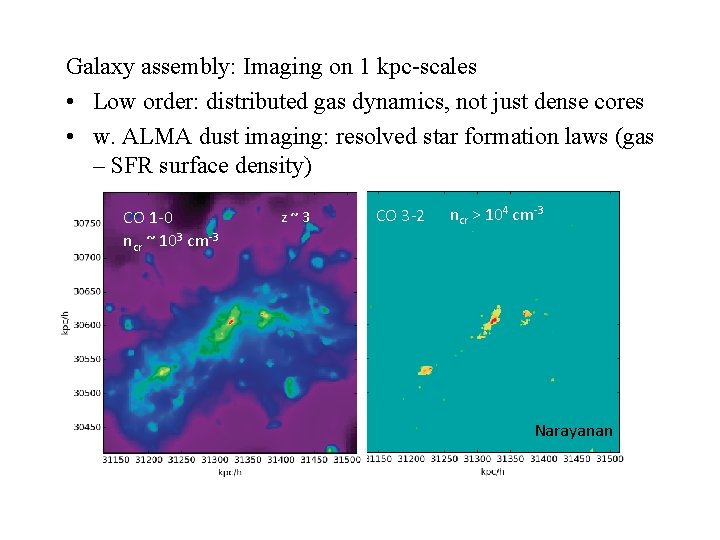
Galaxy assembly: Imaging on 1 kpc-scales • Low order: distributed gas dynamics, not just dense cores • w. ALMA dust imaging: resolved star formation laws (gas – SFR surface density) CO 1 -0 ncr ~ 103 cm-3 z~3 CO 3 -2 ncr > 104 cm-3 Narayanan
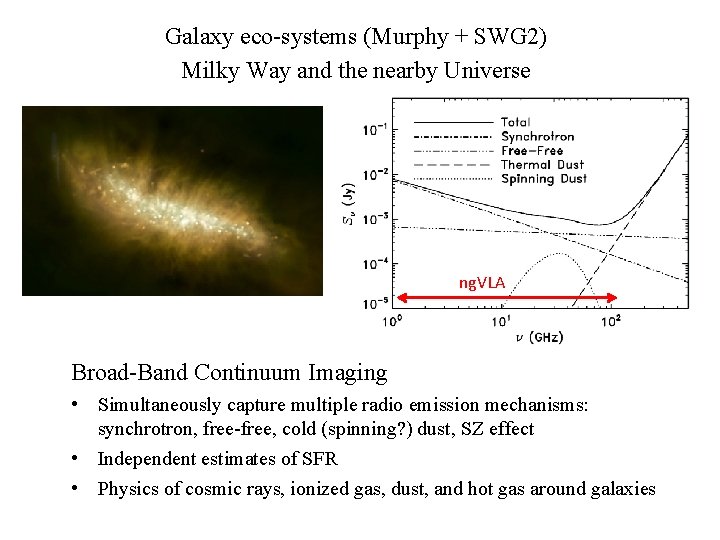
Galaxy eco-systems (Murphy + SWG 2) Milky Way and the nearby Universe ng. VLA Broad-Band Continuum Imaging • Simultaneously capture multiple radio emission mechanisms: synchrotron, free-free, cold (spinning? ) dust, SZ effect • Independent estimates of SFR • Physics of cosmic rays, ionized gas, dust, and hot gas around galaxies
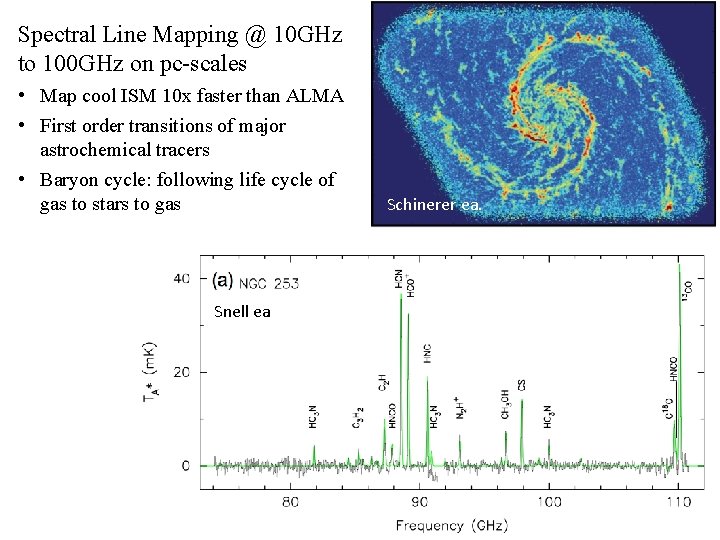
Spectral Line Mapping @ 10 GHz to 100 GHz on pc-scales • Map cool ISM 10 x faster than ALMA • First order transitions of major astrochemical tracers • Baryon cycle: following life cycle of gas to stars to gas Snell ea Schinerer ea.
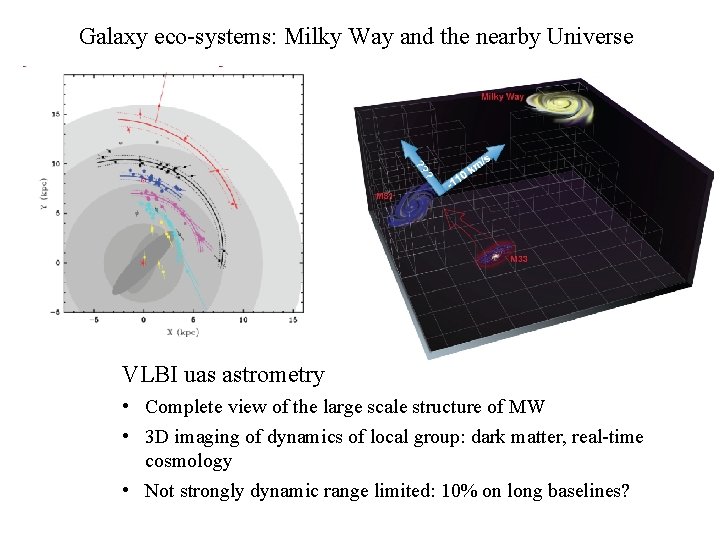
Galaxy eco-systems: Milky Way and the nearby Universe VLBI uas astrometry • Complete view of the large scale structure of MW • 3 D imaging of dynamics of local group: dark matter, real-time cosmology • Not strongly dynamic range limited: 10% on long baselines?
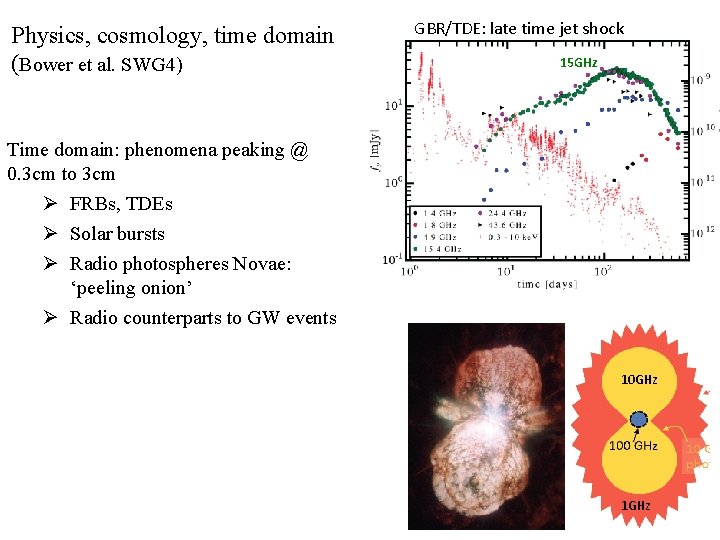
Physics, cosmology, time domain (Bower et al. SWG 4) GBR/TDE: late time jet shock 15 GHz Time domain: phenomena peaking @ 0. 3 cm to 3 cm Ø FRBs, TDEs Ø Solar bursts Ø Radio photospheres Novae: ‘peeling onion’ Ø Radio counterparts to GW events 10 GHz 1 GHz
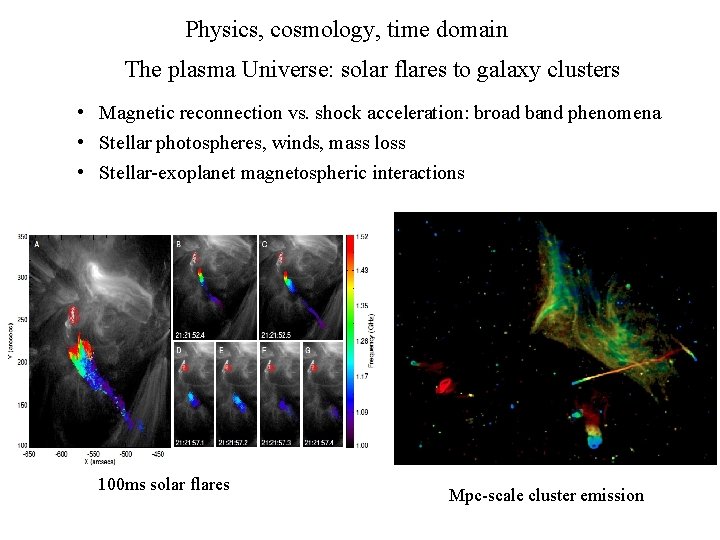
Physics, cosmology, time domain The plasma Universe: solar flares to galaxy clusters • Magnetic reconnection vs. shock acceleration: broad band phenomena • Stellar photospheres, winds, mass loss • Stellar-exoplanet magnetospheric interactions 100 ms solar flares Mpc-scale cluster emission
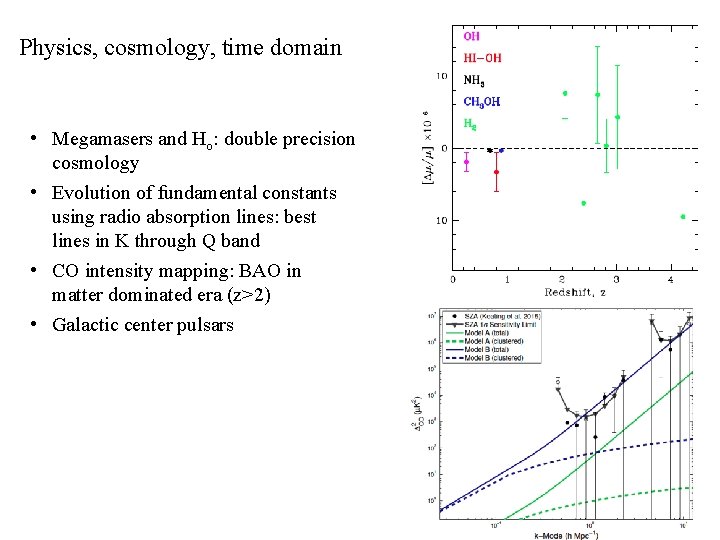
Physics, cosmology, time domain • Megamasers and Ho: double precision cosmology • Evolution of fundamental constants using radio absorption lines: best lines in K through Q band • CO intensity mapping: BAO in matter dominated era (z>2) • Galactic center pulsars
Killer gap: where ng. VLA excels wrt SKA 1 and ALMA • • • Imaging terrestrial zone planet formation Dense gas history of Universe Pre-biotic molecules Maser, CO cosmology Next steps Ø Quantify! physical modeling + configurations + simulations Ø Focused workshop on science case, calculations Ø Call for community white papers?