
Science Update Programme Conductive Polymers From Research to
- Slides: 60
Science Update Programme Conductive Polymers: From Research to Products Education Bureau, HKSAR Department of Chemistry University of Hong Kong May 2002
Course Coordinator Dr. Wai Kin Chan, Department of Chemistry, HKU Content • Introduction to Electrical Conductivity • Electrical Conductivity of Polymers • Polyacetylene: First example of conducting polymer • Conduction Process in Conjugate Polymers • Examples of other conducting polymers and their syntheses • Applications of Conducting Polymers
Conductive Polymers In 2000, The Nobel Prize in Chemistry was awarded to A. J. Heeger, A. G. Mac. Diarmid, and H. Shirakawa “for the discovery and development of electrically conductive polymers” http: //www. nobel. se
References 1. “Handbook of Conducting Polymers” First Edition, T. A. Skotheim Ed. , Marcel Dekker, New York, 1986. 2. “Functional Monomers and Polymers” K. Takemoto, R. M. Ottenbrite, M. Kamachi Eds. , Marcel Dekker, New York, 1997. 3. “Handbook of Organic Conductive Molecules and Polymers” Volume 2, H. S. Nalwa Ed. , Wiley, West Sussex, 1997. 4. “Handbook of Conducting Polymers” Second Edition, T. A. Skotheim, R. L. Elsenbaumer, J. R. Reynolds Eds. , Marcel Dekker, New York, 1998. 5. “Electronic Materials: The Oligomer Approach” K. Müllen and G. Wegner Eds. , Wiley-VCH, Weinheim, 1998. 6. “Semiconducting Polymers: Chemistry, Physics and Engineering” G. Hadziioannou and P. F. van Hutten Eds. , Wiley-VCH, Weinheim, 2000. 7. Other research articles in Nature, Science, Advanced Materials, Applied Physics Letters, Journal of Applied Physics, Macromolecules, Chemistry of Materials, Synthetic Metals etc.
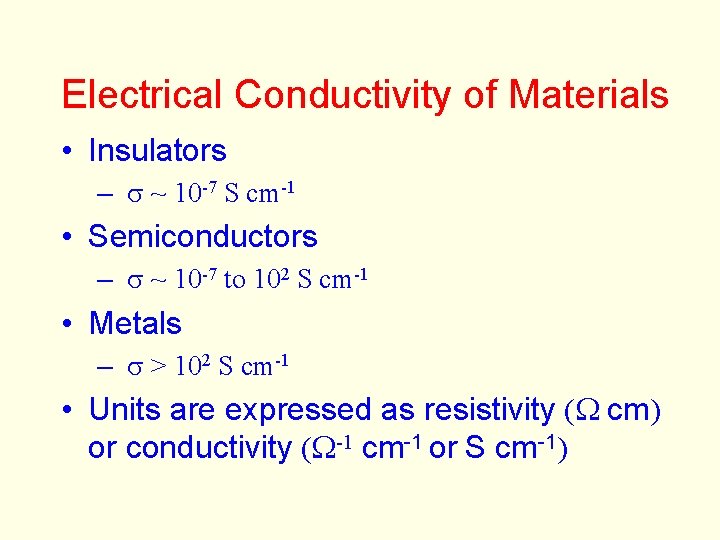
Electrical Conductivity of Materials • Insulators – s ~ 10 -7 S cm-1 • Semiconductors – s ~ 10 -7 to 102 S cm-1 • Metals – s > 102 S cm-1 • Units are expressed as resistivity (W cm) or conductivity (W-1 cm-1 or S cm-1)
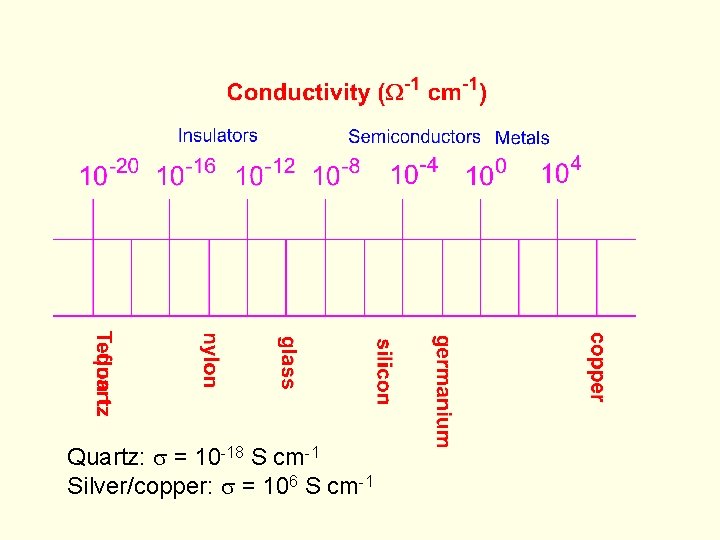
Quartz: s = 10 -18 S cm-1 Silver/copper: s = 106 S cm-1
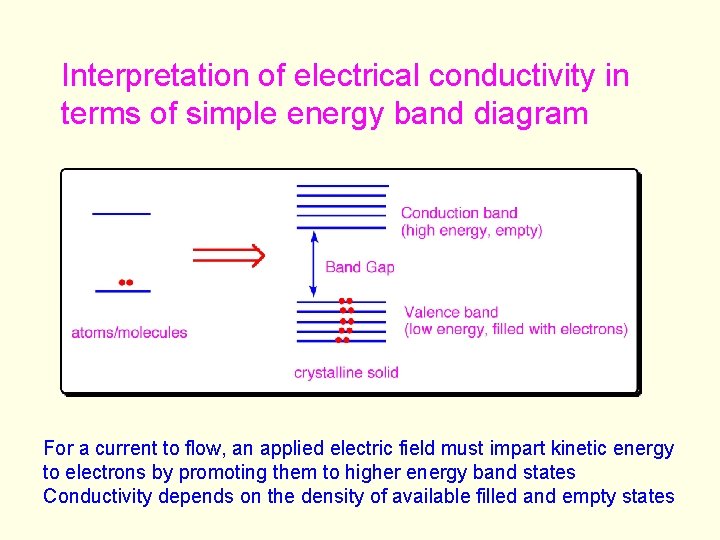
Interpretation of electrical conductivity in terms of simple energy band diagram For a current to flow, an applied electric field must impart kinetic energy to electrons by promoting them to higher energy band states Conductivity depends on the density of available filled and empty states
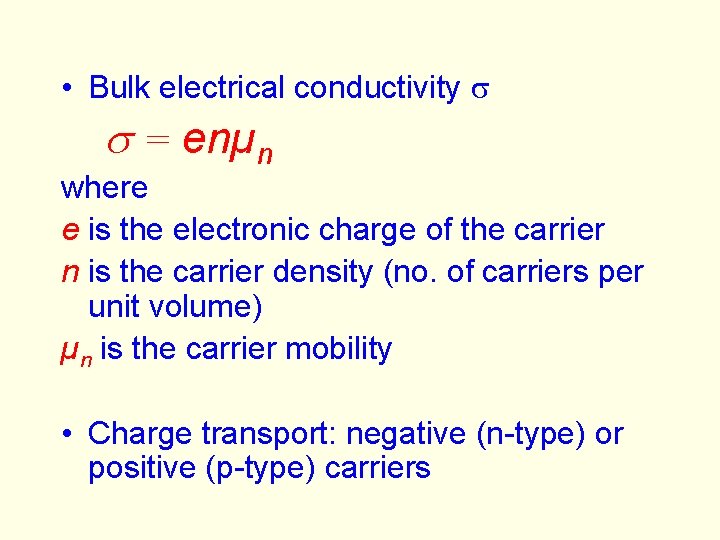
• Bulk electrical conductivity s s = enµn where e is the electronic charge of the carrier n is the carrier density (no. of carriers per unit volume) µn is the carrier mobility • Charge transport: negative (n-type) or positive (p-type) carriers
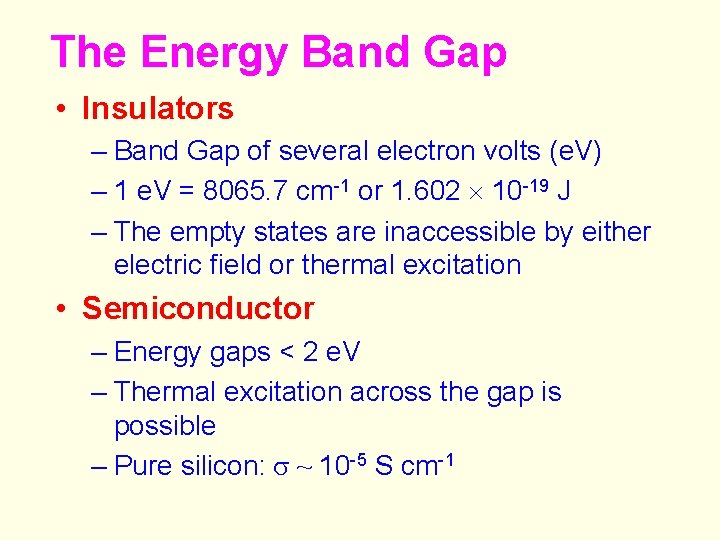
The Energy Band Gap • Insulators – Band Gap of several electron volts (e. V) – 1 e. V = 8065. 7 cm-1 or 1. 602 10 -19 J – The empty states are inaccessible by either electric field or thermal excitation • Semiconductor – Energy gaps < 2 e. V – Thermal excitation across the gap is possible – Pure silicon: s ~ 10 -5 S cm-1
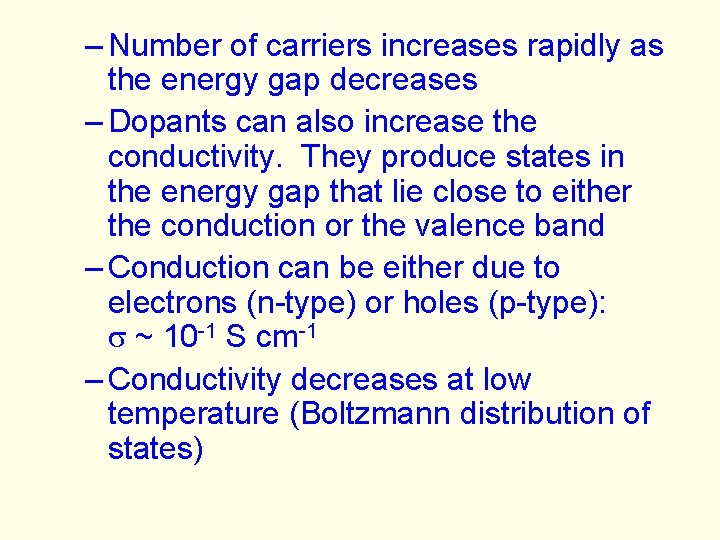
– Number of carriers increases rapidly as the energy gap decreases – Dopants can also increase the conductivity. They produce states in the energy gap that lie close to either the conduction or the valence band – Conduction can be either due to electrons (n-type) or holes (p-type): s ~ 10 -1 S cm-1 – Conductivity decreases at low temperature (Boltzmann distribution of states)
• Metals – Conductivity of materials increases as temperature decreases – Thermal motion of the lattice and scattering processes are reduced – True metallic behavior results when the energy gap between filled and empty states disappears What are the advantageous of using conducting polymers compared to metallic materials?
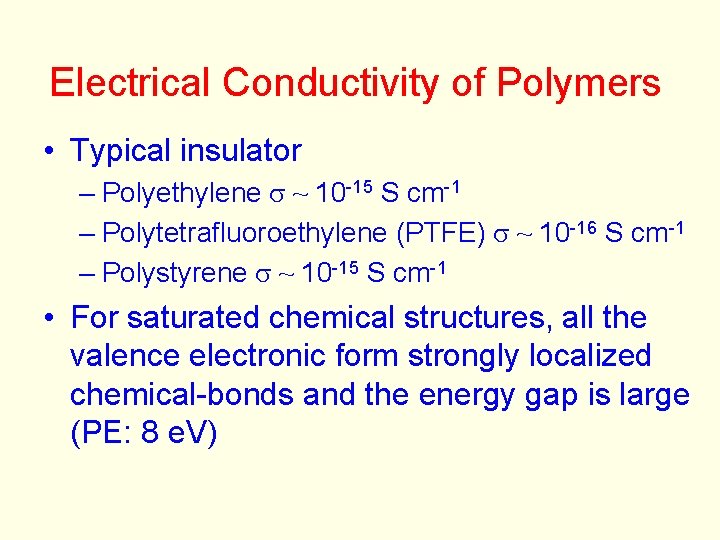
Electrical Conductivity of Polymers • Typical insulator – Polyethylene s ~ 10 -15 S cm-1 – Polytetrafluoroethylene (PTFE) s ~ 10 -16 S cm-1 – Polystyrene s ~ 10 -15 S cm-1 • For saturated chemical structures, all the valence electronic form strongly localized chemical-bonds and the energy gap is large (PE: 8 e. V)
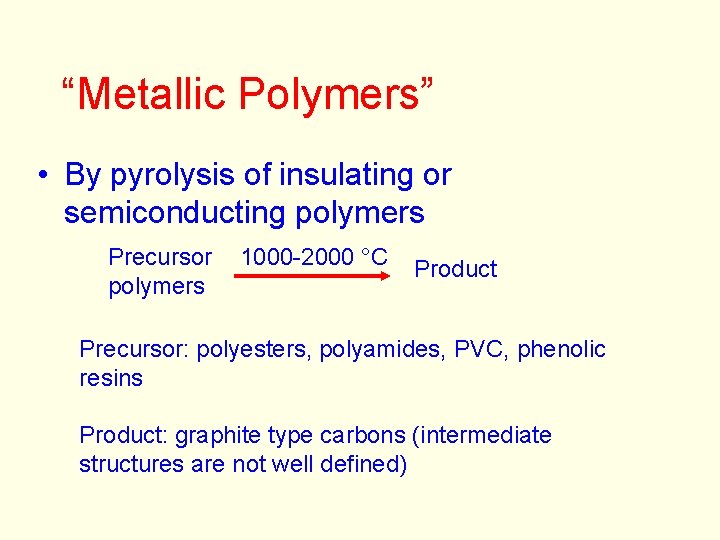
“Metallic Polymers” • By pyrolysis of insulating or semiconducting polymers Precursor polymers 1000 -2000 °C Product Precursor: polyesters, polyamides, PVC, phenolic resins Product: graphite type carbons (intermediate structures are not well defined)
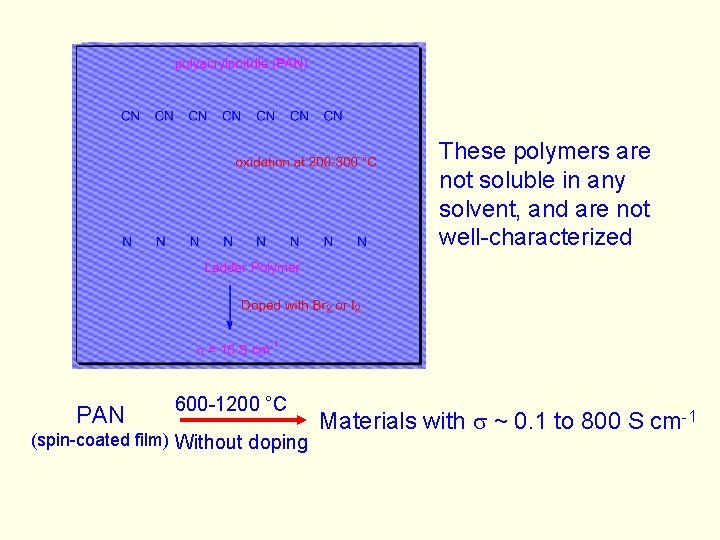
These polymers are not soluble in any solvent, and are not well-characterized PAN 600 -1200 °C (spin-coated film) Without doping Materials with s ~ 0. 1 to 800 S cm-1
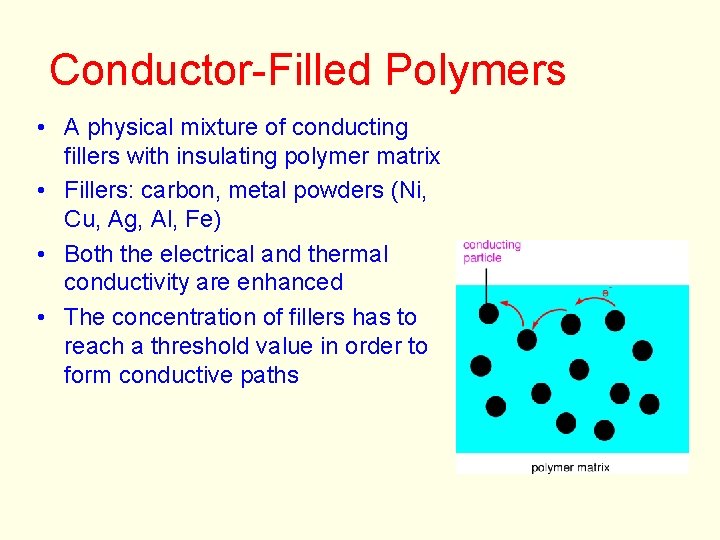
Conductor-Filled Polymers • A physical mixture of conducting fillers with insulating polymer matrix • Fillers: carbon, metal powders (Ni, Cu, Ag, Al, Fe) • Both the electrical and thermal conductivity are enhanced • The concentration of fillers has to reach a threshold value in order to form conductive paths
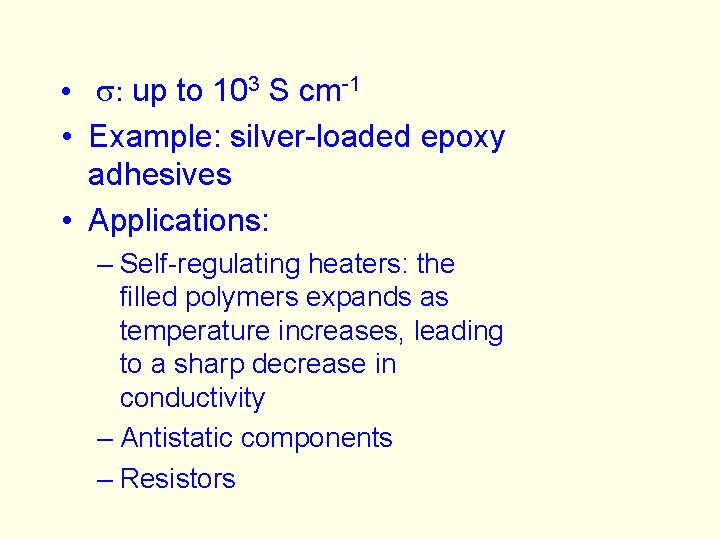
• s: up to 103 S cm-1 • Example: silver-loaded epoxy adhesives • Applications: – Self-regulating heaters: the filled polymers expands as temperature increases, leading to a sharp decrease in conductivity – Antistatic components – Resistors
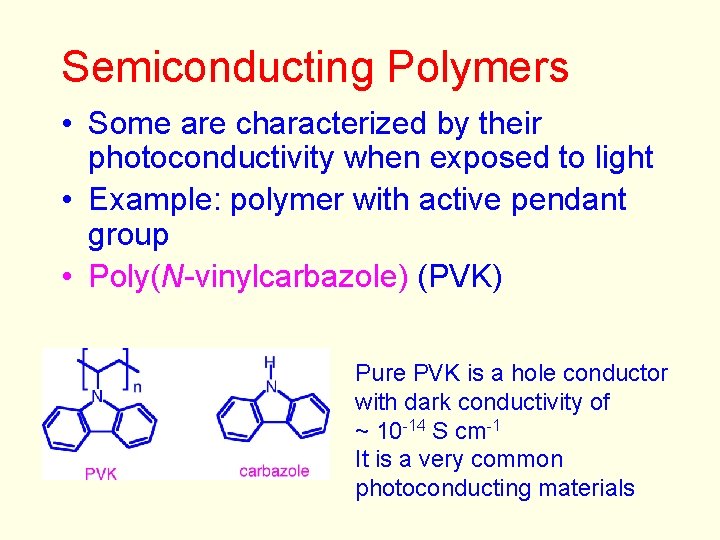
Semiconducting Polymers • Some are characterized by their photoconductivity when exposed to light • Example: polymer with active pendant group • Poly(N-vinylcarbazole) (PVK) Pure PVK is a hole conductor with dark conductivity of ~ 10 -14 S cm-1 It is a very common photoconducting materials
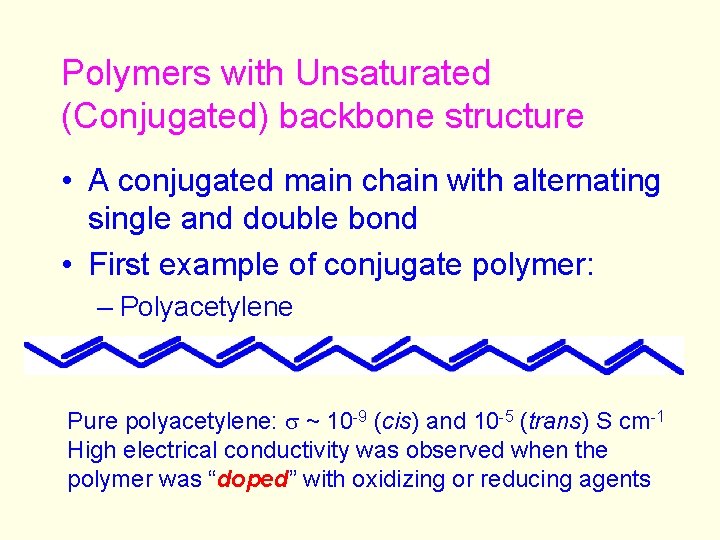
Polymers with Unsaturated (Conjugated) backbone structure • A conjugated main chain with alternating single and double bond • First example of conjugate polymer: – Polyacetylene Pure polyacetylene: s ~ 10 -9 (cis) and 10 -5 (trans) S cm-1 High electrical conductivity was observed when the polymer was “doped” with oxidizing or reducing agents
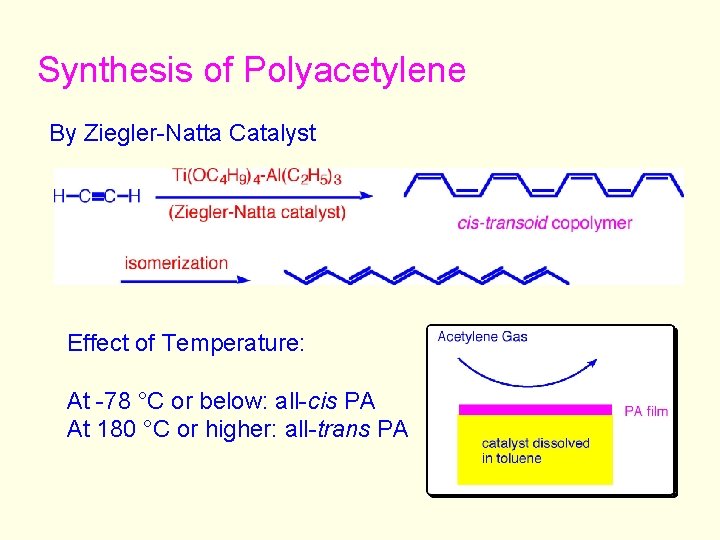
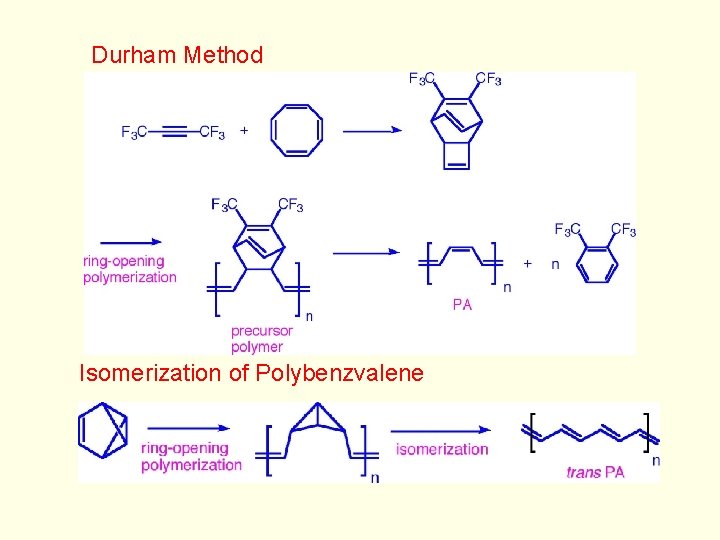
Synthesis of Polyacetylene By Ziegler-Natta Catalyst Effect of Temperature: At -78 °C or below: all-cis PA At 180 °C or higher: all-trans PA
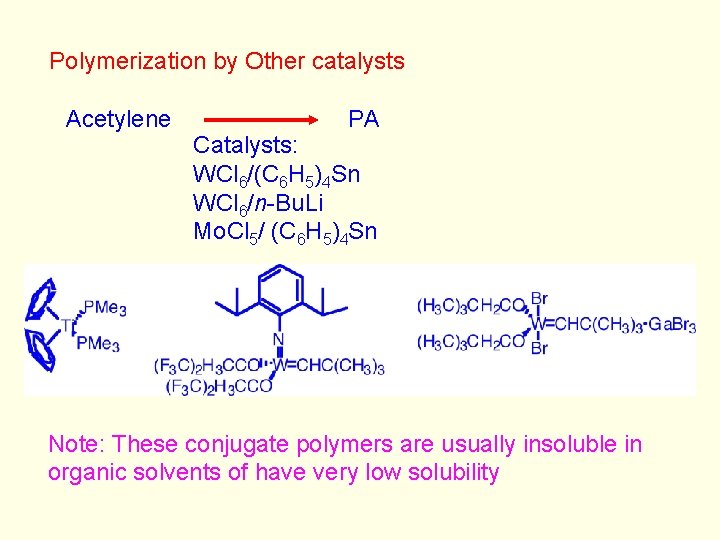
Polymerization by Other catalysts Acetylene PA Catalysts: WCl 6/(C 6 H 5)4 Sn WCl 6/n-Bu. Li Mo. Cl 5/ (C 6 H 5)4 Sn Note: These conjugate polymers are usually insoluble in organic solvents of have very low solubility
Durham Method Isomerization of Polybenzvalene
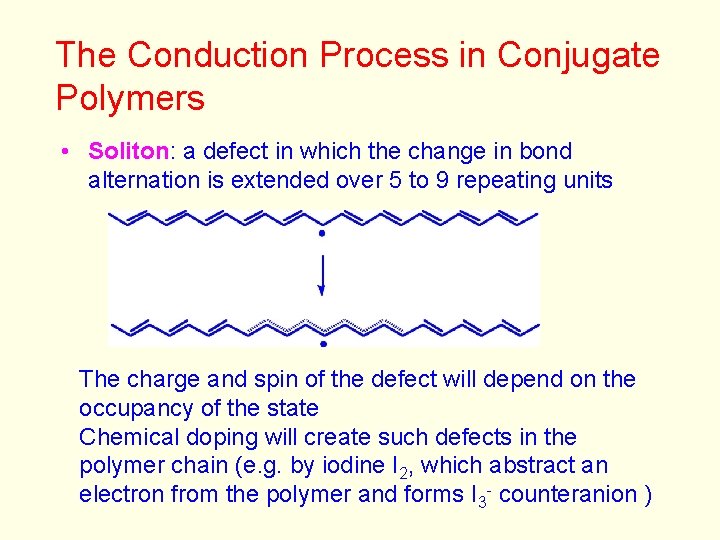
The Conduction Process in Conjugate Polymers • Soliton: a defect in which the change in bond alternation is extended over 5 to 9 repeating units The charge and spin of the defect will depend on the occupancy of the state Chemical doping will create such defects in the polymer chain (e. g. by iodine I 2, which abstract an electron from the polymer and forms I 3 - counteranion )
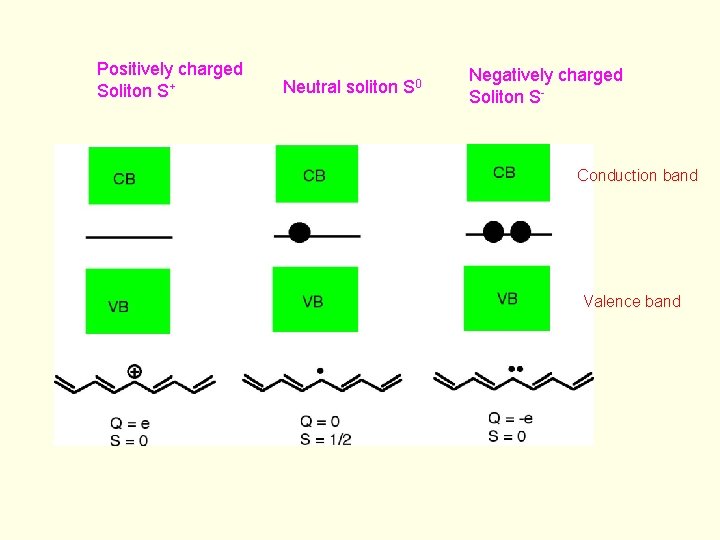
Positively charged Soliton S+ Neutral soliton S 0 Negatively charged Soliton S- Conduction band Valence band
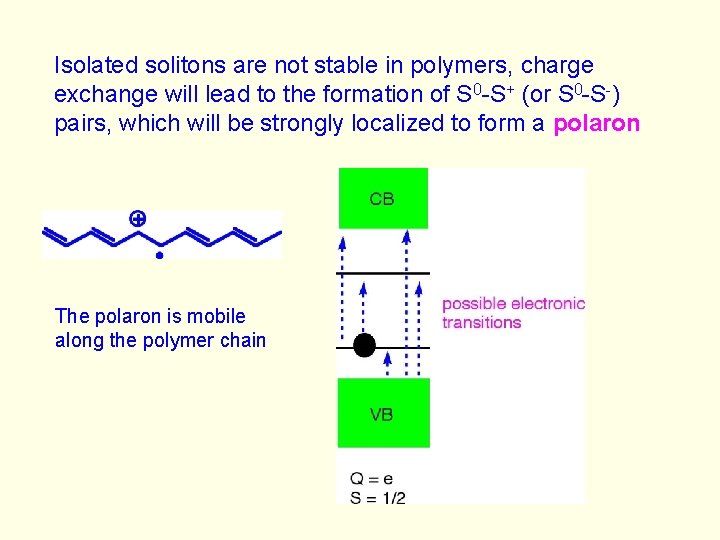
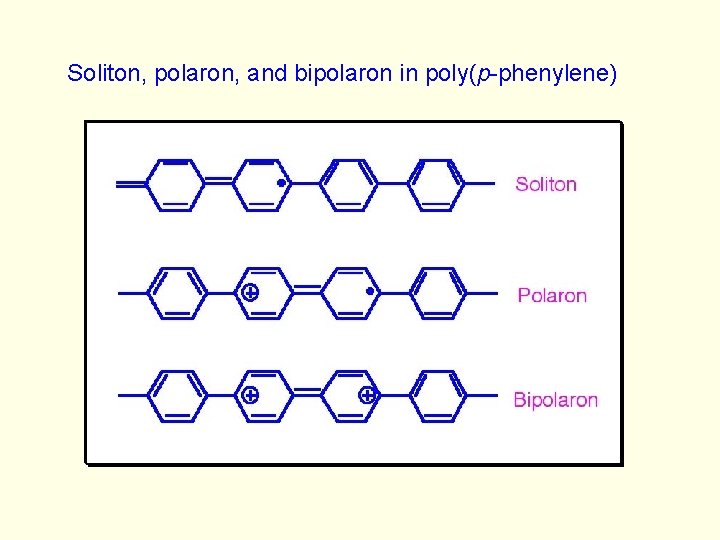
Isolated solitons are not stable in polymers, charge exchange will lead to the formation of S 0 -S+ (or S 0 -S-) pairs, which will be strongly localized to form a polaron The polaron is mobile along the polymer chain
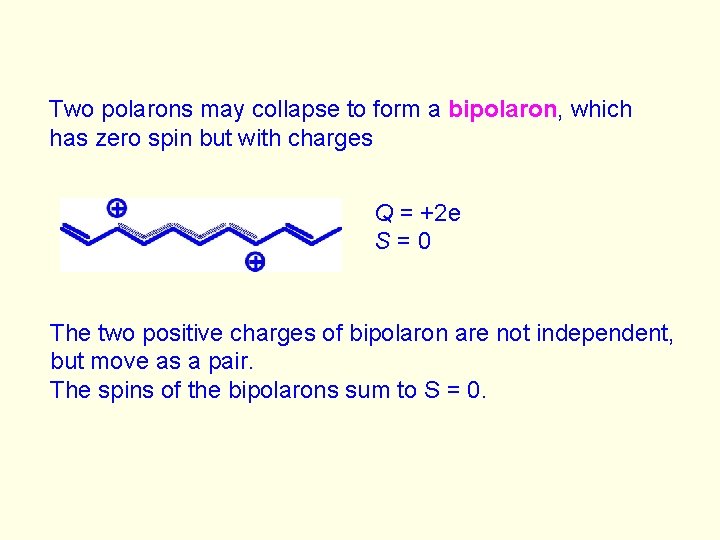
Two polarons may collapse to form a bipolaron, which has zero spin but with charges Q = +2 e S=0 The two positive charges of bipolaron are not independent, but move as a pair. The spins of the bipolarons sum to S = 0.
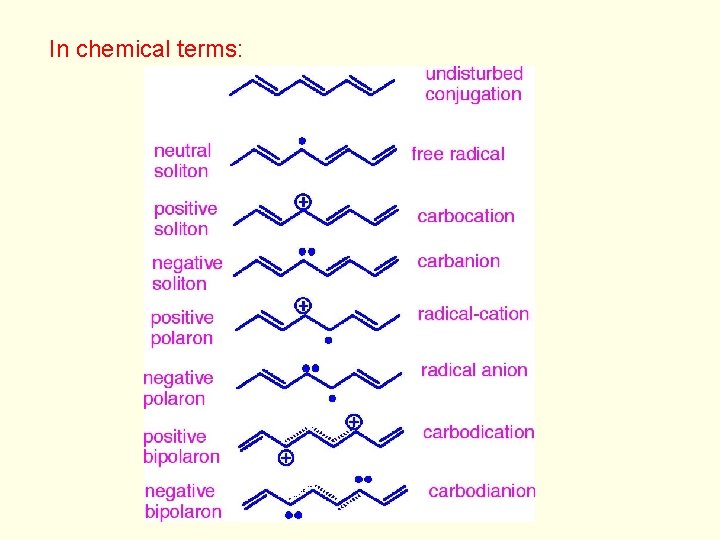
In chemical terms:
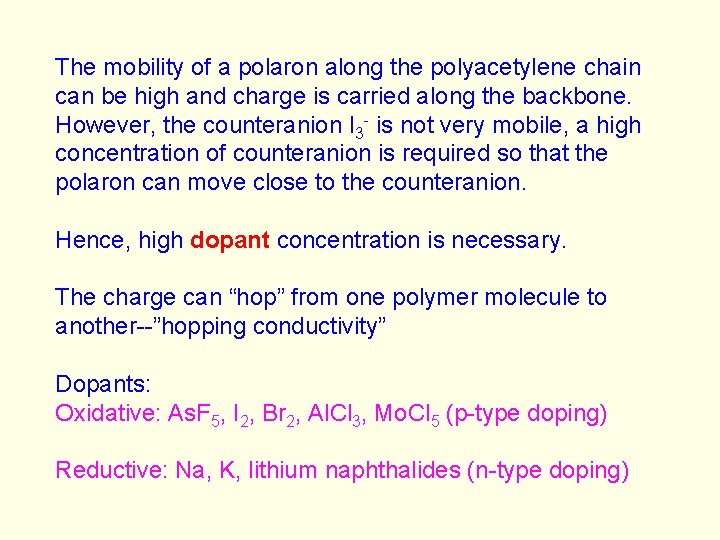
The mobility of a polaron along the polyacetylene chain can be high and charge is carried along the backbone. However, the counteranion I 3 - is not very mobile, a high concentration of counteranion is required so that the polaron can move close to the counteranion. Hence, high dopant concentration is necessary. The charge can “hop” from one polymer molecule to another--”hopping conductivity” Dopants: Oxidative: As. F 5, I 2, Br 2, Al. Cl 3, Mo. Cl 5 (p-type doping) Reductive: Na, K, lithium naphthalides (n-type doping)
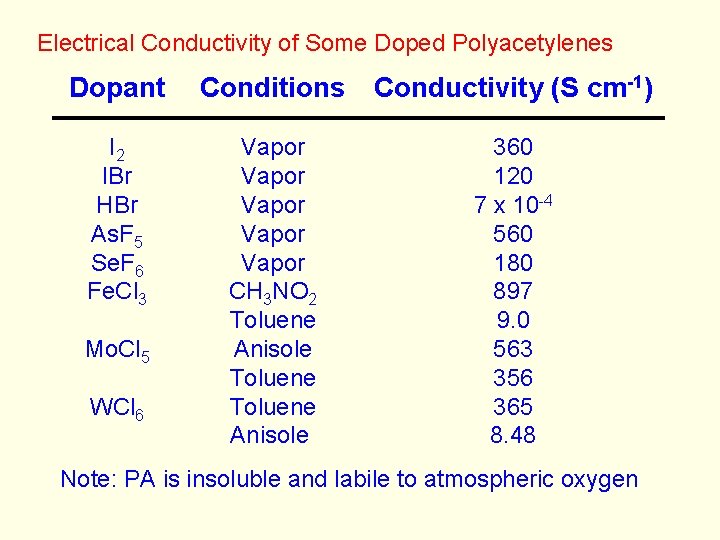
Electrical Conductivity of Some Doped Polyacetylenes Dopant I 2 IBr HBr As. F 5 Se. F 6 Fe. Cl 3 Mo. Cl 5 WCl 6 Conditions Conductivity (S cm-1) Vapor Vapor CH 3 NO 2 Toluene Anisole 360 120 7 x 10 -4 560 180 897 9. 0 563 356 365 8. 48 Note: PA is insoluble and labile to atmospheric oxygen
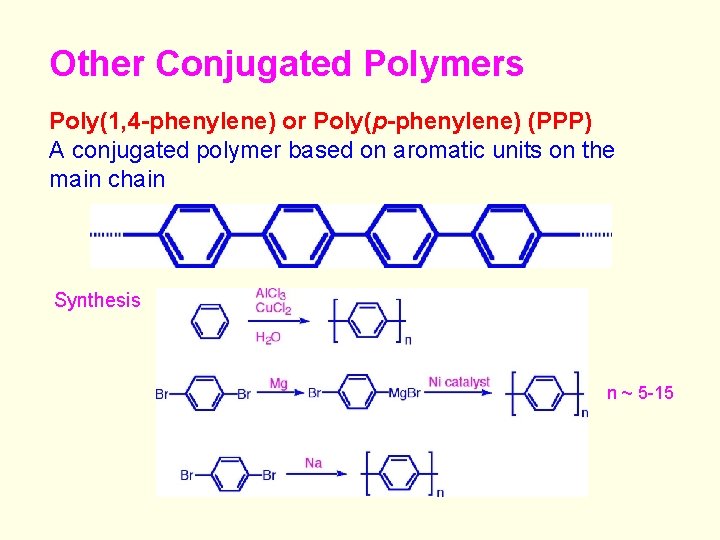
Other Conjugated Polymers Poly(1, 4 -phenylene) or Poly(p-phenylene) (PPP) A conjugated polymer based on aromatic units on the main chain Synthesis n ~ 5 -15
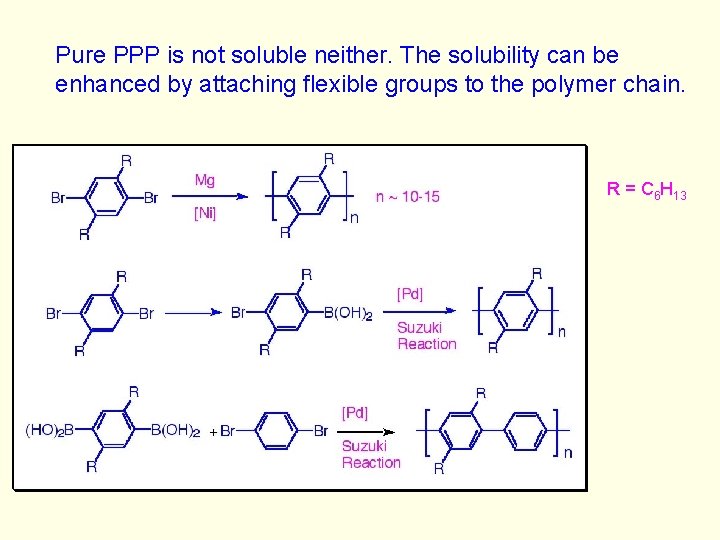
Pure PPP is not soluble neither. The solubility can be enhanced by attaching flexible groups to the polymer chain. R = C 6 H 13
Soliton, polaron, and bipolaron in poly(p-phenylene)
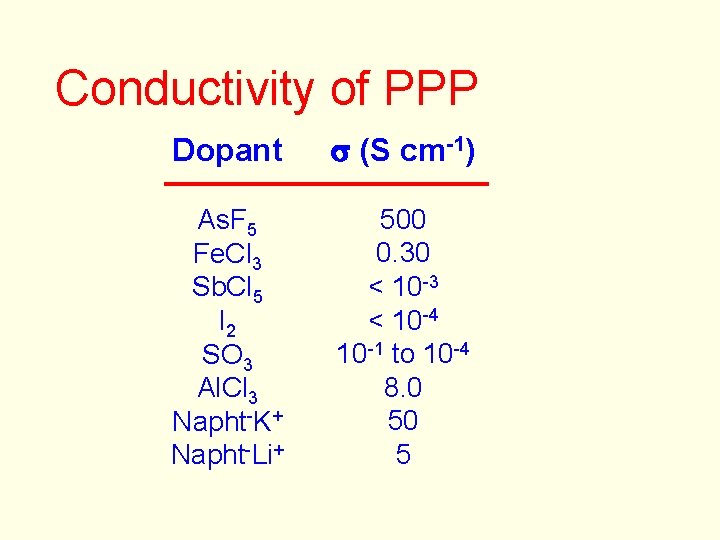
Conductivity of PPP Dopant s (S cm-1) As. F 5 Fe. Cl 3 Sb. Cl 5 I 2 SO 3 Al. Cl 3 Napht-K+ Napht-Li+ 500 0. 30 < 10 -3 < 10 -4 10 -1 to 10 -4 8. 0 50 5
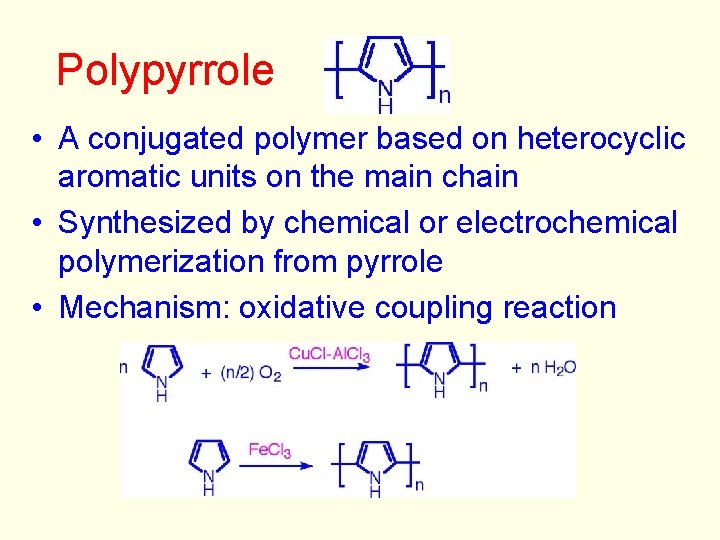
Polypyrrole • A conjugated polymer based on heterocyclic aromatic units on the main chain • Synthesized by chemical or electrochemical polymerization from pyrrole • Mechanism: oxidative coupling reaction
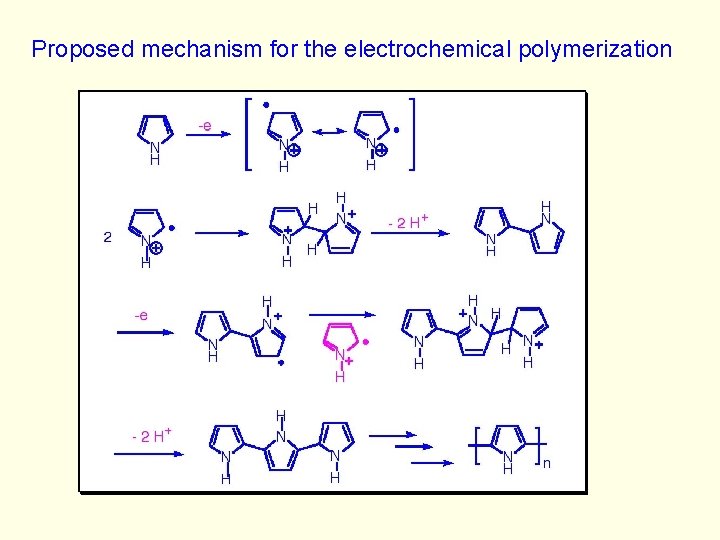
Proposed mechanism for the electrochemical polymerization
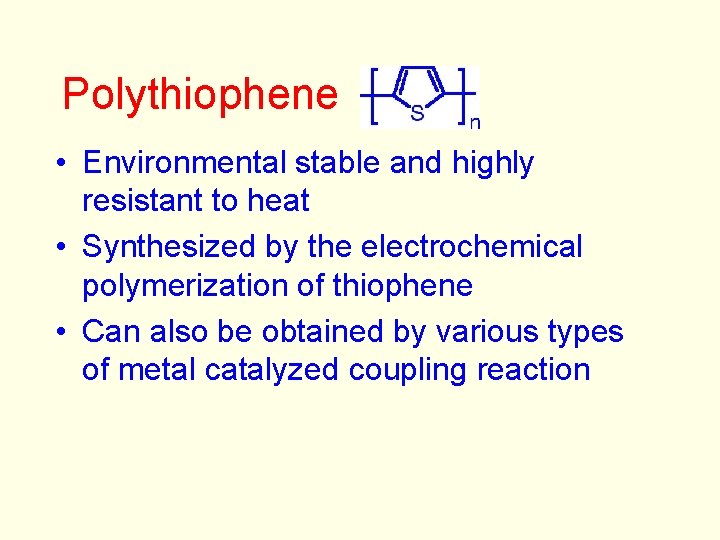
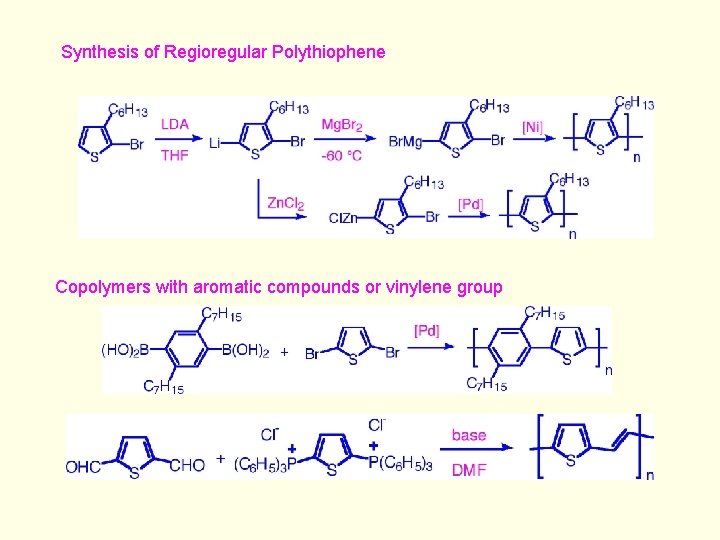
Polythiophene • Environmental stable and highly resistant to heat • Synthesized by the electrochemical polymerization of thiophene • Can also be obtained by various types of metal catalyzed coupling reaction
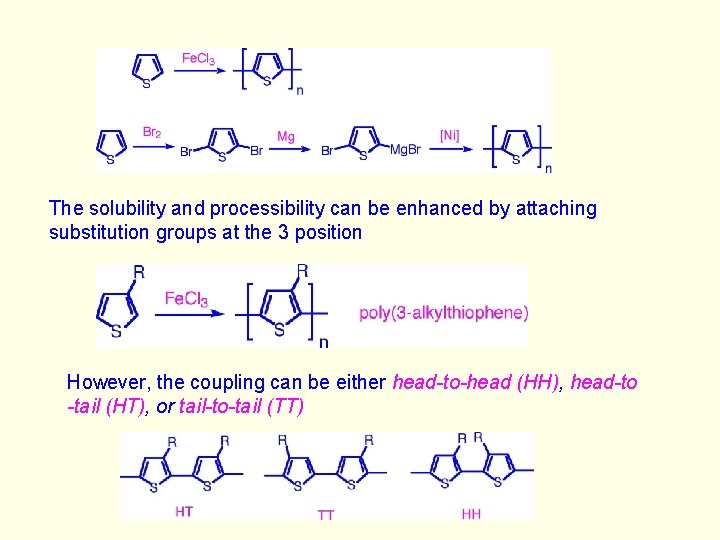
The solubility and processibility can be enhanced by attaching substitution groups at the 3 position However, the coupling can be either head-to-head (HH), head-to -tail (HT), or tail-to-tail (TT)
Synthesis of Regioregular Polythiophene Copolymers with aromatic compounds or vinylene group
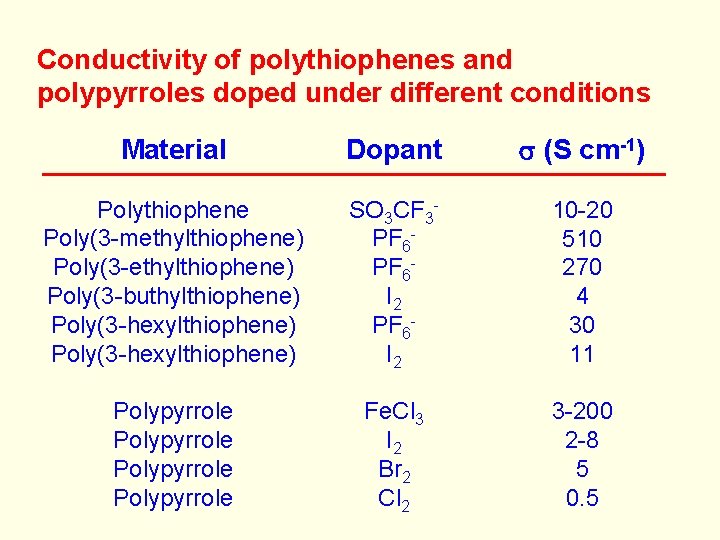
Conductivity of polythiophenes and polypyrroles doped under different conditions Material Dopant s (S cm-1) Polythiophene Poly(3 -methylthiophene) Poly(3 -buthylthiophene) Poly(3 -hexylthiophene) SO 3 CF 3 PF 6 I 2 10 -20 510 270 4 30 11 Polypyrrole Fe. Cl 3 I 2 Br 2 Cl 2 3 -200 2 -8 5 0. 5
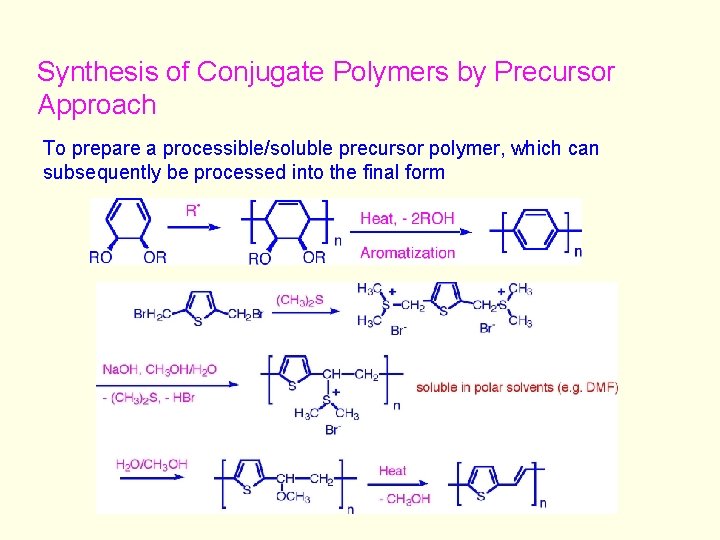
Synthesis of Conjugate Polymers by Precursor Approach To prepare a processible/soluble precursor polymer, which can subsequently be processed into the final form
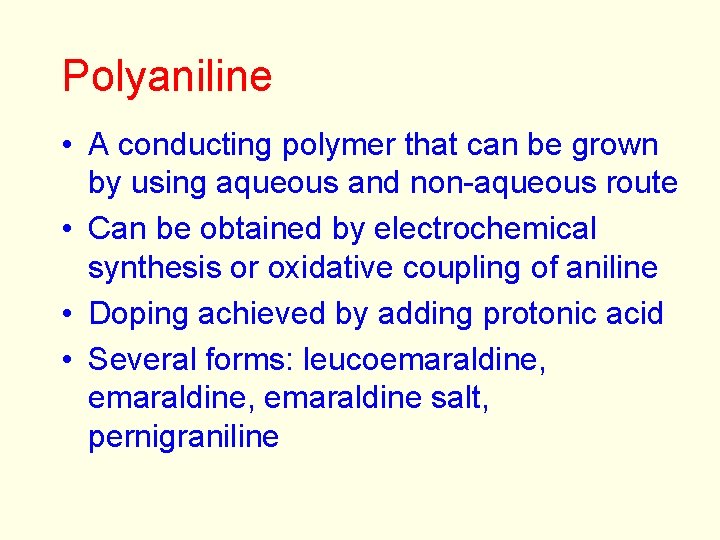
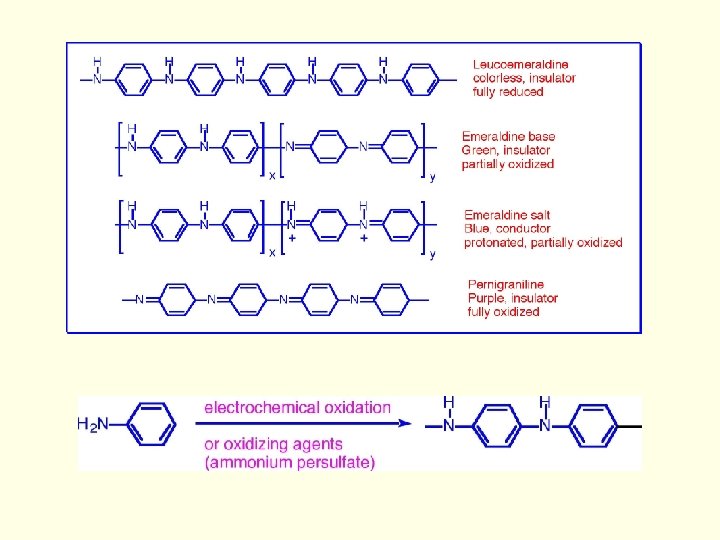
Polyaniline • A conducting polymer that can be grown by using aqueous and non-aqueous route • Can be obtained by electrochemical synthesis or oxidative coupling of aniline • Doping achieved by adding protonic acid • Several forms: leucoemaraldine, emaraldine salt, pernigraniline
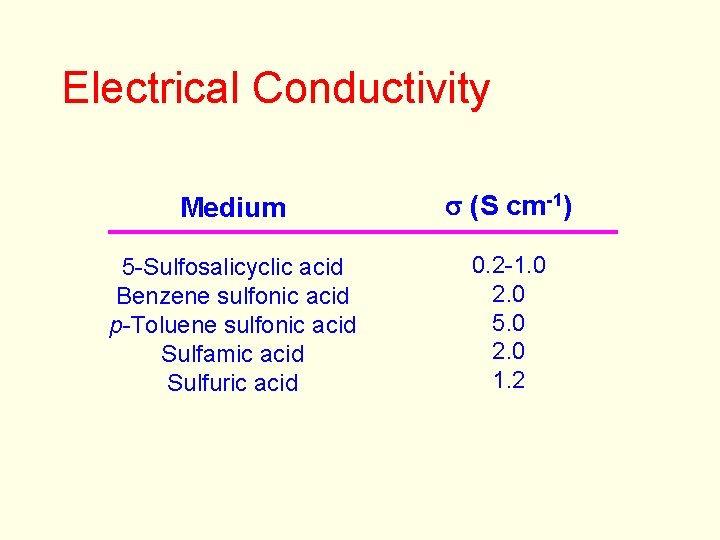
Electrical Conductivity Medium s (S cm-1) 5 -Sulfosalicyclic acid Benzene sulfonic acid p-Toluene sulfonic acid Sulfamic acid Sulfuric acid 0. 2 -1. 0 2. 0 5. 0 2. 0 1. 2
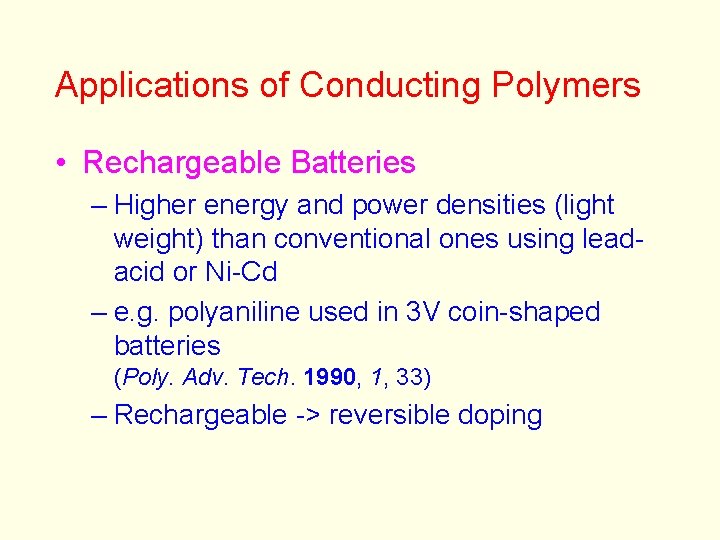
Applications of Conducting Polymers • Rechargeable Batteries – Higher energy and power densities (light weight) than conventional ones using leadacid or Ni-Cd – e. g. polyaniline used in 3 V coin-shaped batteries (Poly. Adv. Tech. 1990, 1, 33) – Rechargeable -> reversible doping
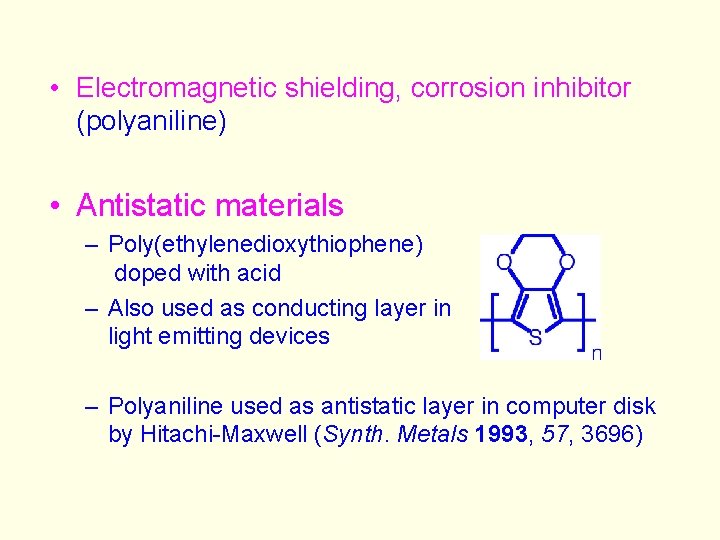
• Electromagnetic shielding, corrosion inhibitor (polyaniline) • Antistatic materials – Poly(ethylenedioxythiophene) doped with acid – Also used as conducting layer in light emitting devices – Polyaniline used as antistatic layer in computer disk by Hitachi-Maxwell (Synth. Metals 1993, 57, 3696)
Other Applications Emission Properties • Polymers with extended p-conjugated systems usually absorb strongly in the visible region • Many of them also emit light after absorbing a photon (photoexcitation)
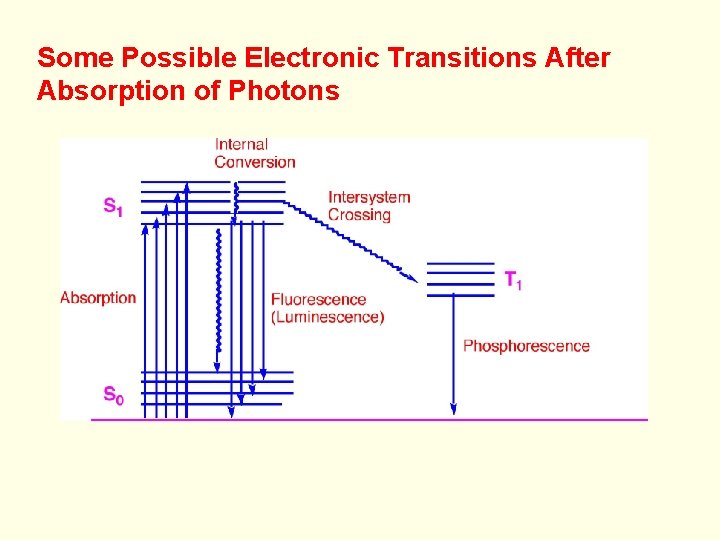
Some Possible Electronic Transitions After Absorption of Photons
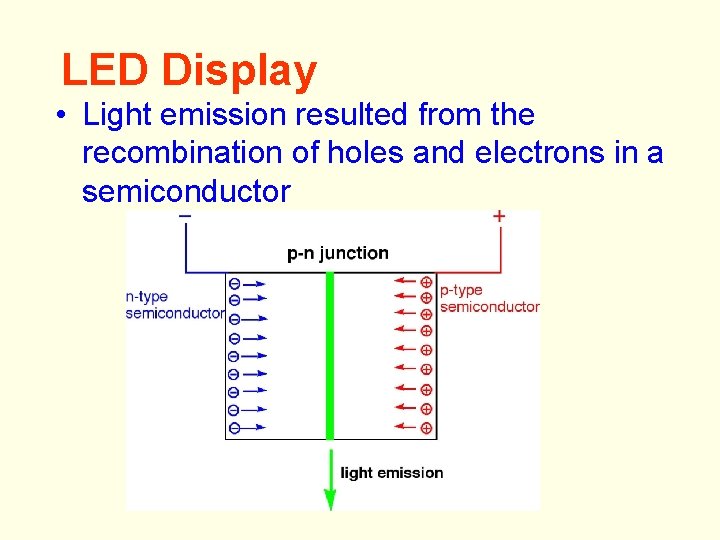
LED Display • Light emission resulted from the recombination of holes and electrons in a semiconductor
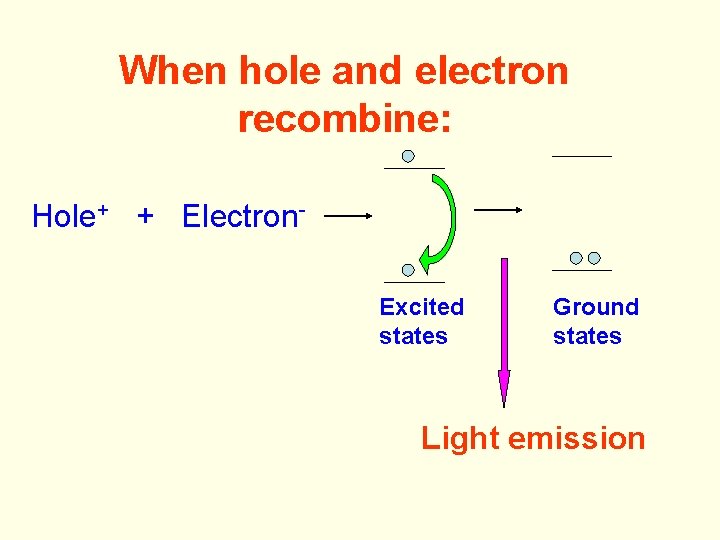
When hole and electron recombine: Hole+ + Electron. Excited states Ground states Light emission
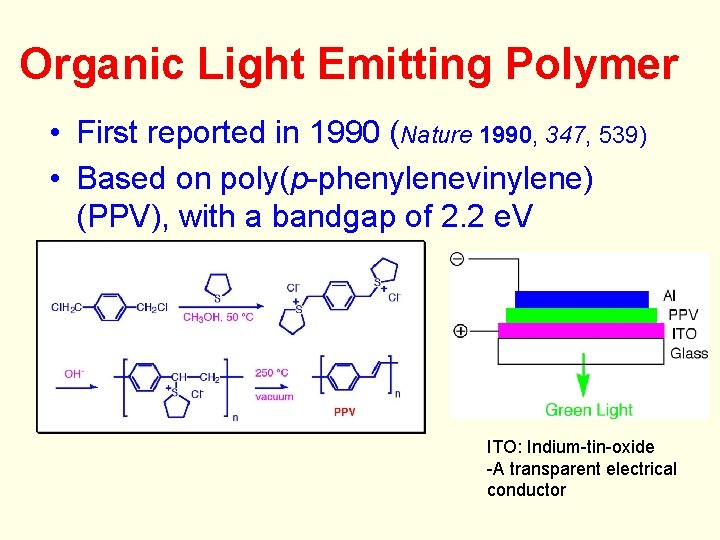
Organic Light Emitting Polymer • First reported in 1990 (Nature 1990, 347, 539) • Based on poly(p-phenylenevinylene) (PPV), with a bandgap of 2. 2 e. V ITO: Indium-tin-oxide -A transparent electrical conductor
• Threshold for charge injection (turn-on voltage): 14 V (E-field = 2 x 10⁶ V/cm • Quantum efficiency = 0. 05 % • Emission color: Green • Processible ? No!! • Polymer is obtained by precursor approach. It cannot be redissolved once the polymer is synthesized
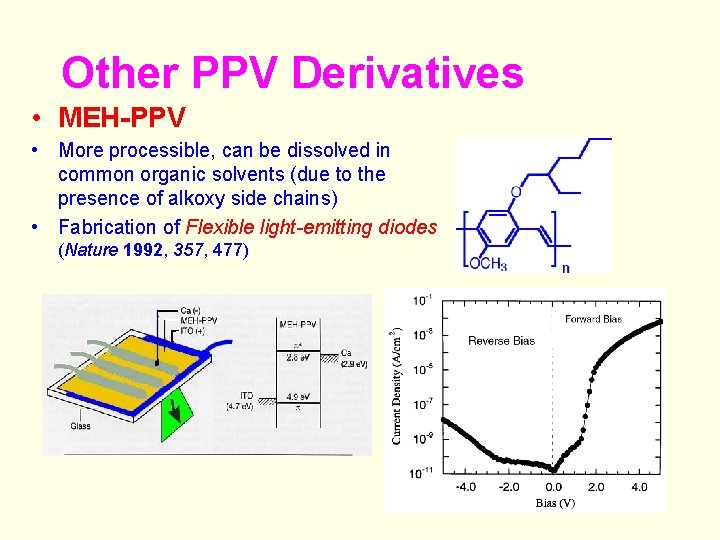
Other PPV Derivatives • MEH-PPV • More processible, can be dissolved in common organic solvents (due to the presence of alkoxy side chains) • Fabrication of Flexible light-emitting diodes (Nature 1992, 357, 477)
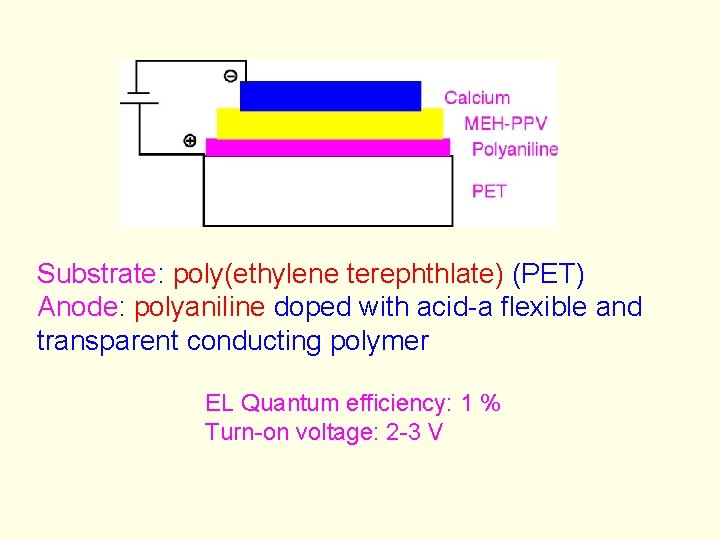
Substrate: poly(ethylene terephthlate) (PET) Anode: polyaniline doped with acid-a flexible and transparent conducting polymer EL Quantum efficiency: 1 % Turn-on voltage: 2 -3 V
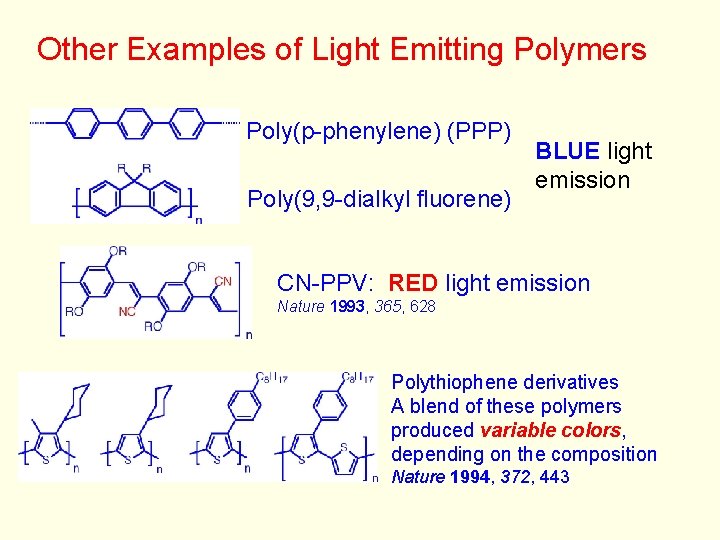
Other Examples of Light Emitting Polymers Poly(p-phenylene) (PPP) Poly(9, 9 -dialkyl fluorene) BLUE light emission CN-PPV: RED light emission Nature 1993, 365, 628 Polythiophene derivatives A blend of these polymers produced variable colors, depending on the composition Nature 1994, 372, 443
Applications • Flat Panel Displays: thinner than liquid crystals displays or plasma displays (the display can be less than 2 mm thick) • Flexible Display Devices for mobile phones, PDA, watches, etc. • Multicolor displays can also be made by combining materials with different emitting colors.
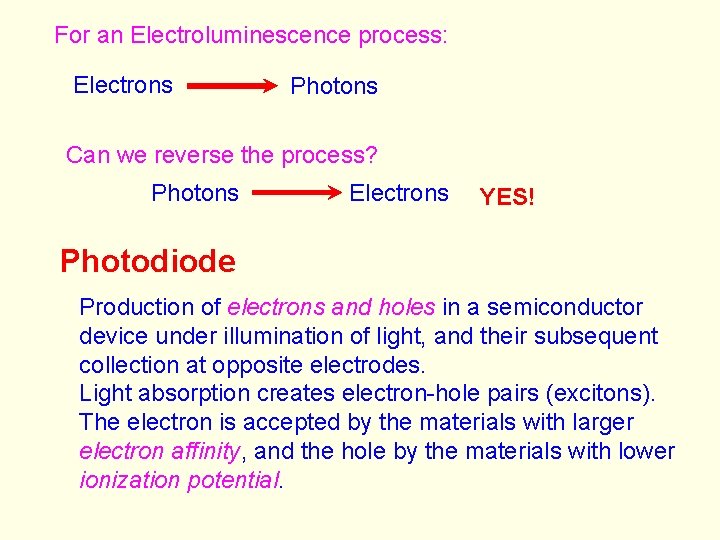
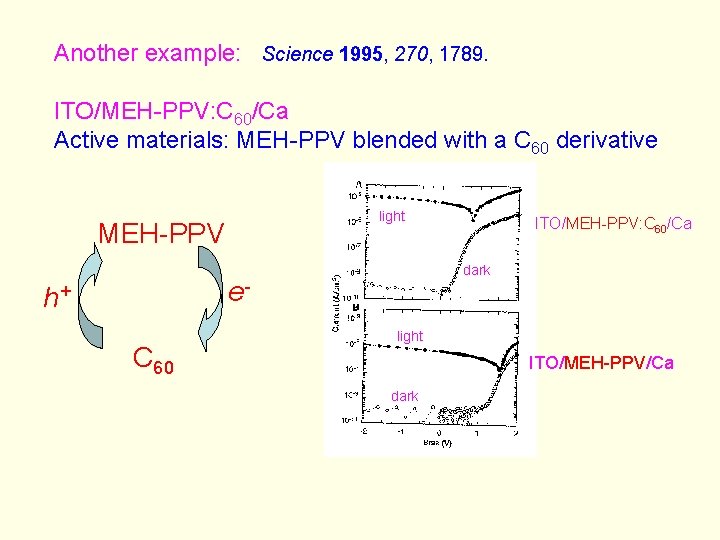
For an Electroluminescence process: Electrons Photons Can we reverse the process? Photons Electrons YES! Photodiode Production of electrons and holes in a semiconductor device under illumination of light, and their subsequent collection at opposite electrodes. Light absorption creates electron-hole pairs (excitons). The electron is accepted by the materials with larger electron affinity, and the hole by the materials with lower ionization potential.
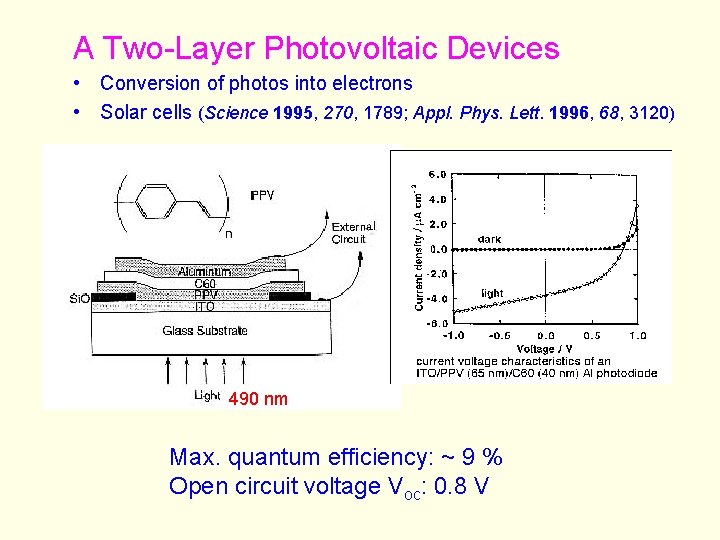
A Two-Layer Photovoltaic Devices • Conversion of photos into electrons • Solar cells (Science 1995, 270, 1789; Appl. Phys. Lett. 1996, 68, 3120) (Appl. Phys. Lett. 1996, 68, 3120) 490 nm Max. quantum efficiency: ~ 9 % Open circuit voltage Voc: 0. 8 V
Another example: Science 1995, 270, 1789. ITO/MEH-PPV: C 60/Ca Active materials: MEH-PPV blended with a C 60 derivative light MEH-PPV dark e- h+ C 60 ITO/MEH-PPV: C 60/Ca light ITO/MEH-PPV/Ca dark
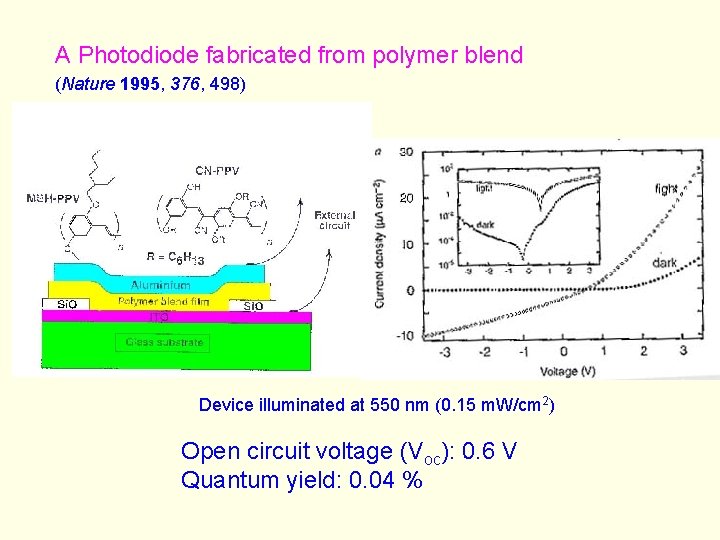
A Photodiode fabricated from polymer blend (Nature 1995, 376, 498) Device illuminated at 550 nm (0. 15 m. W/cm 2) Open circuit voltage (Voc): 0. 6 V Quantum yield: 0. 04 %
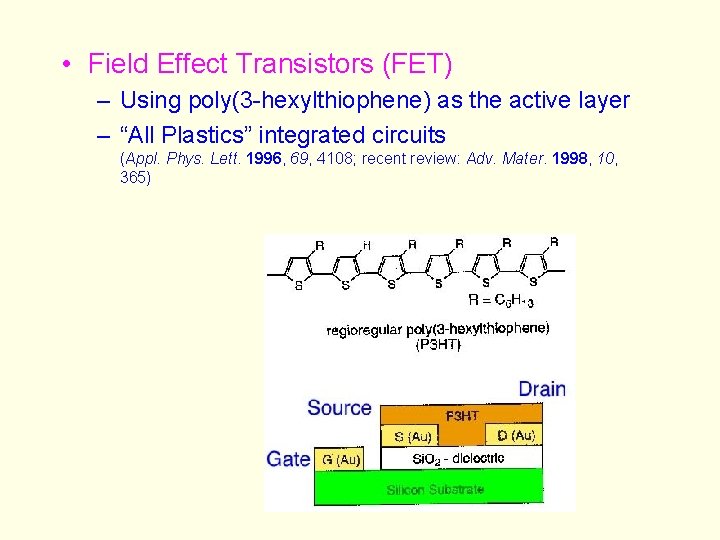
• Field Effect Transistors (FET) – Using poly(3 -hexylthiophene) as the active layer – “All Plastics” integrated circuits (Appl. Phys. Lett. 1996, 69, 4108; recent review: Adv. Mater. 1998, 10, 365)
More Recent Development • Use of self-assembled monolayer organic field-effect transistors • Possibility of using “single molecule” for electronic devices (Nature 2001, 413, 713)