
Science Study Guide Science is a Content Area
- Slides: 22
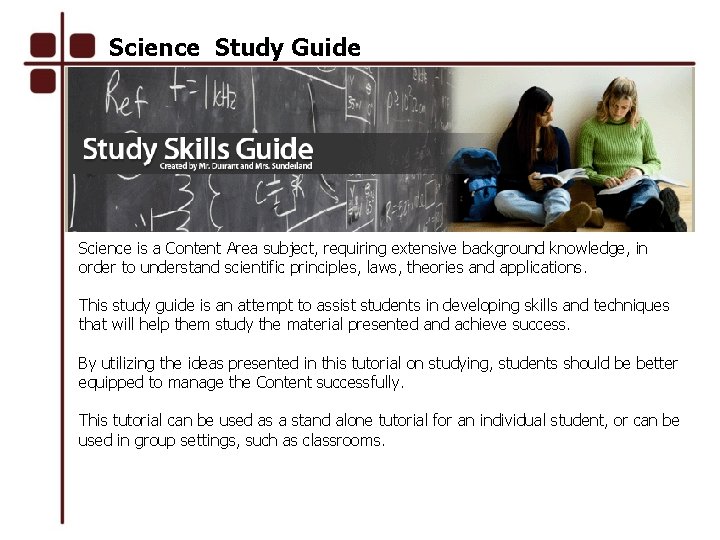
Science Study Guide Science is a Content Area subject, requiring extensive background knowledge, in order to understand scientific principles, laws, theories and applications. This study guide is an attempt to assist students in developing skills and techniques that will help them study the material presented and achieve success. By utilizing the ideas presented in this tutorial on studying, students should be better equipped to manage the Content successfully. This tutorial can be used as a stand alone tutorial for an individual student, or can be used in group settings, such as classrooms.
Science Study Guide REVIEW: REVIEW means to view or look at it again. Studying is an ongoing process and cannot be left until the night before an exam to be effective. STUDY: STUDY means to think about the work until you understand it and can put it in your own words. 1. Studying is a daily process. 2. Plan your work. Divide the subject to be covered by the test into sections according to the number of days before the test for review. 3. Make a study schedule and check it off as you go. 4. Set a goal to improve your marks. 5. Study alone, or in a study group - that is focused on learning. 6. Memorize by learning. Make sure you understand what you read. If you cannot clearly express the ideas, you are trying to relearn, in your own words, you don't really understand it yet!
Science Study Guide METHODS OF STUDYING 1. Three R's of studying: - Read many times. - Recite in your own words. - Review often. 2. Memorize by learning Read a section over until it is thoroughly understood. Read aloud with expression. Emphasize difficult points out loud. If you cannot clearly express the ideas in your own words you do not know them yet. 3. Test yourself Make up different types of tests: (a) True/False (b) Matching (c) Multiple Choice (d) Fill in the Blanks (e) Essay Questions (f) Numerical Response (g) Scenario and Interpretation (h) Identifying and Illustrating
Science Study Guide METHODS OF STUDYING cont. . . 4. If you have access to a tape recorder, tape your answers to your "test" questions. Listen to yourself and check your answers. If you found something difficult or you missed part of the answer, try again and again, until you have the correct answer repeated and explained in your own words. 5. Note the main ideas and organize the details and examples under these. Then make up your own test questions and answer them later. FIND THE METHOD THAT SUITS YOU BEST. USE IT. IMPROVE IT. “OVERLEARNING" GIVES YOU CONFIDENCE TO FACE A TEST.
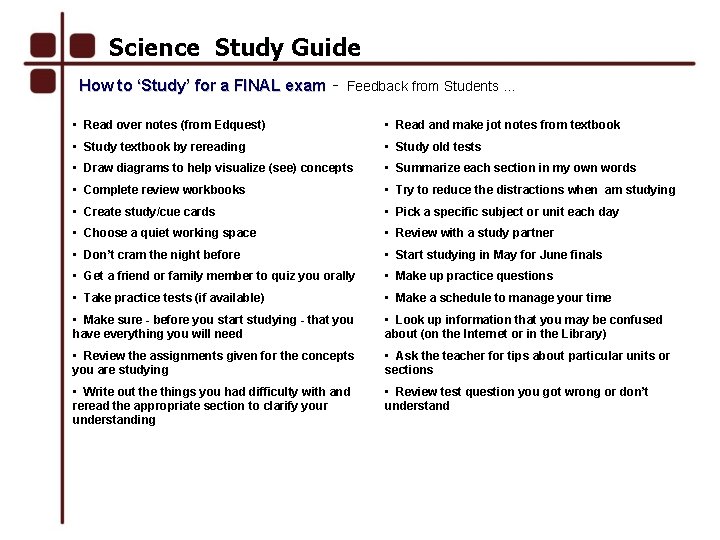
Science Study Guide How to ‘Study’ for a FINAL exam - Feedback from Students … • Read over notes (from Edquest) • Read and make jot notes from textbook • Study textbook by rereading • Study old tests • Draw diagrams to help visualize (see) concepts • Summarize each section in my own words • Complete review workbooks • Try to reduce the distractions when am studying • Create study/cue cards • Pick a specific subject or unit each day • Choose a quiet working space • Review with a study partner • Don’t cram the night before • Start studying in May for June finals • Get a friend or family member to quiz you orally • Make up practice questions • Take practice tests (if available) • Make a schedule to manage your time • Make sure - before you start studying - that you have everything you will need • Look up information that you may be confused about (on the Internet or in the Library) • Review the assignments given for the concepts you are studying • Ask the teacher for tips about particular units or sections • Write out the things you had difficulty with and reread the appropriate section to clarify your understanding • Review test question you got wrong or don’t understand
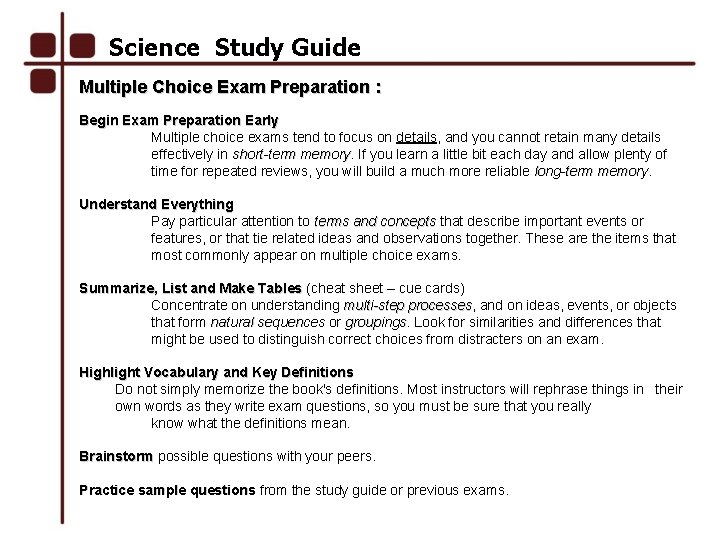
Science Study Guide Multiple Choice Exam Preparation : Begin Exam Preparation Early Multiple choice exams tend to focus on details, and you cannot retain many details effectively in short-term memory If you learn a little bit each day and allow plenty of time for repeated reviews, you will build a much more reliable long-term memory Understand Everything Pay particular attention to terms and concepts that describe important events or features, or that tie related ideas and observations together. These are the items that most commonly appear on multiple choice exams. Summarize, List and Make Tables (cheat sheet – cue cards) Concentrate on understanding multi-step processes, processes and on ideas, events, or objects that form natural sequences or groupings Look for similarities and differences that might be used to distinguish correct choices from distracters on an exam. Highlight Vocabulary and Key Definitions Do not simply memorize the book's definitions. Most instructors will rephrase things in their own words as they write exam questions, so you must be sure that you really know what the definitions mean. Brainstorm possible questions with your peers. Practice sample questions from the study guide or previous exams.
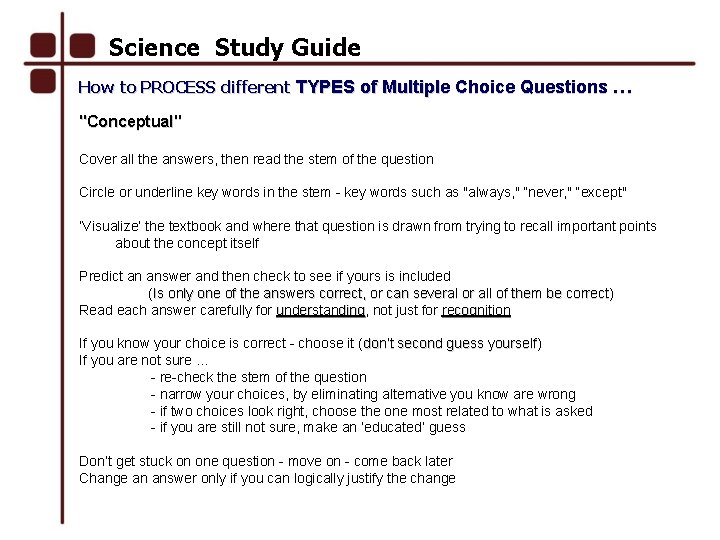
Science Study Guide How to PROCESS different TYPES of Multiple Choice Questions … "Conceptual" Cover all the answers, then read the stem of the question Circle or underline key words in the stem - key words such as "always, " “never, " “except" ‘Visualize’ the textbook and where that question is drawn from trying to recall important points about the concept itself Predict an answer and then check to see if yours is included (Is only one of the answers correct, or can several or all of them be correct) correct Read each answer carefully for understanding, understanding not just for recognition If you know your choice is correct - choose it (don’t second guess yourself) yourself If you are not sure … - re-check the stem of the question - narrow your choices, by eliminating alternative you know are wrong - if two choices look right, choose the one most related to what is asked - if you are still not sure, make an ‘educated’ guess Don’t get stuck on one question - move on - come back later Change an answer only if you can logically justify the change
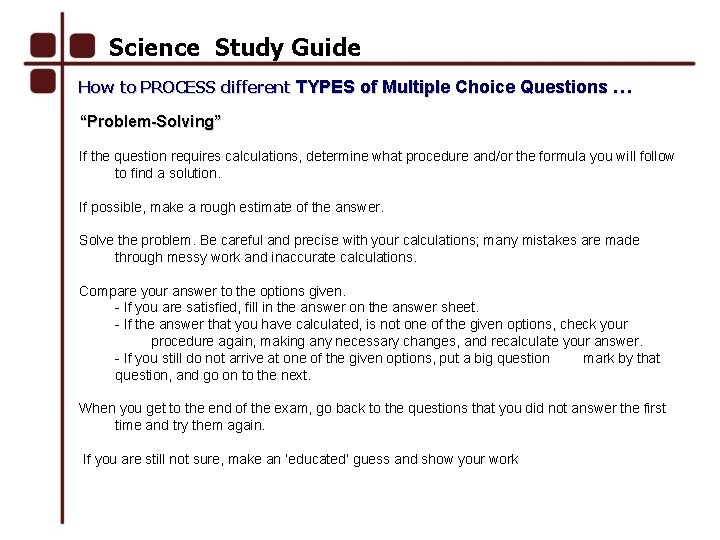
Science Study Guide How to PROCESS different TYPES of Multiple Choice Questions … “Problem-Solving” If the question requires calculations, determine what procedure and/or the formula you will follow to find a solution. If possible, make a rough estimate of the answer. Solve the problem. Be careful and precise with your calculations; many mistakes are made through messy work and inaccurate calculations. Compare your answer to the options given. - If you are satisfied, fill in the answer on the answer sheet. - If the answer that you have calculated, is not one of the given options, check your procedure again, making any necessary changes, and recalculate your answer. - If you still do not arrive at one of the given options, put a big question mark by that question, and go on to the next. When you get to the end of the exam, go back to the questions that you did not answer the first time and try them again. If you are still not sure, make an ‘educated’ guess and show your work
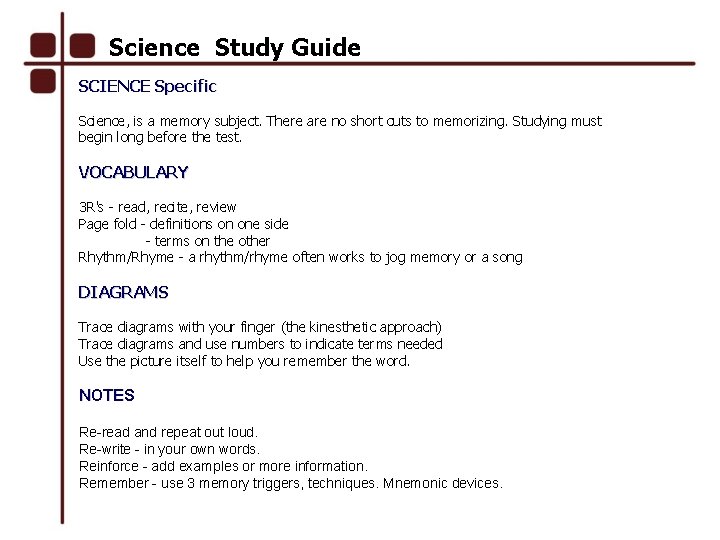
Science Study Guide SCIENCE Specific Science, is a memory subject. There are no short cuts to memorizing. Studying must begin long before the test. VOCABULARY 3 R's - read, recite, review Page fold - definitions on one side - terms on the other Rhythm/Rhyme - a rhythm/rhyme often works to jog memory or a song DIAGRAMS Trace diagrams with your finger (the kinesthetic approach) Trace diagrams and use numbers to indicate terms needed Use the picture itself to help you remember the word. NOTES Re-read and repeat out loud. Re-write - in your own words. Reinforce - add examples or more information. Remember - use 3 memory triggers, techniques. Mnemonic devices.
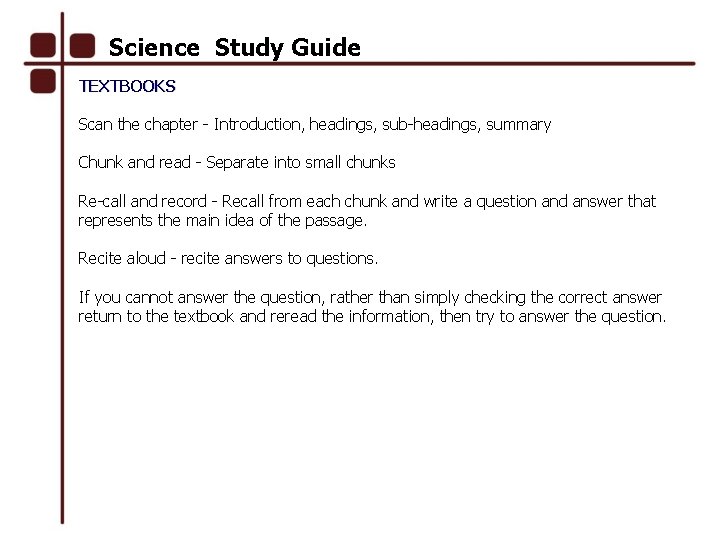
Science Study Guide TEXTBOOKS Scan the chapter - Introduction, headings, sub-headings, summary Chunk and read - Separate into small chunks Re-call and record - Recall from each chunk and write a question and answer that represents the main idea of the passage. Recite aloud - recite answers to questions. If you cannot answer the question, rather than simply checking the correct answer return to the textbook and reread the information, then try to answer the question.
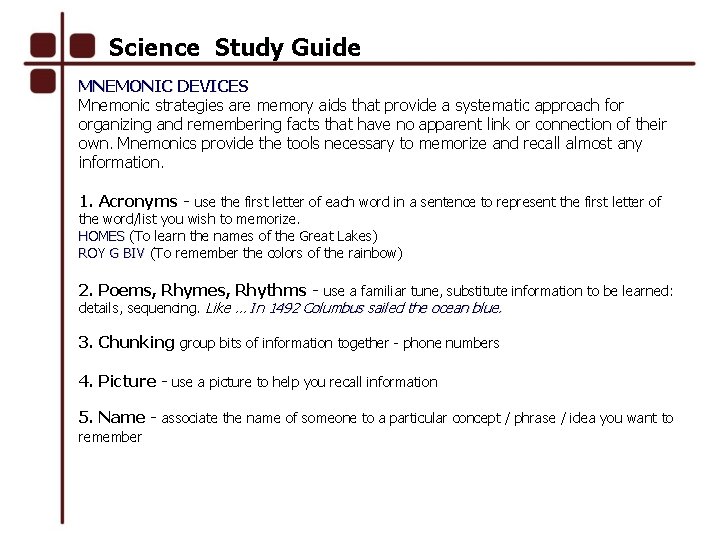
Science Study Guide MNEMONIC DEVICES Mnemonic strategies are memory aids that provide a systematic approach for organizing and remembering facts that have no apparent link or connection of their own. Mnemonics provide the tools necessary to memorize and recall almost any information. 1. Acronyms - use the first letter of each word in a sentence to represent the first letter of the word/list you wish to memorize. HOMES (To learn the names of the Great Lakes) ROY G BIV (To remember the colors of the rainbow) 2. Poems, Rhymes, Rhythms - use a familiar tune, substitute information to be learned: details, sequencing. Like … In 1492 Columbus sailed the ocean blue. 3. Chunking group bits of information together - phone numbers 4. Picture - use a picture to help you recall information 5. Name - associate the name of someone to a particular concept / phrase / idea you want to remember
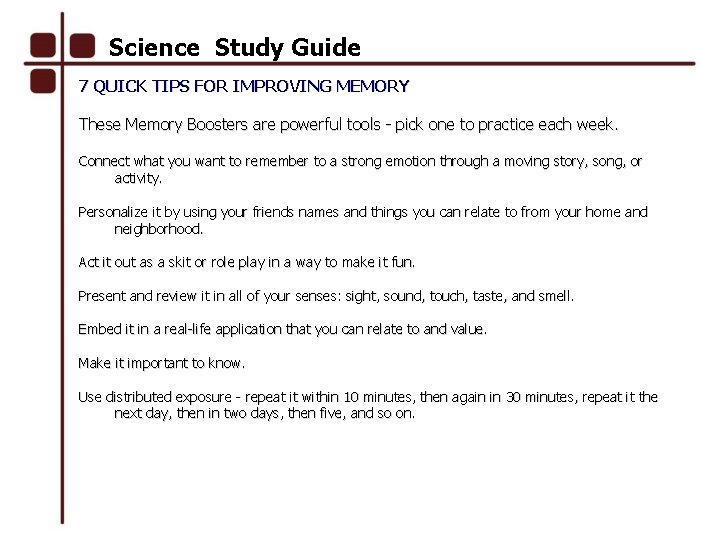
Science Study Guide 7 QUICK TIPS FOR IMPROVING MEMORY These Memory Boosters are powerful tools - pick one to practice each week. Connect what you want to remember to a strong emotion through a moving story, song, or activity. Personalize it by using your friends names and things you can relate to from your home and neighborhood. Act it out as a skit or role play in a way to make it fun. Present and review it in all of your senses: sight, sound, touch, taste, and smell. Embed it in a real-life application that you can relate to and value. Make it important to know. Use distributed exposure - repeat it within 10 minutes, then again in 30 minutes, repeat it the next day, then in two days, then five, and so on.
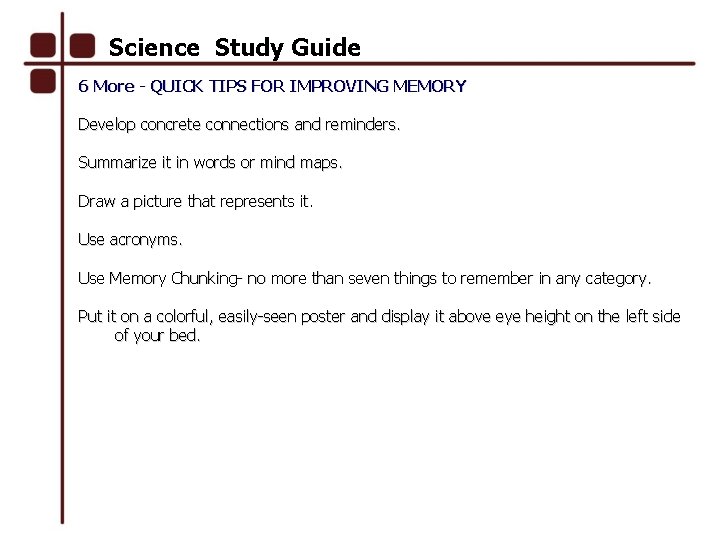
Science Study Guide 6 More - QUICK TIPS FOR IMPROVING MEMORY Develop concrete connections and reminders. Summarize it in words or mind maps. Draw a picture that represents it. Use acronyms. Use Memory Chunking- no more than seven things to remember in any category. Put it on a colorful, easily-seen poster and display it above eye height on the left side of your bed.
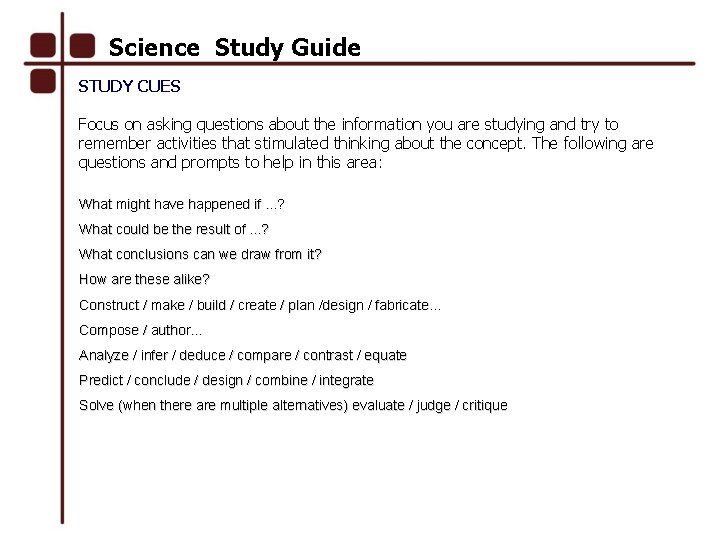
Science Study Guide STUDY CUES Focus on asking questions about the information you are studying and try to remember activities that stimulated thinking about the concept. The following are questions and prompts to help in this area: What might have happened if. . . ? What could be the result of. . . ? What conclusions can we draw from it? How are these alike? Construct / make / build / create / plan /design / fabricate. . . Compose / author. . . Analyze / infer / deduce / compare / contrast / equate Predict / conclude / design / combine / integrate Solve (when there are multiple alternatives) evaluate / judge / critique
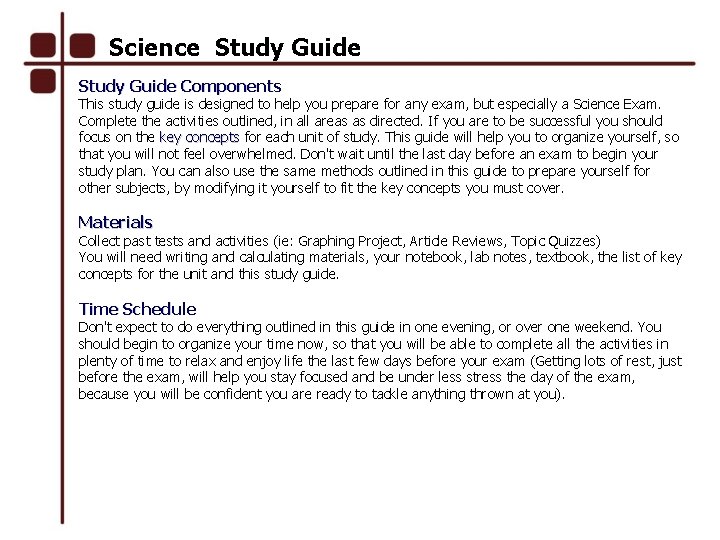
Science Study Guide Components This study guide is designed to help you prepare for any exam, but especially a Science Exam. Complete the activities outlined, in all areas as directed. If you are to be successful you should focus on the key concepts for each unit of study. This guide will help you to organize yourself, so that you will not feel overwhelmed. Don't wait until the last day before an exam to begin your study plan. You can also use the same methods outlined in this guide to prepare yourself for other subjects, by modifying it yourself to fit the key concepts you must cover. Materials Collect past tests and activities (ie: Graphing Project, Article Reviews, Topic Quizzes) You will need writing and calculating materials, your notebook, lab notes, textbook, the list of key concepts for the unit and this study guide. Time Schedule Don't expect to do everything outlined in this guide in one evening, or over one weekend. You should begin to organize your time now, so that you will be able to complete all the activities in plenty of time to relax and enjoy life the last few days before your exam (Getting lots of rest, just before the exam, will help you stay focused and be under less stress the day of the exam, because you will be confident you are ready to tackle anything thrown at you).
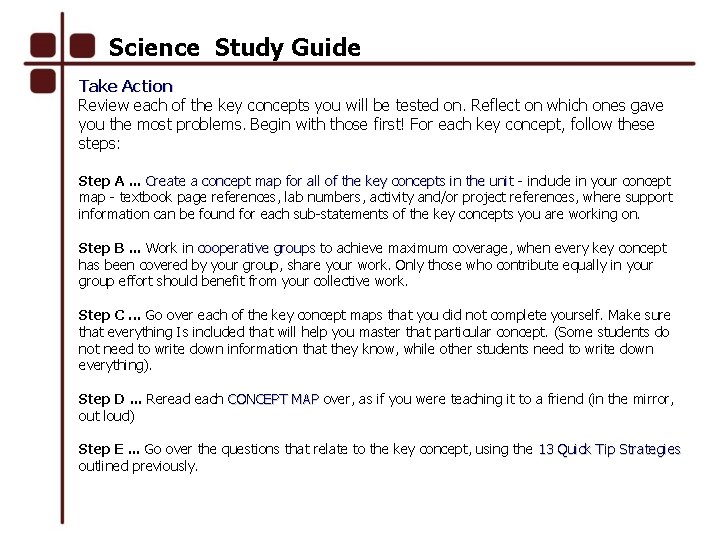
Science Study Guide Take Action Review each of the key concepts you will be tested on. Reflect on which ones gave you the most problems. Begin with those first! For each key concept, follow these steps: Step A. . . Create a concept map for all of the key concepts in the unit - include in your concept map - textbook page references, lab numbers, activity and/or project references, where support information can be found for each sub-statements of the key concepts you are working on. Step B. . . Work in cooperative groups to achieve maximum coverage, when every key concept has been covered by your group, share your work. Only those who contribute equally in your group effort should benefit from your collective work. Step C. . . Go over each of the key concept maps that you did not complete yourself. Make sure that everything Is included that will help you master that particular concept. (Some students do not need to write down information that they know, while other students need to write down everything). Step D. . . Reread each CONCEPT MAP over, as if you were teaching it to a friend (in the mirror, out loud) Step E. . . Go over the questions that relate to the key concept, using the 13 Quick Tip Strategies outlined previously.
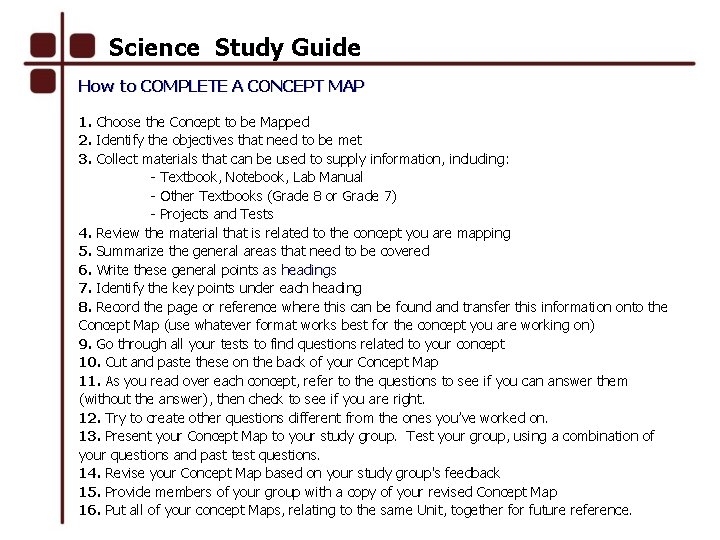
Science Study Guide How to COMPLETE A CONCEPT MAP 1. Choose the Concept to be Mapped 2. Identify the objectives that need to be met 3. Collect materials that can be used to supply information, including: - Textbook, Notebook, Lab Manual - Other Textbooks (Grade 8 or Grade 7) - Projects and Tests 4. Review the material that is related to the concept you are mapping 5. Summarize the general areas that need to be covered 6. Write these general points as headings 7. Identify the key points under each heading 8. Record the page or reference where this can be found and transfer this information onto the Concept Map (use whatever format works best for the concept you are working on) 9. Go through all your tests to find questions related to your concept 10. Cut and paste these on the back of your Concept Map 11. As you read over each concept, refer to the questions to see if you can answer them (without the answer), then check to see if you are right. 12. Try to create other questions different from the ones you’ve worked on. 13. Present your Concept Map to your study group. Test your group, using a combination of your questions and past test questions. 14. Revise your Concept Map based on your study group's feedback 15. Provide members of your group with a copy of your revised Concept Map 16. Put all of your concept Maps, relating to the same Unit, together for future reference.
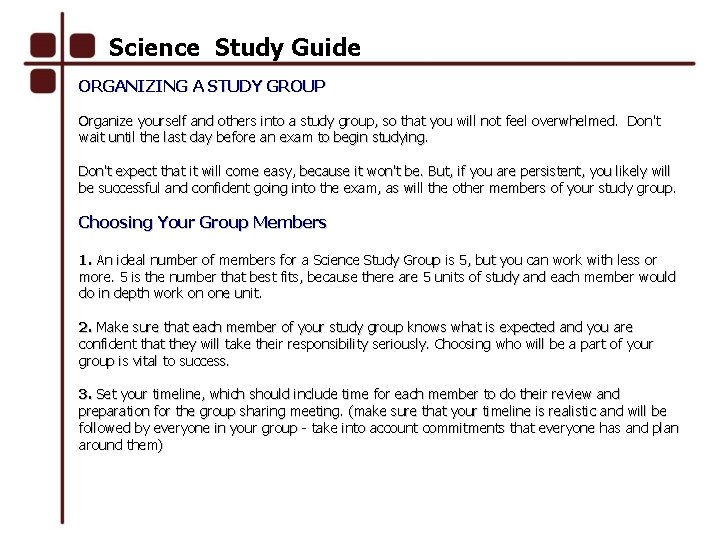
Science Study Guide ORGANIZING A STUDY GROUP Organize yourself and others into a study group, so that you will not feel overwhelmed. Don't wait until the last day before an exam to begin studying. Don't expect that it will come easy, because it won't be. But, if you are persistent, you likely will be successful and confident going into the exam, as will the other members of your study group. Choosing Your Group Members 1. An ideal number of members for a Science Study Group is 5, but you can work with less or more. 5 is the number that best fits, because there are 5 units of study and each member would do in depth work on one unit. 2. Make sure that each member of your study group knows what is expected and you are confident that they will take their responsibility seriously. Choosing who will be a part of your group is vital to success. 3. Set your timeline, which should include time for each member to do their review and preparation for the group sharing meeting. (make sure that your timeline is realistic and will be followed by everyone in your group - take into account commitments that everyone has and plan around them)
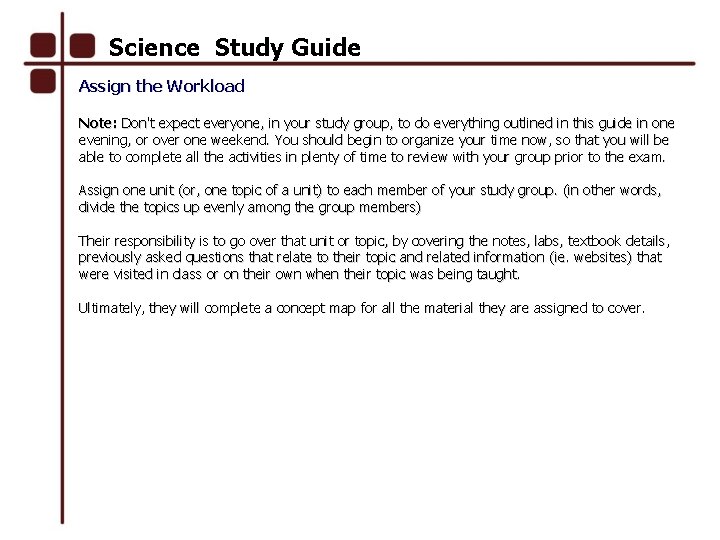
Science Study Guide Assign the Workload Note: Don't expect everyone, in your study group, to do everything outlined in this guide in one evening, or over one weekend. You should begin to organize your time now, so that you will be able to complete all the activities in plenty of time to review with your group prior to the exam. Assign one unit (or, one topic of a unit) to each member of your study group. (in other words, divide the topics up evenly among the group members) Their responsibility is to go over that unit or topic, by covering the notes, labs, textbook details, previously asked questions that relate to their topic and related information ( ie. websites) that were visited in class or on their own when their topic was being taught. Ultimately, they will complete a concept map for all the material they are assigned to cover.
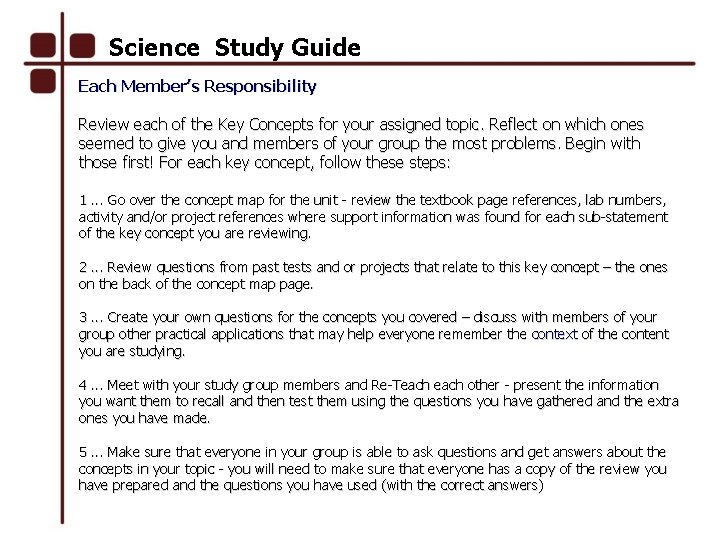
Science Study Guide Each Member’s Responsibility Review each of the Key Concepts for your assigned topic. Reflect on which ones seemed to give you and members of your group the most problems. Begin with those first! For each key concept, follow these steps: 1. . . Go over the concept map for the unit - review the textbook page references, lab numbers, activity and/or project references where support information was found for each sub-statement of the key concept you are reviewing. 2. . . Review questions from past tests and or projects that relate to this key concept – the ones on the back of the concept map page. 3. . . Create your own questions for the concepts you covered – discuss with members of your group other practical applications that may help everyone remember the context of the content you are studying. 4. . . Meet with your study group members and Re-Teach other - present the information you want them to recall and then test them using the questions you have gathered and the extra ones you have made. 5. . . Make sure that everyone in your group is able to ask questions and get answers about the concepts in your topic - you will need to make sure that everyone has a copy of the review you have prepared and the questions you have used (with the correct answers)
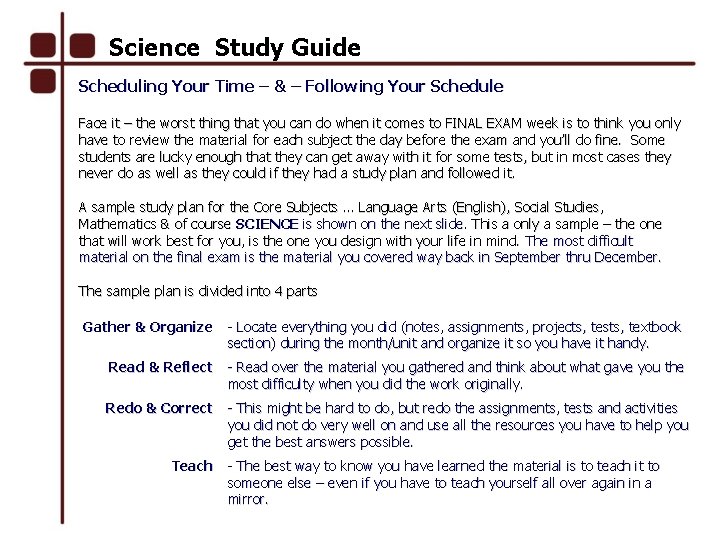
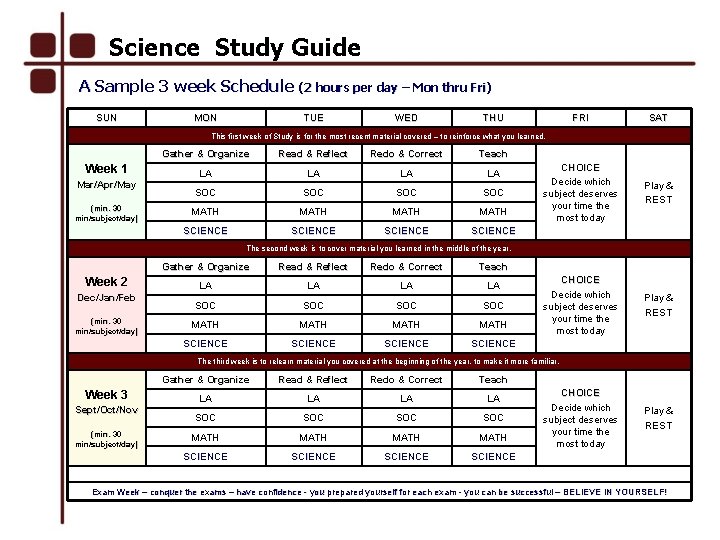
Science Study Guide Scheduling Your Time – & – Following Your Schedule Face it – the worst thing that you can do when it comes to FINAL EXAM week is to think you only have to review the material for each subject the day before the exam and you’ll do fine. Some students are lucky enough that they can get away with it for some tests, but in most cases they never do as well as they could if they had a study plan and followed it. A sample study plan for the Core Subjects … Language Arts (English), Social Studies, Mathematics & of course SCIENCE is shown on the next slide. This a only a sample – the one that will work best for you, is the one you design with your life in mind. The most difficult material on the final exam is the material you covered way back in September thru December. The sample plan is divided into 4 parts Gather & Organize - Locate everything you did (notes, assignments, projects, tests, textbook section) during the month/unit and organize it so you have it handy. Read & Reflect - Read over the material you gathered and think about what gave you the most difficulty when you did the work originally. Redo & Correct - This might be hard to do, but redo the assignments, tests and activities you did not do very well on and use all the resources you have to help you get the best answers possible. Teach - The best way to know you have learned the material is to teach it to someone else – even if you have to teach yourself all over again in a mirror.
Science Study Guide A Sample 3 week Schedule (2 hours per day – Mon thru Fri) SUN MON TUE WED THU FRI SAT CHOICE Decide which subject deserves your time the most today Play & REST This first week of Study is for the most recent material covered – to reinforce what you learned. Week 1 Mar/Apr/May (min. 30 min/subject/day) Gather & Organize Read & Reflect Redo & Correct Teach LA LA SOC SOC MATH SCIENCE The second week is to cover material you learned in the middle of the year. Week 2 Dec/Jan/Feb (min. 30 min/subject/day) Gather & Organize Read & Reflect Redo & Correct Teach LA LA SOC SOC MATH SCIENCE The third week is to relearn material you covered at the beginning of the year, to make it more familiar. Week 3 Sept/Oct/Nov (min. 30 min/subject/day) Gather & Organize Read & Reflect Redo & Correct Teach LA LA SOC SOC MATH SCIENCE CHOICE Decide which subject deserves your time the most today Play & REST Exam Week – conquer the exams – have confidence - you prepared yourself for each exam - you can be successful – BELIEVE IN YOURSELF!